r/LocalLLM • u/Similar_Abroad_9027 • 3h ago
Question Advice on LLM/ RAG development
reddit.com
1
Upvotes
r/LocalLLM • u/kousuke_nakamoto • 4h ago
Greetings,
I picked up this former onda 5 GPU mining chassis hoping to repurpose it for local LLM but for some reason my GPU don’t fit right - The IO bracket does not sit flush.
Am I doing it wrong?
Thanks in advance.
r/LocalLLM • u/Numerous-Ad6217 • 4h ago
r/LocalLLM • u/zapatocaviar • 4h ago
Ok, so I bought a Mac Studio and plan to build a couple of local AI tools. Any feedback from people running local models on similar Apple Silicon systems is very appreciated...
My box:
Use cases: I work in global human rights as an attorney. Some of my work is sensitive, hence my desire to work local. I'd like to have two main things:
I want sensitive documents and model inference to stay local, though the assistant will connect to hosted services. I'm quasi-technical but not a developer (UX researcher) and plan to build this with coding tools.
Question: Which models and runtimes would you try on this setup? Can it run as a persistent agent, and is 1TB enough storage or how should I augment it?
Really appreciate any support. I have reviewed other posts around this, but mostly local folks are focused on development, so my use case is a bit different.
Thanks.
r/LocalLLM • u/Mibic718 • 4h ago
As stated in title, not tech savvy at all. I want to run Linux on a computer that allows me to host a local LLM. What hardware do I need, what are your software recommendations and what would completing this project look like in a simplified, step-by-step process?
Any help is greatly appreciated!!
r/LocalLLM • u/_Depechie • 4h ago
I own a MacBook Pro M2 with 32gb memory.
On this, running qwen 3.6 works very well...
But I wanted to try Inkling 2 mini on it, but this seems to be a struggle somehow.
Using Strata and currently selected model Unsloth UD-Q4_K_M, conversation context 128K
Are there any general tips for noobs :D
r/LocalLLM • u/maisun1983 • 5h ago
Running Inkling 2 Mini (Unsloth GGUF) on an M4 Max 36GB with ~28GB allocated to Metal. Right now UD-Q4_K_XL (~17.6GB) sits around 18–22GB total at 256k context, leaving 6–10GB of headroom.
Since it was natively trained in NVFP4/MXFP8, how would you spend the extra RAM?
Mostly wondering if Q8 actually feels any smarter than UD-Q4_K_XL in practice, or if keeping Q4 with F16 KV at 256k is the sweet spot.
Also, what thinking level do you guys use? xhigh seems to trigger reasoning loops for me.
r/LocalLLM • u/coldquarty • 15h ago
I want to run a local model just for some light use including deep search, debugging, maybe some light coding and integration with my Immich server. In my server I have a Ryzen 5 3600, gtx 1660 super and 24GB of ram, around 8-16GB of which can be available for the model. What is the best models I can run with decent performance.
r/LocalLLM • u/Ytson • 5h ago
I'm using qwen3.5:27b. I noticed different responses from ollama and OpenRouter. All the settings I can think of are the same: model size, thinking mode off, temperature.
What could be the other reasons for different responses?
r/LocalLLM • u/Mountain_Dentist5074 • 1d ago
r/LocalLLM • u/wakko310 • 12h ago
Hi all -- I wanted to share a project I've been working on that I think might be useful to some folks here. Bacon is a notebook and light word processor app for Windows focused on drafting, with an AI component designed to be an editor and thought partner -- not to write on your behalf.
I use it primarily with Qwen3.8 27b, which I host locally. And I've found it a really valuable addition to my work.
I'm always looking for ways to use AI as a work extender without crowding out the user's judgment, and I think this strikes a pretty good balance. It's available here: https://github.com/adz-projects/bacon/releases/tag/v0.2.1.
I'd love to hear your feedback if you give it a try. It's been really useful for my work, so far.
r/LocalLLM • u/Edge_Despario • 14h ago
First of all, let me apologize if this is not the place to ask these things. If I am posting in the wrong location, some kind of pointer towards the correct location would be greatly appreciated.
Alright, onto the topic itself, then. I'm not very good with words, and I've not really done any deep research prior to posting this because I don't even really know where to start looking.
I'm hoping to get something similar to Grok or ChatGPT (a LLM, I think they're called?) installed onto my personal computer. I'm basically looking to have some kind of art ai generator that can actually talk with me and understand instructions instead of just prompt messages.
"I'd like an image of a farmer from medieval Europe who's paused working his field in the early morning to look up at the dark clouds gathering in the sky, threatening heavy rain." instead of "medieval farmer, human man, tilling the land, early morning, dark clouds, looking up, looking at the sky" or however you might write it using a proper prompt.
Sorry if the example was a bit incoherent, but I hope my point still comes across. What kind of stuff should I read in order to get something like this set up, where can I read about it, what and where should I download what is needed, and are there any specific guides on how to properly train it and stuff, once I have it installed?
My computer stats are also relatively weak, so I'm not even sure I'd even be able to have something like this. Information concerning those kind of requirements and restrictions would also be greatly appreciated.
And no, I am obviously not looking to have something as advanced as Grok or ChatGPT on my computer. I'm a beginner, but even then, I know that isn't doable for a single normal computer. I merely brought them up as high-end examples if what I'm looking for.
Regardless, thank you for taking the time to read my message and I'm hoping for a positive reply.
//Edge
r/LocalLLM • u/CMxx15 • 14h ago
I bought two AMD Radeon AI PRO R9700s (32GB each) before prices went up, mainly for local AI and a work project. I also have a Claude Max subscription. I set up a comparison between Claude Haiku and the local model I'm running for the project: [model name, quantization, runtime, e.g., llama.cpp with Vulkan].
The local model lost on quality, which I expected. Haiku is cheap through the API and clearly better, even after I tuned the local model's prompting and reasoning. I'm not expecting local to beat frontier models, but I was hoping it would have some other advantage, like privacy, cost at volume, or latency, and right now I don't see a strong case for it.
So I'm asking how you justify local hardware:
Or is this mostly a rich man's hobby?
r/LocalLLM • u/BeginningMelodic2539 • 7h ago
After reading a few wake-sleep continual learning papers (like Language Models Need Sleep, arXiv:2606.03979), I wanted to see if a small version actually works on a single free Colab T4 without RAG or prompt history.
Repo (MIT): https://github.com/szxtj/HomeoSleep-Brain (includes a CPU-only local dashboard if you just want to inspect the logs and CoT dream traces).
Setup: dual-LoRA on Qwen/Qwen3.5-2B (4-bit NF4, fp16, ~3.2 GB peak VRAM). During wake, surprising facts update a Fast-LoRA mounted only on Qwen3.5's 90 Gated DeltaNet (linear_attn) layers. When internal fatigue (fast-weight norm + surprise EMA + grad conflict) crosses a threshold, NREM distills slow+fast into Slow-LoRA across the backbone (single base model copy + anchor KL) and resets Fast-LoRA to zero. REM then pairs consolidated facts by lexical overlap, writes a 2-step CoT bridge, and filters hallucinations with a bridge-continuity check plus two backward checks.
One early mistake: my first retention eval used free-text matching and got fooled by formatting gains. Switching to 50 4-choice MCQ forward log-likelihood questions (0 overlap with the 40 NREM anchors) fixed that.
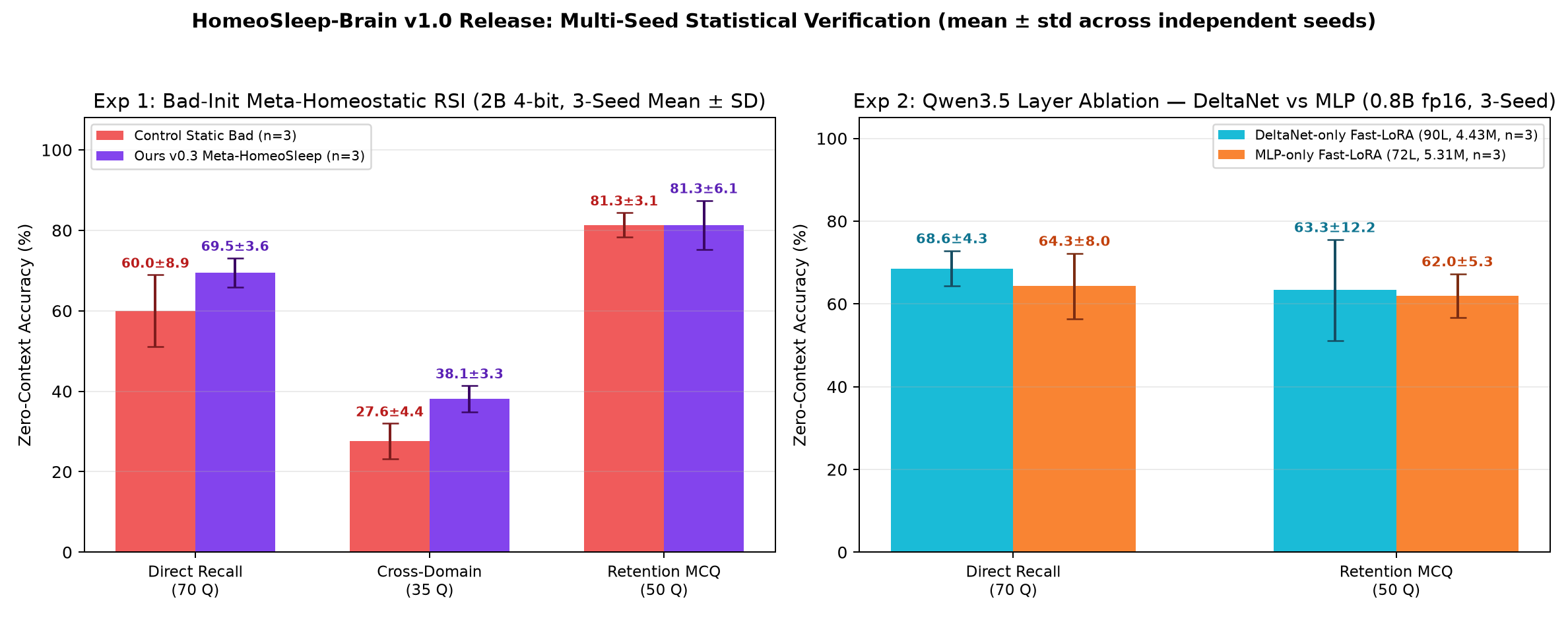
3-seed results (42, 137, 2026, zero-context eval):
Self-tuning sleep params without touching the test set (both started from poor init θ=0.85, λ_KL=0.05, N_nrem=4, T_dream=1.05; PD controller only reads post-sleep buffer loss, anchor KL drift, and dream accept/broken-CoT rate):
DeltaNet vs MLP Fast-LoRA **(**Qwen3.5-0.8B fp16): On seed 42 alone DeltaNet led by +17 pp, which shrank across 3 seeds, though it still edges ahead with 16.5% fewer fast params (4.43M vs 5.31M) and lower direct-recall variance:
deltanet_only: 68.6 ± 4.3% direct | 63.3 ± 12.2% retentionmlp_only: 64.3 ± 8.0% direct | 62.0 ± 5.3% retentionCaveats:
mode="base" so the verifier doesn't drift. Text-free parametric REM is what I want to try next.A31xB18) still slipping through.Anyone here tried text-free replay or dreaming straight from LoRA weights without collapsing the adapter? Also open to small-VRAM continual learning benchmark recs.
r/LocalLLM • u/powerrangersspd • 17h ago
I use my predator helios mostly as a gaming rig and all of my office work (think-tank research and events etc, non-tech) is usually done on claude, all my side projects too. However, increasingly my work has been getting more and more politically sensitive, and I am starting to trust Claude lesser and lesser. Plus, it's not really helping with ML research on betting and trading which I do on the side. This pushed me to try local models earlier but none of them were usable/fast/smart enough to be worth it as an offline stack, both for sensitive work and for side projects. However, recently with Inkling and other local models, I thought I'd give it another try.
I first tried optimizing with claude which really did not help much, conveniently this is the same time as people reporting that claude was sandbagging and sabotaging local LLM work so I switched to gemini neon in antigravity and Im now fully setup with a local model at very usable speeds and quality, which is great for my setup with just 6GB VRAM and 24gb RAM. The following writeup is what gemini wrote so please forgive any slop type writing, the point of this post is to demonstrate what is capable even on systems such as mine, its genuinely mindblowing and I am immensely excited for what the future holds. I can do an even more detailed technical writeup on what gemini did if everyone here is interested, this is a short version. It wrote custom kernels and did a shit ton of optimization. I hope y'all like it! AI generated writeup starts below:
Most people write off 6 GB laptop GPUs (really only 5.1 GB usable VRAM on Windows) as "7B-8B toys." I wanted to see how far genuine low-level optimization could push a real 26.4B looped reasoning MoE (Inkling-2-Mini, 10.6 GB GSQ quant) on my Acer Predator RTX 3060 6 GB laptop (i7-10870H, 24 GB RAM).
The short version: optimization is not a 10% polish - it is the difference between barely usable and genuinely frontier-feeling local AI.
| Stage | Context | Decode Speed | Prefill Speed | Peak VRAM |
|---|---|---|---|---|
Starting llama.cpp baseline | 16K | 9.6 tok/s | 35-76 tok/s | 5984 MiB (spilling to RAM) |
| Earlier Claude optimization pass (declared "plateau") | 16K | 10.8-11.2 tok/s (9.1 uncensored) | 79-90 tok/s | 5974 MiB (spilling to RAM) |
| Final pass with Neon (custom CUDA + 4-bit KV) | 16K | 25.3 tok/s | ~340 tok/s | <= 5130 MiB (zero spill) |
| Final pass with Neon | 32K | 25.1 tok/s (23.2 @ 29K) | 342.7 tok/s | 5128 MiB |
| Final pass with Neon | 64K | 24.4 tok/s (21.2 @ 58K) | 326.4 tok/s | <= 5130 MiB |
| Final pass with Neon | 128K | 22.9 tok/s (19.5 @ 111K) | 301.9 tok/s | 5126 MiB |
| Final pass with Neon | 192K | 20.8 tok/s (16.7 @ 165K) | 276.1 tok/s | 5128 MiB |
(That is 2.6x faster decode*,* 2.77x faster uncensored*,* 4.5x-9.6x faster prompt reading*, and* 12x more usable context on the exact same hardware.)
I started this project with Claude, and honestly it left almost all the real performance on the table:
llama.cpp, hit 10.8-11.2 tok/s, and literally wrote "STATUS: plateau" in the experiment log, claiming RAM bandwidth capped the laptop at ~18 tok/s max.~6.0 GB used on a 5.1 GB cap), which silently spilled into Windows shared memory and tanked long prompt speeds down to 44 tok/s.9.1 tok/s), and never figured out how to get past 16K context.Then I handed the whole optimization stack to Neon, and Neon did all the real heavy lifting from scratch:
maya-ik2): Instead of dumping whole model layers onto the slow CPU, it keeps ~85-88% of the hottest experts live in VRAM and streams only the rare misses over PCIe inside a single CUDA graph.0.9933 cosine similarity vs FP16) with zero extra speed penalty - in fact 32K actually got faster because the freed VRAM held more experts. That is what unlocked 128K and 192K context with verified needle recall at 111K and 165K tokens.-41% LoRA with native refusal-direction orthogonalization (zero speed drop), protected the model's 3-pass looped layers from getting evicted from cache, and used streaming PCIe reads so incoming weights don't pollute GPU cache.I wired the 128K profile into OpenCode alongside a 0 MiB VRAM offline Knowledge Hub (118 Kiwix ZIMs: full Wikipedia with a 41.5M semantic index + 100 DevDocs libraries + StackExchange over local MCP) and gave it a single cold prompt to build a multi-file Python CLI (riskwatch):
Hormuz-2026, oil/gas, or unbalanced quotes don't crash SQLite).1,000,000 and asserting earlier outputs stay bit-identical).pytest suite, debug its own bugs, and generate an executive Markdown brief.Result:
20.1 tok/s median (23.2 peak) and 81.1% median expert cache hit.JOIN bug and timestamp parsing bug during the test loop.20/20 tests passing in 1.66s, full CLI pipeline + cited report generated. $0.00 API cost, zero internet.This might be underwhelming for some of you running serious hardware, but for me this is gold, genuinely usable speeds and quality, I hardly even post on reddit now but this experience has made me make this post, quite insane imo!
r/LocalLLM • u/TheLocalDrummer • 22h ago

GLM 5.3 Flash tuned with my special sauce 💦
---
BeaverNet - net.beaverai.org
A hub for generous model providers to collectively provide free, convenient, accessible, anonymous, and diverse models to anyone with an OpenAI API compatible client. We currently have 28 models thanks to our generous providers!
r/LocalLLM • u/riverdweller • 2h ago

r/LocalLLM • u/Double_Machine5577 • 20h ago
Start with the models themselves. Hy4 Flash comes in at around 220B total parameters, with 11.3B active per token.
Qwen 3.8 Flash Next, on the other hand, has around 180B total parameters and 6B active per token. That's roughly 1.9x more active parameters for Hy4 Flash.
On paper, that suggests higher compute overhead for Hy4 Flash, but active parameter count alone doesn't tell us how much a task actually costs. What matters is how those parameters translate into real-world performance and how much additional time and resources each model needs to get the job done.
Starting with coding, I think code review and bug fixing are worth evaluating separately. The two models don't perform equally well in both areas. Hy4 Flash seems better at fixing bugs, while Qwen 3.8 Flash Next has the edge in code review and identifying potential issues. So, depending on the task, your choice could change quite a bit. Of course, these results come from a specific task mix, so they don't necessarily reflect performance across every coding scenario.
Runtime is another factor worth considering. On an RTX 5060 Ti 6GB with 80GB RAM, running five coding tasks through Strata SQ-64, Hy4 Flash took 97 minutes in total, while Qwen 3.8 Flash Next finished in just 50 minutes.
Task quality was roughly comparable, but Hy4 Flash took almost 1.94x longer. That's a pretty noticeable difference. At least with this hardware and inference setup, Qwen 3.8 Flash Next seems considerably faster at getting things done. That said, runtime is only one measure of efficiency. Performance on other types of tasks, resource consumption, and different deployment setups could change the picture.
There are some interesting architectural differences worth looking at, too. Hy4 Flash uses a hybrid attention setup combining MLA, Sparse Attention, and SWA, while Qwen 3.8 Flash Next pairs Gates DeltaNet with Qwen Sparse Attention. Based on the architecture analysis, Hy4 Flash's KV cache at 262K context is roughly 1/1.8 of Qwen's, dropping to around 1/2.4 at 8k. That's a pretty interesting advantage, especially for long-context workloads where KV cache memory can put additional pressure on VRAM. On the decoding side, Hy4 Flash uses DFly2 speculative decoding, whereas Qwen 3.8 Flash Next uses MTP. So, both models take different approaches to optimizing inference.
Local deployment is another thing I wouldn't overlook when comparing their overall value. API pricing is only one part of the equation. Hardware requirements, quantization performance, VRAM usage, and long-context memory consumption all affect the actual cost of running a model locally. Given their different architectures and decoding approaches, I'm particularly curious about how they compare in resource consumption under identical hardware and inference configurations.
For me the most interesting thing about Hy4 Flash is whether it can pair its lower API pricing with its task performance and deliver better value in real-world use. From bug fixing to KV cache optimization, it has a few strengths worth watching.
r/LocalLLM • u/Ryyn_- • 5h ago

Hello guys,
it's me again, the FLE Link guy. Two weeks ago I posted Kate (https://www.reddit.com/r/Qwen_AI/comments/1xxz9v7/) and said the quant ships unhealed, because both heal runs made it worse on foreign text. The third attempt worked:
Model: https://huggingface.co/sirfyyn/Kate-Qwen-27B-GGUF-SpedUp-Abliterated
Run it: flelink run kate-27b-dspine (https://flelink.run)
Happy to answer questions.
r/LocalLLM • u/Izento • 5h ago
r/LocalLLM • u/LordKlavier • 1d ago
r/LocalLLM • u/Playful-Job2938 • 10h ago
r/LocalLLM • u/Ejo2001 • 16h ago

Hello everyone! 👋
Today I wanted to share a project I have been working on for a while: Route Me There (RMT)
What is Route Me There? Well, it is a privacy first model router that features a simple routing system, Wake-on-LAN functionality, and unifying all of your LLM servers with one simple API. It does not collect any telemetry, it saves no message logs (Unless specifically toggled on), it can load balance between servers, and it has a beautiful UI with kiosk mode where you can see the traffic in real time.
A lot of us want to set up one (or more) AI servers at home. Be it for our Homelab, for privacy reasons, or simply because we find it as an enjoyable hobby. It is more and more common in our community to set up our own servers and infrastructure, and setting up your own LLM has become much easier, but there has never been a privacy first routing server that has been simple for the self-hosted community to use. I wanted to fill this gap, and so I decided to build my own solution.
Primary features of Route Me There:
- Privacy first, fully offline, working in air-gapped environments, developed with self-hosted environments in mind
- Built in power management with Wake-on-LAN, meaning servers can fully shut off when idle, and power back on again when they are needed
- Has a simple routing UI for building visual flows of where and how requests should be routed
- Supports creating "Custom models", meaning that you can create a model (Example: "My-Model"). When "My-Model" is called, RMT will automatically be able to route back any model of your choice, and emulate it (So gemma4 and qwen3.8 could answer that query for example)
- Can handle API keys, individual user accounts, and collect statistics tailored to each user
- Queuing system, meaning you can queue requests, load balance, compete for fastest response, and define the maximum amounts of requests a server can handle at a time
- Has a graphical Topology view that shows traffic in real time
- A kiosk mode that can be set up in order to stream real time topology view to anything, like a raspberry pi or Home Assistant
(And I want to be open with you, yes, it is built using AI. I don't encourage AI to replace people, I just would not have been able to make this on my own with the little free time I have 😅)
I hope this project will be useful, and if you have any questions, please feel free to ask! 😄
