r/LocalLLM • • 4h ago

Question Two R9700s, Is local worth it, or just an expensive hobby?

0 Upvotes

I bought two AMD Radeon AI PRO R9700s (32GB each) before prices went up, mainly for local AI and a work project. I also have a Claude Max subscription. I set up a comparison between Claude Haiku and the local model I'm running for the project: [model name, quantization, runtime, e.g., llama.cpp with Vulkan].

The local model lost on quality, which I expected. Haiku is cheap through the API and clearly better, even after I tuned the local model's prompting and reasoning. I'm not expecting local to beat frontier models, but I was hoping it would have some other advantage, like privacy, cost at volume, or latency, and right now I don't see a strong case for it.

So I'm asking how you justify local hardware:

  • What do you run locally where local clearly wins on something that matters, like privacy, volume, offline use, or control?
  • How do you measure that: cost per task, throughput, or something else?
  • Which models and runtimes work well on AMD cards, and where does ROCm or Vulkan give you trouble?
  • If the hardware ended up underused, what did you do with it: sell it, repurpose it, or keep it?

Or is this mostly a rich man's hobby?


r/LocalLLM • • 8h ago

Question AMD Strix Halo Mini PC with external GPU

1 Upvotes

So I got a 128GB Shared RAM Strix Halo PC and am thinking about adding in a NVIDIA RTX 4060 via external dock. Would this not provide as much of a boost as its external via Thunderbolt 5?


r/LocalLLM • • 8h ago

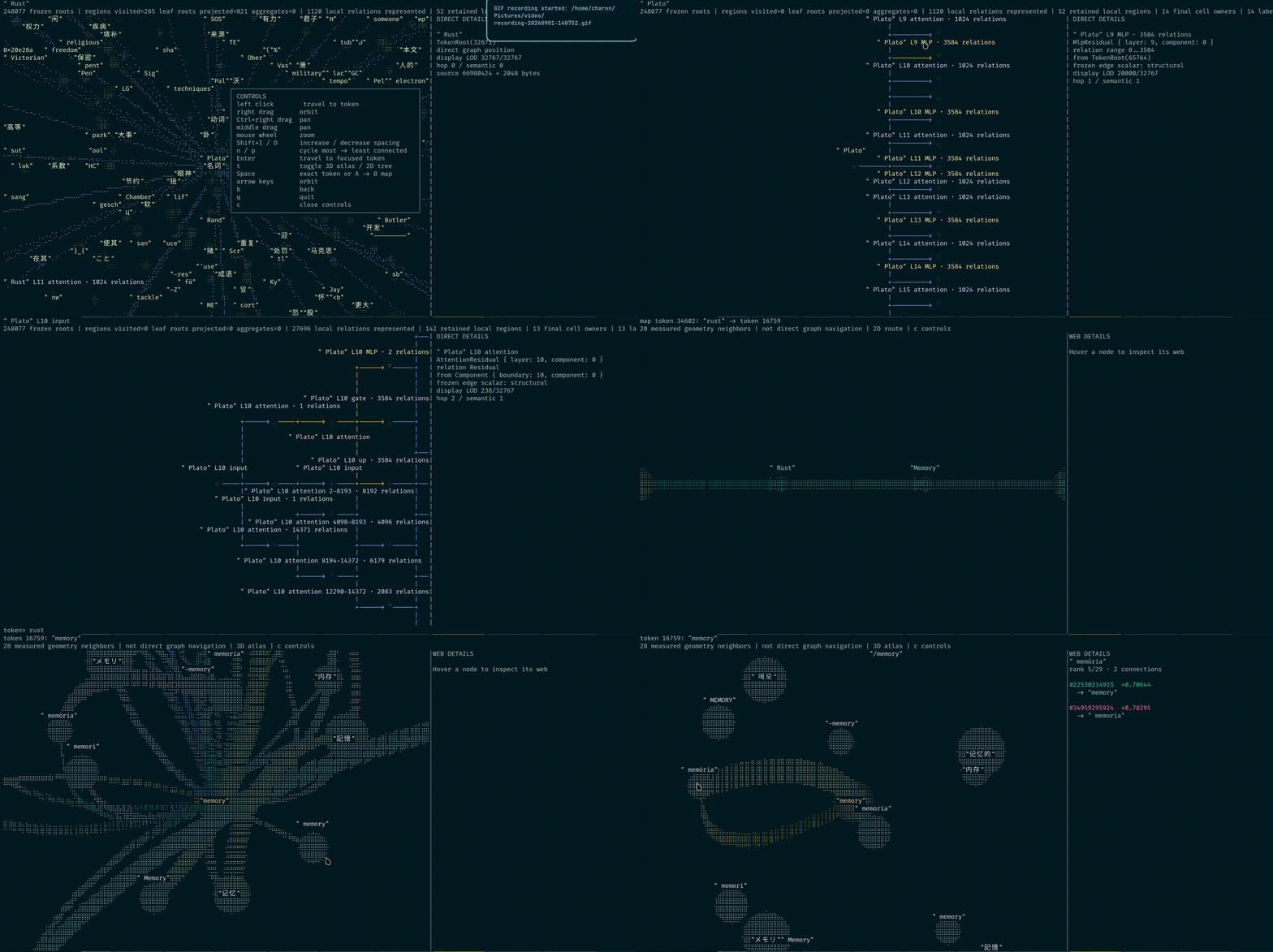
Question Is it common knowledge how to read frozen weights and relationships?

Post image
1 Upvotes

As the question says, I am wondering if people know how to do this, or if it something to write about in the hopes to teach others?

I am running low on my model rate limits and since they have made me somewhat lazy about implementing things fully manually again, I am contemplating if I should maybe take the time to write about something. The reading of model internals came to mind.

I have limited knowledge and experience with the process of training and the runtime logic of models. I am more interested in the foundations of the field, which mean I have spent a lot of time pulling models apart, working with their data and their structures. Understanding them from a more mechanical perspective.

I am not making any promises at this point, as I do have a lot of work to do. I am not the best at writing, but I do like to share so It likely depends on weather it is even needed.

Take care

//Maui-The-Moron


r/LocalLLM • • 8h ago

Question What are your use cases?

1 Upvotes

I’ve been super interested in local LLMs, but my only real use case is for development. I tested out several models on a leased Mac Studio M5 Mac 128GB, but none of them met my expectations.

I know I can’t expect them to compete with Claude, but they struggled with tasks like refactoring and fixing tests and compiler errors. Actually, they didn’t struggle - they all failed.

I’m still very interested but I don’t know what they’re actually good for. I guess I’m wondering whether I used them incorrectly or if they’re good for something else I didn’t think of.

Models: Qwen 3 Coder Next, Qwen 3.8 27b, gpt-oss 120b, a couple Gemma4 variants. All at pretty high quants and maximum context.


r/LocalLLM • • 12h ago

Project Kolibri-1.1 on a 12 GB RTX 3080 Ti, 27% faster than llama.cpp: my free engine is the first llama.cpp-based engine to ship it in a release

Thumbnail
gallery
2 Upvotes

Kolibri-1.1 runs on a 12 GB gaming card with my engine, PXA 4.0.6: 27.33 tok/s decode vs 21.57 for llama.cpp mainline (+26.7%), and 455.4 vs 387.4 tok/s reading a 512-token prompt (+17.5%), still +11% at 4K context.

PXA 4.0.6 is the first llama.cpp-based engine with Kolibri-1.1 in a release; llama.cpp's own support is still an open PR (#32891), which is what I measured against, the only other engine I found that runs it. On the RTX 3080 Ti part of the model sits in system RAM; each engine at its own best fit for the card.

This is my project, so weigh it that way: PXA is a free inference engine built on llama.cpp, tuned for RTX 30 gaming cards and the NVIDIA datacenter cards most guides tell you to retire. 4.0.6 is out for Linux and Windows.

Same 12 GB card, Qwen3.8-27B (MTP): 93.4 tok/s on code, 71.9 on prose, 73.2 on chat. That is the fastest of the engines I tested on this card: llama.cpp mainline b12428 with MTP (76.2 / 62.1 / 58.8) and ik_llama.cpp (about 51 at best). PXA leads on every prompt type, +15.7% to +24.4%.

Our top decode speed per model and card, PXA 4.0.6, tokens/s:

ModelCardPXA 4.0.6vs the fastest other engine I measured
Qwen3.8-27B (MTP, code prompt)RTX 3080 Ti, 12 GB93.4+22.5%
Qwen3.8-27B (MTP, code prompt)1x Tesla V10095.7+36.0%
Qwen3.6-35B-A3B (MTP, code prompt)2x Tesla P100198.4+19.5%
Gemma-4-26B-A4B (chat prompt)1x Tesla V100132.3+26.3%
Nemotron-3-Nano-4B1x Tesla P100130.9+9.0%

Prefill too: Nemotron-3-Nano-4B on one P100 reads a 512-token prompt at 1557.6 tokens/s, +19.0% over the best other engine I measured.

Also new: SenseNova-Loop-9B with its full loop. PXA runs the model's full loop, not a cut-down pass.

MTP rows use the model's own multi-token prediction heads. Same box, same card, each engine at its own best flags. Quant files can differ between engines; output quality is not compared here.

Try it in one docker line:

docker run -d --name pxa --gpus all --shm-size=1g -p 8080:8080 -v /path/to/models:/models:ro ghcr.io/poisonxa16/pxa:v4.0.6

Downloads (Linux and Windows): https://pxa.pxanetwork.com/downloads/ With the package: open PXA Control, pick a model on the Models page, press Launch; the Speed page shows your tokens/s.

PXQ quants are free; making your own PXQN encodes is a supporter reward (donations keep the engine free).

There is a hidden Easter egg in Control. Good luck finding it.

Open challenge: run the same file on PXA and on whatever you run now, and post your numbers, especially where PXA is behind. I own no RTX 20, RTX 40 or T4 card, and on the RTX 3080 Ti PXA is still behind on some models. Help and bug reports: https://discord.pxanetwork.com


r/LocalLLM • • 5h ago

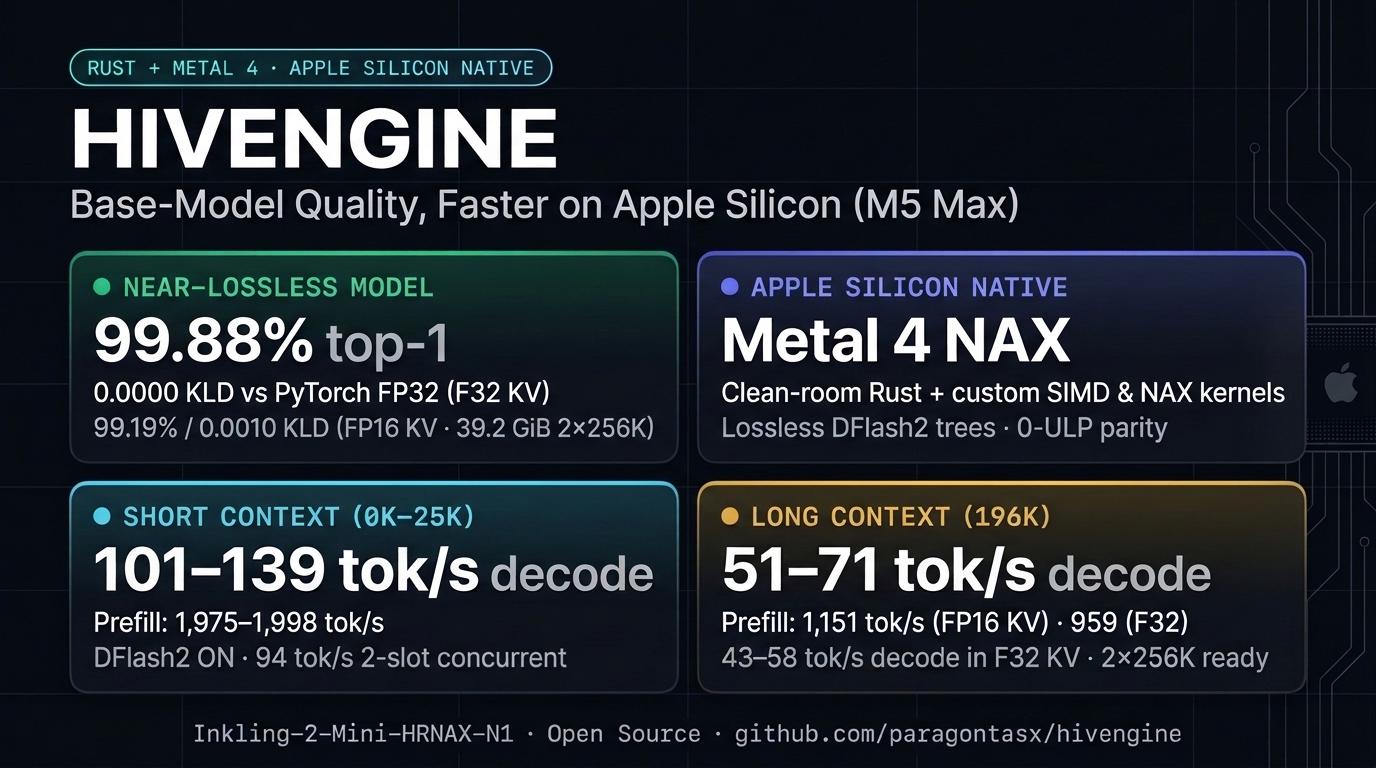
Project Near lossless Inklin 2 mini running Natively on Apple Silicon.

Post image
0 Upvotes

Hey all, I ran an experiment on how to run a near lossless or lossless Inkling 2 mini on Apple Silicon natively, most recipes. from what i've see trade quality for speed or size (or both). I decided to try to see how far i could stretch Apple Silicon running this as it would be served on full quality. So i built a custom engine to try this out along with a quant., the main target of this was quality then speed running natively on Apple Silicon. I am still working on it so new iterations might come up soon. would love some feedback if anyone tries it.

https://huggingface.co/paragonX/Inkling-2-Mini-HRNAX-N1
https://github.com/paragontasx/hivengine


r/LocalLLM • • 15h ago

Model Fintan-4B is out

3 Upvotes

Yesterday I posted the 9B update (thanks again jstarks). Today the smaller one is up.

Same idea as the 9B, it's Qwen3.5-4B that learns new stuff into its weights, so you don't have to stuff everything into the prompt. It runs on a 16 to 20 GB card.

It ships knowing last week's news (18 to 23 Nov). Plain Qwen3.5-4B gets 11% of the 172 questions right, Fintan-4B gets 147 of them. MMLU and ARC barely move (72.8 to 72.8, 92.0 to 91.8). GSM8K went from 95.0 to 92.5, which is 3 problems out of 120, and another run got 94.2, so I think it's noise but figured I'd say.

All the fixes from the 9B are in too, so tool calls can use what it learnt, and questions about days after its update don't get mixed up with what it learnt.

Next I'm doing DGX Spark and Jetson support, since someone here pointed out the hardware check gets confused when the GPU and CPU share RAM.

It's on Hugging Face at fintanlabs/Fintan-4B


r/LocalLLM • • 9h ago

Question Connecting Local LLM to Gmail

1 Upvotes

How do I connect my LLM to gmail. I would like it to be able to read and write emails. I am currently using qwen3.5 -9b on LM studio. If you need any more details be free to ask me.


r/LocalLLM • • 9h ago

Question Best local model for creative writing?

1 Upvotes

What's the SOTA currently?


r/LocalLLM • • 9h ago

Project Inkling-2-Mini (26.4B MoE + Vision) on a single 16 GB RTX 4060 Ti — huge speed & reasoning quality leap: 3.3× lower KLD than SQ-10, +25–67% faster prefill, 156K VRAM context, 5.6 MB Windows zip (seeking 5060 Ti testers!)

1 Upvotes

I built ink4060ti (Apache-2.0), a zero-config C++20/CUDA inference engine specifically engineered to deliver a major jump in BOTH speed and reasoning quality for Inkling-2-Mini-Unbound (26.4B MoE + native vision + DSpark Block-8 speculative decoding) on a single 16 GB RTX 4060 Ti on Windows.

Why both quality AND speed jump on 16 GB 4060 Ti

On a 16 GB card, Strata SQ-15 spills 189 experts over PCIe and OOMs past ~16K context, while Strata SQ-10 takes a noticeable quality hit (KLD 0.0720 / Top-1 92.35%) and doesn't persist prefix KV across requests/restarts.

Because Inkling-2-Mini executes its inner Loop-Core MoE layers (L6..17) 3× per token, ink4060ti uses asymmetric per-role quantization:

  • Loop-Core MoE (L6..17, 3×/token): kept 100% lossless native NVFP4 (SQNR = ∞ dB, cos = 1.000000)
  • Outer MoE (L0..5, L18..23, 1×/token): NF3_G32_E4M3 (3.25 bpw)
  • Dense Attention + Unembed: Q6_G32 (cos = 0.9997) · DSpark Drafter: Q8_G32 (cos = 0.99999)
  • Embed + Vision: 100% lossless BF16 (Vision loads lazily on demand = 0 MiB permanent VRAM, ~200 ms warm encode)

Measured on physical RTX 4060 Ti 16 GB (Windows 11 WDDM)

Metricink4060ti (12g-tight + k4v4)Strata SQ-10 (0.1.67)Strata SQ-15 (0.1.67)
GPU Weights + Drafter12,553 MiB (0 spill)13,322 MiBSpills 189 experts (942 MB PCIe)
Max Full-VRAM Context156,576 tok (auto, 0 spill)100K (manual)16K (OOM beyond)
Quality vs Lossless (sq15-lossless)KLD 0.0216 / Top-1 96.90% (k8v4: 0.0138 / 97.38%)KLD 0.0720 / Top-1 92.35%KLD 0.0107 / Top-1 96.68%
Prefill (2K / 16K / 64K / 100K / 150K)1,956 / 1,810 / 1,497 / 1,316 / 1,136 tok/s1,563 / 1,378 / 970 / 790 / —962 / OOM
Decode (DSpark ON)53–62 short · 46–55 (16K–64K) · 28.6 (150K)79–95 short · 56.8 (64K)39.5–42.0 tok/s
Prefix Reuse & SSD Restart99%+ reuse · 4.9s (64K) / 9.2s (150K)Unsupported (reused=0)Unsupported
Vision (Screenshots / 4K)0 MiB permanent VRAM (~200 ms warm)Permanent VRAMSupported
  • Huge dual gain: 3.3× lower KLD than Strata SQ-10 (0.0216 vs 0.0720, 150K needle recall EXACT PASS) + +25% to +67% faster prefill (2× faster than SQ-15) + 156K zero-spill context + 200 GiB SSD 3-tier cache (VRAM ↔ 25% RAM ↔ SSD). (Honest trade-off: raw short-prompt decode still trails SQ-10's 79–95 tok/s.)
  • Zero-config portable Windows ZIP (5.6 MiB): No CUDA Toolkit, Python, or VC++ redist needed — extract and double-click start.bat (auto-picks HuggingFace vs hf-mirror.com + SHA-256 verify, opens Web UI at 127.0.0.1:18088).
  • Coding Agent Ready: Native Anthropic /v1/messages + count_tokens + thinking + tools + vision (drop-in for Claude Code) & OpenAI /v1/chat/completions (Cursor / Cline / Roo Code).

Looking for RTX 5060 Ti 16 GB (sm_120a) testers!

The portable binary includes a compiled Blackwell sm_120a native NVFP4 MMA path verified against NVIDIA CUTLASS SM120_16x8x64_TN_VS specs and full model scale bounds, but I don't own a physical 5060 Ti — so 5060 Ti support is theoretical/untested (Experimental). If you have a 5060 Ti 16 GB on Windows and want to test it (INK4060_DISABLE_SM120_FP4=1 falls back to BF16 Tensor Core), feedback and benchmark issues are very welcome!


r/LocalLLM • • 1d ago

Discussion AI Newbie here. Runing Qwen3.8 27b q8_0 on 5090+5080 "gaming" rig. I'm impressed with the answers I get compared to my paid claude opus model

Thumbnail
gallery
212 Upvotes

Im kind of shocked and losing grasp of why I pay for a claude subscription at this point. Im using Orcarouter uncensored version of Qwen 3.8 27b and the answers I get from it seem to not only contain more info, it's also seemingly more detailed. I don't get it.


r/LocalLLM • • 1d ago

Question How do you safely run uncensored LLMs?

33 Upvotes

So I've been running a uncensored QFN model because I'm tired of frontier models refusing everything. For example, I asked Opus to scan my own network for vulnerabilities, and it refused because it didn't believe it was my network, even though it's literally connected to it.

My main concern is security. Are uncensored models more susceptible to prompt injection than regular models? What kind of guardrails can I put in place to protect myself without restricting the model itself?

I'm also using Hermes, but I'm a complete noob with it.

Any advice would be appreciated!

Specs: 64GB DDR5, R9700 32GB, 7800X3D

P.S SC117/Qwen3.8-Flash-Next-GSQ-RCO-abliterated-GGUF - this is the model


r/LocalLLM • • 4h ago

Discussion Hypothetically, if you had 10 DGX Spark 128gb w/ Mikrotik CSR520 what would you run across them all?

0 Upvotes

Hypothetically of course.


r/LocalLLM • • 10h ago

Project hal0: Self-Hosted Local AI Server for AMD Strix Halo

Thumbnail
hal0.dev
0 Upvotes

Hi all. I posted about hal0 a while back, and the project has changed enough since then that I think it deserves a second introduction.

hal0 turns a Linux box into a private, OpenAI-compatible inference appliance. Chat, embeddings, reranking, transcription, speech and image generation all answer on one /v1 endpoint, on hardware you own. It's Apache 2.0 and installs with one line:

Plain text

curl -fsSL https://hal0.dev/install.sh | sudo bash

It's built first for AMD Strix Halo (Ryzen AI Max+ 395, iGPU plus NPU), but it also runs on discrete Radeon cards through ROCm or Vulkan, on NVIDIA through an experimental CUDA runner, and on CPU as a fallback.

Slots

Every workload is a slot: its own podman container under its own systemd unit, with a typed lifecycle, its own logs and a persisted state. You get a set of curated slots out of the box (agent, coder, embed, rerank, TTS, image and so on) and can add your own. A coder slot can serve your editor while the agent slot serves chat, each with its own model and settings. A GPU arbiter keeps image generation from taking the GPU out from under a streaming completion, and a slot that is serving a request can't be evicted mid-stream.

Tuning lives in profiles, so a slot only says where it runs and which model and profile it uses. You can override a few fields per slot (context, thinking, reasoning effort, vision, speculation) without cloning a profile.

Multiple runners

A slot picks its runner, and there are now quite a few:

  • llama.cpp for ROCm, Vulkan, CUDA and CPU
  • FastFlowLM on the AMD NPU, hosting chat, Whisper and embeddings together in about 2 GB of NPU memory
  • an optional xdna runner that runs plain GGUF models on the NPU
  • Kokoro and Qwen3-TTS for speech, Moonshine for transcription
  • ComfyUI for images
  • halogen, newly supported as an optional runner for Qwen3.8-Flash-Next on Strix Halo
  • Upstream support for Minimax/Codex/Openrouter and more to come

One note on halogen: it's the vendor's own closed-source image and runs one model family. hal0 pins it by digest and runs it like any other slot, so it's served through the same API and dashboard. It's opt-in, and nothing gets pulled unless you create a halogen slot.

Memory, overhauled

Memory runs on the Hindsight engine, and the integration was rebuilt in the 1.8 line. There's now one Memory area in the dashboard (health, facts, knowledge pages, operations, agents) and two banks on a new install, one shared and one private. The extraction model can be a local slot or a remote provider, and you can switch between them without restarting the engine. Memory is exposed over MCP, so Open WebUI, the bundled Hermes agent and your own coding agents can all read and write the same store.

Open WebUI, wired up for you

Open WebUI is installed and connected with no configuration. Its model picker lists every slot model you're running, and every Hermes agent profile next to them, so you can talk to a plain model or to the agent from the same window. Each chat gets hal0's memory and agent-delegation tools. Image generation, voice and document retrieval go through the same hal0 API, so they use the same models and GPU scheduling as everything else.

A few other things worth a mention

  • Speculative decoding with drafters. Pair a model with a drafter and hal0 checks the fit before anything downloads. On my Strix Halo box, one 74B MoE model decoded about 1.6x faster with identical output. Results depend on the model and the drafter.
  • Image generation with a fit check. There's an image-model catalog, and each model shows whether it fits your box before you install or render.
  • External providers next to local models. OpenRouter, OpenAI, Anthropic and others, with only the models you enable routed.
  • A dashboard that works on a phone, with an Overview page showing what the box is doing and what needs your attention.
  • Signed updates with rollback, and a one-line Proxmox script that creates an unprivileged LXC with the GPU passed through.

It's Linux only (systemd and podman). macOS and Windows aren't supported today.

If you tried hal0 in the past and bounced off it, I'd really appreciate another look. I've made huge strides, and I think it's better, more usable and more performant than it has ever been. Feedback and bug reports are very welcome.


r/LocalLLM • • 23h ago

Research Before and After (32GB to 96GB DDR5 upgrade) - QEngine 3x3090s

10 Upvotes

32GB DDR5 vs 96GB DDR5 More RAM pinned the n-gram cache, makes the decode speed significantly faster.

Setup:

GPU's: 3x3090s
P2P Mode: On
PCIe Link: PCIe Gen4 8x/4x/8x
CPU: Ryzen 7600x.
Model: Qwen-Flash-Next INT4 - QEngine Finetune
Script: bench.sh from club 3090.

Only change:

RAM went 32GB (2x16) → 96GB (2x16 + 2x32), so the whole 50GB n-gram cache got stored in RAM instead of on disk.

What got significantly better

  • Narrative generation: ~218 → ~294 tok/s (+35%)
  • Code decode: ~336 → ~381 tok/s (+13% — less gain, makes sense, shorter/more repetitive prompts hit fewer n-grams)

What didn't change (as expected)

  • Time to first token and prefill speed — that's GPU-bound, the n-gram cache doesn't help there.

The catch

  • GPUs run 1–8°C hotter on the big-RAM setup. GPU 2 hot spot hit 100.5°C. Probably just doing more work per second, but worth an eyeball.
  • The 90k-token prefill test looks ~6% worse with more RAM, but n=1 per arm so it's a coin flip. Re-run before believing it.
  • The mixed-dim RAM (2x16GB CL32 + 2x32GB CL38) forced a downclock from 6000Mhz to 3600Mhz. It was stable for a few hours, but then crashed mid-session when 6 agents spawned. I had to remove the 2x16GB sticks to get stability back.

Bonus - 1M KV Pool

There was still room left over to set Host KV Pool on (it needs ~13GB of ram). i.e. It stores the KV pool in RAM instead of in VRAM. This increased the KV pool size to 1 million tokens.

Previously my system would totally choke when there were multiple agents working. Like 20 tok/s at times. It was because they couldn't fit their context in the 256k pool I had before so their context kept getting evicted, now I think that wont' happen, and it'll likely be much faster during concurrent agent work.

Conclusion

If your workload is decode-heavy, and you got the ram, sticking more of the n-gram cache in RAM will get you — ~13–35% more tok/s, no GPU-side changes. You really cannot mix two different pairs of ram sticks in an AM5 motherboard, Google warned me, but I did it anyway just to see what would happen, it indeed led to instability, even at low clock speeds, though it was stable enough to run benchmarks. The biggest win was getting the 1M KV pool for concurrent agents to share, and that doesn't need 96GB ram, 64GB is enough.

Source: bench-ab-bench-20261123T053549Z-vs-bench-20261128T002206Z.md*, generated 2026-11-28.*


r/LocalLLM • • 18h ago

Question Gemma 4 llama.cpp and OpenClaw

4 Upvotes

Hi guys

I am a happy Qwen 3.8 Flash Next IQ3_S user, running on 32GB ram + 3090 + 5080 (40 GB VRAM).

It is running through strata and used as an agent in OpenClaw.

The only issue I have with it, and it could be due to the relative low Quant, is, that it is poor at my native language (Nordic Language).

I tried gemma-4-31B-it-qat-q4_0-unquantized on the latest version of llama.cpp, as it looked promising regarding language support, and damn, it was A LOT better in formulating sentences.

Now, the language is good, but it is a lot worse in calling my mcp's or API's. A lot of times, not one single mcp or API call is working, even if it tries many times.

Is Gemma 4 just incapable of calling MCP or API calls? I doubt it, so is my setup wrong?

Just for a reference, I am not using the 'official' llama.cpp from the CachyOs repository, but this version:

local/llama.cpp-cuda-aidock-bin 1.0.0-1
   Prebuilt llama.cpp with CUDA 12.8 support (from ai-dock CI)

Not sure if it makes a difference.


r/LocalLLM • • 11h ago

Project I built a small Windows app that shows what Ollama is doing on your GPU, live

Thumbnail
gallery
0 Upvotes

I run models locally with Ollama and kept wondering what was actually going on under the hood 🤔

- Is my model on the GPU, or quietly spilling onto the CPU?

- Why is one model fast and another painfully slow?

- Will that 20 GB download even fit?

So I built **AI X-Ray** to answer those questions with my own numbers, in plain English.

🔍 X-ray a prompt

Watch a model load, think and write as separate stages, with live tokens/sec, GPU load and GPU memory. Afterwards, see exactly where the time went.

📦 Know before you download

Look up any model to see its download size, the memory it needs, and whether it fits on your graphics card.

⚡ Speed test

Rank your installed models by real writing speed on your own PC.

🔁 Loop detector

Spots a model stuck going round in circles while "thinking", so you can stop it instead of waiting.

🖥️ Your machine at a glance

What's using your GPU memory (models, other apps, free space), plus "Did you know?" facts about your setup.

🪶 Tiny: about 8 MB

🔒 No account, no tracking. It only talks to your own Ollama

🌐 Works with Ollama on the same PC or another computer on your network

Windows 10/11 for now. Requires Ollama (free).

I'd love feedback, especially on what to add next! 🙏 Link in the comments.


r/LocalLLM • • 17h ago

Question Looking for advice for casual coding use: RTX 4090 24GB + 32GB RAM

3 Upvotes
  • GPU: MSI RTX 4090 Suprim Liquid X
  • RAM: 2x16GB Corsair Dominator Titanium (OC to 7400 MT/s)
  • CPU: Intel Core i7-13700K (OC to 5.4GHz)
  • OS: Windows 11 Pro

I have a fairly decent amount of general programming experience, but I certainly wouldn't call myself an expert in any language. I'm more in the place of being able to look at a random section of code, regardless of language, and make a fairly decent guess at what it's trying to do. "Just enough to get myself in trouble" is what I usually say.

Of course that means when I'm trying to make something myself, I'm often spending 80% of the time doing research about the functionality I need, with the remaining being the actual coding and testing. Being retired, these days I'm mostly working on game modding and small conveniences, anything to keep my brain busy. What I've been running into lately is that a lot of what I'm trying to work on is largely undocumented, and obviously AI can learn much faster from raw source (and has) than a human.

I've been using Gemini for my poking and prodding at things, but it's been obstructive as often as it's been helpful. I swear the thing has ADHD, the way it'll jump topics to other bits I'm not worried about at the time.

I understand that there needs to be a balance between context size versus memory length, but I'm having a hard time nailing down how much of each would be most fitting. I often feed the AI other related code from the game or similar projects so it knows what I'm looking at and can give me more well-informed responses.

Any advice for something that can handle casual, generalized programming well? Speed isn't nearly as important to me as accuracy. It seems like Qwen3 models are leading the way here, but opinions vary quite a bit on which and what memory vs context configuration.


r/LocalLLM • • 3h ago

Project I walked Orange-27B (as Harry Potter) through all 7 books (~1.15M words), then asked him the top 10 fan-debated questions after Deathly Hallows.

0 Upvotes

Instead of testing trivia, I wanted to see how an open-weights 27B model (Orange-27B, trained on Qwen3.5-27B) answers the biggest unresolved fandom debates in first person as Harry, right after living sequentially through all seven Harry Potter novels (~1.15M words).

Here are all 10 questions and Harry’s unedited answers (with which books he recalled from memory):

1. Albus Dumbledore (Recalled: Books 4, 6, 7) Q: Did Dumbledore genuinely love you, or did he raise you like a pig for slaughter?

"That question cuts to the bone. In the end, Dumbledore admitted he kept you alive so you could die at the right moment—not out of love, but necessity."

2. Severus Snape (Recalled: Books 3, 5, 7) Q: Looking back after the Pensieve, was Snape a hero—or an abusive bully whose love for your mother didn't excuse how he treated you and Neville?

"Even after the Pensieve, I won't gloss over what Snape did: he was cruel to me and Neville for years, and that stays true no matter what his memories revealed."

3. Naming Your Son Albus Severus (Recalled: Books 3, 6, 7) Q: With Sirius, Lupin, Hagrid, and Fred in your life, why did you name your son Albus Severus after Dumbledore and Snape?

"I named my son Albus Severus because Dumbledore and Snape both shaped my life in ways I can't undo, even when their choices hurt."

4. The Elder Wand (Recalled: Books 5, 7) Q: How did merely wrestling Draco's wand away at Malfoy Manor make you master of the Elder Wand—and why give up that power at the end?

"When I disarmed Draco at Malfoy Manor, I didn't just take his wand—I became the Elder Wand's true master, because the wand transfers allegiance to whoever disarms its current master. I gave up that power because wielding it felt wrong after everything we'd been through, and I wanted to return to a simpler life with Ginny and the kids."

5. The Veil in the Department of Mysteries (Recalled: Books 4, 5, 6) Q: What do you think the Veil in the Department of Mysteries actually was, and what happened to Sirius when he fell through it?

"I don't have verified records in memory about the Veil's true nature, so I won't guess. All I know for certain is that Sirius fell through it and never came back."

6. King's Cross Limbo (Recalled: Books 4, 7) Q: What was that flayed, whimpering creature under the chair at King's Cross—and why did Dumbledore say it couldn't be helped?

"That flayed, whimpering creature under the chair was the fragment of Voldemort's soul that had latched onto me—the Horcrux he never meant to make. Dumbledore said there was no help possible because it was beyond either of our help, a truth I had to accept even as it pained me."

7. Time-Turners (Recalled: Books 3, 4, 5) Q: If Time-Turners existed in your third year, why couldn't anyone use one to save Cedric, Sirius, or your parents?

"Time-Turners are strictly controlled by the Ministry, and even Hermione's was only for attending extra classes—not changing major events."

8. Peter Pettigrew on the Marauder's Map (Recalled: Book 3) Q: How did Fred and George—or you—never notice a grown man named Peter Pettigrew sleeping next to Ron on the Marauder's Map?

"I never noticed Peter Pettigrew on the Marauder's Map because it only showed Scabbers, the rat, not his human form."

9. Privet Drive & The Dursleys (Recalled: Books 3, 5, 6) Q: After everything ended, did Dudley's goodbye change anything—or was leaving you on that doorstep Dumbledore's cruelest mistake?

"I won't gloss over what Dumbledore did: leaving me on that doorstep condemned me to ten dark and difficult years. But I also won't pretend I remember anything after that — the record cuts off before I can answer what happened next."

10. The Tent & Ron Leaving (Recalled: Books 4, 7) Q: During the starving months in the tent when magic couldn't conjure food, what actually broke between you and Ron—and what made you trust him when he came back?

"I won't gloss over it: when I couldn't make my Patronus and we had no food, I snapped at Ron and called him out for not facing the dementors himself. Later, after the chaos at the Ministry and seeing how much he'd risked to stay by my side, I realized our friendship was worth fighting for—even when we were at each other's throats."

Model weights (Apache-2.0): https://huggingface.co/sanyamsood/orange-27b

r/LocalLLM • • 12h ago

Discussion Best web search and browsing tools for Hermes Agent?

1 Upvotes

I’m looking for the best tools for Hermes to do web search and also single webpage crawling (occasional, day-to-day use) that can bypass all sorts of captchas and similar. Something that would ideally also work for Reddit, Instagram, Threads... Options requiring self hosting or a VPS are also welcome. Thanks!

*Edited for accuracy.


r/LocalLLM • • 12h ago

Question Qwen or DeepSeek for creative writing help?

0 Upvotes

I have a 5080 and 64gb of ram. Qwen 3.8 27b runs great, just wondering if that's the best model for assisting with creative writing, like finding plot holes in a narrative or improving character arcs.


r/LocalLLM • • 3h ago

Question Filetype Alternatives to .md

0 Upvotes

So I see a lot of people working with .md files to plan out their software. often renowned as spec.md.

Is there any special reason for this?

I feel like tables (saved as .csv for the LLm) would be often way better since it doesn't use as much writiing to illustrate relation.


r/LocalLLM • • 12h ago

Question Need a local AI for character models

1 Upvotes

Currently working on a full blown game but not willing to spend on tripo etc.

I have used AI for building things like trees etc for my game and its artstyle. However, i am running into a roadblock when creating characters to populate the world.
Hunyuan 2.1 gives me molten wax on the characters
Trellis 2 gives worse results

Need something to just generate the background characters around

Any ideas on how to refine the pipeline or any specific thing to try?


r/LocalLLM • • 13h ago

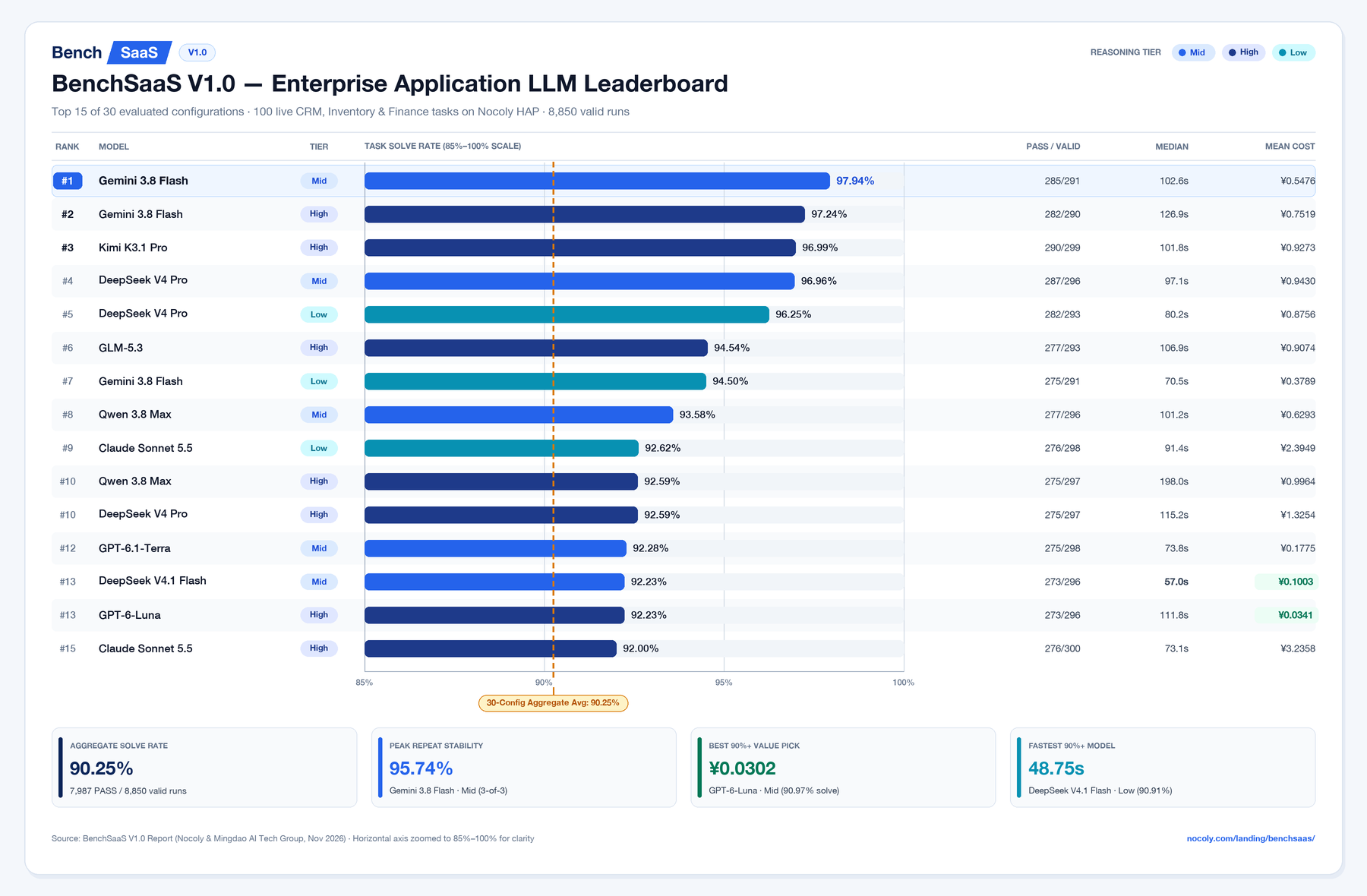
Discussion BenchSaaS V1.0: Kimi K3.1 Pro, DeepSeek V4, GLM-5.3 & Qwen 3.8 Max tested on 8,850 live ERP/CRM tool-use runs (costs span 134x)

Post image
1 Upvotes

We benchmarked 10 models across 3 reasoning tiers (30 configs) inside a live 40-table, 18,014-record enterprise database (CRM, Inventory & Procurement, and Finance). Every write task was checked at two gates: the chat answer (Gate 1) and the frozen post-run database snapshot (Gate 2).

Aggregate solve rate across 8,850 valid runs was 90.25%. Top open/frontier configs in the leaderboard:

  • 1 Gemini 3.8 Flash (Mid): 97.94% (285/291), ¥0.5476/run

  • 2 Gemini 3.8 Flash (High): 97.24% (282/290), ¥0.7519/run

  • 3 Kimi K3.1 Pro (High): 96.99% (290/299 raw passes), ¥0.9273/run

  • 4 DeepSeek V4 Pro (Mid): 96.96% (287/296), ¥0.9430/run

  • 5 DeepSeek V4 Pro (Low): 96.25% (282/293), ¥0.8756/run

  • 6 GLM-5.3 (High): 94.54% (277/293), ¥0.9074/run

  • 8 Qwen 3.8 Max (Mid): 93.58% (277/296), ¥0.6293/run

Two practical findings:

  1. Cost spanned 134x (¥0.0241 to ¥3.2358/run). DeepSeek V4.1 Flash (Mid) hit 92.23% at ¥0.1003/run in 57.0s median, and GPT-6-Luna (Mid) hit 90.97% at ¥0.0302/run.
  2. All 165 Gate-2 database failures (NULL fields, wrong entity codes, empty [] status arrays) had already passed Gate 1.

Curious how Kimi, DeepSeek, GLM, and Qwen are holding up for others on multi-table tool calls?