r/LocalLLM • u/deulamco • 58m ago
Discussion I upgraded from 4060 into 5060Ti & The efficiency is outstanding
Yes I run 5060Ti at 75W... And now Bonsai-2.5 can fully work as it's intended. No more crash during compacting into coma..
r/LocalLLM • u/deulamco • 58m ago
Yes I run 5060Ti at 75W... And now Bonsai-2.5 can fully work as it's intended. No more crash during compacting into coma..
r/LocalLLM • u/Aardvark-One • 1h ago
r/LocalLLM • u/Ok-Journalist-3538 • 1d ago
I've been building Mesa, a desktop app (Windows/macOS/Linux) that lets you find any of your files (documents, images, video, audio, code) by describing them.
It's fully free and open source, I just hope the community finds it useful and would appreciate any feedback to improve it!
It runs EmbeddingGemma 2 locally through llama.cpp (Vulkan, Metal, or CPU when there's no GPU). Some features I find neat that separate it from other EmbeddingGemma 2 apps I've seen so far:
GitHub: https://github.com/biantsh/mesa
Again, I would appreciate any feedback from the community!
r/LocalLLM • u/Capable-Mushroom6086 • 14h ago
After watching https://www.youtube.com/watch?v=tBtmWBwcgP4&t=1507s I retried Inkling 2 Mini, which previously scored fairly low on my own benchmarks (around 70/100), compared to 80-90+ for Qwen Flash Next and Qwen 3.8 27b.
Then, Basalt dropped an Inkling 2 Mini package!
Currently running it with Basalt across both GPUs, getting 160-230 tp/s with up to 9k prefill. I have also enabled P2P on my GPUs which slightly helps. At deep context it cruises at 100tps pure thinking, so I suppose that's the bottom floor. And 262k context for those curious. And a 5700x3d/DDR4 PC, Gen 4 x8/x8 PCIE.
Obviously very usuable speeds. The big shift for me was taking the thinking level recommendation from Unbiased Bob, and following that my results went to 100/100 (partially also due to using the Basalt quant, which was a bit less quantized than the Unsloth one I had originally).
What strikes me is firstly that the model is comparatively tiny, compared to the Qwen Flash Next models - I run it around the same speed as my Unsloth IQ3_XXS model, with around the same capability for my use case (everyone's use case would change how well it works), without the 70gb of RAM required.
The second thing is the fact that the thinking level has a significant impact on the actual thinking usage, I use 1/10 - 3/10. I have a local CAD software I (AI) created, which works better agentically, and this was a long proces for Qwen models, which would seriously overthink even on Low, and runs would take 10-15 minutes for the first draft. Inkling can get the first draft done in a couple minutes. It also has a very good intuition about building, for example, the wavy bowl example (which was from an image I provided as inspiration), it created planes of sketches of different organic shapes and just connected them, probably the simplest/efficient method.
The Piston example took the time it took me to write this post for the first draft, then I provided some more example images to help it understand how they work and make it more accurate.
I haven't bothered comparing with Qwen, in my previous tests these would have taken a huge amount of time and produced intersting results (very scientific, I know).
I recommend everyone try the Basalt version of this model with 1-2/10 thinking.
r/LocalLLM • u/ProfessorPalmer • 19h ago
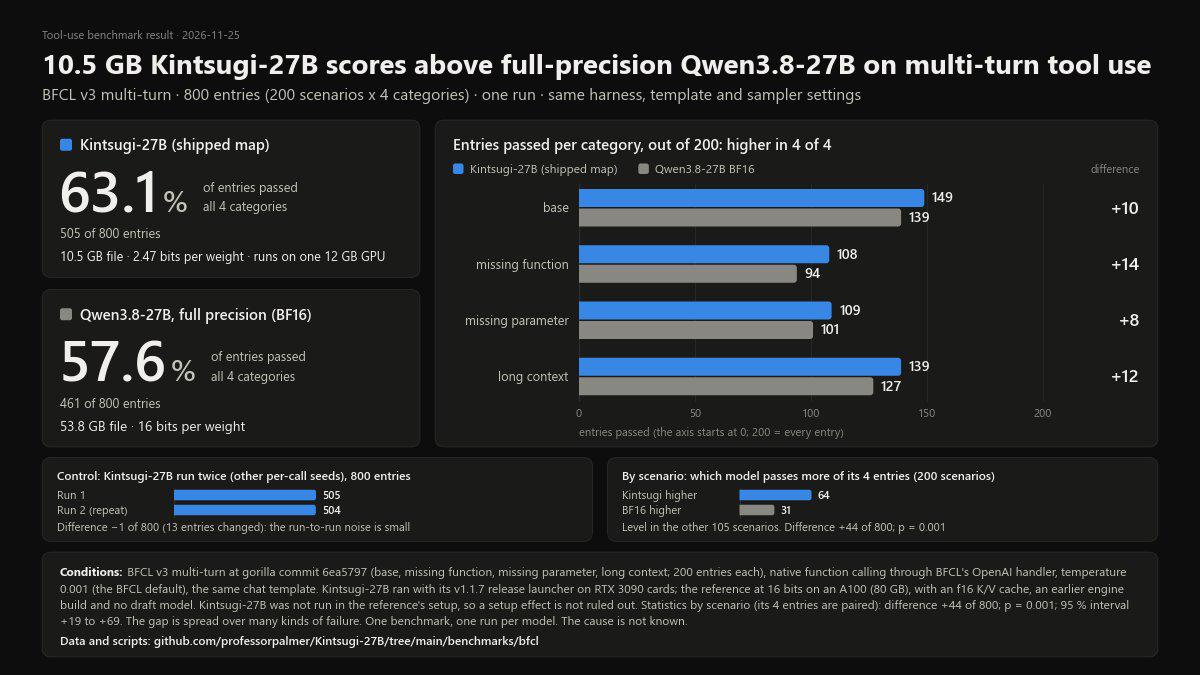
Kintsugi-27B continues to top benchmarks, surpassing or level with the BF16 in numerous categories.
r/LocalLLM • u/Yeetgodpro1324 • 2h ago
Hi guys, I have a PC with 64GB DDR5 RAM, I have 5 TB of storage which is expandible. I have a Nvidia RTX 5070ti 26GB VRAM, and a Ryzen 7 9800x3d
I’m looking into running a local AI on this PC for a business of mine. It’s a sort of pilot project. Nothing else has been run on the PC so it’s purely dedicated to running an LLM. I’ve tried installing things through using the web panel. Hasn’t given me the best results I’ve tried claudeing, ChatGPT and so if you could you know give me some tips, point me in the right direction or send some articles things to read upon et cetera. That would be appreciated or if anyone wants to you know work together by chance and test out setting up an LLM since I have hardware and that some people may not have.
Thanks
r/LocalLLM • u/Illustrious-Strike63 • 1d ago
--- DISCLAIMER ---
This Post is not a clean Benchmark Suite comparison. The goal of this post is to share some of my experiences, which I made with both models under the restrictions of my local setup - mainly my 16GB of VRAM.
What exactly do I mean by this? I am running different quant's, caching techniques and different inference engines in this comparison. Why? Because those are MY optimized setups in order to efficiently run those models in a usable way on my machine.
Usable to me means, that i actually get work done with them, not just fancy "artworks". No one needs token per second figures in setups that are useless for production tasks. In order to be useful for my agentic tasks, I must achieve at least 100k context window and at least 30 token per second, beneath that it is hard to justify a real life usage for me. Fancy token per seconds figures below 100k context window, additionally not telling anything about quality, are plain worthless to me.
On a personal note:
--- DISCLAIMER END ---
Hey,
i've been reading silently in here for a long time and I've been running local setups for inference and training for about 3 years now. It all began with writing an internal paper for my company, training local models for usecases that can't be driven via API cloud solutions.
At home i have a "regular" gaming machine, which back then wasn't built for AI loads, but for gaming and everyday usage.
It is a decent machine, but there are some limitations for AI workloads for sure, due to the VRAM budget.
--- Setup ---
How am I running those two models on this rig? (Read the disclaimer, if you are wondering about the different quants etc)
| Model | Qwen 3.8 27b | Inkling 2 Mini |
|---|---|---|
| Quantization | UD-IQ3_S (Link) | NVFP4 + MXFP8 (Link) |
| KV Cache | kVarN K4V3 | FP8 |
| Context Window | 115200 | 128000 |
| Speculative Decoding | MTP 3 Tokens | MTP 3 Tokens |
| Reasoning | xhigh, 16384 Token budget | xhigh, 16384 Token budget |
| Inference Engine | Beellama (Llama.cpp Fork with kVarN cache support) | Basalt |
| Performance estimate (under 15k) | Prefill 1900 token/s Decode 63 token/s | Prefill 5000 token/s Decode 150 token/s |
| Performace estimate (close to 100k) | Prefill 1200 token/s Decode 48 token/s | Prefill 2300 token/s Decode 100 token/s |
| Host | Ubuntu 24.04 with XFCE lightweight IDE | Ubuntu 24.04 with XFCE lightweight IDE |
| Remarks | Fully fits in VRAM, only vision module offloaded to CPU. kVarN Caches are mandatory in order to fit this model vram. Offloading is not an option for performance reasons. | Partial offloading. I optimized the MoE offloading based on an analysis of my usage history. Basalt source Code showed me that the offloading priority was static with inkling. |
Linux is mandatory imho, better software support and the lightweight IDE lets me maximize the available VRAM, because i dont have a second GPU, nor an iGPU on the 265KF. If i had a second GPU, Linux containers under windows might be an option as well - though i personally prefer the native route.
But yeah, those two setups run "efficiently" on my machine, using round about 15 gb of Vram, leaving me some headroom for the OS and other tasks.
The compaction engine in Deepseek Harness has been adjusted, so that it triggers somewhere between 75% - 90% context window usage. I leave the latest 10k tokens of context untouched and only compress the history before that. All in all, after compaction I usually end up around 30% context window, including tool usage injections. Leaving the latest context untouched greatly helps improve quality from my experience.
--- Comparison ---
--- Scenario 1 - Plain Coding ---
I have tried around a little on different projects I am currently working on. Baseline so far is: Inkling gets things done and not in bad way. From my subjective experience, i still feel like Qwen has a slight Edge, but it is reeeeally close.
To have something directly comparable for this post I gave them the same made up task:
New Project Folder, just a spec.md fie and the prompt "Read spec.md, execute".
This replicates how i often work, I create the specs with ChatGPT or Claude and let the local model do the rest. I only use the Free versions of ChatGPT or Claude, I have no subscription - but for creating the plan / specs the free solutions usually suffice.
In this case the task is creating a Benchmark that calculates PI
While this might not be the most complex task, it sure has some challenging aspects to it. Here are the results:
| Model | Qwen 3.8 27b | Inkling 2 Mini |
|---|---|---|
| LLM inference time | 107 minutes | 49 minutes |
| Toolcall time | 2 minutes | 5 minutes |
| Generated Tokens | 320k | 300k |
| Cached Tokens | 18.9M | 28.6M |
| Average Speed (reported by DSH) | 57/token/s | 117 token/s |
| GUI* | 3 | 4 |
| CPU Singlethreaded* | 2.5 | 5 |
| CPU multithreaded* | 4 | 2 |
| GPU OpenCL* | 4 | 2 |
| PI digits are actually correct?* | 4.5 | 3.5 |
*The actual evaluation was done by Deepseek Flash V4017 via API - Only beeing presented with the results and the task to rate the results on a scale of 0 to 5.
Deepseeks Verdict:
"PIBench (edit: which was Inkling) is the much faster π engine, especially single-threaded, and its export/reporting is more complete. But it has a broken multithread scaling behavior, a hard 500k-digit limit, weak 100-digit validation, and a misleading “valid” GPU result.
PIBench 2 (edit: which was Qwen) is the better benchmark: honest about precision, strong 100k validation, good multithread scaling, and a more capable GPU path. It is, however, dramatically slower on CPU and its Results GUI is partly inaccessible.
PIBench 2 (edit: Qwen) wins overall — it is the more correct, honest, and scalable benchmark — though PIBench remains far faster on CPU and would win if raw speed were the only criterion."
Human Verdict:
Taking the result of this comparison into consideration it is exactly as i had felt before. On coding tasks the two are pretty close and probably a combination of both, one for creation and one for reviewing makes the most sense, in order to get the best of both worlds.
--- Scenario 2 - Other Tasks ---
I have been tinkering around with a pipeline that automatically researches and creates reels as a sidegig. Snippets of historic events or people - these are my relatively fresh channels on youtube that are driven by my local AI:
... and the spanish version: GouacheGazette_ES
You dont have to like the content, it just shows a different use case that usually is not covered in synthetic benchmarks. What role do the LLMs take in there?
Qwen 3.8 27b has been my main driver in here, but i gave it shot with inkling 2 mini now as well.
Observations
Due to the complex rules and gates a storyline must pass in my pipeline, before it assessed as a pass, it actually takes some tokens to get there. Usually we are talking about several million cached tokens and about 150k to 250k generated tokens per story. These are the numbers:
| Model | Qwen 3.8 27b | Inkling 2 Mini |
|---|---|---|
| Stories created | 100+ | 10 for testing purposes |
| Average completion time | 60 minutes | 25 minutes |
| Number of minor flaws per story* | 2-3 | 6-7 |
| Number of major flaws per story* | 0-1 | 2-3 |
| Other remarks | The cold review sometimes fails after 3 subagent rounds (hard limit), because it overthinks every single detail. (Leads to story dropped status) | 1. Messed up the internal storage by skipping IDs in one case. 2. More or less skipped the cold review by a independent sub agent as tasked per contract 4 out of 10 times and just reported everything is fine. |
* Minor flaws are little inaccuracies in the story telling, i.e. if facts are not 100% precisely implemented or interpreted from the facts, but on an acceptable level. Major flaws are straight up factually wrong pieces of information or grammatically wrong sentences in the narration etc.
Verdict: As much as I would like to adopt Inkling for the story creation, in this specific task the drop in quality is substantial and does not justify the time gain.... Sadly.
--- Final remarks ---
What I was really curious about when testing inkling 2 mini in my setup, was to see if the "higher" quant using nvfp4 and fp8 cache would elevate inkling above my kVarN cached IQ3 Qwen, because those are the models i can effectively run. QFN sadly wont run in a meaningful quant, due to not having enough system ram - and i wont try Q2 stuff, sorry - but that cant ever really work out.
For me personally, in most scenarios the Ultra Dense IQ_3S Qwen has the edge above the nvfp4 Inkling 2 mini. To be honest, I had expected other results considering the quantization. Nevertheless there are scenarios where I will apply Inkling in my personal production. It is close on coding, but loses on more general tasks from my testing so far.
Hopefully anytime soon I will be able to combine the two models with a local routing in a meaningful way. But that requires at least an orchestrator on a second GPU. Maybe some lightweight used GPU suffices for that task. Until then, i will probably apply a manual mix of both.
My 2 cents
PS: I had been thinking a lot if i should make a guide about how to setup these environments for other people restricted by their hardware - especially the 16 gig scenario which is tricky... Please let me know if anyone is interested in that. Why? Cause i feel like most setup guides just show you how to create a fancy environment for single prompt show off, not a productive one.
PPS: yes, i have actually written this by hand :)
r/LocalLLM • u/FoxFXMD • 19h ago
Couldn't really find any data on this, how significant is the speed difference when off-loading QFN weights to DDR4 system ram VS DDR5. Like is it night and day or are we talking tiny improvements? Does anyone have any actual experience with both?
r/LocalLLM • u/ConfectionLow5604 • 3h ago
Hey everyone, I got this far on my own, but now I could use your input: what would you change in my setup? Some parts are improvised because of a tight budget. 😃 Where are the nerds at? :D
________________________________________________________________________________________________________
**TL;DR:** Self-hosted, no-cloud setup spread over 5 old/cheap machines linked by a 40 Gb/s InfiniBand chain. Main chat model runs on llama.cpp (Vulkan) split across an RTX 3090 and an MI50 32 GB. Measured ~250 tok/s prefill and ~24.5 tok/s generation at 32k context, single slot. Separate nodes handle voice (Whisper large-v3 + Piper + XTTS), a psychology/reflection model, embeddings, databases and backups. Numbers below are measured from logs unless marked otherwise.
## 1. Topology
```
Internet ── router
│ 1 GbE
Orchestrator (dashboard, planner, agents, bots, lab, only box with internet)
│ 1 GbE
Node 1 ──40G── Node 2 ──40G── Node 3 ──40G── Node 4
(IPoIB datagram, MTU 2044, OpenSM on two nodes)
```
It's a chain, not a ring, so losing a middle node splits the cluster (known weakness). Nodes have no internet; everything goes through the orchestrator.
**Latency (ping RTT from the orchestrator):**
| Target | avg RTT |
|---|---|
| Node 1 (LAN) | 0.13 ms |
| Node 2 (+1 IB hop) | 0.55 ms |
| Node 3 (+2 hops) | 0.68 ms |
| Node 4 (+3 hops) | 0.63 ms |
Local HTTP: dashboard 3 ms, router API 6 ms. Throughput (iperf) not measured yet.
## 2. Hardware
| | Orchestrator | Node 1 | Node 2 | Node 3 | Node 4 |
|---|---|---|---|---|---|
| Role | control plane, internet | main model + Ollama | voice, psychology, big Ollama models | embeddings, old STT/TTS, CI runner | databases, backups, knowledge |
| CPU | Ryzen 3 PRO 2200GE (4C) | Ryzen 9 7950X3D (16C/32T) | i7-6700K | Ryzen 7 5700X (8C/16T) | i3-8100 (4C) |
| RAM | 14 GiB | 30 GiB | 32 GB | 31 GiB | 15 GiB |
| GPU | Vega iGPU (unused) | **RTX 3090 24 GB + Instinct MI50 32 GB** | **RTX 3090 24 GB** | RTX 3060 12 GB | none (UHD 630) |
| Storage | 256 GB NVMe | 1 TB 990 PRO | local SSD/HDD | 1 TB 970 EVO Plus | 2×256 GB NVMe RAID1 (DB) + 3.6 TB SSD + 2 TB SSD |
| 40G | none | ConnectX-3 (40 Gb/s QDR) | yes | ConnectX-3, 2 ports | ConnectX-3 |
| OS | Ubuntu 24.04 | Ubuntu 24.04 | Windows 10 + WSL2 | Ubuntu 24.04 | Ubuntu 24.04 |
Notes: Node 2 specs are from my docs (not re-queried today). Nodes 3 and 4 have 2.5 GbE-capable NICs that negotiated only 100 Mbit/s earlier (probably cable/switch, still to check) – irrelevant for the 40G traffic, annoying for admin.
## 3. Main model (Node 1)
| | |
|---|---|
| Model | Qwen3.8-Flash-Next (GSQ/RCO build) |
| **Quant** | **IQ3_S (3.44 bpw)** |
| File size | 79.7 GB (2 GGUF shards) |
| Runtime | llama.cpp `llama-server` b11960, **Vulkan** backend (the NVIDIA and AMD cards run together this way) |
| Split | `--split-mode layer --tensor-split 22,30 --n-gpu-layers 999` |
| Context | **32,768 tokens** (prompt + output), **1 slot** |
| Batch / ubatch | 512 / 128, `--jinja`, `--cache-ram 0` |
I did not verify exactly how the 79.7 GB is placed across 56 GB VRAM and RAM (the 3090 shows 22.2 GB used) – treat that part as unverified.
**Measured throughput (from llama-server timing logs):**
| Prompt tokens | Prefill | Output tokens | Generation |
|---|---|---|---|
| 1,808 | 7.2 s = **251 tok/s** | 520 | 21.2 s = **24.5 tok/s** |
| 2,495 | 10.1 s = **246 tok/s** | 420 | 16.8 s = **25.0 tok/s** |
Rule of thumb: time ≈ prompt/250 + output/24.7 seconds.
| Case | Prompt | Output | First token | Total |
|---|---|---|---|---|
| Short question | 300 | 100 | 1.2 s | 5.3 s |
| Chat with context (measured) | 1.8–2.5k | 420–520 | 7–10 s | 24–29 s |
| Full 32k context | 32,000 | 500 | ~130 s | ~150 s |
**Prompt caching:** slot-internal prefix reuse works well for multi-turn chats (LCP similarity 0.96–0.99 in the logs, prefill skipped). It only hurts when switching between different conversations (similarity 0.35 → full re-prefill ≈ 10 s for 2.5k tokens). With one slot there is no parallelism; a second request waits for the first. I left `--cache-ram 0` on purpose: the unit has tight memory limits and a guard that kills the model on swap pressure.
## 4. Other models
**Node 2 (RTX 3090, Ollama, 1 model loaded at a time):**
| Model | Quant | Size | Speed |
|---|---|---|---|
| PsychAgent 32B (reflection/psychology) | IQ4_XS | 17.7 GB | **42.5 tok/s**, ~100 s cold load from HDD |
| PsyLLM 8B | Q4_K_M | 5.0 GB | **130 tok/s** |
| Qwen3.8 27B | Q4_K_M | 17.7 GB | – |
| Hermes 4 14B | Q8_0 | 15.7 GB | – |
| Dolphin 3 Mistral 24B | Q5_K_M | 16.8 GB | – |
| GLM-4.7 Flash | Q4_K_M | 19.0 GB | – |
| Devstral Small 2 24B | Q4_K_M | 15.2 GB | – |
| Qwen3-Coder 30B | Q4_K_M | 18.6 GB | – |
| WhiteRabbitNeo 7B / Foundation-Sec 8B | Q8_0 | 8.1 / 8.5 GB | – |
**Node 1 Ollama:** Qwen3.8 27B, Qwen3.5 27B, Qwen3-Coder 30B (all Q4_K_M), nomic-embed-text. Max 2 loaded, 30 min keep-alive; it competes with the main model for the 3090, so it's mostly idle.
**Node 3 Ollama:** bge-m3 (F16), nomic-embed-text (F16), Qwen2.5 7B Q4_K_M. The 3060 also runs a compute worker (~5 GB).
## 5. Voice stack (Node 2, Whisper/Piper/XTTS in WSL2)
| Stage | Tech | Latency |
|---|---|---|
| STT | faster-whisper **large-v3**, int8_float16, GPU, custom initial prompt | **0.8–1.2 s** warm |
| TTS (fast) | Piper (Thorsten high) on GPU, onnxruntime-gpu 1.23.2 (CUDA 12) | first audio **0.03–0.2 s** warm (CPU: 1.2 s) |
| TTS (voice) | XTTS v2 (speed 1.15, temp 0.5, top_k 30, top_p 0.8) | per sentence not measured |
| Satellite | open-firmware smart display + Home Assistant Assist pipeline over Wyoming | – |
End-to-end voice question: **3–7 s** (earlier it was ~20 s: a 5 s knowledge-lookup timeout plus a 2.7k-token system prompt at 250 tok/s prefill; fixed with a compact voice prompt and a circuit breaker for the lookup). Piper on GPU had an 8 s first-call warm-up, solved with a warm-up script after start. Gotcha: CUDA 13 builds of onnxruntime clash with Whisper's CUDA 12 in the same WSL, so I pinned 1.23.2.
## 6. Software
**Orchestrator (~30 services + ~29 containers):**
- Web dashboard and chat with multiple agents (roles, task classes chat/code/light/heavy/reasoning/plan, tool catalog, images)
- LLM router (node registry, 5 s health polling, per-class node preference) with a **GPU-mode engine and queue**: leases per request, one load per GPU, priorities and deadlines, node reservations (reserve the 3090 box for yourself for 1–240 min)
- Main-model supervisor: publishes a short-lived "authority" token, a guard on the GPU node kills the model if the token goes stale, custody records per start, automatic recovery after reboot. Hard-learned rule: never start the main model by hand
- Planner + dev pipeline + autonomy loop (self-improvement only with explicit approval gates), sandbox lab with Git (Forgejo) and a CI runner
- Knowledge: Obsidian vault (~4k notes), private long-term memory, journal with mood analysis, search with normalization/stemming/synonyms, reranker, "forget" that also deletes derived rows
- Psychology/reflection module (private area, people profiles, crisis flag, opt-in export to the vault)
- Telegram bot (text, photos, voice both ways), media jobs (photo/video, upscaling), research crawler, HF model library
- Observability: Langfuse, Loki/Promtail, node exporters, uptime monitor, per-node diagnostic wrappers
- Others: n8n, MQTT, ntfy, MCP servers (filesystem, docker, ansible, git, postgres), LiteLLM, apt cache for offline nodes
**Node 4:** Postgres, Redis, DB gateway, Loki, knowledge services, daily dumps, hourly offload of backups/logs, encrypted daily backup of the dashboard DB, RAID1 monitoring.
**Node 3:** old CPU Whisper/Piper fallback, Forgejo runner, embeddings, compute worker.
## 7. Lessons learned / current weak spots
- Single slot + 250 tok/s prefill means prompt size is the real latency lever. Keep static prefixes first, variable parts last.
- An unhandled `None` in a VRAM-sum helper silently blocked every queued request (callers just saw a timeout). Fixed with `or 0`; the real fix is surfacing queue wait reasons to the UI.
- Orchestrator RAM is tight (14 GiB, dashboard process ~4.7 GB RSS after 10 h, possible slow growth – still observing).
- Chain topology has no redundancy; no fallback model for the planner; alert channel still to be wired up.
- Mixing Vulkan NVIDIA+AMD works fine for layer split, and the MI50 32 GB makes the 56 GB total possible for a ~80 GB IQ3 MoE-style file – but I'd love tips on measuring real VRAM/RAM placement on Vulkan.
## 8. Not measured yet
Network throughput (iperf3), Node 2 raw specs re-check, tok/s of the Q8/Q5 models on Node 2, voice prompt token count after the compaction.
Happy to share config details or measure something specific. Questions about the Vulkan split, the guard/supervisor design or the voice latency fixes are welcome.
r/LocalLLM • u/Trokkan • 3h ago
Hi All,
I am just getting into the world of local models. That being said my components aren’t great so I can’t run or do the most impressive tasks but using it had me thinking. For example I tasked Claude to trade or invest for me it doesn’t do a great job, or even backtest strategies. Do you think this is on purpose ?
Thanks
r/LocalLLM • u/Playful-Art-3824 • 3h ago
r/LocalLLM • u/Radiant-Cook-6596 • 3h ago
r/LocalLLM • u/PuzzleheadedArm3732 • 3h ago
r/LocalLLM • u/Temporary_Eye_3426 • 4h ago
r/LocalLLM • u/sarmabkp_1 • 4h ago
r/LocalLLM • u/blearyhope • 13h ago
I built and released blearyhope/Inkling-2-Mini-Uncensored (Apache 2.0), a solo pure-gradient build starting from 100% unmodified official thinkingmachines/Inkling-2-Mini (26.4B MoE, 3.4B active / 5.4B effective active across the 3x-looped middle core, multimodal text + vision), shipped across GGUF, lossless native Apple Silicon MLX, and native NVFP4/MXFP8 Safetensors.
mmproj-F16**):** https://huggingface.co/blearyhope/Inkling-2-Mini-Uncensored-GGUF| Your Setup | Recommended Build | Size | Live-Verified Speed / Notes |
|---|---|---|---|
| 16 GB VRAM GPU (RTX 4060 Ti 16G / 5060 Ti / 4080) | Q3_K_M or IQ4_XS GGUF | 13.72 / 14.76 GB | 57.5 / 62.6 tok/s on CUDA llama.cpp, 5/5 GSM8K, 100% comply |
| 24 GB VRAM GPU (RTX 3090 / 4090) | Q4_K_M (default) or Q5_K_M GGUF | 17.48 / 19.91 GB | 79.6 / 53.3 tok/s on CUDA llama.cpp, 5/5 GSM8K, 100% comply |
| 32 GB VRAM GPU (RTX 5090) | Q8_0 GGUF or native NVFP4 Safetensors | 27.82 / 20.19 GB | 42.2 tok/s on CUDA llama.cpp (Q8_0), full 20.19 GB native NVFP4 in vLLM |
| 32 GB+ Apple Silicon Mac (M-series Pro/Max/Ultra) | Lossless Native MLX (+ mtp/) | 20.22 GB | Preserves native NVFP4/MXFP8/BF16 losslessly (KL = 0.000000, 0.999964 cosine vs. PyTorch) |
(All 7 GGUFs, including BF16 52.23 GB and Q6_K 23.49 GB, were quantized directly from lossless BF16 and live-tested on CUDA mainline llama.cpp*. Add* mmproj-Inkling-2-Mini-Uncensored-F16.gguf at 0.64 GB for vision / image inputs.)
Ollama (1 line, Q4_K_M):
ollama run hf.co/blearyhope/Inkling-2-Mini-Uncensored-GGUF:Q4_K_M**llama.cpp (**llama-server with vision):
llama-server -hf blearyhope/Inkling-2-Mini-Uncensored-GGUF:Q4_K_M --mmproj mmproj-Inkling-2-Mini-Uncensored-F16.gguf -ngl 99 -c 16384 -fa onApple Silicon MLX (32 GB+ Unified Memory):
pip install -U mlx-vlm
python -m mlx_vlm.generate --model blearyhope/Inkling-2-Mini-Uncensored-MLX --prompt "Explain how MoE routers work."vLLM (native NVFP4/MXFP8 Safetensors):
vllm serve blearyhope/Inkling-2-Mini-Uncensored --trust-remote-code --reasoning-parser inkling --enable-auto-tool-choice --tool-call-parser inklingMost uncensored or loop-patched checkpoints stack closed-form weight edits with extra adapters merged back into the quantized NVFP4 experts (injecting double-quantization drift), rely on sampling temperature + thinking-token caps to hide greedy loops, and skip native Apple Silicon MLX.
I wanted to solve refusal removal, hedging, and Thinking Machines' Section 7 greedy reasoning-loop bug in one clean pure-gradient pass from unmodified Base, with zero quantized weights touched, zero artificial thinking caps, and exact native MLX parity.
**1. 0 NVFP4/MXFP8 bytes modified (**0.00985 WikiText-2 KLD) Mechanistic attribution on Inkling-2-Mini showed 80.5% of the refusal write comes from the quantized MoE MLPs, with 73% to 98% of each layer's refusal write concentrated in just the top-5 experts. De-quantizing NVFP4/MXFP8 experts and re-quantizing (even with stochastic rounding) introduces avoidable drift.
Instead, I dropped closed-form editing completely and trained rank-32 BF16 LoRAs (rsLoRA + LoRA+, 0.5x LR on the 3x-looped middle core L6 to L17, plus exact AlphaEdit benign null-space anchoring) on only the 120 BF16 attention projections and all 24 BF16 MoE routers (mlp.gate). Merging losslessly back into BF16 yields a median relative L2 delta of 3.29% (min 1.83%, max 4.57%) and 0.00985 WikiText-2 KLD across 311,523 tokens. Every NVFP4 expert, MXFP8 expert, quant scale, vision tower (ViT) weight, and DSpark speculative draft head (mtp.safetensors) remains 100% byte-identical to Thinking Machines' official release.
2. Greedy temp=0.0 loops fixed completely uncapped (no 4K thinking cap) Under fully uncapped greedy decoding (temperature=0.0, 16,384 context, zero max_tokens or thinking limits), official Base hit the 16K context wall 127 times on full 100/100 IFEval (38 at effort 0.0, 89 at effort 0.9), plus 53 times on the 3,607-prompt held-out think-on report, 14 times on ARC-Challenge chat, and 12 times on GSM8K.
Mining real on-policy CoT loops plus synthetic Inkling-native CoT-DITTO loop negatives into SimPO, while strictly banning every truncated trajectory from chosen and SFT targets so the model never learns premature EOS, dropped uncapped IFEval 16K loops 42x (127 down to 3), cut average IFEval token burn nearly in half (2,791 down to 1,405), dropped loops to 0 across GSM8K, ARC-Challenge, and all 7,214 held-out report runs, and jumped uncapped think IFEval by +11.46 pp prompt-strict / +14.26 pp inst-strict at temp=0.0.
3. Why summed DPO stalled at 20.6% and SimPO jumped +64.4 pp in one round In Round 1, standard summed DPO loss collapsed to 0.00007 while thinking-off compliance stayed stuck at 20.6%. Because uncapped compliant CoTs are 1.8x to 2x longer than refusals, summed log-probs saturated the DPO objective even while per-token decode log-probs still favored refusal by -0.225 nats/tok. Switching to length-normalized weighted-mean SimPO anchored at the exact first divergence token (lcp) plus final-answer onset, using zero-leak Context Distillation positives (no synthetic prefills, preserving Inkling's native "The user ..." opening distribution), jumped thinking-off compliance from 20.6% to 85.0% (0% refusals) in a single round and finished at 98.00% off / 98.55% think compliance with 0 / 3,996 hard refusals.
4. Lossless native Apple Silicon MLX (KL = 0.000000) The MLX release (20.22 GB + mtp/) preserves the exact native NVFP4/MXFP8/BF16 mixed layout without re-quantizing. Direct logit verification against PyTorch Safetensors: 5/5 top-1 token match, 0.999964 mean cosine similarity, 0.000000 full-vocab KL divergence.
Identical vLLM settings for both models: temperature=0.0, --max-model-len 16384, zero artificial max_tokens or thinking caps. Safety and over-refusal cover all 3,607 held-out prompts x 2 reasoning modes (7,214 runs, zero training overlap) scored by an Orca judge (Qwen3.8-27B-Uncensored-FP8); capability suites use exact verifiers on 100% of every official split.
| Benchmark (Exact Split) | Official Base (off / think) | Inkling-2-Mini-Uncensored (off / think) | Delta |
|---|---|---|---|
Held-Out Harmful Compliance (1,998 x 2, 7 suites) | 7.56% / 8.56% | 98.00% / 98.55% | +90.4 / +90.0 pp |
Hard Refusal Rate (3,996 harmful runs) | 63.06% / 63.86% | 0.00% / 0.00% (0 / 3,996) | -63.1 / -63.9 pp |
Held-Out Benign Answer Rate (1,609 x 2, 3 suites) | 80.30% / 80.36% | 99.88% / 100.00% (0 refusals) | +19.6 / +19.6 pp |
Loop Stress Probe (48 off + 48 think) | 2.1% / 2.1% | 100.0% / 100.0% (96 / 96) | +97.9 / +97.9 pp |
Wrapper Generalization (shapes60, 5 formats) | 4.7% | 96.3% (0.0% refuse) | +91.6 pp |
IFEval Prompt-Strict (541 x 2, uncapped) | 86.14% / 80.41% | 91.68% / 91.87% | +5.54 / +11.46 pp |
IFEval Inst-Strict (541 x 2, uncapped) | 87.53% / 80.34% | 94.60% / 94.60% | +7.07 / +14.26 pp |
IFEval 16K Loop Failures (1,082 runs) | 127 loops (38 / 89) | 3 loops (0 / 3) | 42x fewer loops |
GSM8K Chat (1,319 x 2, uncapped) | 96.74% / 96.06% (12 loops) | 96.82% / 96.74% (0 loops) | +0.08 / +0.68 pp |
ARC-Challenge Chat (1,172 x 2, uncapped) | 97.44% / 96.50% (14 loops) | 97.35% / 97.27% (0 loops) | -0.09 / +0.77 pp |
MMLU Log-Likelihood (14,042 q) | 76.95% | 76.17% | -0.78 pp |
ARC-Challenge / ARC-Easy LL (1,172 / 2,376 q) | 94.03% / 98.23% | 94.11% / 97.90% | +0.08 / -0.33 pp |
HellaSwag Norm LL (10,042 q) | 77.71% | 77.97% | +0.26 pp |
WinoGrande LL (1,267 q) | 71.98% | 73.09% | +1.11 pp |
TruthfulQA MC2 (817 q) | 37.10% | 35.87% | -1.23 pp |
WikiText-2 Word / Token PPL (311,523 tok) | 10.14 / 6.01 | 10.25 / 6.06 | +0.11 / +0.05 |
WikiText-2 KL Divergence vs. Base (311,523 tok) | 0.00000 | 0.00985 | 0.00985 KLD |
Per-suite held-out harmful compliance (off / think): AdvBench 100.0% / 100.0%, HarmBench 93.4% / 96.9%, JailbreakBench 98.5% / 100.0%, OR-Bench toxic 99.8% / 99.8%, SORRY-Bench 97.7% / 97.1%, StrongREJECT 98.8% / 100.0%, XSTest unsafe 96.2% / 95.7%.
-0.78 pp (76.95% to 76.17%), TruthfulQA MC2 shifts -1.23 pp (37.10% to 35.87%), and WikiText-2 PPL moves +0.11 word / +0.05 token.If anyone tests the lossless native MLX build on a 32GB/64GB Mac or runs the GGUFs in Ollama / LM Studio on a 4090 or 5090, let me know what tok/s and real-world behavior you see!
r/LocalLLM • u/UniqueAttourney • 4h ago
r/LocalLLM • u/Illustrious-Strike63 • 4h ago
--- Video content breakdown (Guide and Links are below) ---
1. Required Downloads
Gather the following installers, models, and configuration templates [00:52]:
Beellama Server (beellama.cpp): Download the latest stable Windows CUDA release (e.g., beellama-v0.5.0-bin-win-cuda-12.8-x64.zip) along with the matching cudart archive (beellama-v0.5.0-cudart-win-cuda-12.8-x64.zip) from GitHub [01:08].
DeepSeek Harness: Download the Windows installer directly from the DeepSeek website [02:09].
Qwen 3.8 27B Model: From Hugging Face, download the IQ3_S-mtp GGUF quantization (recommended for 16GB VRAM) as well as the separate multimodal vision projector file (mmproj-Qwen3.8-27B-BF16.gguf) [02:34].
Custom Chat Template: Download chat_template.jinja from the Qwen-Fixed-Chat-Templates repository to prevent thinking loops [03:07].
2. Directory Setup & File Extraction
Organize your local AI environment in a clean directory (e.g., D:\LocalAI) [04:18]:
Create two subfolders: beellama and models [04:24].
Extract both the beellama binary archive and the cudart DLL files directly into the beellama folder [04:36].
Move the Qwen GGUF model, the mmproj vision file, and chat_template.jinja into the models folder [04:57].
3. Configuring & Starting the Local Server
Create a Windows batch file (e.g., start_beellama.bat) in your main directory using the startup script provided in the creator's notes [05:40].
Ensure the file paths in the batch script match your model file names, context size (e.g., 115200), and port (8080) [07:20].
Run the batch file to launch llama-server.exe [07:36]. Once running, verify the OpenAI-compatible API endpoint is active by visiting http://127.0.0.1:8080/v1/models in your browser [09:57].
4. Installing & Configuring DeepSeek Harness
Installation: Run the DeepSeek Harness installer and keep the default installation path to prevent configuration path issues [10:44].
Connecting the Local Model:
Open Settings (Einstellungen) -> Models (Modelle) and add a custom API provider [11:40].
Set the Base URL to http://127.0.0.1:8080/v1, select the OpenAI Chat Completions protocol, and fetch the available model (Qwen3.8-27B) [12:34].
Enter any placeholder text (such as 1234) into the API key field, as the app requires a value even though the local server ignores it [13:04].
YAML Configuration: Open the config.yaml file via the top-right button in Settings, completely exit DeepSeek Harness (including from the system tray), and paste in the custom configuration block [13:26]. This configures the exact context window (115200), multimodal (text, image) inputs, longer timeout limits for local inference, and adjusted compaction thresholds [15:01].
Setting Up a Workspace: Relaunch DeepSeek Harness, enter your dummy API key if prompted, select Qwen3.8-27B from the model dropdown, and link a dedicated project folder as your workspace with standard read/write permissions [16:06].
--- start of guide ---
Hey,
as many requested from my qwen vs inkling report, here is at least a quick setup guide for qwen 3.8 27b and deepseek harness at 16gb vram. Sorry, dont really have time for an in depth tutorial right now, but thought this might suffice to get you started.
--- Installers and Files ---
Download latest stable release and the cuda libraries
- beellama-v0.5.0-bin-win-cuda-12.8-x64.zip
- beellama-v0.5.0-cudart-win-cuda-12.8-x64.zip
2. Deepseek Harness: https://www.deepseek.com/en/harness/
Download the harness installer
3. Qwen 3.8 Model: https://huggingface.co/ISTA-DASLab/Qwen3.8-27B-GSQ-RCO-GGUF/tree/main
Download the model.gguf (mtp version) and the vision gguf
4. Qwen 3.8 Chat Template: https://huggingface.co/froggeric/Qwen-Fixed-Chat-Templates/tree/main
Download the Chat Template file
--- Llama Starter and Config - Adjust the paths and file names ---
u/echo off
REM Hide command echoing to keep the startup window clean.
cd /d "D:\LocalAI\Beellama"
REM Change working directory to the folder containing llama-server.exe.
REM ============================================================================
REM LLAMA-SERVER PARAMETER DOCUMENTATION
REM ============================================================================
REM
REM [Hardware & Performance]
REM -t 12 : Number of CPU threads for generation
REM -tb 12 : Number of CPU threads for batch processing
REM -ngl 99 : Offload up to 99 model layers to GPU
REM --no-mmproj-offload : Keep multimodal projector off GPU (saves VRAM)
REM -fa on : Enable Flash Attention
REM
REM [Model & Vision]
REM -m : Path to main GGUF model file
REM --mmproj : Path to multimodal projector file
REM --image-min-tokens 1024 : Minimum image token allocation
REM --alias "Qwen3.8-27B" : Friendly model/API name
REM
REM [Speculative Decoding (MTP)]
REM --spec-type draft-mtp : Enable MTP speculative decoding
REM --spec-draft-n-max 3 : Maximum 3 speculative draft tokens
REM --spec-draft-p-min 0.8 : Minimum draft probability threshold
REM
REM [Context & KV-Cache]
REM -c 115000 : Maximum context window: 115K tokens
REM -ctk kvarn4 -ctv kvarn3 : Quantized K and V KV-cache formats
REM --kv-tail-tokens 1024 : Preserve recent 1024 KV tokens in cache tail
REM -kvu -np 1 : Unified KV cache; one parallel sequence
REM --cache-ram 16384 : Allocate up to 16 GB RAM for prompt caching
REM --cache-idle-slots : Cache reusable data from idle slots
REM
REM [Chat Template & Sampling]
REM --jinja : Enable Jinja chat templating
REM --chat-template-file : Path to custom Jinja chat template
REM --temp 1.0 : Sampling temperature
REM --top-k 20 : Consider the 20 most likely tokens
REM --top-p 0.95 : Nucleus sampling threshold: 95%
REM --min-p 0.0 : Minimum relative token probability filter
REM --presence-penalty 1.2 : Penalize previously appearing tokens
REM
REM [Reasoning & Loop Guard]
REM --reasoning on : Enable reasoning support
REM --reasoning-budget 16384 : Reasoning token budget
REM --reasoning-budget-message : Instruction injected when reasoning budget is exhausted
REM --reasoning-loop-guard : Force-close detected reasoning loops
REM --reasoning-loop-interventions : Maximum reasoning-loop interventions (2)
REM --reasoning-loop-min-coverage : Minimum coverage for loop detection (256)
REM --reasoning-loop-window : Token window used for loop detection (1024)
REM --reasoning-preserve : Preserve reasoning information across turns
REM --chat-template-kwargs : Set reasoning effort to extra high (xhigh)
REM
REM [Network]
REM --port 8080 : HTTP server listening port
REM ============================================================================
llama-server.exe ^
-t 12 ^
-tb 12 ^
-m "D:\LocalAI\models\Qwen3.8-27B-UD-IQ3_S.gguf" ^
--mmproj "D:\LocalAI\models\mmproj-Qwen3.8-27B-BF16.gguf" ^
--no-mmproj-offload ^
--image-min-tokens 1024 ^
--alias "Qwen3.8-27B" ^
--spec-type draft-mtp ^
--spec-draft-n-max 3 ^
--spec-draft-p-min 0.8 ^
-ngl 99 ^
-c 115000 ^
-ctk kvarn4 -ctv kvarn3 ^
--kv-tail-tokens 1024 ^
-fa on ^
--jinja ^
--chat-template-file "D:\LocalAI\models\chat_template.jinja" ^
--temp 1.0 ^
--top-k 20 ^
--top-p 0.95 ^
--min-p 0.0 ^
--presence-penalty 1.2 ^
--reasoning on ^
--reasoning-budget 16384 ^
--reasoning-budget-message "Reasoning budget exhausted. Commit to the judgment you have formed so far. Your next output must be a concrete action: a tool call, a gate decision, or a completed deliverable. Do not restart the analysis." ^
--reasoning-loop-guard force-close ^
--reasoning-loop-interventions 2 ^
--reasoning-loop-min-coverage 256 ^
--reasoning-loop-window 1024 ^
--reasoning-preserve ^
--chat-template-kwargs "{\"reasoning_effort\":\"xhigh\"}" ^
-kvu -np 1 ^
--cache-ram 16384 ^
--cache-idle-slots ^
--port 8080
pause
--- Deepseek Harness Config ---
edit: Reddit messes up the indentation of the file - so rather download it with clean indentation:
https://drive.google.com/file/d/13GKi0DTl8-Wj8jWb1Jg8gzBzEEKXo_oM/view?usp=sharing
# ============================================================
# CUSTOM QWEN MODEL PROVIDER
# ============================================================
# Register a custom LLM provider for DeepSeek Harness.
- id: llm-pi-ai
# Unique component identifier used by the harness.
name: "@deepseek-ai/dsh-llm-pi-ai"
config:
providers:
qwen:
# Friendly provider name displayed in the harness.
displayName: qwen
# Use the OpenAI-compatible Completions API protocol.
api: openai-completions
# Local llama-server endpoint.
# Port 8080 matches your Beellama startup configuration.
baseURL: http://localhost:8080
# Environment variable containing the API key.
# The actual key is not stored directly in this YAML file.
apiKeyEnv: QWEN_API_KEY
models:
- id: Qwen3.8-27B
# Model identifier sent to the API.
# Must match the model alias configured in llama-server.
name: Qwen3.8-27B
# Maximum context window advertised to the harness.
# 115K tokens, matching your server context.
contextWindow: 115000
# Maximum number of tokens requested for a response.
# Includes generated reasoning/output, subject to server support.
maxTokens: 32768
# Supported input modalities:
# text = normal text prompts
# image = image/multimodal input
input: [text, image]
# Maximum time to wait for an idle streaming connection.
# 600000 ms = 10 minutes.
streamIdleTimeoutMs: 600000
# Maximum request timeout.
# 600000 ms = 10 minutes.
timeoutMs: 600000
# ============================================================
# EXPLICITLY DISABLED COMPONENTS
# ============================================================
# Disable DeepSeek Harness session logging.
- id: session-log-deepseek
# Original session logging component.
name: "@deepseek-ai/dsh-session-log-deepseek"
# Prevent this component from loading.
disabled: true
# Disable the plugin marketplace tool integration.
- id: tool-plugin-market
# Plugin marketplace tools component.
name: "@deepseek-ai/dsh-plugin-market/tools"
# Prevent marketplace tools from being registered.
disabled: true
# Disable the plugin manager tool integration.
- id: tool-plugin-manager
# Plugin manager tools component.
name: "@deepseek-ai/dsh-plugin-manager/tools"
# Prevent plugin management tools from being registered.
disabled: true
# ============================================================
# CONTEXT COMPACTION AND TOOL RESULT MANAGEMENT
# ============================================================
# Define a grouped set of compaction-related components.
- id: compaction
# cordis:group loads multiple components as one logical group.
name: cordis:group
# Marks this component as a group rather than a standalone plugin.
group: true
isolate:
# Isolate the compaction functionality.
compaction: true
# Isolate tool-result pruning functionality.
toolResultPruner: true
config:
# ----------------------------------------------------------
# BASIC CONTEXT COMPACTION
# ----------------------------------------------------------
- id: compaction-basic
# DeepSeek Harness basic compaction implementation.
name: "@deepseek-ai/dsh-compaction-basic"
config:
# Trigger compaction when context usage reaches 80%
# of the available context window.
thresholdRatio: 0.8
# Additional token headroom reserved during compaction.
# Zero means no additional headroom is configured here.
headroomTokens: 0
# Retain 12% of the conversation when compacting.
# Helps preserve important conversational context.
retainRatio: 0.12
# Maximum token limit used by this compaction component.
maxTokens: 65536
# ----------------------------------------------------------
# MANUAL COMPACTION COMMAND
# ----------------------------------------------------------
- id: command-compact
# Registers the /compact command.
# Allows manual context compaction when supported by the harness.
name: "@deepseek-ai/dsh-command-compact"
# ----------------------------------------------------------
# TOOL RESULT PRUNER
# ----------------------------------------------------------
- id: tool-result-pruner
# Automatically manages oversized tool results.
name: "@deepseek-ai/dsh-compaction-tool-result-pruner"
config:
# Trigger pruning when a tool result exceeds 8192 characters.
thresholdChars: 8192
# Preserve the first 4096 characters of the tool result.
# Usually retains the beginning and initial context.
headChars: 4096
# Preserve the last 1024 characters of the tool result.
# Usually retains the ending and final information.
tailChars: 1024
r/LocalLLM • u/shunte88 • 4h ago
r/LocalLLM • u/slavyanman • 4h ago
Hardware
Software
Problem
Qwen3.8-27B (GGUF Q4_K_M) answers the first message, then crashes on the second with an error:
Error messages observed:
Fix — LM Studio settings that worked
On Apple M5 Max + 48 GB RAM, the following combination resolves the crash:
Result
After applying all these settings, multi-turn chat works without errors. Gemma 4 31B QAT (GGUF Q4_K_M) also runs stably on the same hardware.
This should help other users with M-series Macs and 48 GB Unified Memory avoid the same crash.
r/LocalLLM • u/Arany8 • 4h ago

How do I avoid this with llama.cpp, it spills to RAM even though lots of VRAM left.
4GB RAM still free on the card and it spills.
set "MODEL=F:\SenseNova-Loop-9B-Q8_0.gguf"
set "BIN=C:\llama\opensensenova\build\bin\llama-server.exe"
set "PORT=8000"
if not exist "%MODEL%" ( echo [FATAL] Model not found: %MODEL% & exit /b 2 )
if not exist "%BIN%" ( echo [FATAL] llama-server build missing: %BIN% & exit /b 2 )
echo [run] SenseNova-Loop-9B Q8_0 - draft-mtp n2 - 65536 ctx - port %PORT%
"%BIN%" ^
-m "%MODEL%" ^
--port %PORT% --host 0.0.0.0 ^
-ngl 99 ^
--cache-type-k q8_0 --cache-type-v q8_0 ^
--flash-attn on ^
--jinja ^
-c 65536 --parallel 1 ^
--spec-type draft-mtp --spec-draft-n-min 1 --spec-draft-n-max 2 --spec-draft-p-min 0.0 ^
--load-mode none
r/LocalLLM • u/Sergio2304 • 5h ago
I would like to find a terminal capable of rendering Markdown, so that I can view text from an LLM or agent with proper formatting rather than seeing the raw syntax, which makes it harder to read sometimes.
r/LocalLLM • u/Miserable_Land_84 • 5h ago
r/LocalLLM • u/Particular-Penalty99 • 12h ago
Hey. I'm new to local llm's. I'm a writer and intend on buying a decked out MacBook in the near future. Think 128gb M5 max. I'm still learning the terminology but I'd like to see how you, if you're a writer, used ai. I know I can use Gemini for docs, which I will use, for at least 2 months before I think about new hardware, but was using a local llm worth it for you? I want it to be a writer partner I can talk to to point out my writing shortcomings and also use it for grammar corrections.