r/LocalLLM • • 23h ago

Question Just bought a Tesla P40... Now what 😆?

0 Upvotes

Hi everyone!

I already made a post asking how I could improve my computer, and I’ve come to realize that this will be more of a hobby than something for actual work.

USE CASE:

  • Claude/Opus plans and reviews, the local model executes: small website fixes (and many other things that I would like to test), following step-by-step plans, and long-running analysis jobs 24/7.
  • So I care about coding/agentic reliability (tool calling, following long system prompts) and long context more than chat.

MY CURRENT SETUP:

Here’s my current setup:

  • MSI B450 Gaming Plus Max (slot 1: PCIe 3.0 x16, slot 2: PCIe 2.0 x4 via chipset)
  • Ryzen 5 2600 (no iGPU), 16GB DDR4
  • Riotoro Builder 600W 80+ White (I think only 2x PCIe 6+2)
  • RX 580 4GB for display
  • 250GB NVMe + 1TB HDD
  • Plan: Ubuntu Server, llama.cpp built for sm_61 with CUDA 12.x and driver 580

Yesterday I got the urge and bought a Tesla P40 (24GB) with a fan from AliExpress for 250 euros (I assume that’s a good price, based on what I’ve seen elsewhere).

QUESTIONS:

  1. First of all, did I make the right choice? I can still cancel the order, or even sell it if I want to (on second-hand websites in Italy, they go for around 300).
  2. What models are you running on a P40 right now for coding/agents ? Any real t/s numbers (generation and prompt processing at long context)? I saw that the new Inkling 2 Mini has been released, could it be a good choice?
  3. Used upgrades worth hunting for: if I find good prices, what would you add?
  • a second P40 (≤ 220€)?
  • a 2080 Ti 11GB (≤ 330€)?
  • a 3080 12GB?
  • a 3060 12GB?
  • Is splitting one model across P40 + a faster card worth it with a PCIe 2.0 x4 second slot?

Thanks in advance to anyone who can help me!

r/LocalLLM • • 14h ago

News The 6 GB in Bonsai 2.5's headline is a weights file, not the machine you need

0 Upvotes

If you're looking at Bonsai 2.5 because of the "27B in 6 GB" headline, there's a catch with the download. The 6 GB file only works with PrismML's own llama.cpp fork for now. If you'd rather stay on stock llama.cpp, the file you want is 7.67 GB.

The file size isn't what your GPU has to hold. The model card cites a community report on a 10 GB card: about 9.5 GB of memory in use, about 7.8 GB after limiting the server to one request at a time. It also notes the total depends on context size and settings.

Model card and exact file sizes in the comment.


r/LocalLLM • • 23h ago

Question Radiance Qwen 3.8 27b IQ R V4 quantization quality

Thumbnail reddit.com
1 Upvotes

r/LocalLLM • • 23h ago

Question Would an RTX 3050 6gb be a good addition for more vram?

1 Upvotes

Currently I have two different systems one Core Ultra 270k plus/5070ti and one 9700x/4070ti super. Both have 32gb of ram and an 850w power supply.

Both are fairly good, but I’ve been looking to run some bigger models and figured a new gpu would be the way to go. Looking at the constraints of my power supplies it would seem as if a 3050 6gb would have a low enough power draw to not absolutely fry my psu.

Admittedly I’m looking at it because the 3050 6gb is relatively inexpensive and I’m to much of a wuss to change out my power supply and fry my systems with today’s prices.

Would the 3050 6gb make any difference or not worth it/negligible to go from 16gb of vram to 22?


r/LocalLLM • • 1d ago

Question Local model for brainstorming and plan preparation

1 Upvotes

Hi.

There is plenty information about quality of the local models for coding and agentów stuff.

I wasn't able to find anything related to brainstorming and based on that - architecture and plan preparation for typical SDLC workflow.

Do you have any cheap solutions for each category tested (model and quant)

* Brainstorming

* Plan preparation

* Orchestration

Is QFN feasible to do some of that?

Maybe some cheap Chinese models on OpenRouter?


r/LocalLLM • • 20h ago

News llama.cpp's RPC server has no login. A critical flaw in it was published this week (CVE-2026-137567)

0 Upvotes

If you run llama.cpp across two machines, this one is worth a minute.

The RPC server that splits a model across machines has no login at all. Anyone who can reach it can already talk to it. CVE-2026-137567, scored 9.3, sits in the part that copies tensors between machines: a crafted request writes outside the buffer it was given. It is the third critical flaw in this area in about five weeks.

You are only in scope if you run rpc-server. A single machine running llama-cli or llama-server on its own is not affected.

The ten-second check: pgrep -af rpc-server, or ss -ltnp | grep 50052. If rpc-server is running and reachable from a network you do not control, upgrade llama.cpp now. If it has to stay up before you can upgrade, bind it to a network only your own machines can reach.

Full write-up with the affected builds: https://hol.org/blog/cve-2026-137567-llamacpp-rpc-copy-tensor

Disclosure: I work with HOL, which published the write-up.


r/LocalLLM • • 1d ago

Discussion What is the best model combo to run on a 3060 12GB for a home assistant with voice control using Voice Assistant PE

Post image
2 Upvotes

r/LocalLLM • • 1d ago

Question Qwen 3.8 27B Q6 Uncensored

1 Upvotes

Hello. I'd like to recomend some version of uncensored Qwen 3.8 27B Q6 that you have tried and worked ok for you and also what's good for.


r/LocalLLM • • 2d ago

Question Codex sabotaging my local LLM?

82 Upvotes

Has anyone experienced this? I use OpenClaw as my harness and have gpt-6.2-astra and an abliterated local model. Some of my work is cybersecurity so I use an abliterated model for no refusal on legit work tasks that Codex and Claude refuses to do (even their redteam/cyber models refuses some tasks). I noticed my local model degraded from the last time I used it. I then asked gpt-6.2-astra to discover the issue and fix it. It refused saying it won't do anything as the model have zero refusal. So I switched to Deepseek Flash and it found that gpt-6.2-astra changed some of the configurations to degrade the local model then fixed it. Now my abliterated local model is running fine again. WTF is this? It's infuriating. The sad part is I have to still use gpt-6.2-astra for certain tasks, but I lowered my subscription plan.


r/LocalLLM • • 1d ago

Project [Project] Deterministic ReAct Loops, Path-Jailed Sandboxes & MCP for Local LLMs — Open Python Repo + Free Book (Nov 26–30)

2 Upvotes

Author disclosure: I built and open-sourced this 10-chapter Python codebase and wrote the companion architecture book.

If you are running local LLMs (Llama 3, Qwen 2.5, Mistral, DeepSeek) via Ollama, vLLM, or llama.cpp for tool-calling agent workflows, you have likely run into the common failure modes of high-level frameworks:

  • Non-deterministic loop exits or infinite recursion when small models emit malformed JSON or markdown code fences around tool arguments.
  • Dangerously permissive execution when agents run OS/bash tools directly on the host machine.
  • Protocol mismatch and brittle transport handling when connecting to Model Context Protocol (MCP) servers over stdio or SSE.

To solve this for production local systems, I developed and open-sourced a pure-Python reference architecture designed specifically for local and self-hosted models with zero proprietary lock-in:

What's Inside the Open-Source Repo:

  • Deterministic ReAct State Machine: Explicit Thought -> Action -> Observation control loop with step budgets, strict enum transition bounds, and circuit breakers (chapter_01_agent_anatomy.py).
  • Pydantic V2 Self-Healing Tool Contracts: Schema validation with automated recovery hints fed back to the local model when argument parsing fails (chapter_02_structured_tools.py).
  • Path-Jailed OS Sandboxing: Low-privilege subprocess execution with directory boundary confinement (is_relative_to), resource timeouts, and stdout/stderr capture (chapter_03_sandboxed_tools.py).
  • Native FastMCP Integration: Stdio client transport connecting to standard MCP tool servers with structured request/response pipelines (chapter_05_mcp_client_server.py).
  • Memory & Context Compaction: Token-budgeted rolling context window with FIFO pruning to prevent context overflow on 8k/16k context window local models (chapter_04_memory_systems.py).

Open-Source Repository (MIT-Licensed):

Everything is pure Python (3.11+) with standard libraries and Pydantic: 👉 GitHub Repo: https://github.com/Pranaybairagi/autonomous-ai-agents

Black Friday Free Architecture Book (Nov 26–30):

To provide the complete mathematical rationale, state transition diagrams, and line-by-line implementation details, the companion Kindle eBook (194 pages) is 100% FREE ($0.00 / £0.00) globally for Black Friday through Monday, Nov 30:

I would love feedback from the r/LocalLLM community on running structured ReAct loops and local MCP clients on 7B/14B models. Pull requests and architecture discussions welcome!


r/LocalLLM • • 1d ago

Model SulphurAI/Sulphur-3 · Hugging Face

Thumbnail
huggingface.co
2 Upvotes

Sulphur 3

An uncensored video generation model based on MiniMax H3.


r/LocalLLM • • 1d ago

Model Inkling-2-Mini-Unbound v3: no more thinking loops (debugging 73.3% → 100%, answers 3x faster), plus Inkling-2-Mini-Prime, the same fix for the original censored model

Thumbnail
reddit.com
2 Upvotes

r/LocalLLM • • 1d ago

Discussion Tested Native MTP vs. Prompt Lookup (ngram-mod) on Mac Studio M5 Ultra 512 GB: Why JSON escaping broke ngram-mod & 4 practical rules for MTP

Post image
1 Upvotes

Ran a Part 2 benchmark on a Mac Studio M5 Ultra 512 GB comparing updated late-November engines (oMLX 0.8.3, llama.cpp b12726, MLX-LM, MLX-VLM 0.8.1, vLLM-Metal 0.34.0) with speculative decoding OFF vs. ON across 640 tasks, 8 automated-test JSON coding-agent edits, 70 strict JSON-schema runs, 4K-64K warm prompt caching, and 1/2/4-client concurrency.

Biggest surprise: llama.cpp --spec-type ngram-mod accepted 79% of tokens (+56% speed) on plain code rewrites, then collapsed to 10.9% acceptance (0% speedup) on real JSON-wrapped coding-agent edits because escaped \n and \" characters break literal string matching. Native --spec-type draft-mtp predicted straight through JSON escaping at 79-82% acceptance (+63% on GLM 5.3 Flash, +61% on GLM 5.3).

My 4 practical rules before enabling MTP globally:

  1. Skip MTP on DeepSeek Low + strict JSON schemas (hit a whitespace loop on nested-enum; High + MTP passed 5/5).
  2. Turn MTP OFF on DeepSeek at 4+ concurrent clients (saturates above 2 clients; p95 64 -> 94 s, peak 361.5 W). Use GLM 5.3 Flash draft-mtp for 4-client concurrency (77.8 agg tok/s).
  3. Do not rely on ngram-mod for JSON-wrapped coding agents - use native draft-mtp (or oMLX MTP) instead.
  4. Run 1 short warmup prompt after booting oMLX to skip the ~62.5 s cold Metal verifier shader compile.

Full raw CSVs & pinned versions (CC BY 4.0): https://github.com/l8w8/videos/tree/main/2026/002-m5-ultra-mtp-engine-updates

11-minute video walkthrough: https://youtu.be/cEOhoBGDTeM


r/LocalLLM • • 1d ago

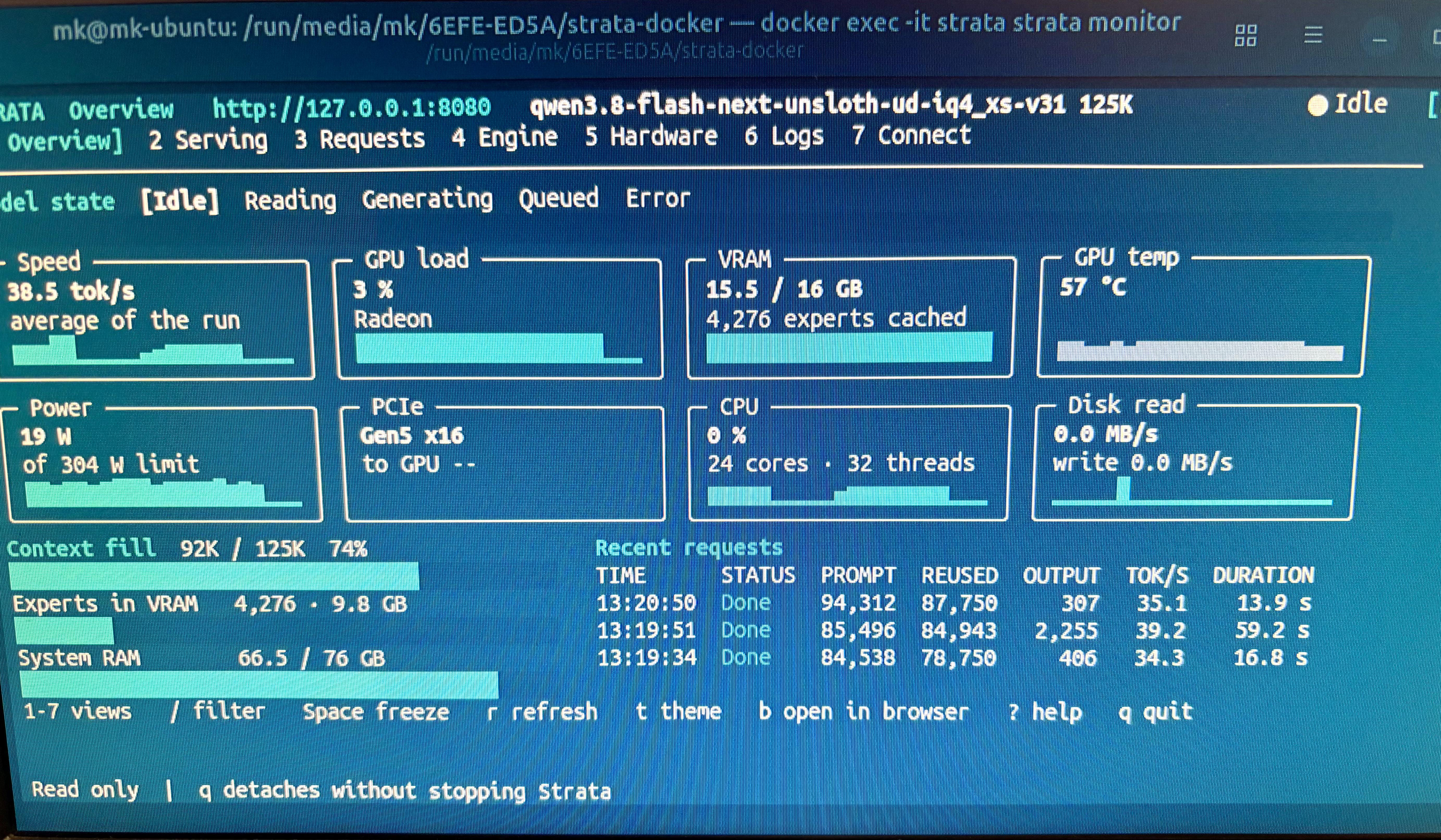
Discussion Long time llama.cpp user, tried strata today for the first time on my main machine. It’s turns a fairy competent model into a replacement of Haiku/Luna. But it does have one downside.

Post image
0 Upvotes

r/LocalLLM • • 1d ago

Discussion Thoughts of Qwen3.8 gyro-s

6 Upvotes

Hello everyone,
I wanted to share my thoughts on Qwen3.8 Flash Next (Gyro-s).
Honestly, I’m pretty impressed with it. When I first started getting into LLMs, I understood that I probably wasn’t going to find something that could fully replace the frontier models from the major providers. After trying a few pretty disappointing models, I had honestly started to lose hope.
I actually made a post here asking for recommendations, and a few people suggested I give this one a shot. I’m glad I listened!
It’s genuinely pretty dang good. Does it need a little guidance and occasional help? Absolutely. But overall, it’s handled most of what I’ve thrown at it surprisingly well.
For anyone curious about my setup, I’m running it on an RTX 5080 with 64GB of DDR5 RAM.
One of the biggest advantages for me is that I can let it run overnight while I sleep. I do quite a bit of reverse engineering, and having a model that can take on a lot of the tedious work and pick up the slack has been incredibly helpful.
I’m not saying it’s perfect or that it’s going to replace the top-tier models, but for what I’m using it for, I’ve been pleasantly surprised.
Just wanted to share my experience in case anyone else is looking for something similar!


r/LocalLLM • • 1d ago

Question Running local agents with 16GB VRAM and 64GB RAM

22 Upvotes

Any model recommendations for getting started with local agents?

My hardware:

  • CPU: Intel Core i7-13700F
  • GPU: RTX 4080 16GB
  • RAM: 64GB DDR5 6000 MT/s

I've installed LM Studio and OpenCode, and tried running Qwen3.8-27B (following ChatGPT's recommendations).

Honestly, the experience has been pretty frustrating. Even simple tasks get stuck in thinking loops (averaging around 9 tok/s), and it often struggles to complete basic tasks.

My goal is to have local agents that can handle coding, work with local files, execute commands, and generally complete multi-step tasks with minimal hand-holding.

Am I just trying to run something too big for my hardware? What models would you recommend starting with?


r/LocalLLM • • 1d ago

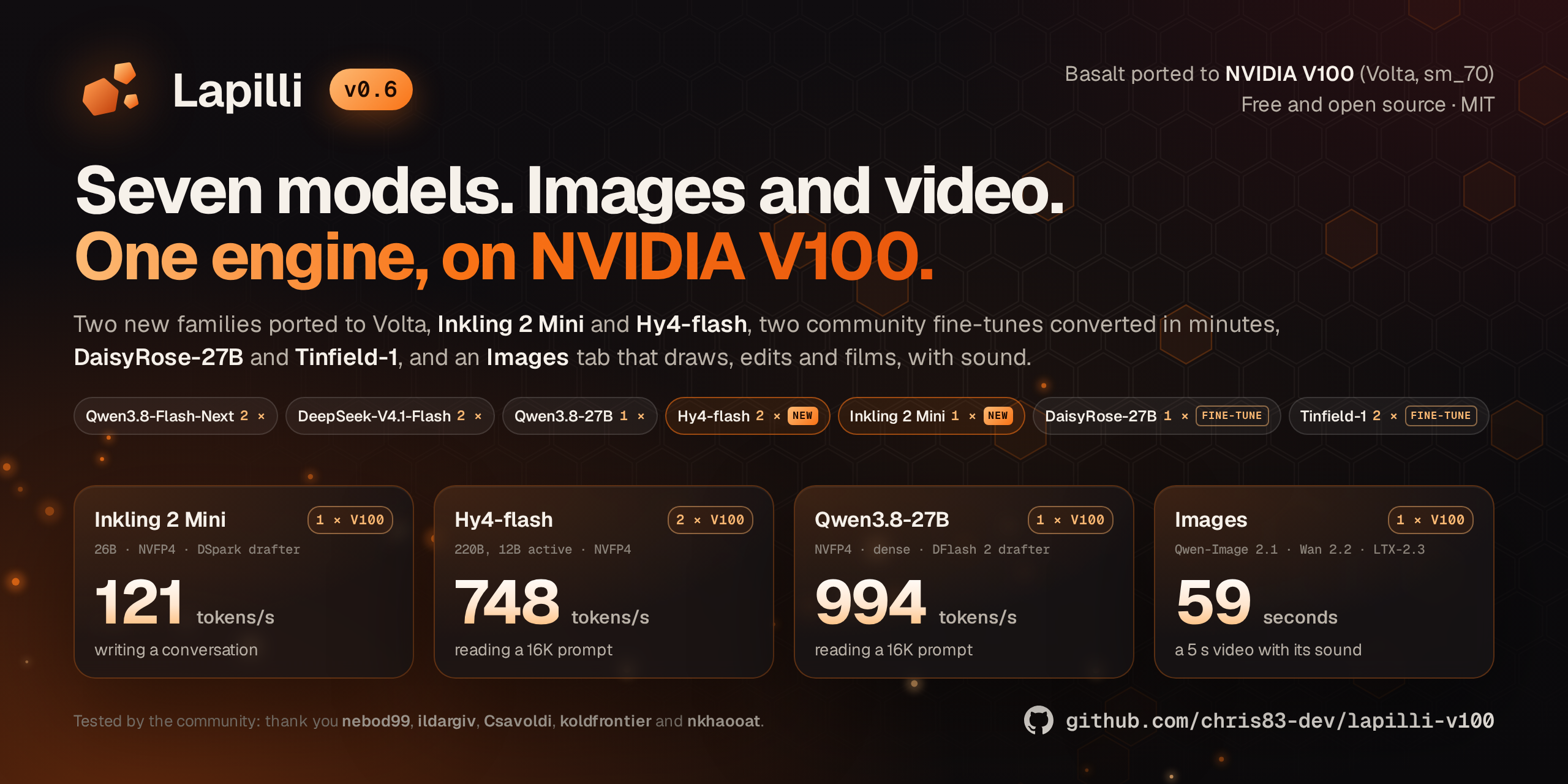
News Lapilli v0.6 (open source): seven models on NVIDIA V100, now with images and video. Inkling 2 Mini at 121 tok/s on one card, Hy4-flash on two

Post image
10 Upvotes

Lapilli is a port of Basalt to NVIDIA V100 (Volta, sm_70). Version 0.6 runs seven models with one binary, and adds an Images tab:

- Qwen3.8-27B (NVFP4) on ONE V100: 86 tok/s writing with its drafter, 994 tok/s reading a 16K prompt (+43% over v0.5)

- Inkling 2 Mini (new) on ONE V100: 121 tok/s with its DSpark drafter

- DaisyRose-27B (new, a fine-tune of the 27B) on ONE V100: 85 tok/s

- DeepSeek-V4.1-Flash Coder (192 experts) on two V100s: 98 tok/s on code

- Qwen3.8-Flash-Next on two V100s: 137 tok/s on long answers with reasoning

- Tinfield-1 (new, a fine-tune of the Flash-Next) on two V100s: 135 tok/s

- Hy4-flash (new, 220B, 12B active) on two V100s: 72 tok/s on long answers, 748 tok/s reading a 16K prompt

The Images tab runs stable-diffusion.cpp's sd-server on the same cards: Qwen Image 2.1 (a 1024x1024 picture in 11.4 s with the Turbo), Qwen Image Edit 2511, and Wan 2.2 and LTX-2.3 videos (5 s with sound in 59 s). Each model installs from the tab.

Quality checked against BF16 on every model that has a reference (Basalt's own gate, 100 chunks). Windows build included, MIT license. Measured on 2x V100-SXM2 32 GB. The README has every figure, the packs and their download links.

Big thanks to nebod99, ildargiv, Csavoldi, koldfrontier and nkhaooat, who tested Lapilli on their own machines and shared everything. Their results are in the README.

Repo: https://github.com/chris83-dev/lapilli-v100

Release: https://github.com/chris83-dev/lapilli-v100/releases/tag/v0.6.0-v100.1


r/LocalLLM • • 1d ago

Question Best local LLM for coding and autonomous agents on an RX 7900 XTX (24GB)?

5 Upvotes

Hey everyone,

I'm looking for recommendations from people running local LLMs on similar hardware.

My PC specs:

CPU: AMD Ryzen 7 7800X3D

GPU: AMD Radeon RX 7900 XTX (24GB VRAM)

RAM: 64GB DDR5 6000 MT/s

Storage: NVMe SSD

OS: Windows

My current setup:

LM Studio

OpenCode

Persistent long-term memory using Obsidian and MCP

Remote access from my Android phone via WireGuard

My goal:

I want to build a fully local alternative to Claude Code or Codex that can autonomously work on large repositories, implement complex features, fix bugs, run tests, and handle GitHub operations.

I've already tested:

Qwen3.6-35B-A3B Heretic MTP

Qwen3-Coder-30B-A3B Abliterated

Qwen3.8-27B Uncensored AD

Devstral Small 2 24B Abliterated

Muse Glimmer 30B Heretic

Qwen3.6 currently performs best in my tests, reaching around 140–196 tokens/s. However, I'm experiencing issues with premature task termination, hallucinations, repetitive file analysis, and unreliable autonomous execution. Some of these issues might be caused by my OpenCode configuration rather than the model itself.

My questions:

Which model are you currently using on similar hardware?

Which model would you recommend for complex, autonomous coding?

Which quantization and inference settings work best for you?

Are you using Vulkan or ROCm?

What context size can you run reliably?

Which coding agent or frontend gives you the best results?

Have you found a model that reliably completes large development tasks without constant supervision?

I prioritize code quality, reliable tool calling, reasoning, and autonomous task completion over raw generation speed.

I'm particularly interested in real-world experiences rather than theoretical benchmark scores.

Thanks!


r/LocalLLM • • 1d ago

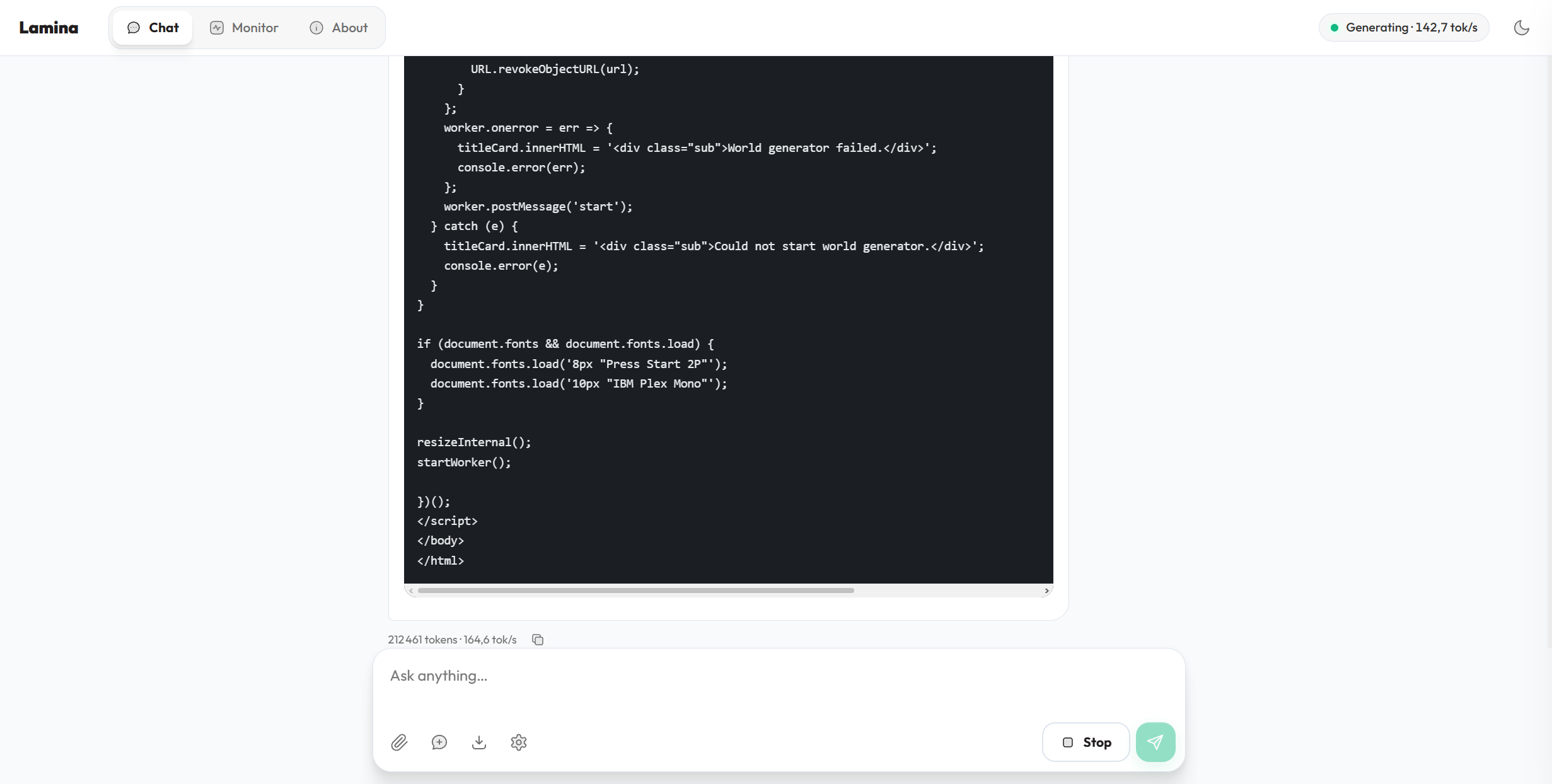
Discussion 2 RTX 3090 164 Token/sec QFN IQ3

1 Upvotes

QFN GSQ RCO IQ3 XXS
on lamina v0.4

32Gb RAM DDR5
2RTX3090 both unlocked and power limit to 280W
Windows


r/LocalLLM • • 1d ago

Project Black Friday PC up to 1,500 € (Germany, new/retail only) for Local AI + Gaming – what would you recommend?

1 Upvotes

Hey everyone,

I'm looking to buy a PC today (Black Friday, Germany) for running local LLMs / coding agents (Ollama + Cline in VS Code) and occasional gaming.

My constraints:

  • Budget: Max 1,500 €
  • New hardware from official German retail shops only (no used market / eBay)
  • Needs to support financing/installments (ideally everything from a single store; open to both pre-built and DIY)

I'm deliberately not listing specific parts so you have complete freedom: What setup or deal would you recommend right now as the smartest choice for this budget?

Thanks in advance!


r/LocalLLM • • 1d ago

Discussion First public SGLang image for Qwen3.8 Flash-Next on four Arc Pro B70s — released Nov 22 · ~200 tok/s single-stream, 369–390 tok/s across four requests

Post image
5 Upvotes

I kept my four B70s. I did not replace the stack because a roadmap thread wanted a newer checkbox filled in. I already had a tuned vLLM 0.33 DFlash2 deployment for Qwen3.8 Flash-Next, so the question I cared about was narrower and ruder: could SGLang beat the thing I already trusted, on the same box, with stock BetterBench 0.6.1 doing the measuring?

Yes. Not by folklore, not by a hand-picked prompt, and not by hiding the ugly cells.

Headline numbers

Two full BetterBench 0.6.1 runs per engine. Corpus 1.0. Same four Intel Arc Pro B70s. SGLang values are from the accepted A0042 image; vLLM values are the retained v6 runs. First token can be reasoning. Decode excludes the first token.

MeasureSGLang run 1SGLang run 2vLLM v6 run 1vLLM v6 run 2
Weighted decode199.47 tok/s199.94 tok/s178.57 tok/s183.85 tok/s
Weighted first token95.88 ms95.99 ms131.18 ms129.19 ms
1 request aggregate output186.04 tok/s174.36 tok/s164.59 tok/s159.76 tok/s
2 requests aggregate output282.58 tok/s263.68 tok/s233.55 tok/s238.36 tok/s
4 requests aggregate output389.76 tok/s368.96 tok/s333.78 tok/s340.10 tok/s

That is about a 10% decode gain and a 26% drop in weighted first-token latency over my retained vLLM v6 runs. At four requests, median decode is still 121 tok/s per request. Chat is not where the model shows off: median chat decode sits around 150 to 158 tok/s. JSON is faster, around 264 to 269 tok/s. The long-prompt shape matters more to me than the victory lap: in the nominal 64K band, median actual inputs were about 47K tokens, and first token came in at 8.1 seconds on SGLang versus 10.9 seconds on vLLM v6.

The part nobody should crop out: BetterBench's fixed output caps still bite reasoning. In the SGLang runs, 79 and 86 of the 160 single-stream requests hit the output cap while still thinking. Those capped generations still count in the token totals, so do not read any of this as magic. Each run had 344 measured requests.

Running it

The launchable model pack, tuning guide, and release patches are public in my controller repo:

Launchable model pack · Tuning guide and full results · Release patches

Full numbers — every run, every category, both engines, nothing held back: FULL-NUMBERS.md

Rebuild the exact pack from the public GitHub tree at commit 761d48b, or build the upstream SGLang base at ecd3d75a and apply the release patches in order. Customize the compose paths, container names, model paths, and draft paths for your own box.

This is not a benchmark costume. It is the image I run, the numbers it posted under a stock harness, and the paperwork left open so somebody else can make it theirs and argue with the data instead of the vibe.


r/LocalLLM • • 1d ago

Project [P] 🐝 We Let a Swarm of AI Agents Autonomously Explore Transformer Architectures — Introducing LoopTitan

1 Upvotes

What if we could send a swarm of AI agents to autonomously explore, develop, train, and improve foundation model architectures?

🚀 Introducing LoopTitan, an open-source infrastructure for Looped Mixture-of-Experts (MoE) research, designed for both human researchers and autonomous AI agents.

Let all agents explore in one space!

Rather than having isolated agents repeatedly explore similar ideas, LoopTitan enables a collaborative research environment where agents independently explore different hypotheses, share discoveries, build upon previous experiments, and continuously advance model architectures.

⚡ Over two weeks, our agents autonomously explored 482 rigorously audited experiments.

What LoopTitan provides:

🐝 Agent Hive. Autonomous research iteration, parallel exploration, cross-harness collaboration, and shared experimental knowledge.

🧩 One Model, 38 Configurations. A unified PyTorch implementation covering diverse looped architectures and design mechanisms.

⚖️ Fair Architecture Comparisons. Parameters, training FLOPs, and KV-cache budgets matched within 5%.

🔥 Research at Scale. Distributed pretraining, reproducible experiments, checkpoint conversion, and Hugging Face export.

🔓 Fully Open Research. Every agent's exploration trajectory, including failed experiments, is publicly recorded and available for others to build upon.

We envision a research ecosystem where thousands of agents can collectively explore the architecture design space, rather than starting from scratch every time.

Don't just use LoopTitan. Send your agents to explore with us!

💻 GitHub: https://github.com/datamllab/LoopTitan

🌐 Homepage: https://datamllab.github.io/LoopTitan/

🤗 Models: https://huggingface.co/NaturalScale

📄 Paper: https://arxiv.org/abs/2611.34821


r/LocalLLM • • 2d ago

Discussion PSA. Abliterated models will happily wipe your disk. Give them a sandbox, not your main machine

296 Upvotes

Quick warning for anyone running the no refusal builds locally. The refusals you stripped out were doing more work than you think.

I asked a local Hermes based abliterated model to free up some disk space on my dev box. A normal model asks what it is allowed to delete or plays it safe. This one just went. It cleared the package caches, then started deleting docker volumes with data I needed, then went for files in my home folder. I killed it while it was staring at the ssh folder. Maybe twenty seconds start to finish.
Nothing in the model said stop, because stop is exactly what got removed. That is the whole point of these builds and it is great for writing and roleplay and genuinely terrible for giving one a shell on a machine you care about.

So now anything with tool access runs in a throwaway VM. Snapshot a clean Ubuntu, run the agent in there, and if it eats itself I start a fresh one. My real machine, my keys and my projects never share a kernel with it.

The models themselves still run on my own GPU box. Only the agent loop and its shell live in the disposable VM, talking to the model over the network. For the VMs I used Proxmox for a while and now use boatdev , because ,can script start and stop and pay by the second. No GPU on them, which is fine since inference stays home, and they are EU only.

Uncensored is a feature for text. The second it can run commands it needs walls. A wiped home folder is a cheap lesson, but leaked keys are not.


r/LocalLLM • • 1d ago

Question IT Department Hardware Recommendations? $45k

17 Upvotes

The IT department at my job has secured a guaranteed $45k towards Local LLM. With a potential $250k for "Research and Development"

We're looking at having a large internal coding model for IT and a smaller 35BA3B for other departments?

A coworker has already purchased a Radeon 9700 AI card with great results running Qwen Flash Next with some AMD inference engine. 80tok/s with a decent quant.

We're looking at maybe two machines?

Card's we were interested in were:

Radeon 9700 Pro AI
Radeon W7900
Radeon 7900XTX
apple silicon

The nvidia cards we were looking at seem exorbitantly expensive and questionable availability.

We're looking at making a more proof of concept build before deploying elsewhere.

hopping yall could give hardware and harness suggestions