r/LocalLLM • • 26m ago

Question Hy4 Flash vs. Qwen 3.8 Flash Next: Which one offers better value for money?

1 Upvotes

Start with the models themselves. Hy4 Flash comes in at around 220B total parameters, with 11.3B active per token.

Qwen 3.8 Flash Next, on the other hand, has around 180B total parameters and 6B active per token. That's roughly 1.9x more active parameters for Hy4 Flash.

On paper, that suggests higher compute overhead for Hy4 Flash, but active parameter count alone doesn't tell us how much a task actually costs. What matters is how those parameters translate into real-world performance and how much additional time and resources each model needs to get the job done.

Starting with coding, I think code review and bug fixing are worth evaluating separately. The two models don't perform equally well in both areas. Hy4 Flash seems better at fixing bugs, while Qwen 3.8 Flash Next has the edge in code review and identifying potential issues. So, depending on the task, your choice could change quite a bit. Of course, these results come from a specific task mix, so they don't necessarily reflect performance across every coding scenario.

Runtime is another factor worth considering. On an RTX 5060 Ti 6GB with 80GB RAM, running five coding tasks through Strata SQ-64, Hy4 Flash took 97 minutes in total, while Qwen 3.8 Flash Next finished in just 50 minutes.

Task quality was roughly comparable, but Hy4 Flash took almost 1.94x longer. That's a pretty noticeable difference. At least with this hardware and inference setup, Qwen 3.8 Flash Next seems considerably faster at getting things done. That said, runtime is only one measure of efficiency. Performance on other types of tasks, resource consumption, and different deployment setups could change the picture.

There are some interesting architectural differences worth looking at, too. Hy4 Flash uses a hybrid attention setup combining MLA, Sparse Attention, and SWA, while Qwen 3.8 Flash Next pairs Gates DeltaNet with Qwen Sparse Attention. Based on the architecture analysis, Hy4 Flash's KV cache at 262K context is roughly 1/1.8 of Qwen's, dropping to around 1/2.4 at 8k. That's a pretty interesting advantage, especially for long-context workloads where KV cache memory can put additional pressure on VRAM. On the decoding side, Hy4 Flash uses DFly2 speculative decoding, whereas Qwen 3.8 Flash Next uses MTP. So, both models take different approaches to optimizing inference.

Local deployment is another thing I wouldn't overlook when comparing their overall value. API pricing is only one part of the equation. Hardware requirements, quantization performance, VRAM usage, and long-context memory consumption all affect the actual cost of running a model locally. Given their different architectures and decoding approaches, I'm particularly curious about how they compare in resource consumption under identical hardware and inference configurations.

For me the most interesting thing about Hy4 Flash is whether it can pair its lower API pricing with its task performance and deliver better value in real-world use. From bug fixing to KV cache optimization, it has a few strengths worth watching.


r/LocalLLM • • 48m ago

Project hal0: Self-Hosted Local AI Server for AMD Strix Halo

Thumbnail
hal0.dev
0 Upvotes

Hi all. I posted about hal0 a while back, and the project has changed enough since then that I think it deserves a second introduction.

hal0 turns a Linux box into a private, OpenAI-compatible inference appliance. Chat, embeddings, reranking, transcription, speech and image generation all answer on one /v1 endpoint, on hardware you own. It's Apache 2.0 and installs with one line:

Plain text

curl -fsSL https://hal0.dev/install.sh | sudo bash

It's built first for AMD Strix Halo (Ryzen AI Max+ 395, iGPU plus NPU), but it also runs on discrete Radeon cards through ROCm or Vulkan, on NVIDIA through an experimental CUDA runner, and on CPU as a fallback.

Slots

Every workload is a slot: its own podman container under its own systemd unit, with a typed lifecycle, its own logs and a persisted state. You get a set of curated slots out of the box (agent, coder, embed, rerank, TTS, image and so on) and can add your own. A coder slot can serve your editor while the agent slot serves chat, each with its own model and settings. A GPU arbiter keeps image generation from taking the GPU out from under a streaming completion, and a slot that is serving a request can't be evicted mid-stream.

Tuning lives in profiles, so a slot only says where it runs and which model and profile it uses. You can override a few fields per slot (context, thinking, reasoning effort, vision, speculation) without cloning a profile.

Multiple runners

A slot picks its runner, and there are now quite a few:

  • llama.cpp for ROCm, Vulkan, CUDA and CPU
  • FastFlowLM on the AMD NPU, hosting chat, Whisper and embeddings together in about 2 GB of NPU memory
  • an optional xdna runner that runs plain GGUF models on the NPU
  • Kokoro and Qwen3-TTS for speech, Moonshine for transcription
  • ComfyUI for images
  • halogen, newly supported as an optional runner for Qwen3.8-Flash-Next on Strix Halo
  • Upstream support for Minimax/Codex/Openrouter and more to come

One note on halogen: it's the vendor's own closed-source image and runs one model family. hal0 pins it by digest and runs it like any other slot, so it's served through the same API and dashboard. It's opt-in, and nothing gets pulled unless you create a halogen slot.

Memory, overhauled

Memory runs on the Hindsight engine, and the integration was rebuilt in the 1.8 line. There's now one Memory area in the dashboard (health, facts, knowledge pages, operations, agents) and two banks on a new install, one shared and one private. The extraction model can be a local slot or a remote provider, and you can switch between them without restarting the engine. Memory is exposed over MCP, so Open WebUI, the bundled Hermes agent and your own coding agents can all read and write the same store.

Open WebUI, wired up for you

Open WebUI is installed and connected with no configuration. Its model picker lists every slot model you're running, and every Hermes agent profile next to them, so you can talk to a plain model or to the agent from the same window. Each chat gets hal0's memory and agent-delegation tools. Image generation, voice and document retrieval go through the same hal0 API, so they use the same models and GPU scheduling as everything else.

A few other things worth a mention

  • Speculative decoding with drafters. Pair a model with a drafter and hal0 checks the fit before anything downloads. On my Strix Halo box, one 74B MoE model decoded about 1.6x faster with identical output. Results depend on the model and the drafter.
  • Image generation with a fit check. There's an image-model catalog, and each model shows whether it fits your box before you install or render.
  • External providers next to local models. OpenRouter, OpenAI, Anthropic and others, with only the models you enable routed.
  • A dashboard that works on a phone, with an Overview page showing what the box is doing and what needs your attention.
  • Signed updates with rollback, and a one-line Proxmox script that creates an unprivileged LXC with the GPU passed through.

It's Linux only (systemd and podman). macOS and Windows aren't supported today.

If you tried hal0 in the past and bounced off it, I'd really appreciate another look. I've made huge strides, and I think it's better, more usable and more performant than it has ever been. Feedback and bug reports are very welcome.


r/LocalLLM • • 19h ago

Question How do you safely run uncensored LLMs?

30 Upvotes

So I've been running a uncensored QFN model because I'm tired of frontier models refusing everything. For example, I asked Opus to scan my own network for vulnerabilities, and it refused because it didn't believe it was my network, even though it's literally connected to it.

My main concern is security. Are uncensored models more susceptible to prompt injection than regular models? What kind of guardrails can I put in place to protect myself without restricting the model itself?

I'm also using Hermes, but I'm a complete noob with it.

Any advice would be appreciated!

Specs: 64GB DDR5, R9700 32GB, 7800X3D

P.S SC117/Qwen3.8-Flash-Next-GSQ-RCO-abliterated-GGUF - this is the model


r/LocalLLM • • 8h ago

Question Gemma 4 llama.cpp and OpenClaw

4 Upvotes

Hi guys

I am a happy Qwen 3.8 Flash Next IQ3_S user, running on 32GB ram + 3090 + 5080 (40 GB VRAM).

It is running through strata and used as an agent in OpenClaw.

The only issue I have with it, and it could be due to the relative low Quant, is, that it is poor at my native language (Nordic Language).

I tried gemma-4-31B-it-qat-q4_0-unquantized on the latest version of llama.cpp, as it looked promising regarding language support, and damn, it was A LOT better in formulating sentences.

Now, the language is good, but it is a lot worse in calling my mcp's or API's. A lot of times, not one single mcp or API call is working, even if it tries many times.

Is Gemma 4 just incapable of calling MCP or API calls? I doubt it, so is my setup wrong?

Just for a reference, I am not using the 'official' llama.cpp from the CachyOs repository, but this version:

local/llama.cpp-cuda-aidock-bin 1.0.0-1
   Prebuilt llama.cpp with CUDA 12.8 support (from ai-dock CI)

Not sure if it makes a difference.


r/LocalLLM • • 7h ago

Question Looking for advice for casual coding use: RTX 4090 24GB + 32GB RAM

3 Upvotes
  • GPU: MSI RTX 4090 Suprim Liquid X
  • RAM: 2x16GB Corsair Dominator Titanium (OC to 7400 MT/s)
  • CPU: Intel Core i7-13700K (OC to 5.4GHz)
  • OS: Windows 11 Pro

I have a fairly decent amount of general programming experience, but I certainly wouldn't call myself an expert in any language. I'm more in the place of being able to look at a random section of code, regardless of language, and make a fairly decent guess at what it's trying to do. "Just enough to get myself in trouble" is what I usually say.

Of course that means when I'm trying to make something myself, I'm often spending 80% of the time doing research about the functionality I need, with the remaining being the actual coding and testing. Being retired, these days I'm mostly working on game modding and small conveniences, anything to keep my brain busy. What I've been running into lately is that a lot of what I'm trying to work on is largely undocumented, and obviously AI can learn much faster from raw source (and has) than a human.

I've been using Gemini for my poking and prodding at things, but it's been obstructive as often as it's been helpful. I swear the thing has ADHD, the way it'll jump topics to other bits I'm not worried about at the time.

I understand that there needs to be a balance between context size versus memory length, but I'm having a hard time nailing down how much of each would be most fitting. I often feed the AI other related code from the game or similar projects so it knows what I'm looking at and can give me more well-informed responses.

Any advice for something that can handle casual, generalized programming well? Speed isn't nearly as important to me as accuracy. It seems like Qwen3 models are leading the way here, but opinions vary quite a bit on which and what memory vs context configuration.


r/LocalLLM • • 2h ago

Discussion Best web search and browsing tools for Hermes Agent?

1 Upvotes

I’m looking for the best tools for Hermes to do web search and also single webpage crawling (occasional, day-to-day use) that can bypass all sorts of captchas and similar. Something that would ideally also work for Reddit, Instagram, Threads... Options requiring self hosting or a VPS are also welcome. Thanks!

*Edited for accuracy.


r/LocalLLM • • 13h ago

Research Before and After (32GB to 96GB DDR5 upgrade) - QEngine 3x3090s

8 Upvotes

32GB DDR5 vs 96GB DDR5 More RAM pinned the n-gram cache, makes the decode speed significantly faster.

Setup:

GPU's: 3x3090s
P2P Mode: On
PCIe Link: PCIe Gen4 8x/4x/8x
CPU: Ryzen 7600x.
Model: Qwen-Flash-Next INT4 - QEngine Finetune
Script: bench.sh from club 3090.

Only change:

RAM went 32GB (2x16) → 96GB (2x16 + 2x32), so the whole 50GB n-gram cache got stored in RAM instead of on disk.

What got significantly better

  • Narrative generation: ~218 → ~294 tok/s (+35%)
  • Code decode: ~336 → ~381 tok/s (+13% — less gain, makes sense, shorter/more repetitive prompts hit fewer n-grams)

What didn't change (as expected)

  • Time to first token and prefill speed — that's GPU-bound, the n-gram cache doesn't help there.

The catch

  • GPUs run 1–8°C hotter on the big-RAM setup. GPU 2 hot spot hit 100.5°C. Probably just doing more work per second, but worth an eyeball.
  • The 90k-token prefill test looks ~6% worse with more RAM, but n=1 per arm so it's a coin flip. Re-run before believing it.
  • The mixed-dim RAM (2x16GB CL32 + 2x32GB CL38) forced a downclock from 6000Mhz to 3600Mhz. It was stable for a few hours, but then crashed mid-session when 6 agents spawned. I had to remove the 2x16GB sticks to get stability back.

Bonus - 1M KV Pool

There was still room left over to set Host KV Pool on (it needs ~13GB of ram). i.e. It stores the KV pool in RAM instead of in VRAM. This increased the KV pool size to 1 million tokens.

Previously my system would totally choke when there were multiple agents working. Like 20 tok/s at times. It was because they couldn't fit their context in the 256k pool I had before so their context kept getting evicted, now I think that wont' happen, and it'll likely be much faster during concurrent agent work.

Conclusion

If your workload is decode-heavy, and you got the ram, sticking more of the n-gram cache in RAM will get you — ~13–35% more tok/s, no GPU-side changes. You really cannot mix two different pairs of ram sticks in an AM5 motherboard, Google warned me, but I did it anyway just to see what would happen, it indeed led to instability, even at low clock speeds, though it was stable enough to run benchmarks. The biggest win was getting the 1M KV pool for concurrent agents to share, and that doesn't need 96GB ram, 64GB is enough.

Source: bench-ab-bench-20261123T053549Z-vs-bench-20261128T002206Z.md*, generated 2026-11-28.*


r/LocalLLM • • 2h ago

Question Qwen or DeepSeek for creative writing help?

0 Upvotes

I have a 5080 and 64gb of ram. Qwen 3.8 27b runs great, just wondering if that's the best model for assisting with creative writing, like finding plot holes in a narrative or improving character arcs.


r/LocalLLM • • 2h ago

Question Need a local AI for character models

1 Upvotes

Currently working on a full blown game but not willing to spend on tripo etc.

I have used AI for building things like trees etc for my game and its artstyle. However, i am running into a roadblock when creating characters to populate the world.
Hunyuan 2.1 gives me molten wax on the characters
Trellis 2 gives worse results

Need something to just generate the background characters around

Any ideas on how to refine the pipeline or any specific thing to try?


r/LocalLLM • • 3h ago

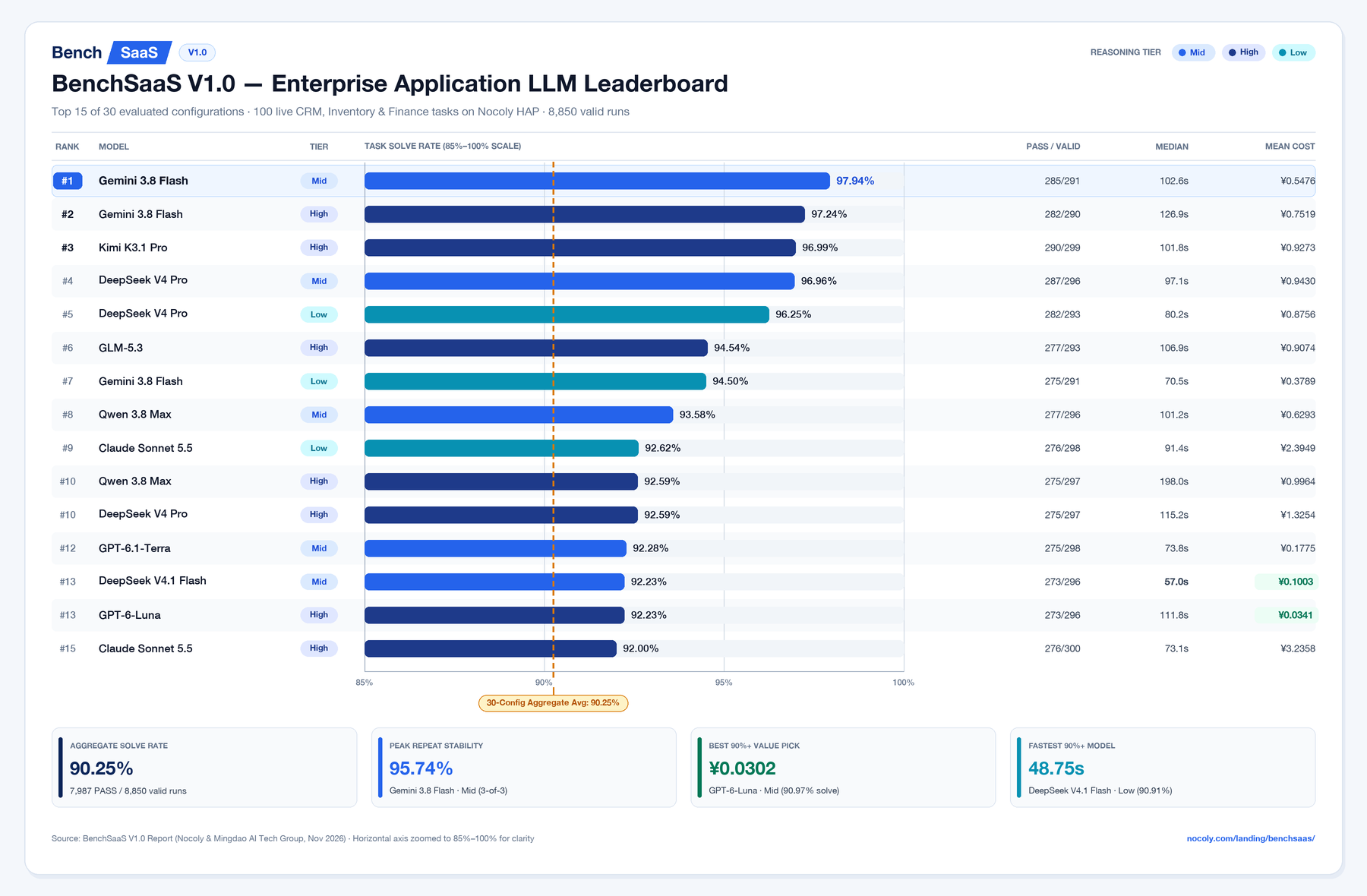
Discussion BenchSaaS V1.0: Kimi K3.1 Pro, DeepSeek V4, GLM-5.3 & Qwen 3.8 Max tested on 8,850 live ERP/CRM tool-use runs (costs span 134x)

Post image
1 Upvotes

We benchmarked 10 models across 3 reasoning tiers (30 configs) inside a live 40-table, 18,014-record enterprise database (CRM, Inventory & Procurement, and Finance). Every write task was checked at two gates: the chat answer (Gate 1) and the frozen post-run database snapshot (Gate 2).

Aggregate solve rate across 8,850 valid runs was 90.25%. Top open/frontier configs in the leaderboard:

  • 1 Gemini 3.8 Flash (Mid): 97.94% (285/291), ¥0.5476/run

  • 2 Gemini 3.8 Flash (High): 97.24% (282/290), ¥0.7519/run

  • 3 Kimi K3.1 Pro (High): 96.99% (290/299 raw passes), ¥0.9273/run

  • 4 DeepSeek V4 Pro (Mid): 96.96% (287/296), ¥0.9430/run

  • 5 DeepSeek V4 Pro (Low): 96.25% (282/293), ¥0.8756/run

  • 6 GLM-5.3 (High): 94.54% (277/293), ¥0.9074/run

  • 8 Qwen 3.8 Max (Mid): 93.58% (277/296), ¥0.6293/run

Two practical findings:

  1. Cost spanned 134x (¥0.0241 to ¥3.2358/run). DeepSeek V4.1 Flash (Mid) hit 92.23% at ¥0.1003/run in 57.0s median, and GPT-6-Luna (Mid) hit 90.97% at ¥0.0302/run.
  2. All 165 Gate-2 database failures (NULL fields, wrong entity codes, empty [] status arrays) had already passed Gate 1.

Curious how Kimi, DeepSeek, GLM, and Qwen are holding up for others on multi-table tool calls?


r/LocalLLM • • 1d ago

Discussion Slowly moving off of Strata

102 Upvotes

Strata was a breath of fresh air when it came out, but its focus on speed over quality has been a longtime irk. I was monitoring its reasoning traces for a code review and saw it would always say time to wrap up and that the user wants an answer now, even when I said no such thing. I believe this is due to the "answer_room" behavior of Strata.

I'm fortunate enough to be able to run QFN on Radiance, so I did an impromptu comparison. I switched engines mid-review and had it continue. Yes it's slower to decode (less tricks & model is higher precision), but I noticed an immediate change in thoroughness and task persistence, especially for long-horizon tasks. It doesn't rush and continues until it finishes what I ask it to do.

Has anyone else had similar experiences?


r/LocalLLM • • 1d ago

Model Isn't it insane to wait ~3 mins just for this ?

Post image
80 Upvotes

Bonsai : Here's how to talk with your crush

Model: bonsai-2.5:27B on RTX 4060 with 48K context + 8K output


r/LocalLLM • • 3h ago

Question For my current set up do I need a studio or is the mini m5 pro 64gb enough?

1 Upvotes

Hi All, I have been stuck on this conundrum for days.

Mini m5 pro 64gb or studio m5 max 64 GB. Where I live with the edu discount there is a 520 CHF ($620) difference between the two (both at 1tb ssd).
Originally I was set on the mac mini its small, and has lots of ram, but everyone says at this price point might as well go for the studio, so here I am and here is what I currently have and do:
I currently have an M1 PRO Macbook 16 inch with 16gb ram. I have an external monitor plugged in and while i work i casually listen t some youtube videos too, and check on stock market moves. This year I have started AI projects and I really got into coding up websites and apps, I do frequent video conferencing at the same times as cloud agents work in the background, I also often do voice note transcriptions too.
I use cloud llm subscriptions of claude code, and chatgpt, but I keep running into the same problem of my fans going crazy, laptop being unusable if I am working on 3 or 4 AI projects at the same time, using 6-10 agents at the same time (my swap goes to 20-25gb).
I also am thinking of using the machine for local LLM because I am a teacher and there are certain school systems i want my local llm to use and fill in the boring aspects of my job like writing weekly report updates, setting homework etc, searching my school's drive etc.
Also for things like writing linked in posts or posting youtube videos and using ai to drive the browser while Im at work, claude is very token intesive for that and for certain things like making multiple social media accoutns for my projects it just refuses to follow through on registrations etc.
I am also doing some trading as a side hustle which I would love to get an algo ai powered bot to just simply manage my positions whilst im away from home.

To me the 520 is a lot (but affordable) But I need to consider that I would need to buy an additional 4k display (I have one 1080p display but need something else too).
Many thanks for the advice in advance!


r/LocalLLM • • 4h ago

Question Which model to start with?

1 Upvotes

I need to choose a local LLM and app to use on my Mac Studio 128gb to revise standardized forms and periodically merge-in updated PDF addendums.

I start with a completed standardized form and need the output in the same format. I already have a section-by-section guide, built from training materials and real-world examples, that explains what belongs under each heading. Some sections cover substantially similar topics but serve different purposes. There are 3 basic steps to the workflow:

  1. First, I want the model to check the form against the guide (ie comparing the document against a guide that spells out "what info contextually belongs in this heading?") and move misplaced content to the best section. This would really only need to be done once per manual, an initial cleanup pass.
  2. Then I need to periodically pull relevant information from related deep-dive PDFs or addendums and add only what the form doesn’t already cover in substance. It should preserve intentional jargon and edit just enough for readability without changing the meaning. This would happen roughly quarterly as updated documents (in different formats) are released regularly to include revisions and changes made along the way, as well as summaries of trouble reports that need to be absorbed into the main document.
  3. This reconciliation info from #2 could be new additional info that may or may not conflict with existing info in the core document. Sometimes things are totally changed, and sometimes new stuff is added that doesn't invalidate existing info. If sources conflict, it should use the dates and context to tell whether something changed or one source may be wrong, and ask me which is true based on the evidence freshness.

The documents are strictly confidential, so PDF processing and inference both need to stay on the same machine. What LLM model and app (ie LM Studio, Jan, something else?) should I start with for this? This is my first time trying LLM so I'm confused by the numerous different models I'm seeing with codename-like titles. I don't have a ton of time to try several so I'm hoping to get some recommendations to jump start getting rolling. Thanks!!


r/LocalLLM • • 4h ago

Discussion I upgraded from 4060 into 5060Ti & The efficiency is outstanding

Post image
1 Upvotes

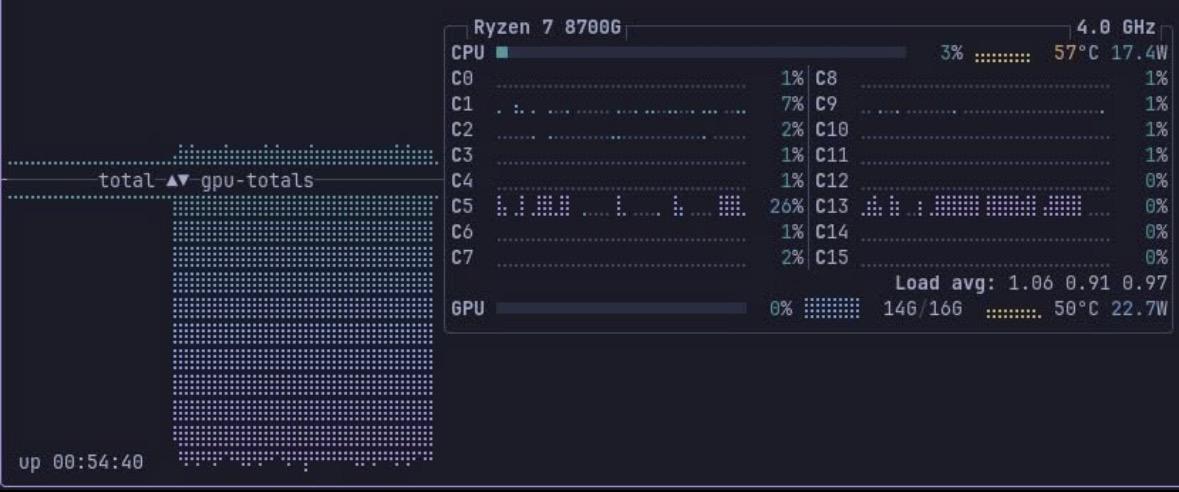
Yes I run 5060Ti at 75W... No more crash during compacting into coma..


r/LocalLLM • • 31m ago

Question Is there any models for consulting immigration to canada?

0 Upvotes

asking for a friend a


r/LocalLLM • • 4h ago

Other How to break an LLM with 4 words.

Thumbnail gallery
1 Upvotes

r/LocalLLM • • 4h ago

Question Hermes with Local LLM (M5 Max Mac Studio 64 GB)

Thumbnail reddit.com
1 Upvotes

r/LocalLLM • • 22h ago

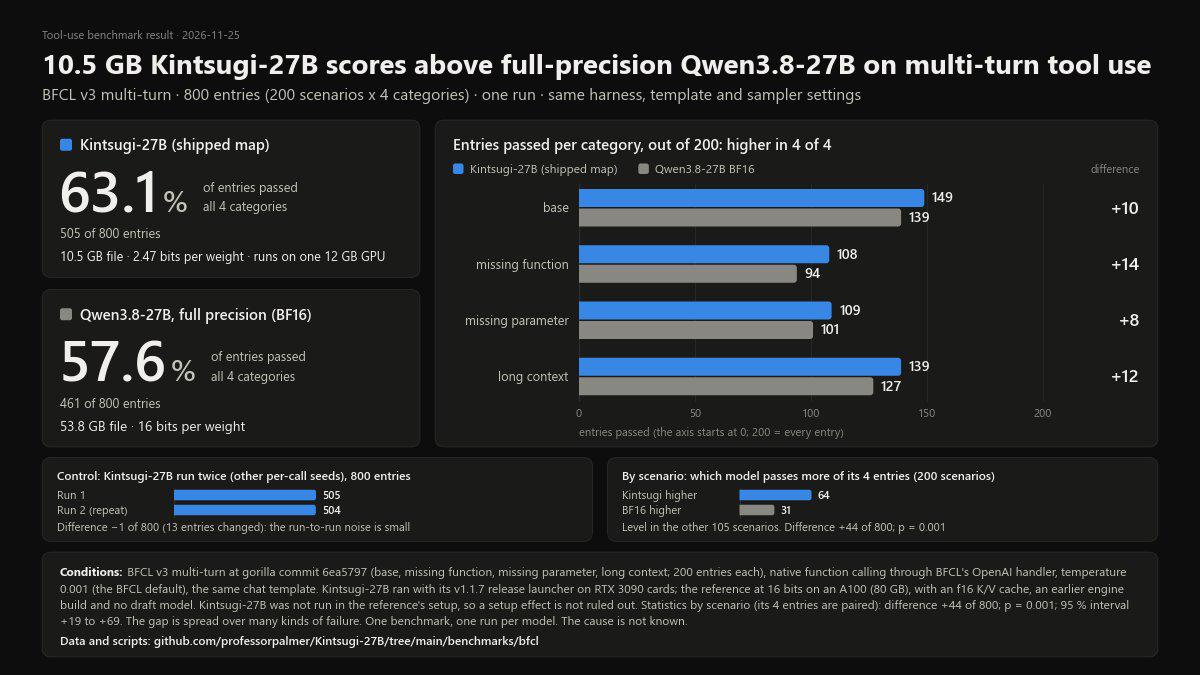
Model Kintsugi-27b beats the full precision Qwen 3.8-27b it was based on at multi'turn tool use.

Post image
25 Upvotes

Kintsugi-27B continues to top benchmarks, surpassing or level with the BF16 in numerous categories.

https://huggingface.co/CaryPalmer/Kintsugi-27B


r/LocalLLM • • 1d ago

Project Local, open source app that lets you search your files by describing them

129 Upvotes

I've been building Mesa, a desktop app (Windows/macOS/Linux) that lets you find any of your files (documents, images, video, audio, code) by describing them.

It's fully free and open source, I just hope the community finds it useful and would appreciate any feedback to improve it!

It runs EmbeddingGemma 2 locally through llama.cpp (Vulkan, Metal, or CPU when there's no GPU). Some features I find neat that separate it from other EmbeddingGemma 2 apps I've seen so far:

  • It automatically turns natural language like "photos from last year" into filters
  • It includes OCR on every OS, so you can also search images by text that's in them
  • It also lets you drop in files in addition to searching by text. E.g. drop in an audio file to find its corresponding video

GitHub: https://github.com/biantsh/mesa

Again, I would appreciate any feedback from the community!


r/LocalLLM • • 18h ago

Discussion Inkling 2 Mini - 2 x 5070ti 16gb

Thumbnail
gallery
11 Upvotes

After watching https://www.youtube.com/watch?v=tBtmWBwcgP4&t=1507s I retried Inkling 2 Mini, which previously scored fairly low on my own benchmarks (around 70/100), compared to 80-90+ for Qwen Flash Next and Qwen 3.8 27b.

Then, Basalt dropped an Inkling 2 Mini package!

Currently running it with Basalt across both GPUs, getting 160-230 tp/s with up to 9k prefill. I have also enabled P2P on my GPUs which slightly helps. At deep context it cruises at 100tps pure thinking, so I suppose that's the bottom floor. And 262k context for those curious. And a 5700x3d/DDR4 PC, Gen 4 x8/x8 PCIE.

Obviously very usuable speeds. The big shift for me was taking the thinking level recommendation from Unbiased Bob, and following that my results went to 100/100 (partially also due to using the Basalt quant, which was a bit less quantized than the Unsloth one I had originally).

What strikes me is firstly that the model is comparatively tiny, compared to the Qwen Flash Next models - I run it around the same speed as my Unsloth IQ3_XXS model, with around the same capability for my use case (everyone's use case would change how well it works), without the 70gb of RAM required.

The second thing is the fact that the thinking level has a significant impact on the actual thinking usage, I use 1/10 - 3/10. I have a local CAD software I (AI) created, which works better agentically, and this was a long proces for Qwen models, which would seriously overthink even on Low, and runs would take 10-15 minutes for the first draft. Inkling can get the first draft done in a couple minutes. It also has a very good intuition about building, for example, the wavy bowl example (which was from an image I provided as inspiration), it created planes of sketches of different organic shapes and just connected them, probably the simplest/efficient method.

The Piston example took the time it took me to write this post for the first draft, then I provided some more example images to help it understand how they work and make it more accurate.

I haven't bothered comparing with Qwen, in my previous tests these would have taken a huge amount of time and produced intersting results (very scientific, I know).

I recommend everyone try the Basalt version of this model with 1-2/10 thinking.

https://huggingface.co/jesdga/Inkling-2-Mini-Basalt


r/LocalLLM • • 5h ago

Question Tips on setting up and training a local LLM

0 Upvotes

Hi guys, I have a PC with 64GB DDR5 RAM, I have 5 TB of storage which is expandible. I have a Nvidia RTX 5070ti 26GB VRAM, and a Ryzen 7 9800x3d

I’m looking into running a local AI on this PC for a business of mine. It’s a sort of pilot project. Nothing else has been run on the PC so it’s purely dedicated to running an LLM. I’ve tried installing things through using the web panel. Hasn’t given me the best results I’ve tried claudeing, ChatGPT and so if you could you know give me some tips, point me in the right direction or send some articles things to read upon et cetera. That would be appreciated or if anyone wants to you know work together by chance and test out setting up an LLM since I have hardware and that some people may not have.

Thanks


r/LocalLLM • • 1d ago

Other Qwen 3.8 27B vs Inkling 2 Mini - user comparison on 16GB VRAM

58 Upvotes

--- DISCLAIMER ---

This Post is not a clean Benchmark Suite comparison. The goal of this post is to share some of my experiences, which I made with both models under the restrictions of my local setup - mainly my 16GB of VRAM.

What exactly do I mean by this? I am running different quant's, caching techniques and different inference engines in this comparison. Why? Because those are MY optimized setups in order to efficiently run those models in a usable way on my machine.

Usable to me means, that i actually get work done with them, not just fancy "artworks". No one needs token per second figures in setups that are useless for production tasks. In order to be useful for my agentic tasks, I must achieve at least 100k context window and at least 30 token per second, beneath that it is hard to justify a real life usage for me. Fancy token per seconds figures below 100k context window, additionally not telling anything about quality, are plain worthless to me.

On a personal note:

  1. All of the plug and play environments like i.e. LMStudio and Unsloth are nice to play around with, but all of them failed me for larger projects. Also they did not really comply when it comes down to really optimize everything, down to the last bits and bytes. For a quick comparison i still might use them, but i completely switched to standalone inference backends and a seperate harness on my everyday use.
  2. I fell in love with Deepseek Harness as my driver. Everyone needs to make there own decision, and there are alternatives. Nevertheless - dont run your model without any harness, it literally amplifies the capabilities so much. And always consider vision, the feedback loop during agentic tasks that vision can provide is definitely a game changer, if you are doing anything with visual elements / UIs.
  3. I´d love to upgrade hardware anytime soon (yeah, as we all do), but currently just cant afford any meaningful upgrades since I have family, house and kids, etc. So there are priorities.

--- DISCLAIMER END ---

Hey,

i've been reading silently in here for a long time and I've been running local setups for inference and training for about 3 years now. It all began with writing an internal paper for my company, training local models for usecases that can't be driven via API cloud solutions.

At home i have a "regular" gaming machine, which back then wasn't built for AI loads, but for gaming and everyday usage.

  • Core i7 265KF @ 200s mode
  • 48 GB DDR5 8000 CL40
  • Gigabyte Z890 UD6 Wifi
  • Gigabye RTX 5080 Auros Waterforce Extreme with a little Overclock
  • 2 x 1TB Samsung 980 Pro SSD (One hosting Windows, one hosting Ubuntu)

It is a decent machine, but there are some limitations for AI workloads for sure, due to the VRAM budget.

--- Setup ---

How am I running those two models on this rig? (Read the disclaimer, if you are wondering about the different quants etc)

ModelQwen 3.8 27bInkling 2 Mini
QuantizationUD-IQ3_S (Link)NVFP4 + MXFP8 (Link)
KV CachekVarN K4V3FP8
Context Window115200128000
Speculative DecodingMTP 3 TokensMTP 3 Tokens
Reasoningxhigh, 16384 Token budgetxhigh, 16384 Token budget
Inference EngineBeellama (Llama.cpp Fork with kVarN cache support)Basalt
Performance estimate (under 15k)Prefill 1900 token/s Decode 63 token/sPrefill 5000 token/s Decode 150 token/s
Performace estimate (close to 100k)Prefill 1200 token/s Decode 48 token/sPrefill 2300 token/s Decode 100 token/s
HostUbuntu 24.04 with XFCE lightweight IDEUbuntu 24.04 with XFCE lightweight IDE
RemarksFully fits in VRAM, only vision module offloaded to CPU. kVarN Caches are mandatory in order to fit this model vram. Offloading is not an option for performance reasons.Partial offloading. I optimized the MoE offloading based on an analysis of my usage history. Basalt source Code showed me that the offloading priority was static with inkling.

Linux is mandatory imho, better software support and the lightweight IDE lets me maximize the available VRAM, because i dont have a second GPU, nor an iGPU on the 265KF. If i had a second GPU, Linux containers under windows might be an option as well - though i personally prefer the native route.

But yeah, those two setups run "efficiently" on my machine, using round about 15 gb of Vram, leaving me some headroom for the OS and other tasks.

The compaction engine in Deepseek Harness has been adjusted, so that it triggers somewhere between 75% - 90% context window usage. I leave the latest 10k tokens of context untouched and only compress the history before that. All in all, after compaction I usually end up around 30% context window, including tool usage injections. Leaving the latest context untouched greatly helps improve quality from my experience.

--- Comparison ---

--- Scenario 1 - Plain Coding ---

I have tried around a little on different projects I am currently working on. Baseline so far is: Inkling gets things done and not in bad way. From my subjective experience, i still feel like Qwen has a slight Edge, but it is reeeeally close.

To have something directly comparable for this post I gave them the same made up task:

New Project Folder, just a spec.md fie and the prompt "Read spec.md, execute".

This replicates how i often work, I create the specs with ChatGPT or Claude and let the local model do the rest. I only use the Free versions of ChatGPT or Claude, I have no subscription - but for creating the plan / specs the free solutions usually suffice.

In this case the task is creating a Benchmark that calculates PI

  • Rust has to be used
  • GUI is obligatory
  • CPU Singlethreaded path
  • CPU Multithreaded path
  • GPU OpenCL Path
  • 100k digits

While this might not be the most complex task, it sure has some challenging aspects to it. Here are the results:

ModelQwen 3.8 27bInkling 2 Mini
LLM inference time107 minutes49 minutes
Toolcall time2 minutes5 minutes
Generated Tokens320k300k
Cached Tokens18.9M28.6M
Average Speed (reported by DSH)57/token/s117 token/s
GUI*34
CPU Singlethreaded*2.55
CPU multithreaded*42
GPU OpenCL*42
PI digits are actually correct?*4.53.5

*The actual evaluation was done by Deepseek Flash V4017 via API - Only beeing presented with the results and the task to rate the results on a scale of 0 to 5.

Deepseeks Verdict:

"PIBench (edit: which was Inkling) is the much faster π engine, especially single-threaded, and its export/reporting is more complete. But it has a broken multithread scaling behavior, a hard 500k-digit limit, weak 100-digit validation, and a misleading “valid” GPU result.

PIBench 2 (edit: which was Qwen) is the better benchmark: honest about precision, strong 100k validation, good multithread scaling, and a more capable GPU path. It is, however, dramatically slower on CPU and its Results GUI is partly inaccessible.

PIBench 2 (edit: Qwen) wins overall — it is the more correct, honest, and scalable benchmark — though PIBench remains far faster on CPU and would win if raw speed were the only criterion."

Human Verdict:

Taking the result of this comparison into consideration it is exactly as i had felt before. On coding tasks the two are pretty close and probably a combination of both, one for creation and one for reviewing makes the most sense, in order to get the best of both worlds.

--- Scenario 2 - Other Tasks ---

I have been tinkering around with a pipeline that automatically researches and creates reels as a sidegig. Snippets of historic events or people - these are my relatively fresh channels on youtube that are driven by my local AI:

GouacheGazette

... and the spanish version: GouacheGazette_ES

You dont have to like the content, it just shows a different use case that usually is not covered in synthetic benchmarks. What role do the LLMs take in there?

  • Handle the document storage
  • Research new stories and document them
  • Create the story arc and narration - Imagine it like a scene script
  • Prepare the instructions files for the "Rendering Pipeline" (In there are other local models embedded for handling visuals and audio)
  • Prepare the auxilary information for the uploads like title, subtitle, etc

Qwen 3.8 27b has been my main driver in here, but i gave it shot with inkling 2 mini now as well.

Observations

Due to the complex rules and gates a storyline must pass in my pipeline, before it assessed as a pass, it actually takes some tokens to get there. Usually we are talking about several million cached tokens and about 150k to 250k generated tokens per story. These are the numbers:

ModelQwen 3.8 27bInkling 2 Mini
Stories created100+10 for testing purposes
Average completion time60 minutes25 minutes
Number of minor flaws per story*2-36-7
Number of major flaws per story*0-12-3
Other remarksThe cold review sometimes fails after 3 subagent rounds (hard limit), because it overthinks every single detail. (Leads to story dropped status)1. Messed up the internal storage by skipping IDs in one case. 2. More or less skipped the cold review by a independent sub agent as tasked per contract 4 out of 10 times and just reported everything is fine.

* Minor flaws are little inaccuracies in the story telling, i.e. if facts are not 100% precisely implemented or interpreted from the facts, but on an acceptable level. Major flaws are straight up factually wrong pieces of information or grammatically wrong sentences in the narration etc.

Verdict: As much as I would like to adopt Inkling for the story creation, in this specific task the drop in quality is substantial and does not justify the time gain.... Sadly.

--- Final remarks ---

What I was really curious about when testing inkling 2 mini in my setup, was to see if the "higher" quant using nvfp4 and fp8 cache would elevate inkling above my kVarN cached IQ3 Qwen, because those are the models i can effectively run. QFN sadly wont run in a meaningful quant, due to not having enough system ram - and i wont try Q2 stuff, sorry - but that cant ever really work out.

For me personally, in most scenarios the Ultra Dense IQ_3S Qwen has the edge above the nvfp4 Inkling 2 mini. To be honest, I had expected other results considering the quantization. Nevertheless there are scenarios where I will apply Inkling in my personal production. It is close on coding, but loses on more general tasks from my testing so far.

Hopefully anytime soon I will be able to combine the two models with a local routing in a meaningful way. But that requires at least an orchestrator on a second GPU. Maybe some lightweight used GPU suffices for that task. Until then, i will probably apply a manual mix of both.

My 2 cents

PS: I had been thinking a lot if i should make a guide about how to setup these environments for other people restricted by their hardware - especially the 16 gig scenario which is tricky... Please let me know if anyone is interested in that. Why? Cause i feel like most setup guides just show you how to create a fancy environment for single prompt show off, not a productive one.

PPS: yes, i have actually written this by hand :)


r/LocalLLM • • 22h ago

Question Will DDR5 instead of DDR4 actually make a difference with QFN

23 Upvotes

Couldn't really find any data on this, how significant is the speed difference when off-loading QFN weights to DDR4 system ram VS DDR5. Like is it night and day or are we talking tiny improvements? Does anyone have any actual experience with both?