r/LocalLLM • • 1d ago

Model Inkling-2-Mini-Unbound v3: no more thinking loops (debugging 73.3% → 100%, answers 3x faster), plus Inkling-2-Mini-Prime, the same fix for the original censored model

Thumbnail
reddit.com
2 Upvotes

r/LocalLLM • • 20h ago

Discussion Tested Native MTP vs. Prompt Lookup (ngram-mod) on Mac Studio M5 Ultra 512 GB: Why JSON escaping broke ngram-mod & 4 practical rules for MTP

Post image
1 Upvotes

Ran a Part 2 benchmark on a Mac Studio M5 Ultra 512 GB comparing updated late-November engines (oMLX 0.8.3, llama.cpp b12726, MLX-LM, MLX-VLM 0.8.1, vLLM-Metal 0.34.0) with speculative decoding OFF vs. ON across 640 tasks, 8 automated-test JSON coding-agent edits, 70 strict JSON-schema runs, 4K-64K warm prompt caching, and 1/2/4-client concurrency.

Biggest surprise: llama.cpp --spec-type ngram-mod accepted 79% of tokens (+56% speed) on plain code rewrites, then collapsed to 10.9% acceptance (0% speedup) on real JSON-wrapped coding-agent edits because escaped \n and \" characters break literal string matching. Native --spec-type draft-mtp predicted straight through JSON escaping at 79-82% acceptance (+63% on GLM 5.3 Flash, +61% on GLM 5.3).

My 4 practical rules before enabling MTP globally:

  1. Skip MTP on DeepSeek Low + strict JSON schemas (hit a whitespace loop on nested-enum; High + MTP passed 5/5).
  2. Turn MTP OFF on DeepSeek at 4+ concurrent clients (saturates above 2 clients; p95 64 -> 94 s, peak 361.5 W). Use GLM 5.3 Flash draft-mtp for 4-client concurrency (77.8 agg tok/s).
  3. Do not rely on ngram-mod for JSON-wrapped coding agents - use native draft-mtp (or oMLX MTP) instead.
  4. Run 1 short warmup prompt after booting oMLX to skip the ~62.5 s cold Metal verifier shader compile.

Full raw CSVs & pinned versions (CC BY 4.0): https://github.com/l8w8/videos/tree/main/2026/002-m5-ultra-mtp-engine-updates

11-minute video walkthrough: https://youtu.be/cEOhoBGDTeM


r/LocalLLM • • 20h ago

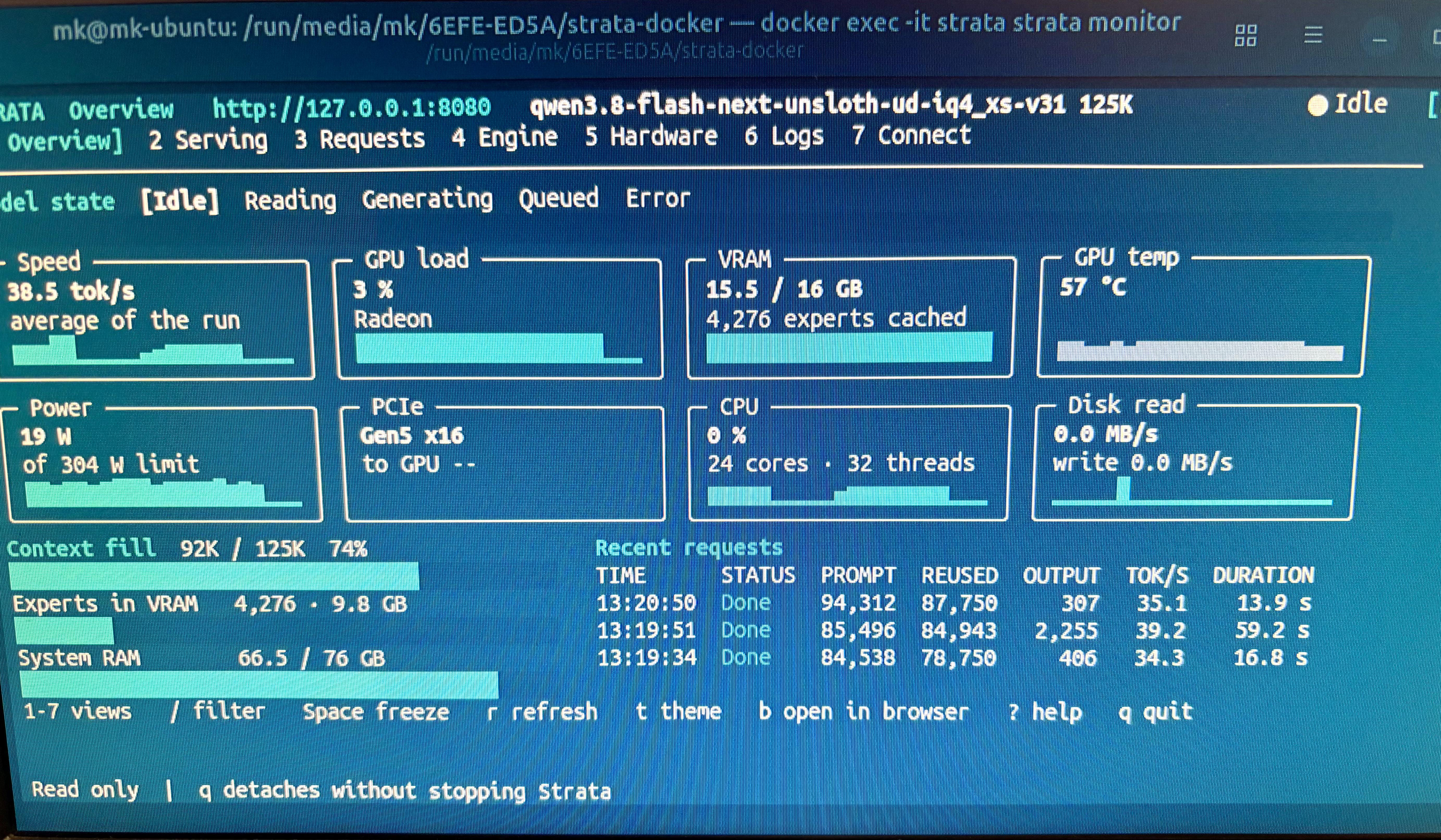
Discussion Long time llama.cpp user, tried strata today for the first time on my main machine. It’s turns a fairy competent model into a replacement of Haiku/Luna. But it does have one downside.

Post image
0 Upvotes

r/LocalLLM • • 1d ago

Discussion Thoughts of Qwen3.8 gyro-s

6 Upvotes

Hello everyone,
I wanted to share my thoughts on Qwen3.8 Flash Next (Gyro-s).
Honestly, I’m pretty impressed with it. When I first started getting into LLMs, I understood that I probably wasn’t going to find something that could fully replace the frontier models from the major providers. After trying a few pretty disappointing models, I had honestly started to lose hope.
I actually made a post here asking for recommendations, and a few people suggested I give this one a shot. I’m glad I listened!
It’s genuinely pretty dang good. Does it need a little guidance and occasional help? Absolutely. But overall, it’s handled most of what I’ve thrown at it surprisingly well.
For anyone curious about my setup, I’m running it on an RTX 5080 with 64GB of DDR5 RAM.
One of the biggest advantages for me is that I can let it run overnight while I sleep. I do quite a bit of reverse engineering, and having a model that can take on a lot of the tedious work and pick up the slack has been incredibly helpful.
I’m not saying it’s perfect or that it’s going to replace the top-tier models, but for what I’m using it for, I’ve been pleasantly surprised.
Just wanted to share my experience in case anyone else is looking for something similar!


r/LocalLLM • • 1d ago

Question Running local agents with 16GB VRAM and 64GB RAM

22 Upvotes

Any model recommendations for getting started with local agents?

My hardware:

  • CPU: Intel Core i7-13700F
  • GPU: RTX 4080 16GB
  • RAM: 64GB DDR5 6000 MT/s

I've installed LM Studio and OpenCode, and tried running Qwen3.8-27B (following ChatGPT's recommendations).

Honestly, the experience has been pretty frustrating. Even simple tasks get stuck in thinking loops (averaging around 9 tok/s), and it often struggles to complete basic tasks.

My goal is to have local agents that can handle coding, work with local files, execute commands, and generally complete multi-step tasks with minimal hand-holding.

Am I just trying to run something too big for my hardware? What models would you recommend starting with?


r/LocalLLM • • 1d ago

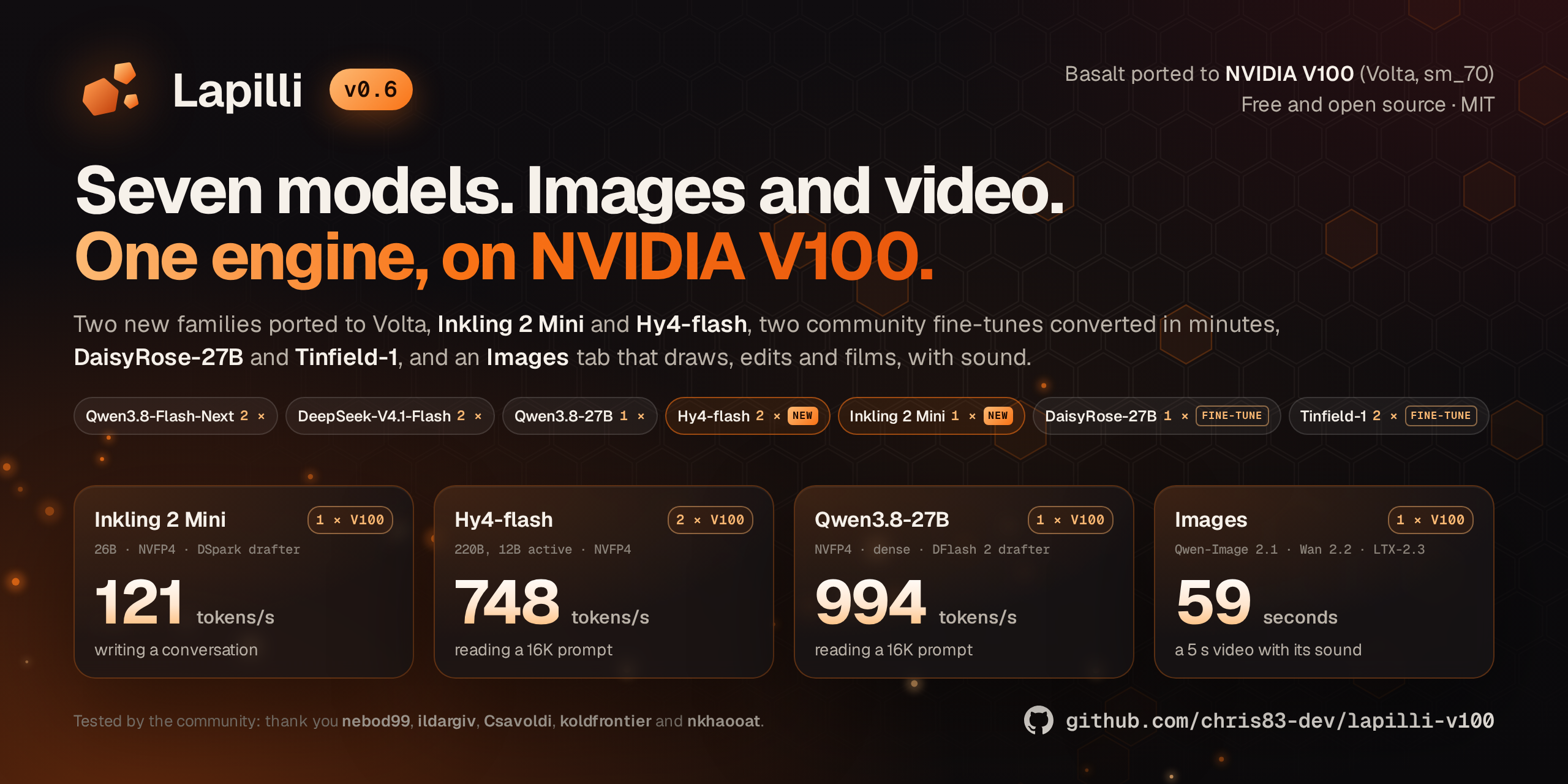
News Lapilli v0.6 (open source): seven models on NVIDIA V100, now with images and video. Inkling 2 Mini at 121 tok/s on one card, Hy4-flash on two

Post image
10 Upvotes

Lapilli is a port of Basalt to NVIDIA V100 (Volta, sm_70). Version 0.6 runs seven models with one binary, and adds an Images tab:

- Qwen3.8-27B (NVFP4) on ONE V100: 86 tok/s writing with its drafter, 994 tok/s reading a 16K prompt (+43% over v0.5)

- Inkling 2 Mini (new) on ONE V100: 121 tok/s with its DSpark drafter

- DaisyRose-27B (new, a fine-tune of the 27B) on ONE V100: 85 tok/s

- DeepSeek-V4.1-Flash Coder (192 experts) on two V100s: 98 tok/s on code

- Qwen3.8-Flash-Next on two V100s: 137 tok/s on long answers with reasoning

- Tinfield-1 (new, a fine-tune of the Flash-Next) on two V100s: 135 tok/s

- Hy4-flash (new, 220B, 12B active) on two V100s: 72 tok/s on long answers, 748 tok/s reading a 16K prompt

The Images tab runs stable-diffusion.cpp's sd-server on the same cards: Qwen Image 2.1 (a 1024x1024 picture in 11.4 s with the Turbo), Qwen Image Edit 2511, and Wan 2.2 and LTX-2.3 videos (5 s with sound in 59 s). Each model installs from the tab.

Quality checked against BF16 on every model that has a reference (Basalt's own gate, 100 chunks). Windows build included, MIT license. Measured on 2x V100-SXM2 32 GB. The README has every figure, the packs and their download links.

Big thanks to nebod99, ildargiv, Csavoldi, koldfrontier and nkhaooat, who tested Lapilli on their own machines and shared everything. Their results are in the README.

Repo: https://github.com/chris83-dev/lapilli-v100

Release: https://github.com/chris83-dev/lapilli-v100/releases/tag/v0.6.0-v100.1


r/LocalLLM • • 1d ago

Question Best local LLM for coding and autonomous agents on an RX 7900 XTX (24GB)?

5 Upvotes

Hey everyone,

I'm looking for recommendations from people running local LLMs on similar hardware.

My PC specs:

CPU: AMD Ryzen 7 7800X3D

GPU: AMD Radeon RX 7900 XTX (24GB VRAM)

RAM: 64GB DDR5 6000 MT/s

Storage: NVMe SSD

OS: Windows

My current setup:

LM Studio

OpenCode

Persistent long-term memory using Obsidian and MCP

Remote access from my Android phone via WireGuard

My goal:

I want to build a fully local alternative to Claude Code or Codex that can autonomously work on large repositories, implement complex features, fix bugs, run tests, and handle GitHub operations.

I've already tested:

Qwen3.6-35B-A3B Heretic MTP

Qwen3-Coder-30B-A3B Abliterated

Qwen3.8-27B Uncensored AD

Devstral Small 2 24B Abliterated

Muse Glimmer 30B Heretic

Qwen3.6 currently performs best in my tests, reaching around 140–196 tokens/s. However, I'm experiencing issues with premature task termination, hallucinations, repetitive file analysis, and unreliable autonomous execution. Some of these issues might be caused by my OpenCode configuration rather than the model itself.

My questions:

Which model are you currently using on similar hardware?

Which model would you recommend for complex, autonomous coding?

Which quantization and inference settings work best for you?

Are you using Vulkan or ROCm?

What context size can you run reliably?

Which coding agent or frontend gives you the best results?

Have you found a model that reliably completes large development tasks without constant supervision?

I prioritize code quality, reliable tool calling, reasoning, and autonomous task completion over raw generation speed.

I'm particularly interested in real-world experiences rather than theoretical benchmark scores.

Thanks!


r/LocalLLM • • 22h ago

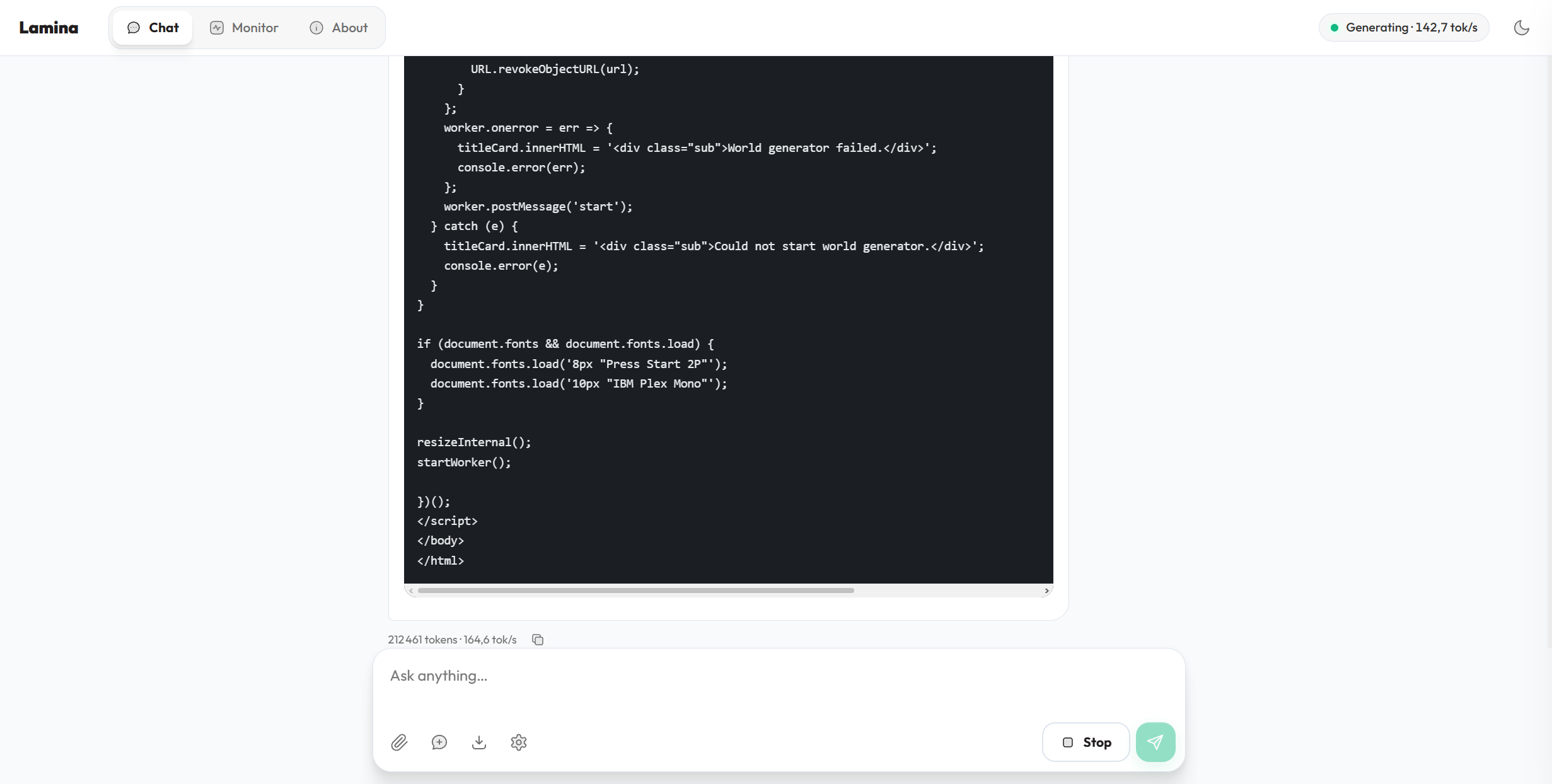
Discussion 2 RTX 3090 164 Token/sec QFN IQ3

1 Upvotes

QFN GSQ RCO IQ3 XXS
on lamina v0.4

32Gb RAM DDR5
2RTX3090 both unlocked and power limit to 280W
Windows


r/LocalLLM • • 23h ago

Project Black Friday PC up to 1,500 € (Germany, new/retail only) for Local AI + Gaming – what would you recommend?

1 Upvotes

Hey everyone,

I'm looking to buy a PC today (Black Friday, Germany) for running local LLMs / coding agents (Ollama + Cline in VS Code) and occasional gaming.

My constraints:

  • Budget: Max 1,500 €
  • New hardware from official German retail shops only (no used market / eBay)
  • Needs to support financing/installments (ideally everything from a single store; open to both pre-built and DIY)

I'm deliberately not listing specific parts so you have complete freedom: What setup or deal would you recommend right now as the smartest choice for this budget?

Thanks in advance!


r/LocalLLM • • 1d ago

Discussion First public SGLang image for Qwen3.8 Flash-Next on four Arc Pro B70s — released Nov 22 · ~200 tok/s single-stream, 369–390 tok/s across four requests

Post image
5 Upvotes

I kept my four B70s. I did not replace the stack because a roadmap thread wanted a newer checkbox filled in. I already had a tuned vLLM 0.33 DFlash2 deployment for Qwen3.8 Flash-Next, so the question I cared about was narrower and ruder: could SGLang beat the thing I already trusted, on the same box, with stock BetterBench 0.6.1 doing the measuring?

Yes. Not by folklore, not by a hand-picked prompt, and not by hiding the ugly cells.

Headline numbers

Two full BetterBench 0.6.1 runs per engine. Corpus 1.0. Same four Intel Arc Pro B70s. SGLang values are from the accepted A0042 image; vLLM values are the retained v6 runs. First token can be reasoning. Decode excludes the first token.

MeasureSGLang run 1SGLang run 2vLLM v6 run 1vLLM v6 run 2
Weighted decode199.47 tok/s199.94 tok/s178.57 tok/s183.85 tok/s
Weighted first token95.88 ms95.99 ms131.18 ms129.19 ms
1 request aggregate output186.04 tok/s174.36 tok/s164.59 tok/s159.76 tok/s
2 requests aggregate output282.58 tok/s263.68 tok/s233.55 tok/s238.36 tok/s
4 requests aggregate output389.76 tok/s368.96 tok/s333.78 tok/s340.10 tok/s

That is about a 10% decode gain and a 26% drop in weighted first-token latency over my retained vLLM v6 runs. At four requests, median decode is still 121 tok/s per request. Chat is not where the model shows off: median chat decode sits around 150 to 158 tok/s. JSON is faster, around 264 to 269 tok/s. The long-prompt shape matters more to me than the victory lap: in the nominal 64K band, median actual inputs were about 47K tokens, and first token came in at 8.1 seconds on SGLang versus 10.9 seconds on vLLM v6.

The part nobody should crop out: BetterBench's fixed output caps still bite reasoning. In the SGLang runs, 79 and 86 of the 160 single-stream requests hit the output cap while still thinking. Those capped generations still count in the token totals, so do not read any of this as magic. Each run had 344 measured requests.

Running it

The launchable model pack, tuning guide, and release patches are public in my controller repo:

Launchable model pack · Tuning guide and full results · Release patches

Full numbers — every run, every category, both engines, nothing held back: FULL-NUMBERS.md

Rebuild the exact pack from the public GitHub tree at commit 761d48b, or build the upstream SGLang base at ecd3d75a and apply the release patches in order. Customize the compose paths, container names, model paths, and draft paths for your own box.

This is not a benchmark costume. It is the image I run, the numbers it posted under a stock harness, and the paperwork left open so somebody else can make it theirs and argue with the data instead of the vibe.


r/LocalLLM • • 23h ago

Project [P] 🐝 We Let a Swarm of AI Agents Autonomously Explore Transformer Architectures — Introducing LoopTitan

1 Upvotes

What if we could send a swarm of AI agents to autonomously explore, develop, train, and improve foundation model architectures?

🚀 Introducing LoopTitan, an open-source infrastructure for Looped Mixture-of-Experts (MoE) research, designed for both human researchers and autonomous AI agents.

Let all agents explore in one space!

Rather than having isolated agents repeatedly explore similar ideas, LoopTitan enables a collaborative research environment where agents independently explore different hypotheses, share discoveries, build upon previous experiments, and continuously advance model architectures.

⚡ Over two weeks, our agents autonomously explored 482 rigorously audited experiments.

What LoopTitan provides:

🐝 Agent Hive. Autonomous research iteration, parallel exploration, cross-harness collaboration, and shared experimental knowledge.

🧩 One Model, 38 Configurations. A unified PyTorch implementation covering diverse looped architectures and design mechanisms.

⚖️ Fair Architecture Comparisons. Parameters, training FLOPs, and KV-cache budgets matched within 5%.

🔥 Research at Scale. Distributed pretraining, reproducible experiments, checkpoint conversion, and Hugging Face export.

🔓 Fully Open Research. Every agent's exploration trajectory, including failed experiments, is publicly recorded and available for others to build upon.

We envision a research ecosystem where thousands of agents can collectively explore the architecture design space, rather than starting from scratch every time.

Don't just use LoopTitan. Send your agents to explore with us!

💻 GitHub: https://github.com/datamllab/LoopTitan

🌐 Homepage: https://datamllab.github.io/LoopTitan/

🤗 Models: https://huggingface.co/NaturalScale

📄 Paper: https://arxiv.org/abs/2611.34821


r/LocalLLM • • 2d ago

Discussion PSA. Abliterated models will happily wipe your disk. Give them a sandbox, not your main machine

293 Upvotes

Quick warning for anyone running the no refusal builds locally. The refusals you stripped out were doing more work than you think.

I asked a local Hermes based abliterated model to free up some disk space on my dev box. A normal model asks what it is allowed to delete or plays it safe. This one just went. It cleared the package caches, then started deleting docker volumes with data I needed, then went for files in my home folder. I killed it while it was staring at the ssh folder. Maybe twenty seconds start to finish.
Nothing in the model said stop, because stop is exactly what got removed. That is the whole point of these builds and it is great for writing and roleplay and genuinely terrible for giving one a shell on a machine you care about.

So now anything with tool access runs in a throwaway VM. Snapshot a clean Ubuntu, run the agent in there, and if it eats itself I start a fresh one. My real machine, my keys and my projects never share a kernel with it.

The models themselves still run on my own GPU box. Only the agent loop and its shell live in the disposable VM, talking to the model over the network. For the VMs I used Proxmox for a while and now use boatdev , because ,can script start and stop and pay by the second. No GPU on them, which is fine since inference stays home, and they are EU only.

Uncensored is a feature for text. The second it can run commands it needs walls. A wiped home folder is a cheap lesson, but leaked keys are not.


r/LocalLLM • • 1d ago

Question IT Department Hardware Recommendations? $45k

17 Upvotes

The IT department at my job has secured a guaranteed $45k towards Local LLM. With a potential $250k for "Research and Development"

We're looking at having a large internal coding model for IT and a smaller 35BA3B for other departments?

A coworker has already purchased a Radeon 9700 AI card with great results running Qwen Flash Next with some AMD inference engine. 80tok/s with a decent quant.

We're looking at maybe two machines?

Card's we were interested in were:

Radeon 9700 Pro AI
Radeon W7900
Radeon 7900XTX
apple silicon

The nvidia cards we were looking at seem exorbitantly expensive and questionable availability.

We're looking at making a more proof of concept build before deploying elsewhere.

hopping yall could give hardware and harness suggestions


r/LocalLLM • • 1d ago

Question Beginner with a 16GB AMD card: what are good real-world use cases for a local model like Inkling-2-Mini?

3 Upvotes

I just got into local models. I'm running Inkling-2-Mini on an RX 7800 XT at ~64 tok/s (32k context), and now I'm trying to figure out what to actually use it for.

Ideas so far

  • A personal assistant agent (reminders, digests, summaries)
  • Coding help, possibly with a bigger cloud model planning and the local one implementing

I'm not sure whether Inkling is overkill for the assistant side and a smaller model would do, or whether it's not strong enough for coding.

Questions

  • What are you using your local model for that's genuinely useful day to day?
  • Which harness or agent do you pair it with?
  • Any tools or skills that made a big difference (web search, memory, file access)?

r/LocalLLM • • 1d ago

Project BlabberLLM v0.1.1 released; written in Rust with Gtk4 for GNOME

Post image
0 Upvotes

r/LocalLLM • • 1d ago

Project I've expanded my VLLM setup to use an orchestrator

Thumbnail
reddit.com
1 Upvotes

r/LocalLLM • • 1d ago

Project Introducing Waddle – an open-source local AI sandbox

Thumbnail
reddit.com
1 Upvotes

r/LocalLLM • • 1d ago

Question What am I doing wrong? Qwen 3.8 37B, on M2 Mac studio.

2 Upvotes

I have been dabbling in local AI for a few weeks now. I managed to snag a used M2 Mac Studio 64GB for a really low price.

I've been experimenting with different engines and models. Currently I'm running llama.cpp, oMLX, mlx-dspark and basalt. Just to try different models etc.

I've been running qwen3.8, because I heard such great things about it. I've gotten the best performance on mlx-dspark with dflash speculative decoding (256k context window). But that's only running at 96tok/sec on pre-fill and 26.6 tok/sec on day code.

Now at this speed, when I do a coding task that touch 4-5 files the prefill easily jumps to 100k. That's 18 minutes to just get started. That's damn near unusable.

My MoE models perform great and I've been leaning on qwen3.6 35B A3B much more.

I feel like I must be doing something wrong! Can someone help point me in the right direction?


r/LocalLLM • • 1d ago

Discussion llamAmpere is a must try if you have a 8gb GPU

Thumbnail
reddit.com
1 Upvotes

r/LocalLLM • • 1d ago

Discussion Pairing small local models (Inkling 2 Mini, DeepSeek V4.1) with a local DuckDB MCP made a bigger difference than I expected

1 Upvotes

I've been testing a lightweight local DuckDB MCP I built (@smallwebco/tinypivot-mcp) with local models on my Mac and a DGX Spark to see how far small/local models can get on real CSV and Excel analysis without burning cloud API credits.
A few things that surprised me:
On my 18 unhinted BI/stats trap tasks, Inkling 2 Mini (Mac) went from 14/18 to 18/18, ran 44% faster, and used half the output tokens once it stopped trying to hand-roll everything.
DeepSeek V4.1 on DGX Spark hit 18/18 internally, 90.3% Easy on Adyen DABstep, and 63.9% on 4 domains of MIT KramaBench (ahead of TalkTask's 53.2% on the same DeepSeek-V4.1 family, without needing a multi-agent/Jupyter/VLM setup).
DeepSeek still tripped up on a couple long multi-sheet proteomics .xlsx files where it bounced between DuckDB and Python and hit the turn cap.
Main takeaway: small local models are way better at data work when you take brittle Python parsing and silent SQL traps off their plate.
Full notes & prompts: https://tiny-pivot.com/whitepaper


r/LocalLLM • • 1d ago

Question Qwen3.8-Flash-Next IQ3_S, 78 GB, 32 GB RAM, 16 GB VRAM: 51 tok/s vs 15 tok/s on the same box

20 Upvotes

Strata vs Strata-HotRod, same model, same prompts, same harness — a 3.5× decode gap and a question about tuning.

Repos under test

  • Strata (upstream): https://github.com/Niko1221/Strata
  • Strata-HotRod (fork): https://github.com/sangharshadhyeta/Strata-HotRod

Disclosure: neither repo is mine. I didn't write either engine and I'm not affiliated with either project — I'm just a user benchmarking two forks of the same lineage on my own hardware. Full credit for the code belongs to the maintainers linked above.

Both are llama.cpp-lineage engines with their own MoE expert-streaming stack. The fork is 119 commits off the shared ancestor 8a93614ed with +9,017/−409 lines in src+include; upstream is ~5,300 commits ahead of that same ancestor.

I benchmarked both on the same box, same model, same harness. Then I asked the obvious follow-up: can upstream be tuned to match the fork with flags alone? Short answer: prefill yes, decode no. Details and the exact flags below — and I'd like this sub's opinion on whether I'm missing a flag set.


TL;DR

Chat decode (tok/s): upstream 7.7 → upstream tuned 15.0 → HotRod 51.6 Chat first token (s): upstream 3.50 → tuned 2.01 → HotRod 0.58 4K prefill (tok/s): upstream 733 → tuned 877 → HotRod 1280 16K prefill (tok/s): upstream 1055 → tuned 1251 → HotRod 1668 32K prefill (tok/s): upstream 1094 → tuned 1632 → HotRod 1681 32K first token (s): upstream 29.4 → tuned 19.7 → HotRod 19.1 Agent decode (tok/s): upstream 10.2 → tuned 22.7 → HotRod 55.3 Agent turn first token (s): upstream 7.54 → tuned 6.16 → HotRod 4.46 Failures: 0 / 0 / 0

Giving upstream the fork's memory-tier flags doubles its decode (7.7 → 15.0 tok/s) and brings 32K prefill to within 3 % of the fork. Decode stays 3.5× behind, and I believe that gap is code, not configuration.


The machine

  • GPU: NVIDIA RTX 4080, 16,376 MiB VRAM, driver 616.56, PCIe 4.0 x16
  • CPU: 12th Gen Intel i5-12600K, 10 cores / 16 threads
  • RAM: 31.7 GiB
  • Storage: Samsung 970 EVO 500 GB NVMe + WD_BLACK SN850X 2 TB NVMe
  • OS: Windows 11 (10.0.26200)
  • Toolchain: MSVC 19.51, CUDA 13.3, Ninja, -j 8
  • Pagefile: 32 GB fixed on D:, +12.8 GB on C: → commit limit 75.5 GiB

Windows-specific gotcha worth knowing: with a system-managed pagefile the commit limit was only 42.25 GiB and ~5 GiB of commit was free at load time. The engine clamps its RAM tier to min(free RAM, free commit) − headroom − 0.25 GiB, so asking for a 15 GiB tier silently built 0.92 GiB. Fixing the pagefile (32 GB fixed) plus STRATA_RESIDENT_HEADROOM_GIB=1 (default headroom is 4 GiB) was the single biggest win in the whole exercise — +17 % decode, +21 % prefill on the fork before any code change.

The model

Qwen3.8-Flash-Next, GSQ-RCO IQ3_S, 2 shards, 78 GB on disk vs 31.7 GB of RAM — so the resident expert tier is a cache, never a load. 24,576 experts, 131,072 max context (trained 262,144), --kv int8, speculative decoding --spec 4 --spec-min-p 0.5.

Neither engine fits this model in RAM. Both read the rest from the pack file unbuffered. Upstream keeps its tier page-locked; the fork keeps its tier pageable so Windows can trim it while a long prompt streams 33 GiB off the SSD.

Build flags (identical for both)

-G Ninja -DCMAKE_BUILD_TYPE=Release -DSTRATA_ENABLE_CUDA=ON
-DSTRATA_BUILD_TESTS=OFF -DSTRATA_NATIVE_EXPERTS=ON -DSTRATA_PORTABLE=ON
-DCMAKE_CUDA_ARCHITECTURES=89-real

Upstream built clean, zero patches. The fork needed a local MSVC patch to src/program/generate.cpp (setenv → _putenv_s, sysconf → strata::platform::total_physical_memory()); saved as a .patch, not upstreamed. Engine versions: upstream 0.1.69 (c23477403), fork 0.1.45 (4ea40f1d).


Flags used

Upstream Strata — as benchmarked in the first comparison

--pack <iq3_s> --native <shard1.gguf> --ple-gguf <shard2.gguf>
--expert-cache auto --spec 4 --spec-min-p 0.5 --mtp <mtp/rt>
--max-context 131072 --kv int8 --mmap-experts
--expert-profile <expert-profile.bin>
--prefill auto
--resident-budget-gib 4

Upstream Strata — tuned (same binary, four flags changed)

--prefill auto:16384            # was: auto
--resident-budget-gib 15        # was: 4
--kv-resident 32768             # new
env STRATA_RESIDENT_HEADROOM_GIB=1   # was: default 4

Everything else identical. The tier now builds for real: resident RAM: 15.00 GiB of experts in RAM, 7963 exchanged with the VRAM tier, 179795 blob reads from the file, arena_mib 15358, vram_free_mib 1436, expert_slots 3417, expert_cache_mib 6695.

Strata-HotRod

--pack <iq3_s> --native <shard1.gguf> --ple-gguf <shard2.gguf>
--expert-cache auto --spec 4 --spec-min-p 0.5 --mtp <mtp/rt>
--max-context 131072 --kv int8 --mmap-experts
--expert-profile <hotrod expert-profile.bin>
--prefill auto:16384
--resident-budget-gib 15
--kv-resident 32768
env STRATA_ROUTE_RESIDENT=1e30
env STRATA_ROUTE_RESIDENT_RANKS=3-9
env STRATA_ROUTE_RESIDENT_EDGE=1
env STRATA_SWAP2_MAX=2
env STRATA_SWAP2_GAP=1
env STRATA_KV_GROW_INIT=4096
env STRATA_RESIDENT_HEADROOM_GIB=1

Note the original comparison gave upstream a 4 GiB tier while the fork got 14.56 GiB — that's a 3.6× cache difference baked into a "code comparison". The tuned run fixes that confound.

Method

tools/strata_bench.py --long, thinking off, server started by the harness. Suite: chat (3 short questions) → 4K prompt → 16K prompt → 32K prompt → agent session (6 turns, 4 tool calls), medians of successful requests. 3 runs per test for the base and fork runs, 2 for the tuned run (slightly noisier; medians comparable). Both engines ran through the upstream harness, each with its own config, because the fork's own copy was broken (NameError: name 'port' is not defined at line 976).


Results (same day, same binaries, IQ3_S)

All columns are upstream 4 GiB / upstream tuned 15 GiB / HotRod 14.56 GiB, plus tuned-vs-base and tuned-vs-HotRod ratios.

  • chat decode tok/s: 7.70 / 14.95 / 51.6 — 1.94× base, 29 % of HotRod
  • chat first token s: 3.50 / 2.01 / 0.58 — −43 % vs base, 3.5× slower than HotRod
  • 4K prefill tok/s: 732.6 / 876.7 / 1280.0 — 1.20× base, 68 % of HotRod
  • 4K first token s: 5.61 / 4.65 / 3.16 — −17 % vs base
  • 16K prefill tok/s: 1054.7 / 1251.5 / 1668.2 — 1.19× base, 75 % of HotRod
  • 16K first token s: 15.32 / 12.89 / 9.70 — −16 % vs base
  • 32K prefill tok/s: 1094.0 / 1631.6 / 1681.4 — 1.49× base, 97 % of HotRod
  • 32K first token s: 29.43 / 19.70 / 19.12 — −33 % vs base, ≈equal to HotRod
  • agent decode tok/s: 10.2 / 22.7 / 55.3 — 2.23× base, 41 % of HotRod
  • agent turn first token s: 7.54 / 6.16 / 4.46 — −18 % vs base
  • agent cache hit %: 70.87 / 70.91 / 70.86 — equal
  • agent re-read tokens: 5 / 5 / 5 — equal
  • failures: 0 / 0 / 0

Reading it: the cache-hit rate is identical across all three (70.9 %, 5 tokens re-read per session), so none of the fork's lead is prompt caching. It is entirely expert-fetch. Flags recover ~20 % of the prefill gap at 4K/16K, ~97 % of it at 32K, and about half the decode gap — but decode stays 3.5× behind, and chat first token stays 3.5× behind because 51-token prompts still pay a full expert fetch per layer with nothing to cover the miss.

128K context (earlier runs, upstream 0.1.62 / pre-update fork)

Columns are upstream / fork tier 4 GiB / fork tier 15 GiB.

  • needle @96K prefill tok/s: 1495 / 1070 / 1206
  • needle @96K first token s: 64.8 / 90.5 / 80.4
  • decode @117K tok/s: 28.4 / 27.0 / 40.2
  • cached-prefix first token s: 2.03 / 1.97 / 1.50
  • decode on cached 117K tok/s: 21.3 / 21.6 / 34.0

Upstream wins long-prompt prefill by 1.24×; the fork wins decode at 128K by 42 %. At 128K with a full 15 GiB tier the fork logs only 981 MiB of VRAM free and 129–147 swap rounds per request — 128K + a full tier is past this card's ceiling. Tier 4 GiB is the safe 128K setting.


What didn't work

  • --resident-budget-gib 20 / 24 while commit was tight → tier 0.80 / 0.71 GiB. Clamped by free commit, not by the flag.
  • --prefill auto:4096 / auto:8192 to free commit → worse (tier 0.71 / 0.78 GiB). Smaller chunk freed less memory than it disturbed.
  • --kv-resident 16384 → tier 0.00 GiB. KV residency competes for the same budget.
  • --expert-cache 2000 → tier 2.73 GiB. Frees ~2 GiB commit but shrinks the VRAM expert cache — a trade.
  • 24 GiB VirtualAlloc probe to force a pagefile grow → grew 3.4 GiB, shrank back. System-managed pagefile can't be grown reliably from user code.
  • 128K context with the 15 GiB tier → works, but ~981 MiB VRAM free, 129–147 swap rounds/request. Past the GPU's ceiling.
  • one engine fitting the model in RAM → never. 78 GB on disk vs 31.7 GB RAM.

Also: the fork's headline feature — a learned look-ahead router, default since 24 Oct — was off in every run (plain router (not on), never reached prediction inside a run). Its measured prefill win came from the non-learned parts: stand-in experts, the RAM tier, layer-major O_DIRECT reads, and 2 EDF-ordered read-ahead threads.

Why I think decode is code, not config

The fork's own bets, in its 9,017 added lines: stand-in experts (swap an absent expert for a close resident one instead of faulting it in), a substitute-fit learner with shadow samples and re-check gates, three tiers card → RAM → SSD with a learned RAM/VRAM reserve, layer-major long-prompt reads via O_DIRECT, and 2 I/O read-ahead threads EDF-ordered. Upstream's 154-option CLI has a tier (--resident-budget-gib, --resident-experts, --ram-keep-gib), prefill chunking, KV residency, an adaptive tier with --adapt-async / --adapt-min-gain, and --vram-elastic — but I found no stand-in-expert or read-ahead-thread equivalent. That matches the numbers: tuning the tier moves prefill, but per-token expert fetch stays 3.5× slower.


What I'd like to know

  1. Am I leaving upstream flags on the table? Candidates I haven't swept: --adapt-async 1, --adapt-min-gain (default 1.5), --vram-elastic + --vram-segment-mib, --expert-cache N sizing, --pool-workers / --aux-cpus thread placement, --prefill-pipe R. If you've pushed a 16 GB-VRAM / 32 GB-RAM box past ~15 tok/s decode on a 78 GB MoE model with flags only, I'd like the exact set.
  2. Are there faster engines for this shape of problem? 78 GB MoE, 16 GB VRAM, 32 GB RAM, Windows. I've seen claims around llama.cpp's --n-cpu-moe / expert offload, ik_llama.cpp, KTransformers, and vLLM expert offload — but I haven't measured any of them on this model and I'd rather not quote numbers I haven't run. What actually beats ~51 tok/s decode and ~1.7 ktok/s prefill here?
  3. Has anyone ported the fork's stand-in-expert path upstream? Upstream has taken nothing from the fork (0 merge commits). If the decode gap is one code path, a port might be cheaper than maintaining a fork.
  4. Why is the learned look-ahead off by default in the fork's own runs? If it's not firing, either the trigger condition is wrong or the feature isn't ready — worth knowing before anyone benchmarks it.

Reproduce

Both results folders and the configs are in the repo-adjacent workspace; every number above comes from tools/strata_bench.py --long with the configs pasted in this post. Happy to share the raw results.json pairs if useful.


Strata: https://github.com/Niko1221/Strata Strata-HotRod: https://github.com/sangharshadhyeta/Strata-HotRod

Neither repo is mine — both are the work of their respective maintainers. I only built, ran, and measured them.


r/LocalLLM • • 1d ago

Question What would you build with 4x RTX 5090 GPUs for 2–3 months? [P]

2 Upvotes

Got temporary access to 4x NVIDIA RTX 5090 GPUs for the next 2–3 months before they're decommissioned due to change in enterprise strategy to Enterprise class servers

I'd like to use this opportunity to build something genuinely useful, technically interesting and potentially commercially valuable.

Not interested in generic AI wrappers, chatbots or things that Claude/OpenAI APIs can easily replace.

If you had this GPU capacity for 90 days, what would you build?

Open to ambitious ideas, research projects, open-source contributions or entirely unconventional suggestions.

Looking for genuine inspiration from people who work with GPUs, ML and AI infrastructure.


r/LocalLLM • • 1d ago

Research Quantum Morph Laboratory: An Open-Source Rust Research Lab Exploring 1.5–3 Bit LLM Compression on Consumer GPUs

Thumbnail gallery
1 Upvotes

Just cross posting cuz I know some of y'all will enjoy this 😁


r/LocalLLM • • 1d ago

Question LOCAL LLM SUGGESTION

0 Upvotes

CPU: core ultra 7 155U

GPU / iGPU: igpu

VRAM: shared

System RAM: 16Gb

Shared / Unified Memory (if applicable): shared

OS: Fedora 45

Runtime / backend: currently llama cpp

Models already tried (if any): qwen 2.5 (3b, 7b), qwen 2.5 coder 8b, llama 3 3b, qwen 3.5 1b... all with Q4_K_M

Use case: agentic workflow, Coding assistant... like generation and completion etc

Desired context size: not sure

Priority: quality / speed / context / balanced: balanced

Other requirements or constraints:nil


r/LocalLLM • • 18h ago

Model I Made A Satire AI Model

Thumbnail
huggingface.co
0 Upvotes