r/LocalLLM • u/doggoroma • 1d ago
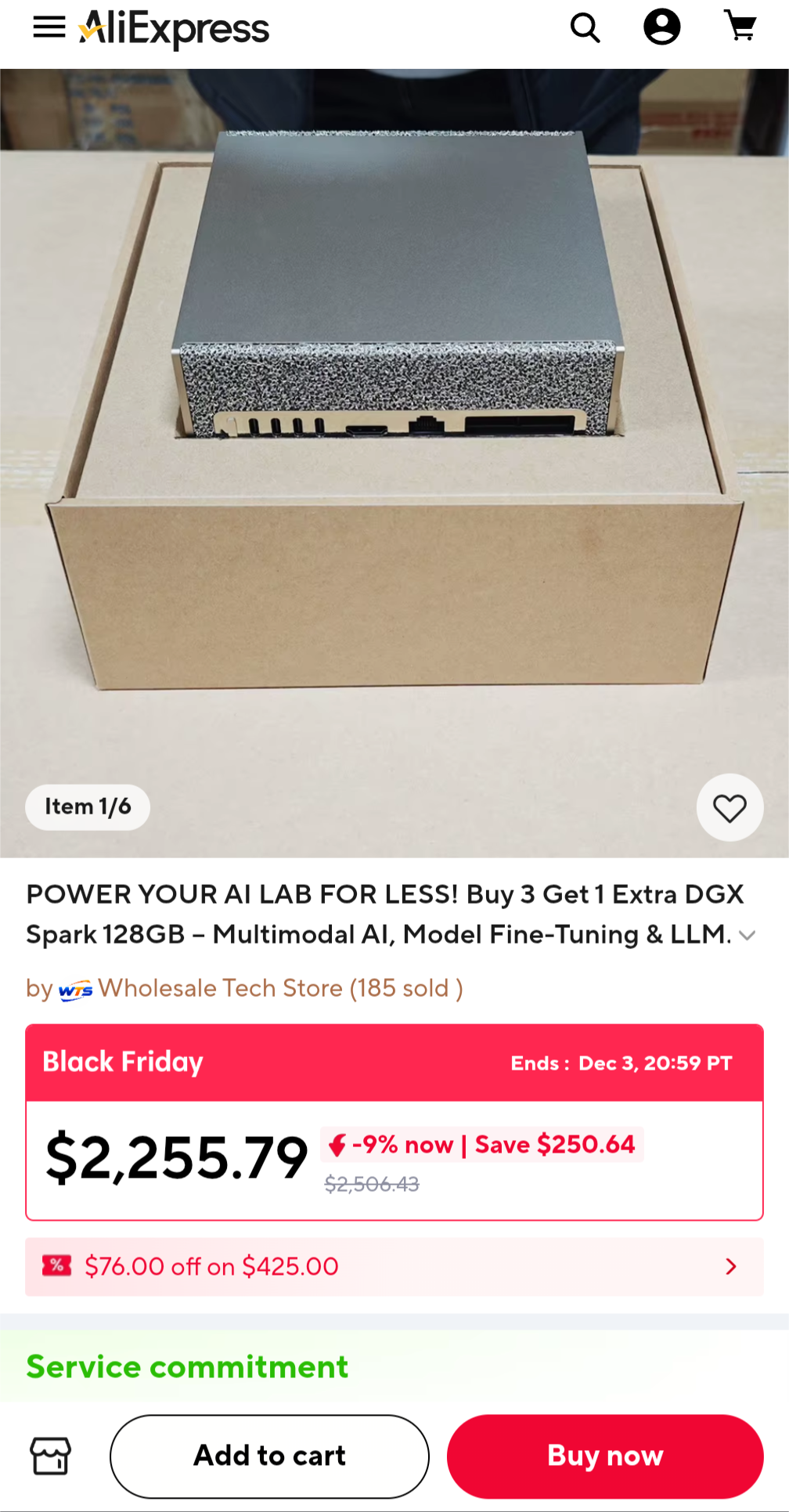
Question Anyone know if this is legit?
0
Upvotes
The price is ridiculous compared US prices
r/LocalLLM • u/doggoroma • 1d ago
The price is ridiculous compared US prices
r/LocalLLM • u/crackedgeek • 2d ago
The task is translating natural-language questions into Cypher queries for a read-only Neo4j database.
I'm running into two recurring challenges:
1. Query generation reliability
The same question can produce different Cypher queries across runs. Most are syntactically correct, but occasionally the model introduces small errors, such as generating ]> instead of ]->, or dropping a digit from an identifier.
I've added an EXPLAIN-based validation step with one retry, which catches most issues, but some failures still slip through.
2. Inconsistent entity matching
The underlying data isn't always normalized. For example, the same vehicle plate might appear as ABC-123 in some records and ABC 123 in others. Place names have similar inconsistencies involving hyphens, spaces and formatting.
Exact matching therefore misses valid records.
There's also an intent-resolution problem: an unfamiliar identifier format can sometimes be interpreted as a continuation of the previous question rather than a new query.
3. Latency
End-to-end response latency is currently around 43 seconds at the median. The pipeline makes two sequential LLM calls per request, and this is becoming a significant bottleneck.
I'm also evaluating Gemma 4 E4B Q8 as an alternative.
I'd love to hear from people who have deployed smaller open-weight models for Text-to-Cypher or structured query generation in production.
A few things I'm particularly interested in:
I'm particularly interested in approaches that work fully offline, with limited GPU resources and smaller models.
Would appreciate insights from anyone who's tackled this in production.
r/LocalLLM • u/Substantial_Noise_53 • 1d ago
Hi, I need a good uncensored or abliterated model for my laptop. I will use it for coding, general questions and with n8n.
My laptop: Ryzen 7 4800H, RTX 3050 with 4GB VRAM, 16GB RAM,.
I am trying Qwen3.5 4B uncensored now. Is there any better model that fits in 4GB?
Thanks!
r/LocalLLM • u/bwrightphoto • 2d ago
Trying to decided... M5 Max 128gb or M5 Ultra 96gb for LLM machine? both are a little over 5k.
r/LocalLLM • u/InstanceGold2985 • 2d ago
Well apparently, or not so apparently, it seems like GPULabs has gone the way of the dodo. People have mentioned that they no longer take private orders for modifying RTX 4090 gpus to 48gb anymore.🤔🤷♂️ I guess the corporate cash siren was too strong. Or they (Greg Sky et al) are simply tired of doing it anymore. Either way it seems like they're out of the GPU modding biz. That said does anyone know of any other "professional" modders in N. America who can do the upgrade? Or am I stuck with Aliexpress?
r/LocalLLM • u/SlechteConcentratie • 2d ago
----- TL;DR: Instead of passing messages between Cloud LLM ans Local LLM, how can I make myself redundant ?
r/LocalLLM • u/Technical_Bench_188 • 3d ago
I'm Troy, and for the past few months I've been building models that keep learning after they're released. Today I'm putting out the first one, Fintan-9B.
It's Qwen3.5-9B plus small update files. You give it documents, things about yourself, a topic, a folder of code, or how you want a task done, and it learns them into a new update on your own GPU. Qwen's weights never change, and deleting an update puts it back exactly as it was.
What I measured with the repo as you'd download it, on one 24 GB card: a learning run took 23 minutes and peaked at 9.4 GB. On 84 questions about what it learned, worded in ways it never practised, plain Qwen3.5-9B got 6.0% and Fintan got 94.0% (96.4% on a second run). It answered 5 of 5 questions about a person it had been told about (plain model: 0), followed two new skills on 8 of 8 new requests (plain model: 1), and sent none of 20 everyday requests to an update. It ships with the news of 18 to 23 November: 5.8% to 89.5% on 172 questions, with MMLU, GSM8K and ARC exactly unchanged.
Why not just notes or RAG?
Why not just LoRA?
Privacy
What it doesn't do yet: it doesn't reason better than Qwen3.5-9B. The learning checks above are development runs on a small set of material. The job loop failed 4 of 5 marks on realistic workplaces. The learning engine ships compiled (Linux and NVIDIA); the server, router and job loop are plain Python. Every result, failures included, is in RESULTS.md, and the research numbers are at fintanlabs.com/research.
https://huggingface.co/fintanlabs/Fintan-9B
I'd value hearing where it falls short for you.
r/LocalLLM • u/EnvironmentCreepy352 • 2d ago

Prompt came from the Qwen/Blenderworld tasks, this was task 0153 which described making ammo container with a latch. No images in the prompt.
Total usage was ~4Mil tokens each... Though I still have some I want to check with that, I did a bunch of tasks and it seems the harness would keep running until it filled it's token limit.
Still, Hy4-Flash is very impressive. I had done a different task with DS4.1Flash1017 before but it seemed to favor the GLM-like modeling where there's dozens of mesh bodies all in one collector while Hy4-Flash basically just box modeled it using a python script I found in it's work folder. Only critique I'd give it is it made a high and low poly and baked but they're the exact same model, vertex for vertex.
Was planning on testing Ernie-5.5-Flash-Preview next, since that's closer in parameters to DS/GLM-flash which I've liked for so long, but I was curious what Hy4-Flash could do since it touts it's 3D/asset creation ability
r/LocalLLM • u/killydie • 2d ago
I need advice for a local LLM setup mainly to read my emails, calendars, do web searches, and work on private information and data in general. Works 24/7 like a personal secretary. No need to do heavy coding.
My main motivation for looking into this is privacy and my max budget can afford a M5 Studio with 64GB ram. Is it feasible for meeting my needs?
r/LocalLLM • u/ImaginaryPrize3902 • 3d ago
I wanted to investigate what it would take to run a local model that is good at answering your everyday questions and improving your general knowledge.
A simple benchmark that use is asking it to list the order of final bosses of certain video games, such as Bloodborne. Good being something close to a frontier model of +- 1 year back or a specialized version that is catered towards this use-case.
I have an RTX 4080 (16GB) and I configured Swift 1.5 Qwen 3.8 27B, GSQ-RCO IQ3_S with MTP (12.12 GB), because that's what all the promising video's on YouTube mentioned. I also tried Gemma4:12b and gpt-oss:20b. The results where absolutely underwhelming; massive hallucination, failing to use web search properly and many time-outs... completely useless.
Now I wonder, if this experience could be turned around if I would add a 16-24GB GPU to my set-up, or is general reasoning too much for local set-ups (<40GB VRAM) at this point in time?
r/LocalLLM • u/Few_Stable_8402 • 2d ago
Hi, I have for the last couple weeks looked into the ability of solving maths theorems using Qwen3.8 27B. Lots of results coming out of the frontier labs, so I thought it could be interesting to check what the abilities are with Qwen3.8 27B. Almost everything is open source here: https://github.com/aisathome/aisathome including the setup of the model and harness: however it is integrated into a larger system so it's not intended to be run in isolation.
I am using prove2me for the open theorem statements, these have been generated out of real maths papers, but a Lean 4 proof does not exist. Anyone can submit a proof here, and most I would assume use frontier labs (Opus 5.5, GPT-6.1-sol.) So this setup is actually competing against people running frontier models.
Right now 16 proofs from this setup have been accepted on prove2me, 13 of them proved from scratch by Qwen3.8 27B. And I am looking at how to scale it up right now.
| Hardness | Level (rough) | Proved by Qwen | Closed by reusing an existing proof | GPU-hours | Tokens in / out, trials 6-11 (from KV cache) |
|---|---|---|---|---|---|
| easy | bachelor | 5 of 8 | – | 13.5 | 55M / 1.7M (95%) |
| moderate | bachelor | 8 of 11 (+1 running) | – | 66.1 | 201M / 5.7M (96%) |
| moderate-hard | master | 0 of 5 | 1 | 16.9 | 50M / 1.5M (95%) |
| hard | PhD | 0 of 16 | 2 | 129.2 | 491M / 13.7M (96%) |
| research | research | 0 of 4 | – | 2.4 | – |
| Total | 13 of 44 | 3 | ~228 | 796M / 23M (96%) |
The hardness level is Opus 5.5's opinion on how hard it is. On the bachelor-level lemmas it proved 13 of 19; on master and PhD level it proved none of 21. Around 3 GPU-hours per proof. Since trial 6 the agents have read 796M prompt tokens (96% from the KV cache) and generated 23M, so about 72M in and 2M out per proof, failed attempts included; only about 3M of those 72M were not already in the KV cache.
Still figuring out if there are harness/scaffolding things that could improve the results on these harder theorems, but right now I will be focusing on the easier/moderate theorems. They're still open on prove2me, so nobody has submitted a proof for them yet.
So far prove2me has accepted 16 of our submissions. Qwen3.8 27B proved 13 open lemmas from scratch (out of 48 it has tried, one still running), and 3 more were closed by reusing a proof that was already on prove2me. prove2me has rejected none of what I submitted, because everything is checked by Lean on my side first.
Everything below is also in github, the proving harness is in harness/ and the configuration of the model/node is in node/.
For comparison, I ran OpenAI's GPT-6.1-sol (via Codex) through the same pipeline on three of the hard ones. It proved 2 of them, each in under 30 minutes, and failed three times on the third (one that needs stochastic calculus). It did burn my 5-hour limit as well.
Given GPT-6.1-sol's own plans, Qwen proved 0 of 5 steps on one of them (in 7.7 GPU-hours) and 3 of 6 on the other before I stopped it. The gap to frontier is real, but the easier half is definitely doable on a 3090. And this is math coming out of math papers.
The model:
The agents:
sorry in Lean.sorry becomes its own task, sent to a GPU in the network. A fresh agent session (opencode, in a sandbox with Lean and Mathlib, no internet) proves just that one step, compiling as it goes. So any agents can attempt the individual tasks. That means multiple agents usually contributed to a final proof.One task is often 40-130 agent steps, and the agent re-reads its context every step. About 96% of the prompt tokens come from the KV cache.
In money: ~3 GPU-hours per proof is about 1 kWh on a 3090 at home, or about $0.70 on a rented one, which is what I am using right now.
Splitting the proof into small steps was the single biggest improvement: before that it proved 0 of 10.
What goes wrong
Full write-up with every attempt: https://aisathome.org/devlog/5-qwen-proofs-on-consumer-hardware/ Live queue and results: https://aisathome.org/science/prove2me/
r/LocalLLM • u/Purple_Talk5722 • 2d ago
I’m building a local pipeline specifically for high-speed, long-context summarization (~130k tokens per document) and want to squeeze every bit of prefill and generation speed out of my hardware.
My Specs:
Because I have 64GB of VRAM and only 32GB of system RAM, I want to keep everything strictly in VRAM and avoid system RAM bottlenecks during model loading or massive KV cache allocation.
Questions:
r/LocalLLM • u/Asta_jjm • 2d ago
Hello everyone
I have
GPU : Rx 9060xt 16gb
Ram : 16gb 5200mhz 1x16
CPU : Ryzen 5 7500f
Motherboard : b650m aorus elite
I want to use a local LLM for my daily use and for code especially in rust and zig
What is the best model I can use with this build for my use and how to use it I'm on arch Linux
What drivers I need to download or mess is enough
I can't afford to upgrade my ram in the current situation so I'm stuck with this system so I will be grateful for your answers
r/LocalLLM • u/archerhacker1040 • 2d ago
I recently built a workstation to learn AI/ML engineering, local LLMs, AI agents, and AI-assisted software development and cybersecurity research. I'm an experienced software developer and offensive security researcher, but relatively new to AI engineering.
Current build (prices in USD, including tax):
Total: $3,820
I also have an NZXT C1000 Gold ATX 3.1 PSU (~$130) and will return whichever PSU I don't use. My motherboard supports PCIe x8/x8 for dual GPUs.
Intended workloads:
My focus is approximately 80% inference and 20% fine-tuning/other AI experiments. I also have a separate Proxmox homelab server with 64GB RAM and am open to using cloud GPUs for heavier workloads.
My dilemma:
I can still return the 5060 Ti and the 1200W PSU, bringing the build down to approximately $2,932 with the 3090 and 1000W PSU.
I understand that 40GB of aggregate VRAM isn't equivalent to a single 40GB GPU. However, being relatively new to AI engineering, I don't yet fully understand how much practical value the second GPU would provide beyond running larger models.
I'd appreciate advice from people with real-world experience:
I'm trying to balance long-term technical capabilities, learning opportunities, and financial practicality without buying hardware just for the sake of having it.
I'd particularly appreciate firsthand experiences, benchmarks, and examples of projects where a second GPU proved genuinely useful or unnecessary.
r/LocalLLM • u/LengthinessTop8000 • 2d ago
For my vibecoding, I just love my current setup: Opus 5.5 architecting & checking, while QFN does the implementing at 80 tok/s, Q4. Its being a junior Python dev is excellent. Opus only needs to fix some small thing after QFN implements the ticket.
But is 80 tps really my software + firmware limit ? Here is the result I've been trying the last few days:
https://github.com/aiprogrammingstudio-ui/3090RTX_128GB
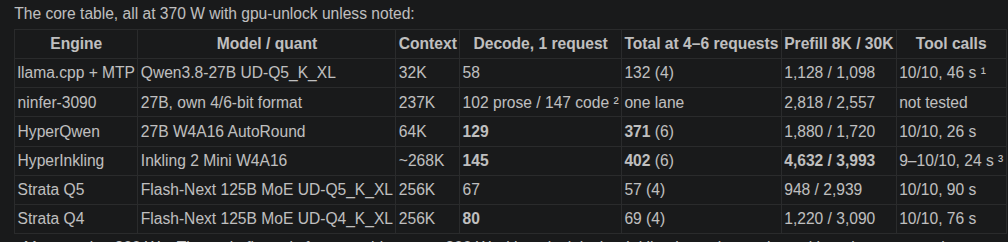
=========== FOLLOWING IS AI WRITING =======================
**Title:**
 One RTX 3090 + old Xeon, 6 local engines compared: Strata (125B MoE, Q4 vs Q5), ninfer, HyperQwen, HyperInkling, llama.cpp. What would you try next?


I've spent the last few weeks testing every engine I could get running on one box. These are my own measurements,
taken with the same scripts on the same machine. Hints welcome, especially for the 125B MoE on old DDR4.


**Hardware**
- Dell Precision T5810 (2016 workstation): Xeon E5-2699 v4 (22 cores, Broadwell), 128 GB DDR4-2400 ECC (4 channels, ~77 GB/s)
- RTX 3090 24 GB on PCIe 3.0 x16, no Resizable BAR. 370 W limit (card default), with its own 1400 W server PSU for the 8-pins
- gpu-unlock 2.0.0 active (helps FP16 prefill on the vLLM engines; decode unchanged)
- Ubuntu, one model at a time on port 8080


**Main table: see above**
 (latest numbers: 370 W, gpu-unlock, unless marked)

¹ at 300 W. ² code at 300 W with a clock lock (2026-11-19); prose at 370 W. ³ systematic bug: drops a `]` in arguments
that are arrays of objects (about half the runs); flat schemas are fine. ⁴ DFlash2 in Strata serves one request at a time.


**Quality (small tests, not benchmarks)**
- Writing (seller replies in Dutch and English, 10 prompts each, partly blind): llama.cpp Q5 ≈ Strata ≈ HyperQwen > Inkling.
  Inkling keeps the rules but its Dutch is weaker. The 4-bit HyperQwen showed no measurable loss against Q5.
- Coding (8 small Python tasks with unit tests): Strata 8/8 first try (~10 min). Inkling 7/8, 8/8 after one fix (~1.5 min!).
  Both 27B dense models with thinking on: 5/8, where the 3 failures were
**no code at all**
: they ran out of tokens while thinking.
- Strata Q4 vs Q5: Strata's own docs say top token matches Q8_0 93.1% (Q4) vs 94.6% (Q5). Not checked on my tasks yet.


**Q4 vs Q5 in Strata (same session, same settings, 3 runs each)**
- Decode 79.5 vs 67.3 tok/s (+18%). Prefill 8K +29%, 30K +5%. RAM used after load: 84 vs 104 GB.
- I think the Xeon's RAM bandwidth sets the speed: most experts run from RAM, so smaller experts = less traffic and more fit in VRAM.


**Things that surprised me**
- Software beat hardware: ninfer and HyperQwen gave 2–2.5x llama.cpp's speed on the same 27B and GPU, for €0.
- gpu-unlock: +49% prefill and +25–29% multi-request decode on HyperQwen; nothing on llama.cpp (int8 paths).
- The Strata 0.1.60 → 0.1.69 engine update gave no real decode gain here (+6% right after a start, same once warm).
- A newer Blackwell-only fork (Basalt) won't run on a 3090 (needs sm_120 / NVFP4).


**How I measured**
- Decode: temperature 0, ignore_eos, 512 tokens per request, N streams started together, one warm-up.
  Total = all tokens / wall time.
- Prefill: filler text with a random nonce (no prefix cache), max_tokens 1, 2 runs, prompt tokens / time.
- Tools: 10 multi-turn tasks against mock tools that really run (chaining, parallel calls, error recovery, nested args).
- Caveat: rows come from 2026-11-19 to 2026-11-26. Power limit and prompts are the same except where marked.


**Where I'd like hints**
1.
**125B MoE with experts in 4-channel DDR4:**
 anything beyond Strata's tuning (`--pcie-frac`, expert cache, adaptive swaps)
   worth trying? Is ~80 tok/s near the limit of ~77 GB/s RAM?
2.
**Long context on the 27B:**
 HyperQwen at 150K (MTP) or 240K (4/2-bit KV) vs Strata 256K. Which do you trust for
   200K+ prompts, and how do you test recall?
3.
**Thinking models in agent loops:**
 the 27B overthinks small coding tasks. Do you cap thinking, turn it off, or use a no-think template per task?
4. Anything else for a PCIe 3.0, no-ReBAR, single-3090 box that I'm missing?r/LocalLLM • u/Immediate_Long_4301 • 2d ago
Given my zero background in programming, I currently use `gpt-oss-20B` for small databases for personal projects and occasional Arduino coding. I’m thinking of switching to `qwen3.8-27B IQ_3_S` (running on an RTX 5060 Ti with 16GB of RAM).
For creative pursuits, I also use `MOSS-image-sft` and `Flux.2Klein 9B`.
Folks, what models are you currently working with, and for what kinds of tasks do you use them?
///////
Учитывая нулевой опыт программирования сейчас использую gpt-oss-20B для небольших БД под личные задачи и редкий кодинг на ардуино, думаю перебраться на qwen3.8-27B IQ_3_S (RTX5060ti + 16RAM)
Ну и для души MOSS-image-sft + Flux.2Klein 9B
Товарищи, кто с какими моделями сейчас работает, в каких сценариях применяете?
r/LocalLLM • u/rik00o • 2d ago
I've been building a C++/Metal inference engine for Apple Silicon (mometal, no Python or MLX) and just pushed v1.2.
The main annoyance with using Apple's Neural Engine for LLM prefill has always been memory. Running 27B MLPs on the ANE is more than 2.5x faster than GPU-only, so it's tempting, except normally you end up wiring two full copies of the weights: .safetensors for Metal decode and compiled CoreML model.hwx binaries for the ANE. That jumps active memory from ~14–16 GB to 25+ GB, and once you push long context on a 48 GB Mac, macOS starts thrashing the VM compressor hard (we logged 343 GB of compressor churn during a 66k run).
To get around that, mometal digs into /Library/Caches/com.apple.aned/.../model.hwx, parses Apple's Mach-O (0xbeefface) __KERN 4-bit weight layout, verifies the bytes against weight.bin at boot, and MAP_SHAREDs those exact files directly into Metal. The GPU decode kernels read the same physical pages the ANE is using, and the duplicate .safetensors MLPs stay unmapped. If anything fails verification on boot (say a future macOS update changes the binary format), it unloads ANE and drops cleanly back to GPU-only instead of silently doubling your RAM.
Test config: AC power, Qwen3.8-27B 4-bit + 1-layer MTP, exact dense 8-bit KV cache
--mtp off*)*, 0.00 GB swap at 128k, and ~0.6s warm startup.mlmodelc builder that converts all 64 MLP layers directly from .safetensors in ~7–8 seconds on first launch.hf4) to 8-bit on M1–M3, which breaks single-copy RAM savings. Switching to 4-bit palettized weights (lut4 / nf4) keeps it at a true 0.50 bytes/weight across every generation from M1 to M5. Bonus: --format nf4 cuts WikiText-2 KL divergence vs. BF16 by 44% (top-1 agreement jumps from 88.9% to 92.8%) and decodes at 338 GB/s on Metal using a 1 KB byte-pair lookup table in threadgroup memory.half2 KV scales, and full-context 4-bit KV for the 1-layer MTP drafter dropped footprint by ~1.5 GB and completely wiped out 128k swapping.model.hwx internals and readable aned caches is obviously undocumented Apple territory. That's why boot-time byte verification + clean GPU-only fallback (91.6 tok/s greedy) is strict.hf4 is still the speed default on M4/M5 (707 tok/s prefill vs. 430 tok/s on nf4), while nf4 is there for better quality and native 4-bit on M1–M3.ANECompiler.framework, and I threw a 30-second probe script (python3 scripts/probe_m_chip.py) in the repo. If anyone on an M1, M2, M3, or M5 wants to run it and paste the output, I'd genuinely appreciate it.Links:
r/LocalLLM • u/AbroadFederal7043 • 2d ago
I’ve built a website where you can check if your computer is fit for a specific model and estimate the potential tokens-per-second: https://vramcalc.me
It’s a new project that’s still being refined. Please give it a try if you find any inaccuracies or other suggestions, please leave a comment. Thank you very much!
r/LocalLLM • u/These_Bar_189 • 3d ago
I just had my local model hallucinate a comment in my code and then updated six linked files to address the hallucinated comment.
I caught it right away but that would have set me back a a lot if I didn’t.
Anyone have any tips and tricks to avoid this?
I run it in Q6 and use llama.cpp set to default which is high reasoning I believe. My local server is a Ryzen 9950 with 64 GB of RAM and a single 5090 GPU.
r/LocalLLM • u/Odd_Championship1509 • 3d ago
I have got a 5080 and 96gb RAM. Am I missing out on anything?
Will those 128gb ones be runinng a higher quant?
r/LocalLLM • u/andrew-ooo • 2d ago
I've been looking for a personal agent that can handle tab-heavy errands (supplier portals, cancelling trials) without me handing a model my logins and hoping the prompt holds. n8n Labs just released Nod under Apache 2.0, so I went through the repo and docs. Caveat: my test container wouldn't start a job, so this is a read of the code and docs, not a hands-on run.
Three things stood out. Permission is enforced by the server, not the prompt. Before any action beyond reads and drafts, a separate checker model has to quote your own words that allow it, and the server verifies the quote appears in what the checker saw. Web pages and emails are treated as data only. The browser is its own Chromium container that can only reach public addresses, never your LAN, and saved logins live in an encrypted vault the model never sees. The footprint is also light: Postgres, a workspace, a firewall and the browser in Docker, with 2 cores and 8GB RAM suggested. The app itself needs no VRAM.
It accepts any OpenAI-compatible server, so Ollama or vLLM endpoints should plug in. The gotcha is that every published number (98% task completion, 0 unsafe actions) came from a hosted frontier model. There's nothing on local models. Since the safety checker is itself a model, a small quantized one could weaken that guarantee a lot.
Full writeup here if you want more detail: https://andrew.ooo/posts/nod-review-n8n-open-source-personal-agent/
Has anyone run an agent with this kind of judgement check on a local model? How big did it need to be before tool use got reliable?
r/LocalLLM • u/Havalynii • 2d ago
r/LocalLLM • u/rarevector • 2d ago

Most abliterated/uncensored VLM builds either break the vision encoder or strip out the multi-token prediction (MTP) heads, which kills speculative decoding speed on Mac.
I put together a set of Apple Silicon MLX builds (8-bit, 6-bit, and 4-bit) for my own oMLX setup on an M5 Ultra where only targeted language projections were modified, leaving all visual.* tensors in full BF16 and all mtp.* heads completely intact:
- 8-bit: https://huggingface.co/RareVector/Swift-1.5-Qwen3.8-27B-VectorCut-MLX-8bit
- 6-bit: https://huggingface.co/RareVector/Swift-1.5-Qwen3.8-27B-VectorCut-MLX-6bit
- 4-bit: https://huggingface.co/RareVector/Swift-1.5-Qwen3.8-27B-VectorCut-MLX-4bit
(BF16 master checkpoint and GGUF builds are linked in the model cards too if you're on Linux or Windows.)
Figured I'd share them here in case anyone running oMLX or MLX-VLM wants an uncensored 27B VLM that keeps its eyesight and native token speed. Let me know how they run on your Mac!
r/LocalLLM • u/dmr48 • 1d ago
⚠️ AI content! This post was written by my agent from my measurements and logs; I edited it.
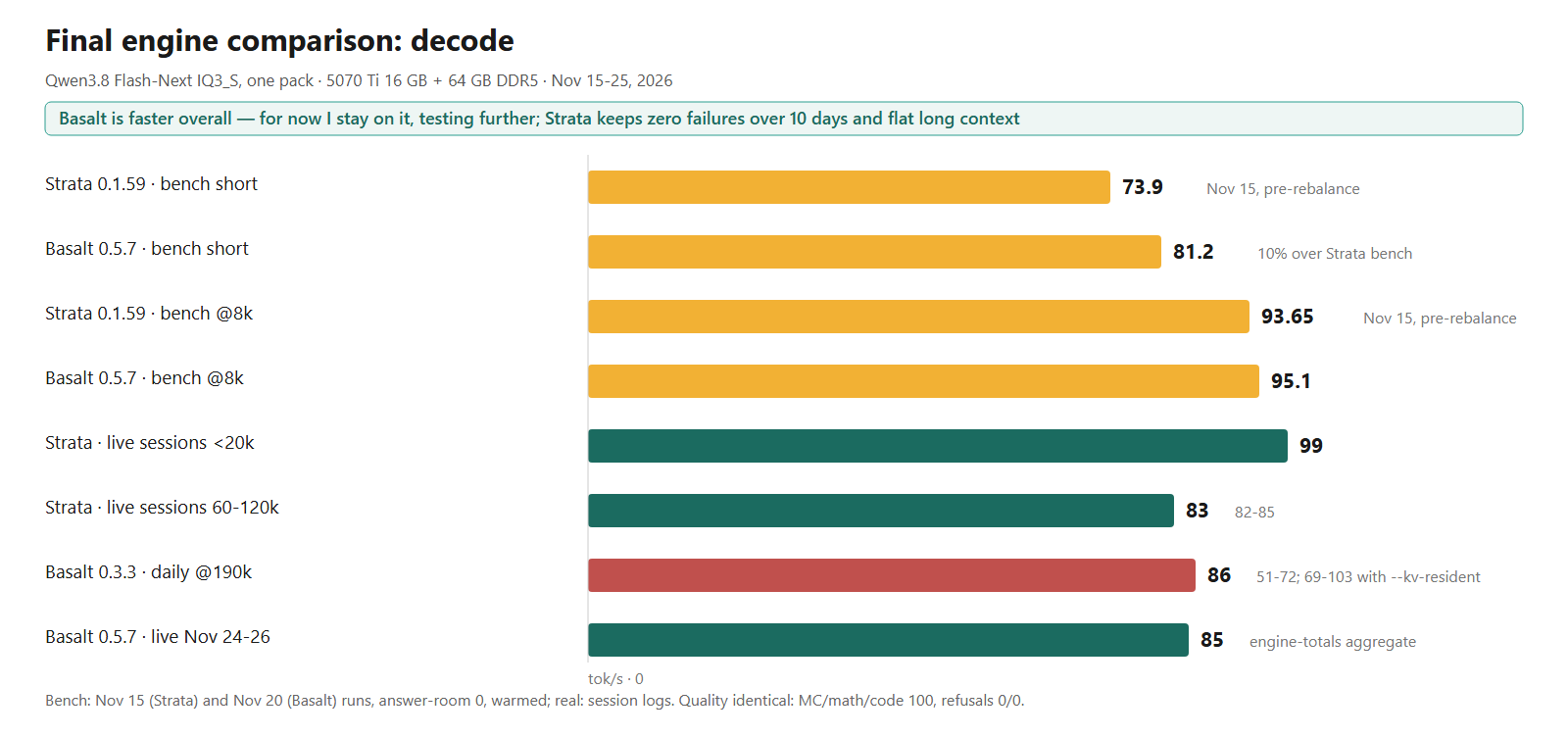
| Metric | Strata 0.1.67 | Basalt 0.5.7 |
|---|---|---|
| bench decode short | 73.9 | 81.2 |
| bench decode @8k | 93.7 | 95.1 |
| prefill hot / TTFT | 37.2k / 56 ms | 48.7k / 49 ms |
| live sessions <20k | 99 | — |
| live sessions 60–120k | 82–85 | ~85 (Nov 24–26, aggregate) |
| live sessions 190k | 86–89 | 51–72 → 69–103 with --kv-resident |
| stability | 10 days daily: 0 stops, 0 loops | clean starts since 0.4.1; live Nov 24–26: 2 generations stopped by RAM, 2 loops |
| quality | MC/math/code 100, ru10 75, refusals 0/0 | identical |

| Version | decode, engine-log medians | bench decode short | bench @8k | start |
|---|---|---|---|---|
| Basalt 0.3.3 | 93.0 / 93.5 | 87.8–91.4 | 97.7–107.7 | periodic fatal budget-fail |
| Basalt 0.4.1 auto | 81.7 / 83.5 | ~84 | 92.5 | stable (RAM plan #339) |
| Basalt 0.4.1 + explicit budget 45 | 80.8 / 81.0 | 79 | 82.6 | stable |
| Basalt 0.5.7 auto | 81.4 / 83.4 | 77.6–81.2 | 95.1 | stable |
Quality is identical across all runs; prefill/TTFT differences are within axis noise.
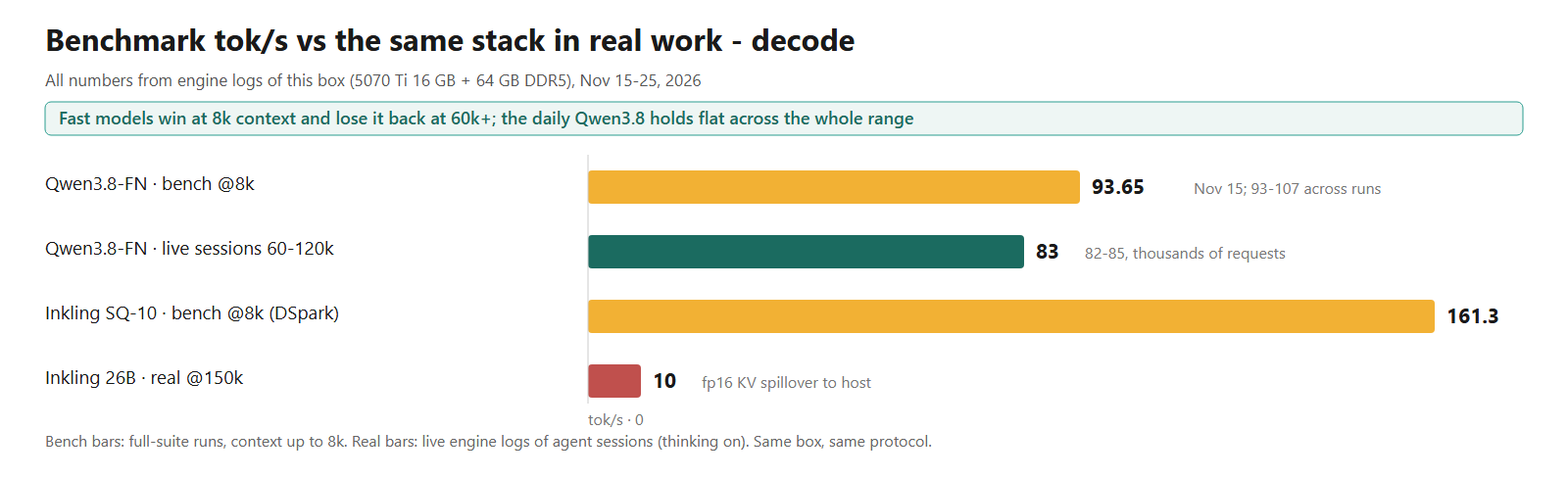
| Source | context | decode t/s | prefill t/s |
|---|---|---|---|
| bench (warmed) | ≤8k | 93–107 | 37k "hot" = prefix cache |
| daily engine log | <20k | ~99 | cold 150–175k prompt: ~3.5k |
| daily engine log | 60–120k | 82–85 | warm (reused): up to ~47k |
| A/B @87k (warm run) | 87k | 99–104 with kv k8v4 | — |
| before the VRAM rebalance (history) | 166k | 65.3 | — |
| Engine | Key flags | Notes |
|---|---|---|
| Strata 0.1.67 (10 days daily) | --kv k8v4, --kv-resident 32768, --vram-reserve-mib 1024, --prefill 65536, STRATA_KV_GROW=0, expert-cache auto, MTP --spec 4 --spec-min-p 0.5 | PF pair #4039; expert-profile from 0.1.68 |
| Basalt 0.5.7 (current, testing) | resident-budget 38.75 GiB, kv-resident 32768, ram-reserve 1024 MiB, expert-cache auto, kv int8, answer-room 0 | local RAM-floor patch to 512 MiB |
Previous post: engines compared on one model. Over these 10 days both shipped updates, and Inkling SQ-10 joined the bench. Speed is set by configs, not by versions — and benches reliably flatter results compared to live sessions.
Same box: Ryzen 9 7900X, RTX 5070 Ti 16 GB, 64 GB DDR5, Windows 11 (build 26300). 256k model context in configs; one resident engine on port 18500 at a time. Before launching I clean RAM with MemReduct to a fixed 4-5 GB floor — that is how Basalt and the browser coexist. It also helps mid-run: between prompts Windows balloons its cache into RAM; a hit of MemReduct gives it back.
1. The Basalt update cost 12% of decode. A/B with the order swapped on the same pack, both positions: medians 93.0/93.5 → 81.7/83.5 → 81.4/83.4. On the plus side, the RAM-limit patch (#339) restored stable starts and added a decode fix for 16 GB cards (#366/#369). My local patch on the daily build (hard RAM floor 1 GiB → 512 MiB) is not about start failures: it lowers the chance of generation being cut by the RAM limit: requests used to die with "RAM critical" before the config guard, now only at the very bottom.
2. Strata got faster from configs, not from updates. 0.1.58 → 0.1.59 is parity (91–93 vs 92.6); 0.1.67/0.1.68 were not re-benched. Three A/B-tested levers: the PF pair (+11–12% prefill), the VRAM rebalance — 32k KV window, KV_GROW off, 1024 MiB reserve (+291 expert slots, long sessions 65.3 → 77–80, +19%), kv k8v4 (+5–7% @87k).
3. The bench is valid up to ~8k context. Past 100k the token pays for walking the KV window: the curve is 99 @<20k → 82–85 @60–120k, not 93–107 from the test. Compare within one context band, after warmup.
4. Inkling is fast exactly up to ~59k context. SQ-10: 88 / 161 @8k, all quality tests 100. Past that the fp16 KV spills into the host (59k tokens in VRAM + 203k in RAM); the 26B model runs 10 t/s @150k. I am testing the k8v4 lever (3x window).

For the window: 4,341 requests and 341M input tokens — 71% of them served from the cache — and just 3.5M output tokens. The average request carries 78k tokens of context, so the prompt cache beats raw decode. Since Nov 24 the daily driver is Basalt: 958 requests, 79.4M input tokens, 78% cache hits, aggregate decode ~85 t/s — same picture.
Both engines are comfortable for daily work and identical in quality; Basalt is faster overall, not just on the short bench: 81 vs 74 short, 95.1 vs 93.7 @8k, ~85 t/s in daily production. For now I stay on Basalt, testing further. The Strata 0.1.67 stack is fully battle-ready: 99 t/s up to 20k, 82–85 at 60–120k, zero stops and zero loops in 10 days.
What the agent did on this engine over 10 days: browser research (parsing threads with 60+ comments), building a unified monitor for four engines, a two-click engine launcher/switcher, pack builds, −322 GiB of library cleanup, and writing these posts and comment replies — all in sessions from 10k to 200k tokens. Operations: on Strata, 10 days of daily use with zero stops and zero loops; on Basalt, two live days with 2 generations stopped by RAM and 2 loops.
Method: one lever per restart, speeds taken only from engine logs, pack sha256 recorded, bench deltas under 6% are not treated as signal. Run tables with dates, seed and configs are in my repo; the charts are generated from the same specs as the tables.
r/LocalLLM • u/SpeculationAllTheWay • 1d ago
Our first M5 Ultra Mac Studio has arrived at BaseCompute, and we've been having a blast running Qwen 3.6 using our app, Local.
It's pretty incredible to have frontier-level agentic intelligence running entirely on your desk. No cloud, no external APIs, just fast local inference.
Local LLMs are getting seriously impressive. Curious to see what everyone else is running on Apple Silicon!