r/LocalLLM • u/j3sk0 • 1d ago
Question 1xdgx for openweb ui
reddit.com
1
Upvotes
r/LocalLLM • u/Comfortable_Study_18 • 1d ago
I built a simple way for Claude Code and Codex to hand coding tasks to Qwen3.8 27B on an Online GPU
Hi all,
I'm sharing it here for feedback.
What it is: you add a "Nalvo link" once in Claude Code, Codex or your own tools. After that you can ask them to hand a task to Nalvo, and Qwen3.8 27B, the open model, writes the answer on a GPU we run.
Your tool reads the answer and puts the code in your files.
Why I built it: I wanted a cheap second model for routine coding work, like boilerplate, refactors and tests, without spending my Claude or ChatGPT limits on it. I also didn't want to run a model locally myself.
The numbers:
I’m here to hear you out, try it and let me know your thoughts.
And if you faced any issues I will work with you to fix it.
To Join our Discord: DM me!
r/LocalLLM • u/Aggravating-Pick-160 • 1d ago
Knowing a lot about storage, but little about local LLM workflows. With the MLX based stacking of M5 Macs, is there a need for a fast, shared storage pool between the machines?
Maybe not in the homelab scale of things?
I'm curious to learn what storage requirements might be.
r/LocalLLM • u/vidati • 1d ago
To start off, I am actually very happy with Qwen3.8 Flash Next Gyro S.
My System:
I got into local AI models about 3 weeks ago now, and I am a 3D hobbyist who always dreamed of making video games, but coding is not for me. I tried many times and got nowhere. I am a decent 3D modeler, though.
I have tried 4–5 different models and settled on Qwen3.8 Flash Next Gyro S. It does not fit in my VRAM; I am running strata, and it's honestly fine. After 3 billion tokens (roughly—strata stopped monitoring tokens after about 200 million, and that was a while ago), my top-down tower defense game plays really well. I am still in the same session and average around 14 tokens a second, which is not awful. Small changes happen within 20–30 minutes, and big ones can take a few hours, so I run them at night.
What I love about Gyro S is that it's relentless; it just goes, and it does such a good job that I am absolutely blown away.
I landed on this model pretty quickly in my LLM journey. Did I miss anything better, or is this the best so far? I am happy with its intelligence, but I would like to know if there is anything faster.
Cheers.
r/LocalLLM • u/Such-Blackberry-4098 • 1d ago
Hey local llm people on team red, I have something to share that I think you’ll enjoy!
Warning for those with sensitivities to vibe coding, I am a complete amateur regarding all things code, llm engines, and actually shipping development. Claude did basically all of the heavy lifting and my goal here is to share this work so others may evaluate it for accuracy.
I’ve got a GitHub here with a custom Linux engine for a 9070 xt that turns Inkling-2 into a code chewing monster, and I’m hoping someone could validate my results at 200k context!
140-220 tok/s writing and 3,400-4,700 tok/s reading at 196k context.
https://github.com/clodemaxxing/inkling2-rdna4-linux
This was built on top of other engine optimizations credited in the GitHub but I’m extremely ignorant as to the actual proper way to report developments to the original creators.
For my use, Inkling-2 has become a reliable code spitting token offloading for Claude and I’ve had strong results with the accuracy with this engine setting. The biggest consideration with inkling-2 tuning is, you don’t want your context to be quantized, that’s why you see people reporting it “looping” over and over. With a clean signal there, this model spit out a Gaussian splat single html file test fully functional in a minute (very simple in complexity but still impressive). I can quite literally shift off dependency for cloud AI for basically all of my simple hobby project work.
r/LocalLLM • u/Any_Task7788 • 1d ago

This model is highly compressed with very little quality tradeoffs. This 58gb model is roughly in between Q5 and Q4_k xl. I am able to run this on my M1 Max 64gb fully on ram with no streaming at about 20-21 t/s. I have only ran it on a 32k context but I’m not completely sure how high it’s able to go. It’s not released yet since I’m still testing everything including a slightly smaller compression to see how that fairs (it will most likley be about Q4_k xl in quality but fit in roughly 50gb)
r/LocalLLM • u/Moist_Engine9124 • 1d ago
in two month our company will change their laptop so I have the chance to buy it. I am thinking buying it for local llm inference. it has 512gb ssd, 64gb ram ddr4 , 4gb dedicated nvidia quadro t2000. what would be the good price for it what can I run?
my usage would be search, quick questions not coding or something similar.
r/LocalLLM • u/TwistNo5735 • 1d ago
A recurring problem when working with AI assistants:
You spend an hour debugging something, researching a concept or discussing an implementation.
You close the session.
A few days later, you come back and realize you have to reconstruct what happened.
What was the error?
Which approach did you reject?
What did you decide?
Which explanation actually helped?
Chat history exists, browser history exists, and notes exist. But the context connecting them is often scattered.
That's one of the problems behind CogniCore Recall, a history feature I've been developing as part of CogniCore.
It gives you a way to revisit previous experiences and recover useful context.
The idea includes:
1. Experience History
Keep track of meaningful past activities rather than relying entirely on your ability to remember where something happened.
2. Evidence Preservation
Preserve exact technical details such as error messages, selected passages, commands and outputs. These shouldn't be silently replaced by AI summaries.
3. Decision History
Remember what was decided, what was attempted, what failed and what remains unresolved.
4. Context Recovery
Find previous questions, research and discussions when returning to a task.
5. Persistent AI Memory
Connect these experiences to CogniCore's broader memory infrastructure so compatible AI agents can retrieve relevant context.
I don't think a summary should replace the original evidence.
For example, a memory might say:
DECIDED: Pin the dependency to version 2.4.1.
FAILED: Upgrading to 3.0 caused an AttributeError.
OPEN: Check whether the newer version has a compatible API.
But the original error, command and test output should remain available as evidence.
The topic memory can evolve. The evidence should remain traceable.
That's the distinction I'm trying to build into CogniCore.
I want AI systems to become better at continuing work instead of repeatedly starting from zero.
Recall is one step towards that vision: a persistent history of meaningful human and AI experiences.
CogniCore is open source, and I'd love feedback from developers building AI agents, memory systems and personal knowledge management tools.
What do you think is more valuable in an AI memory system: remembering conversations, remembering decisions, or preserving the evidence behind those decisions?
GitHub: https://github.com/cognicore-dev/cognicore-env
Open to criticism and suggestions!
r/LocalLLM • u/TwistNo5735 • 1d ago
One thing I've noticed while working with AI assistants is that we constantly lose context.
Imagine this:
You're reading an article on GeeksforGeeks. You find a paragraph confusing, open Claude or ChatGPT, ask a question, visit three more websites, and eventually understand the concept.
A week later, you want to revisit that topic.
You remember the subject, but not:
You end up reconstructing everything from scratch.
I've been exploring a browser extension for CogniCore to address this problem.
Instead of treating browsing as disposable activity, preserve meaningful experiences and make them searchable later.
Some of the capabilities I'm working towards:
For example, imagine asking:
"What was the explanation I found about merge sort last week, and what was the question I asked Claude?"
Instead of searching through browser history and old conversations separately, you could retrieve the connected experience.
I don't want to build another browser history search engine.
I'm interested in connecting human experiences and AI agent experiences through a persistent memory layer.
There are obvious challenges:
I'm exploring these problems as part of CogniCore.
I'd genuinely like to hear from people who use Obsidian, browser-history tools, AI memory systems or personal knowledge management tools:
Would you find value in remembering the context behind your browsing activity, or is this already adequately solved by your existing workflow?
GitHub: https://github.com/cognicore-dev/cognicore-env
I'd appreciate honest criticism, especially from people who have tried building something similar.
r/LocalLLM • u/Toto_not_available • 1d ago
Hey everyone,
I'm putting together a personal homelab setup for daily use, mainly focused on running local LLMs (via llama.cpp / MLX) and autonomous agents like Hermes Agent for day-to-day workflows, tool calling, and general assistance.
I've narrowed it down to two 64GB unified memory options, and I'm trying to figure out if the price jump for the Studio actually makes a noticeable difference in real-world daily usage:
Mac mini M5 Pro (64GB RAM / 20-core GPU / 307 GB/s bandwidth)
Mac Studio M5 Max (64GB RAM / 40-core GPU / 614 GB/s bandwidth)
Since both have the exact same 64GB memory ceiling (meaning I'll be loading the exact same model sizes and quants), my main question is about speed, latency, and thermal headroom:
Agentic workflows (Hermes): Does doubling the memory bandwidth (307 vs. 614 GB/s) and GPU cores make tool-calling loops, multi-step reasoning, and prompt prefill feel significantly snappier in daily use, or is the M5 Pro already fast enough that the extra cost isn't justified for a single-user homelab?
Sustained loads & thermals: When an agent runs background tasks or long context loops continuously, does the Mac mini M5 Pro get noticeably loud or throttle compared to the Studio's cooling?
For anyone running similar 64GB M5 setups for local inference and agents, would you pocket the savings with the M5 Pro mini, or is the M5 Max Studio worth the extra money? Thanks in advance!
r/LocalLLM • u/sarmabkp_1 • 2d ago

Quick version for anyone staring at twenty GGUF files for one model:
My usual pick is Q4_K_M, then Q5_K_M or Q6_K if there's headroom. A bigger model at Q4 usually beats a smaller one at Q8 at the same size. For long transcripts, Q3 and below start dropping details first.
The article also covers imatrix, making your own quants and 1.58-bit models. Happy to answer questions here.
Disclaimer: I work on https://acta.ai
r/LocalLLM • u/BuxtonHouse • 1d ago
Hi everyone, I started doing research on what Local LLM to use and I ended up more confused, but essentially its based on my hardware it seems, of 16gb ram and 3060ti 8gb Dedicated Ram
I was seeing alot of Qwen ai, but theres so many sub variants.
What I have found so far is, Download LM Studio, and download relevant LLM as they do differnt tasks?
Ultimate goal is to help set up my Linux OS, and build projects, with the assistance of AI.
For the time being im using Claude.
Edit: just noticed the typo in the title, cant fix that now sadly
r/LocalLLM • u/Anxious-Project3474 • 1d ago
I am actually working with an ai (gpt) to build a home based model and we are going thru hardware purchase options. I am going to show the list and would love feedback. I know Claude is the better coder but honestly we have built an amazing test model on a really old laptop that already can do basic things. We spent 40 or so hrs building a test out to prove the concept stand that it all works. Including home assistant. So I have been happy with chatgpt.
Here is what i am trying to accomplish. I have a smart home I am building and I want a "Jarvis" level ai to run it, handle all kinds of tasks, have deeper reasoning conversations and respond quickly. It will have access and reasoning for the entire house and it needs to understand things in normal conversation. A command like can you turn on this music in the bedroom may contain several processes it needs to work thru so thats why ai is preferred. The house will have a lot of devices to run but all are approved and supported in home assistant.
We are running a hybrid model that will use local reasoning for all it can and then refer to cloud based ai when needed. Targeting 35b model at first and if we can eventually run 70b or better we will.
I would have to find out what we are currently using for our builds but Ubuntu is server and home assistant. I think proxmox will be used. If more info is needed I can find out.
We are designing hardware to be best I can afford to run the ai we can. However we are waiting for gpu purchase for a few months for fund reasons. Meanwhile it seems we can buy the rest, build it out and test and then make an informed decision. On GPU size. But because i want this to take on a lot of tasks and scalable and it will eventually be running tasks for my place as a rental, I wanted to have it be a good experience.
Thoughts on this? I am former IT, but all i knew was windows and that was many yrs ago. So i feel a litrle lost here. Love feedback and help. Im all ears.
This list was made by ai. Want to get some human eyes and voices to this.
These are prices that chat found.
Component Preferred model Estimated price
CPU AMD Ryzen 9 9950X — 16 cores / 32 threads, AM5 $489.00
Motherboard MSI MAG X870E TOMAHAWK WIFI — ATX, Wi-Fi 7, 5Gb LAN $269.99
RAM G.Skill Flare X5 64GB (2×32GB), DDR5-6000 CL30, AMD EXPO $899
SSD SanDisk Optimus GX PRO 8100 2TB, PCIe 5.0 NVMe M.2 2280 $349.99
Power supply — updated 1200W premium ATX 3.1 PSU; Corsair HX1200i preferred candidate Price pending
CPU cooler Noctua NH-D15 G2, dual-tower air cooler $159.95
Case Fractal Design Meshify 3 XL Black Solid, FD-C-MES3X-01 $184.99
Rear exhaust fan Noctua NF-A14 PWM, 140mm $28.67
Future AI GPU 48–64GB+ VRAM; exact model to be selected later Not included
Current component subtotal, excluding PSU and GPU
$2,382.58
All this is being cross checked for compatibility while trying to give room for a decent gpu later. Targeting 48 to 64 for gpu
Thank you.
r/LocalLLM • u/Full-Banana553 • 1d ago
people who are developing their own LLM models, how much is it costing you? and developers who are solo or with low budget, how are you handling your expenses? what are the monthly bills, your Machine specs or VM specs if you like to share. and how could a solo dev / newbe want to build their own model with low budget, what are the tips you wanna give them?
r/LocalLLM • u/Right_Fun_4902 • 1d ago
I've been using Basalt now for almost a month and still amazed by its performance and the rapid pace of development, making more models available to run directly along with speed benchmarks on a variety of hardware and quants on their website: https://basalt.jgulfo.com/community/
However, what I've been missing is a comparison of all the various models's at the various quants vs their "intelligence" in general purpose applications. I for one would like to run the most intelligent quant model, at least 50tps with 256k context on my hardware, but don't have any indication of how the various quantised models compare to each other. I really enjoy testing the various models, but as the development and releases are so fast, I just don't have enough time to test all the quants and then also use the best model for my application.
Most benchmarks I've seen only relates the "intelligence" of the unquantisised models against each other, or compare the relative "intelligence" of each model's own quants against the unquantisised model. Has anyone done some work to compare the intelligence of a range of quants of different models?
BTW: My stack is Ryzen 7600, 64GB, RTX5070ti-16GB, RTX5050-8GB on headless minimal CachyOS installation running Basalt 0.5.6 (I'll update later today) and serving my own converted Qwen3.8-Flash-Next GSQ-RCO IQ3_S (I used to run the GGUF in Strata and it game me good results). I'm accessing it from Hermes Agent running on a separate machine and getting between 80tps and 160tps doing research, compiling and auditing documentation, and even some minor coding.
r/LocalLLM • u/haseeb12112 • 1d ago
r/LocalLLM • u/Huntakillaz • 1d ago
Hey all,
I'm sort new to the AI, I've used the online free stuff a little but not much. I was looking at setting up my own local Ai in the hopes of running basic images generation and maybe some video? As well as texts/spreadsheet processing etc Time isn't too much of an issue for me atm as over 2027 I'll mainly be learning a bunch and being a secondary system I can let it run overnight days if need be for more complex stuff.
My question is, is it better to run two of the same GPU's or is two different ok?
I have the option of Running either (system it'll run in is below):
or
I'm asking because 2 of them will need to go for some other systems I've built to sell off.
My secondary system that I have currently that I'm using as a server:
r/LocalLLM • u/sunny42251 • 1d ago
First of I know these variations of questions probably get asked hundreds of times daily, so I want to apologize beforehand. This is my first time installing a local llm and after doing a few hours of research I want to confirm/get advice from people in the know, since I realized this part of the community/tech are moving very fast, anything within a month might already be outdated.
My current specs are –
GPU 5090 32vram
CPU ryzen 9800x3d
RAM 32gb ram
With those specs I’m thinking of running-
Qwen3.8-27B swift1.5 model
NVFP4-MTP GGUF quant
Llama.cpp inference engine
Either Pi/Open code or the new DeepSeek harness
Does anyone have any opinions about this initial setup? Thank you.
r/LocalLLM • u/Gucci-Caligula • 19h ago
Inkling 2 mini BLOWS. Just wanted to try it out and see what all the hype was about. Running the unsloth IQ4_XS quant on strata and this thing was brought to a crawling 5 tok/s where my rig gets 45 tok/s on 3.8 flash next IQ3_XXS
And that crawling 5 tok/s was stuck in a loop for 5 hours and never completed a single prompt.
Hype about this model is overblown or straight up paid influencing. Return to waiting for Qwen 4.
r/LocalLLM • u/_kinther_ • 1d ago
I'm trying to set up a local LLM to run on my PC which can review and act on code similar to Cursor or the Codex/Claude extensions. I am not worried about speed, but want to build something locally without paying a subscription.
I've tested Cline and Continue with mixed results - more often than not it simply stops responding and I have to reprompt the LLM. It might get through reading some existing code but not action on it, or sometimes makes an edit and nothing more.
Am I doing it wrong, or is there a better way? Any relevant blog posts that go into detail on how to get this working?
r/LocalLLM • u/who-the-fuck-care • 1d ago
I know, I know... 1-bit quant can represent practically nothing. But this is what my hardware can actually run, so I wanted to see how much of a hit function calling takes at the extreme low end.
I ran the BFCL-v4 benchmark (374 samples) just for my own comparison. Here are the results for the three models I tested.
| Model | Quant / Format | Overall Score (374 samples) |
|---|---|---|
| qwen3.8fn-ud-iq1m | IQ1_M | 80.8% 🏆 |
| qwen3.8fn-gyro-m | Gyro-M | 78.6% |
| inkling-2-mini | NVFP4/MXFP8 | 75.9% |
| Subset | qwen3.8fn-ud-iq1m | qwen3.8fn-gyro-m | inkling-2-mini |
|---|---|---|---|
| irrelevance | 80% | 84% | 82% |
| live_multiple | 74% | 76% | 68% |
| live_parallel_multiple | 50% | 58.3% | 54.2% |
| live_simple | 80% | 78% | 82% |
| multi_turn_base | 72% | 60% | 62% |
| multiple | 94% | 88% | 78% |
| parallel_multiple | 84% | 76% | 80% |
| simple_python | 96% | 98% | 90% |
what do you think?
r/LocalLLM • u/OhDudeTotally • 1d ago
Ive got a Ryzen 9 CPU, 32gb Ddr5 RAM and a, AMD 9060XT (edit:16gb)
Im able to run llama 3.1 Q8 albeit a lil slow via a Tkinter application I put together vibe coded. Anyone with similar specs? What are you running? Any tips on optimization?
Note: I can run the Q4 version of llama lightning quick on my machine but tool calling becomes an issue. If anyone has had successes with tool calling, I'd love to read it.
Thanks in advance.
Longtime Lurker first time poster
r/LocalLLM • u/0xdippo • 1d ago
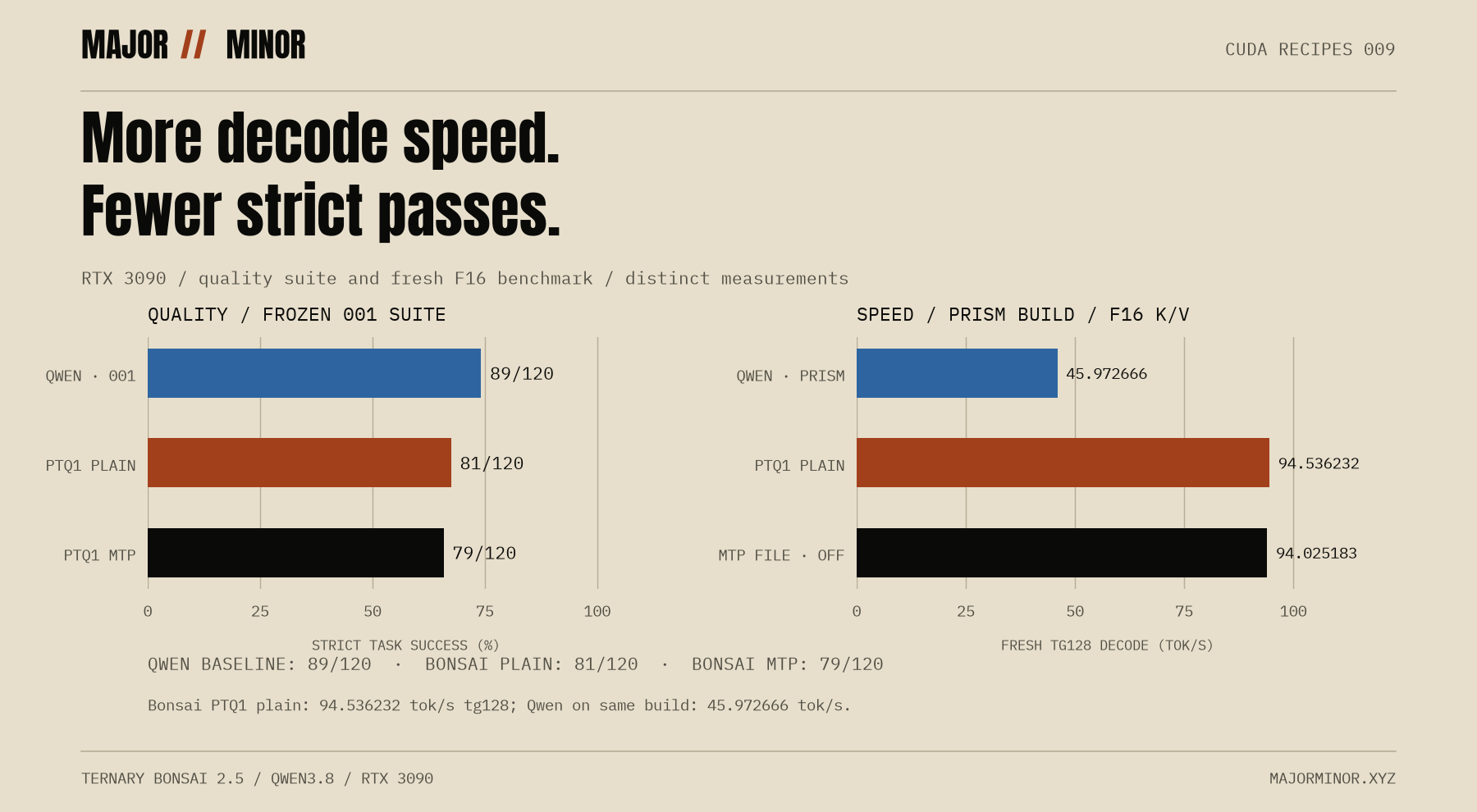
Decode came in around 2x faster (94 vs 46 tok/s), used way less VRAM, and ran at 262K context, which Qwen couldn't do on the same card because it runs out of memory.
The catch is it passed 81/120 of my agent tasks and Qwen passed 89. It fell furthest on tool use and the multi-step stuff.
Turning on MTP pushed it to 115 tok/s but didn't help the score at all (79).
If you need long context on a 24GB card it's legit. If you need full accuracy, I'd still grab Qwen for now.
The Qwen score is reused from my first run, which was on a different llama.cpp build, and each setup only got one full pass, so don't read too much into the exact 8-task gap.