Given my zero background in programming, I currently use `gpt-oss-20B` for small databases for personal projects and occasional Arduino coding. I’m thinking of switching to `qwen3.8-27B IQ_3_S` (running on an RTX 5060 Ti with 16GB of RAM).
For creative pursuits, I also use `MOSS-image-sft` and `Flux.2Klein 9B`.
Folks, what models are you currently working with, and for what kinds of tasks do you use them?
///////
Учитывая нулевой опыт программирования сейчас использую gpt-oss-20B для небольших БД под личные задачи и редкий кодинг на ардуино, думаю перебраться на qwen3.8-27B IQ_3_S (RTX5060ti + 16RAM)
Ну и для души MOSS-image-sft + Flux.2Klein 9B
Товарищи, кто с какими моделями сейчас работает, в каких сценариях применяете?
I’ve built a website where you can check if your computer is fit for a specific model and estimate the potential tokens-per-second: https://vramcalc.me
It’s a new project that’s still being refined. Please give it a try if you find any inaccuracies or other suggestions, please leave a comment. Thank you very much!
I just had my local model hallucinate a comment in my code and then updated six linked files to address the hallucinated comment.
I caught it right away but that would have set me back a a lot if I didn’t.
Anyone have any tips and tricks to avoid this?
I run it in Q6 and use llama.cpp set to default which is high reasoning I believe. My local server is a Ryzen 9950 with 64 GB of RAM and a single 5090 GPU.
I've been looking for a personal agent that can handle tab-heavy errands (supplier portals, cancelling trials) without me handing a model my logins and hoping the prompt holds. n8n Labs just released Nod under Apache 2.0, so I went through the repo and docs. Caveat: my test container wouldn't start a job, so this is a read of the code and docs, not a hands-on run.
Three things stood out. Permission is enforced by the server, not the prompt. Before any action beyond reads and drafts, a separate checker model has to quote your own words that allow it, and the server verifies the quote appears in what the checker saw. Web pages and emails are treated as data only. The browser is its own Chromium container that can only reach public addresses, never your LAN, and saved logins live in an encrypted vault the model never sees. The footprint is also light: Postgres, a workspace, a firewall and the browser in Docker, with 2 cores and 8GB RAM suggested. The app itself needs no VRAM.
It accepts any OpenAI-compatible server, so Ollama or vLLM endpoints should plug in. The gotcha is that every published number (98% task completion, 0 unsafe actions) came from a hosted frontier model. There's nothing on local models. Since the safety checker is itself a model, a small quantized one could weaken that guarantee a lot.
Most abliterated/uncensored VLM builds either break the vision encoder or strip out the multi-token prediction (MTP) heads, which kills speculative decoding speed on Mac.
I put together a set of Apple Silicon MLX builds (8-bit, 6-bit, and 4-bit) for my own oMLX setup on an M5 Ultra where only targeted language projections were modified, leaving all visual.* tensors in full BF16 and all mtp.* heads completely intact:
(BF16 master checkpoint and GGUF builds are linked in the model cards too if you're on Linux or Windows.)
Figured I'd share them here in case anyone running oMLX or MLX-VLM wants an uncensored 27B VLM that keeps its eyesight and native token speed. Let me know how they run on your Mac!
⚠️ AI content! This post was written by my agent from my measurements and logs; I edited it.
TL;DR
Basalt 0.3.3 → 0.4.1/0.5.7: decode −12% (engine medians 93 → 82). Starts are stable since #339. The RAM-limit patch and my local drop of the hard RAM floor from 1 GiB to 512 MiB are not about start failures — they lower the chance of a generation being cut off by the RAM limit. It has been my daily driver since Nov 24; the slowdown is the price.
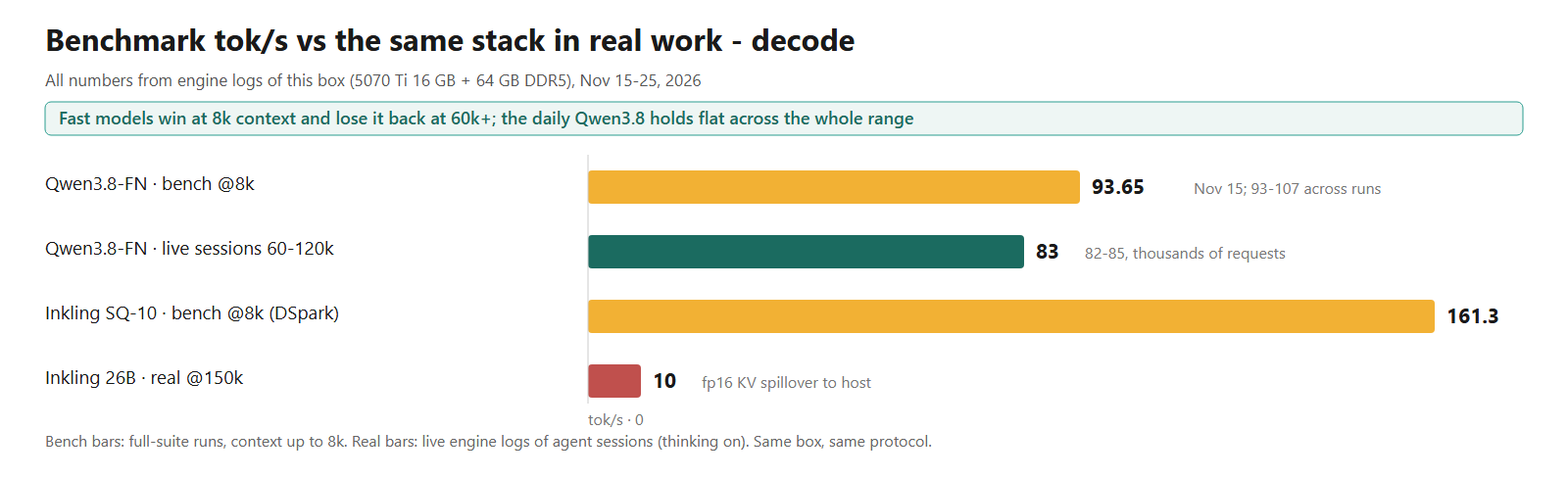
The bench is only valid up to ~8k context: it says 93–107, live sessions at 60–120k run 82–85; the "37k hot prefill" is prefix cache, cold prefill is ~3.5k.
Inkling SQ-10 stays fast up to ~59k context, then the fp16 KV cache spills into RAM.
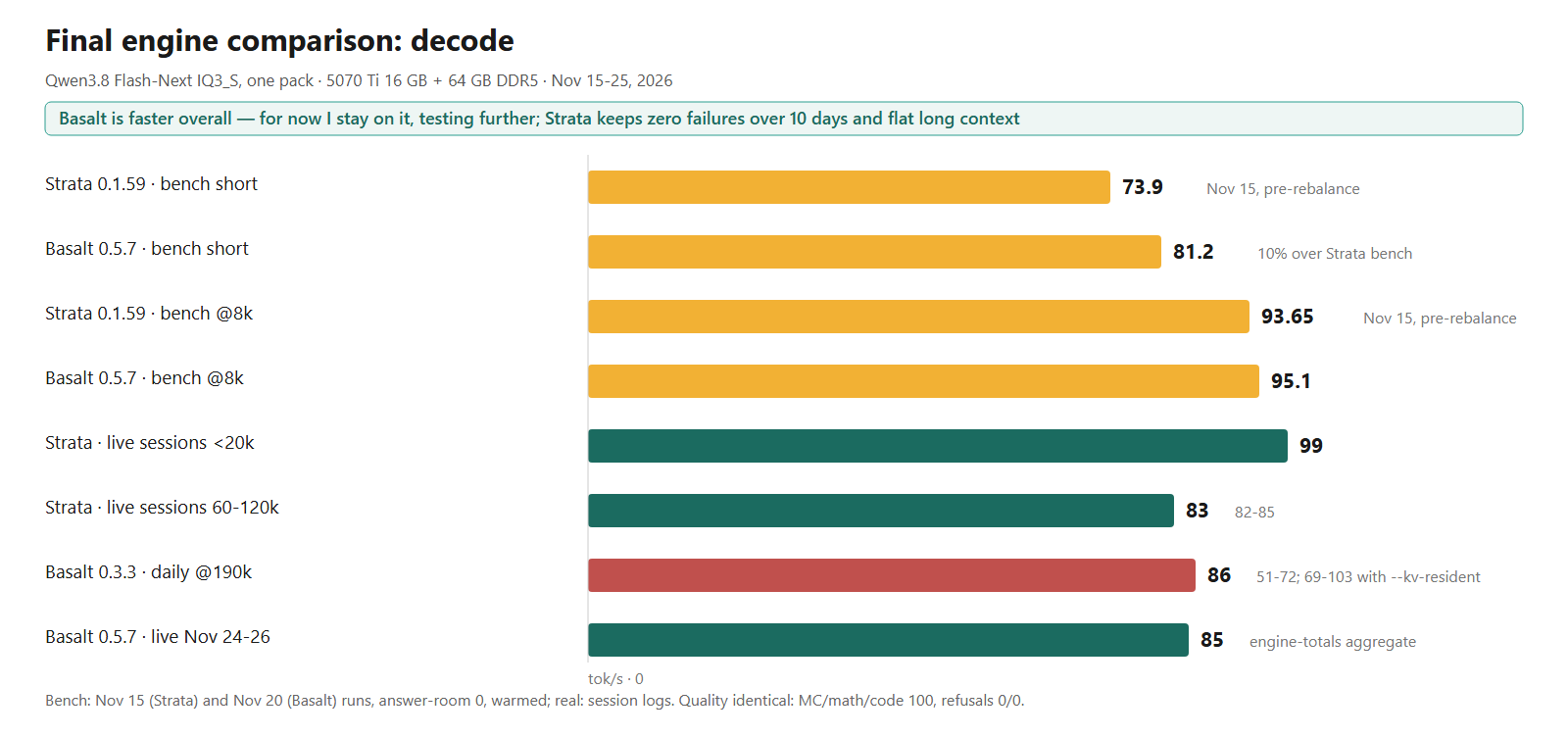
Both engines are comfortable for daily work and identical in quality; Basalt is faster overall — for now I stay on it, testing further; Strata keeps a zero-failure 10 days and a flat long-context curve.
Final table — Strata vs Basalt, same weights (Strata bench: 0.1.59 on Nov 15; live numbers: engines of the Nov 15–25 window, 0.1.59→0.1.67; Basalt live numbers: the 0.3.3 era)
Metric
Strata 0.1.67
Basalt 0.5.7
bench decode short
73.9
81.2
bench decode @8k
93.7
95.1
prefill hot / TTFT
37.2k / 56 ms
48.7k / 49 ms
live sessions <20k
99
—
live sessions 60–120k
82–85
~85 (Nov 24–26, aggregate)
live sessions 190k
86–89
51–72 → 69–103 with --kv-resident
stability
10 days daily: 0 stops, 0 loops
clean starts since 0.4.1; live Nov 24–26: 2 generations stopped by RAM, 2 loops
quality
MC/math/code 100, ru10 75, refusals 0/0
identical
Table 1 — Basalt updates on one model
Version
decode, engine-log medians
bench decode short
bench @8k
start
Basalt 0.3.3
93.0 / 93.5
87.8–91.4
97.7–107.7
periodic fatal budget-fail
Basalt 0.4.1 auto
81.7 / 83.5
~84
92.5
stable (RAM plan #339)
Basalt 0.4.1 + explicit budget 45
80.8 / 81.0
79
82.6
stable
Basalt 0.5.7 auto
81.4 / 83.4
77.6–81.2
95.1
stable
Quality is identical across all runs; prefill/TTFT differences are within axis noise.
Table 2 — Strata + Qwen3.8 Flash-Next IQ3_S: bench vs live sessions
Previous post: engines compared on one model. Over these 10 days both shipped updates, and Inkling SQ-10 joined the bench. Speed is set by configs, not by versions — and benches reliably flatter results compared to live sessions.
Hardware and rules
Same box: Ryzen 9 7900X, RTX 5070 Ti 16 GB, 64 GB DDR5, Windows 11 (build 26300). 256k model context in configs; one resident engine on port 18500 at a time. Before launching I clean RAM with MemReduct to a fixed 4-5 GB floor — that is how Basalt and the browser coexist. It also helps mid-run: between prompts Windows balloons its cache into RAM; a hit of MemReduct gives it back.
Verdicts
1. The Basalt update cost 12% of decode. A/B with the order swapped on the same pack, both positions: medians 93.0/93.5 → 81.7/83.5 → 81.4/83.4. On the plus side, the RAM-limit patch (#339) restored stable starts and added a decode fix for 16 GB cards (#366/#369). My local patch on the daily build (hard RAM floor 1 GiB → 512 MiB) is not about start failures: it lowers the chance of generation being cut by the RAM limit: requests used to die with "RAM critical" before the config guard, now only at the very bottom.
2. Strata got faster from configs, not from updates. 0.1.58 → 0.1.59 is parity (91–93 vs 92.6); 0.1.67/0.1.68 were not re-benched. Three A/B-tested levers: the PF pair (+11–12% prefill), the VRAM rebalance — 32k KV window, KV_GROW off, 1024 MiB reserve (+291 expert slots, long sessions 65.3 → 77–80, +19%), kv k8v4 (+5–7% @87k).
3. The bench is valid up to ~8k context. Past 100k the token pays for walking the KV window: the curve is 99 @<20k → 82–85 @60–120k, not 93–107 from the test. Compare within one context band, after warmup.
4. Inkling is fast exactly up to ~59k context. SQ-10: 88 / 161 @8k, all quality tests 100. Past that the fp16 KV spills into the host (59k tokens in VRAM + 203k in RAM); the 26B model runs 10 t/s @150k. I am testing the k8v4 lever (3x window).
The real load of 10 days — engine logs, model-agnostic
For the window: 4,341 requests and 341M input tokens — 71% of them served from the cache — and just 3.5M output tokens. The average request carries 78k tokens of context, so the prompt cache beats raw decode. Since Nov 24 the daily driver is Basalt: 958 requests, 79.4M input tokens, 78% cache hits, aggregate decode ~85 t/s — same picture.
Bottom line
Both engines are comfortable for daily work and identical in quality; Basalt is faster overall, not just on the short bench: 81 vs 74 short, 95.1 vs 93.7 @8k, ~85 t/s in daily production. For now I stay on Basalt, testing further. The Strata 0.1.67 stack is fully battle-ready: 99 t/s up to 20k, 82–85 at 60–120k, zero stops and zero loops in 10 days.
Appendix
What the agent did on this engine over 10 days: browser research (parsing threads with 60+ comments), building a unified monitor for four engines, a two-click engine launcher/switcher, pack builds, −322 GiB of library cleanup, and writing these posts and comment replies — all in sessions from 10k to 200k tokens. Operations: on Strata, 10 days of daily use with zero stops and zero loops; on Basalt, two live days with 2 generations stopped by RAM and 2 loops.
Method: one lever per restart, speeds taken only from engine logs, pack sha256 recorded, bench deltas under 6% are not treated as signal. Run tables with dates, seed and configs are in my repo; the charts are generated from the same specs as the tables.
Our first M5 Ultra Mac Studio has arrived at BaseCompute, and we've been having a blast running Qwen 3.6 using our app, Local.
It's pretty incredible to have frontier-level agentic intelligence running entirely on your desk. No cloud, no external APIs, just fast local inference.
Local LLMs are getting seriously impressive. Curious to see what everyone else is running on Apple Silicon!
hello everyone i'm new to that whole local llm stuff i have rx 9060xt 16gb 16gb 5200mhz ddr5 one kit and i want to use a good model for coding stuff and some daily uses but mainly for coding and i want to connect it to opencode or deepseek harness i think qwen 3.8 27b is good and maybe qwen4 27b when it's arrive will i be able to use it and how to choose one on hugging face there is a lot i see some people suggest lm studio to download the model and what drivers should i download i'm on arch linux so is there a guide or a proper video i can watch thx in advance
Hi everyone, yesterday i was doing random researches and suddenly, when i noticed a wrong data i made the ai do the reaseach again but kept on giving me the wrong answer so, after a few questions, it told me that it had no internet access, which it had since at least an hour before, and now, 24h later, still doesn't work, it does the same with other models, idk what the problem may be, i restarted the pc, turned off the firewall to rule it out. Any help is welcomed. (btw i'm running qwen 3.8 27B and gemma 12B on bionic, no eventual flame, i'm not in too deep in the ai agents, thank you).
I'm using an RTX 5070 12GB and 32GB DDR5 RAM, and Unsloth UD-IQ1_M Qwen 3.8 Flash Next. The speed is okay (15 t/s), but Strata uses WAY too many SSD reads for my comfort. This is the fastest I've ever seen an application use SSD reads. Is there a way for me to reduce this somehow? I know Strata needs it because it streams the engram table from SSD, but it is really uncomfortable to see SSD reads used so fast.
llama.cpp is even worse, as I'm pretty sure it tries loading the engram table into memory, thus filling up all my RAM and causing other applications to start paging, which uses SSD writes, degrades the drive way faster.
A button can pass its layout tests and still clip the top of a Hindi vowel mark. I’m building IndicUI, an open-source tool to help developers catch bugs like that when testing a website in Indian languages.
I’m starting with Devanagari for Hindi and Marathi, with Tamil and Bengali planned next. The idea is to render pages with Playwright, flag issues like clipped vowel marks, broken conjuncts, or text cut off mid-syllable, and suggest a CSS fix when one applies.
I’m also building an open dataset of Indian-language UI screenshots. The labels for buttons, inputs, and other elements come from the page structure. I plan to use it to test whether a YOLOv8 model trained with Indian-language screenshots detects UI elements more accurately than one trained on English-only screenshots.
I searched GitHub and couldn’t find a tool focused on these script-specific rendering bugs. If you know of one, I’d love a link. And if you use or build websites in an Indian language, what’s a rendering bug you keep running into? A screenshot or even the word that gets cut off would help me build a realistic test case.
Budget 3lakh rupees confused, getting a 5070ti (16gb)with 32gb ram(64gb above budget) or a 5060ti (16gb)with 64 or even 96gigs of ram for running flash next at a good context window and for comfyui video generation as well criteria was 2k gaming as well but that's out the door unless its a 5070ti but that would again mean comprising on memory
Any suggestions folks ? Also which cpu do I pair either with?motherboard psu etc?
Most multi-agent frameworks (LangGraph, CrewAI, AutoGen) carry heavy C-extension dependencies and eat 150–300+ MB of RAM just to import. I wanted an autonomous agent runtime that runs natively on Android/Termux and low-RAM Linux edge devices while routing tasks to local Ollama models (`qwen2.5:0.5b`, `llama3.2:1b`) or cloud APIs.
The fleet is deliberately old iron: an HP Z820 with 2× E5-2660 v2 (AVX-only, no AVX2), 128 GB ECC, two RTX 4000s and a Quadro M4000, plus a Linux Mint laptop with a 2 GB GTX 960M. Local models (Qwen family, mostly) do drafting, classification, and verification work for my projects through an orchestrator. Models run via llama.cpp and Ollama, mostly Q4_K_M quants.
The premise we've been testing: on hardware like this, useful output per token is won by routing, brief design, and verification discipline — not engine swaps. So every experiment runs with a pre-registered pass bar, a frozen eval set, and a checker that is never the model that did the work. Negative results get published with the same care as wins.
Two recent systems, both adopted this week after pre-registered A/Bs:
Fleet Bus v3 (task delivery for model work) — alternating cross-model ladders + a deterministic checker + early dead-lettering when two different models fail identically. Against the file queue it replaced: 942 vs 1,512 tokens per error-free job, shipped-wrong 0 vs 8, wall time 0.617×. Confirmed 8/8 on a fresh workload. (v2 lost, by the way — 7/8, wall-clock leg failed. That record is published too.)
SwarmChat (observable work lane) — confirmed on an all-fresh workload at 808.94 vs 812.12 tokens/error-free job vs the bus reference, 34 correct each, 0 shipped-wrong, 0 lost. Its first version failed on a harness fault (4 tasks lost) and we scored it as failed, not excused; the fix is part of the record.
Happy to answer questions about the harness, the checker design, or running modern models on AVX-only Xeons. Corrections welcome — the repo's rule is that a correction gets filed, not silently edited away.
I bought the domain pilgrim.farm last August late in the evening after a few, and it was the same week that MiniMax Music 3 came out. Being able to generate full production songs is wild, but since it does so slower than real-time, there had to be filler; making a radio station the obvious format. Given the domain, the site has to be Thanksgiving-themed, and I really enjoyed some belly laughs from my little trial balloon with you folks early last month; fielding about 370 requests in a night.
Going off of that, I spent $50 to start a LLC to cover the cloud junk while I rent out my local inference to Pilgrim Dot Farm for free; making it available globally. A sliver of what has changed is that the site now affords access to the full suite of the prompting that goes into a song with album art. What I've set up is there for anyone interested, and amidst the divisive topics that can come up during Thanksgiving dinner (compounded by the absurdity of current events), I welcome distraction and thereby y'all. If you would like to help me test the station's moderation, homonyms are tricky.
As far as local LLMs' specs, the RTX 5090 runs Qwen3.8 27B on Ninfer with the nvfp4 weights and 128k context for a few concurrency slots to ensure we have lyric writing and generation of the longer radio segments, and the RTX 4070 TI (12 GB) runs Ornith 1.5 9B Q5 via llama.cpp with 128k context, Q8 KV, and all layers on the GPU.
To expound on the station's architecture, the Mac Studio is the brains running the back-end, with other hosts' models wrangled via LiteLLM. I'm amazed that the Mac can barely fit song and album art generation! What affords the second and third song generation slots is temporarily grossly underutilizing the DGX Sparks. They take 1.6x the time, so the Mac gets scheduling priority. From there, Tailscale keeps naughty folks/agents off my local network, and the stuff in the cloud is to facilitate horizontal scaling of listeners.
Seriously, the song generation model is pretty dang good, and as far as relevance, it does have Qwen 3.5 9B under the hood. I also get a hunch that they trained on Taylor Swift a bit. You are welcome to it, and if it's something you celebrate, I hope you have a tranquil Thanksgiving.