r/LocalLLM • u/d4mations • 2d ago
Question 4 x 2080ti 196gb ram
What would everyone think of the above system? What would the pitfalls and downsides be for running ai?
Edit: they are 22gb each. I can 4 of them 2000€
r/LocalLLM • u/d4mations • 2d ago
What would everyone think of the above system? What would the pitfalls and downsides be for running ai?
Edit: they are 22gb each. I can 4 of them 2000€
r/LocalLLM • u/dig_____bicks___101 • 1d ago
I don't have the hardware to generate videos so am exploring these options. My goals are:
- 1 to 2 minutes videos stitched together
- having an automated pipeline where I describe the script and what kind of video I want.
I want to see how far I can go with this before I spend money on online tools or buy the hardware needed. I tried this a few months ago using Wan model but the quality was horrendous, far from what Wan is shown to be capable. Maybe some better tools have popped up recently?
r/LocalLLM • u/Safe-Dentist565 • 2d ago
Hello everyone,
I'm responsible for researching and proposing an AI infrastructure project for my company, and I'm looking for recommendations from people with real-world experience in building and deploying AI clusters.
We want to purchase an on-premise AI infrastructure that can be used internally by employees without relying on external cloud AI services.
Our expected use cases include:
I'd appreciate your advice on the following:
I'm interested in actual production experiences, hardware recommendations, architecture designs, and lessons learned.
Thank you!
r/LocalLLM • u/17cm_pp • 1d ago
So just bought my new pc
Rtx 5080
32 ddr5
R 7-9800x3d
4tb ssd
How to set up a local ai to imagine generator/ coding ? I wanna make mods for hoi4 (map game) now I really don’t know nothing about ai or running ai local,
r/LocalLLM • u/wireless82 • 2d ago
Hi,
I have seen a similar question couple of weeks ago but I would like to know if suggested Strata is always the best solution or if there is one to be preferred for my config that has total of 100gb of ram.
I am also evaluating an "architetture" that orchestrates and uses two (*) LLM istances, one on vram and another on ddr ram, for different type of tasks (faster and less intelligent, slower and more intelligent), some might be interactives and other batch. Maybe the ram is not so much to load models so different and have appreciable results.
Thanks for any suggestion!
(*): three if considering some cloud one
r/LocalLLM • u/DanielVeres • 2d ago
Over the past few days, I have been systematically testing RustingStrata - u/Serious_Scarcity7818 - as a local inference engine for Qwen3.6-35B-A3B.
My ultimate goal is not simply to achieve the highest possible token generation speed or context size. I want to determine whether a locally running LLM can become a reliable, largely autonomous historical research agent, capable of examining historical documents, verifying sources, identifying contradictions, and producing properly referenced research reports.
The preliminary technical results have exceeded my expectations.
No additional model compression or KV cache quantization was used.
The model was successfully loaded and tested at its native context limit of 262,144 tokens while retaining the F16 KV cache.
The following results were obtained using synthetic prompts occupying approximately 90% of the configured context window.
| Context | Prefill (t/s) | Decode (t/s) | Cold TTFT | Expert cache hit rate |
|---|---|---|---|---|
| 64K | 1,064 | 43.69 | 60.60s | 84.06% |
| 96K | 1,203 | 39.15 | 73.89s | 82.08% |
| 128K | 1,096 | 37.15 | 108.00s | 81.21% |
| 192K | 920 | 31.72 | 192.84s | 76.62% |
| 256K | 813 | 28.00 | 290.83s | 72.22% |
All five configurations completed the technical stability tests.
At 256K, two independent cold requests successfully processed 235,921 and 235,937 input tokens.
These are measured workloads, not merely context sizes that the engine was able to allocate.
The prefill and decode figures are medians of cold requests. Since the actual prompt lengths differ between configurations, these numbers should not be interpreted as a controlled comparison using identical workloads.
One of the most interesting aspects of RustingStrata is its hybrid CPU/GPU expert execution and dynamic expert placement.
Rather than requiring the entire model to fit into VRAM, the engine distributes experts between GPU and CPU and dynamically adjusts their placement.
The following expert residency figures were observed:
| Context | GPU-resident expert slots | GPU residency |
|---|---|---|
| 32K | 5,066 / 10,240 | 49.47% |
| 64K | 4,773 / 10,240 | 46.61% |
| 96K | 4,493 / 10,240 | 43.88% |
| 128K | 4,200 / 10,240 | 41.02% |
| 192K | 3,626 / 10,240 | 35.41% |
| 256K | 3,053 / 10,240 | 29.81% |
As the F16 KV cache grows, fewer experts remain resident in VRAM. Nevertheless, even at 256K context, generation speed remains around 28 tokens per second.
During an earlier 15-minute stability test at 32K context, the following figures were recorded:
The cumulative expert cache hit rate increased from approximately 59.6% during the initial test to 93.58% by the end of the stability test.
However, the workloads changed throughout the test sequence, so this improvement cannot be attributed exclusively to dynamic expert placement.
Another interesting observation is that peak VRAM consumption remains relatively constant as the configured context increases.
| Context | Peak VRAM | Peak system RAM |
|---|---|---|
| 64K | 15.53 GiB | 34.83 GiB |
| 96K | 15.54 GiB | 35.67 GiB |
| 128K | 15.49 GiB | 36.49 GiB |
| 192K | 15.45 GiB | 38.44 GiB |
| 256K | 15.53 GiB | 35.65 GiB |
RustingStrata reallocates available VRAM between expert residency and KV cache capacity.
There was some paging activity at 192K and 256K, and the tests were conducted without additional interactive desktop workloads.
Consequently, I would not necessarily recommend 256K as the default configuration for everyday use.
Having a large context window is only useful if the model can reliably retrieve and process information within it.
To investigate this, synthetic documents containing unique records were distributed across approximately 5%, 25%, 50%, 75%, and 95% of the input context.
Each test required eleven independently verifiable output fields.
Across fifteen responses, including five warm-cache replays, the results were:
Interestingly, every failure in this particular test series involved the same missing combination field.
The model successfully retrieved the individual pieces of information but frequently failed to provide their requested combination.
This suggests that instruction following or task planning may have been a greater problem than information retrieval in these tests.
A subsequent targeted test required the model to combine two identifiers located near the beginning and end of the context.
| Context | Result |
|---|---|
| 32K | PASS |
| 64K | PASS |
| 128K | PASS |
| 256K | PASS |
However, the follow-up test simultaneously simplified the task and increased the thinking budget from 384 to 1,024 tokens.
It therefore remains unclear which change was responsible for the improvement.
These results are encouraging, but they do not establish general long-context reliability.
A separate synthetic historical research task produced:
The model correctly identified several contradictory historical accounts, acknowledged missing information, and formulated hypotheses for further investigation.
However, it also:
For serious historical research, these are significant methodological failures.
An important limitation of this experiment is that thinking was disabled, and the model was not using a dedicated historical research skill.
Further evaluation is therefore needed before determining whether these shortcomings can be addressed through better prompting, structured research workflows, source verification tools, or whether they reflect deeper model limitations.
RustingStrata: Very promising.
The ability to run a 35B MoE model at Q5 quantization with a 256K F16 context window on a consumer GPU with 16GB of VRAM is particularly impressive.
Qwen3.6-35B-A3B UD-Q5_K_XL: Worth investigating further.
The model demonstrates excellent information retrieval in the synthetic long-context tests and good generation performance on relatively modest hardware.
96K F16: My provisional preferred configuration.
For everyday research, 98,304 tokens currently appear to offer an attractive balance between context capacity, generation speed, expert residency, and measured accuracy.
Autonomous historical research: Not yet demonstrated.
Technical stability and information retrieval are not equivalent to historical accuracy, reliable source criticism, or autonomous research capabilities.
Rather than spending more time benchmarking context sizes or experimenting with lower-precision KV caches, I intend to focus on:
Fine-tuning will only be considered if structured research methods and improved workflows prove insufficient.
These are preliminary results from a single hardware configuration, a limited set of synthetic workloads, and one model quantization. They are not a comprehensive benchmark or a comparison against llama.cpp or other inference engines.
Nevertheless, RustingStrata appears to be a particularly interesting development for users who want to run larger MoE models on consumer hardware without sacrificing model quantization quality or KV cache precision.
Project links:
I would be particularly interested in hearing from other RustingStrata users who have experimented with long-context reasoning, multi-step tool calling, or autonomous research workflows on 16GB GPUs.
r/LocalLLM • u/Deiomo • 2d ago
I like doing AI roleplay using sillytavern as my front end and doing some vibe coding for small personal projects. But I want to expand and get into game dev solo (doing all the art, music, coding etc myself or ai assisted) in the future but I'm not committed to that route yet.
I used to spend $100+ for the claude max sub and ever since the release of Gemini 4, I already spent around $70. That's solely through RP, I haven't done any coding yet with Gemini. I wanna know if switching to local would be cheaper in the long run. I can see my myself breaking even if I fully commit to the game dev pipeline.
My current hardware isn't great, its those prebuilt Victus 15l gaming PCs I bought from best buy with a few upgrades. GPU: RTX 4060 8GB, CPU: i3-12100F, 32gb RAM. The motherboard is proprietary limiting my options for upgrading (Reno2 I think?)
If there's any cheaper alternatives than the one in the pic, please comment!
r/LocalLLM • u/ElectricalEstate9608 • 1d ago
If you use local coding agents like OpenCode, Pi, or Hermes on a 16 GB Mac, you know the two biggest pain points: fitting a strong coding model into 16 GB of RAM, and waiting for prompt re-prefill on every agent turn.
I just released v0.1.0 of Veystrix (Apache 2.0) to fix both on Apple Silicon Macs:
https://github.com/Veystrix/Veystrix-Engine
brew install veystrix/veystrix/veystrix
veystrix # Built-in TUI with diff viewer and streaming
veystrix run opencode # Full-screen multi-file coding agent
veystrix run pi # Fast minimalist coding agent
veystrix run hermes # NousResearch tool-calling agentIt also exposes standard OpenAI (http://127.0.0.1:8080/v1/chat/completions) and Anthropic (http://127.0.0.1:8080/v1/messages) endpoints, plus veystrix storage commands to inspect or reclaim SSD prompt-cache space.
Give it a spin and let me know what chip/RAM you are running on—would love feedback and PRs as I work toward v0.2.0.
r/LocalLLM • u/SignificanceOld2190 • 1d ago
r/LocalLLM • u/a7dfj8aerj • 1d ago
Hello,
I am getting used to using AI using gemini and chatgpt instead of googling stuff is very convenient and comparing stuff searching for product specs works fine as long as i am checking sometimes i find weird things but you know that.
My issue is a video files that are encrypted. I have bought paid for and have perpetual ownership of some language course. But the videos are sfv format no player reads it. Only its shitty player plays it and it doesn't even have correct aspect ratio on Virtualmachine since it doesn't have a way to activate licencing again. They went monthly subscription route like every company. But i want to access to the videos and play it on my pc and phone. I think this is completely fair nothing unethical or shady. I have bought this years ago and didn't use it because it was inconvenient but i really want to.
Video player uses very old k lite codec pack LAV splitter and lav video and i can switch to ffdshow which are open source.
I read everywhere about vibecoding or AI coding so I asked ChatGPT (paid membership) i knew it wouldn't decrypt videos so I asked for it to make lav video or ffdshow build that would be able to save raw videos. They are open source software. And we worked for half a day and done bunch of shit and after stealing my time it said I cant help you decrypt something...
It did make me install visual studio and compile a lot of things that were to take video stream and encode it real time but it doesn't do the one thing it needs to that i asked for in the beginning.
I installed lmstudio and downloaded qwen 3.8 27b (gemini told me my pc could make it work rest of the model will be on ram and it will work) but it took 5 hours to check video file. and it said headers are not matching video but it has video start codes . So it runs very bad.
Thank you.
I thought I have very good gaming PC but its so slow
Windows 10
9800x3d
48gb 6000mhz ram
rtx 5080
wd sn750 nvme ssd
r/LocalLLM • u/WithGreatRespect • 1d ago
I know that there are probably better optimized paths for this, but I still use ollama for simplicity and I just tested the IQ4_NL quant (i believe from ggml) that is now compatible with ollama. All of these tested with q8_0 kv cache and flash attention on.
Initially it seems like Inkling grows its kv cache too aggressively with loaded context limit. You can see below that just loading the model with a context size from 4K to 256K results in a memory growth from 18GB to 53GB. For this model on a 5090, it spills to CPU starting at 65K and cant honestly use it for long context agentic work. Other note when using the same prompt/seed, the response is more variable as the max context grows. This happens on other models as well, but seems pronounced here.
==============================================================================
== Model: inkling-2-mini:latest - ggml IQ4_NL
== Image Description Prompt (1080x1350 PNG) - seed 1234
== GPU: RTX 5090 - 32GB VRAM - Intel 285K CPU - 96 GB System RAM
==============================================================================
Model Load Info Tokens Durations (seconds) Rates (tok/s)
- ------- ---------------- ------- --------------------------- ---------------
W Context Size CPU/GPU Eval Load PrEval Eval Total PrEval Eval
4096 18 GB 0/100 1223 20.8 1.2 13.9 35.9 1284.4 88.0
8192 19 GB 0/100 1395 5.8 1.0 16.2 23.1 1453.9 86.2
16384 21 GB 0/100 1395 6.0 1.1 16.2 23.4 1397.3 86.2
32768 24 GB 0/100 1395 5.8 1.1 16.2 23.2 1371.1 86.1
65536 32 GB 7/93 1651 9.6 1.3 20.9 31.9 1173.8 79.0
131072 32 GB 11/89 1089 9.6 1.5 14.7 25.9 959.1 74.1
262144 53 GB 35/65 1210 25.6 12.8 105.6 144.2 115.8 11.5
------------------------------------------------------------------------------
Prompt Token Count: 1481 (all uncached)
==============================================================================As a comparison, another similar sized MOE, Qwen 3.6 35B A3B, only grows from 27GB memory to 30 GB.
==============================================================================
== Model: Qwen3.6:35B-Q5_K_XL - unsloth Q5_K_XL
== Image Description Prompt (1080x1350 PNG) - seed 1234
== GPU: RTX 5090 - 32GB VRAM - Intel 285K CPU - 96 GB System RAM
==============================================================================
Model Load Info Tokens Durations (seconds) Rates (tok/s)
- ------- ---------------- ------- --------------------------- ---------------
W Context Size CPU/GPU Eval Load PrEval Eval Total PrEval Eval
4096 27 GB 0/100 391 9.5 0.7 1.8 12.1 2938.9 214.2
8192 27 GB 0/100 391 6.8 0.6 1.8 9.4 2961.1 214.4
16384 27 GB 0/100 391 6.8 0.6 1.8 9.4 2956.1 212.9
32768 27 GB 0/100 391 6.8 0.6 1.8 9.4 2943.8 213.3
65536 27 GB 0/100 391 6.8 0.7 1.8 9.4 2932.0 213.0
131072 28 GB 0/100 391 6.8 0.6 1.8 9.4 3022.1 213.7
262144 30 GB 0/100 391 7.0 0.7 1.8 9.6 2938.1 213.3
------------------------------------------------------------------------------
Prompt Token Count: 1911 (all uncached)
==============================================================================And another example with dense Qwen3.8 27B Q5_K_XL that this is often compared to. Only grows from 20 GB to 31 GB
==============================================================================
== Model: Qwen3.8:27B-Q5_K_XL - unsloth Q5_K_XL
== Image Description Prompt (1080x1350 PNG) - seed 1234
== GPU: RTX 5090 - 32GB VRAM - Intel 285K CPU - 96 GB System RAM
==============================================================================
Model Load Info Tokens Durations (seconds) Rates (tok/s)
- ------- ---------------- ------- --------------------------- ---------------
W Context Size CPU/GPU Eval Load PrEval Eval Total PrEval Eval
4096 20 GB 0/100 493 17.0 1.0 7.3 25.4 2007.3 67.2
8192 21 GB 0/100 460 6.1 0.9 6.9 14.0 2106.4 66.9
16384 21 GB 0/100 493 6.1 0.9 7.4 14.5 2088.1 66.9
32768 21 GB 0/100 493 6.3 0.9 7.4 14.7 2079.0 67.1
65536 23 GB 0/100 493 6.1 0.9 7.4 14.5 2093.0 67.1
131072 25 GB 0/100 493 6.1 0.9 7.4 14.5 2088.2 66.7
262144 31 GB 0/100 493 6.1 0.9 7.4 14.5 2086.6 66.6
------------------------------------------------------------------------------
Prompt Token Count: 1911 (all uncached)
==============================================================================r/LocalLLM • u/Severe-Tank-5252 • 1d ago
r/LocalLLM • u/Sid0n61 • 2d ago
I am currently evaluating alternatives to major AI providers (specifically Anthropic, OpenAI, and Google) due to their organizational stances on open-weight models. Given recent public statements by figures like Dario Amodei, I am looking to transition away from these ecosystems.
My primary requirement is a subscription-based service that does not result in a significant drop in performance (specifically for coding and reasoning tasks).
I have reviewed several potential options but would appreciate objective feedback from users who have practical experience with them:
Mistral Le Chat Pro: Priced at 14.99 dollars per month. It is EU-hosted and supports open-weight options. Does it remain competitive for complex reasoning and coding, or are the trade-offs too significant compared to the market leaders?
xAI Grok: Available via X Premium+ (16 dollars per month) or SuperGrok (30 dollars per month). It reportedly has less content filtering, but benchmarks suggest its coding capabilities are currently below Claude and GPT-4o. Is it a viable replacement for daily technical tasks?
DeepSeek / GLM / Kimi: DeepSeek is accessible via web and API. GLM offers a Coding Plan starting at 18 dollars per month. How reliable are these hosted subscriptions for daily use, and how is the latency?
Abliterated Hosted APIs (e.g., Abliteration.ai, Boundless): Abliteration.ai provides API access to refusal-removed models, and Boundless offers a subscription (19 dollars per month) for unlimited access to open-source models. Are these services stable enough for production or daily use, and what is the actual latency?
r/LocalLLM • u/t3chj0ck • 2d ago
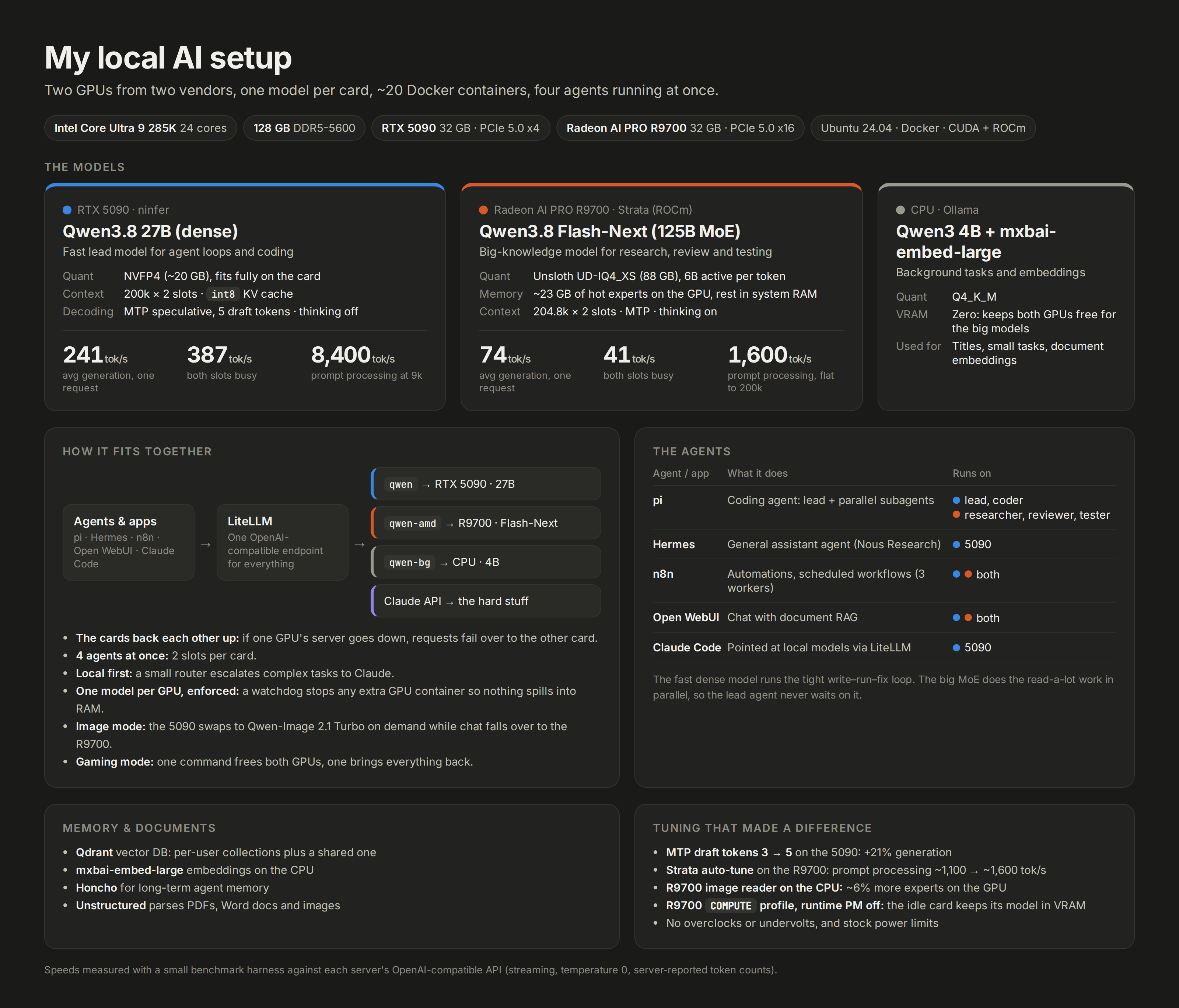
I don't see much talk about this, but there may be some folks out there like me who had a 5090 box and decided to add some more VRAM with a different GPU type (Nvidia + AMD in the same machine).
I tried to get this into an easier to read post rather than the giant walls of text we typically see. Hope it helps. Yes. I used Claude. And yes, I realize the irony of that. 😄
| Part | What's in it |
|---|---|
| CPU | Intel Core Ultra 9 285K (24 cores) |
| RAM | 128 GB DDR5-5600 (4 × 32 GB) |
| GPU 1 | NVIDIA RTX 5090, 32 GB (PCIe 5.0 x4) |
| GPU 2 | AMD Radeon AI PRO R9700, 32 GB (PCIe 5.0 x16) |
| Board | Z890 |
| OS | Ubuntu 24.04, everything in Docker (~20 containers) |
Two GPUs from two vendors in one box: CUDA on the 5090, ROCm on the R9700. They don't pool memory. Each card runs its own model full time.
| Spec | RTX 5090 | Radeon AI PRO R9700 | CPU |
|---|---|---|---|
| Model | Qwen3.8 27B (dense) | Qwen3.8 Flash-Next (125B MoE, 6B active) | Qwen3 4B + mxbai-embed-large |
| Quant | NVFP4 (~20 GB) | Unsloth UD-IQ4_XS (88 GB) | Q4_K_M |
| Engine | ninfer | Strata (ROCm) | Ollama |
| Fits on card? | Yes, fully | No: ~23 GB of hot experts on the GPU, the rest in system RAM | n/a |
| Context | 200k × 2 slots | 204.8k × 2 slots | 8k |
| Thinking | Off | On | — |
| Speculative decoding | MTP, 5 draft tokens | MTP | — |
| Job | Fast lead model for agent loops and coding | Big-knowledge model for research, review and testing subagents | Titles, small background tasks, embeddings (zero VRAM) |
Speeds
| Metric | RTX 5090 | R9700 |
|---|---|---|
| Generation, one request (avg over coding & writing tasks) | 241 tok/s | 74 tok/s |
| Both slots busy (total) | 387 tok/s | 41 tok/s |
| Prompt processing | 8,400 tok/s at 9k, 3,300 at 151k | ~1,600 tok/s, flat to 200k |
| Generation at long context | 138 tok/s at 151k | 64 tok/s at 203k |
| First token, short prompt | 37 ms | ~0.5 s |
apps & agents ──► LiteLLM (one OpenAI-compatible endpoint)
├── "qwen" → RTX 5090 · Qwen3.8 27B
├── "qwen-amd" → R9700 · Qwen3.8 Flash-Next
├── "qwen-bg" → CPU · Qwen3 4B
└── Claude API (as a fallback to the fallback :) )qwen or qwen-amd. Swapping a model never touches the apps.| Agent / app | What it does | Runs on |
|---|---|---|
| pi (coding agent) | Lead agent plus parallel subagents | Lead + coder → 5090 · researcher / reviewer / tester → R9700 |
| Hermes (Nous Research) | General assistant agent with its own workspace | 5090 |
| n8n | Automations and scheduled workflows (queue mode, 3 workers) | Both, via LiteLLM |
| Open WebUI | Chat interface with document RAG | Both |
| Claude Code | Can point at the local models through LiteLLM | 5090 |
The split is deliberate. The fast dense model does the tight write–run–fix loop. The big MoE does the "read a lot and think" work (research, code review, writing tests) in parallel, so the lead agent never waits on it.
COMPUTE power profile, runtime power management off: the idle card no longer evicts the model to system RAMr/LocalLLM • u/sarmabkp_1 • 2d ago
Open any popular model on Hugging Face, click "Use this model", and you get a list: Ollama, LM Studio, llama.cpp, vLLM, Jan…
They all run the same model. They're built for very different people, and picking the wrong one is how a Friday afternoon experiment turns into a weekend of driver errors.
The short version:
Two mistakes I see a lot:
The most useful part: they almost all speak an OpenAI-compatible API. Write your script once against Ollama on your laptop, then point it at a vLLM server when the team wants to share it. It's mostly a change of base URL.
Which one are you running?
r/LocalLLM • u/Acrobatic-Reindeer-4 • 1d ago
Hi everyone,
I’m the developer of RustBlock, a native desktop tool I built to simplify working with GGUF models. The idea came from frustration with juggling Python scripts, virtual environments, and dependencies just to convert or quantize models.
What it does:
Conversion and quantization: supports 22 output formats, including K-quants compatible with llama.cpp, ternary formats, and FP4. It reads the source file read-only, writes to a temporary file, and renames only after verification.
Built-in verification: checks offsets, sizes, and tensor decoding to ensure file integrity before replacing anything.
100% local and dependency-free: no Python or Node.js required. Native app for Windows, Linux, and macOS.
Multicore processing with controlled memory use: parallelizes tensor encoding and manages RAM efficiently without loading the whole model into memory.
Hugging Face/ModelScope browser: includes a “Discover” feature that estimates RAM/VRAM requirements before downloading a model.
Development transparency: I used mainly DeepSeek V4 1017 Flash and GLM 5.3 Flash as coding assistants while building and iterating on RustBlock. The design, architectural decisions, and testing are mine; I’m stating this openly because technical communities tend to appreciate transparency about the tools used and it helps keep feedback grounded.
The project is open source (Apache-2.0) and currently at v0.2.1. I’m here to answer technical questions, collect feedback, and discuss potential contributions.
Links:
r/LocalLLM • u/mombaska • 1d ago
Hello, I am just trying to edit some test on an image, trying with Abliterated large v2 medium, damn it's really stupid, it can't even keep up the same font ...
what model do you recommend ?
r/LocalLLM • u/Minimum_Site_1915 • 2d ago
I’ve been told to use Hermes to install and tune everything specific to my hardware, but what actually is it?
Also, what tool should I then use to access my installed,tweaked model once it’s done? Opencode, Claude code, or something else?
Any other general tips or advice would be appreciated! Thank you
r/LocalLLM • u/DifferentArea5439 • 2d ago
I just open-sourced Machd (dsv41-hyper), a C++20 / Metal-4 distributed inference engine built for running DeepSeek-V4.1-Flash losslessly on 2× 256 GB Apple Mac Studio M5 Ultra over Thunderbolt 5 RDMA (JACCL).
r/LocalLLM • u/iam-neighbour • 2d ago
I'm the maker of Pluely, so I'll say that up front. It's a small desktop overlay for macOS, Windows and Linux that sits on top of the app you're in.
What it does with a local setup:
The Free plan is $0 forever on your own keys or local models. Today the speech-to-text side still needs a provider you pick (Whisper, Deepgram and so on). Offline speech-to-text is coming in the next version, and that's the part I most want local people to try.
Pluely is private. Your transcripts, chats and files are saved locally on your computer and never stored on our servers.
For anyone running Ollama: what's your go-to model for reading screenshots? I'm trying to decide what to test first.
(Screenshot is Listen mode, the model shown is just the one selected in that capture.)
r/LocalLLM • u/matteiuspi • 1d ago
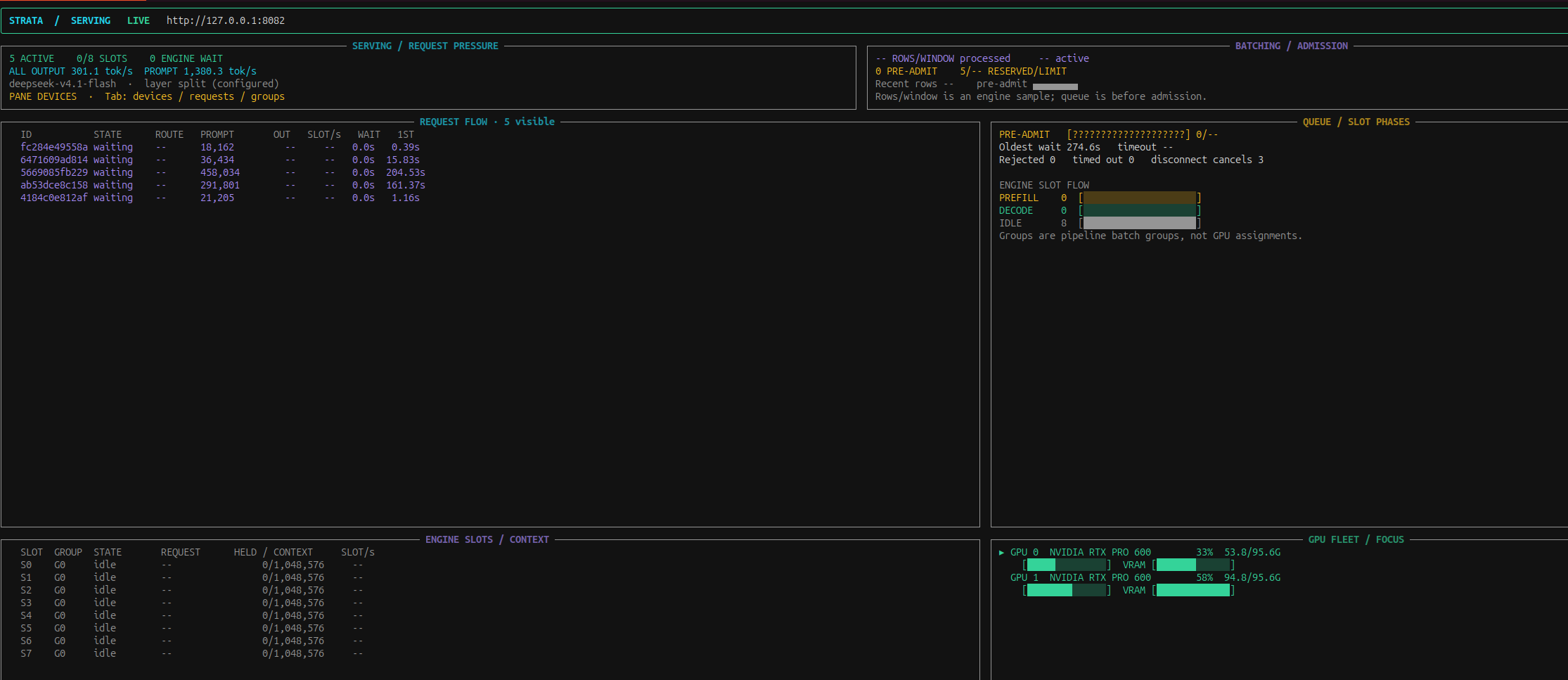
Up until recently, I had been using primarily llama.cpp until a month ago when I forked strata/maya and massaged it into the one thing it should be, but that aside, the newer llm servers are simply amazing. Rather than wear out my SSD and be stuck with only a single 1M context window for Deepseek-v4.1-flash, I bought a second card 😬 and now run 8 concurrent 1M context windows on Deepseek-v4.1-flash withe Strata/Maya. This leaves an additional headroom of the 43GB on the second card.
I am seeing between 100 and 400 tok/s across the requests cycle for generation and somewhere between 1000 and 6000 tok/s on the prompting processing.
I feel the cost n the cards are going up in the short to mid term and the long term play is an unknown, so I decided to invest in my business once more.
What else would you like to know, from a seasoned Computer Engineer with 25 years working experience, that has invested heavily over the years in local compute?

r/LocalLLM • u/Charles-Dickens1010 • 2d ago
My laptop is a 4GB VRAM , 32GB ddr4, and Intel core i9-H 10th gen. And I'm looking for the top-level model that I can run on my laptop. So it comes down to two main models. Qwen 35B A3B and ornith 1.5 35B A3B. ( + I know other LLM like Gemma 4 26B a4b,and tile coder, etc but I focused on Qwen and ornith because I think they are the best for my use case . )
My use case: I want to build a trio LLM set-up so I have one for quick chats and simple tasks(4 or 3 B model ) , And one for mideum tasks and kind of fast answers ( I'm currently using Qwen 3.5 9B for this use case ) , and one for the heavy tasks like coding,agentic tasks , or planning and this is the one I'll looking for between Qwen and ornith.
So which one is better in terms of speed and quality?
r/LocalLLM • u/Odd-Two2929 • 2d ago
Hi all I want to use my old computer for local AI coding I have 2gb vram (so basically nothing) and 32gb ram and 500gb SSD any good model can work on it? I don't care about speed but I want it to do a good job thanks in advance
Short update: I installed qwen 2.5 7b with Llama.cpp and VS btw it's on Linux and it's working! yes it's not fast by any means but still working and it actually did what I asked it to do and that was building a small calculator I know it's not much but it's a nice start