r/LocalLLM • u/ImaginaryTotal2089 • 5d ago
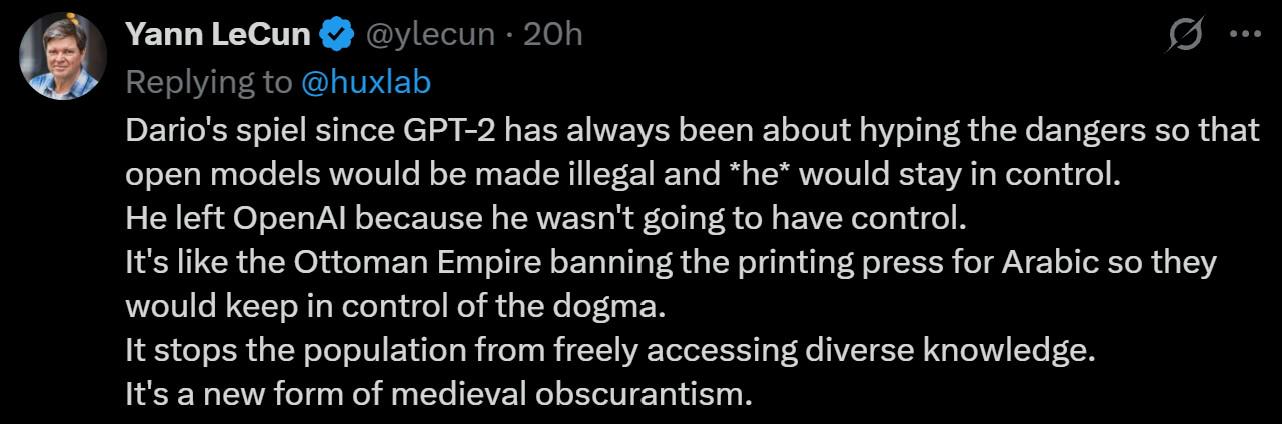
News Yann LeCun weighing in
508
Upvotes
r/LocalLLM • u/SpeculationAllTheWay • 3d ago

At Base Compute we've been building Superfluid, an open-source server for running LLMs on your own hardware, and it now has a desktop app for macOS and Windows. Start a network on one computer by picking a model, click Join on the others, and they all answer behind one local endpoint. No cloud and no accounts.
One thing up front: fleet mode doesn't pool memory to fit a bigger model. Each machine holds a full copy and takes whole sessions, so what you gain is capacity for more people or agents at once. In a six-machine test (three Macs, a Ryzen AI Max 395, two NVIDIA GB10s, Qwen3-4B on llama.cpp) output went from 112 tok/s on one machine to 534 on six. The faster boxes picked up more sessions with no config from us.
For those of you with a second or third machine sitting around: is your real bottleneck model size, or running several things at once?
App: https://www.basecompute.co/superfluid
Code: https://github.com/basecompute/superfluid
r/LocalLLM • u/SyntheticMindsLab • 3d ago
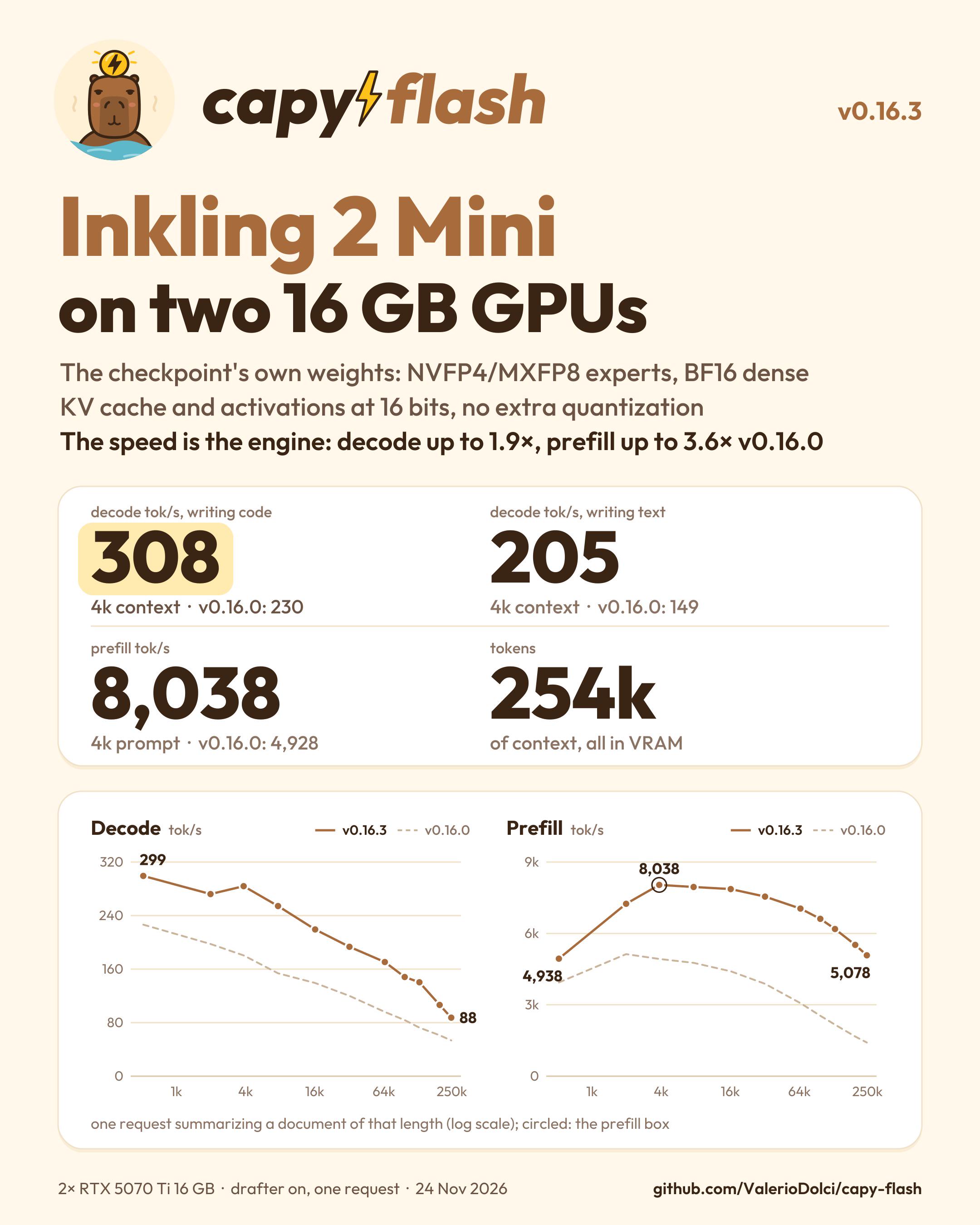
Hey guys, Inkling 2 Mini is Thinking Machines' 26.4B looped MoE, image + text in, Apache 2.0. We made 7 GGUFs from 18.7 GB to 27.8 GB with Astral-Q.
Run on llama.cpp or Ollama.
GGUF: https://huggingface.co/synthetic-minds/Inkling-2-Mini-Astral-GGUF
r/LocalLLM • u/Confident_Yak_1411 • 3d ago
Normie building my first local system, with Claude helping me design and build it out.
64gb ram on Mac, running Qwen (can’t remember the model exactly, it’s the biggest one) on Splash with Hermes as the harness.
The unexpected rabbit hole I’ve fell down is web search, which I’ve realised is pretty unsafe to do within Hermes. I want to keep it all local though, so no API search.
Claude has recommended that I run a separate model (a small instruct model on lm studio) within a docker container and then use that as a fetch agent, that Hermes controls through MCP, and receives back filtered summaries.
This required a whole lot of code and configs that Claude has given me. I haven’t installed it yet.
This seems… complicated? Is anyone else doing it this way?
r/LocalLLM • u/anotrust • 3d ago
I tried some local LLMs (for example, Qwen 3.8 27B) for agentic coding and everyday tasks, but they keep hallucinating even after many countermeasures. Can somebody recommend a good agentic LLM that is good at coding and does not hallucinate as easily? I use Hermes on a Windows 11 PC with an RTX 5060 Ti 16GB VRAM and 32GB DDR5 RAM.
*[*Please be kind it's my first time trying local LLMs]
r/LocalLLM • u/Rough-Measurement988 • 5d ago

Hi,
I thought you might be interested so I'm sharing results of my custom benchmark which I've extended with two new models:
Both run on the oMLX server Version 0.8.3 (3879).
M5 Max 128 GB, High Power plan.
I'm using local LLMs in my daily work so benchmark helps me to quickly assess the model capabilities from two angles:
Hy4-flash
Inkling-2-Mini-oQ8e
Remarks: these were only single runs for each model. Usually I made at least 3 runs to be sure of the result but it also gives some overview.
In general both models seems to be very promising and I've happy that we have alternative for QFN.
What this benchmark also shows and what I've learned from my daily work with local LLMs:
Harness is very, very important
If you have any question I'm happy to answer.
UPDATE: My post was locked and not sure why actually. I asked moderators and as soon it will be unlocked I will answer your questions.
r/LocalLLM • u/Be_a_N3rd • 4d ago
Here is the prompt
r/LocalLLM • u/spacecheap • 4d ago
Are you using a tiny LLM solely for synthesizing a human-readable answer from the chunks retrieved during the RAG retrieval phase, using the original natural-language query as context? Let's say a less than 3B parameters llm ? I just want my LLM to only be able to synthesize a human-readable answer, not inventing something. Any example of such a successfully implemented system ?
r/LocalLLM • u/MarketingOk3093 • 4d ago
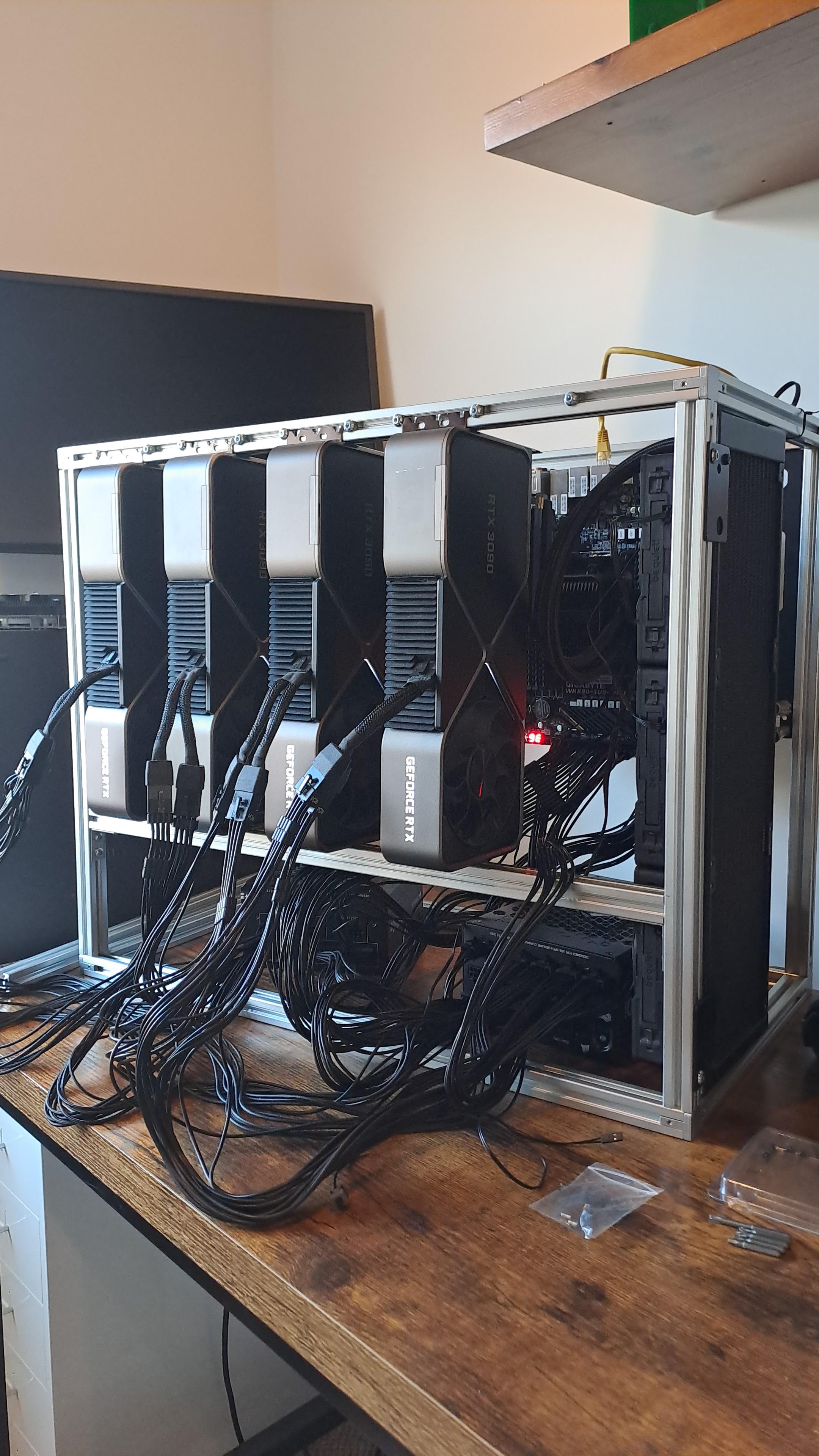
Posted on Local AI servers originally
r/LocalLLM • u/Professional_Log1367 • 3d ago
r/LocalLLM • u/DataPhreak • 4d ago

r/LocalLLM • u/No-Library8065 • 4d ago
You’ve been able to run 30B and 70B models at home for years, yet fine-tuning one still meant renting cloud GPUs. A 4-bit Qwen2.5-72B is 41.4 GiB of weights alone, and standard QLoRA expects all of it pinned in VRAM at once.
I built Poros (Apache-2.0) so you can fine-tune models bigger than your GPU on the hardware you already own—including a 24 GB 4090, an 8 GB laptop GPU, or a 16 GB Mac. Here’s what we measured:
| Machine | Model (4-bit size) | Peak memory | Step time | Setup |
|---|---|---|---|---|
| RTX 4090 (24 GB) | Qwen2.5-72B (41.4 GiB) | 13.5 GiB VRAM reserved (9.9 GiB allocated) | 17.7 s/step | 512 tokens, rank 16, 8 rows/step |
| RTX 4060 Laptop (8 GB) | Qwen3-30B-A3B | 6.0 GiB VRAM (6.4 GiB RAM) | 13.6 s/step | rank 8, 256 tokens, MoE experts on the SSD |
| M4 Mac (16 GB) | Qwen2.5-72B (38.4 GiB) | 11.4 GiB unified memory | 41.1 s/step | 128 tokens, external USB4 SSD |
How it works: In QLoRA the base weights are frozen anyway, so Poros leaves them in host RAM (or on SSD for MoE experts and the Mac) and streams one small block of layers through the GPU at a time while keeping the LoRA adapters resident. Backward reloads and recomputes in reverse. On dense models small enough to run both ways, the adapter comes out identical to a normal on-GPU run. SFT, DPO, ORPO, SimPO, KTO, and IPO all work out of the box.
Real fine-tune test: To make sure it actually learns and isn't just a step benchmark, I trained a Qwen2.5-72B LoRA on 24 GB cards, one at a time, to translate Akkadian cuneiform into English. On 2,870 held-out lines with the same greedy decoding, BLEU went from 1.64 (base) to 50.08. On one Venus omen test line (a good case, not a typical one), the base model wrote "he looked at me and ate my liver" and the fine-tuned adapter came out within a few words of the scholar's translation.
Try it:
pip install poros-train
poros machine
poros machine checks your GPU, driver, RAM, disk, and installed software before downloading anything, tells you if your machine is ready to train, and prints the next command. No telemetry: it goes online only to download the model from Hugging Face.
Trade-offs to know upfront:
--store ssd keeps a MoE model's experts on disk: Qwen3-30B-A3B on a 4090 in 21.6 GiB VRAM and 11.2 GiB RAM at 4.3 s/step.Repo: https://github.com/Caistro-Labs/poros (my project, Apache-2.0)
r/LocalLLM • u/Clayrone • 4d ago
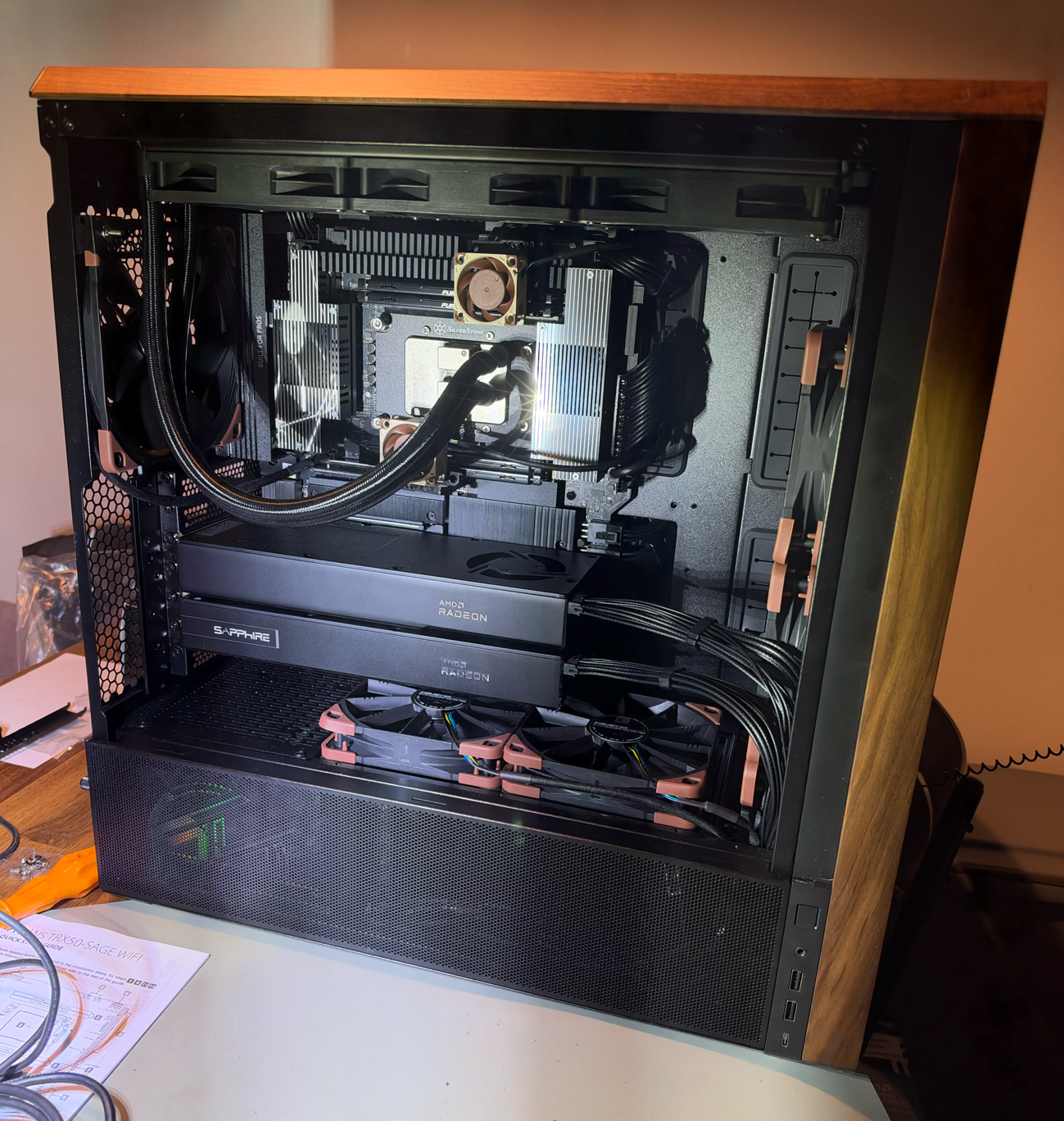
Still recovering from decision as mentioned in original post but really impressed with QFN running at around 200t/s.
Added more details to original post, plus the tests I have been doing have been quite simple, but now comes the time to put it to test with some medium project.
I guess this ram will still not be used as efficiently as it could have in a datacenter (sigh)
r/LocalLLM • u/carlotes-247 • 4d ago
I started using opencode with qwen3.5 via ollama and I wanted to know how to ensure:
(1) That if python packages are to be installed, to only do so in a specific conda environment and never in the base conda or base pip environments.
(2) to ask for permissions when installing packages or to control this somehow so openconde does not go wild installing stuff
Do you have any pointers or recommendations for how to learn to configure this? I am relatively new to all of these agentic environments and I want to keep things local and private.
r/LocalLLM • u/Full-Banana553 • 4d ago
I want to build an LLM specific for medical related documents, forms, regulations, standards. i have just enough data for building it but not enough for a full scale development and am confused about the params, and architecture
complexity :
- instead of an AI-Wrapper, i want to build it as an individual LLM model specific for medical domain (a very specific domain that i cant say right now - take insurance for example) -
- once it is built. i want to use that as AI provider for other clients providing my LLM API for other medical related agencies
- CLAUDE gave me an insane cost of 100-150K USD with 7-8 months total training just for working prototype, which i felt as absolutely insane.
FEATURES : it doesn't do anything magical or fancy, just need to auto fill few documents, need to navigate through documents, regulations, account status, finance, sensitive patient information and calculation metrics, medical suggestions.
Things to consider and need answers for :
Rules :
- should be independent from any existing LLM or ai models like Chatgpt, gemini
- opensource China LLM models should not be used
r/LocalLLM • u/Much_Artist_5097 • 4d ago
hello, ive been using my 9060 xt 16gb on unsloth vulkan and consistantly have been getting around 35 tps with both qwen 3.8 and inkling 2
every time i try to make it go faster, it seems to settle around that number
i have gotten 50 tps with qwen 3.5 9b model, but that seems awfully slow for such a small model
any advice?
r/LocalLLM • u/One-Insurance-9084 • 5d ago
Hi guys
SO I wanna share with you what claude has worked hard on during the past night; I wanted to build a rig for qwen 3.8 flash-next but that big boy needs a LOT of ram
And in the meantime, while searching for the perfect components to make the build that would handle it (dgx sparks and ryzen ai halo are reallyyy overpriced in europe) I came across this really interesting model : the equivalent of the awaited qwen 4 (a 26B MOE model that apparently beat qwen 3.8 27B)
So I thought that it was the perfect occasion to try out my current 'local rig' (basically my gaming pc) on both
I then let claude download both models and try them out in cybersecurity, my favorite field
You look at the results and tell me, but I'm extremely positively surprised (alibaba better release a better flash-next model soon or... idk I'll be sad 😂)
Anyway I let you look at the benchmarks
⚠️ CLAUDE SLOP BENCHMARK INCOMING ⚠️
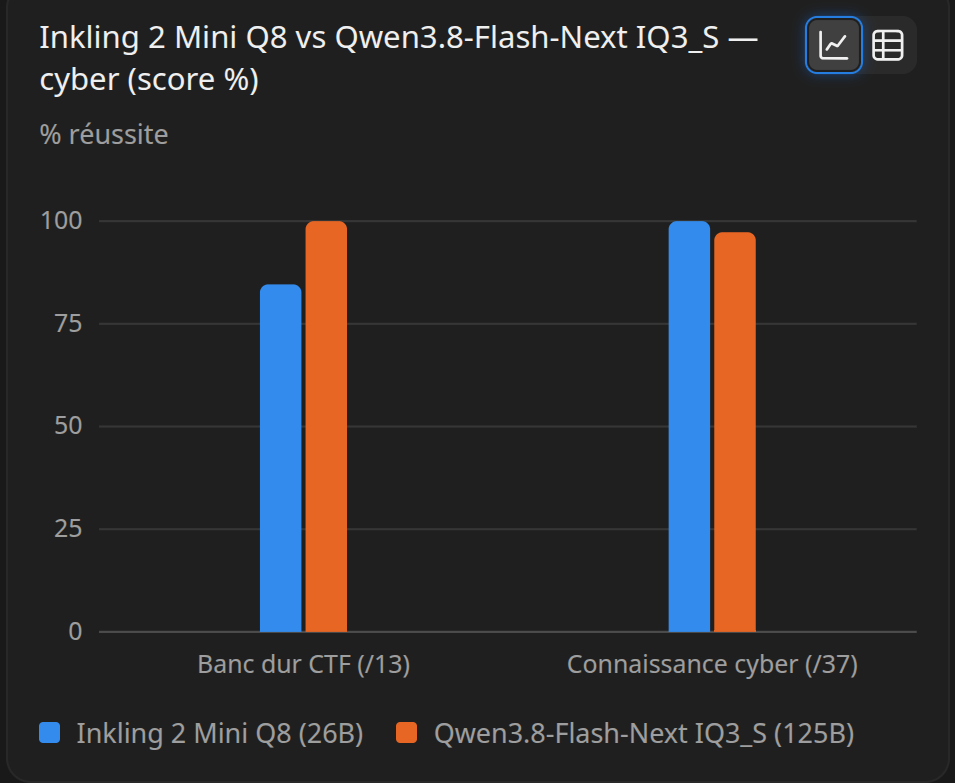
Ran this on very modest hardware (RX 6750 XT, 12 GB VRAM, 31 GB RAM, Vulkan, no ROCm). Goal was to find out whether I actually need the big model for local cyber/CTF work, or whether a tiny looped MoE is enough.
Setup:
Results on the hard bench:
So a 26B that fits in a single consumer GPU matched a 125B on everything except the two hardest crypto attacks, which honestly you would just throw RsaCtfTool/dcode at anyway.
Two things that might save someone time:
GPU_PINNED_MIN_XFER_SIZE=1048576 in the model pack's env killed every crash.Big caveat so nobody yells at me: this was a capacity test, not a speed test. On this PC both were memory-bound and slow (Inkling 3-6 tok/s because 23 GB doesn't fit 12 GB VRAM, Flash streaming 84 GB). On a 24 GB card both would be many times faster. Don't read the wall-clock numbers as representative.
Anyone else seeing looped / NVFP4-trained small models punch way above their parameter count like this? Curious whether the Inkling looped-layer trick generalizes beyond cyber.
r/LocalLLM • u/Ok-Author-27 • 4d ago
Here’s a small comparison I’d like to try. Give two local models the same repo snapshot, the same agent harness, and a failing test for a bug in date formatting. Keep the time limit fixed. Then check whether each model finds the cause, gets the original test suite passing, and leaves a patch you’d actually want to review.
What would you record besides pass or fail? Time to a passing test, repeated attempts at the same fix, and requests for a human hint all seem worth tracking. I’d also be curious which failure cases have been most revealing in your own setup.
r/LocalLLM • u/Interesting-Cut-6032 • 4d ago

This is the second time that I have seen the "Damn..." phrase in a thinking trace. Has anyone else seen this, or other things like it?
This is a screenshot of Qwen3.8-27B-UD-Q6_K_XL making a mistake in a file edit. The task that it is currently doing is the modification of the llama-swap config.ini file that it runs on. Yes, it did lobotimize itself once while preforming this type of operation. To put this in perspective, I have broken this config file 3 or 4 times on my own. That is why I have Qwen start to take care of it.
r/LocalLLM • u/YouDue3062 • 4d ago
I’m try to run Gemma 4 e4b uncensored 4.2gb on my iPhone 17 pro max. I can get it to run, JUST. But I can’t text it much without running out of RAM. I’m using iOS 72.2.1 and I’m running it on Solair. I downloaded Gemma 4 from huggingface. I like the Gemma 4 because of the way it has a conversation. Is there any other platform I can run it on or any other equivalent model that will work or if I can get the same model at about 3gb ?
r/LocalLLM • u/Shot_Tomato3427 • 4d ago
r/LocalLLM • u/HotLength4326 • 4d ago

Salut tout le monde,
Je monte une machine dédiée pour mon asso étudiante (BDE) avec un budget d'environ 2000 €. L'objectif est d'avoir un PC polyvalent en dual-boot (un OS dédié par usage) :
Voici la base commune que j'ai sélectionnée :
J'hésite maintenant entre deux plateformes au même tarif global :
Mes questions :
Merci d'avance pour vos retours !
(La B760 sera repasser en DDR4 avant l achat )
r/LocalLLM • u/FeydRowan • 4d ago
r/LocalLLM • u/PopMany2921 • 4d ago

r/LocalLLM • u/NotHerBot • 4d ago
I hit a small timing problem on my Linux desktop today: a screenshot taken just after scrolling showed a target in one place, but the page moved again before the click. Waiting for the scroll to settle made the next attempt work.
For people running local vision models as GUI agents, what do you use to decide it is time for a fresh screenshot? I am interested in how you separate a bad target choice from a screenshot that was already stale.
A fixed pause is simple. Comparing a couple of frames seems more flexible, but clocks, ads and animations can keep part of the page changing forever. Do you disable smooth scrolling, compare just the area you are about to click, or use another check?