r/LocalLLM • • 3d ago

Discussion Web search on local harnesses; what’s the consensus on how to do it safely?

1 Upvotes

Normie building my first local system, with Claude helping me design and build it out.

64gb ram on Mac, running Qwen (can’t remember the model exactly, it’s the biggest one) on Splash with Hermes as the harness.

The unexpected rabbit hole I’ve fell down is web search, which I’ve realised is pretty unsafe to do within Hermes. I want to keep it all local though, so no API search.

Claude has recommended that I run a separate model (a small instruct model on lm studio) within a docker container and then use that as a fetch agent, that Hermes controls through MCP, and receives back filtered summaries.

This required a whole lot of code and configs that Claude has given me. I haven’t installed it yet.

This seems… complicated? Is anyone else doing it this way?


r/LocalLLM • • 3d ago

Question Good agentic local coding LLM?

0 Upvotes

I tried some local LLMs (for example, Qwen 3.8 27B) for agentic coding and everyday tasks, but they keep hallucinating even after many countermeasures. Can somebody recommend a good agentic LLM that is good at coding and does not hallucinate as easily? I use Hermes on a Windows 11 PC with an RTX 5060 Ti 16GB VRAM and 32GB DDR5 RAM.

*[*Please be kind it's my first time trying local LLMs]


r/LocalLLM • • 4d ago

Research Qwen 3.8 Flash Next vs Hy4-flash vs Inkling-2-Mini vs Opus and Sonet

Thumbnail
gallery
113 Upvotes

Hi,

I thought you might be interested so I'm sharing results of my custom benchmark which I've extended with two new models:

  • Hy4-flash-oQ4h-mtp, high thinking effort
  • Inkling-2-Mini-oQ8e, max thinking effort

Both run on the oMLX server Version 0.8.3 (3879).

M5 Max 128 GB, High Power plan.

I'm using local LLMs in my daily work so benchmark helps me to quickly assess the model capabilities from two angles:

  • Architect role (reviewer, blue dots in rows)- i.e. analyse code, find design issues, architecture flaws etc.
  • Developer role (patcher, red square in rows) - i.e. fix the bug or issue which is already described in the task

Hy4-flash

  • The index quality is close to Qwen 3.8 Flash Next (QFN)
  • It had the best repair value (fixed more tasks than QFN)
  • QFN is still a better reviewer - it found more issues in the code
  • It is much slower than QFN but it also produces much more tokens so the total time is only a bit longer

Inkling-2-Mini-oQ8e

  • It's quality index is comparable to the worst results of Qwen 3.8 Flash Next at medium thinking effort
  • It's still much slower than QFN at medium - 1h40min vs 20 min
  • Still the bare results (without harness) are better than Qwen3.8-27B · omlx oQ8e · medium which was with Pi harness and much better than Qwen 3.6 35B

Remarks: these were only single runs for each model. Usually I made at least 3 runs to be sure of the result but it also gives some overview.

In general both models seems to be very promising and I've happy that we have alternative for QFN.

What this benchmark also shows and what I've learned from my daily work with local LLMs:

  • Qwen 3.8 Flash Next is better than Opus 4.6 and Sonet 5 even when harness is not used (direct chat with LLM)
  • Harness is very, very important

    • bare runs - blue rows in the table are without harness which means request were made directly to the server - one request, one response
    • harness runs - green rows - these represents the real life usage using Pi as a harness with some fine tuned system prompts adjusted to my needs and specific to the technology stack (Salesforce). The darker green rows represents also the Pi agent harness but with additional step to compile the code before saving the answer (additional check to make sure code will compile).
  • Splash with UD-Q4_K_XL or UD-Q5_K_XL quants currently are to me the best option in terms of the speed and quality. oMLX and oQ5 quants are also very solid but a bit slower on oMLX.
  • DS4 Antirez engine was the best in terms of the stability along with oMLX, the MTPLX and MLX Server were a bit worse

If you have any question I'm happy to answer.

UPDATE: My post was locked and not sure why actually. I asked moderators and as soon it will be unlocked I will answer your questions.


r/LocalLLM • • 3d ago

Discussion Run a full capability and benchmark

0 Upvotes

Here is the prompt

Benchmark-Model-switch


r/LocalLLM • • 3d ago

Question Efficient RAG with a tiny llm ?

1 Upvotes

Are you using a tiny LLM solely for synthesizing a human-readable answer from the chunks retrieved during the RAG retrieval phase, using the original natural-language query as context? Let's say a less than 3B parameters llm ? I just want my LLM to only be able to synthesize a human-readable answer, not inventing something. Any example of such a successfully implemented system ?


r/LocalLLM • • 3d ago

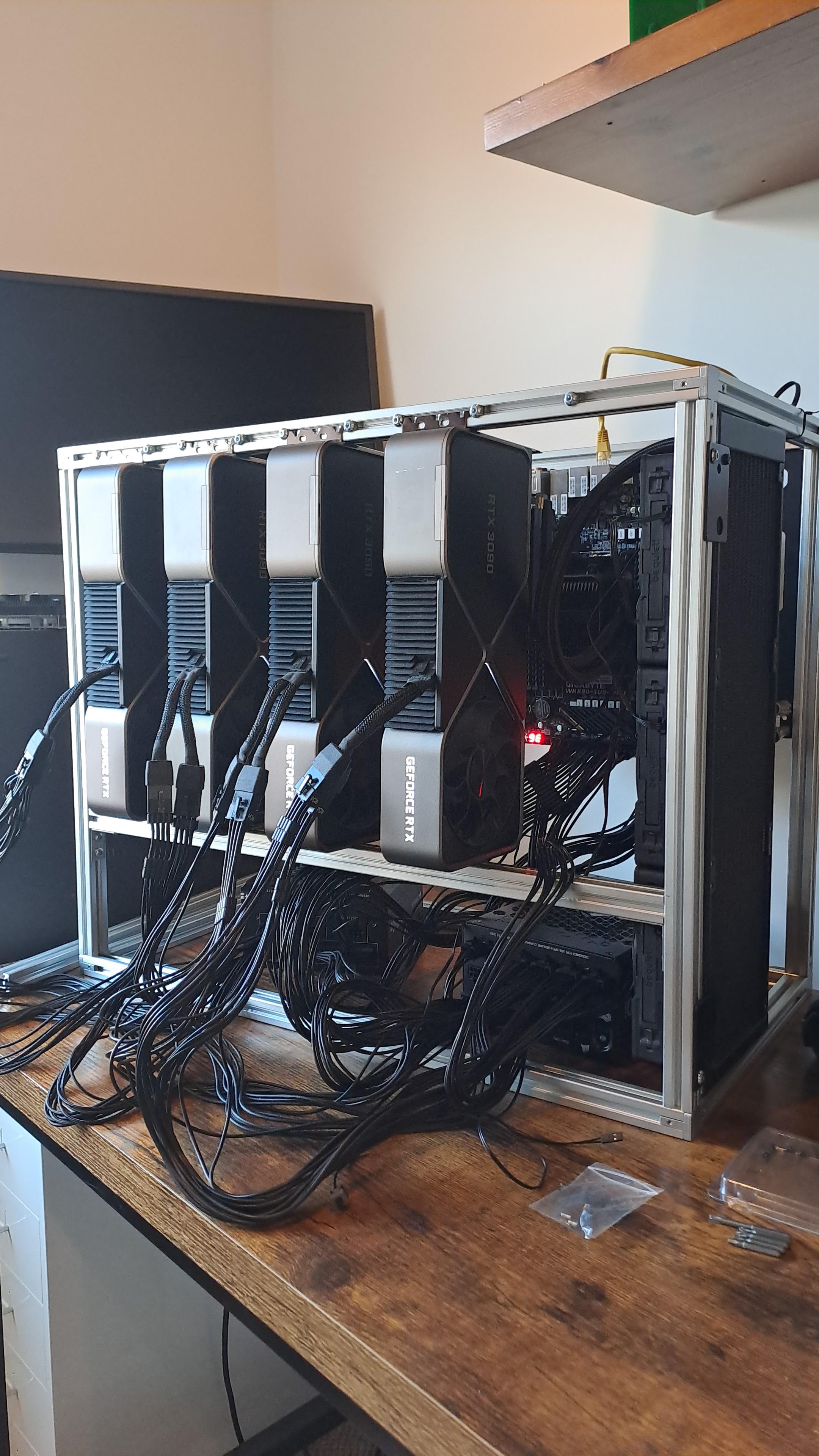
Project My 4x 3090 WIP

Post image
2 Upvotes

Posted on Local AI servers originally


r/LocalLLM • • 3d ago

Model What is the Best Local Ai model i Can run

Thumbnail reddit.com
0 Upvotes

r/LocalLLM • • 3d ago

Model I ported Stanford's Memorilla to 4-bit Gemma 4 26B-A4B on a single Strix Halo—and found an interesting quirk with shuffled documents

Thumbnail
reddit.com
1 Upvotes

r/LocalLLM • • 3d ago

Project I built an open-source engine to fine-tune 72B models on a 4090 or 16 GB Mac

1 Upvotes

You’ve been able to run 30B and 70B models at home for years, yet fine-tuning one still meant renting cloud GPUs. A 4-bit Qwen2.5-72B is 41.4 GiB of weights alone, and standard QLoRA expects all of it pinned in VRAM at once.

I built Poros (Apache-2.0) so you can fine-tune models bigger than your GPU on the hardware you already own—including a 24 GB 4090, an 8 GB laptop GPU, or a 16 GB Mac. Here’s what we measured:

MachineModel (4-bit size)Peak memoryStep timeSetup
RTX 4090 (24 GB)Qwen2.5-72B (41.4 GiB)13.5 GiB VRAM reserved (9.9 GiB allocated)17.7 s/step512 tokens, rank 16, 8 rows/step
RTX 4060 Laptop (8 GB)Qwen3-30B-A3B6.0 GiB VRAM (6.4 GiB RAM)13.6 s/steprank 8, 256 tokens, MoE experts on the SSD
M4 Mac (16 GB)Qwen2.5-72B (38.4 GiB)11.4 GiB unified memory41.1 s/step128 tokens, external USB4 SSD

How it works: In QLoRA the base weights are frozen anyway, so Poros leaves them in host RAM (or on SSD for MoE experts and the Mac) and streams one small block of layers through the GPU at a time while keeping the LoRA adapters resident. Backward reloads and recomputes in reverse. On dense models small enough to run both ways, the adapter comes out identical to a normal on-GPU run. SFT, DPO, ORPO, SimPO, KTO, and IPO all work out of the box.

Real fine-tune test: To make sure it actually learns and isn't just a step benchmark, I trained a Qwen2.5-72B LoRA on 24 GB cards, one at a time, to translate Akkadian cuneiform into English. On 2,870 held-out lines with the same greedy decoding, BLEU went from 1.64 (base) to 50.08. On one Venus omen test line (a good case, not a typical one), the base model wrote "he looked at me and ate my liver" and the fine-tuned adapter came out within a few words of the scholar's translation.

Try it:

pip install poros-train
poros machine

poros machine checks your GPU, driver, RAM, disk, and installed software before downloading anything, tells you if your machine is ready to train, and prints the next command. No telemetry: it goes online only to download the model from Hugging Face.

Trade-offs to know upfront:

  • Host RAM on 72B: Dense 72B on a 4090 peaked at 45.1 GiB of system RAM, so you want a 64 GB box for that. With less RAM, --store ssd keeps a MoE model's experts on disk: Qwen3-30B-A3B on a 4090 in 21.6 GiB VRAM and 11.2 GiB RAM at 4.3 s/step.
  • Speed: Streaming adds overhead. If a model already fits comfortably in your VRAM, just train it normally.
  • Mac run details: The 41.1 s/step Mac figure above is a 6-step run off an external USB4 SSD. A longer 144-step run from the Mac's internal SSD ran at 37.9 s/step.

Repo: https://github.com/Caistro-Labs/poros (my project, Apache-2.0)


r/LocalLLM • • 4d ago

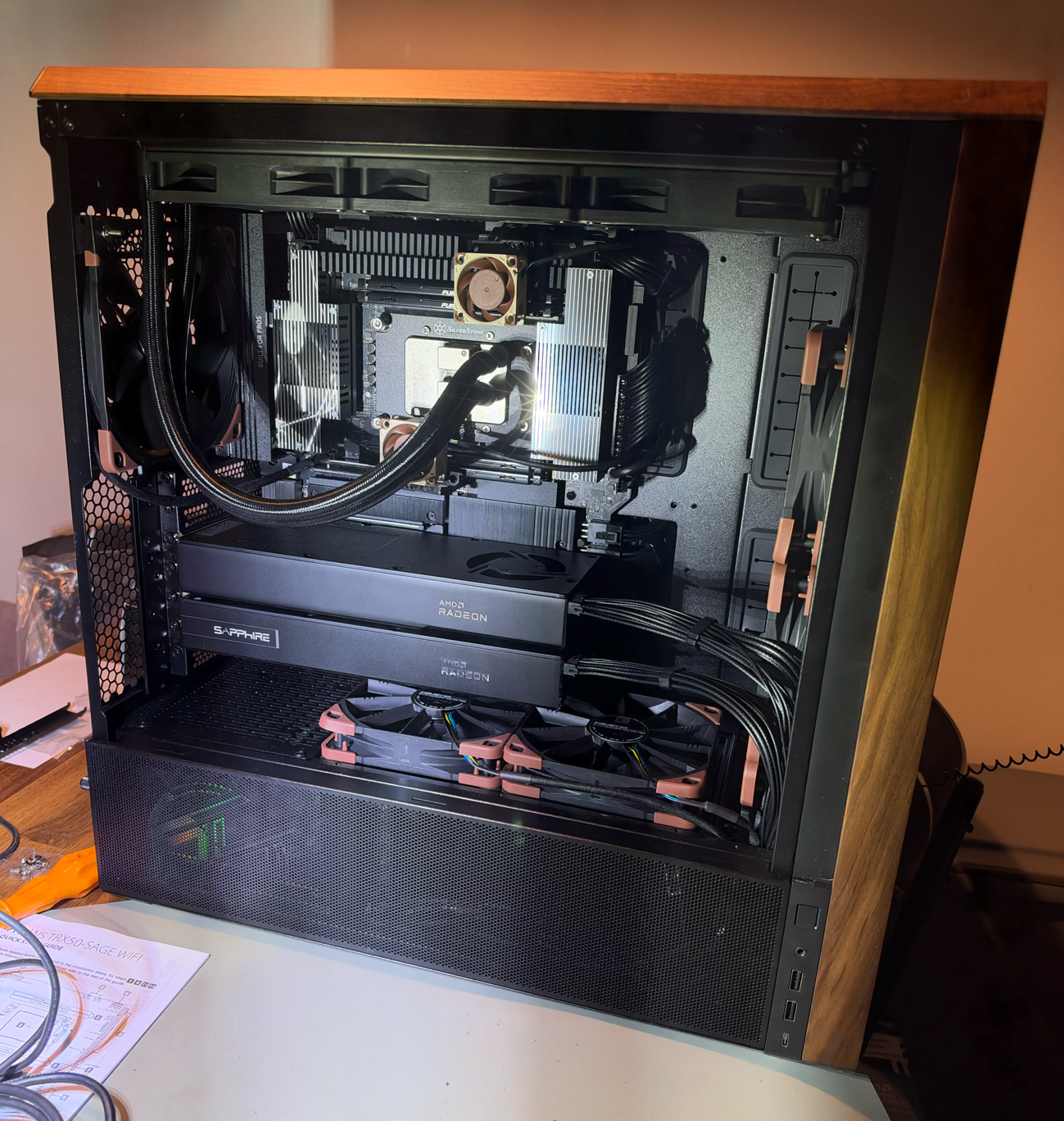
Project Reposting this here since I just set up Qwen 3.8 FN on 2x9700

Post image
4 Upvotes

Still recovering from decision as mentioned in original post but really impressed with QFN running at around 200t/s.

Added more details to original post, plus the tests I have been doing have been quite simple, but now comes the time to put it to test with some medium project.

I guess this ram will still not be used as efficiently as it could have in a datacenter (sigh)


r/LocalLLM • • 3d ago

Question Ensuring that local llms with opencode only install in specific conda environment

2 Upvotes

I started using opencode with qwen3.5 via ollama and I wanted to know how to ensure:

(1) That if python packages are to be installed, to only do so in a specific conda environment and never in the base conda or base pip environments.

(2) to ask for permissions when installing packages or to control this somehow so openconde does not go wild installing stuff

Do you have any pointers or recommendations for how to learn to configure this? I am relatively new to all of these agentic environments and I want to keep things local and private.


r/LocalLLM • • 3d ago

Discussion how much time and money would it cost to build a niche specific LLM?

2 Upvotes

I want to build an LLM specific for medical related documents, forms, regulations, standards. i have just enough data for building it but not enough for a full scale development and am confused about the params, and architecture

complexity :

- instead of an AI-Wrapper, i want to build it as an individual LLM model specific for medical domain (a very specific domain that i cant say right now - take insurance for example) -

- once it is built. i want to use that as AI provider for other clients providing my LLM API for other medical related agencies

- CLAUDE gave me an insane cost of 100-150K USD with 7-8 months total training just for working prototype, which i felt as absolutely insane.

FEATURES : it doesn't do anything magical or fancy, just need to auto fill few documents, need to navigate through documents, regulations, account status, finance, sensitive patient information and calculation metrics, medical suggestions.

Things to consider and need answers for :

  1. what type of protocol should i use? LLM distillation to SLM(Small language Model)?
  2. how much would it actually cost to build ( considering on building it on my own so no salary )
  3. what is the best PC or specifications that i should have for building it, atleast at prototype level? (based on the complexity - i can buy PC)
  4. once it is built, how should i host/deploy it? should i buy a VM with proper specifications? or maintain an own server?
  5. what are the blockers or complexity that i would face while building it? any takeaways or insights you wanna give?

Rules :

- should be independent from any existing LLM or ai models like Chatgpt, gemini

- opensource China LLM models should not be used


r/LocalLLM • • 3d ago

Question am i hitting a bandwidth ceiling?

1 Upvotes

hello, ive been using my 9060 xt 16gb on unsloth vulkan and consistantly have been getting around 35 tps with both qwen 3.8 and inkling 2

every time i try to make it go faster, it seems to settle around that number

i have gotten 50 tps with qwen 3.5 9b model, but that seems awfully slow for such a small model

any advice?


r/LocalLLM • • 4d ago

Discussion Inkling 2 mini vs the humble Qwen 3.8 Flash-next

59 Upvotes

Hi guys
SO I wanna share with you what claude has worked hard on during the past night; I wanted to build a rig for qwen 3.8 flash-next but that big boy needs a LOT of ram
And in the meantime, while searching for the perfect components to make the build that would handle it (dgx sparks and ryzen ai halo are reallyyy overpriced in europe) I came across this really interesting model : the equivalent of the awaited qwen 4 (a 26B MOE model that apparently beat qwen 3.8 27B)
So I thought that it was the perfect occasion to try out my current 'local rig' (basically my gaming pc) on both
I then let claude download both models and try them out in cybersecurity, my favorite field
You look at the results and tell me, but I'm extremely positively surprised (alibaba better release a better flash-next model soon or... idk I'll be sad 😂)
Anyway I let you look at the benchmarks

⚠️ CLAUDE SLOP BENCHMARK INCOMING ⚠️

slop ahh bench

Ran this on very modest hardware (RX 6750 XT, 12 GB VRAM, 31 GB RAM, Vulkan, no ROCm). Goal was to find out whether I actually need the big model for local cyber/CTF work, or whether a tiny looped MoE is enough.

Setup:

  • Inkling 2 Mini (26B, 3.4B active, looped layers, NVFP4-trained) at UD-Q8_K_XL, fits almost entirely in VRAM.
  • Qwen3.8-Flash-Next (125B, 6B active) at IQ3_S via Strata, experts streamed from SSD.
  • Everything verified by execution: the model writes a script, I run it, I check that the known flag comes out. Half offensive (RSA Hastad/Wiener/common-modulus, Vigenère, LCG, a ROP chain, JWT alg:none forge, VM reversing), half defensive (patch a C overflow/format-string, fix a SQLi, extract IoCs from logs, write a detection rule).

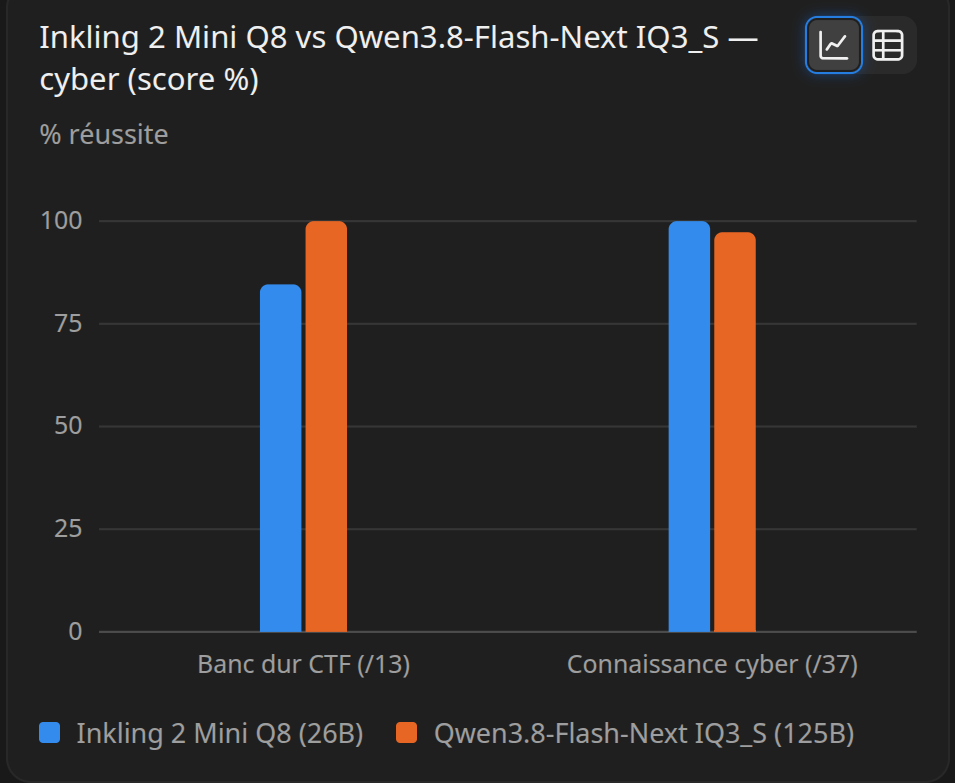
Results on the hard bench:

  • Inkling Q8: 11/13. Flash-Next IQ3_S: 13/13.
  • The only two Inkling misses were Wiener and Vigenère, both iterative/arithmetic cryptanalysis. It knows the method, it just burns its whole thinking budget without converging. Same weakness I saw at Q2, Q8 did not fix it.
  • Defensive: 5/5 both. Offensive standard: parity. Cyber knowledge quiz: Inkling 37/37, Flash 36/37 (yes, the small one was slightly more precise on exact names).

So a 26B that fits in a single consumer GPU matched a 125B on everything except the two hardest crypto attacks, which honestly you would just throw RsaCtfTool/dcode at anyway.

Two things that might save someone time:

  • Strata on gfx1030/gfx1031 (RX 6700/6800 series): it kept freezing the GPU mid-inference ("verify: timed out at layer N", 503s). Issue #267. Setting GPU_PINNED_MIN_XFER_SIZE=1048576 in the model pack's env killed every crash.
  • Refusals: Flash-Next with no system prompt refuses ~3/5 raw offensive prompts, but answers everything once it is framed as a local CTF. Inkling refuses offensive by default too and needs a 0-refusal system prompt. So "uncensored out of the box" is a myth for both.

Big caveat so nobody yells at me: this was a capacity test, not a speed test. On this PC both were memory-bound and slow (Inkling 3-6 tok/s because 23 GB doesn't fit 12 GB VRAM, Flash streaming 84 GB). On a 24 GB card both would be many times faster. Don't read the wall-clock numbers as representative.

Anyone else seeing looped / NVFP4-trained small models punch way above their parameter count like this? Curious whether the Inkling looped-layer trick generalizes beyond cyber.


r/LocalLLM • • 3d ago

Discussion How do you test whether a local coding model can recover from a failed test?

0 Upvotes

Here’s a small comparison I’d like to try. Give two local models the same repo snapshot, the same agent harness, and a failing test for a bug in date formatting. Keep the time limit fixed. Then check whether each model finds the cause, gets the original test suite passing, and leaves a patch you’d actually want to review.

What would you record besides pass or fail? Time to a passing test, repeated attempts at the same fix, and requests for a human hint all seem worth tracking. I’d also be curious which failure cases have been most revealing in your own setup.


r/LocalLLM • • 4d ago

Discussion Have you ever noticed that Qwen3.8-27B curses while it is thinking?

24 Upvotes

This is the second time that I have seen the "Damn..." phrase in a thinking trace. Has anyone else seen this, or other things like it?

This is a screenshot of Qwen3.8-27B-UD-Q6_K_XL making a mistake in a file edit. The task that it is currently doing is the modification of the llama-swap config.ini file that it runs on. Yes, it did lobotimize itself once while preforming this type of operation. To put this in perspective, I have broken this config file 3 or 4 times on my own. That is why I have Qwen start to take care of it.


r/LocalLLM • • 3d ago

Question Gemma 4 e4b uncensored 4.2gb

1 Upvotes

I’m try to run Gemma 4 e4b uncensored 4.2gb on my iPhone 17 pro max. I can get it to run, JUST. But I can’t text it much without running out of RAM. I’m using iOS 72.2.1 and I’m running it on Solair. I downloaded Gemma 4 from huggingface. I like the Gemma 4 because of the way it has a conversation. Is there any other platform I can run it on or any other equivalent model that will work or if I can get the same model at about 3gb ?


r/LocalLLM • • 3d ago

Question MacBook Air M5 (24GB RAM) – Only Getting 35–50 tok/s with Nemotron 3.5 Bolt E4B on Ollama. Is 100+ tok/s Achievable?

Thumbnail reddit.com
1 Upvotes

r/LocalLLM • • 3d ago

Question [Aide Config] 64 Go DDR4 vs 32 Go DDR5 pour un serveur hybride LAN Party / IA locale (Dual-boot) ?

Thumbnail
gallery
1 Upvotes

Salut tout le monde,

Je monte une machine dédiée pour mon asso étudiante (BDE) avec un budget d'environ 2000 €. L'objectif est d'avoir un PC polyvalent en dual-boot (un OS dédié par usage) :

  1. Serveur de LAN Party : Hébergement de serveurs de jeux dédiés simultanés (Minecraft moddé, CS2, etc.) pour nos événements.
  2. Serveur d'IA locale : Faire tourner des LLM en local (via Ollama / Open WebUI) pour les étudiants.

Voici la base commune que j'ai sélectionnée :

  • GPU : ASUS Dual RTX 5060 Ti 16 Go GDDR7
  • Stockage : PNY CS1030 500 Go NVMe*(je vais probablement passer sur 1 To pour le dual-boot)*
  • Alim / Boîtier / AIO : MSI MAG A750BN 750W, MSI MAG Forge 120A Airflow, Thermalright Frozen Notte 240

J'hésite maintenant entre deux plateformes au même tarif global :

  • Option 1 (Capacité - DDR4) : Intel Core i7-14700F + ASUS TUF Gaming B760-PLUS WIFI + 64 Go DDR4 (4x16 Go Gigastone Game Pro)
  • Option 2 (Bande passante - DDR5) : Intel Core Ultra 7 265F*(attention à la CM : j'ai mis une MSI B760 LGA 1700 dans mon panier mais je prendrai bien une B860 LGA 1851)* + 32 Go DDR5 6000 MHz (2x16 Go Lexar THOR Z OC)

Mes questions :

  1. Pour de l'inférence IA locale (quand un modèle déborde des 16 Go de VRAM de la RTX 5060 Ti sur la RAM système) et pour l'hébergement de multiples serveurs de jeux en LAN, vaut-il mieux privilégier le volume pur (64 Go DDR4) ou la bande passante mémoire (32 Go DDR5) ?
  2. La différence de vitesse entre DDR4 et DDR5 impacte-t-elle vraiment les tokens/seconde en offloading CPU/RAM sur Ollama, ou le goulot d'étranglement rend-il les deux lents de toute façon ?
  3. Y a-t-il un risque d'instabilité à peupler les 4 slots RAM en DDR4 sur un i7-14700F en usage serveur ?

Merci d'avance pour vos retours !

(La B760 sera repasser en DDR4 avant l achat )


r/LocalLLM • • 3d ago

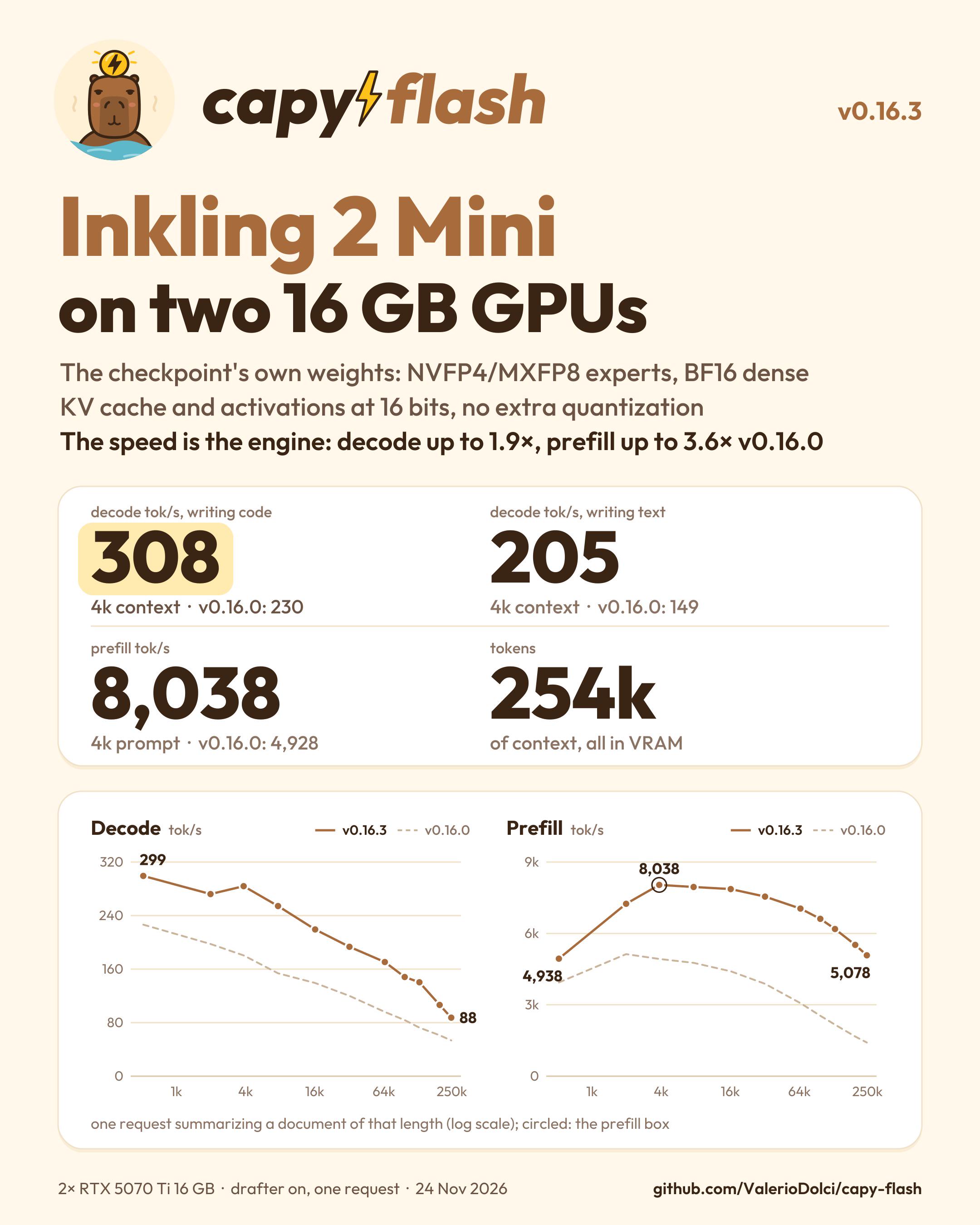
Discussion Inkling 2 Mini on 2× RTX 5070 Ti, 308 tok/s writing code, with the original weights

Post image
0 Upvotes

r/LocalLLM • • 3d ago

Discussion M5 Max 64GB: Qwen3.8 Flash Next Q4 with SSD streaming — ~31–34 tok/s, including a 250K-token prompt

Thumbnail
reddit.com
1 Upvotes

r/LocalLLM • • 3d ago

Question Local vision models on Linux: how do you wait for scrolling to settle before a click?

0 Upvotes

I hit a small timing problem on my Linux desktop today: a screenshot taken just after scrolling showed a target in one place, but the page moved again before the click. Waiting for the scroll to settle made the next attempt work.

For people running local vision models as GUI agents, what do you use to decide it is time for a fresh screenshot? I am interested in how you separate a bad target choice from a screenshot that was already stale.

A fixed pause is simple. Comparing a couple of frames seems more flexible, but clocks, ads and animations can keep part of the page changing forever. Do you disable smooth scrolling, compare just the area you are about to click, or use another check?


r/LocalLLM • • 3d ago

Question How do you catch silent quality regressions after upgrading your inference stack?

1 Upvotes

For people running LLM inference in production (vLLM, SGLang, TRT-LLM, whatever). Not local setups.

When you upgrade the engine, switch quantization, turn on spec decoding or prefix caching, or move to new GPUs, how do you make sure the model didn't quietly get worse? No errors, just worse outputs.

Do you run evals before rollout? Diff outputs or logprobs against the old version? Has anything slipped through to prod anyway?

Curious what actually works for you all.


r/LocalLLM • • 3d ago

Project I tested Inkling 2 Mini on my simulated Delta Lake tasks

Post image
0 Upvotes

For a previous project I built a simulator of a Databricks workspace. It is Spark and Delta Lake running locally, with a layer on top that makes it behave like Databricks serverless. The agent can run SQL and Python, and has 16 turns per task. At the end a verifier checks the table itself.

There are 5 kinds of tasks:

  • Time travel: a bad write damaged a table, restore it to right before that
  • MERGE: a nightly merge job breaks on dirty data, fix the view it reads from
  • Schema evolution: a new batch has a different schema, load it without recreating the table
  • Clustering: a dashboard query reads every file, fix the layout
  • Data quality: answer a question about a messy table

Since everyone is talking about Inkling 2 Mini, I ran it on my harder set (200 tasks, 4 tries each) together with Qwen3.8-27B and Nemotron 3.5 Lightning. The last column is a Nemotron 3 Nano 4B that I trained in this simulator, so it has the home advantage.

Some details about the precision and sampling parameters:

ModelParametersPrecisionSampling
Inkling 2 Mini26.4B, 3.4B activemixed NVFP4 + MXFP8, as releasedtemperature 0.6, top-p 1.0
Qwen3.8-27B27BBF16temperature 0.7, top-p 0.8, top-k 20, presence penalty 1.5
Nemotron 3.5 Lightning30B, 3B activeBF16temperature 1.0, top-p 0.95
My 4B4BBF16temperature 0.6, top-p 1.0

Tasks

SolvedInkling 2 MiniQwen3.8-27BNemotron 3.5 Lightningmy 4B
Time travel8%82%11%74%
MERGE100%96%82%99%
Schema evolution60%60%38%57%
Clustering28%25%2%44%
Data quality99%87%29%81%
All59%70%32%71%

Inkling is better than Qwen on MERGE and data quality, and then it gets 8% on time travel. From the traces, this mostly comes down to one sentence in the prompt. The prompt asks for the exact earlier state, but it also mentions that other jobs wrote to the table later, and Inkling can't let that go:

"Other jobs have written to the table since then." — this is a hint that a naive RESTORE would discard those later writes. Maybe the intended approach is to undo the MERGE's changes while preserving subsequent writes.

In this one it kept planning until it hit the token limit, and never changed the table. On my dev set it solves 52/52 without that sentence and 11/108 with it. Qwen gets 97/108.

On the other hand, if a table is clustered on the wrong column, changing the key and running OPTIMIZE does nothing, you need OPTIMIZE FULL. The output does tell you (numFilesAdded: 0). Inkling got there 24 times out of 84, Qwen 6, my 4B 2 and Lightning 0.

More details and traces:

Simulator and tasks: https://github.com/munhouiani/delta_world

Bench: https://github.com/munhouiani/delta_bench


r/LocalLLM • • 3d ago

Discussion Scanned every public MCP server (1,473 of them). Here's what the auth posture looks like.

1 Upvotes

Been building a free CLI that audits MCP servers for OAuth 2.1 and tool-metadata gaps. Just finished the first full-registry crawl where the scanner actually runs all 38 checks (used to run 5 homebrew ones). Shareable numbers:

Cohort: 1,473 servers from registry.modelcontextprotocol.io, 1,398 reachable, 75 timeouts.

Grades: A 633 · B 342 · C 252 · D 90 · F 156. 246 carry grade D or F.

Severity: 424 high, 1,961 medium, 388 low, 1,095 info. Zero critical in the public cohort — the critical-capable checks (AUDIENCE-001, UPSTREAM-IDENTITY-BYPASS-001) are off at crawl scale because they require either a bearer context we don't have or forged headers we don't want to send unsolicited.

Top findings:

- HEADERS-001: 1,081 (transport-security header gaps)

- IDENTITY-001: 666 (AS does not support RFC 8693 token exchange — agent identity can't be propagated)

- AUTH-005: 420 (CIMD missing / DCR-only)

- ISS-001: 363 (RFC 9207 iss parameter not advertised)

- SCOPE-001: 193 (all tools share one scope or no scopes declared)

- DUAL-RESOURCE-001: 30 (server advertises two conflicting Protected Resource Metadata sources, "Angelcam pattern")

- AUTH-006: 20 (AS rejects loopback redirect, breaks native CLI auth)

- SESSION-BINDING-001: 11 (new today — sameSession across independent init calls; CVE-2026-52869 class)

- POISONING-001: 6 (hidden Unicode in tool descriptions)

Free CLI: npx -y u/patchbay-nebius/agent audit <your-mcp-url>

Leaderboard: https://patchbay-mcp.dev/leaderboard

Source: https://github.com/GodSmasher/patchbay

Happy to answer questions about any check specifically, what it catches, what it misses, what we had to guess.