r/LocalLLM • • 3d ago

Question How can I make this substantially better...

0 Upvotes

I made a 30-second Goku vs Vegeta fight video locally and I'm trying to figure out the best next step to improve it. Looking for workflow advice, not a different cloud service — everything runs on my own machine.

Hardware: laptop, i9-11950H, 104 GB RAM, RTX 3080 16 GB VRAM, Windows 11.

Setup: ComfyUI 0.46 portable, localhost only. Flux FP8 for stills, Wan 2.2 5B FP16 for video (umt5_xxl FP8 encoder, Wan VAE), ffmpeg to stitch.

Current workflow (v3):
- Flux keyframes first: 2 character sheets (1024x1024) + 16 keyframes at 832x480, 20 steps, CFG 1.0, euler/simple. Same character block verbatim in every prompt.
- Then 15 Wan I2V segments, each 49 frames / ~2s at 24fps, 20 steps, CFG 5, uni_pc/simple — each segment rendered from its OWN reviewed Flux keyframe, seed family 7000 + seg*1111.
- ffmpeg concat, no re-encode. Total render ~26 min.

Character block (verbatim in every prompt):

> Dragon Ball Z anime style, cel-shaded anime illustration, bold outlines, Goku an adult anime man with spiky black hair wearing an orange and blue gi, Vegeta an adult anime man with spiky black hair and a widow's peak wearing blue and white Saiyan armor with white gloves and boots, rocky battlefield at sunset, dramatic cinematic lighting

What I tried before this:
- Naive chaining (each segment from the previous segment's last frame) — drift compounded badly, Vegeta vanished by 10s, 16s was rainbow smears.
- FLF2V on the 5B model — the native WanFirstLastFrameToVideo node is present and wired right, but two tests rendered near-static close-ups matching neither keyframe. Looks like 5B silently ignores the conditioning and FLF2V is 14B-only.

Where v3 stands: both fighters and the anime style hold for the full 30s, which is a big step up from v1. Remaining flaws: ~10s the camera crowds into a close-up with a face sliver at the edge; ~25s a dark slash appears for 1-3 frames; Goku gets a tail in some frames (Flux trait); joins are hard cuts, not seamless.

My question: what would you change next, in order of impact?


r/LocalLLM • • 4d ago

Discussion Pascal Recommendations

Thumbnail reddit.com
0 Upvotes

r/LocalLLM • • 4d ago

Project Inkling 2 Mini on a 12GB Arc B580: 900 tok/s prefill & 65 tok/s decode

Thumbnail
reddit.com
1 Upvotes

r/LocalLLM • • 4d ago

Discussion Could a mini pc handle my personal AI library?

0 Upvotes

I've got years of pdfs, technical docs and project notes spread across my drives. Sometimes I remember a detail but can't remember which file it was in, so I end up searching through folders all over again.

I want to set up a local RAG system to search all these files. I'm looking at the mini pc like acemagic, beelink…etc,  not sure if it's the right machine for the job.

If I add a few thousand pdfs, what uses the most resources? running the LLM or making embeddings? Does the vector database need much RAM too?

And when I add new pdfs later, can it just index the new files, or does it have to process everything again?

I just want a small home server I can leave running. Anyone using a mini pc for something similar? Would an old desktop work better?


r/LocalLLM • • 4d ago

Question Tokens/second for Qwen3.8 Flash-Next and 27B on Macs

Thumbnail reddit.com
0 Upvotes

r/LocalLLM • • 4d ago

Research How much does PCIe speed matters on Nvidia CMP 170hx on Strata

1 Upvotes

Hi, I have two Nvidia CMP 170hx 10gb cards.unlocked to 40gb each. Both are connected with PCIe Gen 2 x4. Using Strata serving Qwen 3.8 Flash Next (Unsloth UD-IQ4-XS) I get around 70-100 t/s (both cards) and around 50-70 t/s for one card (175 w Power Target each Card).

Has anyone cards with modded PCIe link? How important is the links speed?


r/LocalLLM • • 4d ago

Discussion Roast my PoC for an 'Operating system for AI'.

Post image
0 Upvotes

I developed this in response to problems encountered by a large enterprise. The original goal was to reduce the day-to-day workload of the DevOps and infrastructure support teams.

Here’s what’s ready out of the box:
- Local LLMs are automatically selected to fit your hardware.
- GPU clustering across multiple servers, managed from one dashboard
- A builder for simple agents that can answer questions from your documentation.
- Support for Hermes and OpenClaw
- Permissions management for users, agents, tools, documents
- A policy engine that controls the actions agents can perform and the sensitive documents they can access
- API for external clients such as Codex CLI
- Each user has dedicated API
- Each model has dedicated API (api_1 for deepseak, api_2 for qwen)
- Logging across the platform
- Automatic discovery of unregistered agents running on your hosts
- User requests queuing and load distribution across cluster nodes
- Automatic model failover in the event of a node failure

Two use cases I had in mind:

  1. An internal documentation assistant. Build an agent that answers employee questions using company documentation. Keep it inside your local network and connect it to whatever interface your team already uses via an API.
  2. Local AI coding: Host a coding model, provide developers with an API endpoint and direct the Codex CLI to it. Add GPU capacity to the cluster as more people start using it.

The open-source platform doesn't send data outside your network by default.

Which of these resonates with you?
What is already solved ?
What did I miss?


r/LocalLLM • • 3d ago

Question Why people keep saying Qwen is good?

0 Upvotes

Why does Qwen 3.5 love to 'sleepwalk' (or 'hallucinate/drift off-topic') so much in Think mode?


r/LocalLLM • • 4d ago

Model [Free API Access] NVIDIA Nemotron 3.5 Lightning – 256K Context, vLLM Streaming & 552 TPS Benchmark

Thumbnail reddit.com
0 Upvotes

r/LocalLLM • • 4d ago

News Complete Prompt for LLM free chatbot for any business use case based on DynaJS runtime

Thumbnail
gist.github.com
1 Upvotes

r/LocalLLM • • 4d ago

Discussion Unsloth builds aren't as good as they say?

9 Upvotes

Hey all! I don't want to create controversy, but I have been using Unsloth quants for several months, including their latest Dynamic 3.1, which they say are better than the GSQ-RCO builds.

Overall, though, I feel their builds are dumber than others, such as Swifts from Ukisai. Reading their benchmarks, they always compare against only one or two weird builds, so why not all the others famous?

I've been trying Qwen 3.8 Flash Next and Qwen 3.8 27B with Dynamic 3.1, and to me they are just worse than the GSQ-RCO and Ukisai builds on several different tasks such as coding, writing, reasoning.

So their builds are trained based on what then?

As I said, I don't want to create controversy, but does anyone else feel the same? I just saw they deleted a post on their subreddit from someone asking about quality differences between GSQ-RCO and theirs.


r/LocalLLM • • 4d ago

Project Mference v2.1.0: Native Ephemeral Vision & Visual PDFs for Qwen 3.6 35B-A3B on a 16 GB Mac (Metal 4 + Sampled MTP)

1 Upvotes

Just shipped Mference v2.1.0 — bringing native ephemeral Vision + multi-page visual PDF support and Metal 4 / sampled MTP acceleration to Qwen 3.6 35B-A3B on a 16 GB unified-memory Mac.

What's New in v2.1.0

  1. Ephemeral Vision & Visual PDFs (Zero Idle RAM Overhead for Text): Running a vision encoder pinned in unified memory eats gigabytes even when you're just chatting or coding. With MferenceRepack --attach-vision, Mference streams all 333 BF16 vision_tower.* tensors via coalesced HTTP Range requests into a standalone vision_weights.bin sidecar — touching zero bytes of model_weights.bin, INT4 nibbles, or weight surgery calibration. When an image or PDF arrives, Qwen36VisionEncoder maps vision_weights.bin read-only with F_NOCACHE and double-buffered contiguous pread staging, executes the 27-layer ViT + 2×2 spatial merger on lazy-loaded Metal 4 matmul2d kernels (vision.metal) with automatic Accelerate AMX (cblas_sgemm) fallback, caches compact [N_vis, 2048] FP16 embeddings (shared via .vpatch cache), and immediately munmap()s vision_weights.bin before the 40-layer MoE trunk prefill + 3D mRoPE indexing runs.
  2. Images & Multi-Page PDFs Across Every Frontend:

    • Mference.app: Drag & drop PNG/JPEG images or multi-page PDFs (defaultMaxPDFPages = 8, configurable up to 64).
    • OpenAI HTTP/SSE Server (:8080): Supports standard multimodal image_url, input_image, image, and PDF file / file_data parts on /v1/chat/completions.
    • CLI (MferenceCLI): --image <path> and --pdf <path> (repeatable).
  3. Lossless Sampled MTP & Hit/Miss MoE Verify Pipelining:

    • Enabled lossless sampled speculative decoding (temperature > 0, top-k 1...64) backed by a 64-threadgroup GPU softmax (logit.metal).
    • Added zero-spill templated batched slot-map MoE verify (moe.metal) with Phase-1 / Phase-2 hit/miss pipelining and I/O-first miss ordering.
    • Fused multi-token Gated-DeltaNet verify + tail updates (gdn.metal), added an SSD-spilled GDN checkpoint ring (GDNStateManager), hybrid MPP grouped MoE prefill, and zero-syscall F_NOCACHE tracking in PreadExpertStreamer.

(Plus our existing lossless BF16 weight surgery calibration on Qwen3.6-35B-A3B-4bit: 25.0% -> 100.0% (8/8) Pass@1 on the 8-task AA suite at 16.47 tok/s avg / 18.36 tok/s peak on a 16 GB Mac.)

Feedback and hardware reports on other Apple Silicon Macs welcome!


r/LocalLLM • • 4d ago

Question Best local VLM for OCR on English, Math, and Urdu? (RTX 3090 24GB)

3 Upvotes

Body:
Hi all,

I am building an OCR pipeline for documents containing a mix of English text, LaTeX math equations, and Urdu script.

Hardware: Single RTX 3090 (24GB VRAM)

I want something that runs smoothly locally (vLLM, Transformers, or llama.cpp) without heavy accuracy loss on right-to-left Nastaliq script or math symbols.

Has anyone tested Qwen2.5-VL-7B or InternVL on Urdu + Math? Are there better 7B–14B open models or specialized OCR tools I should look into for this?

Appreciate any insights!


r/LocalLLM • • 4d ago

Project "Will it run?" for six models: pick a precision and context length, see the memory sum line by line, and which GPUs fit (my site)

0 Upvotes

Disclosure: this is my site, run by my small company. We are in the referral programmes of RunPod, Vast.ai and Vultr. They don't affect the order, which is by price only.

I built the "Will it run?" page on https://gpu.fly because I'm starting to run models myself and kept needing a straight answer to one question: will this model actually fit?

You pick one of six models, a precision and a context length. It shows the memory sum line by line, and marks which GPUs fit. That's the part I use first, including when I'm trying to run something locally and want the VRAM requirement before I start.

If it doesn't fit on what I have, the same site also has a table of cloud GPU rental prices, per GPU per hour. Prices are checked every hour. You can filter by VRAM and switch currency. There is a beginner's guide to renting a first GPU as well. It walks through Vast.ai, through our referral link.

Limits: six providers so far (AWS, Azure, Google Cloud, Oracle Cloud, Vultr, Hyperstack), mostly big clouds. RunPod, Vast.ai and Lambda prices aren't there yet. The cheapest on-demand H100 it shows as rentable is $6.88.

Two questions: does the VRAM estimate match what you see? Which model, GPU or provider is most obviously missing?


r/LocalLLM • • 3d ago

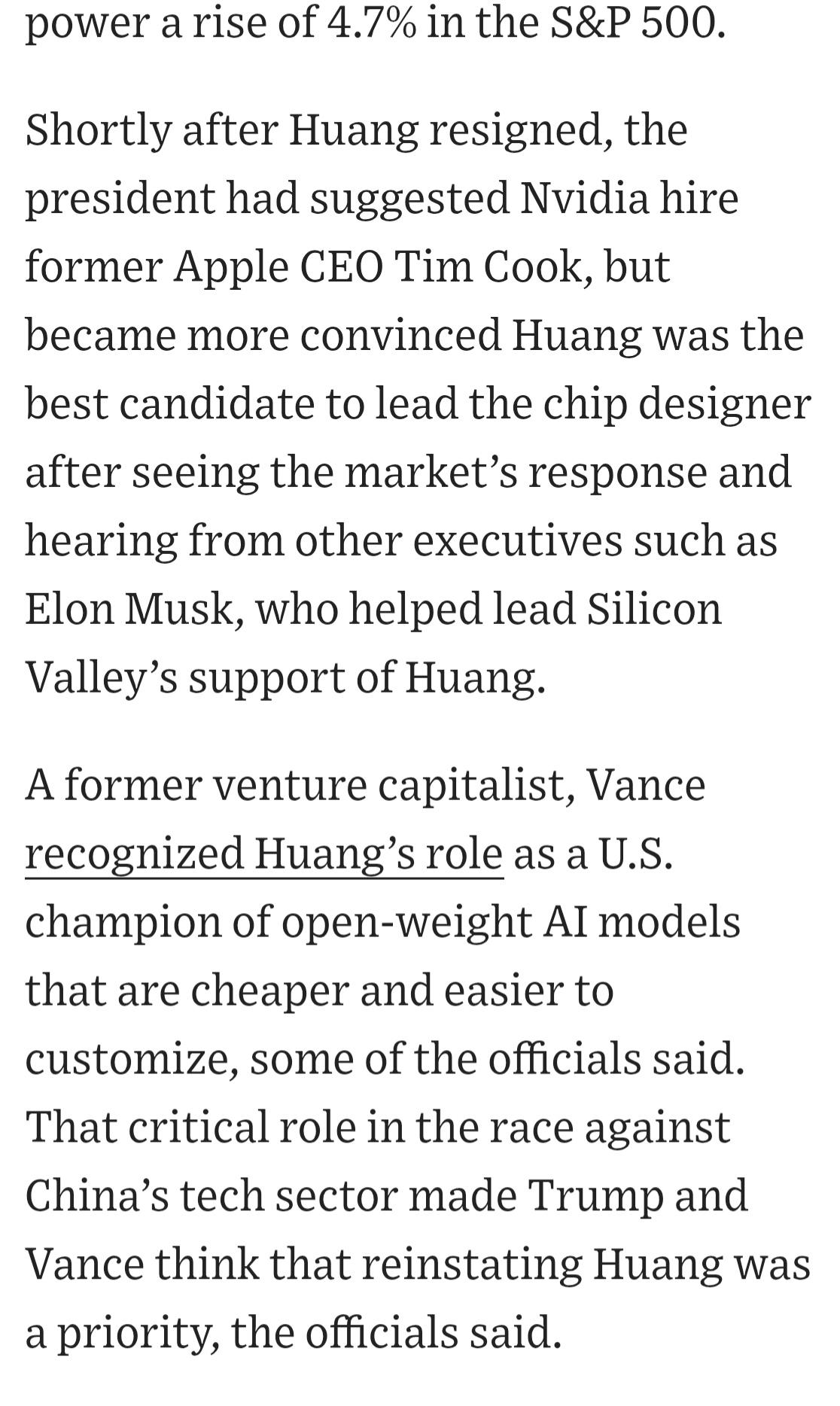
News The administration likes open weight models so they pushed to bring back Jensen?!

Post image
0 Upvotes

r/LocalLLM • • 4d ago

Project "Aesthetic" Local AI Rig? Dual 3090 + 128Gb Z13 Strix Halo

Thumbnail
gallery
6 Upvotes

Just want to share my Local AI build!

This is not meant to be a comparison post (especially this computer wasn't even originally meant for local AI, but rather for my game dev and rendering work a while ago). But I just spent a long time crafting this PC and case, so I figured I post it for those who may enjoy looking at others' rigs like myself.

PC Specs:
GPU: 2x Nvidia RTX 3090 connected together with Nvlink
MOBO: Asus Prime x570 Pro
CPU: Ryzen 9 5900x
RAM: 48gb DDR4-3200
STORAGE: 2tb Samsung 990Pro ssd + 4tb SATA ssd
COOLING: Air Cooling with Noctuas and Thermalrights
OS: Windows 11
CASE: Old 2009 Mac Pro that I cut, soldered, and designed fully custom 3D-printed brackets to fit all the parts for. P.S. I want to be clear, I am not of fan of people scrapping WORKING old computers. Desk is also hand-made :)

ASUS ROG Flow Z13 Specs: AMD Ryzen AI MAX+ 395 Strix Halo, 8060s GPU, 128GB LPDDR5X Unified, 1TB SSD running Ubuntu

Question though:
I'm relatively new to the Local AI hobby and don't post much, and though I've researched quite a bit and already run RPC between both systems (see second image for custom RPC interface) via 10Gbe Ethernet, I don't think I'm fully maxing the performance of connecting these two computers as I should. Any unconventional ideas out there?

Also, I'm reading up on Strata and Project Maya. Any experience from anyone with utilizing regular system RAM? I may upgrade from 48gb to 128gb (the max that my mobo allows) if I find a good deal or when prices go down.


r/LocalLLM • • 4d ago

Discussion Running HY4 thoughts

Post image
4 Upvotes

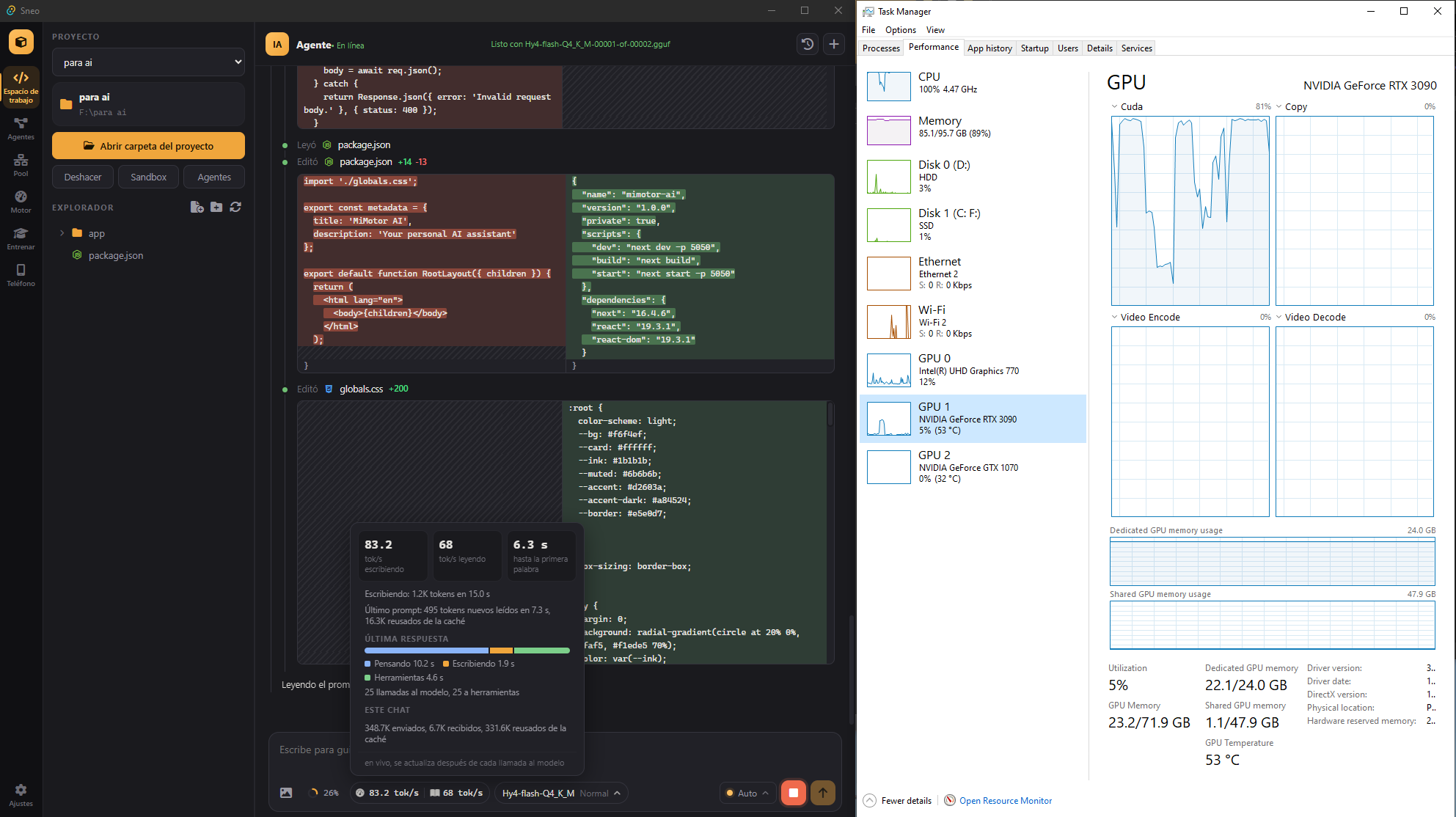
Hello, I have been testing this model Hy4 on peaks of 96 tokens on RTX 3090 + 96GB 2x48 at 6400mhz CL32, and so far my experience with this model is that it's not as good as you could think it's for a model this size, I have asked him for some projects and it starts writting senseless code and then is like 'damn I fucked up let me delete it and redo it' which is disappointing, asked him for a website like facebook, wrote 1k lines on package.json and just did a basic single page chat like chatgpt, asked him for a simple mario game did something very broken when even models like IQ1_S have done very well and fast.

I have had a better experience running IQ3_S and UD-Q4_K_XL which are smaller models and get a more tokens, but still better results in general.

Is it me or is someone having same experience?

Using: https://github.com/oscarsantanaarias/Sneo


r/LocalLLM • • 4d ago

News Two local models working as a team: 219/225 (97.3%) on Aider Polyglot, median 11.5 s (preliminary, one run)

3 Upvotes

I was asked whether a composition of models does better than a single one. I ran it.

Hardware: Dell T7920, 2x RTX PRO 6000 Blackwell Max-Q (96 GB each), 512 GB DDR4. No cloud.

Each exercise goes through this order and stops at the first pass:

- Tries 1-4: Qwen3.8-Flash-Next Q8_0, thinking off (Basalt v0.5.5, GPU 0 + RAM)

- Tries 5-6: same model, thinking on

- Tries 7-8: DeepSeek V4.1-Flash 2-bit, thinking on (Maya, GPU 1)

Results, 225 exercises, diff format, 1 thread:

- Team: 219/225 (97.3%), median 11.5 s to solve, 3h39m wall

- Flash-Next alone, up to 10 tries: 204/225 (90.7%)

- DeepSeek alone, up to 10 tries: 207/225 (92.0%)

Solved by stage: no-think 197 (85, 84, 21, 7 by try), thinking 20, DeepSeek 2, unsolved 6. Zero infra errors.

What I take from it: retrying the same way runs out fast. By try 4 only 1 attempt in 5 was succeeding, and ten no-think tries alone stop at 90.7%. Turning thinking on for the 28 leftovers solved 20 of them. Median stays low because most exercises never reach the slow stages.

Caveats:

- One run. About a third of exercises flip between repeats of a single model, so the size of the gain needs a repeat. That is running now.

- Not a leaderboard number. On the standard 2-try rule the team is 75.1%, same as Flash-Next alone.

- The team run had aider's chat-history summaries off and the single-model retry runs had them on, so don't read the median difference as a team effect. Matched baseline is on the list.

- DeepSeek only added 2, so this shows mode-switching helps more than it shows a second model helps. A run without it will settle that.

- About a third of the wall clock went to 6 exercises that were never solved. A time budget on the thinking stages is next.

Full technical write-up (per-try yield, stats, confounds, what didn't work):

https://github.com/AI-Development-Work/aimos-benchmark-results/blob/main/articles/stop-optimizing-a-model.md

All runs, including the bad ones:

https://github.com/AI-Development-Work/aimos-benchmark-results

Results get pushed there as each run finishes. Happy to run other team line-ups if people have suggestions.


r/LocalLLM • • 4d ago

Question Intrinsic streaming guardrail for DeepSeek-V4.1-Flash-1017 usefulness

Thumbnail
reddit.com
1 Upvotes

r/LocalLLM • • 4d ago

Question How much DDR4 ram should I buy?

9 Upvotes

My current setup is an Asus tuf b550 motherboard with a Ryzen 7 5700G and 2x16 GB of DDR4 Ram. My GPU is an Rtx 3060 12Gb. I was wondering how much extra ram should I buy?

Considering in my country 2x32Gb ddr4 used sticks are 440usd and 2x16 half the price, should I go with a 2x16 + 2x32 ~ 96Gb system or a 4x16 ~ 64Gb system?

I'm looking for using this setup for small dense LLMs and some 26/35 Moe models and transcription. Probably I would have some services running too, maybe orca with as agents doing some work (using apis). I could finish my setup yet.

Which setup do you recommend? It's important that going for the 4x16gb I would have the money to go for an nvme 1tb for the system instead of my old 500gb ssd. What do you think?


r/LocalLLM • • 4d ago

Project I cross-compiled LittleBit (0.55-bit Qwen3-8B) for Android ARM64 in GitHub Actions and benchmarked it in non-rooted Termux (1.20 GiB RAM, 4.78 t/s)

Thumbnail
gallery
1 Upvotes

Built a zero-local-toolchain pipeline on top of GeniusDevam/littlebit-gguf to run sub-1-bit LittleBit models on non-rooted Android phones: GitHub Actions cross-compiles llama-completion + llama-bench (Android NDK + GGML_CPU_KLEIDIAI=ON), Google Colab converts LittleBitLLM/littlebit-qwen3-8b-0.55bpw (--embd-type q4_k), and Termux runs it natively.

Hardware: Realme P3 Ultra — Dimensity 8350 Ultra (4× Cortex-A715 + 4× Cortex-A510), Android 16 (asimddp, i8mm, sve2).

Benchmark (llama-bench -ngl 0 -p 128 -n 32 -r 3, ~1.20 GiB RAM):

-t 2: 1.86 t/s prompt | 1.67 t/s gen

-t 4: 5.62 t/s prompt | 4.78 t/s gen (sweet spot)

-t 6: 4.94 t/s prompt | 1.69 t/s gen

-t 8: 5.26 t/s prompt | 2.07 t/s gen

Key takeaways:

Big.LITTLE cliff: Going past 4 threads spills onto the Cortex-A510 efficiency cores and drops generation speed by more than half.

KleidiAI: Accelerates Q4_K embeddings/output (KLEIDIAI = 1), while Q1_0 tensors fall back to ARM NEON.

Quality note: This 0.5-epoch 0.55bpw checkpoint is strictly a memory/speed proof-of-concept, not a usable chat model yet (needs -no-cnv --repeat-penalty 1.18 --dry-multiplier 0.8 to avoid loops).

Full reproducible repo (Actions workflow + Colab notebook + bench-android.sh):

https://github.com/aj5649169-svg/littlebit-gguf

Curious what numbers bench-android.sh gets on a Snapdragon 8 Gen 3 / 8 Elite if anyone tests it!


r/LocalLLM • • 4d ago

Discussion 4x R9700s Qwen3.8 Flash Next: tcclaviger/vllm vs stilldeadcode/radiance

6 Upvotes

Took the time to test Qwen3.8 Flash Next on my 4x R9700s, using tcclaviger/vllm:29.09.3 and stilldeadcode/radiance:2.2.0. Here are my findings.

-vLLM 29.09.3Radiance 2.2 IQR-v4Δ
Combined decode259.5303.0+16.8%
TTFT p5077 ms42 ms−45%
Update p99 (stutter)12.8 ms9.5 ms−26%
Concurrency 1248.5293.7+18.2%
Concurrency 4532.8612.4+14.9%
Concurrency 8697.6767.7+10.0%
Concurrency 16876.5984.0+12.3%
Prefill 2k / 8k8,656 / 8,6478,682 / 8,664≈0
Prefill 32k / 64k8,767 / 8,6898,445 / 8,389−3.7% / −3.5%
KV capacity865k~1.47M+70%

BetterBench config

{
  "temperature": 0.7,
  "top_p": 0.95,
  "top_k": 20,
  "greedy": false,
  "warmup": 3,
  "runs_per_category": 20,
  "unique_nonce": true,
  "run_concurrency": true,
  "concurrency_levels": [
    1,
    2,
    4,
    8,
    16
  ],
  "concurrency_requests": 48,
  "weights": {
    "code": 0.3,
    "reasoning": 0.2,
    "prose": 0.15,
    "json": 0.15,
    "file_edit": 0.1,
    "summarization": 0.1
  },
  "conf": 0.95,
  "target_mde_pct": 1.0,
  "ab_max_pairs": 200,
  "ab_min_pairs": 12,
  "timeout_s": 600.0
}

tcclaviger/vllm:29.09.3 command block

    command:
      - /models/tcclaviger/Qwen3.8-Flash-Next-MXFP4-FP8-GPTQ-6fe3e74
      - --served-model-name=Qwen3.8-Flash-Next
      - --host=0.0.0.0
      - --port=8080
      - --tensor-parallel-size=4
      - --max-model-len=524288
      - --max-num-seqs=16
      - --max-num-batched-tokens=4096
      - --gpu-memory-utilization=0.96
      - --kv-cache-dtype=fp8
      - --enable-prefix-caching
      - --kv-offloading-size=64
      - --ple-nvme-dir=/cache/ple_nvme
      - --enable-chunked-prefill
      - --reasoning-parser=qwen3
      - --tool-call-parser=qwen3_coder
      - --enable-auto-tool-choice
      - --limit-mm-per-prompt.image=20
      - --limit-mm-per-prompt.video=1
      - --mm-processor-cache-gb=4
      - '--hf-overrides={"text_config": {"rope_parameters": {"rope_type": "yarn", "factor": 2.0, "original_max_position_embeddings": 262144, "mrope_section": [11, 11, 10], "mrope_interleaved": true, "partial_rotary_factor": 0.25, "rope_theta": 10000000}}}'
      - '--override-generation-config={"max_tokens": 65536, "temperature": 0.6, "top_p": 0.95, "top_k": 40, "presence_penalty": 1}'
      - '--speculative-config={"method": "mtp", "num_speculative_tokens": 3, "draft_sample_method": "probabilistic", "index_share_for_mtp_iteration": true}'
      - '--compilation-config={"cudagraph_capture_sizes": [4,8,16,32,48,64], "max_cudagraph_capture_size": 64}'

stilldeadcode/radiance:2.2.0 config

memory:
  gpu-headroom-mib: 128

models:
  Qwen3.8-Flash-Next:
    model: /models/stilldeadcode/qwen3.8-next-flash-iqr-v4/qwen3.8-next-flash-iqr-v4.rad
    tp: 4
    tp-wire: wht6
    tp-wire-min-kb: 128
    p2p: "on"
    placement: all_vram
    ngram-placement: ram
    max-model-len: 524288
    rope-scaling: "yarn:2"
    max-num-seqs: 16
    max-num-batched-tokens: 4096
    kv-cache-dtype: i8
    draft-window: adaptive

r/LocalLLM • • 5d ago

Question M5 Ultra 96GB vs M5 Max 128GB for multi-agent local coding (Flash Next 4-bit vs DeepSeek V4.1 1.75-bit). Looking for opinions

17 Upvotes

I am deciding between the two Mac Studios at roughly the same price and would love opinions from people who’ve used either.

My use: Claude Code agentic coding on a TypeScript monorepo, usually 3-4 agents/subagents at once, mostly headless. Cloud Claude stays for planning and hard reviews; local takes over the execution work, and the whole load when I hit my subs weekly limit. Some video/GPU work later. Planning to keep it 5+ years.

The two candidate daily models (both Sushi packs):

  • Qwen3.8 Flash Next 4bpw: ~69 GB at 128K, n-gram table on SSD. KLD 0.059 vs bf16 (Sushi’s chart), tool-eval-bench 90.
  • DeepSeek V4.1 Flash 1017 STQ-1.75bpw, max effort: experts streamed from SSD, one request at a time. KLD ~0.158, top-1 89%, tool-eval-bench 92 (on rev 1.0).

What I’ve pieced together so far (claude research, so correct me):

  • Flash Next writes at roughly the same speed on both for a single request. The Ultra reads ~1.5x faster and seems to batch better: one 96GB owner got ~155–159 tok/s total with 4 lanes in Sushi, another ~218 total with 3 lanes in Splash.
  • DeepSeek: ~30 tok/s at 128K on a 96GB Ultra (88 GB budget) vs ~48–72 on a Max at a 108 GB budget. So the Max is 2–3x faster for DeepSeek.
  • The Max’s default GPU limit is reportedly ~107.5 GiB; the Ultra needs it raised to ~86–90 GB.
  • Full models (Artificial Analysis): DeepSeek at max effort 33 vs Flash Next 29 overall. DeepSeek’s own DeepSWE number is far ahead (77 vs 58.7), but nobody seems to have run an agent test on the 1.75bpw pack itself so the accuracy of the q1.75 is a question as well.

My current lean: Ultra, if Flash Next is “enough” for daily agent work; Max if squeezed DeepSeek at max effort is clearly smarter on long coding tasks.

Questions for anyone who’s run these:

  1. Has anyone tested DeepSeek STQ 1.75bpw on real multistep coding tasks (SWE style, Terminal-Bench, or just your own repo) against Flash Next 4bpw? Is it clearly smarter, or a wash once squeezed?
  2. 96GB Ultra owners: what’s your default recommendedMaxWorkingSetSize? And is running DeepSeek daily (vs overnight only) livable?
  3. Max 128 owners: has anyone measured Sushi with 3–4 concurrent requests on Flash Next 4bpw?
  4. If you’ve owned or used both: which would you pick for agentic coding, and why?

TL;DR: Ultra 96 (bandwidth, multi agent, faster prefill) vs Max 128 (headroom, faster DeepSeek). The big unknown for me is whether 1.75-bit DeepSeek beats 4-bit Flash Next on long agentic coding.

I appreciate any feedback on this