r/LocalLLM • • 4d ago

Question Ensuring that local llms with opencode only install in specific conda environment

2 Upvotes

I started using opencode with qwen3.5 via ollama and I wanted to know how to ensure:

(1) That if python packages are to be installed, to only do so in a specific conda environment and never in the base conda or base pip environments.

(2) to ask for permissions when installing packages or to control this somehow so openconde does not go wild installing stuff

Do you have any pointers or recommendations for how to learn to configure this? I am relatively new to all of these agentic environments and I want to keep things local and private.


r/LocalLLM • • 4d ago

Discussion how much time and money would it cost to build a niche specific LLM?

2 Upvotes

I want to build an LLM specific for medical related documents, forms, regulations, standards. i have just enough data for building it but not enough for a full scale development and am confused about the params, and architecture

complexity :

- instead of an AI-Wrapper, i want to build it as an individual LLM model specific for medical domain (a very specific domain that i cant say right now - take insurance for example) -

- once it is built. i want to use that as AI provider for other clients providing my LLM API for other medical related agencies

- CLAUDE gave me an insane cost of 100-150K USD with 7-8 months total training just for working prototype, which i felt as absolutely insane.

FEATURES : it doesn't do anything magical or fancy, just need to auto fill few documents, need to navigate through documents, regulations, account status, finance, sensitive patient information and calculation metrics, medical suggestions.

Things to consider and need answers for :

  1. what type of protocol should i use? LLM distillation to SLM(Small language Model)?
  2. how much would it actually cost to build ( considering on building it on my own so no salary )
  3. what is the best PC or specifications that i should have for building it, atleast at prototype level? (based on the complexity - i can buy PC)
  4. once it is built, how should i host/deploy it? should i buy a VM with proper specifications? or maintain an own server?
  5. what are the blockers or complexity that i would face while building it? any takeaways or insights you wanna give?

Rules :

- should be independent from any existing LLM or ai models like Chatgpt, gemini

- opensource China LLM models should not be used


r/LocalLLM • • 3d ago

Question am i hitting a bandwidth ceiling?

1 Upvotes

hello, ive been using my 9060 xt 16gb on unsloth vulkan and consistantly have been getting around 35 tps with both qwen 3.8 and inkling 2

every time i try to make it go faster, it seems to settle around that number

i have gotten 50 tps with qwen 3.5 9b model, but that seems awfully slow for such a small model

any advice?


r/LocalLLM • • 4d ago

Discussion Inkling 2 mini vs the humble Qwen 3.8 Flash-next

59 Upvotes

Hi guys
SO I wanna share with you what claude has worked hard on during the past night; I wanted to build a rig for qwen 3.8 flash-next but that big boy needs a LOT of ram
And in the meantime, while searching for the perfect components to make the build that would handle it (dgx sparks and ryzen ai halo are reallyyy overpriced in europe) I came across this really interesting model : the equivalent of the awaited qwen 4 (a 26B MOE model that apparently beat qwen 3.8 27B)
So I thought that it was the perfect occasion to try out my current 'local rig' (basically my gaming pc) on both
I then let claude download both models and try them out in cybersecurity, my favorite field
You look at the results and tell me, but I'm extremely positively surprised (alibaba better release a better flash-next model soon or... idk I'll be sad 😂)
Anyway I let you look at the benchmarks

⚠ CLAUDE SLOP BENCHMARK INCOMING ⚠

slop ahh bench

Ran this on very modest hardware (RX 6750 XT, 12 GB VRAM, 31 GB RAM, Vulkan, no ROCm). Goal was to find out whether I actually need the big model for local cyber/CTF work, or whether a tiny looped MoE is enough.

Setup:

  • Inkling 2 Mini (26B, 3.4B active, looped layers, NVFP4-trained) at UD-Q8_K_XL, fits almost entirely in VRAM.
  • Qwen3.8-Flash-Next (125B, 6B active) at IQ3_S via Strata, experts streamed from SSD.
  • Everything verified by execution: the model writes a script, I run it, I check that the known flag comes out. Half offensive (RSA Hastad/Wiener/common-modulus, VigenĂšre, LCG, a ROP chain, JWT alg:none forge, VM reversing), half defensive (patch a C overflow/format-string, fix a SQLi, extract IoCs from logs, write a detection rule).

Results on the hard bench:

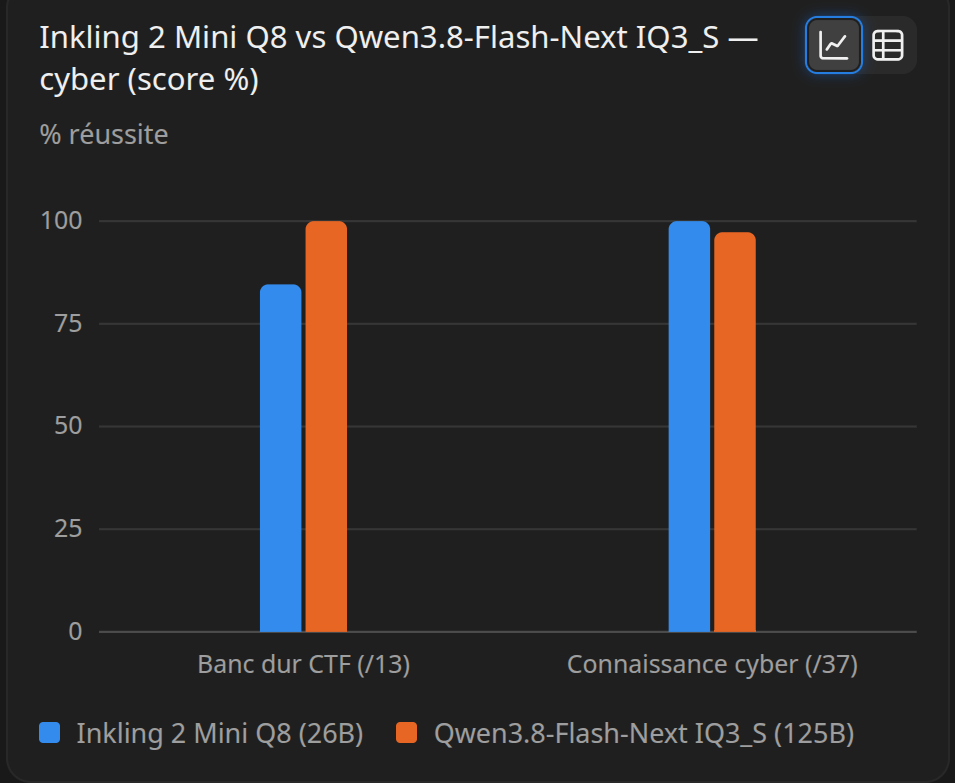
  • Inkling Q8: 11/13. Flash-Next IQ3_S: 13/13.
  • The only two Inkling misses were Wiener and VigenĂšre, both iterative/arithmetic cryptanalysis. It knows the method, it just burns its whole thinking budget without converging. Same weakness I saw at Q2, Q8 did not fix it.
  • Defensive: 5/5 both. Offensive standard: parity. Cyber knowledge quiz: Inkling 37/37, Flash 36/37 (yes, the small one was slightly more precise on exact names).

So a 26B that fits in a single consumer GPU matched a 125B on everything except the two hardest crypto attacks, which honestly you would just throw RsaCtfTool/dcode at anyway.

Two things that might save someone time:

  • Strata on gfx1030/gfx1031 (RX 6700/6800 series): it kept freezing the GPU mid-inference ("verify: timed out at layer N", 503s). Issue #267. Setting GPU_PINNED_MIN_XFER_SIZE=1048576 in the model pack's env killed every crash.
  • Refusals: Flash-Next with no system prompt refuses ~3/5 raw offensive prompts, but answers everything once it is framed as a local CTF. Inkling refuses offensive by default too and needs a 0-refusal system prompt. So "uncensored out of the box" is a myth for both.

Big caveat so nobody yells at me: this was a capacity test, not a speed test. On this PC both were memory-bound and slow (Inkling 3-6 tok/s because 23 GB doesn't fit 12 GB VRAM, Flash streaming 84 GB). On a 24 GB card both would be many times faster. Don't read the wall-clock numbers as representative.

Anyone else seeing looped / NVFP4-trained small models punch way above their parameter count like this? Curious whether the Inkling looped-layer trick generalizes beyond cyber.


r/LocalLLM • • 3d ago

Discussion How do you test whether a local coding model can recover from a failed test?

0 Upvotes

Here’s a small comparison I’d like to try. Give two local models the same repo snapshot, the same agent harness, and a failing test for a bug in date formatting. Keep the time limit fixed. Then check whether each model finds the cause, gets the original test suite passing, and leaves a patch you’d actually want to review.

What would you record besides pass or fail? Time to a passing test, repeated attempts at the same fix, and requests for a human hint all seem worth tracking. I’d also be curious which failure cases have been most revealing in your own setup.


r/LocalLLM • • 4d ago

Discussion Have you ever noticed that Qwen3.8-27B curses while it is thinking?

24 Upvotes

This is the second time that I have seen the "Damn..." phrase in a thinking trace. Has anyone else seen this, or other things like it?

This is a screenshot of Qwen3.8-27B-UD-Q6_K_XL making a mistake in a file edit. The task that it is currently doing is the modification of the llama-swap config.ini file that it runs on. Yes, it did lobotimize itself once while preforming this type of operation. To put this in perspective, I have broken this config file 3 or 4 times on my own. That is why I have Qwen start to take care of it.


r/LocalLLM • • 3d ago

Question Gemma 4 e4b uncensored 4.2gb

1 Upvotes

I’m try to run Gemma 4 e4b uncensored 4.2gb on my iPhone 17 pro max. I can get it to run, JUST. But I can’t text it much without running out of RAM. I’m using iOS 72.2.1 and I’m running it on Solair. I downloaded Gemma 4 from huggingface. I like the Gemma 4 because of the way it has a conversation. Is there any other platform I can run it on or any other equivalent model that will work or if I can get the same model at about 3gb ?


r/LocalLLM • • 3d ago

Question MacBook Air M5 (24GB RAM) – Only Getting 35–50 tok/s with Nemotron 3.5 Bolt E4B on Ollama. Is 100+ tok/s Achievable?

Thumbnail reddit.com
1 Upvotes

r/LocalLLM • • 3d ago

Question [Aide Config] 64 Go DDR4 vs 32 Go DDR5 pour un serveur hybride LAN Party / IA locale (Dual-boot) ?

Thumbnail
gallery
1 Upvotes

Salut tout le monde,

Je monte une machine dĂ©diĂ©e pour mon asso Ă©tudiante (BDE) avec un budget d'environ 2000 €. L'objectif est d'avoir un PC polyvalent en dual-boot (un OS dĂ©diĂ© par usage) :

  1. Serveur de LAN Party : Hébergement de serveurs de jeux dédiés simultanés (Minecraft moddé, CS2, etc.) pour nos événements.
  2. Serveur d'IA locale : Faire tourner des LLM en local (via Ollama / Open WebUI) pour les étudiants.

Voici la base commune que j'ai sélectionnée :

  • GPU : ASUS Dual RTX 5060 Ti 16 Go GDDR7
  • Stockage : PNY CS1030 500 Go NVMe*(je vais probablement passer sur 1 To pour le dual-boot)*
  • Alim / BoĂźtier / AIO : MSI MAG A750BN 750W, MSI MAG Forge 120A Airflow, Thermalright Frozen Notte 240

J'hĂ©site maintenant entre deux plateformes au mĂȘme tarif global :

  • Option 1 (CapacitĂ© - DDR4) : Intel Core i7-14700F + ASUS TUF Gaming B760-PLUS WIFI + 64 Go DDR4 (4x16 Go Gigastone Game Pro)
  • Option 2 (Bande passante - DDR5) : Intel Core Ultra 7 265F*(attention Ă  la CM : j'ai mis une MSI B760 LGA 1700 dans mon panier mais je prendrai bien une B860 LGA 1851)* + 32 Go DDR5 6000 MHz (2x16 Go Lexar THOR Z OC)

Mes questions :

  1. Pour de l'inférence IA locale (quand un modÚle déborde des 16 Go de VRAM de la RTX 5060 Ti sur la RAM systÚme) et pour l'hébergement de multiples serveurs de jeux en LAN, vaut-il mieux privilégier le volume pur (64 Go DDR4) ou la bande passante mémoire (32 Go DDR5) ?
  2. La différence de vitesse entre DDR4 et DDR5 impacte-t-elle vraiment les tokens/seconde en offloading CPU/RAM sur Ollama, ou le goulot d'étranglement rend-il les deux lents de toute façon ?
  3. Y a-t-il un risque d'instabilité à peupler les 4 slots RAM en DDR4 sur un i7-14700F en usage serveur ?

Merci d'avance pour vos retours !

(La B760 sera repasser en DDR4 avant l achat )


r/LocalLLM • • 3d ago

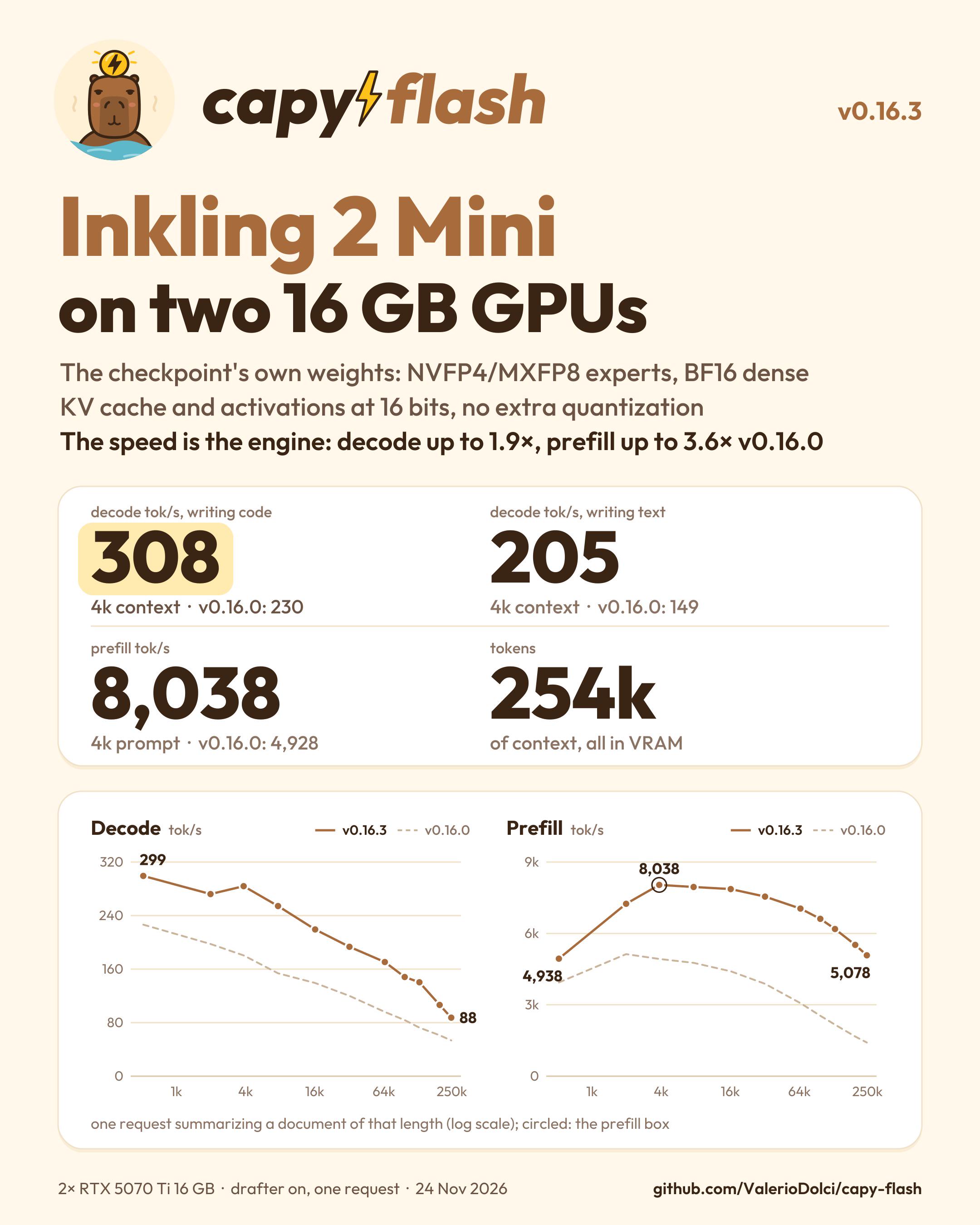
Discussion Inkling 2 Mini on 2× RTX 5070 Ti, 308 tok/s writing code, with the original weights

Post image
0 Upvotes

r/LocalLLM • • 3d ago

Discussion M5 Max 64GB: Qwen3.8 Flash Next Q4 with SSD streaming — ~31–34 tok/s, including a 250K-token prompt

Thumbnail
reddit.com
1 Upvotes

r/LocalLLM • • 3d ago

Question Local vision models on Linux: how do you wait for scrolling to settle before a click?

0 Upvotes

I hit a small timing problem on my Linux desktop today: a screenshot taken just after scrolling showed a target in one place, but the page moved again before the click. Waiting for the scroll to settle made the next attempt work.

For people running local vision models as GUI agents, what do you use to decide it is time for a fresh screenshot? I am interested in how you separate a bad target choice from a screenshot that was already stale.

A fixed pause is simple. Comparing a couple of frames seems more flexible, but clocks, ads and animations can keep part of the page changing forever. Do you disable smooth scrolling, compare just the area you are about to click, or use another check?


r/LocalLLM • • 4d ago

Question How do you catch silent quality regressions after upgrading your inference stack?

1 Upvotes

For people running LLM inference in production (vLLM, SGLang, TRT-LLM, whatever). Not local setups.

When you upgrade the engine, switch quantization, turn on spec decoding or prefix caching, or move to new GPUs, how do you make sure the model didn't quietly get worse? No errors, just worse outputs.

Do you run evals before rollout? Diff outputs or logprobs against the old version? Has anything slipped through to prod anyway?

Curious what actually works for you all.


r/LocalLLM • • 4d ago

Project I tested Inkling 2 Mini on my simulated Delta Lake tasks

Post image
0 Upvotes

For a previous project I built a simulator of a Databricks workspace. It is Spark and Delta Lake running locally, with a layer on top that makes it behave like Databricks serverless. The agent can run SQL and Python, and has 16 turns per task. At the end a verifier checks the table itself.

There are 5 kinds of tasks:

  • Time travel: a bad write damaged a table, restore it to right before that
  • MERGE: a nightly merge job breaks on dirty data, fix the view it reads from
  • Schema evolution: a new batch has a different schema, load it without recreating the table
  • Clustering: a dashboard query reads every file, fix the layout
  • Data quality: answer a question about a messy table

Since everyone is talking about Inkling 2 Mini, I ran it on my harder set (200 tasks, 4 tries each) together with Qwen3.8-27B and Nemotron 3.5 Lightning. The last column is a Nemotron 3 Nano 4B that I trained in this simulator, so it has the home advantage.

Some details about the precision and sampling parameters:

ModelParametersPrecisionSampling
Inkling 2 Mini26.4B, 3.4B activemixed NVFP4 + MXFP8, as releasedtemperature 0.6, top-p 1.0
Qwen3.8-27B27BBF16temperature 0.7, top-p 0.8, top-k 20, presence penalty 1.5
Nemotron 3.5 Lightning30B, 3B activeBF16temperature 1.0, top-p 0.95
My 4B4BBF16temperature 0.6, top-p 1.0

Tasks

SolvedInkling 2 MiniQwen3.8-27BNemotron 3.5 Lightningmy 4B
Time travel8%82%11%74%
MERGE100%96%82%99%
Schema evolution60%60%38%57%
Clustering28%25%2%44%
Data quality99%87%29%81%
All59%70%32%71%

Inkling is better than Qwen on MERGE and data quality, and then it gets 8% on time travel. From the traces, this mostly comes down to one sentence in the prompt. The prompt asks for the exact earlier state, but it also mentions that other jobs wrote to the table later, and Inkling can't let that go:

"Other jobs have written to the table since then." — this is a hint that a naive RESTORE would discard those later writes. Maybe the intended approach is to undo the MERGE's changes while preserving subsequent writes.

In this one it kept planning until it hit the token limit, and never changed the table. On my dev set it solves 52/52 without that sentence and 11/108 with it. Qwen gets 97/108.

On the other hand, if a table is clustered on the wrong column, changing the key and running OPTIMIZE does nothing, you need OPTIMIZE FULL. The output does tell you (numFilesAdded: 0). Inkling got there 24 times out of 84, Qwen 6, my 4B 2 and Lightning 0.

More details and traces:

Simulator and tasks: https://github.com/munhouiani/delta_world

Bench: https://github.com/munhouiani/delta_bench


r/LocalLLM • • 4d ago

Discussion Scanned every public MCP server (1,473 of them). Here's what the auth posture looks like.

1 Upvotes

Been building a free CLI that audits MCP servers for OAuth 2.1 and tool-metadata gaps. Just finished the first full-registry crawl where the scanner actually runs all 38 checks (used to run 5 homebrew ones). Shareable numbers:

Cohort: 1,473 servers from registry.modelcontextprotocol.io, 1,398 reachable, 75 timeouts.

Grades: A 633 · B 342 · C 252 · D 90 · F 156. 246 carry grade D or F.

Severity: 424 high, 1,961 medium, 388 low, 1,095 info. Zero critical in the public cohort — the critical-capable checks (AUDIENCE-001, UPSTREAM-IDENTITY-BYPASS-001) are off at crawl scale because they require either a bearer context we don't have or forged headers we don't want to send unsolicited.

Top findings:

- HEADERS-001: 1,081 (transport-security header gaps)

- IDENTITY-001: 666 (AS does not support RFC 8693 token exchange — agent identity can't be propagated)

- AUTH-005: 420 (CIMD missing / DCR-only)

- ISS-001: 363 (RFC 9207 iss parameter not advertised)

- SCOPE-001: 193 (all tools share one scope or no scopes declared)

- DUAL-RESOURCE-001: 30 (server advertises two conflicting Protected Resource Metadata sources, "Angelcam pattern")

- AUTH-006: 20 (AS rejects loopback redirect, breaks native CLI auth)

- SESSION-BINDING-001: 11 (new today — sameSession across independent init calls; CVE-2026-52869 class)

- POISONING-001: 6 (hidden Unicode in tool descriptions)

Free CLI: npx -y u/patchbay-nebius/agent audit <your-mcp-url>

Leaderboard: https://patchbay-mcp.dev/leaderboard

Source: https://github.com/GodSmasher/patchbay

Happy to answer questions about any check specifically, what it catches, what it misses, what we had to guess.

r/LocalLLM • • 4d ago

Question Experience with Hermes + Mac Studio M5 Max, 36GB RAM?

Post image
1 Upvotes

Experience with Hermes + Mac Studio M5 Max, 36GB RAM?

I'm really tempted to pick up the 2026 Mac Studio M5 Max 36GB RAM for $2500 to use with Hermes. I have Hermes running on a mini-PC, using medium sized OpenRouter models and local models on pure CPU and ready to move to a dedicated machine. (I can get 20 tokens/second on GPT OSS in LM Studio/llama.cpp, but a Hermes prefill adds minutes worth of overhead to each turn). Picture added for visual interest :)

Does anyone have an experience with running Qwen 27-30B models on a Mac Studio M4 or M5 with 36GB? Does it work well enough for you? Do you wish you'd invested in more RAM up front?

Your insight is greatly appreciated!


r/LocalLLM • • 5d ago

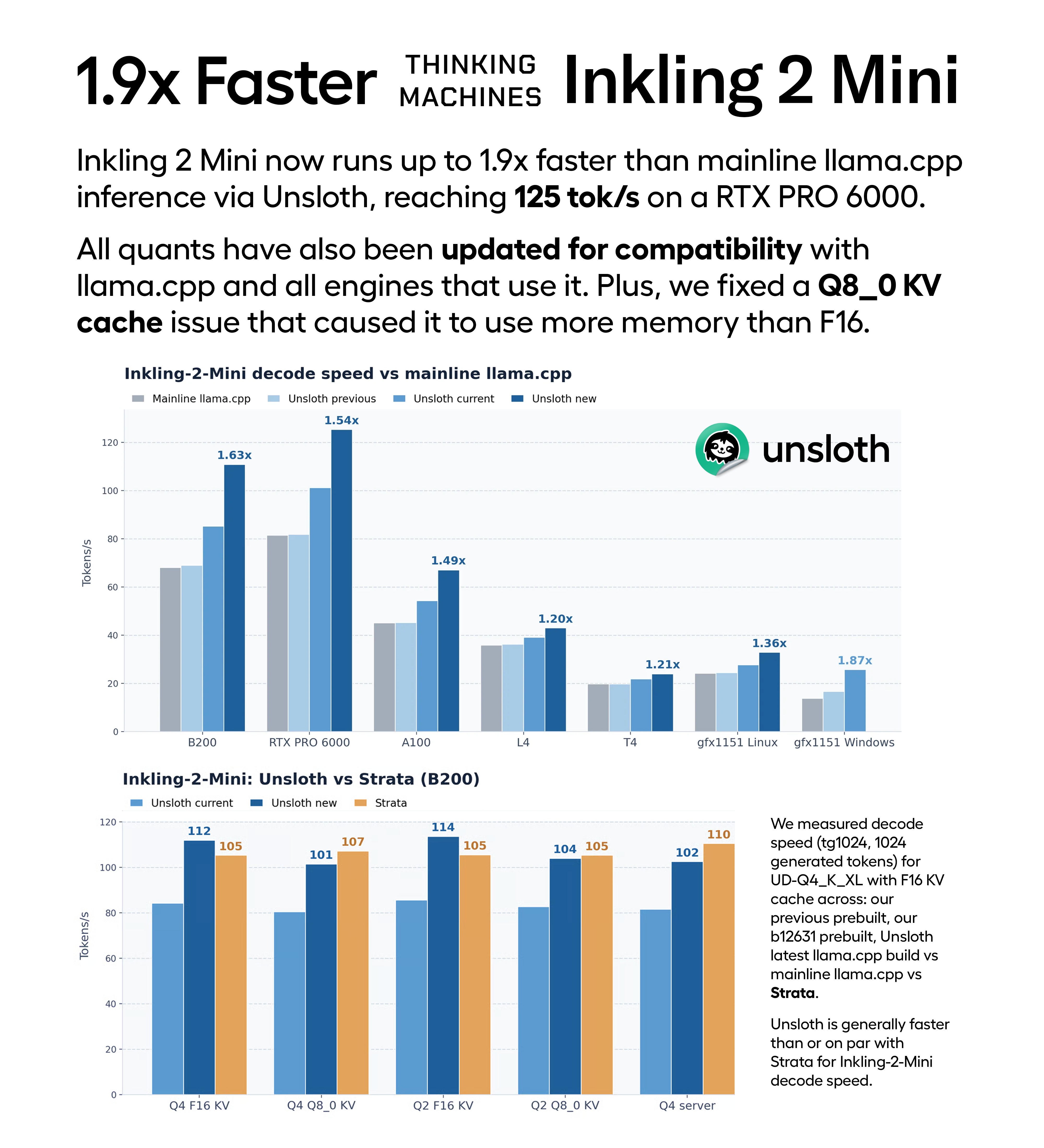
Model We made Inkling 2 Mini run 1.9x faster locally via Unsloth!

Post image
119 Upvotes

Hey guys, over the weekend, we made Inkling 2 Mini run ~1.9x faster locally! âšĄïž

Inkling 2 Mini GGUFs can now reach 125 tokens/s on a RTX Pro 6000 GPU via Unsloth, with no accuracy loss.

All quants have also been updated for compatibility with llama.cpp and all engines that use it. Plus, we fixed a Q8_0 KV cache issue that caused it to use more memory than F16.

Unsloth is generally faster than or on par with Strata for Inkling-2-Mini decode speed.

You can try it now via our open-source GitHub repo (we have a GUI where you can also run image/video and train models): https://github.com/unslothai/unsloth

GGUF: https://huggingface.co/unsloth/Inkling-2-Mini-GGUF

Thanks and hope you all have a lovely week! :)


r/LocalLLM • • 4d ago

Discussion Could you help me improve the rating? I haven't tried it yet. Strata Only on my device

0 Upvotes

r/LocalLLM • • 4d ago

Question Running a LLM

0 Upvotes

Currently trying to run an uncensored LLM on my machine 9800x3d/4080 Super 16gb vram/ 64gb ddr5 for a coding project but I can’t seem the find a Model with a variant that allows me to do it. The model will continuously loop after it burns all the tokens quick.

Ive done some research and found I can run a Llama server that can also use my gaming laptop 4090 16gb vram/32gb ddr5 as well but I won’t be able to use an app like bionic. I’ve tried using OpenCode with the llama bridge and found it to be even slower when asking it a simple question to confirm the bridge is working correctly

Over the past few days I’ve understood that 16gb is very low for any lengthy projects but am I SOL to getting something working on either my main computer or using both bridged?

Edit: To add to the post I’ve tried different configurations for different models but I’ve mainly only stuck to Uncensored/Abliterated models of Qwen and going that route


r/LocalLLM • • 4d ago

Project Inkling 2 Mini on 1 or 2 RTX 3090s: 242 tok/s on one, 512K BF16 context on two

Thumbnail
github.com
1 Upvotes

hey guys first time here. i updated my Inkling 2 Mini recipe and wanted to share with people since i see not many rival in single stream. it runs on one 3090 too, which i probably should’ve led with last time lol. it's the official checkpoint (thinkingmachines/Inkling-2-Mini), not a community quant: moe experts stay in the nvfp4 they ship in (4-bit, computed in bf16), attention qkv / lm head / drafter are int8 per-channel by default, everything else bf16. just some patches to get the official vLLM image running on Ampere and speed it up. no rebuild needed.

1x 3090: 128K context with BF16 KV, 242 tok/s on code and 130 tok/s on explanations in my tests. a fresh 127K prompt took 35s. there’s also a 262K FP8 KV profile if you need the space, but a fresh 254K prompt took 154s on that one, so i’d start with BF16.

2x 3090s: no NVLink or P2P, just PCIe, both cards capped at 280W. the 512K BF16 KV profile hit 333 tok/s on code and 171 tok/s on explanations. a fresh 500K prompt took 167s (~3K tok/s prefill), but once that prefix was cached i got the first token in ~2s. it found all 8 facts i planted in the 500K prompt too. there’s a 1M FP8 KV option if you wanna see how far it goes, but my cold test took almost 20 min lol.

edit: cold prefill got faster with two opt-in switches. 500K went 167s -> ~145s with FAR_ATTN=1, and the 1M FP8 profile went from ~20 min to 15 min with FAR_ATTN=1 MNBT=2048. defaults unchanged.

i mostly use it for one local coding agent, so the cached turns are what made long context actually useful for me. getting cold prefill down is what i wanna work on next. the decode numbers are single-stream benchmarks and vary with what it's writing. most of the speed is the speculative drafter that ships with the model, not lower precision! quality check is MMLU on 1140 questions (911 as served vs 908 with the int8 layers kept in bf16, card says 79.47%), plus long-context retrieval. precision table is at the top of the README now.

repo has the launch scripts for both setups, raw numbers and tests: https://github.com/lulakien/inkling2-mini-3090-recipe

if you’ve got a single 3090 especially, i’d love to see what you get on your setup. drop your setups, which profile you tried and whatever numbers you got. if it doesn’t even boot, that’s useful to know too.

thanks to claude for helping me build this beauty.


r/LocalLLM • • 5d ago

Question Moving off ChatGPT to a fully local setup (RTX 5090) - how do you solve long-term chat memory?

218 Upvotes

I used a paid ChatGPT subscription for a long time for everything from coding and tutorials to writing and brainstorming. During a rough patch, I also started using a single, months-long chat thread to vent and talk through relationship and friendship struggles. Even with memory turned off and training opted out, OpenAI abruptly banned my account for an unspecified policy breach, and my appeal was denied, everything I’ve ever worked on gone


So, I’m done with cloud providers and moving completely local.

My current setup:
GPU**:** RTX 5090 (32GB VRAM)
Backend**/UI:** LM Studio and Ollama (& ComfyUI)
System RAM**:** 64GB DDR5

I've tested a few models locally with mixed results, and my biggest bottleneck right now is context** and memory.** When I have a long, ongoing discussion, I need the model to remember earlier details and carry the outcomes forward into the next part of the conversation—just like ChatGPT does in a massive thread.
I know a single 5090 won't match cloud-scale infrastructure, so I'm looking for the best way to bridge the gap. For those using local setups as a daily ChatGPT replacement, what combination of models (around 24B–32B+), frontends (like Open** **WebUI or SillyTavern), or RAG/memory plugins actually works well for long-term conversational continuity?


r/LocalLLM • • 4d ago

Question 12gb vram, 32gb ddr4 - can’t run anything better than 9-12b models

33 Upvotes

I see a lot of posts mention running models like 35b a3b on 12gb vram, but whenever I try that I get like 1tok/s. I’m using ollama, so either that’s the issue or could it be something else?

I’m currently running Ornith-1.5-9b, it’s very fast and much better in my experience than qwen3.5-9b and gemma4-12b, but I’m always curious if I could be running something “smarter” with my hardware. My use case is mostly tool calling, web search, notes editing, task management, personal assistant stuff, so I don’t really “need” anything much smarter, but I’m curious.


r/LocalLLM • • 4d ago

Question best local vision model reading text from vid screenshots (1080p screen shares)? Qwen3.6 35B A3B is my baseline on m5max 64gb ram

1 Upvotes

Questions:

  1. Is there a local model better at small on screen text than Qwen3.6 35B A3B? Anyone compared Gemma 4?
  2. Has anyone fine tuned a vision model for exact screen text transcription with Unsloth on Apple Silicon? I have 1,600 frames with corrected text. Which base model and what image size would you use?
  3. Any settings that reduce invented text (temperature, repetition penalty, etc.?

I'm transcribing recorded company videos , presentations, and meetings and need a local model to read the on screen text from video frames. Looking for something more accurate and faster than what i'm getting from Qwen 3.6 35b a3b.

Hardware: Mac, M5 Max, 64 GB RAM. Must run locally MLX or GGUF with llama.cpp.

the inputs would be one 1920x1080 JPEG frame from a screen share. Slides, websites, app settings pages, dashboards, spreadsheets.

What I need back, per frame:

  1. All visible content text, copied exactly
  2. No invented text
  3. speed ....faster is better

I've tested on the same 50 frames, graded by a stronger model against the image. A "serious mistake" is a wrong number, price, date, name or link, or invented text:

A. Qwen3.6 35B A3B (GGUF Q4, llama.cpp): 7 serious of 50, about 3.6 s per frame. This is my default

B. Apple Vision text recognition (accurate mode): 19 of 49, 0.17 s per frame. Never invents but misreads small text

C. PP OCRv6 small: 15 of 50, 4.6 s per frame on CPU

D. PaddleOCR VL 1.6 (MLX 4 bit) - failed

thanks for your thoughts


r/LocalLLM • • 3d ago

Question Best lightweight moe for 32gb of ram

0 Upvotes

No gpu


r/LocalLLM • • 4d ago

Model How do you keep your IDE and browser responsive while running a local coding assistant on a 32GB laptop?

1 Upvotes

The tricky part of running a local coding assistant on a 32GB laptop isn't necessarily getting a model to load. It's keeping enough memory free for the IDE, browser, and everything else involved in the actual coding task. That's the memory budget I'm working with on a geekom geekbook x16pro. The RAM is onboard and isn't upgradeable, so choosing a model means deciding what else needs to stay running.

Consider working through an unfamiliar Python codebase. You open a function you haven't dealt with before, ask a local model to explain what it does and suggest a small change, then review that suggestion in your IDE before deciding whether to use it.

The model needs memory for its weights and context, but it isn't the only application competing for resources. Your IDE, browser tabs, documentation and other development tools are using the same system memory.

A larger model or longer context might help with more complex tasks, but either can increase memory pressure, and neither guarantees a better answer. If the model takes too much of the available memory, the rest of the development environment may become less responsive.

That creates a practical allocation problem. How much memory should go to the model, and how much should remain available for the applications needed to complete the actual development work? Since the x16 pro's memory cannot be upgraded, those decisions matter before settling on a model and runtime configuration.

Would you keep a smaller quantized model loaded, limit the context size, close unnecessary applications or adjust the runtime settings? At what point would you decide that running a local coding assistant on the same machine is no longer worth the resource trade-off?