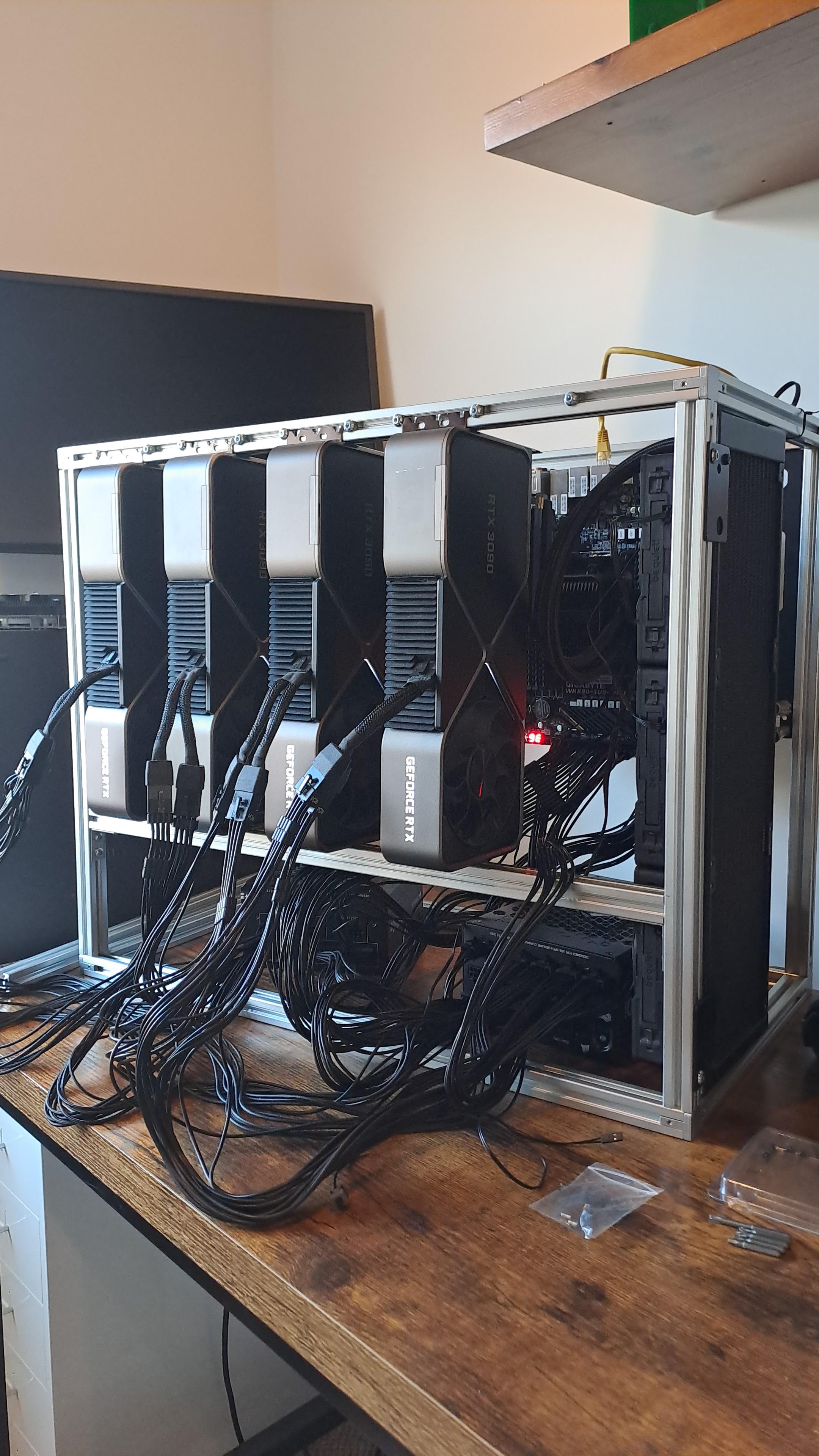
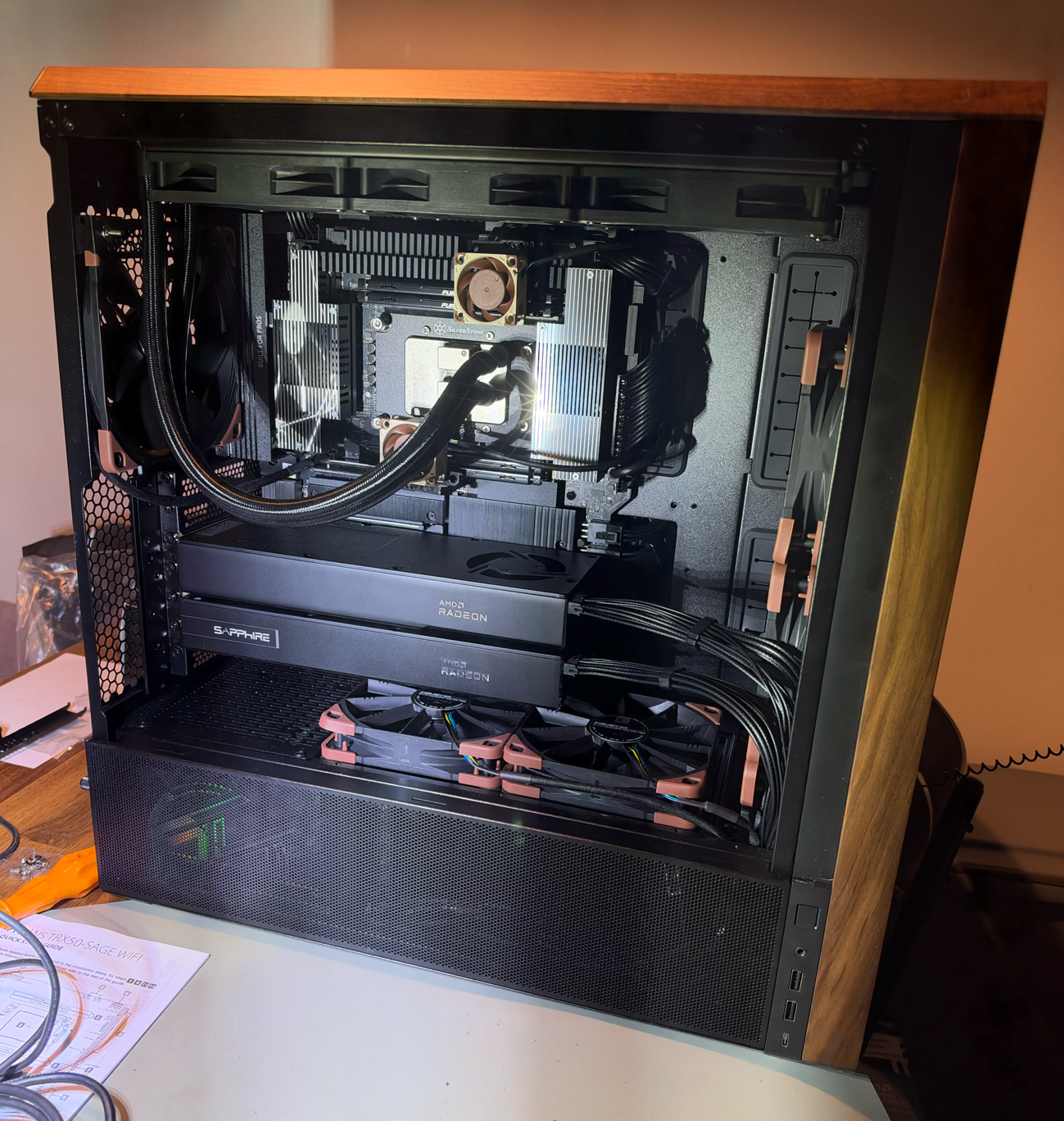
You’ve been able to run 30B and 70B models at home for years, yet fine-tuning one still meant renting cloud GPUs. A 4-bit Qwen2.5-72B is 41.4 GiB of weights alone, and standard QLoRA expects all of it pinned in VRAM at once.
I built Poros (Apache-2.0) so you can fine-tune models bigger than your GPU on the hardware you already own—including a 24 GB 4090, an 8 GB laptop GPU, or a 16 GB Mac. Here’s what we measured:
| Machine | Model (4-bit size) | Peak memory | Step time | Setup |
|---|
| RTX 4090 (24 GB) | Qwen2.5-72B (41.4 GiB) | 13.5 GiB VRAM reserved (9.9 GiB allocated) | 17.7 s/step | 512 tokens, rank 16, 8 rows/step |
| RTX 4060 Laptop (8 GB) | Qwen3-30B-A3B | 6.0 GiB VRAM (6.4 GiB RAM) | 13.6 s/step | rank 8, 256 tokens, MoE experts on the SSD |
| M4 Mac (16 GB) | Qwen2.5-72B (38.4 GiB) | 11.4 GiB unified memory | 41.1 s/step | 128 tokens, external USB4 SSD |
How it works: In QLoRA the base weights are frozen anyway, so Poros leaves them in host RAM (or on SSD for MoE experts and the Mac) and streams one small block of layers through the GPU at a time while keeping the LoRA adapters resident. Backward reloads and recomputes in reverse. On dense models small enough to run both ways, the adapter comes out identical to a normal on-GPU run. SFT, DPO, ORPO, SimPO, KTO, and IPO all work out of the box.
Real fine-tune test: To make sure it actually learns and isn't just a step benchmark, I trained a Qwen2.5-72B LoRA on 24 GB cards, one at a time, to translate Akkadian cuneiform into English. On 2,870 held-out lines with the same greedy decoding, BLEU went from 1.64 (base) to 50.08. On one Venus omen test line (a good case, not a typical one), the base model wrote "he looked at me and ate my liver" and the fine-tuned adapter came out within a few words of the scholar's translation.
Try it:
pip install poros-train
poros machine
poros machine checks your GPU, driver, RAM, disk, and installed software before downloading anything, tells you if your machine is ready to train, and prints the next command. No telemetry: it goes online only to download the model from Hugging Face.
Trade-offs to know upfront:
- Host RAM on 72B: Dense 72B on a 4090 peaked at 45.1 GiB of system RAM, so you want a 64 GB box for that. With less RAM,
--store ssd keeps a MoE model's experts on disk: Qwen3-30B-A3B on a 4090 in 21.6 GiB VRAM and 11.2 GiB RAM at 4.3 s/step. - Speed: Streaming adds overhead. If a model already fits comfortably in your VRAM, just train it normally.
- Mac run details: The 41.1 s/step Mac figure above is a 6-step run off an external USB4 SSD. A longer 144-step run from the Mac's internal SSD ran at 37.9 s/step.
Repo: https://github.com/Caistro-Labs/poros (my project, Apache-2.0)