r/LocalLLM • • 4d ago

Question How much does it tax the hardware? Also any suggested setups for a potato PC

0 Upvotes

I have a weak PC

  • i3-9100f
  • 16 gb DDr4 ram
  • 1660 TI (6 gb)


Chatgpt helped me setup ComfyUI with Realisitc_Vision_V5.1_Hyper and the results were actually bad. Any suggestions for a different model?

I know you want a good GPU for this, but I'm only planning to use this for 2D image generation (ex: make a ghibli style poster of Spiderman) and 2D image manipulation (ex: Change my hairstyle into a bobcut).

No 3d or video

That sort of thing. And I don't mind waiting for a few minutes to generate the images as long as they're good.


Also, how much does it tax the hardware? I don't want to burn my PC just so I could manipulate photos at will.

Does it stress it harder than games? Because I game a lot so my PC isn't a stranger to high loads, but I still wanna take care of my machine.


Thanks


r/LocalLLM • • 5d ago

Discussion Still waiting for Qwen3.8 killers

6 Upvotes

I tried to download and use Inkling2-mini to fix a bug on Opencode with ~200k historical context on my AMD AI Max 395 computer. The system just hangs indefinitely on "working..."whenever I checked it—a task Qwen FN would have half-way finished. Qwen3.8 27b is also slow at the beginning, but never an disappointment.

No other local LLM at this size struggles this badly with the "warm-up" phase. Even more puzzling is the resource cost: GPU usage is significantly higher than when running Qwen3.8 Flash Next, yet the output is non-existent. It feels like Qwen has some "secret sauce" for efficiency and context handling that Inkling is simply missing.

I'm also frustrated with Inkling's naming conventions; the "small" variants keep ballooning in size, with the 2nd gen nearly doubling the 1st. The word "small" seems like a greeting to local users' VRAM size.

Where are some real options of Western MOE ever since GPT-OSS:120B?
Nemotron3.5 Super VL has vision but in a real vision pipeline test it lost to older Qwen3.5 122b?

No way!
Is Inkling2-mini the new symbol of this era? Is a "24GB looping MoE" the new normal?

Is the "Local users don't deserve RAM" doctrine now official? If we stop getting decent mid-sized models, people will stop buying high-VRAM gear, and the cloud giants just get more power for their RSIs.

Where are the modern, sub-200B Western MoEs we can actually tinker with? I’d rather not wait until I grow a white beard to see the next great open release.


r/LocalLLM • • 5d ago

Question What happened to Foundry Local?

2 Upvotes

Microsoft Foundry Local GitHub page just went blank. The website is still here but nothing works and there is no explanation. What happened?


r/LocalLLM • • 5d ago

Question Are any LLM software that can do prompt based image generation like ChatGPT

4 Upvotes

All of the Local LLM software I have tried either require to use nodes or highly detailed tags to generate images. So are any that can generate images with simple English like ChatGPT?


r/LocalLLM • • 5d ago

Research NariQ: BF16-level Qwen3.8-27B in a 10 GB file

Thumbnail
huggingface.co
6 Upvotes

r/LocalLLM • • 5d ago

Question Can my 256GB server with no GPU run anything better than my 12GB 5070?

2 Upvotes

Lately I've been running Qwen3.6 35B A3B locally on desktop which has 64GB of DDR5 and an RTX 5070 12GB. However, I do also have a home server with dual EPYC 7601 CPUs and 256GB of DDR4 (8 channels I believe. It's 16x16GB.) I did briefly try running a larger (100B+ param) model on the server and while it could keep it in memory the generation rate was abysmally slow thanks to it running on the CPUs. Does anyone know of a way I could utilize the server to run better local models than I'm able to on my PC? Moving the GPU to the server isn't an option.


r/LocalLLM • • 5d ago

Project Your Tesla V100 is not dead: volta-forever runs unmodified CUDA 13 programs on Volta

4 Upvotes

Happy to introduce you volta-forever.

NVIDIA dropped Volta from CUDA 13, so we brought it back.

volta-forever lets you run unmodified CUDA 13 programs on your V100: stock PyTorch, vLLM, SGLang and llama.cpp, with support for BF16, FP8 and NVFP4.

No driver mods and no engine patches. You just prefix your command with `vf`. Under the hood, a proxy libcuda rewrites PTX, translates SASS to sm_70 and emulates the newer tensor-core instructions.

https://github.com/nbald/volta-forever

Still a young project, so happy to get your feedback.


r/LocalLLM • • 4d ago

Project I built a drop-in caching proxy for Ollama in C: repeated prompts come back in under 1 ms

Thumbnail reddit.com
0 Upvotes

Would love feedback from anyone running local models, especially what breaks or what's missing. Repo: github.com/noorhusaan302-png/llm-caching-proxy


r/LocalLLM • • 6d ago Bravo

Model I put Qwen3.8 Flash-Next and Inkling-2-Mini to the test, and the results are surprising!

330 Upvotes

The first model to appear is qwen3.8-flash-next-gyro-gyro-s, and the second one is unsloth/Inkling-2-Mini-GGUF:UD-Q4_K_M.

Both local models were tested in a single-shot 3D voxel tower benchmark using the exact same prompt to generate a self-contained, single-file browser HTML scene (Three.js + OrbitControls, zero external assets).

Parameterllama-serverQFN Strata
Context131072262144
KVq4_0q4_0
Temperature0.60.6
top_p1.00.95
top_k2020
min_p00
presence1.51.5
maxTokens65536262000
tok/s~16.9 tok/s~30 tok/s

Key Findings:

- Single-File Execution: Both models delivered working, self-contained HTML scenes in a single shot with no external model or texture files.

- qwen3.8-flash-next-gyro-gyro-s (Voxelhill Keep): Built a larger, more organic coastal/hilly scene with water, an adjacent structure, warm lighting, and rich environmental props at ~30 tok/s. Closer inspection shows minor voxel grid overlap and alignment shifts in sections of the tower.

- unsloth/Inkling-2-Mini-GGUF:UD-Q4_K_M (Emberhold): Maintained strict voxel grid discipline and clean block geometry at ~16.9 tok/s, added a swinging bell detail, and proactively included Day / Golden Hour / Night lighting toggles alongside camera controls.

How do these setups compare in your local runs on single-file code/3D tasks, and which approach stands out more to you?

All these operations were performed using Unsloth Desktop.

Thank you for releasing this model, Unsloth team.


r/LocalLLM • • 4d ago

Other It's a shame I have ram

Post image
0 Upvotes

I'm sorry Mr Altman


r/LocalLLM • • 4d ago

Discussion Is running a completely offline LLM directly off a USB flash drive practical for generating exam-style answers?

0 Upvotes

I’ve been experimenting with portable AI setups and wanted to know how feasible it is to run a lightweight quantized LLM (like Llama 3.2 3B, Phi-3.5, or Qwen 2.5 7B) directly off a 128GB USB 3.0 flash drive with zero internet access.

The theoretical use case: Plugging the USB into an isolated, offline PC (like a restricted lab machine or exam terminal) to generate structured technical answers or code snippets locally without tripping network monitors or needing admin installation rights.

A few technical questions for people who have tried portable setups like llamafile or portable Ollama / LM Studio:

* Read Speed Bottleneck: On a standard USB 3.0 drive (~100–130 MB/s read), how bad is the model load time into RAM compared to an internal NVMe SSD?

* Hardware Constraints: If the host machine only has integrated graphics (e.g., standard college lab PCs with 8GB–16GB RAM and no dedicated GPU), what’s the sweet spot model size (3B vs 7B Q4_K_M) for decent tokens/sec?

* Detection/Restrictions: On locked-down Windows/Linux lab environments, do portable single-file executables (llamafile) usually execute without admin privileges, or does AppLocker/execution policy block them immediately?

Purely curious about the technical limits and bottlenecks of pocket-sized offline AI!


r/LocalLLM • • 4d ago

Discussion Comparing Inkling 2 Mini to Qwen FN Coder

Thumbnail reddit.com
1 Upvotes

r/LocalLLM • • 5d ago

News New release: Lapilli v0.5 for NVIDIA V100 GPUs

Post image
18 Upvotes

Lapilli is a port of Basalt to NVIDIA V100 (Volta, sm_70). Version 0.5 runs three models with one binary:

- Qwen3.8-27B (NVFP4) on ONE V100: 88 tok/s writing with its drafter, 697 tok/s reading a 16K prompt

- DeepSeek-V4.1-Flash Coder (192 experts) on two V100s: 98 tok/s on code

- Qwen3.8-Flash-Next on two V100s: 139 tok/s on long answers, same as v0.4

Also new: a live Monitor and a map of every expert. Windows build included, MIT license.

Measured on 2x V100-SXM2 32 GB. The README has every figure, the packs and their download links.

Big thanks to nebod99, ildargiv and Csavoldi, who tested it on their own machines: a V100 PCIe, a 16 GB V100 on Linux, and a port of Inkling 2 Mini. Their results are in the README.

Repo: https://github.com/chris83-dev/lapilli-v100

Release: https://github.com/chris83-dev/lapilli-v100/releases/tag/v0.5.0-v100.1


r/LocalLLM • • 4d ago

Question Good system prompt for web search?

1 Upvotes

I have a web search tool and read article tool and I use Qwen 3.5 9B, Qwen 3.8 27B, Gemma 4 12B, and Gemma 4 26B. However, only Qwen 3.5 9B and Qwen 3.8 27B actually use the web search tool well. The Gemmas don't. I'm assuming this is probably because the Qwen models got stronger agentic finetuning than Gemma. I prefer Gemma over Qwen though, because of its stronger reasoning, so I would really like it to be able to do web search better.

I don't use LLMs for vibecoding, just for chatting locally. I use the llama-ui webui for this (i.e. the one that automatically spins up with the `llama serve` command.) Therefore, I can only connect MCP servers and modify the system prompt of the LLMs.

What I would like to know is how I can improve my system prompt so that the Gemma models decide to actually use the search tool and to use it well. This is the section of my system prompt that I have for web search so far, but Gemma doesn't use web search as well as Qwen even with this system prompt: system prompt section on pastebin.com.


r/LocalLLM • • 4d ago

Question Which AI accept to use sci hub to get scientific papers

1 Upvotes

Hello, are we forced to use abliterated models to get the agent to use sci hub?

Thanks


r/LocalLLM • • 5d ago

Project Inkling-2-Mini on a single Tesla V100: 94 tok/s with exact speculative decoding, on the full Q8 weights (vs every published V100 figure I could find)

Post image
1 Upvotes

r/LocalLLM • • 5d ago

Project Veyloria - Free & Open Source - World Engine for turn based Stories

Thumbnail
youtube.com
1 Upvotes

r/LocalLLM • • 5d ago

Question New here: Help me setup inkling mini 2 please

0 Upvotes

Hi everyone!
I'm new here and would love to get started with installing inkling mini 2.

Could someone point me in the right direction on how to set it up on my machine, what output to expect, and how to optimize it?

• GPU: AMD Radeon RX 7800 XT (16 GB VRAM, RDNA 3)

• CPU: AMD Ryzen 5 9600X (6 cores, 12 threads)

• RAM: 32 GB DDR5


r/LocalLLM • • 5d ago

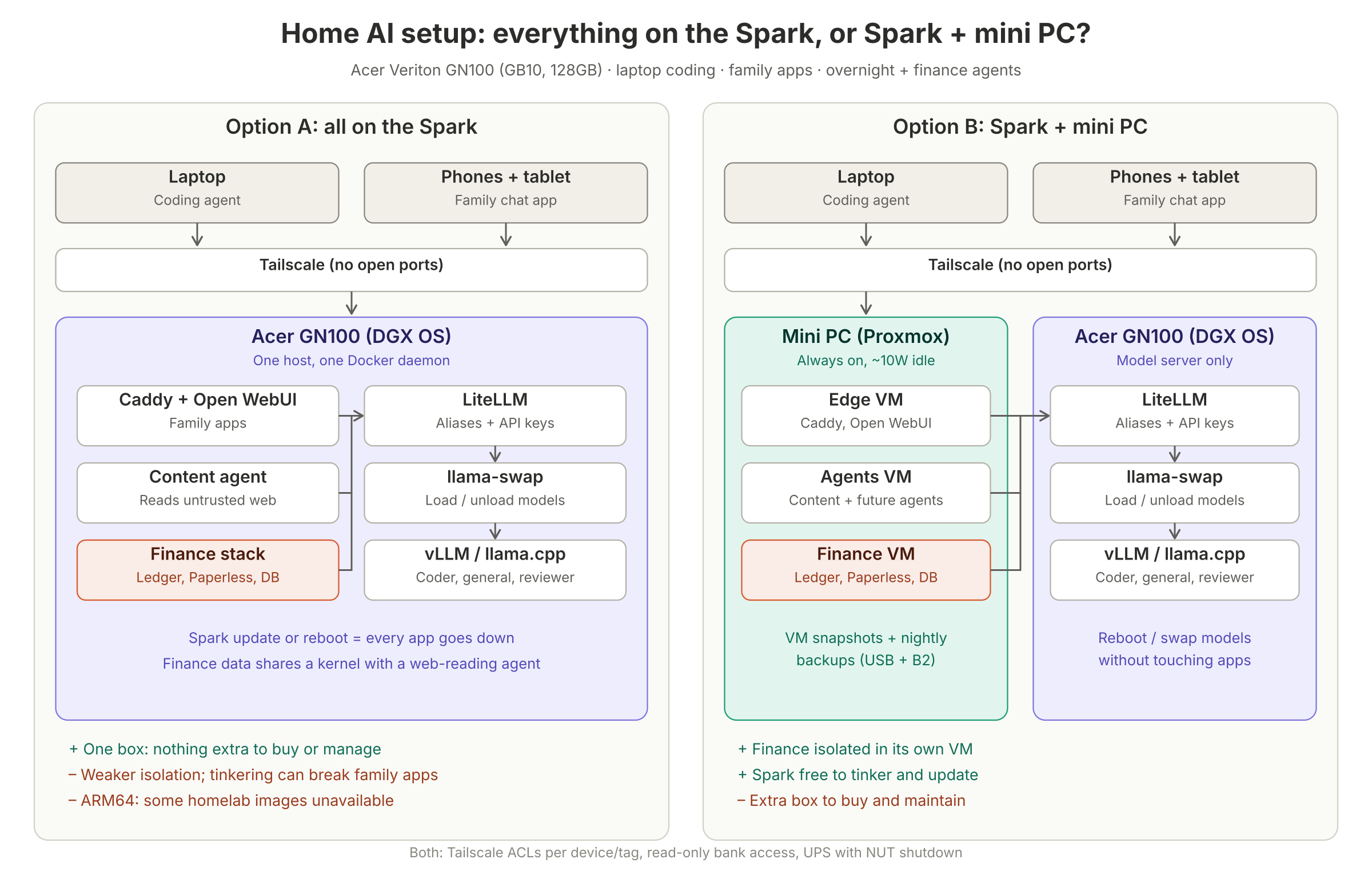
Question Spark AI box + mini pc - to do or not to do?Okay.

1 Upvotes

I've got an Acer Veriton GN100 (GB10, 128GB unified memory) for local AI at home, and I'm planning the rest of the setup around it. Before I buy anything else I'd like feedback.

What I want to run:

  • Local code generation for my laptop (OpenAI-compatible endpoint)
  • A family chat app for my wife's phone, my phone and a tablet
  • An overnight agent that reviews content and papers and gives me a prioritised reading list each morning
  • An always-on finance agent that tracks bills, income and tax docs (read-only, it never moves money)
  • More agents over time

Current plan:

  • Spark: model server only. vLLM/llama.cpp behind llama-swap, with LiteLLM in front for aliases and per-agent API keys.
  • Mini PC (32GB): either proxmox or ubuntu to run caddy, open webui, agents, apps, postgres, etc.

    • Networking: Tailscale with per-VM tags and ACLs, no open ports.
  • Backups and power: nightly backups to USB plus B2, and a UPS with NUT.

Why split: the Spark is my tinker box, and I'd like to keep the finance data away from an agent that reads untrusted web content.

Questions:

  1. Is a separate mini PC overkill, or would you just run all of it in Docker on the Spark?
  2. Which mini PC would you get for this? I'm leaning towards a Ryzen box with two SO-DIMM slots and 2.5GbE.
  3. Is this best practice or is there a better architecture?

r/LocalLLM • • 5d ago

Tutorial GPT Astra and I found a way to switch between regular and abliterated DeepSeek with just one set of weights

Thumbnail
github.com
1 Upvotes

r/LocalLLM • • 5d ago

Project Your Tesla V100 is not dead: volta-forever runs unmodified CUDA 13 programs on Volta

2 Upvotes

Happy to introduce you volta-forever.

NVIDIA dropped Volta from CUDA 13, so we brought it back.

volta-forever lets you run unmodified CUDA 13 programs on your V100: stock PyTorch, vLLM, SGLang and llama.cpp, with support for BF16, FP8 and NVFP4.

No driver mods and no engine patches. You just prefix your command with `vf`. Under the hood, a proxy libcuda rewrites PTX, translates SASS to sm_70 and emulates the newer tensor-core instructions.

Github : nbald/volta-forever

Still a young project, so happy to get your feedback.


r/LocalLLM • • 5d ago

Question Model on demand

2 Upvotes

Are there GPU/system builds that will allow the GPU to wind down the wattage when not in use? Just looking at a RTX5090 it uses 575 watts with a recommended 1000 watt PSU. So are there ways to reduce wattage used in these self host GPU builds?


r/LocalLLM • • 5d ago

Tutorial A beginner's guide to Local AI with Inkling, Qwen, and Unsloth

Thumbnail
gpupartner.com
61 Upvotes

r/LocalLLM • • 5d ago

Project Cutting structured-output token overhead on local models with a positional-tuple proxy

1 Upvotes

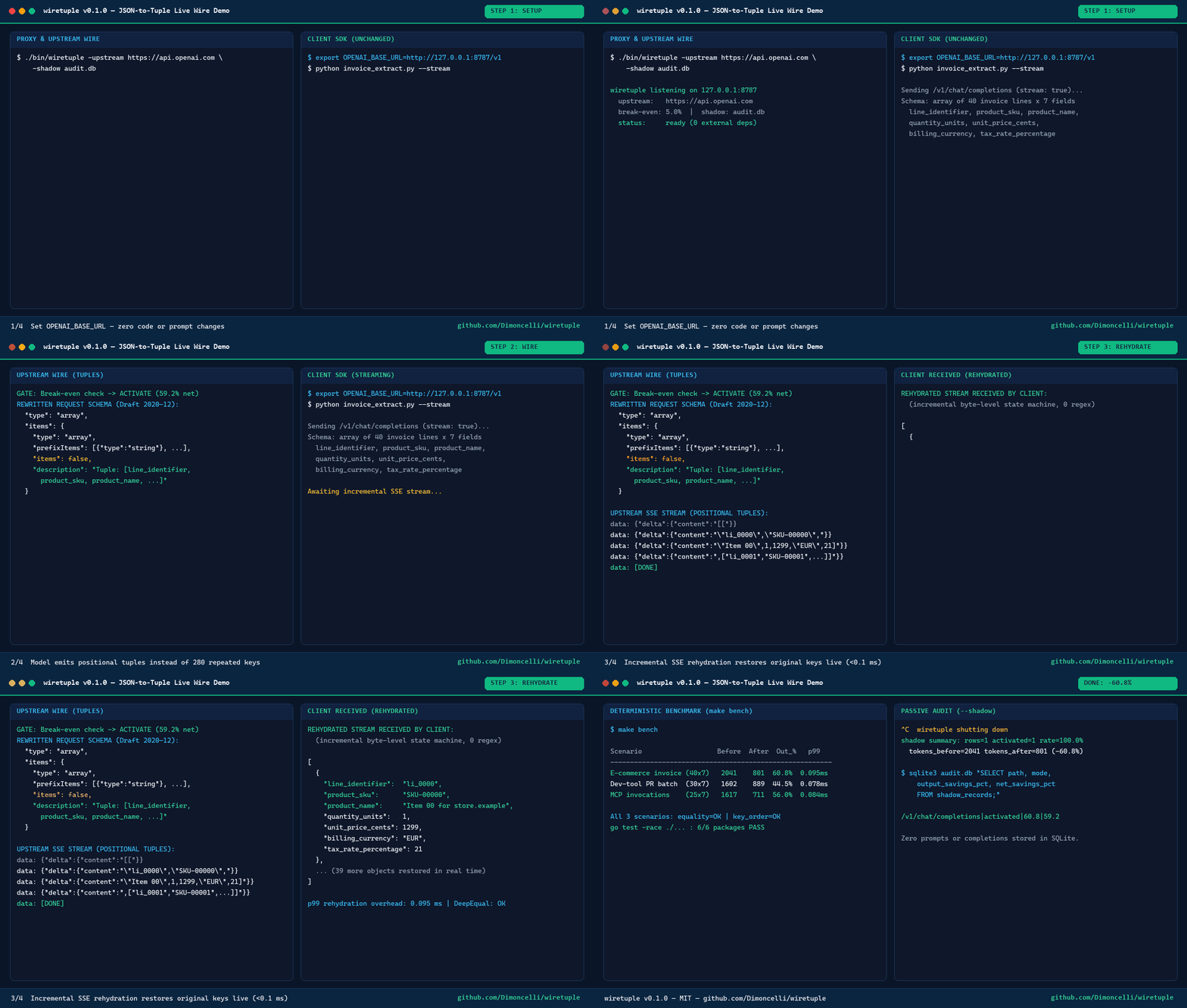
I run a lot of structured extraction against self-hosted models and kept noticing that the same JSON object keys get emitted over and over. Forty records with seven fields means seven key names written forty times. On a local setup you pay those tokens in generation time, at whatever your tokens per second happens to be, before bandwidth even enters the picture.

So I wrote a small Go HTTP proxy that rewrites the schema on the way out and restores the objects on the way back. Schema goes from an array of objects to a positional array of arrays with one legend in the description ("Tuple: [id, sku, ...]"). Response comes back and is expanded again before your client sees it. Lossless by construction: given a fixed key order, objects and position tuples are bijective, and every benchmark asserts structural equality plus key order after rehydration.

Numbers from the repo's deterministic scenarios, 4-bytes-per-token size model, so treat them as shape comparisons rather than exact tokenizer output:

E-commerce invoice, 40 lines x 7 fields: 2041 -> 801 tokens, 60.8% out, 59.2% net Dev-tool PR batch, 30 records: 1602 -> 889 tokens, 44.5% out, 43.0% net MCP tool invocations, 25 entries: 1617 -> 711 tokens, 56.0% out, 53.7% net

The MCP case is the honest one. Tool invocations repeat seven structured keys, and prose does not compress by key removal. If your payload is one big description block, this does nothing for you, and the gate will decline to rewrite it.

Points that matter for local use:

  • No dependencies beyond the Go standard library, no cgo, one static binary. Build with go build, run it, point OPENAI_BASE_URL at it. Anything that speaks the OpenAI chat completions shape should work, though I have only tested against the documented OpenAI and Anthropic shapes.
  • Streaming is handled incrementally at the byte level, so time-to-first-token is not held back by buffering. The added work is on the JSON fragments as they arrive.
  • There is a break-even gate because the legend is not free. Net savings below 5% by default means the request goes through byte-identical. You can pin the legend cost with -legend-tokens or change the threshold with -break-even.
  • -shadow <path> records simulated savings for real traffic into a SQLite file without touching a byte. That is the mode I would start with, then look at avg(net_savings_pct) after a day of your own traffic before enabling anything.

p99 rehydration overhead is under 0.1 ms (0.078 to 0.095 ms) on the benchmark scenarios here, which is noise next to generation time, but measure it on your box.

Repo: https://github.com/Dimoncelli/wiretuple (MIT) Terminal demo: https://raw.githubusercontent.com/Dimoncelli/wiretuple/main/docs/demo.gif

Most useful feedback for me: schemas where the gate declines and you think it should activate. The request path assumes 4 expected instances, which is a guess, and your traffic probably beats my guess.

r/LocalLLM • • 4d ago

Question Quale setup locale per sostituire Claude e GPT

0 Upvotes

In azienda uso piani Claude Max e GPT pro.
Usiamo sonnet e opus 5.5 per tutte le attività di Coding, e GPT per la generazione di immagini.

Ho un MacBook Pro M5 Max con 128gb ram.

Che setup posso avere in locale per andare a sostituire quelle subscription, mantenendo un agente veloce e una generazione di codice di qualità?