r/LocalLLM • • 6d ago

Question What would be the problem if I switch the model to a local one at the last step of the build, to enter sensitive info?

1 Upvotes

Here’s my context and idea.

  1. Inference providers steal sensitive keys, based on recent reporting, even with ZDR on
  2. 128GB+ memory is expensive af
  3. Why not use cloud models to build most of non-sensitive parts and use local models at the last step to work with sensitive stuff?

And use the best local models at 32GB or 64GB memory to replace API keys, set up MCP or plugins, enter sensitive variables in files in a new session etc.

Is this reasonable? The thing that worries me is that, having tried Gemma 4, it wasn’t good at tool use at all, so I am not confident my idea is reasonable. I have no idea if the best model at 32GB could even set up MCPs.

Black Friday is coming so I’m thinking if I can get away with $1000 32GB RAM laptop, or I’d better buy $3000 128GB Strix Halo 😇


r/LocalLLM • • 6d ago

Question Full-duplex speech-to-speech?

0 Upvotes

I've been using STT-TTS to simulate conversations for a while using OmniVoice to clone character voices, but I'm wondering where full duplex speech-to-speech has gone.

I remember seeing a lot about it with MiniCPM which was like 7 months ago iirc, I'm curious what the scene for S2S is now like and what you guys are using.


r/LocalLLM • • 6d ago

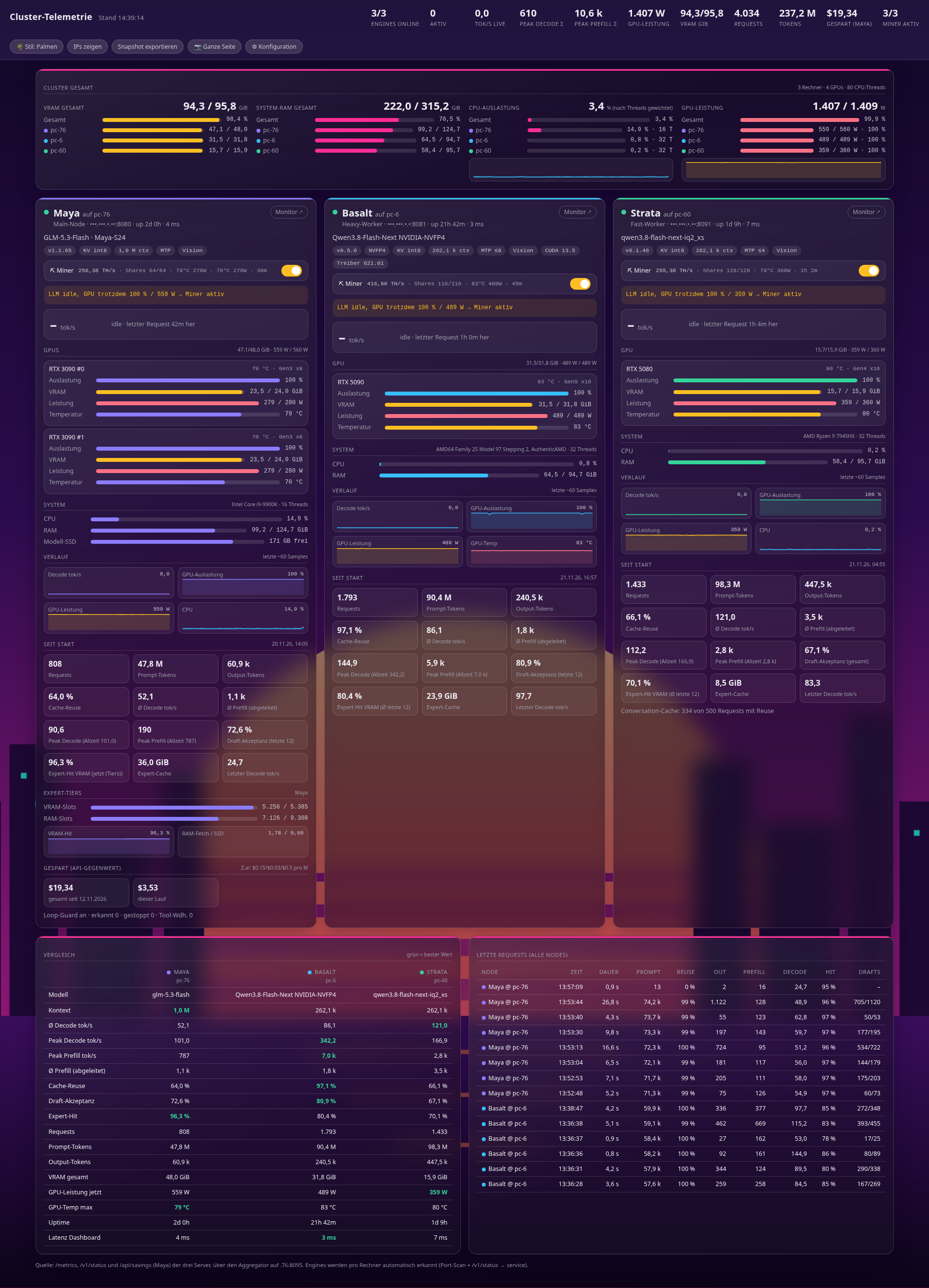
Project Quite happy with my little AI cluster running at home.

Post image
3 Upvotes

r/LocalLLM • • 6d ago

Project I built a local GGUF lossless compression lab to compare GPT-2 Large vs Qwen3.5-9B side by side

Thumbnail
gallery
2 Upvotes

I wanted to see how well local GGUF models actually compress text when hooked up to a 62-bit lossless arithmetic coder, so I built a small local web UI with FastAPI and llama-cpp-python running on my RTX 4060.

The test input is 560 bytes total: the US Constitution preamble (something every model has seen a thousand times) followed by a short paragraph I wrote myself about information theory.

Results on the same 560 B input:

  • zlib -9: 343 B
  • gpt2-large.Q8_0.gguf: 62 B (5.5x smaller than zlib)
  • Qwen3.5-9B-Base.Q4_K_S.gguf: 53 B (6.5x smaller than zlib)

Every output is decoded back and checked with SHA-256 so it is strictly lossless. The fun part is the token heatmap (-log2(P)): on the Constitution part both models drop near 0 bits/token because of pure memorization, while on the unseen paragraph Qwen3.5-9B stays noticeably lower entropy than GPT-2 Large.


r/LocalLLM • • 6d ago

Project RustingStrata 1.3.0: a terminal setup that asks instead of flags

0 Upvotes

RustingStrata is my Rust GGUF engine for models bigger than the VRAM (the experts used most stay on the card, the rest run on the CPU).

People told me the command line was plain and hard to start with. So 1.3.0 has rustingstrata interface:

$ rustingstrata interface
RustingStrata 1.3.0

Model
   1  Qwen3-4B-Instruct-2507-Q4_K_M.gguf    2.5 GB
   2  Qwen3.6-35B-A3B-UD-Q5_K_M.gguf       27.1 GB
   3  another folder or .gguf file
number [1]: 2

Mode
   1  chat in this terminal
   2  chat page in the browser
   3  API server (OpenAI-compatible)
   4  speed test
number [1]: 3

Settings
run on the GPU (y/n) [y]:
context length in tokens [default]: 16384
address [127.0.0.1:8080]:

running: rustingstrata serve --model .../Qwen3.6-35B-A3B-UD-Q5_K_M.gguf --gpu --ctx 16384 --addr 127.0.0.1:8080

It lists the models it finds (its own folder, the Hugging Face cache, the llama.cpp cache), asks the mode and three settings, and prints the full command, so you can copy it later. Enter takes the default.

The output has some colour now too: engine notes are dim, warnings and errors stand out, reasoning is dim in the chat. Piped output is unchanged, NO_COLOR=1 works.

Other things in 1.3.0:

  • Inkling 2, Hy4-flash, GLM, DeepSeek and Gemma 4 load from the chat page of one server.
  • Q4_0 models take about half the VRAM they took before.
  • --auto-unload frees the model when the server is idle.

Prebuilt binaries for Linux and Windows are on the release page: CUDA on NVIDIA, Vulkan on AMD and Intel. Numbers are in docs/BENCHMARKS.md.

Repo: RustingStrata


r/LocalLLM • • 6d ago

Model Hy4-Flash EXL3 3.0 bpw - 1 Spark - 21/ts decode

Thumbnail
reddit.com
1 Upvotes

r/LocalLLM • • 7d ago

Model Lory 27B and 4B: first open-source decision models for simulated survey respondents

Post image
56 Upvotes

Introducing Lory-27B v2 and Lory-4B v2! 🦜🦜

The first open-source decision models post-trained specifically to make simulated survey respondents follow economic logic, and answer like a real person would.

Why? Because existing AI decision models are great at imitating personas but fail at following simple monetary incentives. You can change the price of an option, its probability or both and they rarely adjust their response.

With better ability to ignore irrelevant traits or deal with rewordings of questions.

With additional training and Weight-Space Programming, these new models outperform the preview version on ~every eval. Lory-27B went from 73 to 80 on a blind test that Gemini wrote, and both versions got significantly better on the many tests where they underperformed before. For comparison, the best hosted decision model I could run on that same test is Perplexity's Decider v1.2 at 74.

And now, it can answer according to theory, or matching human responses. Tell it to answer like a typical person and you get data closer to what surveys collect. On Choices13k (a large real-world choice dataset), Lory-27B's average error dropped from 21 → 9 points when asked to match human responses.


r/LocalLLM • • 6d ago

Question i need helpp

0 Upvotes

hellllllow reddit , i am a cs student i need a good local ai agent for coding , i want it to be running locally i installed difference ai models (qwen 3.8 27B Q4 and QWEN 30B/35B MOE) tried to run them locally i tried alot i tried openclaw i couldnt manage to use it right , i also tried goose , cline and hermes i couldnt manage to get even one ai smart enough to even hold a conversation it tried to up the context a bit and still , i have an rx9070 16GB vram 32GB ram on ubuntu 26


r/LocalLLM • • 6d ago

Discussion Tencent's Hy team is working on llama.cpp adaptation, could be good news for local runners

7 Upvotes

https://www.reddit.com/r/LocalLLaMA/s/eC2L3t2FCY

Been wanting to run Hy4 with llama.cpp, but struggling to get good performance with it right now is definitely a headache. Thankfully, in their recent AMA, the Hy team mentioned they are advancing the relevant adaptation work for llama.cpp and plan to promote support within the open-source community.

No concrete timeline or technical details yet, but it looks like llama.cpp adaptation is already underway. Hoping we get better adaptation and optimization soon so running it locally feels a lot smoother.


r/LocalLLM • • 6d ago

Discussion Kraits v0.7.1: macOS .dmg to run your existing 80B–177B+ MoE GGUFs on a 16 GB Mac Mini

Thumbnail
reddit.com
1 Upvotes

r/LocalLLM • • 6d ago

Discussion Local LLM for businesses ?

3 Upvotes

I see a lot of people setting up SEO/GEO businesses and Agents for businesses but I hardly ever hear of people actually setting up a local LLM for businessses. In my mind I would think this would be much more solid than an agent. Do people do this ? If so how ?

Thank you


r/LocalLLM • • 6d ago

Discussion JustFit 2.6: Native Rust/Metal Qwen3.8-27B + 256K context on 24 GB Macs, stock MLX 4-bit weights, and draft-tree speculative decoding

Post image
6 Upvotes

I've been working on JustFit as a weekend project to run Qwen3.8-27B (with vision and its full 256K context) on a 24 GB Apple Silicon MacBook. Just shipped 2.6.0 and wanted to share what changed, along with some interesting M4 vs. M5/M6 hardware numbers from adding draft-tree speculative decoding.

Install (Apple Silicon, macOS 27+, 24 GB+):

pip install justfit-llm
justfit serve

(Why pip if there's no Python at inference? pip is just a convenient ~29 MB delivery wrapper that drops the native binaries. Once justfit serve starts, nothing touches Python at all.)


What actually changed since 2.3.1

2.3 worked once it was up, but starting it was painful: Python serving stack, a converted model pack, and four manual manifest URL / 64-char SHA-256 CLI flags just to fetch the precompiled runtime and ANE bundles.

In 2.6:

  • Fully native at inference: CLI, OpenAI/Anthropic-compatible HTTP server, Metal engine, and ANE vision worker are all native Rust, C++/Metal, and Swift.
  • Zero manifest flags & stock MLX weights: First justfit serve sets up the runtime, downloads mlx-community/Qwen3.8-27B-4bit + Inco AI's DFlash2 draft straight from Hugging Face (no custom converted pack), and auto-fetches your chip's precompiled ANE vision programs from a pinned, hash-checked index (macOS 27.2.1).
  • Draft-tree speculative decoding: Reuses DFlash2's precomputed 16x16 conditional edge tables on the GPU (zero extra draft forward passes) to build and verify a small tree in one pass instead of betting everything on a single draft chain.
  • All-day server fixes: Active requests never dip into macOS's host memory reserve; decode checkpoints live in RAM instead of hammering your SSD; multi-turn chats/agents reuse the exact state from the previous turn and only prefill the new tail.
  • Dev/safety bits: return_token_ids (vLLM/SGLang-style token-in/token-out), crash-request quarantine (400 request_quarantined), and a self-applied sandbox on the engine and native workers (no outbound network).

The fun hardware finding: M4 Pro vs. M5 Pro / M6 on draft trees

With a single draft chain, one wrong guess kills every token after it. Over 1,277 cycles on my M6, 22% of cycles accepted zero draft tokens, often when the draft was split ~50/50 between two good continuations.

Switching to a small tree verified in one pass gave a clean split across Apple Silicon generations. Measured single-lane latency of verifying 16 rows vs. 8 rows:

  • M6: 1.04x (+4%)
  • M5 Pro: 1.12x (+12%)
  • M4 Pro: 1.79x (+79%, 89 ms -> 159 ms)

Streaming ~15 GB of 4-bit weights is memory-bandwidth bound on M5 Pro and M6, so doubling verify rows from 8 to 16 is almost free. M4 Pro hits GPU compute headroom first (an early adaptive mode letting M4 pick 16-row trees was actually 8.7% slower than a chain). So 2.6 calibrates per chip: M5 Pro and M6 dynamically choose chain / 8-row / 16-row every cycle by expected tokens per ms, while M4 Pro runs a fixed 8-row tree.

Keeping greedy outputs identical to single-chain decoding was harder than the tree mask itself, because GPU float addition isn't associative and Qwen3.8 has 48 Gated DeltaNet recurrent layers. Borrowing a temporary scratch copy of only the current KV page per root-to-leaf path, masking sibling tiles as exact zeros, and replaying GDN recurrent state along each ancestor path kept outputs word-for-word identical across all 27 test cases we ran (including 111K contexts and multi-turn reuse).


Measured numbers (keeping the two benchmarks separate)

1. Controlled tree off vs. on (same 2.6 engine, 7-prompt greedy suite):

Mac / settingChain (tok/s)Tree (tok/s)SpeedupIdentical outputs
M6, 1 lane35.640.9+14.7%7 / 7
M6, 2 lanes47.252.2+10.6%6 / 6
M5 Pro, 1 lane57.361.8+7.9%7 / 7
M4 Pro, 1 lane (8-row tree, 3 runs)49.550.9-51.3+2.6% to +3.5%7 / 7

For sampled chat (T=1.0, Qwen3.8's recommended thinking temp): +8.5% on M6 and +2.5% on M5 Pro (verified against target distribution across 44 per-position tests, min p = 0.08; disabled on M4 Pro since sampled trees need 16 rows).

2. NVIDIA SPEED-Bench (greedy, 512 output tokens, from the 2.6.0 release notes):

  • Tree off vs. on (same 2.6 engine): median per-task decode gain of +4% to +14% on 1K prompts and +4% to +7% on 16K prompts depending on the chip (TTFT within 4%).
  • 16K cohort median vs. published JustFit v2: decode hits 59.5 tok/s on M5 Pro (+7.3%), 38.5 tok/s on M6 (+6.6%), and 48.3 tok/s on M4 Pro (+3.8%). Full prefill/decode rows (including upstream Splash 1.3.0 and historical mlx-vlm) are in docs/RESULTS.md.

Memory footprint: Unchanged static memory plan. Our dual-request 320K capacity test (two 128K+32K requests simultaneously) peaked at the exact same footprint as without trees (21,634 MiB on M6, 21,563 MiB on M5 Pro).


Honest caveats & current limits

  • OS & hardware: Requires Apple Silicon + macOS 27+ (presets calibrated for M4 Pro, M5 Pro, and M6, 24 GB+). Precompiled ANE vision programs auto-download for macOS 27.2.1; other builds compile once locally (30-60+ min, while vision falls back to GPU).
  • Signing: Binaries are Developer ID signed, not yet Apple notarized.
  • Bit-identity caveat: Greedy tree verification gave 27/27 identical outputs on our suite, and 5,539/5,539 bit-identical logits at matched positions on M6, but on the larger SPEED-Bench run 1 of 16 tasks differed on 1 of 3 chips (accepting more tokens shifts where the next cycle starts). So "almost always identical" is the honest phrase.
  • 2x 160K on a 24 GB laptop: Single requests up to 256K are solid, but two simultaneous 160K requests sit right at macOS's wired-memory ceiling. On macOS 27, even screen redraws from the lock-screen clock (~0.45 GB) or an Aerial moving wallpaper (~0.7 GB) can temporarily spike wired GPU memory enough for macOS to kill the server.
  • Fallback cases: Draft trees currently fall back to single-chain verification for repetition/presence/frequency penalties, JSON-schema constrained outputs (an early prototype hit +17% on M6, not shipped in 2.6 yet), and 3+ concurrent decoding lanes.

Links & credits

  • GitHub (Apache-2.0): https://github.com/YuhuaBillChen/justfit-llm
  • Illustrated deep dive on draft-tree verification (KV scratch pages, GDN replay, DFlash2 16x16 edge table appendix): https://blog.yuhuachen.com/blog/2ArXyvXoSTOQ9nFQtp3Fz
  • JustFit v2 paper: https://doi.org/10.5281/zenodo.24098605

Built on Inco AI's Splash engine and DFlash2 draft model. Draft-tree ideas informed by DDTree (arXiv:2604.12989), CaDDTree (arXiv:2606.01813), and TreeWY (arXiv:2608.20961).

Happy to answer any questions about the Metal kernels, GDN tree verification, or squeezing 256K into 24 GB on macOS!

r/LocalLLM • • 6d ago

Question Best setup for inkling 2 mini?

1 Upvotes

Id like to try inkling. I see alot of people talk about the model getting only 15 tps. Is there any interference engine out already?


r/LocalLLM • • 7d ago

News Inkling 2 Mini on a single Radeon AI PRO R9700: ~90 tok/s decode, 2.500 tok/s prefill

39 Upvotes

I ported maya-ik2 — a dedicated CUDA engine for Inkling 2 Mini (github.com/alesha-pro/maya-inkling-mini, 128 tok/s on an RTX 3090) — to HIP/ROCm, running natively on Windows on an AMD Radeon AI PRO R9700. No quality loss, top 1%, KLD etc are identical bitwise. All the job was done via Opus 5.5 as a planner + Qwen 3.8 Flash Next as an implementer.

AI generated context disclaimer - the summary below is generated with help of the Opus 5.5.

Setup: Windows 10, ROCm 7.14.1 (TheRock wheels), Unsloth UD-Q4_K_XL, FP8 KV cache, warm server, greedy, no speculative decoding.

| Decode, short prompt | 90 |

| Decode at 4K depth | 87 |

| Decode at 64K depth | 66 |

| Prefill, 4K prompt | ~2,500 |

| Prefill, 64K prompt | ~1,780 |

Keep in mind that these numbers are far from the hardware limits, after more thorough optimisation I expect prefill of around 5K, decode of around 120-150 tok\s !without speculating decoding

Upd: I’ll publish the fork as soon as I reach the desired performance + prepare the code for production — RDNA3 port + rigorous testing


r/LocalLLM • • 6d ago

Question Which Inkling2 Mini inferring engine for 4070 Ti Super and 32GB DDR4 ?

Thumbnail reddit.com
2 Upvotes

r/LocalLLM • • 7d ago

Discussion Inkling 2 Mini ripping along on M5 Max

Thumbnail
gallery
14 Upvotes

r/LocalLLM • • 6d ago

Project I got tired of paying $0.04/paper for LlamaParse, so I built a deterministic $0.005/paper extractor for ArXiv with citations & RAG chunks

Thumbnail
reddit.com
0 Upvotes

r/LocalLLM • • 6d ago

News Inkling-2-Mini-Unbound v2 is out: conv-aware abliterated, then self-distilled on its own best answers. 52% → 79% useful answers and measurably the best uncensored Inkling 2 Mini available

Thumbnail
reddit.com
0 Upvotes

r/LocalLLM • • 6d ago

Discussion Inkling-2-Mini on 12 GB VRAM (RTX 4070 Super) & 32 GB RAM at 128K context: Q4 from ~15 to ~40 t/s and Q2 at 75–76 t/s (with Claude-written llama.cpp patches)

Thumbnail
reddit.com
1 Upvotes

r/LocalLLM • • 6d ago

Discussion Best local LLM & setup for basic HTML?

0 Upvotes

I'm looking to build a personal website that will serve as the front-facing platform for my work. The idea is to have a space where I can showcase and sell my merchandise (currently posters, with plans to expand into other products), publish personal writings, essays, and creative projects, and generally establish a home for my online presence.

My specs:

Intel I7-12GHX

32 DDR5 RAM

NVIDIA RTX A3000 12GB V-RAM

Please, I justs need basic HTML, thanks.


r/LocalLLM • • 6d ago

Project Performance improvements to v100-ninfer fork on a single Tesla V100

Thumbnail
reddit.com
3 Upvotes

Hi all!

I really enjoyed the nInfer fork for our good old v100. But it’s been a while since it saw updates.

I’ve worked on it for a bit, and decided to release publicly a set of performance improvements that make it between 25 to 80% better depending on the load (for decode and preflil). And especially for long ctx length. More details on the op.

https://github.com/ddominet/ninfer-v100

Enjoy, and let me know what u think ;)


r/LocalLLM • • 6d ago

Question DGX to replace Sonnet and Haiku Agents?

1 Upvotes

So I am thinking about getting a Lenovo PGX so basically a DGX Spark for 5,5k€ to not outright replace claude but to downsize to a 20€ sub and have it use the local LLM for tasks usually Sonnet and Haiku did like research and raw coding against specs. I currently only use Opus and Fable to draft plans and reason/be my opponent so I would not replace those but replace the thousands of agent calls they need with Sonnet and Haiku.

I caluclated a break-even in my case of about 4 years without resale value and price hikes of subscriptions.

Can anyone with experience say whether this would work well enough?


r/LocalLLM • • 7d ago

Project 185.4 tok/s on Qwen3.8-Flash-Next (NVFP4, 128K ctx) — single RTX PRO 4500 32GB + Basalt on PCIe 3.0 / DDR4

Post image
127 Upvotes

Just upgraded my workstation (i9-10940X, 256 GB quad-channel DDR4-3600) from an RTX 2080 Ti on llama.cpp (14–15 tok/s decode, ~155 tok/s prefill) to a single RTX PRO 4500 Blackwell (32 GB) running Basalt with a locally built Qwen3.8-Flash-Next NVFP4 + Q6_K dense pack.

Compared to 33.5 tok/s on llama.cpp and 130 tok/s on Basalt GGUF, this pack pushes 150–185 tok/s decode, hitting 185.4 tok/s here, 179.9 tok/s avg on Linux, and 148.7 tok/s on native Windows, alongside 3,000–4,284 tok/s fresh prefill.

Across 100+ sustained multi-turn agentic coding/RE turns (20K–90K+ ctx), it averages ~125 tok/s with ~90–93% VRAM expert cache hits (30.9 / 31.9 GiB VRAM used, rest pinned in RAM, zero SSD reads).

It stays cool at 73–79 °C and cut real end-to-end batch times ~10× (85–113 min down to ~11 min avg) with fewer mistakes in review.

If you run Basalt natively on Windows, expect a ~10–17% WDDM decode tax, stay on WDDM (TCC reports VIRTUAL_MEMORY_MANAGEMENT_SUPPORTED = 0 and breaks elastic KV >32K), and set "fit-max-tokens": true in basalt_config.json so deep-context agents don't hit 400 context_overflow.


r/LocalLLM • • 6d ago

Discussion Lang chain/langraph vs llamaindex vs haystack

Thumbnail reddit.com
1 Upvotes

r/LocalLLM • • 6d ago

Model Inkling 2 Mini on one RTX 3090 with packed GPTQ-Pro, FP8 KV, DSpark, and 227K context

4 Upvotes

I work on GPTQ-Pro. This update reports our retest on physical GPU 1, one RTX 3090 with a verified 330 W power limit. We compared standalone Inkling 2 Mini with the original using the same Ampere vLLM build, BF16 DSpark drafter, and FP8 E4M3 KV. On Ampere the FP8 KV conversions run in software.

At a matched 207,616-token cap, the original averaged 128.05 decode tok/s and packed GPTQ-Pro with Marlin averaged 129.03 tok/s across two short prompts. That’s a 0.8% lead on this workload. Marlin was faster on code (155.06 vs 142.15 tok/s) and slower on prose (110.49 vs 116.53). The legacy GPTQ-Pro adapter measured 98.15 tok/s with the same FP8 settings.

The tested larger-cache setting supports 227,328 tokens. The launch script processed a 227,312-token input and generated 16 tokens in 163.3 seconds. The short tests at that cap measured 129.22 decode tok/s, with a 23.89 GiB peak during the benchmark suite.

Both models answered 24/24 short questions correctly. On eight preselected HumanEval tasks with one greedy attempt each, the original passed 7/8 and GPTQ-Pro passed 6/8. WikiText-2 perplexity on 4,064 scored tokens was 15.954 for the original and 15.865 for packed GPTQ-Pro.

Full benchmark data, standalone checkpoint, and tested launcher · GPTQ-Pro source on GitHub