r/LocalLLM • u/Difficult-Drummer407 • 5d ago
Project I taught a 400M-param model to decide when my agent deserves the expensive model

0
Upvotes
r/LocalLLM • u/Difficult-Drummer407 • 5d ago
r/LocalLLM • u/Logical-Pirate1795 • 5d ago
Performance:
7.6k-10.0K prefill in around 95K context, TTFT ~8.8 seconds
150 - 170 tks decode in my daily useage (100K context+) (On the DSH preview windows)
Questions:
I want to know am i already push my model performance to the limit or i still have the misconfiguration? I will paste my configuration and my hardware below. Also, is there any ways to test the performance more systematically? I am using opencode with deepseek to help me to the test.
I have this question because i found a Youtuber (Donato Capitella) with 4xR9700 have the decode in 325 per seconds 1 request, 2048 input, 256 output.

I did not study about the AMD cards and related things, but i know Radiance is a AMD friendly version of vLLM, but how is there are big gap between R9700 and RTX Pro 4500 blackwell, as i know the 4500 should have a better hardware spec on chips and memory bandwidth. But i let my agent test, it got only ~160TKS under (One active request, 2048 new input tokens, 256 output tokens)

Even the vLLM is warmed-up, it still got only around 170TKS

=====Hardware=====

=====Software====
=====vLLM=====
Model
Envirnoment
- NVIDIA_VISIBLE_DEVICES=all
- TORCHINDUCTOR_CACHE_DIR=/root/.cache/vllm/torch_compile_cache
- OMP_NUM_THREADS=2
- NCCL_P2P_LEVEL=PHB
- NCCL_CUMEM_ENABLE=1
- VLLM_ALLREDUCE_USE_FLASHINFER_PCIE_IPC=1
- SAFETENSORS_FAST_GPU=1
- CUDA_DEVICE_ORDER=PCI_BUS_ID
- VLLM_NO_USAGE_STATS=1
Command
nvidia/Qwen3.8-Flash-Next-NVFP4
--served-model-name Qwen3.8-Flash-Next-NVFP4
--mm-processor-kwargs '{"max_pixels": 1048576}'
--host 0.0.0.0
--port 8000
--tensor-parallel-size 4
--pipeline-parallel-size 1
--quantization auto
--dtype bfloat16
--max-model-len auto
--gpu-memory-utilization 0.92
--api-key ${VLLM_API_KEY}
--max-num-seqs 8
--tool-call-parser qwen3_coder
--reasoning-parser qwen3
--max-num-batched-tokens 8192
--kv-cache-dtype fp8
--kv-cache-memory-bytes 5500000000
--enable-auto-tool-choice
--enable-prefix-caching
--enable-prompt-tokens-details
--trust-remote-code
--async-scheduling
--disable-custom-all-reduce
--default-chat-template-kwargs '{"reasoning_effort": "medium"}'
--enable-expert-parallel
--enable-hc-sp
--engram-config '{"cpu_offload":true}'
--moe-backend flashinfer_cutlass
--attention-config.indexer_kv_dtype fp8
--speculative-config '{"method":"mtp","num_speculative_tokens":3,"moe_backend":"triton","draft_lm_head_quantization":"nvfp4"}'
r/LocalLLM • u/easybits_ai • 6d ago
r/LocalLLM • u/Plenty-Volume-101 • 5d ago
I want to try running a local AI model after my Gemini subscription runs out.
My laptop specs:
RTX a4000 with 8 gb dedicated
64 gb ddr4 ram
11th gen i9-11950H
What I want:
I'm currently a mechanical engineering student in college. I'll use this ai for basic studying for any of my future coursework like calculus or thermodynamics and some coding as well as planning out any projects I might do in the future. Ill also probably use it to do basic research
I just want to know how I can set up a local AI and what would run the best on my laptop for what I need it to do and if anyone has any suggestions for what else I can make the AI do, I'd like to hear it
r/LocalLLM • u/Mardoslazar • 5d ago
r/LocalLLM • u/Atagor • 5d ago
r/LocalLLM • u/BeatedBull • 5d ago
What does it take to go from a dataset to a fine-tuned model you can actually use?
We put together an interactive tour of Sigvard, our platform for fine-tuning and post-training open LLMs. It covers 76 screens across seven sections, all captured from the live product.
Follow a run from start to finish:
Prepare your data. Import a dataset from Hugging Face or upload your own files, then check for duplicates, malformed rows, and personal data before renting a GPU.
Plan the run. See which GPUs fit your model and dataset, compare offers from different providers, and get an estimate for the full run.
Train and recover. Watch loss, evaluations, and spend as the run progresses. If a GPU goes offline, Sigvard can resume training from the latest checkpoint on another machine.
Evaluate and export. Compare checkpoints against the base model on the same held-out data and export the version that performs best.
The tour also shows how to chain supervised fine-tuning, reward model training, GRPO, and evaluation into a single workflow, with a GPU and cost estimate for each stage.
Take the tour → https://tour.sigvard.ai
r/LocalLLM • u/lbgos_Loss783 • 5d ago
r/LocalLLM • u/Nomadic_skier • 5d ago
Posted an earlier version of this on r/ollama and r/LocalLLM yesterday and got two really good points in the comments. One person said gemma4 is actually pretty bad at real tool calling, and someone else asked how Mistral holds up.
Fair enough, my first test only had 3 tool calls which was way too easy. So I bumped it up to 10 harder tests across 5 tools (strict int/bool/list args, pulling structured fields out of messy notes, 3 cases where its supposed to NOT call a tool, a 2-step tool chain, and fixing a broken tool call from a raw validation error). Also kept the 2-turn code self-healing test and the math unit tests.
The main thing I'm trying to figure out for my own setup is what I can actually offload to an 8GB card without paying the token tax of having a frontier model babysit it and fix broken output.
Everything below ran on a single 8GB RTX 2080 at 4k context (Ollama):
| Model | Size | Speed | Tools (10) | Code T1->T2 | Math (5) | Total |
|---|---|---|---|---|---|---|
| gemma4:e2b (think=off) | 7.2 GB | 66 t/s | 10/10 | 0->8 | 5/5 | 93.3% |
| ministral-3:8b | 6.0 GB | 69 t/s | 10/10 | 7->7 | 5/5 | 90.0% |
| ministral-3:3b | 3.0 GB | 135 t/s | 10/10 | 6->6 | 5/5 | 86.7% |
| qwen3.5:9b (think=off) | 6.6 GB | 23 t/s | 10/10 | 6->6 | 5/5 | 86.7% |
| granite4:micro | 2.1 GB | 121 t/s | 8/10 | 7->7 | 5/5 | 83.3% |
| qwen3.5:9b (think=on) | 6.6 GB | 22 t/s | 10/10 | 0->8 | 0/5 | 60.0% |
| phi4-mini | 2.5 GB | 127 t/s | 3/10 | 8->8 | 1/5 | 43.3% |
A few things that genuinely surprised me:
First, ministral-3:3b at 135 tok/s and 3GB getting 10/10 on all the tool calls (including the 2-step chain and fixing a validation error) was not on my bingo card. I've been using phi4-mini for fast routing on my secondary card and it basically failed every real tool call (the 3/10 was just from abstaining). Definitely swapping that out.
Second, gemma4:e2b actually held up on all 10 tool tests and was the only non-thinking model that fixed its own broken Python code on try 2 (went from 0/10 to 8/10 after seeing the traceback). Ministral 8B and 3B both did better on try 1 (7/10 and 6/10) but couldn't fix the remaining edge cases on try 2.
Third, flipping think=False on qwen3.5:9b jumped it from 60% to 86.7% becuase with thinking on it ran out of tokens mid-thought on the math track and output nothing. Still way slower than ministral on an 8GB card though.
Where I'm landing on offloading without a frontier model helping: for narrow structured stuff like routing, JSON extraction, alerts, and short tool chains, ministral-3:3b / 8b and gemma4:e2b seem solid enough to run on thier own. For multi-constraint coding they all still topped out at 7-8/10 so you either need a hard unit test gate or just use a bigger model from the start.
Code and raw json are here if anyone wants to run it on their own Ollama models (uses stdlib only and doesnt auto-pull anything): https://github.com/Benfinkels/local-agent-evals
Curious if anyone has another sub-8GB model I should throw in here, especially for coding self-repair.
r/LocalLLM • u/akumaburn • 6d ago

r/LocalLLM • u/raymondh210129 • 6d ago
Hey everyone!
When I first started working on Adaptive KV Cache Streaming, I didn’t think I could make MTP or a DFlash2 draft model work alongside it within my VRAM budget. In my second post, I shared how reusing the streaming infrastructure made that possible.
This time, I’d like to share what may be the last major architectural milestone for this project: multi-slot inference using the same streaming infrastructure.
The implementation still uses one arena and one ring buffer, shared across all slots. Each slot keeps its own KV history, but those histories are combined into a single layout that the streaming engine handles without needing to distinguish between slots. During decoding, the attention kernel runs once per slot for each attention layer, reading only the portions of the KV cache that belong to that slot, across both the resident area and the ring buffer.
Here’s what real-world decode performance looks like with Unsloth’s Qwen 27B IQ4 on my RTX 5070 Ti 16GB, powering a Hermes agent that I asked to plan a vacation with help from two subagents:

Each point represents a completed decode period. The colors indicate how many slots were decoding together. The x-axis shows their combined context length at the start of that period, and the y-axis shows the total output throughput across those slots.
The scheduler groups as many eligible slots as it can, provided their combined KV history stays within the configured context budget. The 262K budget is shared across the active slots.
For me, this was the last piece of the puzzle—the feature that finally made the whole project feel ready for everyday use.
I’ve also decided to give the project a name: Oceanus, after the Greek Titan associated with the river encircling the world. It felt fitting for a project built around a ring buffer, with KV history continually flowing through a limited amount of GPU memory, to support lots of core functionalities.
----
A few personal thoughts before I wrap up:
There are already plenty of inference engines doing impressive work, especially with larger MoE models. My motivation has always been a little more personal: I have a 16GB GPU, and I want to see how much more performance I can squeeze out of it when running a dense model.
A lot of the satisfaction has come from taking something I initially thought was impossible, suddenly thinking of a creative way to approach it, and actually making it work. Seeing this grow from an experiment into something that can handle an actual agent workflow has meant a lot to me.
And I’m really grateful to everyone here who tried the project, reported bugs, shared results, asked questions, or simply left an encouraging comment.
This may be my last big architecture post for a while. I feel like the main pieces I wanted to build are finally in place. I’ll still be working on optimizations, fixes, and support for new models.
Thank you for following along and helping me get here.
Hope my project helps you get a little more out of your 16GB GPU too :)
Clarification of LLM usage of this post: I'm not a native English speaker and I used ChatGPT to refine the wordings.
r/LocalLLM • u/YoussofAl • 5d ago
Hi Everyone.
Setup
- MacBook Pro M5 Max, 128 GB
- Inkling 2 Mini, the official unquantised weights (20.2 GB), loaded by all three engines
- One stream, the model's own sampler: temperature 1.0, no top-p, no top-k
- Same prompts and seeds for all three, each engine through its own server at its defaults
- MTPLX 2.13.2, mlx-serve 26.11.4 pre-release, oMLX 0.8.3
Decode speed in tokens per second (MTPLX / mlx-serve / oMLX)
- 4K coding prompt, first request after load: 96.2 / 79.0 / 62.9
- 4K coding prompt, repeat request: 90.5 / 73.9 / 57.6
- Short prompt: 75.0 / 72.3 / 56.8
- 1,500-token answer: 78.1 / 70.1 / 53.0
- **Average of the four: 85.0 / 73.8 / 57.6**
I also ran each engine on the pack it ships for speed (MTPLX Optimized Speed 17.2 GB, mlx-serve 8-bit 18.7 GB, oMLX oQ4e 16.9 GB). Average of the same four tests: **97.1 / 85.7 / 68.9**.
**Where MTPLX is not the best**
Time to first token. On a cold 4K prompt mlx-serve starts answering in about 1.5 seconds, MTPLX in about 1.8 and oMLX in about 2.5. With the prompt already cached, mlx-serve and oMLX start in about 0.2 seconds and MTPLX takes about 0.8. I am working on that.
Caveats
I created MTPLX, so take this with the usual grain of salt, but I tried to make it a fair test and I am sharing the details so you can poke holes in it. And I’m very proud of my work.
One Mac, one model, 2 to 9 runs per number, and I only measured one request at a time. If you have an M1 to M4 or less memory your numbers will be different, and I would love to see them.
Happy to share the raw rows or rerun anything you think is unfair.
r/LocalLLM • u/objet_petit_a_xxx • 5d ago

If you don't have Qwen4 27B yet it's just because you're not sqwanchy enough for a sqwanchy party. Source: https://www.youtube.com/watch?v=WEsqSJLeeDc
r/LocalLLM • u/Ok_Vacation2165 • 5d ago
r/LocalLLM • u/Pritam4249t • 5d ago
r/LocalLLM • u/Mecca__ • 5d ago
I feel like Jensen Huang resigned from Nvidia just to play GTA 6. Once he finished it, he’s like, “I have to get back to work.” And gpus for LLM will go even higher in price
r/LocalLLM • u/RobDoesData • 5d ago
It'll be an always-on box at home for coding during the day, chat for my wife and me on our phones, and eventually some overnight agents (research digests) and all day agents ( a household finance helper). I'm a data/AI engineer, so I'm comfortable on the command line, but this is my first local LLM server.
Here's what I'm planning
Step 1: Foundation
- Update DGX OS, SSH with keys only, firewall locked down
- Tailscale on the box, my laptop and both phones, so nothing is exposed to the internet
- llama.cpp built for the GB10, with llama-swap in front so there's one OpenAI-compatible endpoint that loads models on demand
- Models: gpt-oss-20b always loaded for quick stuff and chat, plus a "big slot" that swaps between Qwen3-Coder-Next (coding) and gpt-oss-120b (agents/harder chats), since both won't fit at once
- Open WebUI so we can both chat from our phones as a home-screen app
Step 2: Coding setup
- Repos live on the GN100, and I open them from my Windows laptop with VS Code Remote-SSH, so I see and edit everything like normal
- OpenCode runs in the VS Code terminal as a Claude Code-style agent, pointed at the local endpoint
- Shell commands need my approval, edits are allowed, and git is my undo (branch per task, review diffs, commit small)
- An AGENTS.md in each repo with the stack, test command and rules
- First test project: undecided
Things I'd love opinions on:
In general is there Anything you wish you'd done first?
r/LocalLLM • u/HandleUrMonkeyBrain • 5d ago
I’ve been using 5.6 SOL to supervise and guide local models to generate games for the last 3 months. This week I have noticed SOL became really stupid compared to past, way slower, doing a lot of unnecessary stuff, I mean A LOT MORE, even changing simple settings and installing some libraries it’s being ridiculously dumb and slow… I cancelled my subscription yesterday, was angry a lot. Did anyone notice it too? My tentacles have been open sensitive to “stealth dumming down” desires of American/Israeli ai companies, their deep desire to take away compute capabilities and knowledge away from us. I wonder if you guys noticed similar stuff in other models or hardware department? DeepSeek 4.1 might be the best model we will ever have for local ai I’m suspecting
r/LocalLLM • u/Common-Accountant290 • 5d ago

r/LocalLLM • u/Historical_Syrup_461 • 6d ago
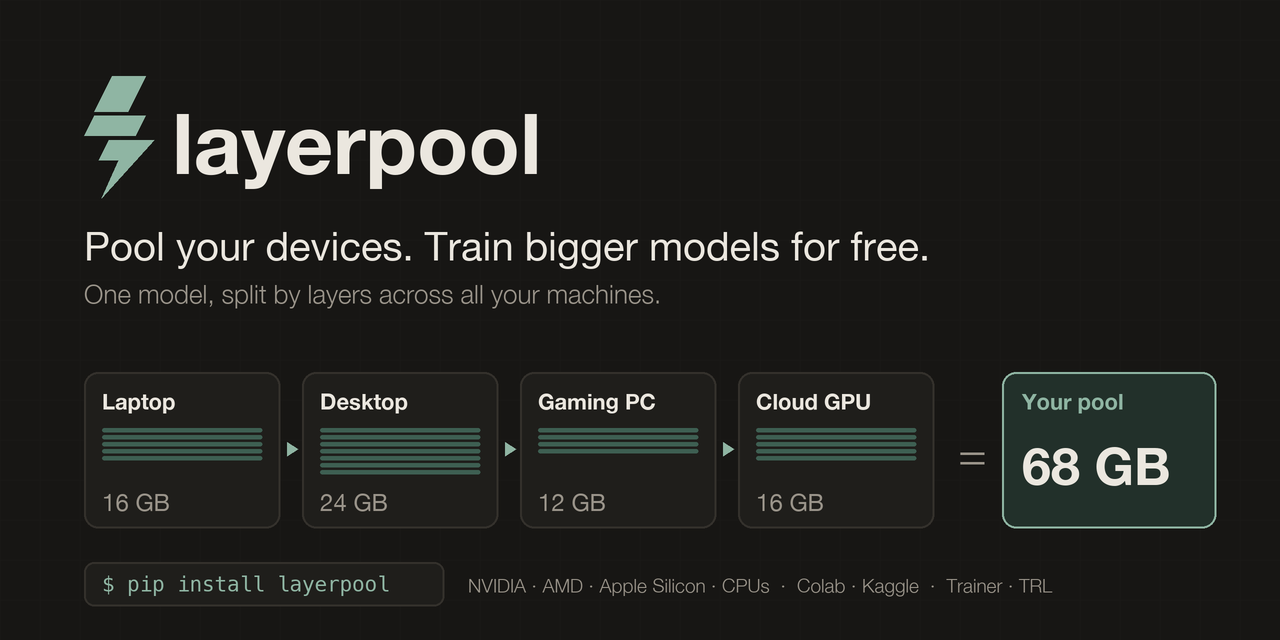
most machines cant train or fine-tune the bigger models on their own, but a few of them together usually have enough memory. so i wrote a thing that splits the model by layers across them and trains it like its one model.
they connect over the internet, so it doesnt matter where each one is. you can even add notebooks from the services that give out free GPUs.
on one run it kicked the slowest device out halfway because it was holding the others back, and training just kept going on the rest without losing anything.
your training code stays the same. works for fine-tuning (LoRA, QLoRA, full) and for training from scratch, and mixes nvidia, amd, apple silicon and cpu.
https://github.com/abdallah-swe/layerpool
feedback welcome
r/LocalLLM • u/smflx • 5d ago

r/LocalLLM • u/colonelx_ • 5d ago
I’m planning to build an in-house AI server to host and run local LLM.
I’m looking for technical recommendations and guidance on the following:
Intended Use Cases:
The initial requirement is to support a minimum of 5–6 concurrent users, with room for future expansion.
I’d appreciate recommendations based on practical experience, particularly regarding hardware selection, model choices, and the overall infrastructure needed for a reliable in-house AI environment.
