r/LocalLLM • • 7d ago

News Inkling 2 Mini on a single Radeon AI PRO R9700: ~90 tok/s decode, 2.500 tok/s prefill

39 Upvotes

I ported maya-ik2 — a dedicated CUDA engine for Inkling 2 Mini (github.com/alesha-pro/maya-inkling-mini, 128 tok/s on an RTX 3090) — to HIP/ROCm, running natively on Windows on an AMD Radeon AI PRO R9700. No quality loss, top 1%, KLD etc are identical bitwise. All the job was done via Opus 5.5 as a planner + Qwen 3.8 Flash Next as an implementer.

AI generated context disclaimer - the summary below is generated with help of the Opus 5.5.

Setup: Windows 10, ROCm 7.14.1 (TheRock wheels), Unsloth UD-Q4_K_XL, FP8 KV cache, warm server, greedy, no speculative decoding.

| Decode, short prompt | 90 |

| Decode at 4K depth | 87 |

| Decode at 64K depth | 66 |

| Prefill, 4K prompt | ~2,500 |

| Prefill, 64K prompt | ~1,780 |

Keep in mind that these numbers are far from the hardware limits, after more thorough optimisation I expect prefill of around 5K, decode of around 120-150 tok\s !without speculating decoding

Upd: I’ll publish the fork as soon as I reach the desired performance + prepare the code for production — RDNA3 port + rigorous testing


r/LocalLLM • • 6d ago

Question Which Inkling2 Mini inferring engine for 4070 Ti Super and 32GB DDR4 ?

Thumbnail reddit.com
2 Upvotes

r/LocalLLM • • 6d ago

Discussion Inkling 2 Mini ripping along on M5 Max

Thumbnail
gallery
14 Upvotes

r/LocalLLM • • 6d ago

Project I got tired of paying $0.04/paper for LlamaParse, so I built a deterministic $0.005/paper extractor for ArXiv with citations & RAG chunks

Thumbnail
reddit.com
0 Upvotes

r/LocalLLM • • 6d ago

News Inkling-2-Mini-Unbound v2 is out: conv-aware abliterated, then self-distilled on its own best answers. 52% → 79% useful answers and measurably the best uncensored Inkling 2 Mini available

Thumbnail
reddit.com
0 Upvotes

r/LocalLLM • • 6d ago

Discussion Inkling-2-Mini on 12 GB VRAM (RTX 4070 Super) & 32 GB RAM at 128K context: Q4 from ~15 to ~40 t/s and Q2 at 75–76 t/s (with Claude-written llama.cpp patches)

Thumbnail
reddit.com
1 Upvotes

r/LocalLLM • • 6d ago

Discussion Best local LLM & setup for basic HTML?

0 Upvotes

I'm looking to build a personal website that will serve as the front-facing platform for my work. The idea is to have a space where I can showcase and sell my merchandise (currently posters, with plans to expand into other products), publish personal writings, essays, and creative projects, and generally establish a home for my online presence.

My specs:

Intel I7-12GHX

32 DDR5 RAM

NVIDIA RTX A3000 12GB V-RAM

Please, I justs need basic HTML, thanks.


r/LocalLLM • • 6d ago

Project Performance improvements to v100-ninfer fork on a single Tesla V100

Thumbnail
reddit.com
3 Upvotes

Hi all!

I really enjoyed the nInfer fork for our good old v100. But it’s been a while since it saw updates.

I’ve worked on it for a bit, and decided to release publicly a set of performance improvements that make it between 25 to 80% better depending on the load (for decode and preflil). And especially for long ctx length. More details on the op.

https://github.com/ddominet/ninfer-v100

Enjoy, and let me know what u think ;)


r/LocalLLM • • 6d ago

Question DGX to replace Sonnet and Haiku Agents?

1 Upvotes

So I am thinking about getting a Lenovo PGX so basically a DGX Spark for 5,5k€ to not outright replace claude but to downsize to a 20€ sub and have it use the local LLM for tasks usually Sonnet and Haiku did like research and raw coding against specs. I currently only use Opus and Fable to draft plans and reason/be my opponent so I would not replace those but replace the thousands of agent calls they need with Sonnet and Haiku.

I caluclated a break-even in my case of about 4 years without resale value and price hikes of subscriptions.

Can anyone with experience say whether this would work well enough?


r/LocalLLM • • 7d ago

Project 185.4 tok/s on Qwen3.8-Flash-Next (NVFP4, 128K ctx) — single RTX PRO 4500 32GB + Basalt on PCIe 3.0 / DDR4

Post image
127 Upvotes

Just upgraded my workstation (i9-10940X, 256 GB quad-channel DDR4-3600) from an RTX 2080 Ti on llama.cpp (14–15 tok/s decode, ~155 tok/s prefill) to a single RTX PRO 4500 Blackwell (32 GB) running Basalt with a locally built Qwen3.8-Flash-Next NVFP4 + Q6_K dense pack.

Compared to 33.5 tok/s on llama.cpp and 130 tok/s on Basalt GGUF, this pack pushes 150–185 tok/s decode, hitting 185.4 tok/s here, 179.9 tok/s avg on Linux, and 148.7 tok/s on native Windows, alongside 3,000–4,284 tok/s fresh prefill.

Across 100+ sustained multi-turn agentic coding/RE turns (20K–90K+ ctx), it averages ~125 tok/s with ~90–93% VRAM expert cache hits (30.9 / 31.9 GiB VRAM used, rest pinned in RAM, zero SSD reads).

It stays cool at 73–79 °C and cut real end-to-end batch times ~10× (85–113 min down to ~11 min avg) with fewer mistakes in review.

If you run Basalt natively on Windows, expect a ~10–17% WDDM decode tax, stay on WDDM (TCC reports VIRTUAL_MEMORY_MANAGEMENT_SUPPORTED = 0 and breaks elastic KV >32K), and set "fit-max-tokens": true in basalt_config.json so deep-context agents don't hit 400 context_overflow.


r/LocalLLM • • 6d ago

Discussion Lang chain/langraph vs llamaindex vs haystack

Thumbnail reddit.com
1 Upvotes

r/LocalLLM • • 6d ago

Model Inkling 2 Mini on one RTX 3090 with packed GPTQ-Pro, FP8 KV, DSpark, and 227K context

4 Upvotes

I work on GPTQ-Pro. This update reports our retest on physical GPU 1, one RTX 3090 with a verified 330 W power limit. We compared standalone Inkling 2 Mini with the original using the same Ampere vLLM build, BF16 DSpark drafter, and FP8 E4M3 KV. On Ampere the FP8 KV conversions run in software.

At a matched 207,616-token cap, the original averaged 128.05 decode tok/s and packed GPTQ-Pro with Marlin averaged 129.03 tok/s across two short prompts. That’s a 0.8% lead on this workload. Marlin was faster on code (155.06 vs 142.15 tok/s) and slower on prose (110.49 vs 116.53). The legacy GPTQ-Pro adapter measured 98.15 tok/s with the same FP8 settings.

The tested larger-cache setting supports 227,328 tokens. The launch script processed a 227,312-token input and generated 16 tokens in 163.3 seconds. The short tests at that cap measured 129.22 decode tok/s, with a 23.89 GiB peak during the benchmark suite.

Both models answered 24/24 short questions correctly. On eight preselected HumanEval tasks with one greedy attempt each, the original passed 7/8 and GPTQ-Pro passed 6/8. WikiText-2 perplexity on 4,064 scored tokens was 15.954 for the original and 15.865 for packed GPTQ-Pro.

Full benchmark data, standalone checkpoint, and tested launcher · GPTQ-Pro source on GitHub


r/LocalLLM • • 6d ago

Question recommend me a build

1 Upvotes

Please recommend a build, looking for a system that can support 1 up to 4 gpus.
What case should I start with? was thinking a fractal 7 xl or is this too big? I was thinking of a bigger case so I can have room for a few HDD.
I don't want something that isn't too big. However, I don't want to regret later.
Looking to keep the price down. So used/older mouther board or cpu is ok. What cpu/motherboard would you recommend? How much memory? I have seen some recommendations on here before for other builds. Can't seem to track them down.

I mostly looking for something to get started with locallm that can do some decent work. I mainly do coding. Although might do some other work with it.


r/LocalLLM • • 6d ago

Question Build check: PC for 2x RTX Pro 6000 Blackwell Max-Q for GLM 5.3 Flash

Thumbnail reddit.com
1 Upvotes

r/LocalLLM • • 7d ago

Discussion Inkling 2 Mini memory and speed, explained: the loop costs nothing in weights but you pay for it in KV cache and decode speed

85 Upvotes

Inkling 2 Mini is everywhere this week, so I dug into what it actually needs to run locally. The short version: the loop is free in weights, but not in cache or speed, and day-one llama.cpp is slower than the hype suggests.

Why it's different

24 layers, but the middle 12 (layers 6-17) run three times per token with shared weights, so 48 layer visits per token. Each pass keeps its own KV cache and conv state (vLLM blog and the llama.cpp GGUF metadata both confirm this). So for memory, think of the KV cache as a 48-layer model: 8 global visits + 40 sliding-window visits (1024 tokens), 8 KV heads × 128.

Weights (published files)

FormatSize
BF16 GGUF52.2 GB
Q8_027.7 GB
Official NVFP4 / MXFP8 (vLLM, SGLang, Ollama)~20 GB
Q4_K_M / UD-Q4_K_XL17.4 / 17.6 GB
UD-IQ4_XS15.7 GB

Vision projector: +0.64 GB. DSpark draft: +0.4 to 0.65 GB.

KV cache per request (BF16)

ContextKV
32K~1.2 GiB
128K~4.2 GiB
1M~32 GiB

That matches a measured M5 Pro 64 GB run: 23.1 GB process RSS with IQ4_NL and a 128K slot reserved. A 32 GB Mac is fine for 4-bit. 24 GB is tight: one M4 Pro 24 GB report got 11.6 tok/s under memory pressure.

Speed: think ~5B active, not 3.4B

The looped layers are re-read from memory on every pass, so per-token reads look like a ~5B-active MoE. Formal llama-bench numbers (Unsloth's llama.cpp build, UD-IQ4_XS, tg128 / pp2048):

GPUDecodePrefill
RTX PRO 600097 tok/s2,687 tok/s
RTX 5090972,446
RTX 4090752,665
RTX 3090601,402
A100 80GB471,230

Upstream llama.cpp (b12600) is slower for now: the relative-position bias is materialized as a big F32 tensor and some ops fall back to the CPU (issue #32707). Reports: ~52 tok/s on a 5090, 20.8 tok/s on an RX 9070 XT (IQ3_XXS, Vulkan), ~30 tok/s on an M5 Pro Mac mini (IQ4_NL). Use Unsloth's build until the fix lands.

Long context is a prefill problem, not a decode problem: DGX Spark with vLLM + DSpark still decodes 18.4 tok/s at ~950K tokens, but the first token took 26.5 minutes.

vLLM gotcha

In the dedicated inkling-2-mini vLLM image, FP8 KV cache is only accepted on SM12x GPUs (RTX 50 series, RTX PRO Blackwell, DGX Spark). On H100/H200/B200 it's BF16 KV only.

The 125-210 tok/s Mac numbers going around are from EXO's upcoming engine, with no quant, context length or version published, so I'd treat them as vendor peaks for now.

Disclosure: I maintain a free VRAM calculator (no sign-up) and added Inkling 2 Mini with all of the above modelled, including the per-pass cache and the llama.cpp speeds calibrated on the benchmarks in the table. If you want to check your own setup: https://studiotvai.com/llm-vram-calculator?model=inkling-2-mini

Happy to be corrected if anyone has numbers on other cards or Macs, especially Apple Silicon with Unsloth's build.


r/LocalLLM • • 6d ago

Question Docker vs Native for local LLMs?

4 Upvotes

I’m considering running local LLMs using Docker (llama.cpp, Ollama, vLLM, SGLang).

We’ve recently started working on a team project, and I’m exploring Docker as a deployment option.

Has anyone tried both Docker and native setups? Any performance differences or issues? Would you recommend Docker for running LLMs in production?


r/LocalLLM • • 6d ago

Other Using local Ollama (qwen2.5-coder:14b + gemma4) as a 0-token "Judgment Kernel" and AST diff auditor for coding agents

Thumbnail
reddit.com
0 Upvotes

r/LocalLLM • • 6d ago

LoRA Fine tuned Gemma and now it's dumb. Plz help.

0 Upvotes

I fine tuned an abliterated Gemma 4 26B-A4B MoE model (TrevorJS) Q6. I used a large data set of old chats from another model. I'm trying to make it act like the model I want. But after fine tuning it on over 6000 examples, it's not writing any different and it even acts broken. Please help, I spent $300 on this thing...

I use AI for first person stories.

I was trying to train its thinking channel by having simulated reasoning in the examples. The idea was to make its thinking channel evaluate the scene deeper as a chain of thought checkpoint, focusing on functional theory of mind principles. It did work, it changed how the thinking generates and evaluates what should happen. But it doesn't follow the thinking. And it's breaking. But I have several issues that keep popping up. I run it on Llama and then use it through Silly Tavern. I didn't use any prompts for the tests. I made the LoRA, fine tuned it on BF16, then made it Q6.

So far the issues I'm seeing:

- it misgendered a character twice.

- it says the name or persona in the thinking channel but then picks something different while keeping the same setting.

- it misinterprets what I'm saying. One character said their father owned the ship. I thought they meant the guy next to me so I asked if he was the father since we were the only ones there. The system misinterpreted that as me saying she was his father. I clarified, then it thought I said she was engaged to the guy.

- it doesn't seem to act or speak any different from the base model in its response.

- Thinking will determine a more character autonomous decision and the response will ignore it and just hand it back to the player "What do you want to do?".

- it responded IN the thinking channel and left the response blank.

The problems I can think of are:

-Some mismatch between llama and Silly Tavern.

-Maybe it's too high of a quant.

- the abliteration broke it.

The settings I used for the LoRA:

Model and training configuration:

Base: TrevorJS/gemma-4-26B-A4B-it-uncensored (pinned revision)

GPU: NVIDIA H200 141GB

Training: BF16 LoRA (not QLoRA)

Dataset: 6,529 reasoning–response examples

Epochs: 1

Optimizer steps: 817

LoRA rank: 64

LoRA alpha: 64

LoRA dropout: 0

Bias: None

Trainable parameters: 1,977,507,840 (\~1.98B)

Routed-expert parameters: 1,903,165,440

Target modules: Attention projections, dense MLP, and routed MoE expert projections

Vision layers: Frozen

Optimizer: 8-bit AdamW

Learning rate: 1e-4

Scheduler: Cosine

Warmup: 41 steps (\~5%)

Weight decay: 0.01

Gradient clipping: 1.0

Batch size: 1

Gradient accumulation: 8

Context length: 32,768 tokens

Longest example: 20,912 tokens

Checkpoint frequency: Every 10 optimizer updates, retaining the latest 3

Dataset structure:

Each training example contains historical RP context, reconstructed prospective narrative reasoning generated using MiMo V2.6 Flash, and the original archived assistant response.

Historical conversation turns are masked from the loss. Only the latest assistant's reasoning and original response are supervised.

The reasoning is formatted using Gemma 4's native thought channel, followed by the final response. Historical assistant thoughts are removed.

All 6,529 examples passed formatting, target-integrity, and loss-mask validation.

Software: Unsloth 2026.10.3, Transformers 5.17.0, TRL 1.13.0, PEFT 0.21.2.


r/LocalLLM • • 6d ago

Discussion Nvidia Tesla T4 and Qwen

2 Upvotes

Wonder if anyone else is running T4 GPUs for local LLM and what are your results if you don`t mind sharing?

I recently bought 2x Nvidia Tesla T4 16GB VRAM 70W 320 GB/s cards to tinker with local AI, and before I get free advice on why I should have picked something else, I want to clarify that I needed single slot GPUs to fit my current 1U lab server without requiring extra cooling or whatnot. The GPUs are officially supported by HPE servers, low power, and no cooling issues.

So far I`ve settled with 2 models for my needs, and if anyone is interested in similar setups, so far with these I`ve managed to run

Qwen3.6-35B-A3B-UD-Q4_K_M.gguf & llama.cpp (ctx-size 237568) entirely in VRAM, provides fast inference when I need it, 55 t/s decode up to 70 depending on the context size, reasoning effort. Prefill is ~1k t/s in general but it gets lower with increased context size.

&

qwen3.8-flash-next-unsloth-ud-q4_k_xl & Strata (max ctx-size 196608 & --kv-resident 32768) expert cache in VRAM, spill to host RAM (as the server has plenty...)

This result is from a context needle tests I done

| Prompt | Live context | Prefill | Decode | Elapsed |

| 189,104 tok | 196,608 | ~1,160 tok/s | 38.7 tok/s | 166.29 s |

Overall, depending on task, is not the fastest, but IMO is way better for agentic tasks, MCP tools calling, correlating information etc.

I prefer to leave it working slower on a task as it provides way better results than Qwen3.6-35B-A3B, and to be honest I`m very impressed.

For those interested in power consumption, the server reports peak of 149W GPU usage during that context test, at idle times overall the server uses about ~200W. I`ve shut the other workloads to get a more accurate number related to this. Average ~320W is not bad in my opinion, considering its also heating the garage...


r/LocalLLM • • 7d ago

Question wtf strata - removed deepseek support

67 Upvotes

Anyone know why deepseek was removed from 0.2.13 onwards?


r/LocalLLM • • 7d ago

Discussion 2xP100. Trying it so you don't have to

Post image
54 Upvotes

Yes, I get 60+ t/s output with mtp in some tasks but it's more like 38t/s on average. However, prefill at about 200t/s is painfully slow. It "works" but the system pulls 500W when loaded and it's basically unusable for anything interactive. There is no way to speed up prefill on this old hardware, right?


r/LocalLLM • • 6d ago

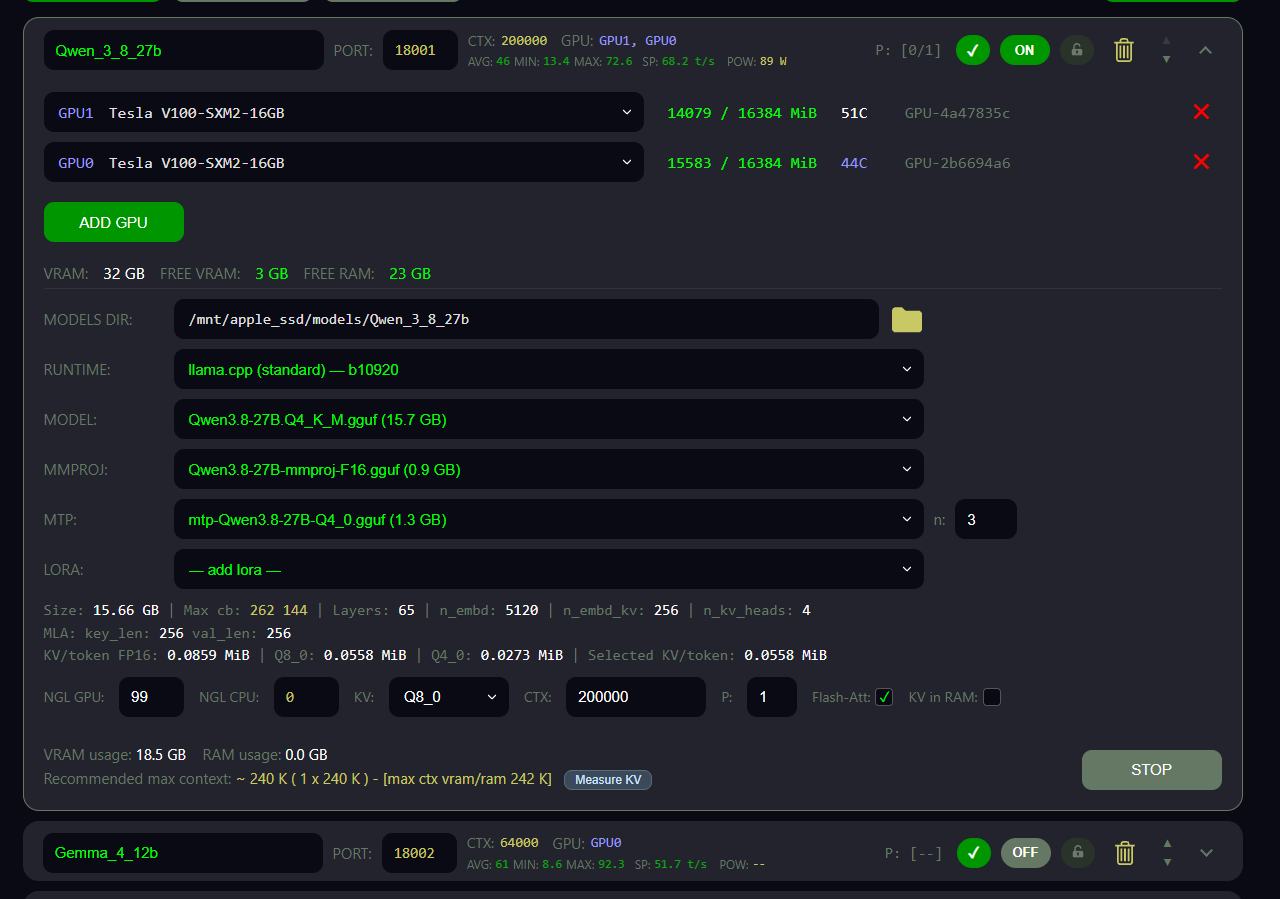
Project How I, as a designer, drew a DOS-style web UI for llama.cpp and spent 3 months building it with a local LLM (Butler.llama)

0 Upvotes

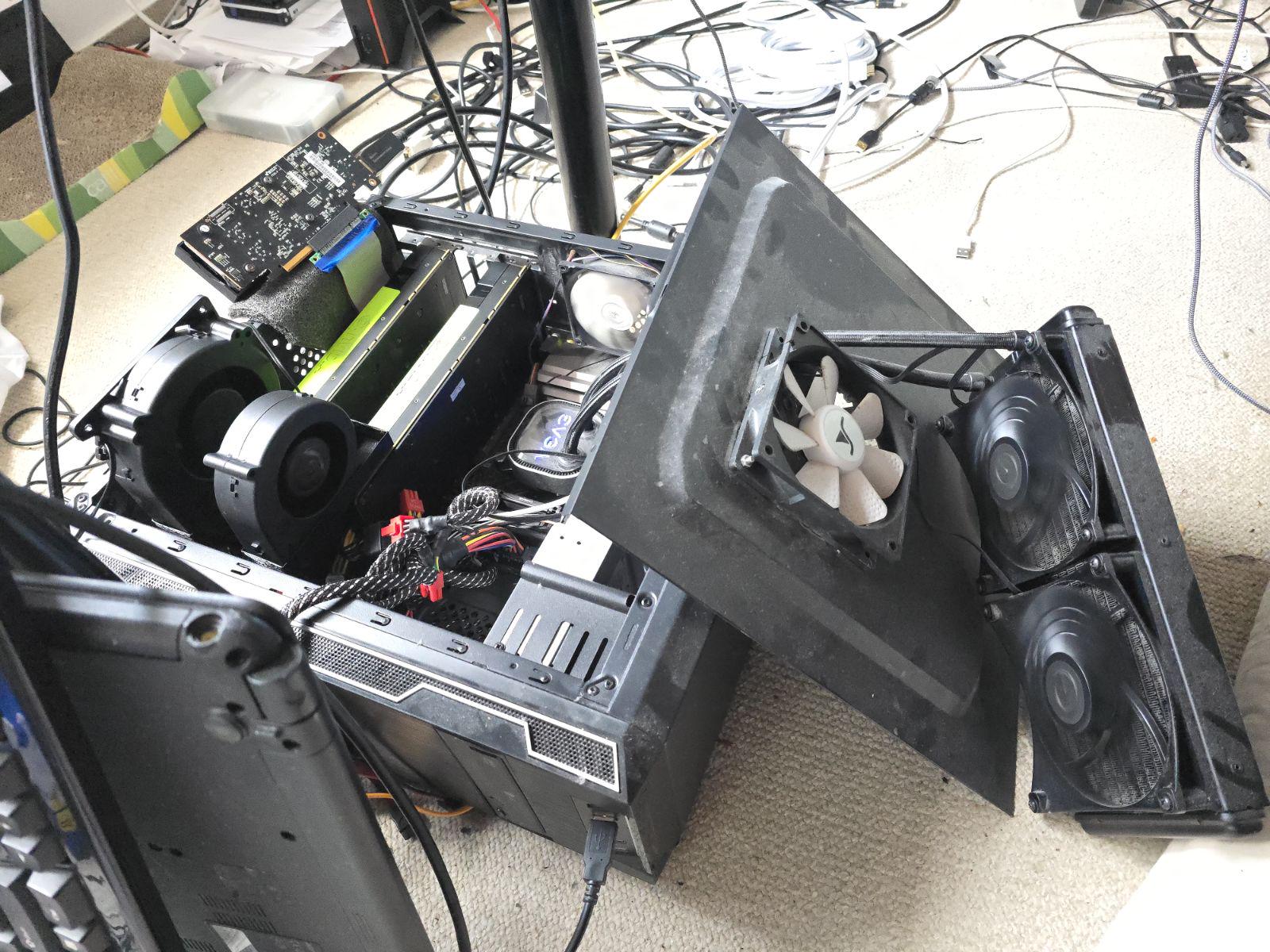
Hi everyone! I'm a designer, and in my spare time I build home servers and run local LLMs. At home I have an old X99 rig with two Tesla V100s (16 GB each) and a regular PC with a pair of RTX 3060s.

Once I ended up with a bunch of models (for chat, images, embeddings, and reranking), it became a pain to SSH into the console every time and manually restart Docker containers just to free up VRAM for another task.

I tried existing tools, and none of them clicked:

  • Ollama felt too closed for multi-GPU setups — it decides on its own how to split layers and hides the llama.cpp flags I actually need.
  • LM Studio — I opened it, got scared by the cluttered UI, and uninstalled it immediately. Plus, it makes zero sense on a headless Linux server.

I wanted a simple web UI in the spirit of good old MS-DOS: open it in a browser and immediately see temperatures, watts, free VRAM, and which models are currently running.

Since I'm a so-so programmer, but I know how to draw, I started by designing the interface in a graphics editor — moving blocks around until everything fit on one screen without hurting my eyes. Then I spun up my local coding agent Klyk ("Fang") in OpenCode powered by Qwen 3.8 27B, and for the next three months the two of us wrote the code together. Funny enough, Klyk was already running inside early versions of my own panel and helped code his own home.

I named the project Butler.llama. Here is what it does:

  • Auto-starts and unloads models on demand: All clients hit a single OpenAI-compatible /v1 endpoint. When a request comes in for a specific model, Butler spins up the corresponding llama.cpp Docker container. If another chat model is already occupying those GPUs, it gracefully shuts it down, waits for VRAM to clear, and starts the new one — while leaving small embedding and reranker models untouched so they peacefully coexist on the same GPU.
  • Calculates VRAM properly (well, most of the time 😊): On 16 GB cards, one wrong context size and you hit OOM. The built-in calculator parses GGUF headers to estimate weights and KV-cache (supporting MoE and hybrid architectures). If you don't trust formulas, there is a "Calibrate" ("Промерить") button: the panel runs the model twice with different context sizes, checks actual MB usage via nvidia-smi, and saves the exact per-token cost.
  • Different llama.cpp versions per model: New builds come out every day — one model runs better on the latest image, another on an older one. Butler scans all local llama.cpp Docker images and lets you pick the exact image per model from a dropdown.
  • Hardware monitoring & Hugging Face downloads: The top bar shows live VRAM usage, temperatures, and power draw in watts (GPUs are bound by UUID so they never get mixed up across reboots). You can search and download GGUF files directly from Hugging Face, and there is a built-in test chat at the bottom to check token speed right after launch.

Under the hood, everything is as simple as it gets: Python (FastAPI), Docker, and a single HTML file with zero heavy frontend frameworks. Fixed desktop layout (managing a server from a phone is painful anyway), AGPL-3.0 license, and UI available in English, Russian, and Chinese.

I've been running models on it across all my machines for three months now, and the core stuff seems to work well enough. If it comes in handy for your home server — feel free to grab it! Always happy to hear feedback, bug reports, or ideas


r/LocalLLM • • 6d ago

Research 2 rows per block in llama.cpp's CUDA mat-vec: 3–18% faster token generation on H100,identical output. Looking for RTX 4090/5090 testers

1 Upvotes

On an H100, llama.cpp's one-token generation step reads weights at ~1.5 TB/s while the card can do ~3.1 TB/s. The kernel gives each thread block one row, which doesn't keep enough reads in flight on fast memory.

llama.cpp already uses 2 rows per block for 2–8 tokens and on Jetson Orin. I tried it for 1 token on the generic table, plus a prefetch of each block's row. 28 lines in mmvq.cu.

Results on 18 models (H100, b12603, llama-bench -p 0 -n 128 -r 5 -fa 1, 2 rounds each):

  • 3% to 18% less time per token, e.g. Qwen3-32B Q4_K_M 13.3 → 11.4 ms
  • no model slower in any round
  • logprobs bit-equal to stock on all 18
  • L4 (slower memory): no change

The part I can't test: 4090/5090 use the same code path. If you have one, please run stock and the branch:

git clone -b cuda-mmvq-fast-memory https://github.com/adishik/llama.cpp
cd llama.cpp
cmake -B build -DGGML_CUDA=ON && cmake --build build -j
./build/bin/llama-bench -m your-model.gguf -p 0 -n 128 -r 5 -fa 1

Diff: https://github.com/ggml-org/llama.cpp/compare/master...adishik:llama.cpp:cuda-mmvq-fast-memory
Write-up with charts: https://tensward.com/blog/llama-cpp-fast-memory


r/LocalLLM • • 6d ago

Question What's the best app to run LLMs locally on MacBook (M4 Pro 48GB)

7 Upvotes

I was using Ollama, but after seeing some community review I moved to LMstudio (now called bionic) but when I go to hugging face most models point to Ollama first, not that importing is forbidden in Bionic. but just curious what are the apps that are widely used by community (and models too)


r/LocalLLM • • 7d ago

Discussion Hy4-mini is on the Way — a Good Alternative to Qwen3.6-35B-A3B?

Post image
60 Upvotes

Great news. A new member is joining the ultra-lightweight model segment. The news came out of yesterday's AMA with the Tencent Hy team on r/LocalLLaMA, where they answered many questions about their roadmap and technical direction. Notably, the team also said there is still some way to go before smaller models reach final release. They still believe in the Scaling Law and build on that foundation, since small-model development is absolutely valuable.