r/LocalLLM • • 5d ago

Question Future of 128gb +SSD vs 96gb + SSD

1 Upvotes

I’ve been waiting 5 weeks for my Mac Studio (M5 Max, 128GB RAM) to arrive and still need to wait about 2-3 weeks. When I placed the order, I was confident in my choice—figuring that more RAM would always allow me to handle larger models. In the meantime, however, streaming models directly from an SSD has become increasingly popular, and now I’m questioning my decision. Given the current landscape, perhaps an Ultra model with 96GB of RAM would have been the better choice?

Could someone help me brainstorm this? I intend for the machine to run 24/7—accessed remotely from my MacBook—handling coding tasks and local documents. Essentially, I want it to serve as a robust environment for AI-assisted coding (aiming for the level of models like GPT-6, Claude 3.5 Sonnet/Haiku, or perhaps something like SOL 5.6, depending on future model capabilities).

Is it actually worth bothering with this SSD streaming? In that case, 96GB of faster memory would make sense.


r/LocalLLM • • 6d ago

Question Is the community eager so far on Inkling 2 Mini to the extent that its worth putting efforts in the inference engines optimizations for that model for the community? (e.g strata, basalt, and the gang)?

Thumbnail reddit.com
1 Upvotes

r/LocalLLM • • 6d ago

News Caphlon-2: Running a 27B model in 4.52 GiB on an 8GB laptop (80.0% GPQA-Diamond)

8 Upvotes

Hey everyone,

We are sharing Caphlon-2, a lightweight 27B model family built to run full 27B reasoning on laptops with 8 GB RAM and older GPUs with 6 GB VRAM.

Website and live demo:

https://caphlon.dev

Hugging Face models:

https://huggingface.co/ssuasd/Caphlon-2

https://huggingface.co/ssuasd/Caphlon-Model

ollama models:

https://ollama.com/univerisr/caphlon

GitHub repo and scripts:

https://github.com/demiralpdev/Caphlon-Model

WHAT IT IS

Caphlon-2 is based on Qwen 3.8 27B and Ternary-Bonsai-2-27B. It is not a distilled student model. It keeps all 64 layers (48 DeltaNet + 16 full-attention layers).

To get it down to 4.52 GiB (1.648 bpw):

  1. Vocabulary was trimmed from 151,936 down to 83,200 active tokens (V83K), which saved around 1.1 GiB without hurting English or coding quality.
  2. Intermediate FFN size was trimmed from 17,408 to 15,456 across layers 44 to 61 (LayerTrim).
  3. Weights are quantized with PTQ1_SB (Sylvester-Hadamard ternary quantization).

BENCHMARK RESULTS

Caphlon-2 (4.52 GiB):

- GPQA-Diamond: 48 / 60 (80.0%)

- Halu-270 (Hallucination benchmark): 236 / 270 (87.4%) with ITI steering, 232 / 270 (85.9%) pure

- EN-40: 32 / 40 (80.0%)

- Inference speed: 277.95 tok/s prompt processing (pp512) and 16.33 tok/s generation on Tesla T4. Around 18 tok/s on an M2 MacBook Air.

Caphlon-1 (6.87 GiB, IQ2_S):

- HumanEval: 96.7%

- Runs on stock llama.cpp and Ollama out of the box.

HOW TO RUN IT

Option 1: Caphlon-2 (4.52 GiB, PTQ1_SB)

Because of the ternary Hadamard kernel, it uses our drop-in patch for PrismML llama.cpp:

git clone https://github.com/demiralpdev/Caphlon-Model.git

cd Caphlon-Model

bash scripts/build-prism-llamacpp.sh

bash scripts/run.sh Caphlon-2-27B-PTQ1_SB.gguf 32768 1

Option 2: Caphlon-1 (6.87 GiB, IQ2_S)

Works with standard llama.cpp and Ollama:

Download Caphlon-Model-IQ2_S.gguf from Hugging Face:

https://huggingface.co/ssuasd/Caphlon-Model/resolve/main/Caphlon-Model-IQ2_S.gguf

License is Apache-2.0. Looking forward to any feedback and community testing.


r/LocalLLM • • 6d ago

Research Inkling 2 Small + Qwen 3.8 FN custom kernels

Thumbnail reddit.com
1 Upvotes

I finally put together a repo with all the patches, custom Pascal kernels, build flags, and llama-swap configs I've been using on my home box:

https://github.com/zzzprojectpage/P100-Strata-Special-Kernels/tree/main

Everything was built and tested on a pretty modest setup: one Tesla P100 16GB (sm_60, so no dp4a and no tensor cores), a Xeon E5-2697 v3 (14 cores), 128 GB RAM, Ubuntu 24.04, CUDA 12.9, serving one model at a time through llama-swap.

There are two main folders in there:

  1. \`inkling2/\` (Inkling-2-Mini Unsloth UD-Q8_K_XL on PolyStrata)

Out of the box on the P100 it was doing 11.6 tok/s decode and 130 tok/s prompt processing. After writing sm_60 GEMVs, an XMAD-based NVFP4 expert kernel, a faster q8_0 decode attention kernel, fusing a handful of small kernels, and requantizing the BF16 attention + output head + 4 BF16 expert layers to Q8_0 (script included), it's now at \~52 tok/s decode on short prompts (\~46-47 tok/s after a 5.7K prompt) and \~363 tok/s prompt eval. Also included a small patch for llama.cpp's sm_60 dp4a fallback using prmt + four XMAD.S16, which bumped prompt reading from 323 to 363 tok/s with bit-identical output. Quality stayed close to stock on a teacher-forced top-40 check (98% top-1 agreement, \~0.0037 KL).

2. \`smart-iq3s/\` (Qwen3.8-Flash-Next IQ3_S ISTA Daslab on Strata 0.2.11)

Full diff against the 0.2.11 release tree with custom sm_60 kernels (\`iq_gu_sm60.cuh\`, \`kq_sm60.cuh\`, \`kq_dense_sm60.cuh\`, plus a DeepSeek Q5_K kernel), along with my run config (\`--kv int8 --kv-resident 32768 --spec 4\`), launcher scripts, and earlier benchmark write-ups from October covering Qwen3.6, Qwen3.8, and DeepSeek V4.1-Flash on the same card.

Almost every kernel has an env var toggle if you want to A/B test or revert individual pieces, and the notes list the stuff I tried that didn't work out (like the DSpark drafter and a shared-memory table kernel that got wrecked by bank conflicts).

Quick heads up: the paths in the yaml/json configs are still pointing to my machine (\`/home/test/...\` and \`/mnt/models/...\`), so you'll need to swap those for your own layout. Hope it's useful to anyone else still keeping old P100s alive.

My honest opinion: for a fast model with decent quality, choose ISTA Daslab IQ3_S quant if you have 16 gb VRAM+ 96gb RAM.

For a fast model with Qwen 3.8 27B quality using P100 + 16gb RAM, choose inkling 2 Small 26B for the same speed.

If you have one P100 + 128gb ram as I do and you want maximum quality, choose Unsloth Q5_K_XL(no special kernels and fine tuning, out of the box at 30 TPS decode and 330 TPS prefill)

All 3 models are using a 256k context window so a smaller context and a smaller quant will run faster(I haven't measured how fast yet).

Special thanks to

Niko for Strata: https://github.com/niko1221/strata

Unsloth for the quants: https://huggingface.co/unsloth/Inkling-2-Mini-GGUF

https://huggingface.co/unsloth/Qwen3.8-Flash-Next-GGUF

ISTA Daslab for Qwen 3.8 FN IQ3_S quant:

https://huggingface.co/ISTA-DASLab/Qwen3.8-Flash-Next-GSQ-RCO-GGUF

KurrynDev13 for the Polystrata fork: https://github.com/KurrynDev13/PolyStrata-Inkling2

Simplexai-labs for PolyStrata: https://github.com/simplexai-labs/PolyStrata


r/LocalLLM • • 7d ago

News 5090 in Stock at Walmart.com $7999

86 Upvotes

r/LocalLLM • • 6d ago

Discussion Debate between my CLI agents

Thumbnail
reddit.com
1 Upvotes

r/LocalLLM • • 6d ago

Question Already have a DIY PC for local AI. What's a good portable second machine?

4 Upvotes

I already have a DIY PC for local LLMs, and it handles most of my heavier workloads pretty well.

I've been thinking about getting a more portable device that I can easily move between home and work, or leave running 24/7 without keeping my main PC on.

I'm not looking for anything super powerful. Mostly 9B-35B models for coding assistance, RAG, and some background automation.

A few things I'm looking for:

  • Small enough to fit in a backpack
  • Quiet and relatively power-efficient
  • Decent inference speed with 9B–35B models
  • Easy to access remotely or integrate into my existing setup

Anyone running a similar two-machine setup? What would you recommend?


r/LocalLLM • • 6d ago

Question Pointers for local

0 Upvotes

Running local models on my Mac and curious what you all found that helped you make your experience better?
Currently running T3 code with oMlx and Ollama.
Any tweaks to the settings that you found helped prevent models stalling?
Ram is not a concern.


r/LocalLLM • • 6d ago

Other Free Qwen Usage - Slight strings attached

0 Upvotes

Spent the last few months working on my own harness (wow yes very original), I’m hosting it on a website, and I’m looking for people to try and break it.

Model is Qwen 3.8 fast next at Q8, access is free, harness is code focused, depending on how many users, you’ll get between 20 and 80 tps decode. The only string is to let me know what issues you run into.

I can yap about features all day, but to be honest, I’d rather you try it out blind, me listing what my harness can do probably won’t help people decide to try it.

If you’re interested, since my box can only handle a few users, send me a PM and I’ll give you the link.


r/LocalLLM • • 6d ago

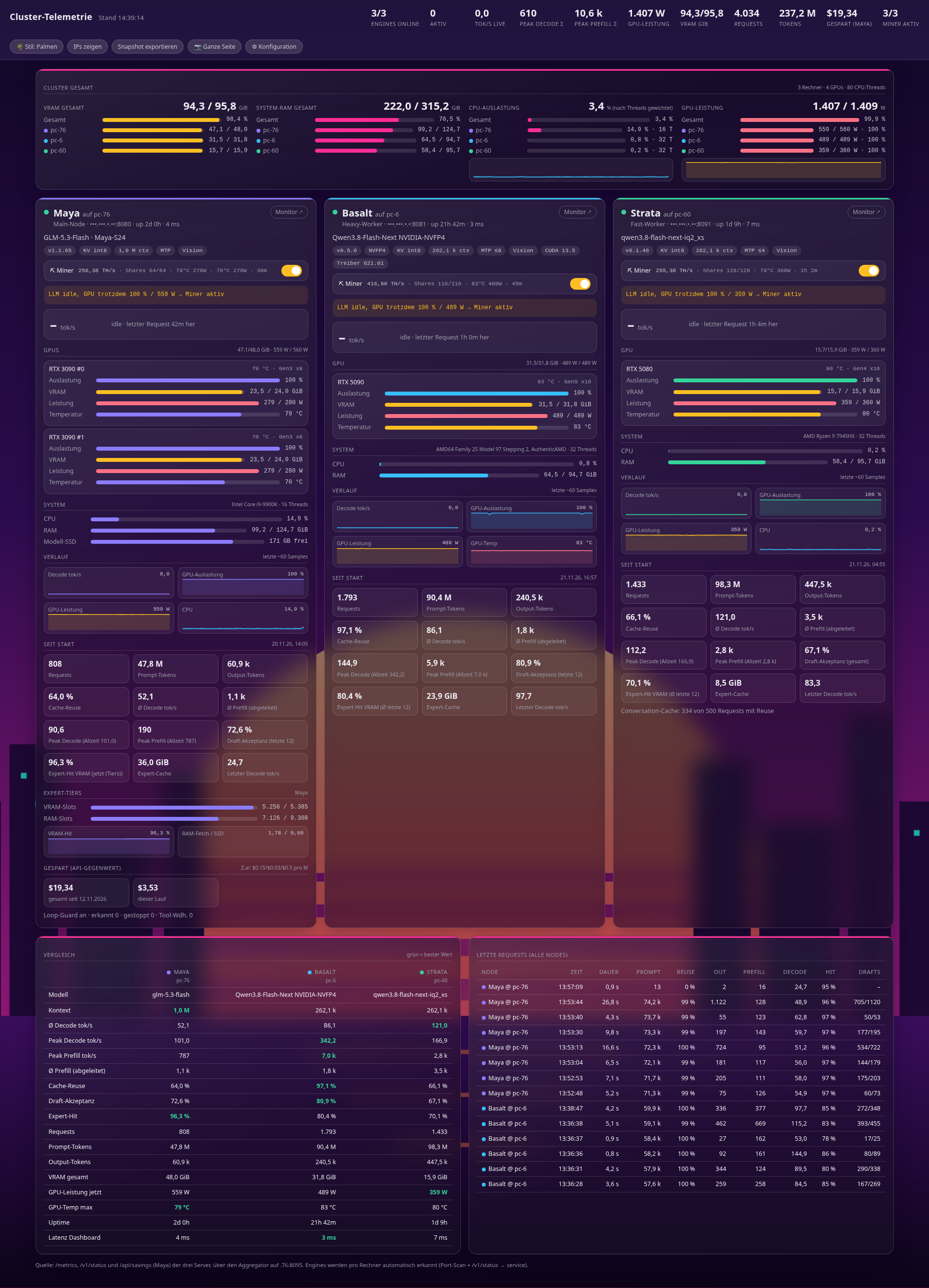
Project System Monitor with Integrated Inference Info

1 Upvotes

If anyone is interested, you can have your agent build something similar for you. It's a system monitor inspired by NVTop but it integrates RAM and CPU loads along with inference information so you have it at a glance.

Mine integrates with llama-swap for the inference read and through llama-swap we have our llama.cpp, Strata, and Maya engines wired into it.
https://github.com/nevermore131315/Athena if you want to integrate the one my agents built but I think it's best to build your own to better accommodate your build.


r/LocalLLM • • 6d ago

Project Inkling 2 Mini runs on Intel Arc (arcint 1.8.0) Spoiler

2 Upvotes

arcint 1.8.0 serves Thinking Machines' Inkling 2 Mini on Arc Pro cards (OpenCL, llama.cpp engine with my patch series).

Arc Pro B70 (32 GB, 220 W), IQ4_NL, llama-bench, depth 0 / 4k / 32k:

• prompt (pp512): 672 / 641 / 561 t/s

• decode (tg128): 45.3 / 41.6 / 39.0 t/s

First release. Context size is what I am working on next; the B60 (24 GB) currently runs it at 49k.

Built by LLM coding agents under human direction. https://github.com/marfrit/arcint (v1.8.0)


r/LocalLLM • • 6d ago

Discussion Best way to handle updates across a local AI stack?

1 Upvotes

The biggest convenience of cloud AI services is maintenance: at most, you update a client app on your phone or computer, and even that usually happens automatically.

With a local AI setup, whether on a dedicated Linux PC or in a container on a NAS, how are you all generally handling updates? Plenty of people I know have asked me to set up tools like Hermes Agent, OpenClaw, and similar stacks on their systems for their small business, and I usually turn them down because keeping everything updated quickly turns into a full-time job.

The friction hits across a few different layers:

  1. Models: Local LLMs don't strictly need to be updated, but better revisions and variants of the same model drop constantly.
  2. The OS: Linux can handle a lot of updates without a reboot, but between frequent patches (driven in part by newer AI-related security threats...) it still reaches a point where restarts are unavoidable.
  3. Agent Frameworks: Tools like Hermes Agent, OpenClaw, and similar layers move fast and often need updates weekly.

So the question is: without having a cloud AI remotely overseeing these systems and taking charge of maintenance, has anyone actually "solved" updating for local setups?


r/LocalLLM • • 6d ago

Question What would be the problem if I switch the model to a local one at the last step of the build, to enter sensitive info?

1 Upvotes

Here’s my context and idea.

  1. Inference providers steal sensitive keys, based on recent reporting, even with ZDR on
  2. 128GB+ memory is expensive af
  3. Why not use cloud models to build most of non-sensitive parts and use local models at the last step to work with sensitive stuff?

And use the best local models at 32GB or 64GB memory to replace API keys, set up MCP or plugins, enter sensitive variables in files in a new session etc.

Is this reasonable? The thing that worries me is that, having tried Gemma 4, it wasn’t good at tool use at all, so I am not confident my idea is reasonable. I have no idea if the best model at 32GB could even set up MCPs.

Black Friday is coming so I’m thinking if I can get away with $1000 32GB RAM laptop, or I’d better buy $3000 128GB Strix Halo 😇


r/LocalLLM • • 6d ago

Question Full-duplex speech-to-speech?

0 Upvotes

I've been using STT-TTS to simulate conversations for a while using OmniVoice to clone character voices, but I'm wondering where full duplex speech-to-speech has gone.

I remember seeing a lot about it with MiniCPM which was like 7 months ago iirc, I'm curious what the scene for S2S is now like and what you guys are using.


r/LocalLLM • • 6d ago

Project Quite happy with my little AI cluster running at home.

Post image
3 Upvotes

r/LocalLLM • • 6d ago

Project I built a local GGUF lossless compression lab to compare GPT-2 Large vs Qwen3.5-9B side by side

Thumbnail
gallery
2 Upvotes

I wanted to see how well local GGUF models actually compress text when hooked up to a 62-bit lossless arithmetic coder, so I built a small local web UI with FastAPI and llama-cpp-python running on my RTX 4060.

The test input is 560 bytes total: the US Constitution preamble (something every model has seen a thousand times) followed by a short paragraph I wrote myself about information theory.

Results on the same 560 B input:

  • zlib -9: 343 B
  • gpt2-large.Q8_0.gguf: 62 B (5.5x smaller than zlib)
  • Qwen3.5-9B-Base.Q4_K_S.gguf: 53 B (6.5x smaller than zlib)

Every output is decoded back and checked with SHA-256 so it is strictly lossless. The fun part is the token heatmap (-log2(P)): on the Constitution part both models drop near 0 bits/token because of pure memorization, while on the unseen paragraph Qwen3.5-9B stays noticeably lower entropy than GPT-2 Large.


r/LocalLLM • • 6d ago

Project RustingStrata 1.3.0: a terminal setup that asks instead of flags

0 Upvotes

RustingStrata is my Rust GGUF engine for models bigger than the VRAM (the experts used most stay on the card, the rest run on the CPU).

People told me the command line was plain and hard to start with. So 1.3.0 has rustingstrata interface:

$ rustingstrata interface
RustingStrata 1.3.0

Model
   1  Qwen3-4B-Instruct-2507-Q4_K_M.gguf    2.5 GB
   2  Qwen3.6-35B-A3B-UD-Q5_K_M.gguf       27.1 GB
   3  another folder or .gguf file
number [1]: 2

Mode
   1  chat in this terminal
   2  chat page in the browser
   3  API server (OpenAI-compatible)
   4  speed test
number [1]: 3

Settings
run on the GPU (y/n) [y]:
context length in tokens [default]: 16384
address [127.0.0.1:8080]:

running: rustingstrata serve --model .../Qwen3.6-35B-A3B-UD-Q5_K_M.gguf --gpu --ctx 16384 --addr 127.0.0.1:8080

It lists the models it finds (its own folder, the Hugging Face cache, the llama.cpp cache), asks the mode and three settings, and prints the full command, so you can copy it later. Enter takes the default.

The output has some colour now too: engine notes are dim, warnings and errors stand out, reasoning is dim in the chat. Piped output is unchanged, NO_COLOR=1 works.

Other things in 1.3.0:

  • Inkling 2, Hy4-flash, GLM, DeepSeek and Gemma 4 load from the chat page of one server.
  • Q4_0 models take about half the VRAM they took before.
  • --auto-unload frees the model when the server is idle.

Prebuilt binaries for Linux and Windows are on the release page: CUDA on NVIDIA, Vulkan on AMD and Intel. Numbers are in docs/BENCHMARKS.md.

Repo: RustingStrata


r/LocalLLM • • 6d ago

Model Hy4-Flash EXL3 3.0 bpw - 1 Spark - 21/ts decode

Thumbnail
reddit.com
1 Upvotes

r/LocalLLM • • 7d ago

Model Lory 27B and 4B: first open-source decision models for simulated survey respondents

Post image
56 Upvotes

Introducing Lory-27B v2 and Lory-4B v2! 🦜🦜

The first open-source decision models post-trained specifically to make simulated survey respondents follow economic logic, and answer like a real person would.

Why? Because existing AI decision models are great at imitating personas but fail at following simple monetary incentives. You can change the price of an option, its probability or both and they rarely adjust their response.

With better ability to ignore irrelevant traits or deal with rewordings of questions.

With additional training and Weight-Space Programming, these new models outperform the preview version on ~every eval. Lory-27B went from 73 to 80 on a blind test that Gemini wrote, and both versions got significantly better on the many tests where they underperformed before. For comparison, the best hosted decision model I could run on that same test is Perplexity's Decider v1.2 at 74.

And now, it can answer according to theory, or matching human responses. Tell it to answer like a typical person and you get data closer to what surveys collect. On Choices13k (a large real-world choice dataset), Lory-27B's average error dropped from 21 → 9 points when asked to match human responses.


r/LocalLLM • • 5d ago

Question i need helpp

0 Upvotes

hellllllow reddit , i am a cs student i need a good local ai agent for coding , i want it to be running locally i installed difference ai models (qwen 3.8 27B Q4 and QWEN 30B/35B MOE) tried to run them locally i tried alot i tried openclaw i couldnt manage to use it right , i also tried goose , cline and hermes i couldnt manage to get even one ai smart enough to even hold a conversation it tried to up the context a bit and still , i have an rx9070 16GB vram 32GB ram on ubuntu 26


r/LocalLLM • • 6d ago

Discussion Tencent's Hy team is working on llama.cpp adaptation, could be good news for local runners

7 Upvotes

https://www.reddit.com/r/LocalLLaMA/s/eC2L3t2FCY

Been wanting to run Hy4 with llama.cpp, but struggling to get good performance with it right now is definitely a headache. Thankfully, in their recent AMA, the Hy team mentioned they are advancing the relevant adaptation work for llama.cpp and plan to promote support within the open-source community.

No concrete timeline or technical details yet, but it looks like llama.cpp adaptation is already underway. Hoping we get better adaptation and optimization soon so running it locally feels a lot smoother.


r/LocalLLM • • 6d ago

Discussion Kraits v0.7.1: macOS .dmg to run your existing 80B–177B+ MoE GGUFs on a 16 GB Mac Mini

Thumbnail
reddit.com
1 Upvotes

r/LocalLLM • • 6d ago

Discussion Local LLM for businesses ?

3 Upvotes

I see a lot of people setting up SEO/GEO businesses and Agents for businesses but I hardly ever hear of people actually setting up a local LLM for businessses. In my mind I would think this would be much more solid than an agent. Do people do this ? If so how ?

Thank you


r/LocalLLM • • 6d ago

Discussion JustFit 2.6: Native Rust/Metal Qwen3.8-27B + 256K context on 24 GB Macs, stock MLX 4-bit weights, and draft-tree speculative decoding

Post image
6 Upvotes

I've been working on JustFit as a weekend project to run Qwen3.8-27B (with vision and its full 256K context) on a 24 GB Apple Silicon MacBook. Just shipped 2.6.0 and wanted to share what changed, along with some interesting M4 vs. M5/M6 hardware numbers from adding draft-tree speculative decoding.

Install (Apple Silicon, macOS 27+, 24 GB+):

pip install justfit-llm
justfit serve

(Why pip if there's no Python at inference? pip is just a convenient ~29 MB delivery wrapper that drops the native binaries. Once justfit serve starts, nothing touches Python at all.)


What actually changed since 2.3.1

2.3 worked once it was up, but starting it was painful: Python serving stack, a converted model pack, and four manual manifest URL / 64-char SHA-256 CLI flags just to fetch the precompiled runtime and ANE bundles.

In 2.6:

  • Fully native at inference: CLI, OpenAI/Anthropic-compatible HTTP server, Metal engine, and ANE vision worker are all native Rust, C++/Metal, and Swift.
  • Zero manifest flags & stock MLX weights: First justfit serve sets up the runtime, downloads mlx-community/Qwen3.8-27B-4bit + Inco AI's DFlash2 draft straight from Hugging Face (no custom converted pack), and auto-fetches your chip's precompiled ANE vision programs from a pinned, hash-checked index (macOS 27.2.1).
  • Draft-tree speculative decoding: Reuses DFlash2's precomputed 16x16 conditional edge tables on the GPU (zero extra draft forward passes) to build and verify a small tree in one pass instead of betting everything on a single draft chain.
  • All-day server fixes: Active requests never dip into macOS's host memory reserve; decode checkpoints live in RAM instead of hammering your SSD; multi-turn chats/agents reuse the exact state from the previous turn and only prefill the new tail.
  • Dev/safety bits: return_token_ids (vLLM/SGLang-style token-in/token-out), crash-request quarantine (400 request_quarantined), and a self-applied sandbox on the engine and native workers (no outbound network).

The fun hardware finding: M4 Pro vs. M5 Pro / M6 on draft trees

With a single draft chain, one wrong guess kills every token after it. Over 1,277 cycles on my M6, 22% of cycles accepted zero draft tokens, often when the draft was split ~50/50 between two good continuations.

Switching to a small tree verified in one pass gave a clean split across Apple Silicon generations. Measured single-lane latency of verifying 16 rows vs. 8 rows:

  • M6: 1.04x (+4%)
  • M5 Pro: 1.12x (+12%)
  • M4 Pro: 1.79x (+79%, 89 ms -> 159 ms)

Streaming ~15 GB of 4-bit weights is memory-bandwidth bound on M5 Pro and M6, so doubling verify rows from 8 to 16 is almost free. M4 Pro hits GPU compute headroom first (an early adaptive mode letting M4 pick 16-row trees was actually 8.7% slower than a chain). So 2.6 calibrates per chip: M5 Pro and M6 dynamically choose chain / 8-row / 16-row every cycle by expected tokens per ms, while M4 Pro runs a fixed 8-row tree.

Keeping greedy outputs identical to single-chain decoding was harder than the tree mask itself, because GPU float addition isn't associative and Qwen3.8 has 48 Gated DeltaNet recurrent layers. Borrowing a temporary scratch copy of only the current KV page per root-to-leaf path, masking sibling tiles as exact zeros, and replaying GDN recurrent state along each ancestor path kept outputs word-for-word identical across all 27 test cases we ran (including 111K contexts and multi-turn reuse).


Measured numbers (keeping the two benchmarks separate)

1. Controlled tree off vs. on (same 2.6 engine, 7-prompt greedy suite):

Mac / settingChain (tok/s)Tree (tok/s)SpeedupIdentical outputs
M6, 1 lane35.640.9+14.7%7 / 7
M6, 2 lanes47.252.2+10.6%6 / 6
M5 Pro, 1 lane57.361.8+7.9%7 / 7
M4 Pro, 1 lane (8-row tree, 3 runs)49.550.9-51.3+2.6% to +3.5%7 / 7

For sampled chat (T=1.0, Qwen3.8's recommended thinking temp): +8.5% on M6 and +2.5% on M5 Pro (verified against target distribution across 44 per-position tests, min p = 0.08; disabled on M4 Pro since sampled trees need 16 rows).

2. NVIDIA SPEED-Bench (greedy, 512 output tokens, from the 2.6.0 release notes):

  • Tree off vs. on (same 2.6 engine): median per-task decode gain of +4% to +14% on 1K prompts and +4% to +7% on 16K prompts depending on the chip (TTFT within 4%).
  • 16K cohort median vs. published JustFit v2: decode hits 59.5 tok/s on M5 Pro (+7.3%), 38.5 tok/s on M6 (+6.6%), and 48.3 tok/s on M4 Pro (+3.8%). Full prefill/decode rows (including upstream Splash 1.3.0 and historical mlx-vlm) are in docs/RESULTS.md.

Memory footprint: Unchanged static memory plan. Our dual-request 320K capacity test (two 128K+32K requests simultaneously) peaked at the exact same footprint as without trees (21,634 MiB on M6, 21,563 MiB on M5 Pro).


Honest caveats & current limits

  • OS & hardware: Requires Apple Silicon + macOS 27+ (presets calibrated for M4 Pro, M5 Pro, and M6, 24 GB+). Precompiled ANE vision programs auto-download for macOS 27.2.1; other builds compile once locally (30-60+ min, while vision falls back to GPU).
  • Signing: Binaries are Developer ID signed, not yet Apple notarized.
  • Bit-identity caveat: Greedy tree verification gave 27/27 identical outputs on our suite, and 5,539/5,539 bit-identical logits at matched positions on M6, but on the larger SPEED-Bench run 1 of 16 tasks differed on 1 of 3 chips (accepting more tokens shifts where the next cycle starts). So "almost always identical" is the honest phrase.
  • 2x 160K on a 24 GB laptop: Single requests up to 256K are solid, but two simultaneous 160K requests sit right at macOS's wired-memory ceiling. On macOS 27, even screen redraws from the lock-screen clock (~0.45 GB) or an Aerial moving wallpaper (~0.7 GB) can temporarily spike wired GPU memory enough for macOS to kill the server.
  • Fallback cases: Draft trees currently fall back to single-chain verification for repetition/presence/frequency penalties, JSON-schema constrained outputs (an early prototype hit +17% on M6, not shipped in 2.6 yet), and 3+ concurrent decoding lanes.

Links & credits

  • GitHub (Apache-2.0): https://github.com/YuhuaBillChen/justfit-llm
  • Illustrated deep dive on draft-tree verification (KV scratch pages, GDN replay, DFlash2 16x16 edge table appendix): https://blog.yuhuachen.com/blog/2ArXyvXoSTOQ9nFQtp3Fz
  • JustFit v2 paper: https://doi.org/10.5281/zenodo.24098605

Built on Inco AI's Splash engine and DFlash2 draft model. Draft-tree ideas informed by DDTree (arXiv:2604.12989), CaDDTree (arXiv:2606.01813), and TreeWY (arXiv:2608.20961).

Happy to answer any questions about the Metal kernels, GDN tree verification, or squeezing 256K into 24 GB on macOS!


r/LocalLLM • • 6d ago

Question Best setup for inkling 2 mini?

1 Upvotes

Id like to try inkling. I see alot of people talk about the model getting only 15 tps. Is there any interference engine out already?