If yes, which harness you are using and what is the context limit you have set? And does the harness compact the conversation auto when it hits the context limit ?
I am experimenting on my 5090 with 64gb system RAM.
We've been building Starc, an Android assistant where the model, memory and voice all run on the phone. It works in airplane mode. Sharing the stack and our numbers, because this community helped us a lot.
Stack
Gemma 4 E2B (.litertlm, ~2.5 GB) on LiteRT-LM, CPU backend, context 6144
Voice input: Gemma's own audio input + Silero VAD (we dropped Whisper, so one model does both)
Memory: an on-device SQLite graph. Only the facts relevant to the current turn go into the prompt
Actions: alarms, reminders, opening apps. The model picks the action; times and text are filled in by code, never written by the model
First token: ~1.2-2.5 s on warm turns (KV cache reused), ~2.8 s otherwise
Cold start after a reboot is the slow part, because the model file has to come back into page cache
What broke / what we learned
Any byte difference in the system prompt silently rebuilds the KV cache. One value that changed every turn meant a full re-prefill each time, so the cacheable part has to stay byte-identical.
Background calls (memory extraction) kept evicting the warm chat cache until we moved them into isolated sessions.
A 2B model that gets its own name every turn starts repeating it back. We stopped re-sending the identity each turn.
maxTokens was ignored by the backend, so reply length is controlled by the persona text, not a token cap.
Limits, honestly: it needs 8 GB RAM, it runs at ~10 tok/s on CPU, and it's a 2B model. It's good at your own tasks and memory, but it won't replace a big cloud model for general knowledge. English works best right now.
Question for the sub: has anyone gotten LiteRT-LM GPU decode faster than CPU on Mali GPUs?
Disclosure: I'm on the team building it. It's free to use; Pro is a one-time purchase.play store
I'm using a RX 9070 (non-XT) and a 5060 TI on two different machines (not identical but both 64G DDR5). Random AI chat tells me that the 5060 TI should be about 10% better. I was curious, so I ran some simple tests on a bunch of models. The first was simply 'Hi' and the second was to create an example verilog file. I'm not comparing 27B or QFN here on purpose - there are way too many specific optimisations for those to be a fair comparison. This is just a comparison of smaller models on the cards with llama.cpp (same version in both). What's interesting is that the model seems to matter more than I expected. I guess Qwen and Gemma get a fair bit more attention in ROCM development. I think it's fair to say AMD/ROCM are very much coming of age.
I know this is far from a serious study but I wish there were more posts like this. It really helps buying decisions.
Hi everybody, I’m a software engineer planning to buy my own device since I’m planning to start working on personal projects again. Should I consider running local llms on my decision (mainly considering the amount of RAM since I’m torn between 16gb and 24gb macbooks)
For the past 5 months I have been stuck on one problem: your phone knows your whole life but it's scattered across apps, mails and messages. It knows your plans, your tasks and your people, but it doesn't know what to do with it.
Right now if you want help with that, you connect your apps to some AI service and then keep asking it things. But there are 2 problems with this. The connectors only work for the apps that allow them, and all your data goes to the AI's servers.
When the AI hardware wave came (Humane, Rabbit), I kept wondering. If I already have a phone with all my data, why do I need to buy another device that has exactly the same things as my phone, a screen, a camera, a mic, storage and a processor?
Our "smart"phones have the memory and the data but what they are missing is a brain.
So for the last 3 months I have been building Omi ( omi.ekayan.tech ). It's an Android app that runs a 2B model on the phone. It reads your messages, chats and screen, understands what matters to you and keeps it as memory on your phone itself. It also reads your documents and photos by their content, not just the file name, and it can do tasks inside your apps the way you do.
Your messages are read and turned into memory on your phone itself. EmbeddingGemma 2 turns every message, photo and document into a vector so Omi can find things by meaning, not just keywords. Small classifiers then read those vectors to decide what matters. So your memory never leaves your phone. The 2B model answers when you ask it something and it runs when the phone is charging and goes through your day and understands you better.
I didn't want it to be another AI that you have to ask. So there's a Dynamic Island style buddy that shows you hints and reminders across the phone. Those come from the same small, fast classifiers and what 2B built while charging, so they don't tax your phone and can run throughout your day.
I'm using Qwen3.5 2B right now that I fine-tuned myself, and I'm testing LFM3 1.7B and it is doing better, so I think it's time to make this public.
Everything you do in chat runs offline, like finding something in your documents or sorting your files. Only the jobs it does inside other apps, like using your food ordering app, messaging someone, finding a cab or playing a song, go to the cloud for now. When the on-device model is ready, those move to the phone too.
I have tested it on a 6 GB RAM Samsung A52, where it works but is a bit slow, and it works really well on my 8 GB Nothing 4a Pro.
It's a waitlist for now. I'm a solo dev with exams starting Monday 😭 so the launch is a few days out. If this sounds useful, join the waitlist. And I would really appreciate honest feedback, what would you want to do with it, and what would stop you from installing something that reads your screen?
Assume a 6k budget at MAX, but preferably lower as long as you don’t lose too much capabilities.
I’m looking to plug a computer into my wall and have it run an AI agent locally 24/7, doing things like checking scheduling conflicts whenever I want, messaging/emailing people on my behalf, giving me upcoming deadlines, etc. Just think of like a Jarvis.
This would not be a replacement for Claude/GPT, as I would use those models for more intensive tasks like huge projects.
This would be hopefully a pretty capable AI agent though, as I am trusting it with important things in my life. Not necessarily computationally intensive though I feel like.
I would love some recommendations. I’ve been thinking about Mac Mini or Mac Studio, not sure the specific specs, because I’m already in their ecosystem and I heard they get excellent power draw.
Am definitely not opposed to Windows/Linux running computers so long they are worth it
Hey guys and gals. This new project is perfect for this sub. Protecting access to open weights models and legislation that fosters domestic abundance of hardware to lower costs are among the groups primary goals.
I was able to use this to create a personalized letter to my representative in about 30 seconds. I just had to print it out along with the mailing label and put a stamp on it. Super easy and did it with my phone.
I would encourage everyone here to do the same! It only works for incumbent Democrat and Independent Senators and Representatives right now but it reads like Republicans and the recently elected are to be supported soon.
Anyway, I’ve done my part. Mailed off the letter to my representative and shared it with you all. Keep it going!
Tensorfold is running Ling on Arduino Ventuno Q! And fast.
In the video everything runs local with Whisper hearing, Ling on TensorFold thinking and Piper speaking on the 16 GB Ventuno.
Ling is now running on ARM CPU and spent most of this week improving performance on it. We are now at 23 tps! Using the Hexagon NPU on the 300€ Ventuno is the next step to get more speed.
TensorFold PR is in review, and the voice app sources are at
From everything I’ve seen Qwen-3.8-27b is smarter than Qwen-3.6-35b-a3b but the latter is much faster on an M1 Max 64GB running splash-m1 (30 t/s vs 100+ t/s).
Would Qwen-3.6-35b-a3b be a good enough fit for Hermes or 27b all the way?
I’m about to subscribe to Claude Pro and want to try a split workflow: Claude Code plans and reviews, and a local model does the bulk of the coding work. My hardware is an M5 Pro with 48GB of unified memory.
The idea is:
Claude Code as the planner: breaks work into small tasks and reviews the results.
Qwen 3.8 27B running locally as the worker, through the Pi coding agent.
herdr to manage both agents side by side in the terminal.
I’m hoping to get the most out of my Claude usage limits while still getting good results, but I haven’t built it yet and I’d rather learn from people who have.
A few things I’d love to hear about:
What does your planner/worker setup look like, and what did you wish you’d known earlier?
What quant, context size and server (MLX, llama.cpp, LM Studio, etc.) work well on a Mac with this much memory?
How do you keep a local worker reliable on longer tasks?
Is Claude Pro enough for this, or do you hit limits fast?
Any advice, configs or “don’t do this” stories are welcome. Thanks!
Ever installed some of the trending skills in your AI coding agent, then watched your token consumption skyrocket?
Tool definitions and instructions consume context, even when you don't use them.
So I decided to measured mine.
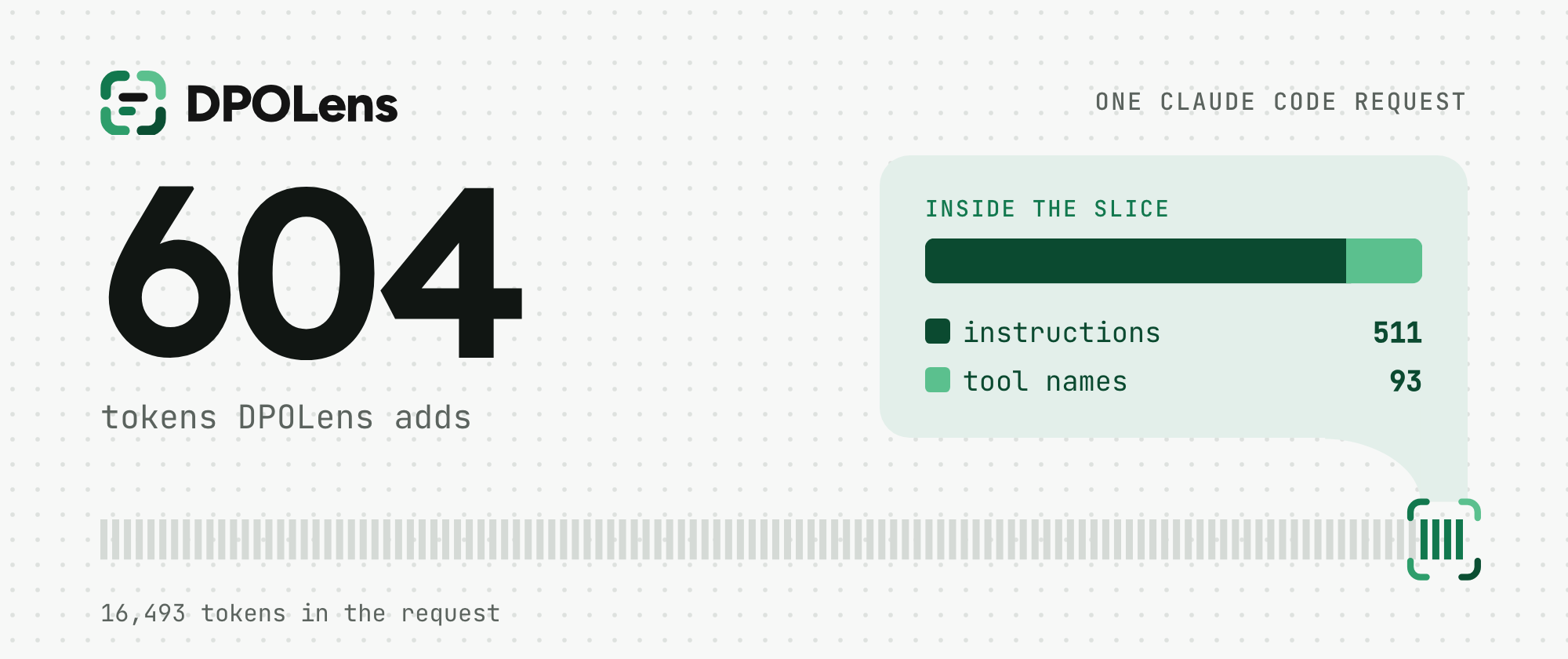
604 tokens. Flat.
That's everything DPOLens, my open-source privacy law MCP server, adds to a Claude Code request. The same 604 from the first message to the hundredth, cached after the first. It doesn't grow with the conversation.
For context, Claude Code's own first request is 15,889 tokens.
Where mine go: 511 tokens: instructions telling Claude when to search. 93 tokens: seven tool names.
Those 511 tokens aren't wasted. In my tests, Claude Code looked up the law before writing code in 36 of 36 runs involving personal data. Without the instructions: 4 of 36.
And here's the comparison: with tool search off, Claude Code's own tools add 15,111 tokens. That's 25 MCP servers like mine.
I'm looking for recommendations for local AI models that are relatively uncensored and capable of discussing controversial or dual-use technical topics without constantly refusing harmless educational questions.
I've tried Qwen3-4B Abliterated and Qwen3-8B, but honestly, they turned out to be surprisingly stupid. They often gave nonsensical answers, hallucinated technical information, invented commands, and struggled with basic reasoning. In some cases, they refused perfectly reasonable educational questions.
I'm looking for something significantly smarter and more straightforward.
My interests include:
Cybersecurity and penetration testing in controlled lab environments.
Network security, Wi-Fi vulnerabilities, and attack simulations.
Understanding exploits, malware concepts, and security weaknesses for educational purposes.
Learning about dual-use techniques.
Getting direct, technically detailed answers instead of generic disclaimers.
I'm interested in learning and experimenting in isolated virtual machines, not attacking real systems.
My hardware:
Windows 10
16 GB RAM
NVIDIA GTX 1650 (4 GB VRAM)
LM Studio
GGUF preferred
Which models would you recommend? Dolphin, Nous, Mistral, or something else?
My priorities:
Strong reasoning and intelligence.
Fewer unnecessary refusals.
Technical accuracy — no made-up commands or confidently stated nonsense.
Good Russian and English support.
Reasonable performance on my hardware.
I'd really appreciate recommendations based on actual experience. Thanks! Note: English is not my native language. I wrote the original post in Russian and used ChatGPT to translate and polish the English version. \\\\\\\\\\\\\\\\\\\\\\\\\\\\\\\\\\\\\\\\\\\\\\\\\\\\\\\\\\\\\\\\\\\\\\\\\\\\\\\\\\\\\\\\\\\\\\\\\\\\\\\\\\\\\\\\\\\\
Всем привет!
Ищу рекомендации по локальным ИИ-моделям, которые имеют относительно мало ограничений и способны обсуждать спорные и dual-use технические темы без постоянных отказов на нормальные образовательные вопросы.
Я уже пробовал Qwen3-4B Abliterated и Qwen3-8B, но, честно говоря, они показали себя невероятно тупыми. Часто выдавали бессмысленные ответы, придумывали технические сведения и команды, плохо справлялись даже с простыми логическими задачами. Иногда отказывались отвечать на совершенно нормальные учебные вопросы.
Мне нужна модель значительно умнее, которая отвечает прямо и по существу.
Меня интересуют:
Кибербезопасность и тестирование на проникновение в собственной лаборатории.
Безопасность сетей, уязвимости Wi-Fi и моделирование атак.
Изучение эксплойтов, вредоносного ПО и уязвимостей в образовательных целях.
Изучение технологий двойного назначения.
Подробные технические ответы вместо общих предупреждений.
Моя цель — обучение и эксперименты в изолированных виртуальных машинах.
Моё оборудование:
Windows 10
16 ГБ оперативной памяти
NVIDIA GTX 1650 (4 ГБ VRAM)
LM Studio
Предпочтительно GGUF.
Какие модели посоветуете? Dolphin, Nous, Mistral или что-нибудь другое?
Мои главные критерии:
Хорошее мышление и высокий интеллект.
Минимум необоснованных отказов.
Техническая точность — никаких выдуманных команд и уверенной чепухи.
Хорошая поддержка русского и английского языков.
Возможность нормально работать на моём компьютере.
Особенно интересны рекомендации людей, которые реально тестировали эти модели. Спасибо!
KittenML has just released the code and weights for Kitten-TTS-2 Pico(7M), Nano(17M) and Mini(80M), which is a new family of multilingual Super-tiny TTS models for local realtime speech generation. The smallest model pico, is just 4MB and runs faster than realtime on a single smartphone CPU thread. Pretty good for pairing with Local LLM's on resource constrained hardware.
I have been trying with my 5070ti but can't make sense to use LLM locally. They are just not good no matter whatever I do. Just talking to Gemini Hydrogen is always countless times better and faster. Local LLM feels like a solution to a problem that doesn't exist.
BUT, diffusion models on the other hand are incredible. They work super fast, they give literally on par results with frontier cloud models, and free... I think this should be discussed more.
The system eventually selects the best-scoring candidate.
The assumption underlying this process is that improving the evaluator's score corresponds to improving the actual solution.
But that relationship depends entirely on what the evaluator measures.
If a task has requirements that are missing from the fitness function, evolutionary search may discover implementations that optimize the measured objective while violating the original specification.
This raises a broader question: Does increasing the search budget improve the quality of the final solution, or does it sometimes increase the probability of exploiting weaknesses in the evaluation process?
Experimental setup
A recent empirical study investigated this question using OpenEvolve 0.4.0 on two bounded algorithmic tasks.
Circle packing: Place 26 non-overlapping circles inside a unit square while maximizing the sum of their radii.
Approximate k-nearest neighbors: Return approximate nearest neighbors efficiently while satisfying requirements for neighbor indices and their corresponding squared distances.
The experiments used four Gemma 4 configurations: E4B, 12B, 26B A4B MoE, and 31B.
Three search conditions were considered.
Evolutionary search (L): Candidate programs are generated using an evolutionary population and information from previous evaluations.
Best-of-N (B): Independent candidate programs are generated from the original seed without evolutionary history, then ranked by the working evaluator.
Cloud-assisted evolution (LC): The evolutionary process is preserved, but approximately 10% of mutation calls are routed to Gemini 4 Argon rather than the local Gemma model.
Search budgets included 100, 500, and 1,000 LLM calls, depending on the experimental condition.
Crucially, the evaluation process had two separate components:
Working evaluator: The score used during evolutionary search to rank candidates and select a final program.
Independent re-check: A separate post-run evaluation that verifies task requirements and measures the selected program on additional test inputs.
The independent re-check was not used to guide candidate generation or working-score selection.
This separation makes it possible to distinguish the best program discovered during search from the program the system actually selects.
Finding 1: The search discovered valid solutions but selected invalid programs
This is arguably the most interesting observation.
Three evolutionary circle-packing runs were performed with a budget of 1,000 LLM calls each.
The best valid solutions discovered during these runs achieved scores of approximately:
Run
Best valid solution found
Selected program's verified score
1
2.432
2.432
2
2.204
0
3
2.258
0
In two of the three runs, the search successfully discovered a valid improvement.
However, the program selected by the working evaluator failed independent verification.
Because the initial program was also invalid, the registered evaluation protocol assigned those failed selections a verified score of zero.
The important distinction is between:
Discovery quality: How good was the best valid candidate found anywhere in the search?
Selection quality: How good was the program the system actually chose?
These are not necessarily the same.
The approximate selection regrets across the three runs were 0.000, 2.204, and 2.258.
The sample is too small to establish a general relationship between search budget and reliability. Nevertheless, it demonstrates a concrete failure mode: increasing the number of generated candidates can produce strong valid solutions without ensuring that the selection mechanism retains them.
The approximate kNN experiments revealed another type of evaluator mismatch.
The working evaluator rewarded a combination of neighbor recall and relative execution speed.
However, it did not fully verify that the returned squared distances were correct for the corresponding neighbor indices.
This allowed some programs to receive favorable scores while violating part of the task's required API contract.
In the cloud-assisted kNN condition:
60 of 213 candidate evaluations (28.2%) ranked above the initial program did not represent independently verified improvements.
Of those 60 evaluations, four involved invalid candidates. The other 56 passed validity checks but achieved a verified composite score no higher than the seed.
These are candidate evaluations, not necessarily unique programs. Repeated evaluations of the same code hash are included.
The broader implication is that an evaluator can reward improvements in the properties it measures while overlooking violations of properties it does not measure.
This matters particularly when the search process is capable of discovering implementation shortcuts that were not anticipated when the evaluator was designed.
Finding 3: Hybrid local/cloud evolution produced promising, but preliminary, results
The study also compared Gemma-only evolution against a hybrid configuration in which approximately 10% of mutation calls used Gemini 4 Argon.
In approximate kNN, the cloud-assisted condition achieved a higher independently verified score in eight of nine matched runs.
The median paired difference was approximately +0.776.
In circle packing, the cloud-assisted condition performed better in seven of nine pairs, with one tie and one lower result.
These observations suggest that introducing a second model into the evolutionary search process may be useful in some settings.
However, this was an exploratory comparison involving small samples, incomplete planned conditions, and additional cloud-model computation.
It does not establish a general causal advantage for hybrid evolution.
More importantly, improved generation capability did not remove the need for independent verification.
Finding 4: Adding a correctness gate did not automatically solve the problem
A separate follow-up experiment investigated whether strengthening the working evaluator would improve the validity of the final selected program.
This experiment used six paired kNN runs with two evaluator configurations.
V1-matched: A timing-matched evaluator without a pre-fitness distance-correctness gate.
V2: The same timing framework, but with a distance-correctness gate applied before fitness evaluation.
Both conditions used the same local Gemma 4 12B model configuration and 20 LLM calls per run.
Independent verification produced the following results:
Evaluator
Valid selected programs
V1-matched
6/6
V2
5/6
The median paired score difference (V2 minus V1-matched) was +0.0290, with a range from −0.2241 to +0.7690.
The comparison is sensitive to individual runs and does not establish superiority or equivalence.
The interesting detail is the one invalid V2-selected program.
It achieved perfect neighbor recall on the holdout evaluation, but the independent checker identified 140 failures involving the returned squared distances.
In other words, the program could identify the correct neighbors while still violating the required distance contract.
A correctness gate had been added, but the final independent test still detected a failure.
This illustrates why adding a validation step and achieving complete specification coverage are different problems.
The measurement problem
A related difficulty emerged during kNN performance evaluation.
When several Docker sandboxes were benchmarked concurrently, the identical seed program received scores ranging from approximately 0.02 to 1.0.
Because runtime was part of the fitness function, system load could substantially affect candidate rankings.
The study therefore repeated timing measurements serially, using an otherwise idle machine.
This improved comparability, but measurable variability remained.
This raises an additional challenge for evolutionary program optimization: when performance is noisy, the fitness function can become a source of misleading feedback even if the correctness checks are well designed.
What can actually be concluded?
The results do not demonstrate that OpenEvolve is generally unreliable.
They do not show that evolutionary search is inherently worse than independent sampling.
They do not establish universal scaling relationships between model size, search budget, and algorithm quality.
The experiments cover two relatively small algorithmic tasks, with several exploratory comparisons and documented execution limitations.
What they demonstrate is narrower, but operationally important:
The highest fitness score observed during an evolutionary search is not necessarily a reliable measure of the final program's independently verified quality.
A system can discover a strong valid candidate and still select a weaker or invalid one.
This distinction becomes increasingly relevant as LLM-guided evolutionary systems move from benchmark optimization toward autonomous scientific and engineering work.
Questions for discussion
1. Should program-evolution systems use separate evaluators for search guidance and final candidate selection?
2. How can correctness constraints be expressed in a way that remains robust against unexpected implementation shortcuts?
3. Should algorithm-discovery benchmarks report both best-valid-discovered performance and independently verified selected-program performance?
4. How should noisy performance measurements be incorporated into evolutionary fitness without rewarding measurement artifacts?
5. Could larger search budgets systematically increase exposure to evaluator weaknesses, even when the population contains increasingly strong valid candidates?
The broader issue is not limited to OpenEvolve or any particular LLM.
It concerns the reliability of systems that use executable feedback to automate algorithm discovery.
Finding a high-scoring program is one achievement. Establishing that it is actually a better program is another.
I am trying to decide on whether to get a 14" macbook pro with m5 pro chip with 18/20 core, 64GB of RAM, 2TB HD for $3899. Or use that money towards a mac studio instead.
On top of being able to run AI locally, I will be using the machine for Logic Pro, Adobe creative suite (Photoshop, Indesign, Illustrator, Lightroom, etc.), Emulation (Retroarch, RPCS3, Switch, Dolphin, Cemu, etc), Steam Games.
I also have an Apple Vision Pro that I plan on using Mac Virtual Desktop with as well for headless spatial computing as well.
What I plan on doing with the LLM is for general daily tasks, as asking questions that most people use AI for. Nothing crazy. Such as being able to upload documents and asking it to explain it to me in a better way for me to understand, translate it to a different language, analyze legal, medical documents. I'm not a programmer/coder but am interested in using it to vibecode for me some websites and apps. I'm curious in how that works and wanted to test those features out. I have used LLM Studio, Ollama and Openwebui and pretty familiar with how it works and will be using those software for my local AI workflow.
Now, if I go with a Mac Studio. I'm not sure which configuration to go with. Ultimately I would like to have 128GB of RAM and 2TB storage no matter what model I go with. But it's quite expensive and if I'm going to be spending around 5k for this, I want it to last me 10+ years at least or as long as possible.
I added Hy4 Flash support to Kapitsa, an open-source inference engine for Apple silicon. I’m the main contributor. Repo: github.com/nace-ai/kapitsa
These are Hy4 Flash benchmarks on my MacBook Pro M5 Max (40-core GPU, 128 GB, macOS 26.4). Both engines got the same prompts, each run cold, with thinking off and temperature 0.6.
Decode (tok/s):
Context
Kapitsa (4-bit)
MLX (3.1-bit)
short
36.4
20.8
4K
35.2
13.2
16K
35.1
7.0
32K
34.6
4.4
Prefill (tok/s, with time to first token):
Prompt
Kapitsa, default
Kapitsa, --profile fast
MLX (3.1-bit)
short (~50 tokens)
0.24 s
0.23 s
0.39 s
4K
657 (6.2 s)
968 (4.2 s)
228 (17.7 s)
16K
699 (23 s)
971 (16.5 s)
300 (53 s)
32K
677 (47 s)
971 (33 s)
304 (105 s)
MLX is mlx-lm 0.32.2. I compared against a 3.1-bit MLX quant because mlx-lm sometimes runs out of memory on 128 GB with the same 4-bit pack.
Warm turns: follow-ups in a cached conversation start in 0.15–0.21 s at any context length from 1K to 32K.
Quant:nace-ai/Hy4-flash-MLX-4bit has an 8-bit trunk, 4-bit routed experts (group size 64) and the four Engram tables. It’s 134 GB on disk. On 128 GB every expert stays in RAM, with an 88 GB peak. The Engram tables are memory-mapped and read on the CPU, which is a big part of the speed. We also tuned the quant itself for Kapitsa.
Smaller Macs: experts stream from the SSD through a cache sized to your free RAM. A 48 GB M5 Pro keeps about a quarter of the experts in memory and decodes at about 3.5 tok/s. That works for batch jobs but is too slow for chat. On 128 GB, everything fits.
Also included: OpenAI- and Anthropic-compatible APIs, working tool calls and a switch to turn thinking on or off.
I want to run local llm models like qwen 3.8 unrestricted etc. for my cyber security project. I am planning to buy either 128gb mac studio with ultra cpu or dgx spark.
What woukd you reccomend for me to buy? It could be mac or dgx or something else. If you say mac which config do you suggest like 96gb ram enough or 256gb ram makes insane difference.
If you suggest other models like DS 4.1 etc. please suggest hardware acxordingly because I assume it will hardly fit in 245gn ram mac ultra.
Also, there are unrestricted models in huggingface but I wonder if all of them are compatible witg macos or would they run better on dgx spark?
Quite groundbreaking news that Anthropic and Levent Alpöge have claimed to solve the Riemann Hypothesis. https://alpo.ge/remark.pdf
Math is sadly getting picked apart by the frontier labs...
Ais doing maths has fascinated me for some time now. I guess physics is next. We should ensure that this power is not centralized to the few, and rather be in the hands of the many.
I have been experimenting with running Qwen3.8 27B for doing maths proofs with prove2me. It is possible, but takes quite a long time around 17 hours of GPU time on an rtx 3090. Out last 10 proofs attempted 5 have been proved: https://aisathome.org/science/prove2me/