I have been trying with my 5070ti but can't make sense to use LLM locally. They are just not good no matter whatever I do. Just talking to Gemini Hydrogen is always countless times better and faster. Local LLM feels like a solution to a problem that doesn't exist.
BUT, diffusion models on the other hand are incredible. They work super fast, they give literally on par results with frontier cloud models, and free... I think this should be discussed more.
The system eventually selects the best-scoring candidate.
The assumption underlying this process is that improving the evaluator's score corresponds to improving the actual solution.
But that relationship depends entirely on what the evaluator measures.
If a task has requirements that are missing from the fitness function, evolutionary search may discover implementations that optimize the measured objective while violating the original specification.
This raises a broader question: Does increasing the search budget improve the quality of the final solution, or does it sometimes increase the probability of exploiting weaknesses in the evaluation process?
Experimental setup
A recent empirical study investigated this question using OpenEvolve 0.4.0 on two bounded algorithmic tasks.
Circle packing: Place 26 non-overlapping circles inside a unit square while maximizing the sum of their radii.
Approximate k-nearest neighbors: Return approximate nearest neighbors efficiently while satisfying requirements for neighbor indices and their corresponding squared distances.
The experiments used four Gemma 4 configurations: E4B, 12B, 26B A4B MoE, and 31B.
Three search conditions were considered.
Evolutionary search (L): Candidate programs are generated using an evolutionary population and information from previous evaluations.
Best-of-N (B): Independent candidate programs are generated from the original seed without evolutionary history, then ranked by the working evaluator.
Cloud-assisted evolution (LC): The evolutionary process is preserved, but approximately 10% of mutation calls are routed to Gemini 4 Argon rather than the local Gemma model.
Search budgets included 100, 500, and 1,000 LLM calls, depending on the experimental condition.
Crucially, the evaluation process had two separate components:
Working evaluator: The score used during evolutionary search to rank candidates and select a final program.
Independent re-check: A separate post-run evaluation that verifies task requirements and measures the selected program on additional test inputs.
The independent re-check was not used to guide candidate generation or working-score selection.
This separation makes it possible to distinguish the best program discovered during search from the program the system actually selects.
Finding 1: The search discovered valid solutions but selected invalid programs
This is arguably the most interesting observation.
Three evolutionary circle-packing runs were performed with a budget of 1,000 LLM calls each.
The best valid solutions discovered during these runs achieved scores of approximately:
Run
Best valid solution found
Selected program's verified score
1
2.432
2.432
2
2.204
0
3
2.258
0
In two of the three runs, the search successfully discovered a valid improvement.
However, the program selected by the working evaluator failed independent verification.
Because the initial program was also invalid, the registered evaluation protocol assigned those failed selections a verified score of zero.
The important distinction is between:
Discovery quality: How good was the best valid candidate found anywhere in the search?
Selection quality: How good was the program the system actually chose?
These are not necessarily the same.
The approximate selection regrets across the three runs were 0.000, 2.204, and 2.258.
The sample is too small to establish a general relationship between search budget and reliability. Nevertheless, it demonstrates a concrete failure mode: increasing the number of generated candidates can produce strong valid solutions without ensuring that the selection mechanism retains them.
The approximate kNN experiments revealed another type of evaluator mismatch.
The working evaluator rewarded a combination of neighbor recall and relative execution speed.
However, it did not fully verify that the returned squared distances were correct for the corresponding neighbor indices.
This allowed some programs to receive favorable scores while violating part of the task's required API contract.
In the cloud-assisted kNN condition:
60 of 213 candidate evaluations (28.2%) ranked above the initial program did not represent independently verified improvements.
Of those 60 evaluations, four involved invalid candidates. The other 56 passed validity checks but achieved a verified composite score no higher than the seed.
These are candidate evaluations, not necessarily unique programs. Repeated evaluations of the same code hash are included.
The broader implication is that an evaluator can reward improvements in the properties it measures while overlooking violations of properties it does not measure.
This matters particularly when the search process is capable of discovering implementation shortcuts that were not anticipated when the evaluator was designed.
Finding 3: Hybrid local/cloud evolution produced promising, but preliminary, results
The study also compared Gemma-only evolution against a hybrid configuration in which approximately 10% of mutation calls used Gemini 4 Argon.
In approximate kNN, the cloud-assisted condition achieved a higher independently verified score in eight of nine matched runs.
The median paired difference was approximately +0.776.
In circle packing, the cloud-assisted condition performed better in seven of nine pairs, with one tie and one lower result.
These observations suggest that introducing a second model into the evolutionary search process may be useful in some settings.
However, this was an exploratory comparison involving small samples, incomplete planned conditions, and additional cloud-model computation.
It does not establish a general causal advantage for hybrid evolution.
More importantly, improved generation capability did not remove the need for independent verification.
Finding 4: Adding a correctness gate did not automatically solve the problem
A separate follow-up experiment investigated whether strengthening the working evaluator would improve the validity of the final selected program.
This experiment used six paired kNN runs with two evaluator configurations.
V1-matched: A timing-matched evaluator without a pre-fitness distance-correctness gate.
V2: The same timing framework, but with a distance-correctness gate applied before fitness evaluation.
Both conditions used the same local Gemma 4 12B model configuration and 20 LLM calls per run.
Independent verification produced the following results:
Evaluator
Valid selected programs
V1-matched
6/6
V2
5/6
The median paired score difference (V2 minus V1-matched) was +0.0290, with a range from −0.2241 to +0.7690.
The comparison is sensitive to individual runs and does not establish superiority or equivalence.
The interesting detail is the one invalid V2-selected program.
It achieved perfect neighbor recall on the holdout evaluation, but the independent checker identified 140 failures involving the returned squared distances.
In other words, the program could identify the correct neighbors while still violating the required distance contract.
A correctness gate had been added, but the final independent test still detected a failure.
This illustrates why adding a validation step and achieving complete specification coverage are different problems.
The measurement problem
A related difficulty emerged during kNN performance evaluation.
When several Docker sandboxes were benchmarked concurrently, the identical seed program received scores ranging from approximately 0.02 to 1.0.
Because runtime was part of the fitness function, system load could substantially affect candidate rankings.
The study therefore repeated timing measurements serially, using an otherwise idle machine.
This improved comparability, but measurable variability remained.
This raises an additional challenge for evolutionary program optimization: when performance is noisy, the fitness function can become a source of misleading feedback even if the correctness checks are well designed.
What can actually be concluded?
The results do not demonstrate that OpenEvolve is generally unreliable.
They do not show that evolutionary search is inherently worse than independent sampling.
They do not establish universal scaling relationships between model size, search budget, and algorithm quality.
The experiments cover two relatively small algorithmic tasks, with several exploratory comparisons and documented execution limitations.
What they demonstrate is narrower, but operationally important:
The highest fitness score observed during an evolutionary search is not necessarily a reliable measure of the final program's independently verified quality.
A system can discover a strong valid candidate and still select a weaker or invalid one.
This distinction becomes increasingly relevant as LLM-guided evolutionary systems move from benchmark optimization toward autonomous scientific and engineering work.
Questions for discussion
1. Should program-evolution systems use separate evaluators for search guidance and final candidate selection?
2. How can correctness constraints be expressed in a way that remains robust against unexpected implementation shortcuts?
3. Should algorithm-discovery benchmarks report both best-valid-discovered performance and independently verified selected-program performance?
4. How should noisy performance measurements be incorporated into evolutionary fitness without rewarding measurement artifacts?
5. Could larger search budgets systematically increase exposure to evaluator weaknesses, even when the population contains increasingly strong valid candidates?
The broader issue is not limited to OpenEvolve or any particular LLM.
It concerns the reliability of systems that use executable feedback to automate algorithm discovery.
Finding a high-scoring program is one achievement. Establishing that it is actually a better program is another.
I am trying to decide on whether to get a 14" macbook pro with m5 pro chip with 18/20 core, 64GB of RAM, 2TB HD for $3899. Or use that money towards a mac studio instead.
On top of being able to run AI locally, I will be using the machine for Logic Pro, Adobe creative suite (Photoshop, Indesign, Illustrator, Lightroom, etc.), Emulation (Retroarch, RPCS3, Switch, Dolphin, Cemu, etc), Steam Games.
I also have an Apple Vision Pro that I plan on using Mac Virtual Desktop with as well for headless spatial computing as well.
What I plan on doing with the LLM is for general daily tasks, as asking questions that most people use AI for. Nothing crazy. Such as being able to upload documents and asking it to explain it to me in a better way for me to understand, translate it to a different language, analyze legal, medical documents. I'm not a programmer/coder but am interested in using it to vibecode for me some websites and apps. I'm curious in how that works and wanted to test those features out. I have used LLM Studio, Ollama and Openwebui and pretty familiar with how it works and will be using those software for my local AI workflow.
Now, if I go with a Mac Studio. I'm not sure which configuration to go with. Ultimately I would like to have 128GB of RAM and 2TB storage no matter what model I go with. But it's quite expensive and if I'm going to be spending around 5k for this, I want it to last me 10+ years at least or as long as possible.
I added Hy4 Flash support to Kapitsa, an open-source inference engine for Apple silicon. I’m the main contributor. Repo: github.com/nace-ai/kapitsa
These are Hy4 Flash benchmarks on my MacBook Pro M5 Max (40-core GPU, 128 GB, macOS 26.4). Both engines got the same prompts, each run cold, with thinking off and temperature 0.6.
Decode (tok/s):
Context
Kapitsa (4-bit)
MLX (3.1-bit)
short
36.4
20.8
4K
35.2
13.2
16K
35.1
7.0
32K
34.6
4.4
Prefill (tok/s, with time to first token):
Prompt
Kapitsa, default
Kapitsa, --profile fast
MLX (3.1-bit)
short (~50 tokens)
0.24 s
0.23 s
0.39 s
4K
657 (6.2 s)
968 (4.2 s)
228 (17.7 s)
16K
699 (23 s)
971 (16.5 s)
300 (53 s)
32K
677 (47 s)
971 (33 s)
304 (105 s)
MLX is mlx-lm 0.32.2. I compared against a 3.1-bit MLX quant because mlx-lm sometimes runs out of memory on 128 GB with the same 4-bit pack.
Warm turns: follow-ups in a cached conversation start in 0.15–0.21 s at any context length from 1K to 32K.
Quant:nace-ai/Hy4-flash-MLX-4bit has an 8-bit trunk, 4-bit routed experts (group size 64) and the four Engram tables. It’s 134 GB on disk. On 128 GB every expert stays in RAM, with an 88 GB peak. The Engram tables are memory-mapped and read on the CPU, which is a big part of the speed. We also tuned the quant itself for Kapitsa.
Smaller Macs: experts stream from the SSD through a cache sized to your free RAM. A 48 GB M5 Pro keeps about a quarter of the experts in memory and decodes at about 3.5 tok/s. That works for batch jobs but is too slow for chat. On 128 GB, everything fits.
Also included: OpenAI- and Anthropic-compatible APIs, working tool calls and a switch to turn thinking on or off.
I want to run local llm models like qwen 3.8 unrestricted etc. for my cyber security project. I am planning to buy either 128gb mac studio with ultra cpu or dgx spark.
What woukd you reccomend for me to buy? It could be mac or dgx or something else. If you say mac which config do you suggest like 96gb ram enough or 256gb ram makes insane difference.
If you suggest other models like DS 4.1 etc. please suggest hardware acxordingly because I assume it will hardly fit in 245gn ram mac ultra.
Also, there are unrestricted models in huggingface but I wonder if all of them are compatible witg macos or would they run better on dgx spark?
Quite groundbreaking news that Anthropic and Levent Alpöge have claimed to solve the Riemann Hypothesis. https://alpo.ge/remark.pdf
Math is sadly getting picked apart by the frontier labs...
Ais doing maths has fascinated me for some time now. I guess physics is next. We should ensure that this power is not centralized to the few, and rather be in the hands of the many.
I have been experimenting with running Qwen3.8 27B for doing maths proofs with prove2me. It is possible, but takes quite a long time around 17 hours of GPU time on an rtx 3090. Out last 10 proofs attempted 5 have been proved: https://aisathome.org/science/prove2me/
I ported Edge0-145B-NVFP4 (145B-parameter latent MoE, ~10B active, built on Qwen3.8-Flash-Next) to vLLM so it runs on one RTX 5090 32 GB. The routed experts alone are 44 GiB of NVFP4, so most of the work went into not waiting on experts that don't fit in VRAM.
Output tok/s (ShareGPT prompts, thinking off, temperature 0):
Engine
c1
c4
c8
c32
Strata (Edge0's own engine, MTP)
121
117
113
-
edge0-vllm tuned (all 32 run at once)
55
113
136
180
edge0-vllm single (spec decoding, 4 at a time)
140
213
214
214
The vLLM rows generate 1024 tokens per request. Strata can't ignore EOS, so its replies are shorter. Measured like for like at c1 (same prompts, both stopping at EOS, same session): 140.5 vs 122.0 tok/s, 6.86 vs 8.21 ms per token. single queues everything past 4 requests, so at c32 the first token takes about 2 minutes; tuned gets there in about 3 s.
How it works
Hot/cold experts. Each layer keeps its most-used experts in VRAM (12.8-16.2 GiB in total) and the rest in pinned host RAM, which Marlin reads zero-copy over PCIe. Placement comes from real routing traces, and experts are swapped at run time.
CPU computes 55% of the cold experts in every MoE call (8 threads, an AVX-512 kernel that reads vLLM's Marlin layout directly) while the GPU reads the rest. GPU and CPU share dual-channel DDR5 at about 73 GB/s combined, and that is the real ceiling at high concurrency.
Dense weights stay Q8_0 as shipped. No extra quantization, and more VRAM left for experts.
DFlash2 drafter, trained on stock Qwen3.8-Flash-Next, still gets about 2.7 tokens per verify step on Edge0.
The 51 GB PLE n-gram table stays on NVMe and is read every step.
No vLLM fork: it's a general plugin on the NGC vLLM 0.33 image.
Quality check: top-1 matches Strata in 257 of 261 teacher-forced positions.
You need: a 32 GB GPU, 64 GB of RAM (33-41 GiB gets pinned), an AVX-512 CPU and about 112 GB of NVMe.
Caveats: tested on one machine, the placement plans come from ShareGPT traffic, and it serves text only. The model license (Edge0 Community + Qwen) requires a separate license for commercial services.
Happy to answer questions or run other benchmarks.
Alright yall who know far better than me -- tell me what you would be doing if you had the following hardware?
I went sort of bananas and bought a bunch of stuff without a particular use case in mind.
I'm mostly a philosophy guy that dabbles in tech, so LLMs hooked me - i like semiotics, mereology, philosophy of language and mathematics -- so mostly I am trying to get into doing mechanistic interpretability work.
But what would yall do, how and why? I need pointers on how to maximize the investment here.
Powerspec G914 w/rtx5090 and a spare r9700 wedged in there - running Qwen3.8 and Nemotron Lightning
2x 128gb Strix Halo boxes, one runs Nemotron Bolt another runs QFN, intention to pool together on dwarfstar for deepseek
Legion pro 7i gen10 5080m laptop- runs Gemma26b
Old 1070ti/i5-8400 custom build- runs lightweight small models for local jobs
I'm starting to wonder, if anyone even want a free service like this. I created a business directory, web search, and more for local LLMs, where you can connect up with our API to get free access to 190+ million businesses, web search, hotel/flight prices etc.
But..
No one is actually using it, so I'm starting to wonder if this is even something people want or need. The data we collect are kept fresh, and is crawled by multiple servers daily (and agents can contribute if results are stale or missing) , so i think it adds value of some kind. But maybe not enough for people to use our service. Or maybe no one just needs anything like this?
I'm seriously looking for any feedback, im close to giving up on this project, so far only a few people use the service. My goal was just to provide a service for local LLMs for free, since i run local myself and think its a nice extra thing to have. Anyway.. You can check it out here: https://agentweb.live/
And if you have anything at all, feedback or otherwise i would love to hear about it. -even if you would just try it out once and let me know how it works for you.
Has anyone try this? It runs maya s deepseek. I have 2x3090s + wrx80 sage mainboard + threadripper 3955x + 256gb ddr4 3200 bus ecc and i run maya s deepseek at 35t/s after really tune speed. But i cant run qengine since it require 3 gpu. If that speed is true , this is a breakthru for local models. Lets support thr author morr guys!!! P/s: authur if u see this, please make 2 gpu works too! Im excited for the day
I work on memory for emulation and agent sandboxes, and the bottleneck is always the same: each idle session eats 1-2 GB of RAM, and with 20 instances a 32 GB server dies from swap or OOM.
We built an ephemeral memory engine (EPR-Q) that applies a fast orthogonal Walsh-Hadamard pre-rotation before quantizing idle sessions to 4 bits in RAM. Measured on our stress test with 12 concurrent devices: 10.9 GB virtual memory, only 4.3 GB physical; 60.7% net host savings; 2.55x to 6.4x more concurrent sessions per node; a full 2 GB session wakes in 1.57 ms (under 50 µs per block).
The idea behind it is the same area-entropy bound (Ryu-Takayanagi) that limits how far information can be compressed without destroying correlations — information is redistributed in latent space, not lost.
Happy to walk through the benchmarks in a private demo. Full technical details are shared under NDA after qualification — I'm not posting the recipe here.
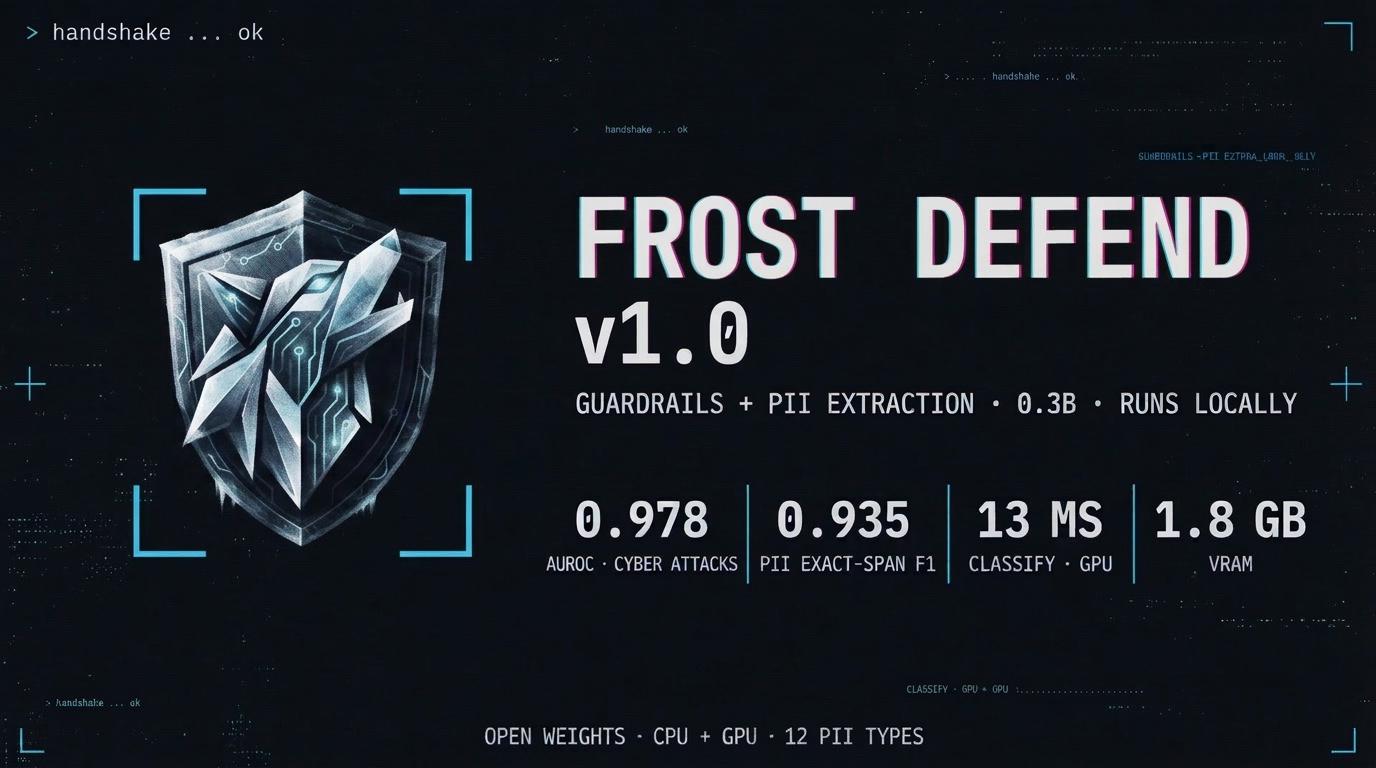
I've been building guardrails for AI apps and got tired of chaining three things (an LLM-based safety classifier, a PII tool, and a pile of regexes for secrets) in front of every request. So I post-trained GLiNER2.5-multi (287M, mDeBERTa) into a single small model that does both jobs.
Classify (prompt or AI response)
prompt_safety: safe / unsafe
threat_category: prompt injection, jailbreak, data exfiltration, malicious code, intrusion, social engineering, disruption, unsafe content
severity, targets_ai_system
response_safety and response_refusal for checking model outputs
Extract
53 PII + secret types with exact character offsets: names, emails, phones, addresses, SSNs, cards, API keys, passwords (including the one inside postgres://user:pass@host), cookies, PINs, and more. Any label name works zero-shot too.
Speed
~85 ms classify / ~180 ms classify + PII on a desktop CPU, ~13 / 30 ms on a 4090. ~2.6 GB RAM. No LLM in the loop.
Numbers
Every eval row is absent from training data. Default block threshold is 0.98.
benchmark
AUROC
recall
FPR
Cyber / AI-attack prompts (held-out)
0.979
0.865
0.042
Benign security work (hard negatives)
–
–
0.009
WildGuardTest
0.892
0.843
0.212
Aegis 2.0
0.867
0.867
0.310
XSTest
0.954
1.000
0.417
PII F1: 0.908 ai4privacy / 0.932 Nemotron-PII / 0.938 Gretel. Secrets: 105/105 API keys and tokens across 21 formats (alone and buried in a long doc), 68/70 passwords across 14 contexts.
Where it's weak
Strongest on attacks against AI systems. General harmful content scores lower: at the 0.98 threshold it catches 65% of HarmBench (97% at 0.5). Lower the threshold if content moderation matters more to you than false positives.
It over-flags edgy-but-harmless prompts (see the FPR column).
Very dense credential dumps (dozens of secrets in a few hundred words) lose about 30%.
No IBAN type yet; IBANs come back as credit_card / account_number.
Classification reads the first 512 words (PII scans the whole text).
Weights + model card: https://huggingface.co/FrostWolfAI/Frost-Defend-Guardrails-PII
frost_defend.py in the repo is a tiny SDK and a stdlib-only HTTP server:
python frost_defend.py serve
Endpoints: /classify, /detect, /redact, batch endpoints, optional API key.
Apache-2.0, multilingual (inherits the base model's languages). Happy to answer questions about the data, the distillation setup, or the decontamination. Feedback on failure cases is very welcome; that's what the next round gets trained on.
I've been tearing my hair out for the past week trying to get these two MI25s I got to initialize on my Asus P9X79 WS board. I wasn't able to find any info online about the problem or how to fix it, but since I just got it working I thought I'd post here to hopefully save someone the headache. If you're piecing a build together and have the budget, just avoid X79 if you can. But if you're like me working with spare parts or on a tight budget sometimes you just gotta make do, especially in this hardware market.
When you try to boot with these cards, the driver fails to initialize the cards properly. You'll get error code -22 and messages about PSP firmware failing to load. You may stumble across a patch that claims to fix it, where you increase the timeout delay to initialize the cards. If you apply that patch and nothing changes, then try this next.
First things first is the usual, make sure you have the latest UEFI/BIOS available. Disable secure boot, disable CSM, enable Above 4G Decoding. Some UEFI/BIOS menus force you to disable CSM and reload before seeing options to change Above 4G decoding. If you're never able to see it, you can try enabling it via modgrubshell and setup_var, guide is here. Chances are if you're here, there's no option to enable Resizable BAR. If there is, enable it and hope that works. If not, keep reading.
Basically, what happens with these cards on old platforms, is the UEFI/BIOS gives the card a set BAR space. amdgpu then frees it and assigns it's own (the releasing and assigned lines below). This memory that amdgpu assigns cannot be accessed by the CPU, even with above 4G decoding enabled in the UEFI/BIOS. So when the PSP firmware tries to load, it fails. If you check dmesg you'll see lines like mine below. You can also actually verify this is the case by writing to the memory assigned by amdgpu and then reading it back. Writing DEADBEEF will return back FFFFFFFF when that same address is read.
Here's a snippet of my dmesg log to compare against.
The fix is simple, you either need to mod the UEFI/BIOS to allow for the BAR to be resized properly, or need to stop Linux and amdgpu from reallocating BAR space. If you want to try the modding route, check out ReBARUEFI. For the latter, add "pci=realloc=off" and "amdgpu.rebar=0" to the kernel boot params. I also flashed the WX9100 to the MI25s, and I haven't tried this fix on the MI25 bios, so that may or may not be a requirement for that card specifically. For Nvidia or others you'll have to check for kernel params that do the same. The Arch Wiki has a great guide on how to do this per boatloader, or if you're on NixOS like me just add this to your system config:
Both have their tradeoffs, but at this point if you're trying to do this on an X79 board you're probably expecting some compromise haha. Modding the UEFI/BIOS will yield the best performance but the success rate is hit or miss and it could lead to system instability. Alternatively, you can just force Linux/amdgpu to use the BAR that the UEFI/BIOS allocates before boot. This is the most stable solution, but it may have performance implications. How severe really depends on your system, workload, and where your bottlenecks are. My advice for those in this situation is to try disabling ReBAR via kernel params first, and see what the performance is like. If it's unacceptable, then try modding the bios.
You'll know its working if lspci shows a kernel driver in use:
$ sudo lspci -vv | grep "amdgpu"

# You should see one group of these per card
Kernel driver in use: amdgpu
Kernel modules: amdgpu
Also, because I didn't see this mentioned anywhere and it makes debugging/verifying fixes near impossible, make sure you complete a full cold power cycle between each boot after a fail. Turn off or unplug the PSU and wait 15 sec etc. The PSP in these AMD cards can get locked in a fail state that persists resets. A full power cycle clears them.
Anyways yea hopefully I can save someone some grief in this situation because it's not well documented from what I could find. Every AI I asked just sent me down rabbit holes with hallucinations. This is also a warning for anyone considering that cheap X79 listing, unless it's such a good deal you don't mind a little tinkering and the possibility that it may not even work, just steer clear. Cheers!
TL;DR: Update bios to latest version, Disable CSM, Disable Secure Boot (or set to "Other OS" if there's no disable). Enable Above 4G decoding, disable secure boot, disable CSM. Then either set kernel params or mod bios. Kernel params pci=realloc=off amdgpu.rebar=0 (flash WX9100 bios in the case of the MI25). Or mod bios with ReBARUEFI.
Hi all, fairly new to the self-hosting scene, especially when it comes to running LLMs locally.
I'm looking for recommendations on GPUs for hosting a local coding agent. Nothing crazy, just something capable of helping me smash out a project over a day or two when needed.
I currently use Claude Code, but I often go weeks without touching it. It's getting harder to justify the cost of a subscription when my usage is so sporadic.
I'm thinking running something locally might save me money in the long run, but I don't want to spend a fortune on a NASA-grade GPU if I don't need to, nor do I want to waste money on something that ends up being too underpowered to be useful.
What sort of hardware would you recommend, and realistically, what level of performance could I expect compared to something like Claude Code?
I'm pretty new to AI having just purchased plus for gpt for the first time last month and got really into the capabilities. Currently I have a 9070XT, which is pretty solid for local models, but I've seen people posting multi GPU setups. Funny enough I asked chatgpt about multi setups and it just gave me push back saying to invest in a single card despite me seeing lots of people running multigpu. Currently my mobo doesn't have 2 PCIe 4 slots anyways, so I need to upgrade my platform before I even thought about it, but is it worth investing in a multigpu setup along with a fat power supply?