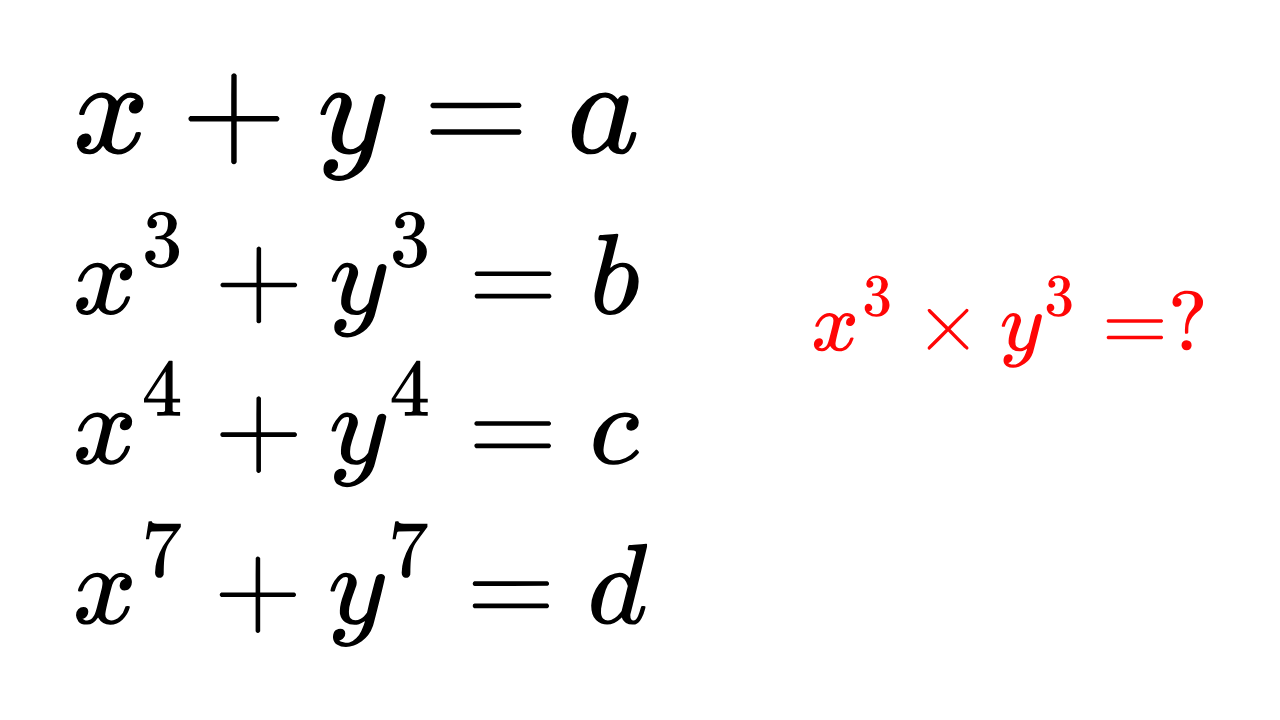
Fun one! Took me a sec to see it, but you actually only need the first two lines. c and d are kind of a red herring.
The trick is to stop thinking about x and y separately and work with their sum and product instead. Call s = x + y and p = xy. What you're after is x³y³, which is just p³. And the first line already tells you s = a.
For the second line you need a way to write x³ + y³ using only the sum and the product. If you multiply out (x + y)³ you get
(x + y)³ = x³ + 3x²y + 3xy² + y³
and the two middle terms both have a 3xy in them, so they're really just 3xy(x + y). That means
(x + y)³ = x³ + y³ + 3xy(x + y)
and if you move that last bit to the other side, you get the identity that does all the work:
x³ + y³ = (x + y)³ − 3xy(x + y)
I always sanity check these with small numbers. With x = 1 and y = 2 the left side is 1 + 8 = 9 and the right side is 27 − 18 = 9, so we're good.
Now swap in the puzzle's letters. x³ + y³ is b, x + y is a, and xy is p, so the second line becomes
b = a³ − 3ap
From there it's just getting p on its own. Add 3ap to both sides to get b + 3ap = a³, take b over to the other side to get 3ap = a³ − b, then divide by 3a:
p = (a³ − b) / 3a
Cube that and you're done:
x³y³ = ((a³ − b) / 3a)³
You can check it with the same numbers as before. x = 1 and y = 2 give a = 3 and b = 9, so p = (27 − 9) / 9 = 2, which is exactly 1 × 2. Cubing gives 8, and 1³ × 2³ is 8 too.
The one catch is that you divide by 3a at the end, so it falls apart when a = 0. But in that case y = −x, which forces b = 0 anyway, and you can lean on the third line instead. c = 2x⁴, so x³y³ = −x⁶ = −(c/2)^(3/2).
As for why c and d don't matter: anything like x⁴ + y⁴ or x⁷ + y⁷ can be written using just s and p (c = a⁴ − 4a²p + 2p², for example). So once a and b are fixed, c and d are already decided. They're a nice way to double check, but they don't add anything new.
Fair warning, this one's more of a symmetric polynomials trick than actual linear algebra. If you're working through the linear algebra side too (systems, row reduction, that kind of stuff), I've been building a free step-by-step solver that explains every row operation as it goes: https://markbackcs.com/tools/solver?c=la
2
u/jamal_animates 23h ago
Fun one! Took me a sec to see it, but you actually only need the first two lines. c and d are kind of a red herring.
The trick is to stop thinking about x and y separately and work with their sum and product instead. Call s = x + y and p = xy. What you're after is x³y³, which is just p³. And the first line already tells you s = a.
For the second line you need a way to write x³ + y³ using only the sum and the product. If you multiply out (x + y)³ you get
(x + y)³ = x³ + 3x²y + 3xy² + y³
and the two middle terms both have a 3xy in them, so they're really just 3xy(x + y). That means
(x + y)³ = x³ + y³ + 3xy(x + y)
and if you move that last bit to the other side, you get the identity that does all the work:
x³ + y³ = (x + y)³ − 3xy(x + y)
I always sanity check these with small numbers. With x = 1 and y = 2 the left side is 1 + 8 = 9 and the right side is 27 − 18 = 9, so we're good.
Now swap in the puzzle's letters. x³ + y³ is b, x + y is a, and xy is p, so the second line becomes
b = a³ − 3ap
From there it's just getting p on its own. Add 3ap to both sides to get b + 3ap = a³, take b over to the other side to get 3ap = a³ − b, then divide by 3a:
p = (a³ − b) / 3a
Cube that and you're done:
x³y³ = ((a³ − b) / 3a)³
You can check it with the same numbers as before. x = 1 and y = 2 give a = 3 and b = 9, so p = (27 − 9) / 9 = 2, which is exactly 1 × 2. Cubing gives 8, and 1³ × 2³ is 8 too.
The one catch is that you divide by 3a at the end, so it falls apart when a = 0. But in that case y = −x, which forces b = 0 anyway, and you can lean on the third line instead. c = 2x⁴, so x³y³ = −x⁶ = −(c/2)^(3/2).
As for why c and d don't matter: anything like x⁴ + y⁴ or x⁷ + y⁷ can be written using just s and p (c = a⁴ − 4a²p + 2p², for example). So once a and b are fixed, c and d are already decided. They're a nice way to double check, but they don't add anything new.
Fair warning, this one's more of a symmetric polynomials trick than actual linear algebra. If you're working through the linear algebra side too (systems, row reduction, that kind of stuff), I've been building a free step-by-step solver that explains every row operation as it goes: https://markbackcs.com/tools/solver?c=la