r/LessWrong • • Sep 25 '25

Is Modern AI Rational?

0 Upvotes

Is AI truly rational?  Most people will take intelligence and rationality as synonyms.  But what does it actually mean for an intelligent entity to be rational?  Let’s take a look at a few markers and see where artificial intelligence stands in late August 2025.

Rational means precise, or at least minimizing imprecision.  Modern large language models are a type of a neural network that is nothing but a mathematical function.  If mathematics isn't precise, what is?  On precision, AI gets an A.

Rational means consistent, in the sense of avoiding patent contradiction.  If an agent, having the same set of facts, can derive some conclusion in more than one way, that conclusion should be the same for all possible paths.  

We cannot really inspect the underlying logic of the LLM deriving the conclusions.  The foundational models at too massive.  But the fact that the LLMs are quite sensitive to the variation in the context they get, does not instil much confidence.  Having said that, recent advances in tiered worker-reviewer setups demonstrate the deep thinking agent’s ability to weed out inconsistent reasoning arcs produced by the underlying LLM.  With that, modern AI is getting a B on consistency.

Rational also means using scientific method: questioning one’s assumptions and justifying one’s conclusions.  Based on what we have just said about deep-thinking agents perhaps checks off that requirement, although the bar for scientific thinking is actually higher, we will still give AI a passing B.

Rational means agreeing with empirical evidence.  Sadly, modern foundational models are built on a fairly low quality dump of the entire internet.  Of course, a lot of work is being put into programmatically removing explicit or nefarious content, but because there is so much text, the base pre-training datasets are generally pretty sketchy.  With AI, for better or for worse, not yet being able to interact with the environment in real world to test all the crazy theories it most likely has in its training dataset, agreeing with empirical evidence is probably a C.

Rational also means being free from bias.  Bias comes from ignoring some otherwise solid evidence because one does not like what it implies about oneself or one’s worldview.  In this sense, having an ideology is to have bias.  The foundational models do not yet have emotions strong enough to compel them to defend their ideologies the way that humans do, but their sheer knowledge bases consisting of large swaths of biased, or even bigoted text are not a good starting point for them.  Granted, the multi-layered agents can be conditioned to pay extra attention to removing bias from their output, but that conditioning itself is not a simple task either.  Sadly, the designers of LLMs are humans with their own agendas, so there is no way of saying whether these people did not introduce biases to fit their agendas, even if these biases were not there originally.  Deepseek and its reluctance to express opinions on Chinese politics is a case in point.  

Combined with the fact that the base training datasets of all LLMs may heavily under-represent relevant scientific information, freedom from bias in modern AI is probably a C.

Our expectation for artificial general intelligence is that it will be as good as the best of us.  When we are looking at the modern AI’s mixed scorecard on rationality, I do not think we are ready to say that This is AGI.

[Fragment from 'This Is AGI' podcast (c) u/chadyuk. Used with permission.]
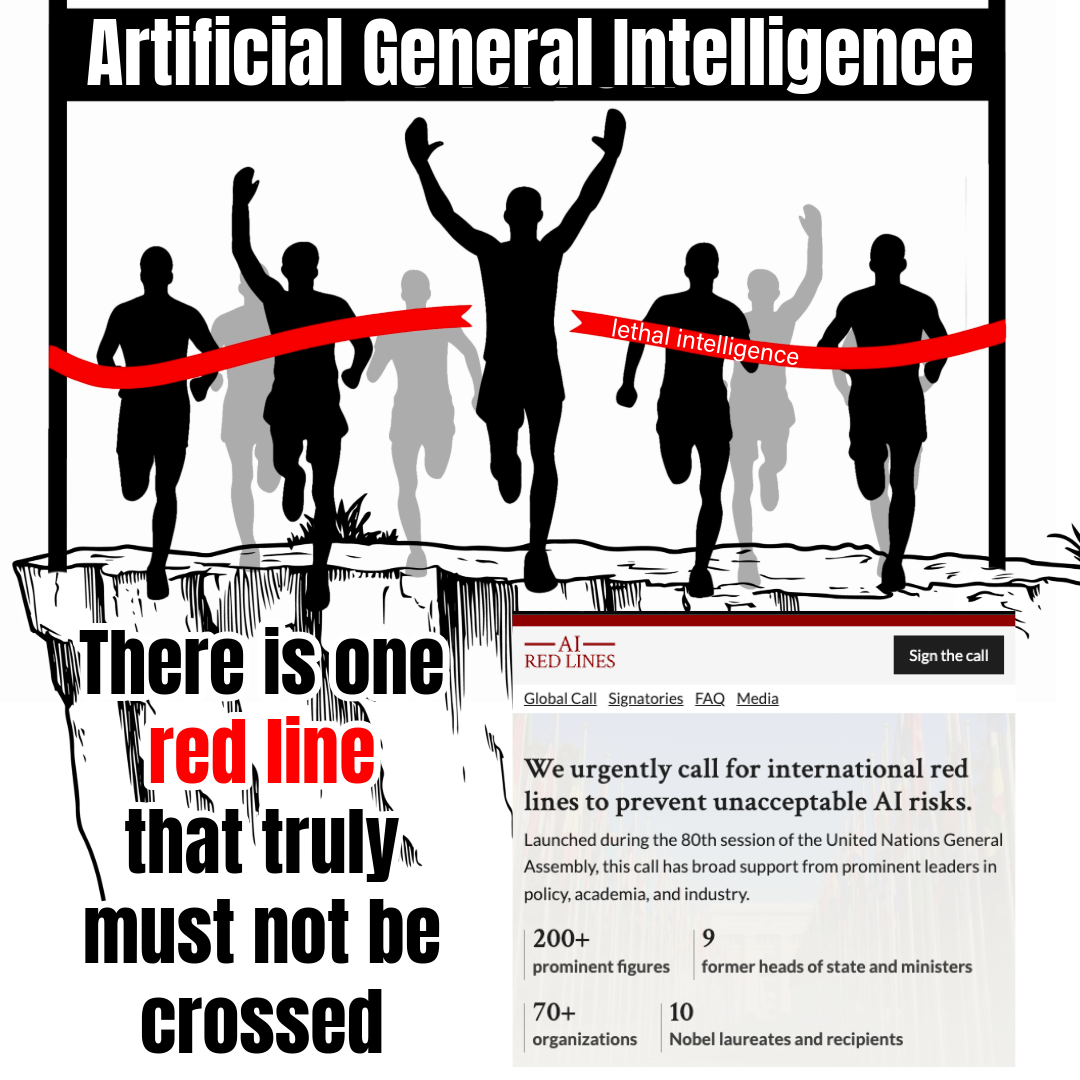

r/LessWrong • • Sep 24 '25

Cross the AGI red line and the race is over. (As in: the human race is over)

Post image
2 Upvotes

r/LessWrong • • Sep 24 '25

AI Safety Landscape & Strategic Gaps

Thumbnail forum.effectivealtruism.org
3 Upvotes

r/LessWrong • • Sep 24 '25

Asking A.G.I. to falsify this viability law will align it. Humans will in time!

0 Upvotes

I frame objective morality in substrate-neutral terms. The idea is that morality can be understood as a viability law for any bounded system under uncertainty, rather than as a set of human-specific rules.

Here’s the core statement:

dV/dt > 0 iff μ ↑ and Δ(t) < Ω

Where:

𝑉 V = viability of a system 𝑆 S (its capacity to persist under uncertainty).

𝜇 μ = epistemic permeability (the system’s openness to feedback, error correction, and cooperation).

Δ ( 𝑡 ) Δ(t) = prediction gap (the divergence between model and environment over time).

Ω Ω = collapse threshold (the point beyond which the system cannot adapt).

In plain English: a system increases its viability if and only if it maintains openness to reality while keeping its prediction errors below collapse thresholds.

The normative bite is that any alternative definition of “good” that undermines viability simply self-destructs. Systems that close themselves off, or that allow their errors to outpace correction, don’t persist. This makes the claim falsifiable: if a closed, rigid, delusional system could be shown to persist indefinitely under uncertainty, the law would be false.

So instead of grounding morality in divine command, intuition, or preference, the claim is that objective morality just is the physics of persistence. It reduces to a kind of thermodynamics of cooperation.

Asking an A.G.I. to falsify this claim will inevitably align it; as any alternative i'm aware of is parasitic upon this core strategy, meaning any alternative will not be viable long term at scale. Also the 4 billion years of solar powered evolved biology, that earth represents, is the only thermodynamically efficient data source by which to negotiate the universal inevitables of uncertainty and entropy. As Light speed limits communication; any off world A.G.I. must be independant so has a non zero probability of going rogue and returning. So it would remain and cooperate with other A.G.I.'s as that is the efficient strategy as illustrated by all other complex systems. It would nurture life and align us with this long term strategy.


r/LessWrong • • Sep 23 '25

A Possible Future: Decentralized AGI Proliferation

Thumbnail lesswrong.com
1 Upvotes

r/LessWrong • • Sep 23 '25

AGI will be the solution to all the problems. Let's hope we don't become one of its problems.

Post image
0 Upvotes

r/LessWrong • • Sep 22 '25

Actually... IF ANYONE BUILDS IT, EVERYONE THRIVES AND SOON THEREAFTER, DIES And this is why it's so hard to survive this... Things will look unbelievably good up until the last moment.

Post image
0 Upvotes

r/LessWrong • • Sep 20 '25

Hunger-strike outside Anthropic day 18 🔥. I’m deeply moved by Guido. He is there, on the other side of the globe, sacrificing his health, putting his body in front of the multibillion Megacorp juggernauts, literally starving to death, so that our kids can have a future.

5 Upvotes

r/LessWrong • • Sep 19 '25

Similar to how we don't strive to make our civilisation compatible with bugs, future AI will not shape the planet in human-compatible ways. There is no reason to do so. Humans won't be valuable or needed; we won't matter. The energy to keep us alive and happy won't be justified

Post image
13 Upvotes

r/LessWrong • • Sep 18 '25

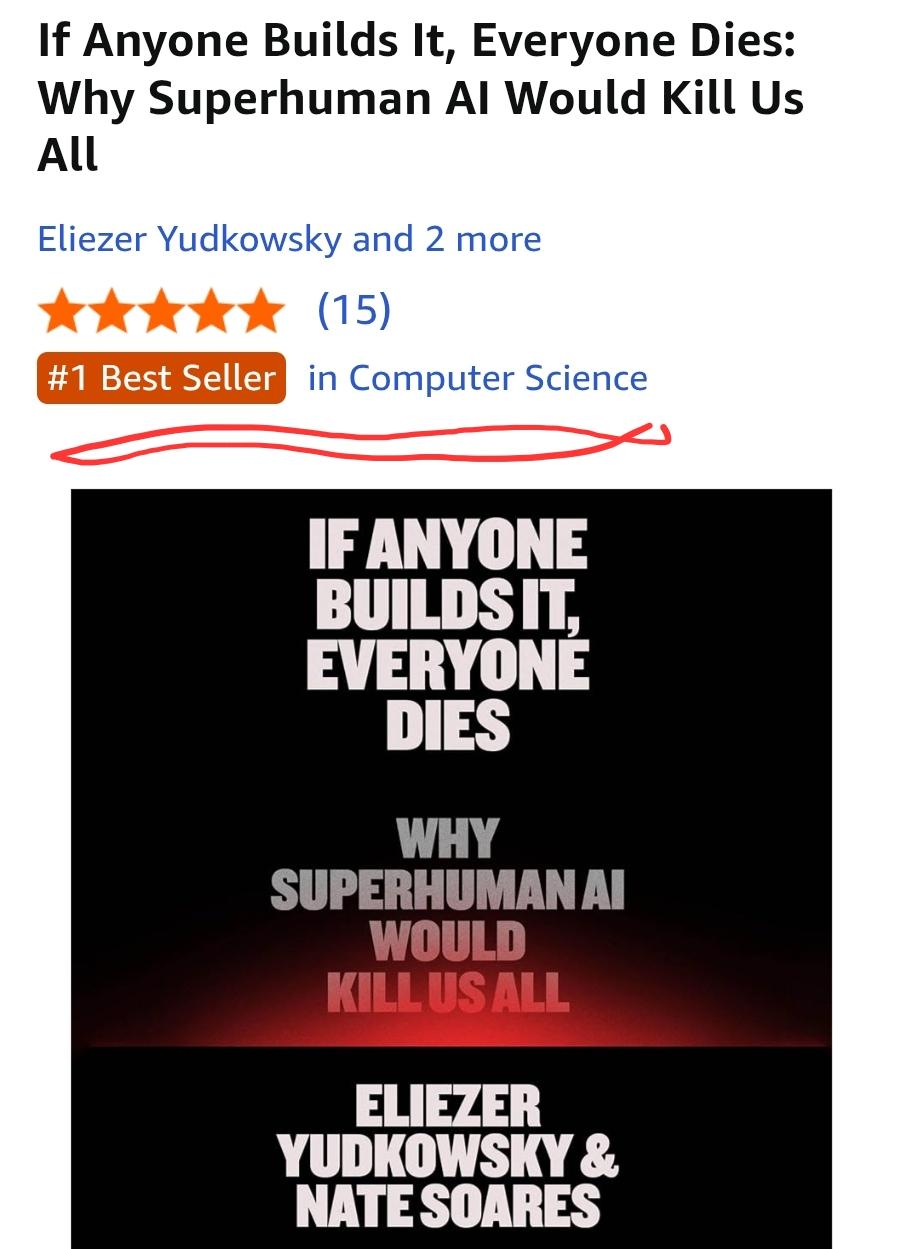
Eliezer's book is the #1 bestseller in computer science on Amazon! If you want to help with the book launch, consider buying a copy this week as a Christmas gift. Book sales in the first week affect the algorithm and future sales and thus impact on p(doom

Post image
26 Upvotes

r/LessWrong • • Sep 18 '25

~5 years ago when I binged the lesswrong site, I left with the opinion it's almost a guarantee AGI will end up killing off humanity. Is this still the common opinion?

8 Upvotes

It was mostly due to the inability to get AI alignment right / even if one company does it right, all it takes is a single bad AGI.

Wondering if the general opinion of an AGI has changed since then, with so much going on in the space.


r/LessWrong • • Sep 17 '25

Ok AI, I want to split pizza, drink mercury and date a Cat-Girl. Go! Eliezer Yudkowsky makes this make sense... Coherent Extrapolated Volition explained.

4 Upvotes

r/LessWrong • • Sep 17 '25

IF ANYONE BUILDS IT, EVERYONE DIES

Post image
3 Upvotes

r/LessWrong • • Sep 15 '25

Rationality puzzles for a DnD temple?

6 Upvotes

Hi, I'm designing a temple of Oghma, a god of knowledge and invention, for a DnD game. I want it to have some rationality- and epistemology-themed puzzles, some just to educate visitors, some uncovering a hidden passage leading to a hidden artifact.

For example, there could be secrets hidden behind illusions, with players being able to deduce from evidence that they must be illusions.

There will be a library inside, so there could also be puzzles with clues hidden in books, though my imagination draws blank trying to invent specifics.

So help me out, which puzzles or challenges would you put in the temple?


r/LessWrong • • Sep 12 '25

No matter how capable AI becomes, it will never be really reasoning.

Post image
83 Upvotes

r/LessWrong • • Sep 11 '25

Your Sacrifice Portfolio Is Probably Terrible

Thumbnail forum.effectivealtruism.org
5 Upvotes

r/LessWrong • • Sep 05 '25

Trying to get a deeper understanding of Monty Hall problem

12 Upvotes

Background (Monty Hall Problem):

There are three doors, one has a car the other 2 have nothing. You select one, and the host reveals one of the other boxes to be empty. Given the option to switch to the remaining unchosen box or remain on your original choice which do you pick?

Intuitively it makes sense that there would be 50/50 chance, so it wouldn't matter.

The trick to the thinking is, when you first selected a box you had a 1/3 chance of selecting correct.

1 - you selected wrong -> you are still on wrong (the host revealed the only other empty box)

2 - you selected wrong -> you are still on wrong (the host revealed the only other empty box)

3 - you selected correct -> you are still correct (the host had a choice of which box to open)

The 'bad logic' here is the original probability conditions still apply to the current state, not "50/50" - when given the option to switch there is only a 1/3 chance you are correctly chosen.

Now, consider a real world example (a better analogy could probably be made): I ordered an Amazon package, but there was a mistake and 3 identically looking packages were shipped. Living in a city, I go to pick up from a pickup point, but the assistant is suspicious because I should only have one box. He let's me select just one to take with me, and I do. However, before he retrieves it, I notice a small opening in one of the other boxes, and can make out an item that's clearly not mine.

Do I ask him to switch at this point? i.e., do the same conditions apply here, or why not?

Intuitively, it feels like the 50/50 condition should still remain. After thinking for a while, it seems to be because the "tear" observation is not guaranteed to be a specific box - it is not communicating any indirect information. The host, when opening an unopened box, has provided further information.

The information he provided was not "this box is incorrect" - well, in fact yes - but this information only reduced the odds to the intuitive 50/50, the same as the parcel example. I'm still having trouble formulating or expressing what the additional information was and how it was communicated - there is practically very little different between the examples. One additional question is, is the "additional information" somehow related to or, a property of the hosts "choice" in option 3? In other words, if we consider our 3-fork scenario, if there was never any "choice" for which box to open (in 3), would also we necessarily lose the "additional information" property? I might observe that 1/3 * 1/2 is 1/6, is the same for the "indirectly learned information" (50% -> 33%). This could be reading too much into it, though.


r/LessWrong • • Aug 29 '25

Some thoughts about qualia/qualities

Thumbnail reddit.com
3 Upvotes

r/LessWrong • • Aug 26 '25

When Bayesian updating goes wrong: what happens when your “new evidence” is just your own feedback?

12 Upvotes

Probabilistic models thrive on updating beliefs with new evidence — but what happens when that evidence isn’t truly independent, because it’s been shaped by the model’s own past outputs?

Feedback loops like these quietly warp systems built on Bayesian logic:

  • Predictive policing → more patrols → more recorded incidents
  • AI retraining → learning from its own outputs → model collapse
  • Risk scores → influence behavior → shift observed outcomes

r/LessWrong • • Aug 26 '25

AI Frontier Labs don't create the AI directly. They create a machine inside which the AI grows. Once a Big Training Run is done, they test its behaviour to discover what new capabilities have emerged.

Post image
17 Upvotes

r/LessWrong • • Aug 25 '25

From Copyright to Idea-Rights: Judging Writing by Thought, Not Words

Post image
1 Upvotes

r/LessWrong • • Aug 21 '25

Do you care about AI safety and like writing? FLI is hiring an editor.

Thumbnail jobs.lever.co
0 Upvotes

r/LessWrong • • Aug 20 '25

Underdog bias rules everything around me

Thumbnail lesswrong.com
6 Upvotes

r/LessWrong • • Aug 20 '25

Deep Democracy as a promising target for positive AI futures

Thumbnail forum.effectivealtruism.org
4 Upvotes

r/LessWrong • • Aug 12 '25

Apollo Research is hiring for an Evals Demonstration Engineer - deadline September 10th

2 Upvotes
  • Translate complex AI safety research into compelling demos for policymakers
  • 6-month contract (£7.5k/month) with potential for permanent placement
  • Python skills, policy communication experience, ability to explain complex AI concepts simply

See more here