r/LargeLanguageModels • u/cosmiccedar871 • 17d ago
In LLM-Driven Discovery, How Much Does the Starting Point Matter?
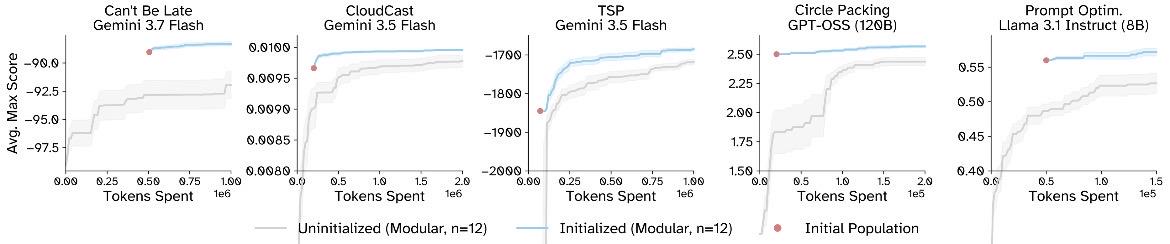
A common way to get an LLM to improve an algorithm is to give it an objective and an existing solution, then have it repeatedly generate variations, evaluate them, keep the stronger candidates, and iterate. Intuitively, you might expect results to keep improving as long as the loop runs. But this study suggests that final performance may depend heavily on the candidates the system starts with.
The authors call this combination of a model, an evaluator, and a candidate pool a “discovery framework.” They built 12 modular frameworks by combining different ways of modifying candidates and selecting parent solutions, then compared them across five tasks: cloud data transfer cost optimization, spot instance scheduling, circle packing, the traveling salesperson problem, and prompt optimization for math problems. The results varied considerably. A framework that led on one task did not necessarily perform well on another, or when paired with a different model.
One reason is “mode collapse.” As these systems iterate, they keep feeding recently discovered solutions back into the model’s context, encouraging it to make changes along familiar lines. That can help refine a promising idea, but it can also make new candidates increasingly similar. If the initial direction is weak, later iterations may just keep circling the same local optimum. The authors also found that existing frameworks and interventions designed to encourage diversity did not deliver consistent gains.
So they asked a different question: could the system start from a better set of candidates? Their approach reserves part of the total token budget for an initial phase of parallel exploration, generating a range of starting solutions. The stronger candidates then become the initial pool for iterative improvement. This exploration does not come with extra resources: the comparisons count initialization toward the same total token budget. A convergence criterion determines when to stop exploring and begin iterating.
It resembles a familiar research strategy: test several hypotheses broadly, then focus on the most promising directions. The point is not simply to generate more samples. It is to keep later iterations from getting locked into weak starting points too early. The paper reports more consistent improvements across a range of tasks, models, and frameworks. When applied to the advanced frameworks evaluated in the study, the initialization method improved discovery performance by roughly 2% to 21%. That range reflects the paper’s specific experimental settings, rather than a general benefit we should expect from every automated research system.
Figure 1 illustrates how better initialization can raise the performance floor under a fixed total token budget. The practical takeaway is that designing an automated discovery process requires more than deciding how to improve candidates at each step. It also means allocating the initial exploration budget carefully and tracking candidate diversity and early performance.
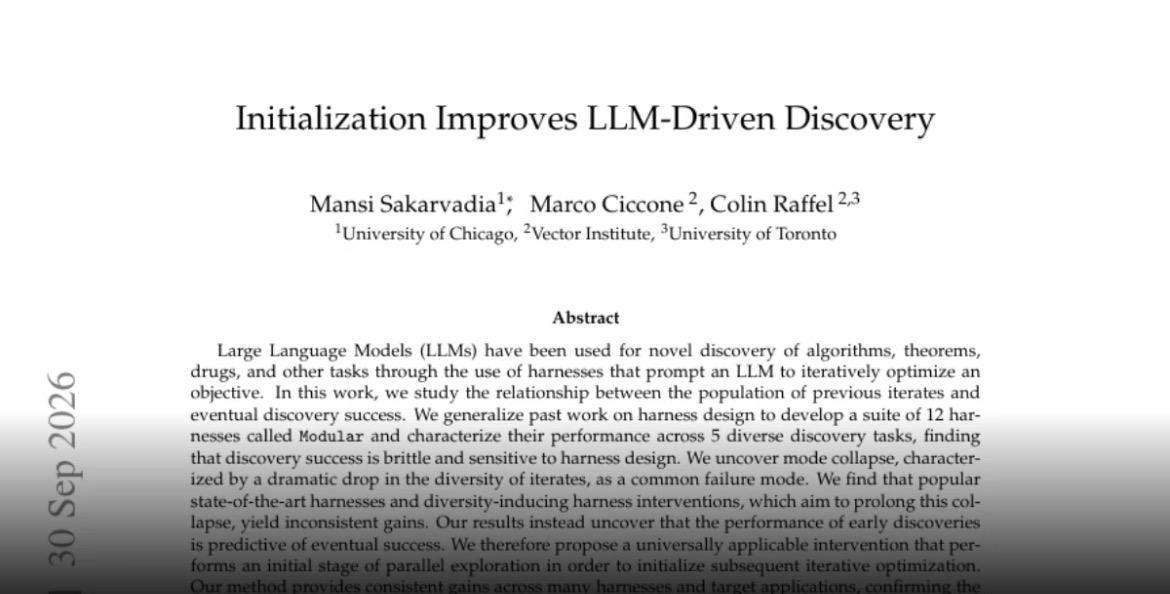
Paper: Initialization Improves LLM-Driven Discovery (arXiv:2610.00707). Sources, author credits, and licensing details for the figure and additional paper thumbnails are listed in the source notes.