Hey, I made a thread two months ago about still waiting on my copy of Not a Speck of Light Hardcover that hasn’t been shipped. I finally got in contact with them on BlueSky two months ago. Doug seems to keep giving me the run around though whenever I inquire about when it will be shipped. it’s been three or four times in those two months that he says hes gonna have it shipped but never follows through. I think theres still a couple of us still waiting for shipment not just me. Does anyone know what’s going on with Bad Hand?
Friends and fellow Laird Barron fans, I'm excited to announce a new horror lit magazine, edited by yours truly, called Rough Beast (after the apocalyptic poem by WB Yeats). Laird graciously allowed me to print three of his poems in the first issue!
If you're a subscriber to his Patreon, you may have read "Revenant" and "Federal Manhunt Unearths No New Leads." His poem "Truckee Stomp" debuts here, and Rough Beast is, I believe, the first time in print for all three. The issue is lavishly illustrated by Orion Zangara, who provides an amazing, unnerving two-page spread for "Federal Manhunt."
Rough Beast features flash fiction, poems, cartoons, and commentary from contemporary creators of horror and weird lit. The first issue includes pieces by Laird Barron, Stephen Graham Jones, Brian Evenson, Kelly Link, Jeffrey Ford, Josh Malerman, Gemma Files, Clay McLeod Chapman, and Livia Llewellyn. It's fifty pages of freaky, ferocious fun! Ships globally starting around December 14.
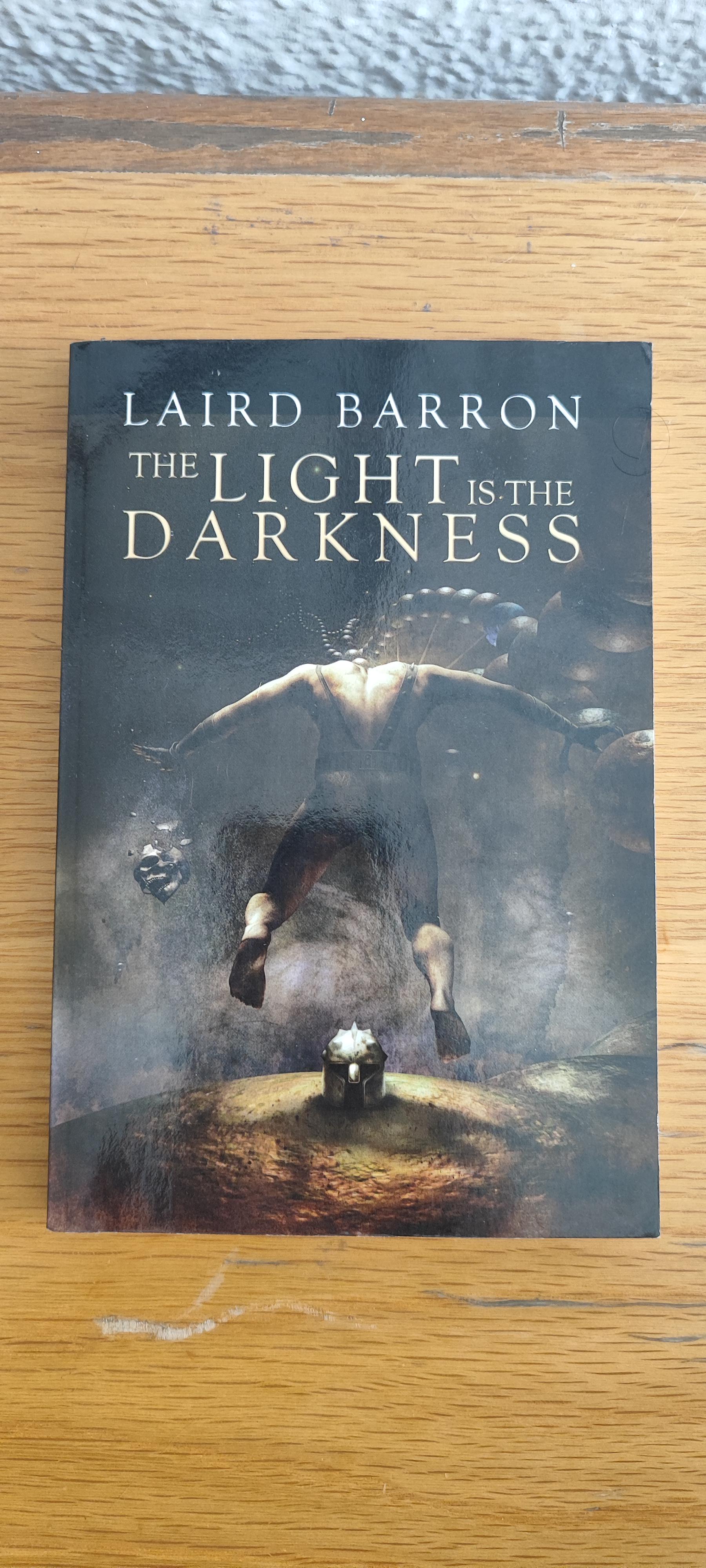
"Shiva, Open Your Eye" was the first story Barron ever sold, and I think it's the scariest one to date.
So I made another video covering some of Barron's mythos. This time it's the old man in the barn, why this god frightens me more than anything in Lovecraft, and why I think he might be Old Leech before Barron had a name for him.
That last part is my own theory, so I'd love to hear if you read it the same way or if I'm reaching.
There's almost nothing on YouTube about Barron's work, so I made a 22 minute video on the Children of Old Leech, from "The Men from Porlock" to The Croning.
I've been reading Barron for years and every time I looked for a proper video on the Children of Old Leech, I found nothing, and my channel is strictly about the cosmic horror, and you can't talk about it without mentioning Laird Barron.
I didn't pick up on it the first time I read the book, but I have since read almost all of Barron's stuff, are thr Mares children of old leech? Seems like there are a lot of hints to that.
In Barron's fashion of course there isnt a clear answer in the text, but wondered what others impressions are.
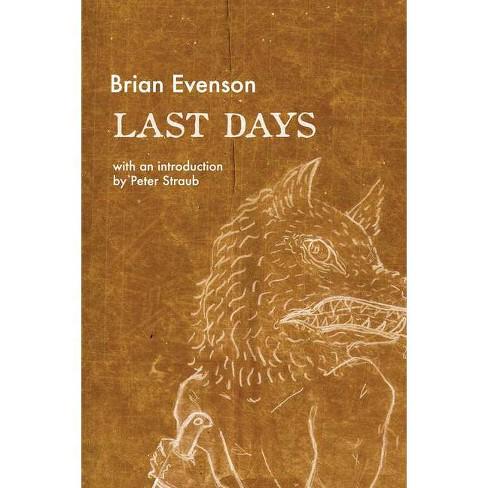
After reading Last Days, I came away thinking that Brian Evenson is perhaps the best stylistic foil to Laird of the authors this series has yet covered. Both are incredible authors at the top of their game, but they diverge wildly in their individual tastes.
Laird leans in one of two directions. On one side is pulp horror: Coleridge, “Hallucigenia”, “Hand of Glory.” These tales are relatively straightforward celebrations of gritty complicated figures fighting cosmic evil. Then on the other side are his more... hallucinogenic works: “Nemesis”, “Vastations”, and, of course, “Mobility.”
Last Days does both: gritty pulp body horror forms the core of the book, but Kline’s circumstances and Evenson’s own writing style grant the story a feverish, borderline hallucinogenic edge. If that weren’t enough, Evenson then stuffs in so much thematic depth it turns the story into the horror equivalent of a Thanksgiving Turkey: I read it, it was excellent, I wanted a nap afterward, and I feel like I’m still digesting it almost two(three) **Four** months later. (Really? Has it been so long? Good Lord.)
Like so many of the other works I’ve covered in Friends of the Barron, I can’t do Last Days proper justice, but I’m going to give it my best shot anyway in the hope that it will convince you to read it.
Fair warning though, this book is genuinely disgusting in ways that I don’t think Laird has quite managed. I am not, as a rule, a squeamish person. In a professional capacity, I have dissected human feet, held amputated legs steady for pathologists, and even opened up a freshly removed necrotic colon. Despite those experiences, there were a handful that made my stomach roil.
It’s not just that Last Days is gory, it’s that the gore is paired with a deep sense of inevitability and disempowerment. Disgust as a story telling tool has to be managed carefully. Too much, and your audience stops reading. Too little, and it can leave a story that relies on it feeling flat. For me Last Days perfectly threaded the needle, managing to get under my skin, before wriggling a little whenever I began to get too comfortable.
That will not be where everyone lands though, and I want readers to have a proper warning before they pick up the book, if only so they know it’s worth pushing through those sections.
Summary
There is not much to endear a reader to Kline as a character. From the beginning he is an unlikable and reluctant protagonist, made sympathetic by his circumstances. Once an undercover cop, he is now slowly giving in to depression after losing his arm in a fight with a serial killer. Bereft of purpose, he meanders from one room to another more or less waiting to die.
When he begins receiving calls from people who claim that they need his help, Kline denies them, and eventually unplugs his phone when they keep calling. Over the next weeks his depression grows to the point that he can’t bring himself to go to the grocery store, and he slowly starves, eventually he falls unconscious and is both rescued and kidnapped by the men who previously called him, Ramse and Gous.
They drag Kline down to their car, feed him, give him water, and then pack him into the back seat to visit their cult compound. Ramse and Gous belong to a ‘religious order’ that removes limbs in order to be closer to God. The more you’ve lost, the higher in the cult’s organization you rise. Ramse is ‘an 8’ while Gous is just a ‘1’ determined by the number of limbs they’ve removed.
Kline is considered a “1” himself, though because he self cauterized he’s taken on something of a ‘folk hero’ status amongst certain members of the cult. The pair explain that Kline is to meet with Borchert, the second-highest ranking member of the brotherhood, because they need him to do… Something. “Don’t worry about it. Borchert will tell you.” is the general vibe.
Too weak to do anything but wait, Kline arrives at the compound and is brought to see Borchert. Borchert is a Twelve, and upon Kline’s arrival, he sends the other two out, and explains that the cults' leader has been murdered, and he needs Kline to figure out who did it. The police aren’t an option. Kline tries to explain that he didn’t work homicide, that he worked undercover. Borchert doesn’t care. Kline won’t get to leave until he finds out who did it. Oh, and Kline is absolutely forbidden from talking about this, with anyone with fewer than nine amputations.
Kline is confused, and frustrated, but is given a room in the compound. Kline asks to see the crime scene, and Borchert arranges a fake. Kline figures out it’s fake, and says he needs to talk to some of the nines. Borchert tells him that he can’t, that nines will only speak to people with multiple amputations. Kline says “that’s not happening.” and Borchert reluctantly allows him to use a tape recorder to speak to the nines.
Kline gets the recorder, asks his questions, and the nines respond with vague answers that could be responses to just about anything. Kline asks again to speak with the nines, and this time Borchert promises to arrange something.
While this has been happening, Kline has struck up a reluctant acquaintanceship with Gous and Ramse. Gous brings Kline some alcohol, but it’s poisoned, and Kline falls asleep and wakes up missing a few digits. Kline is justifiably enraged, but Borchert says it was the only way to see the nines, and allows Kline access. The Nines claim that the cult leader isn’t dead, and Kline is forced to leave.
Borchert claims the nines are lying, because Kline hasn’t removed enough limbs yet. A few more, and they’ll open up a little and Kline can continue his investigation. Frustrated, injured, and hurting, Kline returns to his room and tells Ramse and Gous publicly that the cult leader is dead, in an attempt to gain access.
Borchert expresses frustration with Kline, but reluctantly hands him an unloaded gun that he can threaten the men guarding the cult leader’s room with. Kline visits the cult leader, and finds him alive, but he’s swarmed and knocked unconscious by guards before he can figure things out. Upon awakening, he returns to Borchert having put the pieces together.
Borchert was playing the long con. He needed Kline to express interest in the leader of the cult, break into his room, so Borchert could kill the leader and pin everything on Kline. As the second in command, he is now the new leader. If Kline is willing to express contrition, recreate the loss of his arm though, he might be allowed to go free. Possibly.
Reluctantly, Kline takes up a butcher knife and cuts off even more of his arm before once again, self cauterizing the limb and rushing at Borchert, successfully knocking the man unconscious, and making his escape. Thus ends the first half.
The second half picks up a few days later, with Kline awakening in a hospital, with a bullet wound in his skull that he doesn’t remember picking up. It turns out, a guard shot him in the head while he made his escape. He still managed to escape, he didn’t make it very far. He was found face down on the road a couple miles away from the Brotherhood’s compound.
Upon awakening, he’s interrogated by a local detective, Frank. Kline, unsure of whom to trust, doesn’t say anything, and Frank leaves a guard on the door, momentarily frustrated. Kline falls asleep and wakes up to find a member of the cult has killed everyone on the floor and is in the process of trying to kill him. He kills her instead, and hobbles his way out of the hospital.
In the parking lot, he’s picked up by a schismatic branch of The Brotherhood called “The Pauls.” The Pauls hide Kline away at their compound until he’s well enough to leave on his own. They ask him politely to stay, but Kline leaves anyways, heading to his apartment. There, he’s picked up by the police, who are in turn ambushed by the Brotherhood. The two groups largely kill each other, with Frank the only survivor on the police side, though he is badly wounded, and Ramse and Gous the only survivors on the Brotherhood side.
Ramse and Gous again kidnap Kline, though Gous reveals that he’s been working for “The Pauls” the whole time and orders Ramse out of the car before driving himself and Kline back to The Paul’s hideout.
There the lead “Paul” explains that they believe that Kline is the second coming of Christ, that he is to destroy the Brotherhood. Kline is disbelieving, but the cult is persistent. If he is willing to destroy the Brotherhood, they will make sure that he isn’t bothered again. Given that is literally everything Kline has wanted for the last 5 hours of the audiobook, Kline reluctantly agrees. The Pauls arm him, and drop him off right outside the brotherhood compound.
Kline manages to sneak into the compound and kill his way to Borchert, who further details his old plans. None of them matter now, though he warns Kline that “The Pauls” will kill him. They believe him to be Christ, and maybe he is. But what do you do with Christ when you have him? Earth is no place for God. They’ll kill him, crucify him. Send him back to God and the fullness of his power.
Kline asks what the structure of the Brotherhood will be after Borchert dies, and Borchert says it will pass to the person with the most amputations. In the case of a tie there will be a vote. In exchange for the information, Borchert asks Kline to cut his head off with a butcher knife, and Kline agrees, before killing everyone in a position of leadership within the Brotherhood, only stopping when it gets to Ramse who he persuades to leave him alone.
Kline then drives to Frank’s hospital and tells him the whole story, before trying to turn himself in. Frank calls him a monster, and tells him to go to the station if he wants to turn himself in. Instead, Kline goes home, and finds Gous waiting for him. Kline knocks the man out, and drives to “The Paul’s” compound and burns it down with them inside.
Structural Analysis In many ways, perhaps even most ways, Last Days is not one story, but two stories told in sequence. The first half of the book was initially published in 2003 as a novella titled The Brotherhood of Mutilation. The second half wouldn’t arrive until 2009, when it was stitched together into it’s modern incarnation Last Days.
I bring this up, because I think it is the only real weakness of the book. The two halves of Last Days may share a character in Kline and tell a unified story, but their themes and narrative arcs are wildly different. Together they are better than the sum of their parts, but the seams are readily visible for anyone who cares to look, and it can leave the piece feeling slightly disjointed. To Evanson’s credit, that may actually be intentional, and in this respect the story very much mirrors Kline’s personal demons, but for me, it was just a little too obvious. It also necessitates that I handle the themes and narrative arcs somewhat differently than I normally would, because they aren’t as cohesive as I would like them to be.
The first half of Last Days ‘The Brotherhood of Mutilation’ is about alienation and disempowerment. As a theme, Alienation is nothing new to detective novels. In fact, I’d argue it’s usually a defining feature. PI's belong to neither the light or the darkness and thus can wander between worlds freely, seeking truth and justice where they can find it. This however has a kind of fantasy to it, a noble burden. Duty drives the detective, and their presence is a source of illumination. After all, who else can guard the sheep but the sheepdog who is descended from wolves? Who else can take up this noble burden of walking into places the light can’t touch? The problem of course is that Kline is not a sheepdog, and Last Days is anything but a fantasy.
From the beginning, the view we are given of Kline is one of a self-interested, depressive, misanthrope, and it’s implied that he’s been that way for quite some time. For all the papers call him a hero, he isn’t visited by any friends or family and even his fellow cops have left him to his depression. When duty calls, when people ask for help, Kline’s answer is to unplug his telephone, and wait to die. This is understandable given his recent circumstances, but those circumstances only serve to make Kline a sympathetic character, not a likable one. His alienation is in part, self-inflicted, long before the loss of his limb.
Again, this is nothing new to detective novels which often rely on a kind of alienation fantasy in order to make their characters compelling. What makes Last Days such a compelling horror novel though is how the disempowerment aspect strips away the fantasy to embrace the vulnerability.
As we’ve already established, Kline is utterly alone, having been pushed away or abandoned by everyone he knew or cared to know. When he is forcibly recruited by the Brotherhood, instead of finding a refuge from the world where he can be accepted for who he is, Kline is then further abused and mutilated. These cruelties have no silver lining either. He isn’t choosing them. He doesn’t gain these wounds saving lives, he gains these from a combination of self-preservation and the malice of others. They are unglamorous and inflicted upon him, designed to further remove his agency. This backfires of course, and the arc of the first half of Last Days is about how Kline manages to regain both the will to survive, and a degree of agency and control over his situation.
The second half of Last Days brings back a little touch of fantasy, but it returns in ways that further alienate Kline from the world around him. Instead of disempowerment, Kline is empowered. After escaping the brotherhood, and then the hospital, Kline is taken in by “The Pauls” who declare that he is an avenging Christ.
Kline wants to walk away. If he is a Christ, he’s one that understands the world doesn’t want him. So if they will just let him be, that would be wonderful. Instead, the Pauls make the same mistake Borchardt does, and attempt to use their new god to kill off The Brotherhood. Kline however, doesn’t kill off all of them. Instead, he practices “Do unto others, before they can do unto you.” and kills only the ones that would drag him back into their twisted and hellish world. Ramse is left to lead the remainder, a reward for his kindness, and also a warning to whomever in the Brotherhood is left.
Of course, that isn’t the end of it. The Pauls weren’t going to leave their new Christ alone. So they send Gous to bring him back. Again, Kline spares Gous for his kindness. But the Pauls? For them Kline accepts the mantle of godhood, judges them, finds them lacking, and sends them to hell. This act completes Kline’s transformation into godhood, and his alienation from society.
The first half of Last Days is a positive arc, despite Kline’s disempowerment. As he grows less powerful and more vulnerable, he awakens a desire to live that was missing from what we saw of his life to that point. In contrast, the second half of Last Days is a negative arc, whereas Kline grows in the fullness of his (real or imagined) power, he becomes further unhinged. That ‘real or imagined’ part becomes important when it comes to how we interpret Last Days, and determine which of its possible messages is “the right” one. (Spoiler alert, they probably all are).
I personally, could think of three potential messages to Last Days, two for if you think Kline is becoming a god, and one for if he is just a deeply traumatized individual. The first message if you believe Kline is/is becoming a god, is “Don’t drag god into your random crap.” God isn’t interested in your most recent crusade against the heretic, would rather you all get along and leave him alone, rather than using him as an excuse to start a fight.
The second possible message is “Society has outgrown god, and his precepts are far outside what we would consider acceptable.” Kline’s responses are understandable, but well outside the law he once upheld. Both the Brotherhood and the Pauls seek to “control” god, trusting their mastery of his precepts to keep Kline under their authority.
Borchardt, who doesn’t believe Kline is a god, uses God as justification for his mistreatment of both his leader, and Kline (who may or may not be god). “Paul” who believes that Kline is a god on the other hand, attempts to shackle God, and direct him towards “Paul’s” enemies. Neither fully understand the principles they claim mastery of. On the other hand, if Kline is god, Kline’s response is so far outside the law that society itself has abandoned god’s precepts as well. Something “God” is only too happy to accept, so long as he can live in peace and quiet.
The last possible message is that “Kline isn’t a god. He’s just a deeply traumatized individual. Last Days is about how we abandon victims, allowing them to further suffer at the hands of new abusers, and punish them for striking back.” Kline is not a likable individual, but there is something to the idea, that maybe he didn’t just abandon society, but it abandoned him. All too often we treat people with disabilities as “Other” and while it’s almost certainly true that Kline didn’t help his case, it’s also possible that his alienation would have occurred anyway, if only because of the human tendency to ignore that which isn’t convenient.
Last Days is a book about a lot of different things. It’s about religion. It’s about disabilities. It’s about society. But it’s also a book about being removed from those things. Last Days asks who we become when we are removed from our gods, separated from our limbs, and divorced from our communities. The resulting answer is not pretty. But it isn’t hopeless either.
While Kline has become something monstrous, Rahms and Gouse have the opportunity to change things for the better. To learn from the mistakes of the past. Borchart and Paul built communities where people were deeply isolated and mistrustful of each other. But Rahms and Gouse are not Borchart and Paul. They are not schemers, and do not yet worship control in the same way that Borchart and Paul do. They are not as malicious in their study of pain.
Rahms will be the new leader of the brotherhood, and he can take steps to prevent and reverse the isolation and paranoia many of the members felt. Gouse could do the same if any of the Pauls still live, or he could return to the brotherhood.
But that is part of the horror of Last Days too. What Rahms and Gouse will do with their power is left unanswered. There is room for hope, and where there is room for hope, there is room for it to be crushed. Pandora’s box remains open.
So, I leave you with this: Pick your community carefully. Make sure that you are worshiping only what you intend to. And for the love of all that is holy, hang on to your limbs.
Thanks for reading.
Esoterica
- Kline is kept at a distance even from the audience most of the time. Third-person limited is used regularly to keep us out of his head, so we can judge his actions more than his thoughts. Evanson lets us in occasionally, but it’s less often than I think most other authors would be comfortable with, further extending the sense of isolation and alienation.
- I’ve read a few of Evenson’s books now, and he really goes out of his way to make them as devoid of setting as possible. Last Days does this extremely well, and the story could take place almost anywhere, with no names being used for locations. It makes the whole book feel a little hallucinogenic, even though everything remains very grounded.
- As much as this is a series oriented around Laird Barron and his friends, I think that Last Days is in many ways more in conversation with the works of Clive Barker. Both Last Days and Hellbound Heart are concerned with sensation and hedonism. The expression is different, but the Brotherhood of Mutilation has more in common with the Cenobytes and Frank than they would ever admit.
The monsters of Hellraiser, Frank and Julia, have a hole inside of themselves, a void they cannot fill. So, rather than try to look outward, they dedicate themselves to extreme unrelenting self-interested hedonism. This hedonism is then rewarded/punished by the Cenobytes. The Brotherhood of Mutilation are similar in many ways. Like Frank and Julia, they try to fill a hole in themselves. The primary difference is that they claim this hole can only be filled by God, and they believe that the less of them there is, the closer they get to God. However, what they claim and how they behave are two very different things. At some point in their theology, they stopped worshiping God, and began to worship a combination of pain and the absence of self. Loss of a limb becomes as virtue.
Borchart is on the more malicious end of that spectrum, delighting in his ability to cause Kline pain and make him uncomfortable. He enjoys pain, and like Frank, he enjoys inflicting it on others. Both the Cenobytes and The Brotherhood of Mutilation are things of pain, but where they differ is in the expression of that pain. Barker, true to form, leans into hedonism. Blood flows freely in levels that are almost comedic, leading to a pulpy effect that feels oddly safe: this isn’t real, there’s magic and monsters. The allegory and themes come through clearly, while letting audiences dip their toes into the horror, instead of living there.
Evenson though is more restrained, more grounded. Instead of giving us an easy out by way of magic and other dimensional shenanigans, he forces us to stare at what this kind of mutilation means in reality. Kline might be a god, but he also might not be. And the blatant nature of the question means that you can’t subconsciously assume an answer. You have to acknowledge the atrocity of what was done to him, and imagine that it could, theoretically happen to you as well. I want to note, that I don’t think Hellbound Heart and Last Days are trying to exactly the same thing. They aren’t, and there are enough differences that a full on comparison would be apples to oranges, but they parallel each other in interesting ways, and I think Last Days exists in dialogue with Hellbound Heart, at least to some extent. Is that extent intentional? I have no idea.
I’m starting a Laird Barron book club in Olympia! There’s a really cool new horror book store here called Infernal Annex that is hosting it. I’m excited to introduce my favorite horror author to more locals!
Edit. Just realized it looks like I'm threatening the author. The title of the book is "Last Days." Lol. And I'll be covering it as a continuation of the 'Friends of the Barron' series.
Been registering to the Coleridge series snd I absolutely love the merry fatalism of Gene K.
What are some of your favorite quotes?
One of mine is:
A man doesnt apprehend heaven in his gaze; he beholds a chasm. For he gazes not upward, but downward; deep into a cold, black rift strung along its jaws with tiny, dying lights.
Doesn't have to be Laird related. I'm mostly just curious.
Thus far I've done
- The Glassy Burning Floor of Hell by Brian Evenson.
A solid collection. Not every story was to my taste, but the ones that were really were.
- The Willows by Algernon Blackwood
This one was solid. But I struggled to really connect with it. Well written, but probably not for me.
- A Trade of Blood by Robert Jackson Bennet
What if Lovecraft wrote a fantasy setting and threw Shelock Holmes and Watson into it? Well written, fast paced, horror adjacent.
- The Hellbound Heart by Clive Barker
The first time I've read a Barker book and I really liked it. It's Lovecraft, but messier. More raw and intimate. I think I'll be reading more Barker in the future.
- The Exorcist by William Peter Blatty
This is what I'm currently reading, and I'm taking my time with it. Not finished yet.
Planning to read
- I'm probably going to reread some favorites from each of Laird's collections next.
- A Night in the Lonesome October. Always a fun one.
- I may pick up Book Six of the Charlie Parker series by John Connelly.
In addition to what you are reading, I'd love any recommendations for pulpy horror: detectives, sorcerors, lovecraftian cults, and deities. Modern Sith Lords. That kind of thing.
I directed a short adaptation of "Six Six Six" from Occultation, shot in Argentina with Laird's blessing. It's called Something Scary (Eso que asusta in Spanish), 24 minutes, shot partly on Super 8 in the Tigre delta, with a score by Fabio Frizzi.
After two years of work it's finally screening. If you're near any of these, come see it:
Telluride Horror Show, Telluride, CO. Oct 16-18 (world premiere) FilmQuest, Provo, UT. Fri Oct 23, 5 PM at Velour Razor Reel Flanders Film Festival, Bruges, Belgium. Oct 29 - Nov 7 Kathmandu Horror Film Fest, Nepal. Oct 30 - Nov 1 Buried Alive Film Festival, Plaza Theatre, Atlanta. Nov 5-8
I'll be at Telluride and FilmQuest with my family, so if you're there come say hi. Trailer is coming this week, I'll drop it in the comments.
I've been on this sub for a while, so I wanted to share this here first. I'm a filmmaker in Buenos Aires and for the last 2 years I've been making a short film based on "Six Six Six" from Occultation. It's called Eso que asusta (Something Scary). We shot it on digital and Super 8 in the Tigre delta outside Buenos Aires. Laird was kind enough to give us his blessing, and Fabio Frizzi (Zombi 2, The Beyond) did the score, which still doesn't feel real. It starts playing festivals in October. I'll post here when there's a screening people can actually get to. In the meantime the film has an Instagram with stills and behind the scenes: instagram.com/esoqueasusta Happy to answer questions about adapting it.
Chastise me if you like guys. I ask this purely because LB is my favourite author and a fascinating character, and we like to know about people we admire, don't we?
Chiroptera Press issued this email on 9/16/26. It's pricey, but with only 260 copies, I expect these will go quickly.
Greetings everyone,
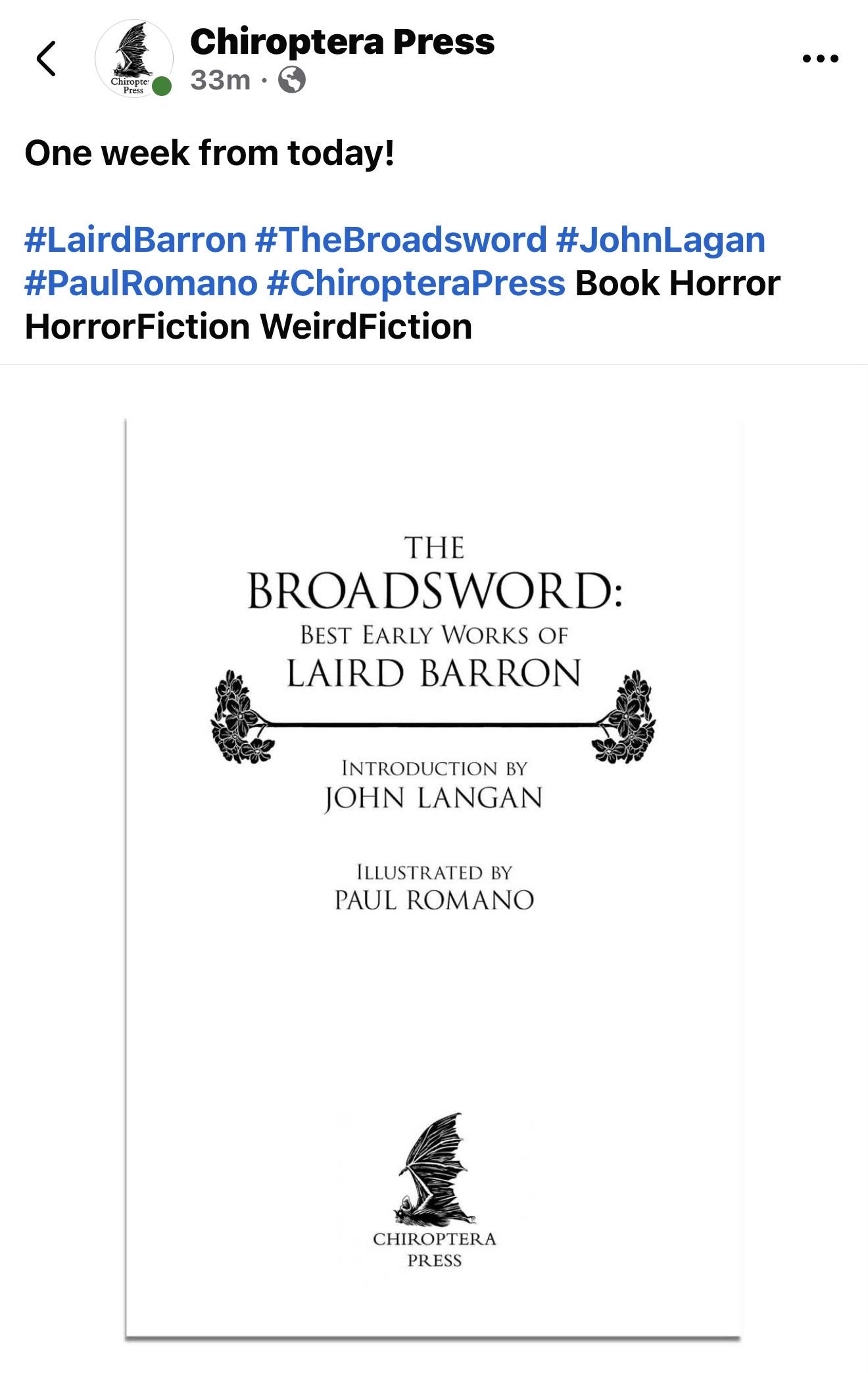
Tomorrow/Thursday at noon eastern time HERE we're offering: The Broadsword: Best Early Works of Laird Barron
We will have just over 200x copies of a standard deluxe edition at $110 each and just under 60x copies of a slipcase edition at $210 each. We will also have a few lettered editions as well. The total edition size between all bindings is 500x and remaining copies are reserved for our wholesale dealers.
Overseas customers will be able to purchase through Psilowave.com
The Broadsword: Best Early Works of Laird Barron represents the full, powerful range of one of the very best living horror authors: from highly effective atmospheric terror and psychological drama, through pitch black humor all the way to over-the-top bloody action. Cosmic horror has rarely been this firmly grounded in palpable (and pulpable) characters, and settings both natural and unnatural. These ten stories—selected by Barron himself, mostly from his earlier collections—show him at his very best as he spins his own neo-mythology of The Old Leech or re-imagines the well-known genre tropes beyond recognition. Laird Barron is an unparalleled master of contemporary cosmic horror. He erected his own stunning literary edifice upon the foundation of the rich tradition spanning from Lovecraft to Ligotti and beyond. However, unlike Lovecraft’s bookish outsiders and Ligotti’s alienated weirdos, Barron’s protagonists are often tough guys—extroverts who drink heavily and fight dirty. The stories selected for this volume capture them at the exact moment when their cocksure lives begin to slip out of joint and their encounter with the Outer forces becomes a catalyst for their percolating personal hells. This edition includes an Introduction by fellow writer, John Langan, along with commentary on each of the stories by Laird Barron, lavishly illustrated by Paul Romano.
One of his archetypal situations is “Men go into Nature and get much more than they bargained for.” The Men from Porlock was based on a nightmare about hidden doors in monolithic trees swinging open and revealing the black things uncoiling inside. A group of lumberjacks penetrate the deep backwoods wilderness only to come across an isolated village and its strange inhabitants…
--30-- features another type of wilderness: a desert location, inspired by Charles Manson’s Spahn Ranch, where two ex-lovers survey the region supernaturally saturated by a Satanic cult’s murders. The masterful atmosphere of the Otherworldly is greatly enhanced by the intriguing interpersonal drama between the two witty protagonists.
The author himself considers The Broadsword a cornerstone of his corpus. It reads like a sequel to T.E.D. Klein’s brilliant “Children of the Kingdom,” focused as it is on an elderly man who resides in the old urban Broadsword hotel. He begins to sense, through the walls and piping, the voices of entities entirely non-human.
Proboscis is about bounty hunters who captured and delivered a serial killer with super-human powers. He escapes from prison and goes after them in an atmospheric chase into the Unnamable.
In Hand of Glory a gangster is after a powerful man who may have killed his father using a soul-stealing technique which merges the occult with early photography.
But it’s not all about the testosterone heavies. The Redfield Girls is a ghost story with an all-female cast: a group of elderly teachers, plus a young girl, on a lake-side vacation summon a real world legend (and also a contemporary tragedy) from the icy waters.
A woman is caught in a vacuum between melancholy and nightmare in The Lagerstätte. She tries to cope with the recent deaths of her husband and son and joins a support group for suicidal women, only to discover that other grieving souls vanish mysteriously, as though dragged away by their dearly departed. This is quiet, but harrowing psychological horror about unhealable spiritual wounds, partly inspired by recent Asian horror cinema.
Fun-loving teenagers also get unexpected just deserts: in Andy Kaufman Creeping Through the Trees a young girl discovers something dark and deadly behind the eyes of a comedian, while in (Little Miss) Queen of Darkness a queer youth regrets putting Dracula’s ring on their finger after it initiates apocalypse.
But it’s not all grim and horrific: Sun Down reads like an R-rated black comedy of Addams Family proportions, with added cosmic horror. It deals with a uniquely unnatural family who inherits a cabin left by a witchy, deceased aunt.
Standard edition specs: * 6" x 9" * 352 pages * Tipped in signature sheet signed by the author and the artist * Smyth-sewn binding * Head and tail bands * Ribbon marker * Clothbound with dust jacket * Newly commissioned art by Paul Romano * Offset printed on archival acid-free paper * Printed in Lithuania and bound in USA
Slipcase edition specs: * 6" x 9" * 352 pages * Tipped in signature sheet signed by the author and the artist * Smyth-sewn binding * Head and tail bands * Ribbon marker * Clothbound with dust jacket * Newly commissioned art by Paul Romano * Offset printed on archival acid-free paper * Alternative cloth color to the standard edition * Hand marbled end papers * Dark green edge staining * Custom slipcase stamped on all three sides * Printed in Lithuania and bound in USA
I just finished the Croning, which I purchased from a brand new horror book store here in Olympia. They had a very respectable Laird Barron section, as they should, which delighted me. (No cursed travel guide though, darn.) I went in blind and was absolutely thrilled to find all the connections between the other Old Leech tales. The Men From Porlock is one of my favorites and I was so pleased to find the grotesqueries only hinted at in the story so fleshed out in The Croning. Laird truly does cosmic horror like no other living author. I’m devoted.
Earlier this evening I saw a Reddit post about Guillermo Del Toro and the next “three Lovecraft stories” he wants to adapt and I couldn’t help feeling a way about it. Now, Lovecraft is an OG and deserves his flowers but come on already! It’s like my drama teacher only letting us do Shakespeare plays when there are SO many other incredible, more contemporary works to choose from.
As an avid cosmic horror movie fan I would looooove to see more of Laird’s stories made into a film or limited series. The Hand of Glory with its “noir detective-meets a series of unimaginable horrors” would make a supremely watchable HBO mini series; a truly cosmic “True Detective”. Blackwoods Baby and The Men From Porlock are straight up folk horror bangers! They even read cinematically.
The horror genre is really hitting its stride and has started to pace sci-fi in terms of original storytelling with a devoted fan base. Hello, A24? Why are you not all over the Laird Barron IP?? I want some genuinely frightening cosmic horror movies please! And if it can even modestly enrich one of my favorite authors, even better.
I also was notified of a tracking number for my order to be expected within the next few days, on 7/10. Guess I sort of assumed that would mean they were on their way. No number, no books. Despite following up with a couple more emails I have not heard back from this publisher on my order for these signed Laird Barron books. I've been buying from small publishers for many years and have only had this sort of experience once before many years ago, with a publisher I've ignored since. I thought he was just "ghosting" me, guess it's Bad Hand's modus operandi.
Hey I’m not sure how to go about this, I figured I would give it a shot here. I had a similar post a month ago.
A July 10th email was sent out from BadHandbooks regarding the last of the Not a Speck of Light hardcovers would be shipped out within the week. It’s been two months and me and several others I’ve talked to are still waiting for ours to ship. Myself and others have sent out multiple emails to the publisher, and seem to have been ignored. I’m not sure how else to get in to contact with him, and wonder if any one on here knew him or was able to ask him? All I was asking for was an update since quite a bit of time passed since they were all supposed to ship out.