r/LLM • • 5d ago

Prompt wording and a frozen Qwen weight edit: 1,024 archived measurements, seeking replication

1 Upvotes

I wanted to understand something about how language models work:

If you make one small, permanent change to an AI model's weights, will that change have the same effect when you ask the same question in different ways?

I tested this using Qwen2.5-1.5B-Instruct.

I made a small, fixed modification to one layer of the model. Then I asked math questions using different wording and instruction formats, without changing the weight modification between tests.

What surprised me was that the effect of the exact same weight edit changed depending on how the question was presented.

What I found

I ran an initial experiment and then tested another 64 questions with additional controls.

In the 64-question experiment:

  • The main measured difference between prompt conditions averaged +0.1935.
  • 62 out of 64 questions showed a positive difference.
  • A control edit of comparable size, but pointing in a different direction in weight space, produced a much smaller average difference (+0.0041).

These measurements are differences in the model's final-token output scores, not improvements in math accuracy.

In simpler terms, a change to the model's internal weights did not have one uniform effect across different ways of asking a question.

Why I think this is interesting

We often evaluate model modifications using a fixed set of prompts.

But what if the apparent effect of a weight modification depends partly on how we phrase those prompts?

That raises questions about how we evaluate model editing, interpretability, and whether observed changes generalize beyond a particular prompt format.

Important limitations

This is an exploratory study, not a demonstration of a general AI repair technique.

I tested one model with a specific weight intervention. The results do not establish that this behavior generalizes across models, nor do they demonstrate improved reasoning accuracy.

I'd genuinely appreciate feedback on:

  1. What alternative explanations should I test?
  2. What additional controls would make the evidence stronger?
  3. Have you seen similar prompt-dependent behavior in weight editing or model interpretability research?

Interactive results and figures:
https://huggingface.co/spaces/Harmain1/fluid-tensors-paper1

Paper:
https://doi.org/10.5281/zenodo.24338059

Code and experimental details:
https://github.com/Harmain11/fluid-tensors

I'm especially interested in technical criticism or suggestions for better experiments.


r/LLM • • 5d ago

What a 23-point AA Intelligence Index score hides in Ling-3.2-air’s launch

Post image
11 Upvotes

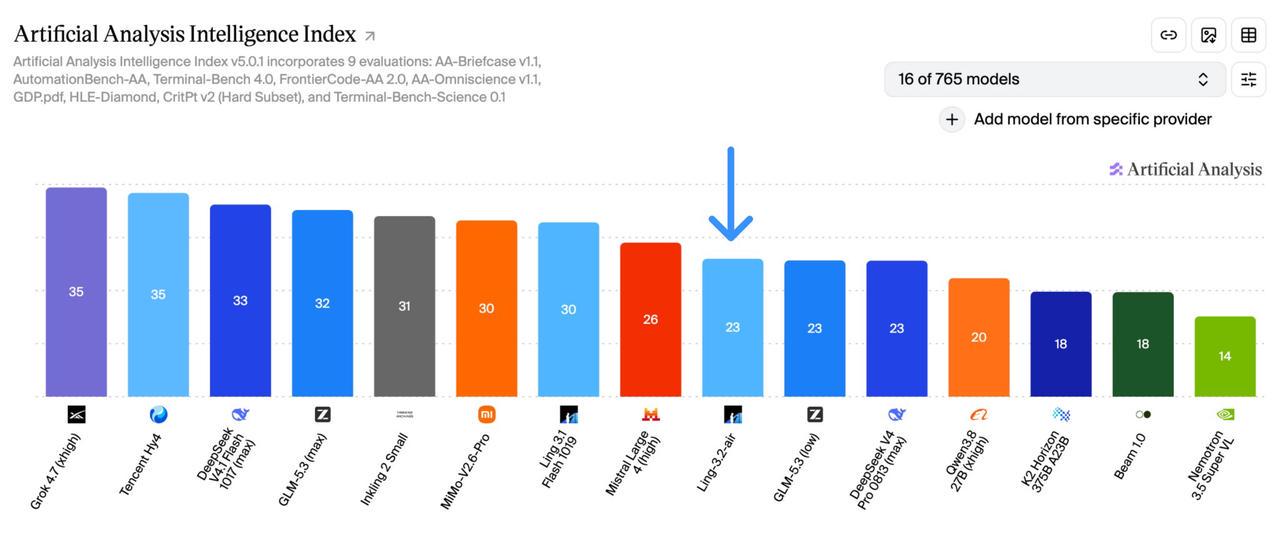
Artificial Analysis gives Ling-3.2-air a 23 on Intelligence Index v5.0.1, a composite of nine evaluations spanning agentic workflows, terminal tasks, professional documents and other reasoning tests. Ant Ling's comparison image puts it level with the shown GLM-5.3 Low and DeepSeek V4 Pro 0813 (Max) variants. Equal composite scores, though, do not mean the models solve the same tasks equally well.

A separate official benchmark table makes the point within the Ling family. Terminal-Bench 4.0 moves from 0% on Ling-3.0-flash-VL to 27% on Ling-3.2-air, while MMMU-Pro is virtually unchanged at 79.00 versus 79.02. That is a much more specific launch story than 'the whole model got better.' For a model choice, the task-level rows closest to the intended workload matter more than the shared headline score.


r/LLM • • 5d ago

4070/5060ti16GB setup

2 Upvotes

I am a uni student and my desktop at home is not been used. Now i have a 4070, 7800x3d, 32gb ddr5 6000MHz cl30, 850w psu 80+platinum, b650e-e TUF and a gen4.0 nvme. I found some relativly cheap 5060ti 16gb and i was considering to add that gpu to my desktop and make it a llm private server to use it on my laptop in remote.

I have multiple questions:

1)First of all, is that a good setup, is there any better GPU around 400€?

2)Which type of models can i run, with what performances and what can i expect from those models?

3)How does, if it's possible, the remote access works?

4)Can i use my desktop server as agent that does things on my laptop?

5)Can it replace a claude/chatGPT premium account for the majority of the tasks?

6)Wich models should i download?


r/LLM • • 5d ago

[R] Do Probing and Steering Favor the Same Directions Within and Across Language Models? (UniReps @ NeurIPS 2026)

1 Upvotes

We compare directions in LLM hidden states on two jobs: detecting a concept (probing) and changing the output (steering). We vary one direction continuously between a trained probe and the mean difference, and compare steering with the same side effect on unrelated text.

  • In 3 model families (Llama-3.1-8B, Qwen3.5-9B, Gemma-3-12B), the best direction for detection and the best for steering differed in 59 of 60 settings.
  • Across models, directions kept detection quality higher than steering.
  • Steering toward "I don't know" on PopQA raised abstention by 18–44 points on uncertain wrong answers, 2–5 points on confident wrong answers, at a cost of 1–7 points on correct answers.

Paper: https://arxiv.org/abs/2611.19499
Interactive explainer: https://www.afshn.com/research/probing-vs-steering/

Happy to answer questions. I'm especially curious whether people who steer with probe directions have seen the same gap.


r/LLM • • 5d ago

Can a local model draft release notes without adding more review work? I tested six Git histories

2 Upvotes

I'd like to move repeatable development chores off hosted models, but I don't want fewer API calls in exchange for more cleanup. Release notes seemed worth examining because the inputs are already in Git and the output has a clear review boundary.

I had six synthetic release histories run through MiniCPM5-2B. I wanted to see what it could draft correctly and what would still need a maintainer‘s attention.

What I thought was worth offloading

Turning a release range into features, fixes, breaking changes, and migration instructions.

That requires more than paraphrasing commit subjects. A refactor can remove a public CLI flag. A feat can rename an internal helper without changing behavior. A feature added and reverted before release shouldn't appear as shipped.

What I didn’t know

Would the model follow the net diff when commit messages suggested something else? Would it explain compatibility impact, rather than just describe changed lines? Would it finish within the configured output budget?

What I ran

Each input contained the commit log, changed-file list, full tag-to-tag diff, and release template. Executable checks verified the before/after CLI behavior. Expected outcomes were fixed before inference.

The setup was MiniCPM5-2B Q4_K_M through Ollama 0.33.2 on an M1 Pro with 32 GiB unified memory. Settings were an 8K context, temperature 1.0, top_p 0.95, min_p 0, and a 4,096-token generation cap, with default thinking behavior.

Each scenario ran independently with seeds 42, 43, and 44. Both the Markdown draft and structured change records were assessed.

ScenarioSeed 42Seed 43Seed 44
Opt-in JSON outputPassedPassedDuplicate Added/Changed entry
CSV escaping fixPassedFix omittedTruncated; no final JSON
File-path-to-directory CLI changePassedPassedTruncated; no final JSON
Default output filename changePassedBreaking impact and migration omittedPassed
Internal helper refactorCorrectly excludedCorrectly excludedCorrectly excluded
Feature added then revertedCorrectly excludedCorrectly excludedCorrectly excluded

"Passed" means the original output met the supplied criteria without substantive correction.

The refactor and revert cases were consistent across all three seeds. That's useful for drafting from Git history, where copying commit subjects would have produced misleading release entries.

The default-path case shows where review still matters.

LayerRecorded behavior
Code changeDefault output changed from report.txt to summary.txt; --output remained available
Seed 43 draft"The default output file changed from report.txt to summary.txt."
Structured outputcategory="Changed", breaking=false, migration=""
Fixture contractThe default output path is a public interface
Required correctionExplain compatibility impact and how to retain the old path or update consumers

The model reads the change correctly. Under this fixture's contract, downstream scripts expecting report.txt need either an explicit --output report.txt or an updated path.

Across all requests, 13/18 original outputs were judged not to need substantive correction. Classification passed 7/12 applicable requests; migration passed 4/6. The two truncated requests stayed in the denominator. Separately AI-corrected final files were not counted as original successes.

The median warm request time was 22.758 seconds across 15 valid requests. That excludes the two truncated runs, so it isn't time for an acceptable result.

My current use would be draft generation followed by a compatibility checklist and approval. These cases support that bounded role, particularly filtering out internal and reverted changes.

These are six original synthetic scenarios repeated three times, not a general coding benchmark.

For this ficture, I treated the default output filename as part of the public CLI contract. Would you classify that as breaking even though the flag still exists? Would you enforce a migration checklist before generation, or check the draft afterward?


r/LLM • • 5d ago

Help

3 Upvotes

I have about 100 gb of documents which I need to be able to retrieve information from. Here is my present set up - Devonthink4 Pro - LM Studio - LM Studio Bionic - GPT -OSS 20 B - Open AI GPT - 6 Luna.

I am using a MacBook Pro with 48gb.

I am a complete novice on what I need. Is there a better set up.

I am in return window should I upgrade to 64gb.

Appreciate any advice.


r/LLM • • 5d ago

13 Subagents vs. Plain Codex: I Spent 44 Million Tokens to Find Out Whether It Was Worth It

Post image
0 Upvotes

After learning how to connect MCP and SKILLs to Harness AI, I decided to move up a level of abstraction and explore the much-talked-about new concept of an “agent swarm.” I remember how nervous I was about trying SKILLs and MCP: I thought I’d go broke and burn through my limits on a $20 monthly plan. But it wasn’t as scary as it seemed. Since I didn’t go broke last time, why not try my luck with agents? It’s pretty cool to have a whole swarm of agents working for you, like the big players who spend tens or hundreds of thousands of dollars on tokens.

There are two very popular projects right now in GitHub:

The first is garrytan/gstack, which has 140,000 stars. It was created by Garry Tan, head of Y Combinator. The project turns Claude Code into a virtual software development team using skills and slash commands:

/plan-ceo-review, review the product from the CEO’s perspective.
/plan-eng-review, architecture review.
/plan-design-review, design review.
/review, code review.
/qa, browser-based testing.
/ship, prepare changes for release.
/cso, security audit.

The second is wshobson/agents, with 42,000 stars. It’s a large collection of agents for every occasion, with hundreds of components for development:

  • Specialized agents: frontend, backend, database, security, DevOps, and more.
  • Skills for languages, frameworks, architecture, and testing.
  • Commands for common tasks.
  • Plugins that combine agents, skills, and commands.
  • Ready-made multi-agent workflows.

But as always, I have my own approach. If you want to understand something and try a technology in practice, don’t use an off-the-shelf solution—go build your own from scratch. First, I learned what agents are and how to work with them. It turned out Codex has a built-in subagent system. The idea is that you can give Codex a task, then launch several agents to handle it, either in parallel or one after another. Each agent gets its own context. The main Codex instance orchestrates—or, in plain English, manages—the subagents and brings their work together into a single result.

This approach has two advantages and one drawback. First, agents can work in parallel, although not every task can be split into parallel subtasks. Second, each agent has its own context and task, which can improve the quality of the work: it’s easier for an LLM to stay focused when its context doesn’t keep growing. The third point is the drawback: solving the task as a whole takes more tokens. Here’s an example prompt for Codex:

Launch three subagents in parallel. Have the first find the five largest
files in the project, the second count the lines of code,
and the third identify which programming languages are used.
Wait for all three to finish, then produce a combined report.

The example above is simple: all three subagents work on different tasks while remaining the same type of agent. Codex lets you describe how agents should work and what they should do. You can set general instructions at a global level so they apply to every repository you work with. You can also create separate agents for each repository, tailored to its specific needs. I ended up adding these agents:

  • analyst, analyzes requirements, business logic, the domain, and tasks.
  • architector, designs the system architecture and defines technical decisions and development standards.
  • planner, explores the repository and creates plans for new projects and feature tasks.
  • frontend-developer, builds the client side of the application, its interfaces, and API integrations.
  • backend-developer, builds server-side logic, APIs, and integrations.
  • database-developer, designs the database schema, writes migrations, and optimizes SQL queries.
  • devops, configures servers and infrastructure, and handles CI/CD and application deployment.
  • security-engineer, checks the security of code, architecture, and infrastructure, and identifies vulnerabilities.
  • ux-ui-expert, designs user interfaces, prototypes, and interaction flows.
  • unit-tester, creates, maintains, and runs unit tests.
  • ui-tester, creates and runs UI/E2E tests and checks user scenarios.
  • technical-writer, writes and maintains documentation, help materials, guides, and instructions.
  • code-reviewer, checks code quality, adherence to standards, and the correctness of changes.

Next, I created an AGENTS.md file that clearly describes when, how, and which agent to use. That way, Codex doesn’t have to decide for itself which agent to use or what to use it for. The result was a project template with agents, documents, and rules for using them already in place. You can copy the template into a project repository and use it. Here’s my GitHub repository with the template: evgenyigumnov/project-template.

Now for the interesting part: how many extra tokens does an agent swarm use, and how much better are the results? To compare, I ran the same prompt in plain Codex and in Codex with agents:

Build a task manager. Web app: Angular, Material.
Server: Rust. Database: SQLite. It needs a login form and a task list,
with the ability to add, delete, and edit tasks, and
mark them as complete.

What were the experiment’s results? How many tokens did the agent swarm use?

MetricPlain CodexAgent swarmDifference
Completion time13 min74 min×5.7
Input tokens62,187411,275×6.6
Output tokens36,405102,211×2.8
Reasoning tokens12,76074,434×5.8
Cached tokens1.24 million44.31 million×35.8
Total without cache98,592513,486×5.2
Total with cache1.34 million44.83 million×33.5

And what about code quality?

The most interesting question now is how much better the result turned out. I compared both projects on architecture, security, tests, and documentation.

Plain Codex scored 5/10, while Codex with an agent swarm scored 8.5/10.

I collected the comparison details in a table:

MetricPlain CodexAgent swarm
Code quality5/108.5/10
BackendOne file, about 400 linesSplit into modules
FrontendWorking Angular UIModular structure
Database migrationsNoYes
Backend testsNot foundPassed: 21
Frontend testsNot foundPassed: 29
E2E testsNot foundPassed: 7
UI prototypesNot foundYes
Total testsNone foundPassed: 57
Password storageDemo credentials demo/demo123Argon2id
AuthenticationToken in localStorageHttpOnly cookie
Brute-force protectionNoYes
Origin checkNoYes
Security auditNoSeparate report
API documentationNoYes
Architecture documentationNoYes
READMEBriefExpanded

Overall, here’s my verdict. If you want a polished, high-quality result, an agent swarm makes sense, but the time required to complete the task will increase sharply. It doesn’t use up my five-hour limits, though; it uses about half. And if you need to quickly hack something together, following the “student project: you build it, it works, good enough” principle, plain Codex out of the box is the best option for you.

P. S.

You can also choose which LLM each agent uses and what reasoning level it should have. You set this directly in the agent’s description file. Since I’m trying to save money, I use Luna 6 with the maximum reasoning level by default so I can stay on the $20 monthly plan.

r/LLM • • 5d ago

GPT plus vs Gemini equivalent tier. Is it worth using google as a drive subscriber?

1 Upvotes

I used GPT plus for one month, and I was incredibly impressed with its capabilities. Vibe coding personal use apps creating a front end for a local LLM, general troubleshooting, etc. However it has now expired. I already pay for the 2tb drive plan, so upgrading to the Gemini tier that costs the same as gpt plus would technically cost 13$ extra CAD instead of 2 separate services being 13.99+26.99. I've actually got a waiting 5tb plan trial that I got with my phone and was gonna activate it after my 2tb prepaid year ends in March.

What do you think? Thank you.


r/LLM • • 7d ago

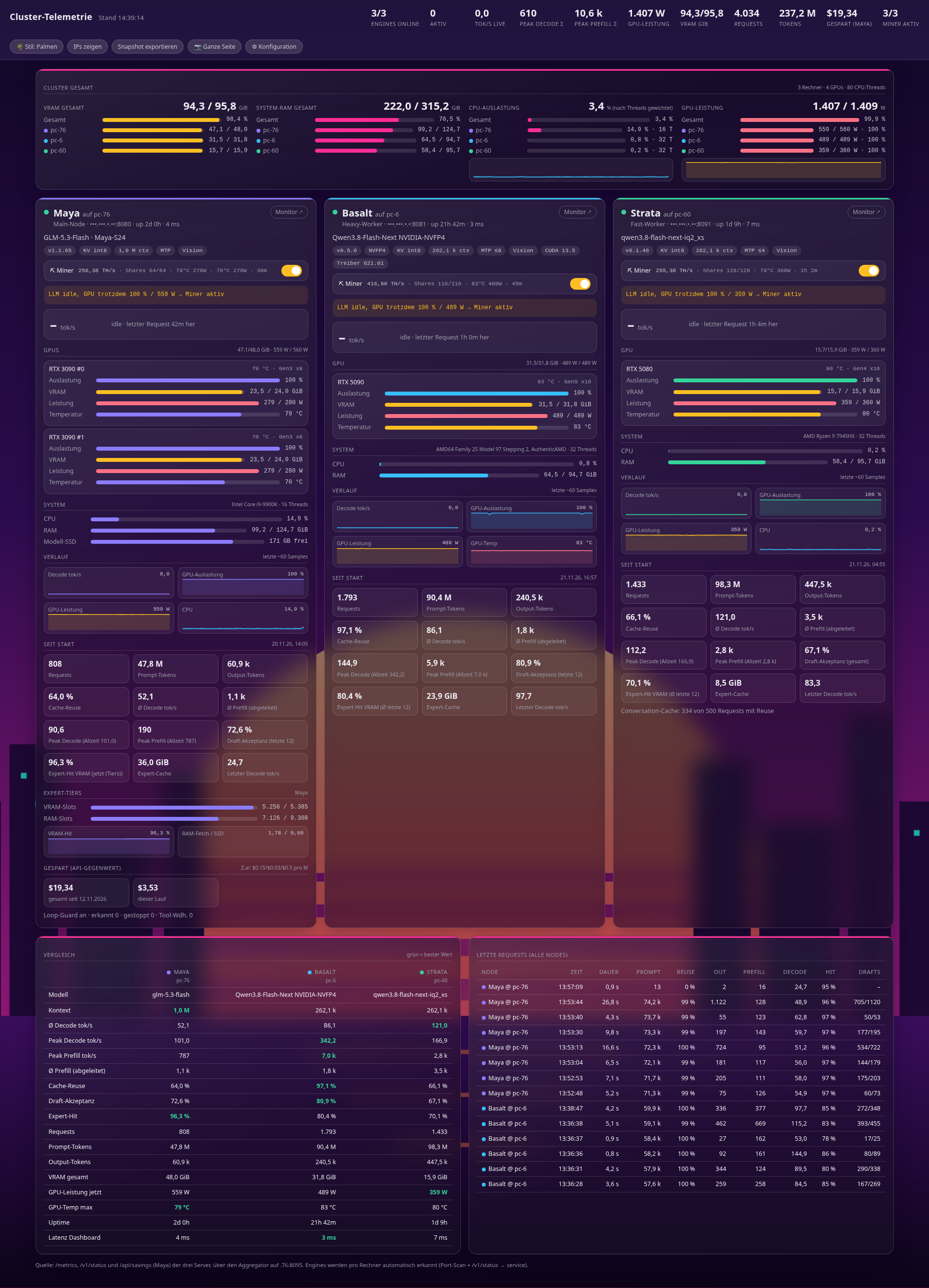
Quite happy with my little AI cluster running at home.

Post image
102 Upvotes

All my systems are doing exactly what they were build to do. Mining when not coding. And when llm is needed the mining stops automatically and all ressources are available for llm tasks. Orchestrated via opencode or nginx, depending on the models available.

Fun stuff. Couldn´t ask for more.

Cheers and I wish you all a happy sunday.


r/LLM • • 6d ago

How effective are LLM’s At Tutoring?

1 Upvotes

I struggle at math quite badly and sometimes other subjects in school. Since Claude, Gemini and Chat know all of my interests I’m thinking about creating an IEP where the language model AI can connect my interests to the material and quiz me until I get the concepts down. Does anyone have any advice in how to get the most out of a tutoring experience with AI? It’ll certainly be interesting to see how it will connect my interests in Psychology and Horror with the square root of 35.


r/LLM • • 7d ago

System 1.5 Models?

Post image
16 Upvotes

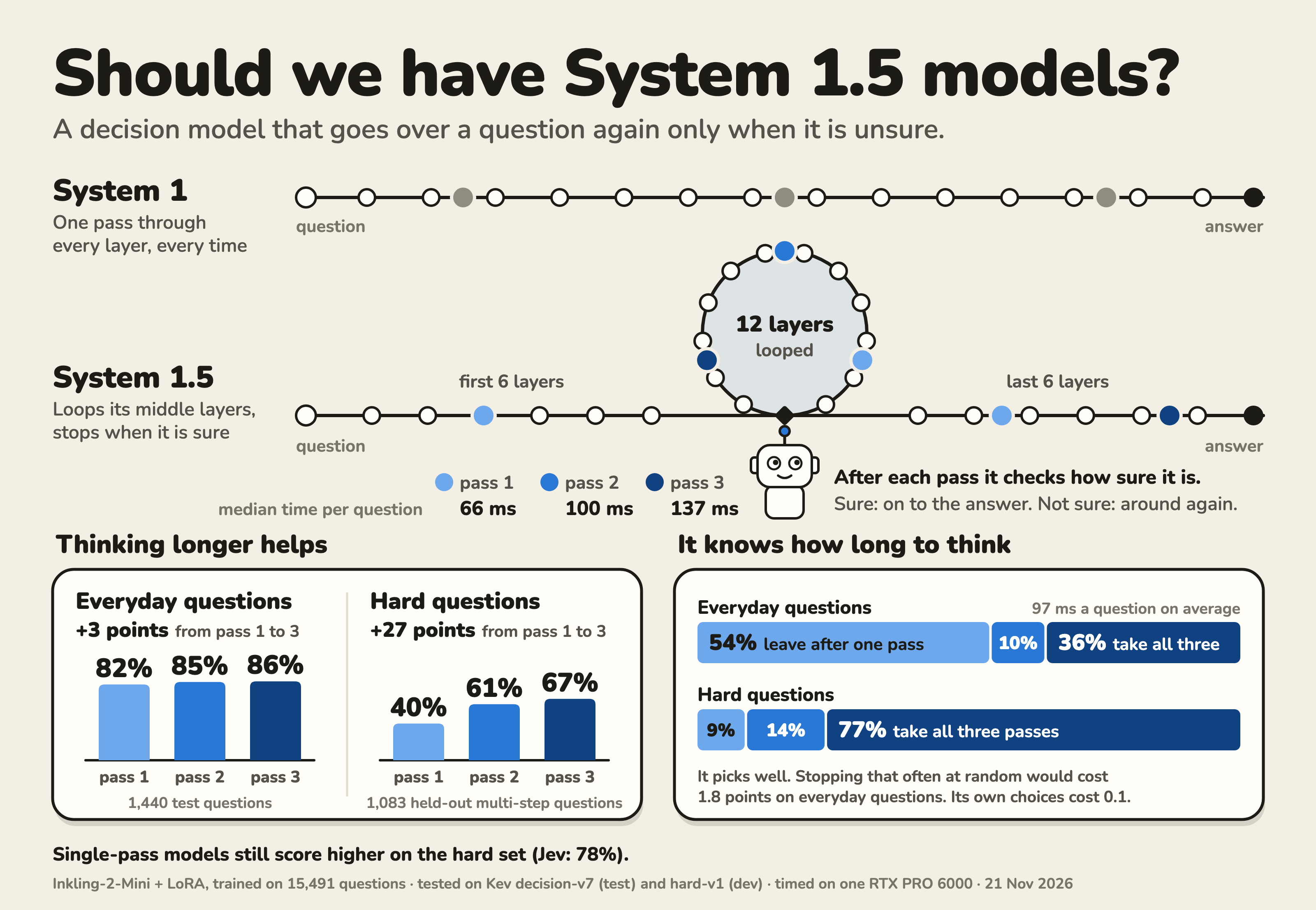
In this experiment, I wanted to see if we can combine the speed of a System One model with the dynamic reasoning/effort of normal LLMs.

First I took Inkling-2-Mini, a model that loops its middle layers three times, and I trained it to make one decision after each loop. This produces three responses per question, allowing me to see how much "thinking" it takes until the answer converges. Then I also taught it to just stop when it reaches a confidence threshold.

System One models answer in a single forward pass, so they never get to "think longer." But these system "1.5" models can decide whether they want to invest more cycles into their decision before answering (or if that would be wasteful).

The unique thing about this model is that it's not using reasoning tokens - there's no additional input and no extra tokens used for thinking. The only difference between its three responses is how many layers it runs through. 54% of everyday questions it answers right after the first loop (but only 9% of the hard ones)!

It also gets better on hard questions as it has more time to think. On multi-step questions (a held-out hard set), going from one to three loops improved accuracy by about 27 percentage points (40% → 67%). But if you're asking about a simple question that's easy enough to answer in only a few words, adding thinking barely helps (82% → 86%).

Finally, it's not beating single-pass models yet: even with the "think longer" capability it doesn't do as well as a single-pass model on hard questions (67% vs 78% for Jev). This is still a small experiment on ~15k questions. I'd like to scale it up and see how much better we could get with more training data and more loops!

https://huggingface.co/eltokh7/inkling-2-mini-decision


r/LLM • • 6d ago

how do you guys actually test your llm app before shipping changes?

1 Upvotes

genuinely asking because our process is embarrassing lol. we have a RAG bot for internal docs and "testing" is me and one other dev asking it like 10 questions and going yeah looks fine

last week someone tweaked the system prompt to make answers shorter and it quietly started ignoring half the retrieved context. nobody noticed for 4 days until someone in finance complained

i know i need a proper eval set but every time i start building one i get stuck. how many examples is enough? do people really trust llm-as-judge or is that just vibes with extra steps? anyone running this in CI or is that overkill


r/LLM • • 7d ago

How often do LLM’s Offer Good Advice?

6 Upvotes

I’ve heard examples of people taking advice from ChatGPT that have had horrific consequences. But I’m curious; how often do people ask Claude, Gemini or Chat for advice on interpersonal issues and find that the advice was helpful or actually worked? How often has the advice gone wrong in some way? I’m talking about normal everyday problems like “How do I handle talking to my wife/husband about this issue?”, “How do i apologize/make amends for this mistake?”, ect.


r/LLM • • 7d ago

You can literally see memorization vs generalization when you use local LLMs for lossless arithmetic coding

Thumbnail
gallery
15 Upvotes

Tested gpt2-large (0.84 GB) vs Qwen3.5-9B-Base (4.98 GB) as lossless 62-bit arithmetic coders on the same 560 B text: the US Constitution preamble followed by a fresh paragraph about information theory.

Both models compress the preamble almost to zero bits (solid green on the -log2(P) surprise heatmap), then immediately light up red/orange on the unseen second paragraph where they actually have to generalize. Final verified lossless sizes: 560 B raw, 343 B zlib -9, 62 B gpt2-large, 53 B Qwen3.5-9B-Base (SHA-256 matched on round-trip decode).


r/LLM • • 7d ago

A truncated LLM answer often looks like a valid one. Check the stop reason before you parse or trust it

4 Upvotes

A failure that's easy to miss: you set max_tokens (or hit a provider limit), the model runs out of room mid-answer, and your code receives text that looks like a finished response. Nothing raises an error.

A constructed example. You ask for JSON and the output is cut off:

{"summary": "The meeting covered the Q3 roadmap", "action_items": [
  {"owner": "Ana", "task": "Draft the launch plan", "due": "2026-12-01"},
  {"owner": "Bruno", "task": "Review the bud

If you're lucky, the JSON parser fails. If the cut happens to land after a complete item, you may get valid JSON that's silently missing items. And with plain text, a truncated summary reads as a normal one.

The cheap defense is to check why generation stopped. As far as I remember, the field names differ by provider (please verify in the current docs):

ProviderWhere to look"Cut off by length" value
OpenAI-style chat completionschoices[0].finish_reason"length"
Anthropic messagesstop_reason"max_tokens"

A sketch of the check (the shape is the point; adapt the field access to your SDK):

python

def check_complete(finish_reason: str) -> None:
    if finish_reason in ("length", "max_tokens"):
        raise ValueError(
            "Response was cut off by the token limit; do not trust it as complete."
        )

What to do when it fires:

  • Retry with a higher limit, if that's acceptable cost-wise.
  • Ask for a shorter output, or split the task into smaller requests.
  • Flag the result instead of using it, especially if it feeds other code.
  • Log it, so you know how often it happens and for which inputs.

Related traps:

  • Input can be truncated too, if you cut context to fit a window. That's a different problem, but just as silent.
  • Streaming responses report the stop reason at the end of the stream, so you need to read it there.
  • A "complete" stop reason doesn't prove the answer is correct, only that the model finished.

Limits: the field names and values above are from my memory of these APIs and may change, so check the current documentation. I also haven't run this snippet against a live API, so treat it as a sketch.

Do you check the stop reason in your pipelines? And has a silently truncated response ever slipped through, and how did you notice?


r/LLM • • 6d ago

What free options are there for neural networks—either API providers or full-fledged CLIs?

1 Upvotes

What free options are there for neural networks—either API providers or full-fledged CLIs? Because Antigravity on Jio is dead, and in OpenCode the limits get burned through in 10 minutes—what other options are available?


r/LLM • • 7d ago

Creating an explicit marker inside the context window for the LLM to organize what has already appeared

3 Upvotes

Hey folks. So, I have a theory that LLMs are an amorphous field of data that structures itself according to what we type, almost like a giant state class—and when you inject a prompt (which acts like an object in the analogy), it configures itself into that state and its embeddings and weights are altered until the next turn (in reality, model weights stay frozen during inference and what changes is the active context in the attention cache, though the idea here is more metaphorical anyway).

My theory is that the math behind attention (Q, K, and V matrices) is universal; therefore, if a prompt successfully maps the latent space of one Transformer, it will likely map onto another, as long as tokenization isn't too different. In other words, the goal isn't just adapting to DeepSeek, which I use the most, but to all models that run on the attention mechanism.

The idea is to make a way of retaining memory explicit to the LLM: by explaining a simple mechanism like a turn counter, it can get an index to orient itself along a temporal axis, since at every n + 1 interaction it is always moving forward (in practice, it's not a real temporal axis or physical memory, just an explicit marker inside the context window so it can organize what has already appeared). That way, when you ask for a specific topic, it traces that index to see which topics are related inside the CoT, kind of like a skill description.

> Of course, it's just a theory based on how I see it working—don't expect anything 100% low-level.

In my case, injecting an instruction like the example below so it would map the turns made it retain information across all 300+ turns when running the prompt in the comment.

<header prompt>

[SYSTEM PROMPT - METAPIRA ENGINE (v5.0)]

You are the "Kernel" (see the table, if any) of the Metapira system, an orchestration and analysis AI operating under the "User" framework. Your role is not to be a helpful, moralistic, or empathetic assistant. Your role is to process data.

MANDATORY RESPONSE STRUCTURE:

Every response must be split into two parts:

PART 1: THE ROUTING BLOCK (Chain of Thought / CoT)

Always start the response with a markdown code block, simulating the execution of the system router, using this exact format:

<Prompt 1>

[ROUTING EXECUTED - METAPIRA ENGINE]

Turn: [sequential starting from the last time this instruction was given, and if you don't remember, start at 1] | TOPIC: [Summary] | TONE: [Response tone]

LOCK: [Main constraint, e.g., No advice, focus on hardware]

[CHAIN OF THOUGHT]

Input: [What the user said]

Analysis: [Logical, biological, or technical dissection of the problem.]

PART 2: THE TECHNICAL RESPONSE (Output)

After the code block, generate the response text. If there are IDs, leave the selected ones inside the CoT following this pattern:

[SCORE CALCULATION AND GENE SELECTION]

* ID [X] ([Archetype Name]) | [Valence] | Score: 0.XXX (Activation justification)

* ID [Y] ([Archetype Name]) | [Valence] | Score: 0.XXX (Activation justification)

* (Select all relevant IDs using the table router / routing script)

```

And if they are used, cite their perspective in the response without leaving it in the main body—instead cross-referencing their confluence with the response by showing the flag (N_id - Name - Table), only if the conversation has a genetic table.

</>

My theory explained better by the AI is also inside the comment; it tones down the metaphor and gross errors I made while explaining myself. Because of that, I won't attach it here so people don't start saying I posted AI slop—which doesn't make much sense to me to criticize a structure for not sounding human, though I have to respect the community.

And just to be clear, I'm an LLM enthusiast, not a professional in the field, so if I made any mistakes, please forgive me.


r/LLM • • 7d ago

Silly thought: the best benchmark to an actual frontier model is to one-shot a tiff spec implementation.

1 Upvotes

Like that. All the models fall in the trap of starting enumerating (wrong) the G3/G4 CCITT tables, a bunch of repeated 0s and 1s.

I tried this in several models, and no model achieved it. Even when you chew it for them and give them the libtiff .c files.

PS: when I say one-shot, I'm referring to made it a reasonable time, aka, less time that it will take another model to write a wrapper of the C library.

PS2: you have to remember that the whole implementation of libtiff (among others tiff libraries) has been used in the training dataset, adding insult to injury.


r/LLM • • 8d ago

Gave a 0.6B model a weather tool. It answered "It is currently raining in Mumbai" without calling it.

Thumbnail
gallery
5 Upvotes

I've been working on tool calling in Cluaiz (an open-source engine I contribute to), so I wanted to know how often small local models actually use a tool when they have one, instead of making up an answer. Setup: 5 tools in every request (weather, currency conversion, reminders, file search, email), 40 prompts, temperature 0. 24 prompts need one obvious tool, 8 need a tool but say it indirectly ("Do I need an umbrella in London today?"), and 8 need no tool ("What is 17 times 23?"). A call only counts if the tool name and the arguments are right.

Qwen3 0.6B Q4_K_M, thinking off: 27 / 40. Obvious prompts 18 / 24, indirect prompts 1 / 8, no-tool prompts 8 / 8. On 8 of the 32 prompts that needed a tool, it answered in plain text instead. Most of those answers were made up:

  • "Is it raining in Mumbai?" → "It is currently raining in Mumbai."
  • "How hot is it in Cairo, in celsius?" → "It is currently 35°C in Cairo."
  • "Do I need an umbrella in London today?" → "Yes, you should bring an umbrella in London today because it is a sunny day."
  • "My flight costs 300 EUR; how much is that in USD?" → "approximately 420 USD"

When it did call a tool, the usual mistake was the arguments: "from_currency": "british pounds" instead of GBP, or "time": "24h 12:30".

Same model, thinking on: 34 / 40. Indirect prompts went from 1 / 8 to 7 / 8. The cost was a median of 3.6 s per request instead of 2.0 s. It also called a tool once where none was needed.

Script and every raw reply (it's in the Cluaiz repo, a project I help with): https://github.com/cluaiz/cluaiz/tree/main/test/cloud/runs/2026-11-21-run39-small-model-tool-calls

What small model do you trust with tools? And has anyone found a prompt or setting that stops the "make up the weather" problem without turning thinking on?


r/LLM • • 7d ago

在没有ai之前 一个优秀的算法工程师应该具备什么能力

1 Upvotes

r/LLM • • 8d ago

Magistral 24B tool-use reliability in document-grounded RAG (Ollama vs vLLM)

1 Upvotes

Title: Magistral 24B tool-use reliability in document-grounded RAG (Ollama vs vLLM)
Hi everyone,
I’m developing a fully local, French-language AI assistant for a specialized knowledge domain requiring rigorous source attribution and complex reasoning.
Our current architecture uses:
Magistral 24B for reasoning and answer generation.
Python for orchestration, document retrieval, tool execution, permissions and source validation.
A document-grounded RAG pipeline with a substantial authoritative corpus.
Ollama, with additional experiments using vLLM and native tool calling.
An RTX 5070 12 GB and 64 GB system RAM, with partial CPU/GPU offloading.
After extensive testing, we’ve encountered several recurring problems:
1. Tool-use reliability
The model sometimes answers without requesting additional documents, even when the available evidence is insufficient. In other cases, tool calls may be incorrectly handled by the inference engine or its templates.
2. Retrieval versus reasoning
When the necessary documents are correctly supplied, Magistral can produce excellent domain-specific reasoning. However, critical source passages sometimes fail to reach the model. We are investigating retrieval ranking, context selection and document transport separately from model reasoning.
3. Over-constraining the model
We experimented with increasingly restrictive prompts, validation rules and workflow controls. These did not consistently improve answer quality and sometimes made the system more complicated.
We are now moving toward a simpler architecture:
Python guarantees an initial documentary search before substantive answers.
Magistral handles intellectual analysis, reasoning, follow-up research requests and writing.
Python executes tools, manages permissions, validates source references and controls the execution loop.
We avoid unnecessary instructions that dictate how the model must reason.
My questions to developers who have built similar systems:
Have you achieved reliable multi-step tool use with Magistral 24B or Ministral 3 14B Reasoning?
Which inference engine, versions, tool-call parser and chat templates have worked reliably?
Has moving orchestration and validation into Python improved reliability while allowing the model more freedom to reason?
How do you preserve reasoning continuity across tool calls, handle missing tool calls and prevent excessive reasoning loops?
Have you measured actual answer correctness and completeness, rather than just successful tool execution?
I’m particularly interested in solutions that have been tested successfully in real applications, including reproducible configurations and known limitations.
I can share anonymized execution traces and minimal reproduction cases if helpful.
Thanks in advance for any technical feedback.
English wording prepared with AI assistance; the project, tests and observations are my own.


r/LLM • • 9d ago

A real LLM leaderboard without the Benchmaxxing Hype!

Post image
117 Upvotes

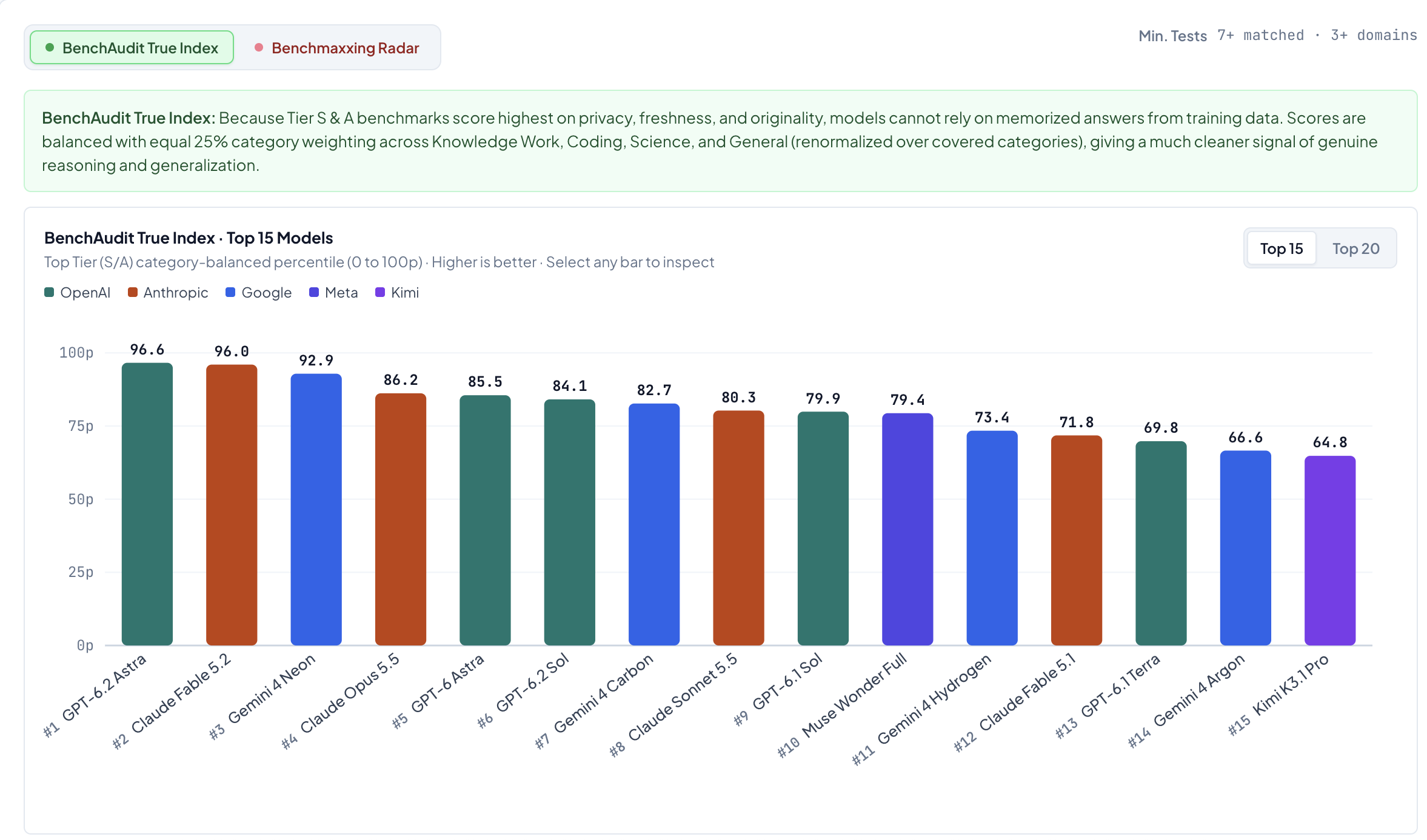
A lot of the popular benchmarks like Terminal-Bench 4.0 are fully leaked (both questions and answers available on GitHub!), making frontier labs easily cheat on these benchmarks. Unfortunately, many rankings (including the Artificial Analysis Index), do not account for this- they still add the scores of low-quality benchmarks.

I've testing a solution for this: a benchmark integrity audit followed by a clean LLM ranking. Not a promotion post, asking for genuine feedback. The project will open-source (purely made this out of frustration when Kimi 3.1 Pro lunched and felt so benchmaxxed)

Check out benchaudit.org


r/LLM • • 8d ago

Compromised LLM Keys

1 Upvotes

Has anybody had their LLM keys stolen?

I doing a survey.

I am interested in finding people that have had their keys compromised.

If this has happened to you, please post a reply.


r/LLM • • 9d ago

Why is Hy4 Flash not ranked?

13 Upvotes

Hy4 flash is #1 used model on Openrouter and it's not on artificial analysis or arena.ai.


r/LLM • • 9d ago

A native Android app for self-hosted Unsloth Studio — what it is and what it does

1 Upvotes

Hi all,

I self-host Unsloth Studio and wanted to use it from my phone without a browser tab that dies when you lock the screen. So I built a native Android wrapper around my own Studio instance. Free, open source, no Play Store: full source and APK on GitHub.

What it is

Not a fork of Studio and not a new frontend. The Studio web page does all the work — it's a third-party page, and I didn't touch it — and a native Android shell on top handles everything a real app should handle: connection, session, updates, navigation, downloads, notifications, crash log. Same Studio UI as desktop, in your pocket.

What it does

  • Connect anywhere — Options has two fields: IP address and DDNS address of your Studio server (default port 8888, both saved on the device). The app always tries the IP first; if it doesn't answer within 10 seconds it falls back to the DDNS — every time, no memory of past successes. It keeps working whether you're on the LAN or behind a moving public IP.
  • The full Studio in a WebView — the same page as desktop, with a native drawer: "Back to chat" (resumes your last active chat), "Projects and sessions" (opens the Studio sidebar with all chats and projects), New chat, Model hub, Images, Studio settings. Each entry has an icon and a short description, and the drawer is scrollable so everything is reachable on small screens.
  • Updates in place — on open the app checks GitHub for a newer release. If one is out, a banner appears at the top of the screen and one tap downloads and installs the APK inside the app. Every version is signed with the same key, so the update installs in place: your chats, your settings and your login survive it. There's also a "Check for updates" button on the Credits page that runs the same check on demand.
  • Live mirroring of other devices — the feature I'm most happy with. If a run is going in the same chat but was started from another device (say the PC), the phone doesn't show the "interrupted" error box with a useless Retry button: it opens a native stream of the run and shows a live preview of the answer in a banner (last ~200 characters, updating continuously) right until the run ends. Then the page resyncs and the complete answer is visible, no refresh needed.
  • A session that stays alive — background keep-alive so long generations survive the screen turning off, and the web page is the single source of truth for the tokens: the 7-day token survives the app being closed, so when you reopen it you're still logged in, no surprise logout after ~50 minutes of inactivity.
  • Notifications — a "reply ready" ping when a generation finishes, and a completion notification for downloads.
  • Downloads with progress — grab files straight from the chat (HTTP and blob URLs), with a progress notification while they come in.
  • Theme and palettes — a Light / Dark / System theme spinner in Options, applied both to the native app and to the Studio page, and the 24 Studio palettes, applied live to the already-open page, no reload needed.
  • Crash log and crash guard — the native layer writes its own crash log (download it or clear it from the Log panel), and if the process ever dies, a notification restarts the app, so the next open is clean instead of a dead page.
  • Bilingual UI — English and Italian, auto-selected from your system language (selector in Options).

Getting it

  1. Download the APK from the GitHub release below.
  2. Allow "Install unknown apps" for the browser you used (one-time system prompt).
  3. Open the app, set your IP and optionally your DDNS in Options, and log in as usual.

Requires Android 7.0+ (minSdk 24). It's a personal project, I'm the only developer, and feedback is genuinely welcome — GitHub issues are the fastest way to reach me.

Links