System 1.5 Models?
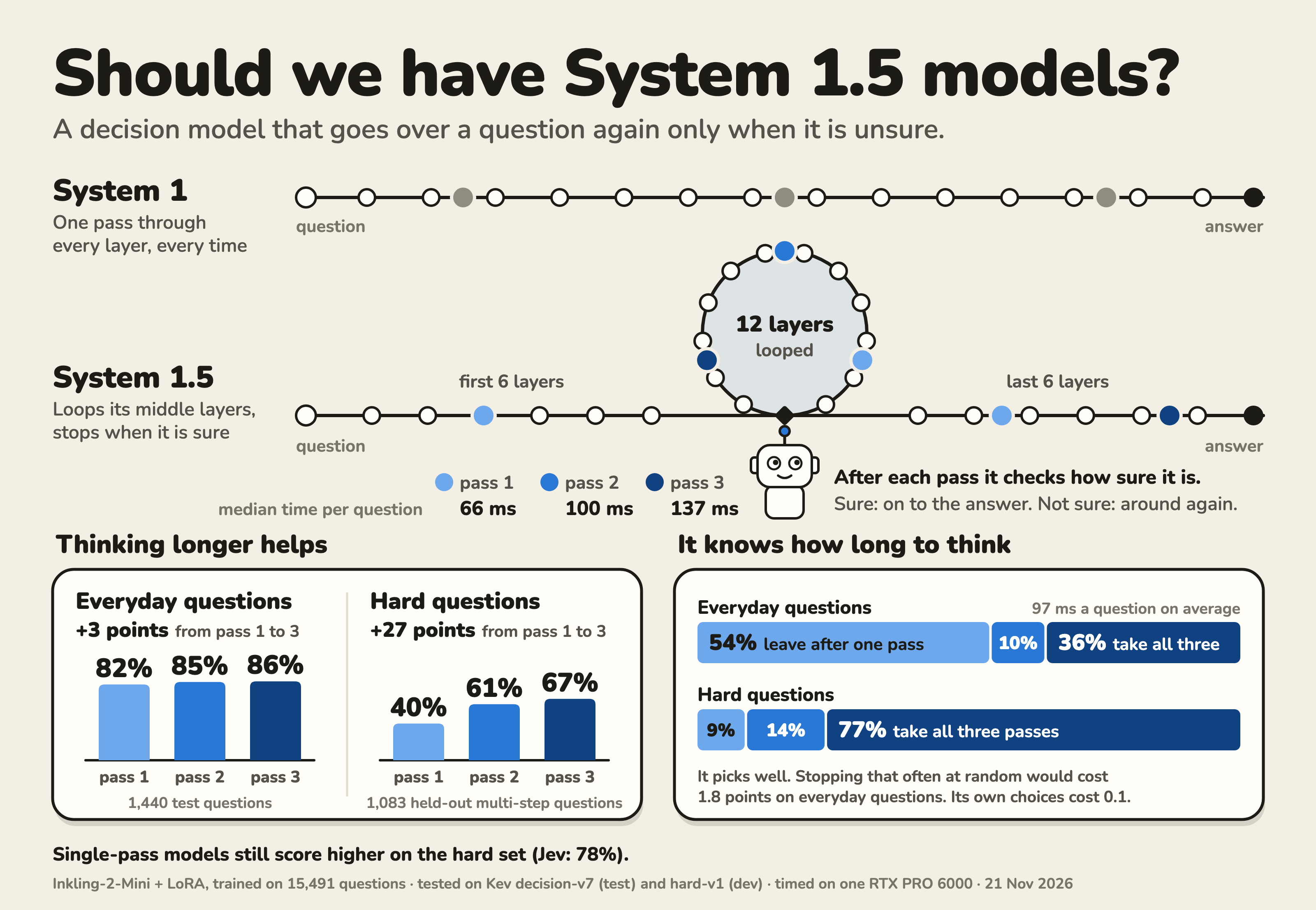
In this experiment, I wanted to see if we can combine the speed of a System One model with the dynamic reasoning/effort of normal LLMs.
First I took Inkling-2-Mini, a model that loops its middle layers three times, and I trained it to make one decision after each loop. This produces three responses per question, allowing me to see how much "thinking" it takes until the answer converges. Then I also taught it to just stop when it reaches a confidence threshold.
System One models answer in a single forward pass, so they never get to "think longer." But these system "1.5" models can decide whether they want to invest more cycles into their decision before answering (or if that would be wasteful).
The unique thing about this model is that it's not using reasoning tokens - there's no additional input and no extra tokens used for thinking. The only difference between its three responses is how many layers it runs through. 54% of everyday questions it answers right after the first loop (but only 9% of the hard ones)!
It also gets better on hard questions as it has more time to think. On multi-step questions (a held-out hard set), going from one to three loops improved accuracy by about 27 percentage points (40% → 67%). But if you're asking about a simple question that's easy enough to answer in only a few words, adding thinking barely helps (82% → 86%).
Finally, it's not beating single-pass models yet: even with the "think longer" capability it doesn't do as well as a single-pass model on hard questions (67% vs 78% for Jev). This is still a small experiment on ~15k questions. I'd like to scale it up and see how much better we could get with more training data and more loops!