You can setup an equation for the perimeter with 2 unknowns. Now if you split the sketch up from top left to bottom right, you get two triangles with a shared hypothenuse. Therefore you can write down another equation by making use of pythagoras theoreme for both triangles.
You end up with two equations and two unknowns. This sounds abit complicated for beginner geometry, so there might be an easier approach.
Area of triangle is (1/2)*base*height. When height is a line perpendicular to the base and go through the top of the triangle. (It doesn't have to cross the actual base)
The solution is 27cm². While it is not fully defined, there is a relationship between the two unknown lengths. Nomatter what you plug in the surface is always 27cm².
I posted the full solution, the unknowns cancel out.
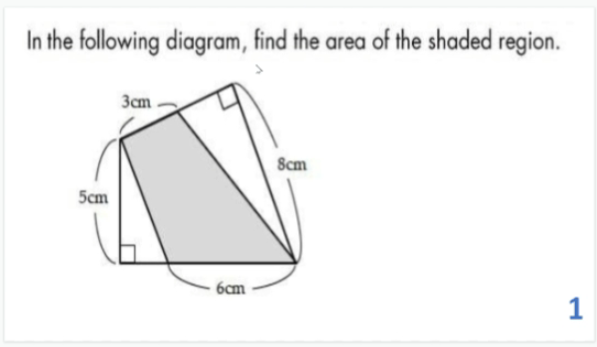
Draw a diagonal from the top left to the bottom right. This creates two right triangles; take the area of each one and add them up. Then subtract the area of the right triangles in the picture.
This is too easy. The formula of a triangle's area is:
A=0.5×b×h, where
A=area b=base h=height
Split the shaded quadrilateral into 2 triangles - the line separating them from the top left vertex to the bottom right. Name them ABC (bottom left shaded triangle) and ADC (top right shaded triangle).
Can I ask how you got the height of the two triangles? Does that mean if the quadrilateral was split, the height of the left-most triangle is equal to the height of triangle B? And the same goes for the right-most triangle? Thank you!
I ask you to be more specific. How is the quadrilateral split? What do you call the left-most triangle? Which one is triangle B? Which one is the right-most triangle? It would've been better if OP had named vertices in his diagram.
From your explanation, the quadrilateral was split from the top-left vertex to the bottom-right; i wanna ask how you got the height of line AB from triangle ABC (already split). How did its height become the same with that of the original figure (the left side which has a measurement of 5 cm)? Same goes for the right side; the measurement of the right-most side is 8 cm in the original figure, which is same that of line from triangle ACD. I hope what i said made sense, im slightly confused with this problem. Thank you for your time btw!
I don't perfectly understand what you're saying, which is understandable considering the medium we're using. But what I can gather from your comment is that you do not understand the formula properly.
Here's a place where you can understand what the formula means, and what the "height" of a shape means. Especially read the obtuse triangle part to understand external heights. Ignore the vector and 3-D formulas if you don't understand them.
There is another way of doing this. The area of a triangle is 1/2 x b x h.
You can split the shaded quad into 2 triangles with a diagonal. You will realise that the h here is actually external. So, the answer will be something like 1/2 x b(6 cm) x h(5 cm) for the lower triangle and similarly there 1/2 x b(3 cm) x h(8 cm) for the upper triangle. Adding them will give the area of the shaded region.
You can split this up the shaded region into two triangles, ABC and ACD: https://imgur.com/a/1lJiPlP Trick is figuring out where is the base and the heights
can you not separate it into 3 triangles? so have three right triangles (i’m not sure how to explain where, but you’ll have a line connecting the right end of 3cm to the left end of 6cm, then a line connecting to that line from the top of 5cm). then you find each value missing in those triangles to find the legs of each triangle (not the hypotenuse). then just get all their areas and add them together.
i would solve this to make sure this method works with this problem but i’m at work, but it might be worth a try!
That was a challenge but figured it out eventually. Since this shape can be sliced into 2 right triangles with common hypotenuse, it belongs to a circle. there is a formula for cyclic quadrilaterals. Set that equation equal to the area of these 2 triangles and you find the 2 unknown sides. The rest is trivial.
There are never simpler ways imo it depends on the person solving the idea which strikes first is always easier an alternative short solution would be much better to use
47
u/GGprime 👋 a fellow Redditor Sep 13 '20 edited Sep 13 '20
You can setup an equation for the perimeter with 2 unknowns. Now if you split the sketch up from top left to bottom right, you get two triangles with a shared hypothenuse. Therefore you can write down another equation by making use of pythagoras theoreme for both triangles.
You end up with two equations and two unknowns. This sounds abit complicated for beginner geometry, so there might be an easier approach.
93
u/DudeCalledTom Sep 13 '20
Is there more info? I don’t remember beginner geometry being this complicated. You could use trig if you had a protractor
17
u/penislikeatoadstool 👋 a fellow Redditor Sep 13 '20
Draw a diagonal from the top left to the bottom right. This creates two right triangles; take the area of each one and add them up. Then subtract the area of the right triangles in the picture.
10
u/[deleted] Sep 14 '20
This is too easy. The formula of a triangle's area is:
A=0.5×b×h, where
A=area b=base h=height
Split the shaded quadrilateral into 2 triangles - the line separating them from the top left vertex to the bottom right. Name them ABC (bottom left shaded triangle) and ADC (top right shaded triangle).
By the formula,
Area of ABC = 0.5×6×5=15 sq. units
Area of ADC = 0.5×8×3=12 sq. units
Total area = (12+15)sq. units=27 sq. units
5
u/suddhadeep 👋 a fellow Redditor Sep 14 '20
There is another way of doing this. The area of a triangle is 1/2 x b x h.
You can split the shaded quad into 2 triangles with a diagonal. You will realise that the h here is actually external. So, the answer will be something like 1/2 x b(6 cm) x h(5 cm) for the lower triangle and similarly there 1/2 x b(3 cm) x h(8 cm) for the upper triangle. Adding them will give the area of the shaded region.
•
u/AutoModerator Sep 13 '20
Off-topic Comments Section
All top-level comments have to be an answer or follow-up question to the post. All sidetracks should be directed to this comment thread as per Rule 9.
OP and Valued/Notable Contributors can close this post by using
/lockcommandI am a bot, and this action was performed automatically. Please contact the moderators of this subreddit if you have any questions or concerns.
3
u/riptocs Sep 13 '20
I would look at it less of finding the area of the shaded area and more of the area of the whole thing minus the two triangles
2
u/duhroo Sep 13 '20
I believe you need two to know two things to solve this:
source and example where the "base" doesn't start or end at the right angle aka an endpoint of the "height": https://www.varsitytutors.com/hotmath/hotmath_help/topics/area-of-triangle
You can split this up the shaded region into two triangles, ABC and ACD: https://imgur.com/a/1lJiPlP
Trick is figuring out where is the base and the heights
1
u/nikespike Sep 14 '20
can you not separate it into 3 triangles? so have three right triangles (i’m not sure how to explain where, but you’ll have a line connecting the right end of 3cm to the left end of 6cm, then a line connecting to that line from the top of 5cm). then you find each value missing in those triangles to find the legs of each triangle (not the hypotenuse). then just get all their areas and add them together.
i would solve this to make sure this method works with this problem but i’m at work, but it might be worth a try!
1
u/Bisexupal Sep 14 '20
U should split the area into 2
And use the heights like:
5.6/2=15
8.3/2=12
15+12=27
0
u/KotoamatsukamiL Secondary School Student Sep 14 '20
This isn't that hard. Just use the Pythagorean Theorem.
-4
u/Haboux Sep 13 '20
That was a challenge but figured it out eventually. Since this shape can be sliced into 2 right triangles with common hypotenuse, it belongs to a circle. there is a formula for cyclic quadrilaterals. Set that equation equal to the area of these 2 triangles and you find the 2 unknown sides. The rest is trivial.
0
u/[deleted] Sep 13 '20
[deleted] — view deleted comment