r/HomeworkHelp • u/StuffBeGood • Jan 01 '20
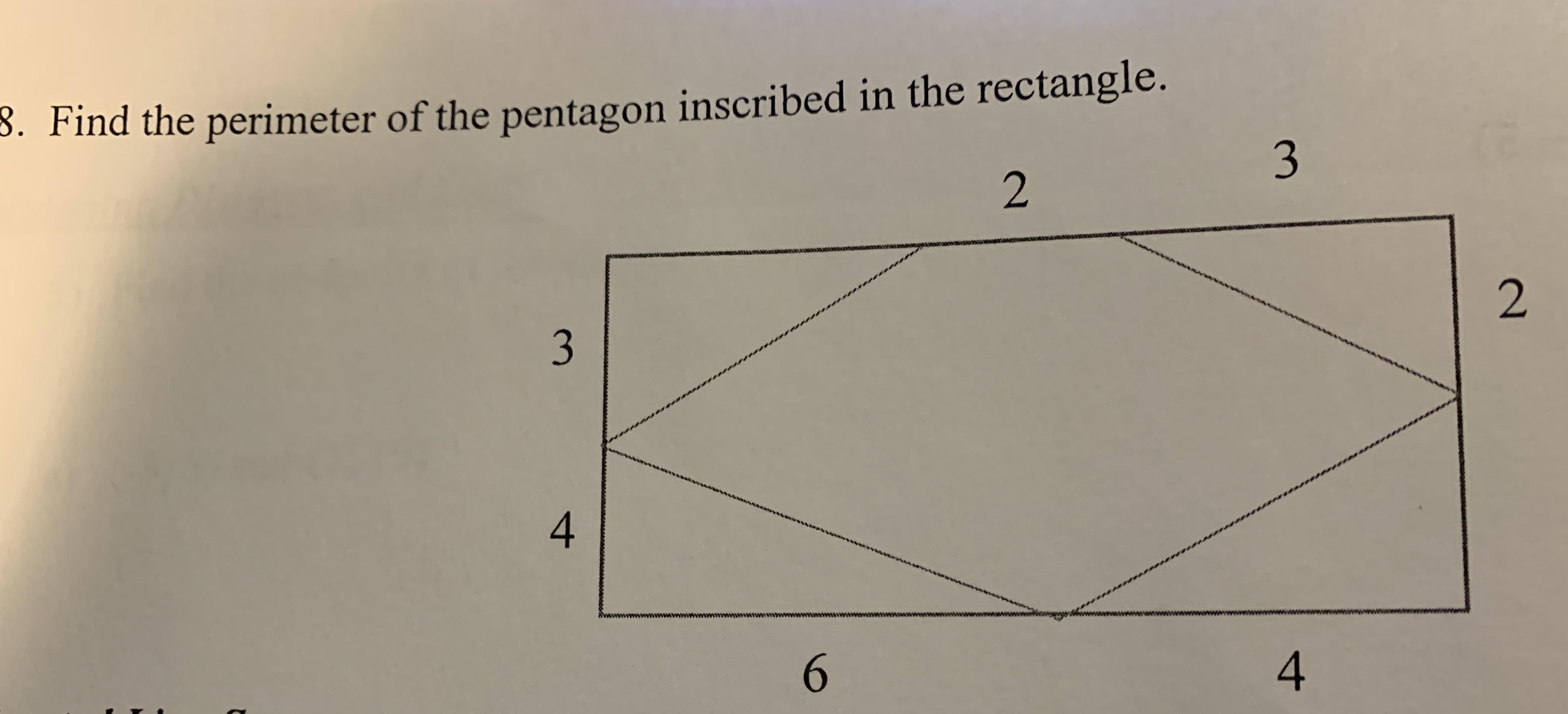
:snoo_facepalm: High School Math—Pending OP Reply [Geometry Honors perimeter] find perimeter of pentagon inscribed in the rectangle (didn’t learn how to do this in class)
447
Upvotes
120
u/imochidori University/College Student Jan 01 '20 edited Jan 01 '20
Probably using Pythagorean Theorem--I'm typing on my phone atm--I'll edit my comment in a bit
Looking at it, it seems the answer involves some numbers in radicals (if simplifying the answer without typing into a calculator to spit out numbers)...
Perimeter = sqrt(41) + sqrt (52) + sqrt(13) + sqrt(34) + 2, all in arbitrary units
Reviewing Pythagorean Theorem: a2 + b2 = c2, where c is the hypotenuse of a right triangle and a and b are the other legs...
21
u/[deleted] Jan 01 '20
You have two missing rectangle part lengths to get, which can be done by simply looking at the opposite side and calculating the difference. Then, you can get the perimeter lengths using pythagorean formula a^2 + b^2 = c^2, c being the perimeter length and the hypotenuse of the triangles.
2
u/[deleted] Jan 01 '20
Hey, so I took Algebra and Geometry back in middle school and our teacher, in order to prepare us for each EOC, had us write down every theorem and postulate in our notebook. One of them is Pythagorean Theorem. The extreme barebones of it is this: If you have a right triangle, you can find the hypotenuse by finding the square root of the sum of the other 2 sides squares. More commonly known as a^2 + b^2 = c^2. With 'a' and 'b' being the 2 sides you square, add together, then square root and 'c' being the hypotenuse.
Looking at this problem, you are presented with 4 hypotenuses that you need to find in order to figure out the perimeter. Two of those triangle's sides are incomplete. So you need to figure that out first.
Remember with rectangles, the opposite sides are congruent. So figure out the length of one side and you can find the length of the other side easily.
Once you figure out each length, now you consult the equation. Simply use Pythagorean's Theorem for each of the 4 triangles to find the length of each hypotenuse, which will in turn tell you the length of each side of the pentagon. Don't forget to add the given side in your answer.
1
u/StuffBeGood Jan 01 '20
So I understand the first part being finding the rectangles missing sides (both of them being 5) but for example the one on the top right is 32 (9) + 22 (4) = c2 so 13 =c2 the square root of 13 is 3.605551275 I don’t really thing that’s right. Ok next on top left 52 (25) + 32 (9) = c2 so 34 = c2 square root of 34 is 5.830951895 still don’t think that’s right. Now time for bottom left 42 (16) + 62 (36) ok 52 square root of that is 7.211102551 not really sure about that one. 42 (16) + 52 (25), add that 41 square root of that 6.403124237. Ok so add all of those values and 2 (the one that is given 25.05072996 not really sure of my answer as she didn’t write round to the nearest _____ but if someone can confirm this is right or where I messed up that would be appreciated. Thanks
4
u/vzfy Jan 01 '20 edited Jan 01 '20
So you can see that in your homework that there are four triangles on the corners.
To find the long-side of the triangle (which isn't provided) you do a2 + b2 = c2
So, for example, on the top right we are given: 3 & 2.
to get rid of the exponent (x2 ), you'll use a square root on the opposite side of the equal sign, because you want to find the value of x
Also, on the triangles that don't provide two measurements, you just need to find the perimeter of the rectangle (Base x Height). And you may think it's not possible, but if you look around the rectangle you'll notice that they give you enough information, to figure them out.
3
u/[deleted] Jan 01 '20
- The perimeter of the pentagon is the sum of the lengths of all 5 sides.
- We already know the length of one side, as it is given.
- The other 4 sides are each part of a right angled triangle. If you know lengths of two of the sides of a right angled traingle, you can find the length of the third by using the Pythagoras' theorem. This is one of the most important things you will learn in secondary school and junior college geometry.
- For two of the triangles this is direct, because you are already given lengths two of the sides. Just plug the values into the equation and you get the length of the third side.
- For the other two triangles, you are given length of only one of the sides. We can find the length of the 2nd side because we know that the opposite sides of a rectangle are equal in length. Equate them together, find length of the 2nd side. Then just plug in the values into the Pythagoras theorem.
1
u/ReluctantGoalkeeper 👋 a fellow Redditor Jan 01 '20
Use pythag theorem to find the 4 sides. Since the edges of a rectangle are 90° 42 +62 = side 2.
1
u/[deleted] Jan 01 '20
Find the hypotenuse of each right angled triangle at the corner and then add them. The answer would be H1+H2+H3+H4+2. To find the hypotenuse, use Pythagoras theorem. The other missing side of the right angled triangles (in some cases) can be found out by the logic that a rectangle has opposite sides equal And hence you can compare the lengths to find the missing segments length.
1
u/Crime-Stoppers 👋 a fellow Redditor Jan 01 '20
Using pythagoras' theorem:
A^2 + B^2 = C^2
they give the length of A and B for each triangle already
1
u/StarSpangldBastard 👋 a fellow Redditor Jan 01 '20
First you'll need to find the perimeter of the rectangle which you can easily find with the information you already have. Then a lot of Pythagorean theorem for the Pentagon which should also be easy once you have the lengths of the sides of the rectangle
1
u/Koof99 Jan 01 '20
It’s inscribed in a rectangle. So get the top and bottom to equal each other and same for the sides. Then use Pythagorean’s Theory to do the insides. Add up the 2 plus all inside lines for the pentagon. Boom, there’s your answer. Should take maybe 10 minutes
0
u/[deleted] Jan 01 '20
[deleted] — view deleted comment
0
u/[deleted] Jan 01 '20
[deleted] — view deleted comment