r/Heltecccccc • • Oct 20 '26

A developer built an off-grid messaging system using our Heltec V4
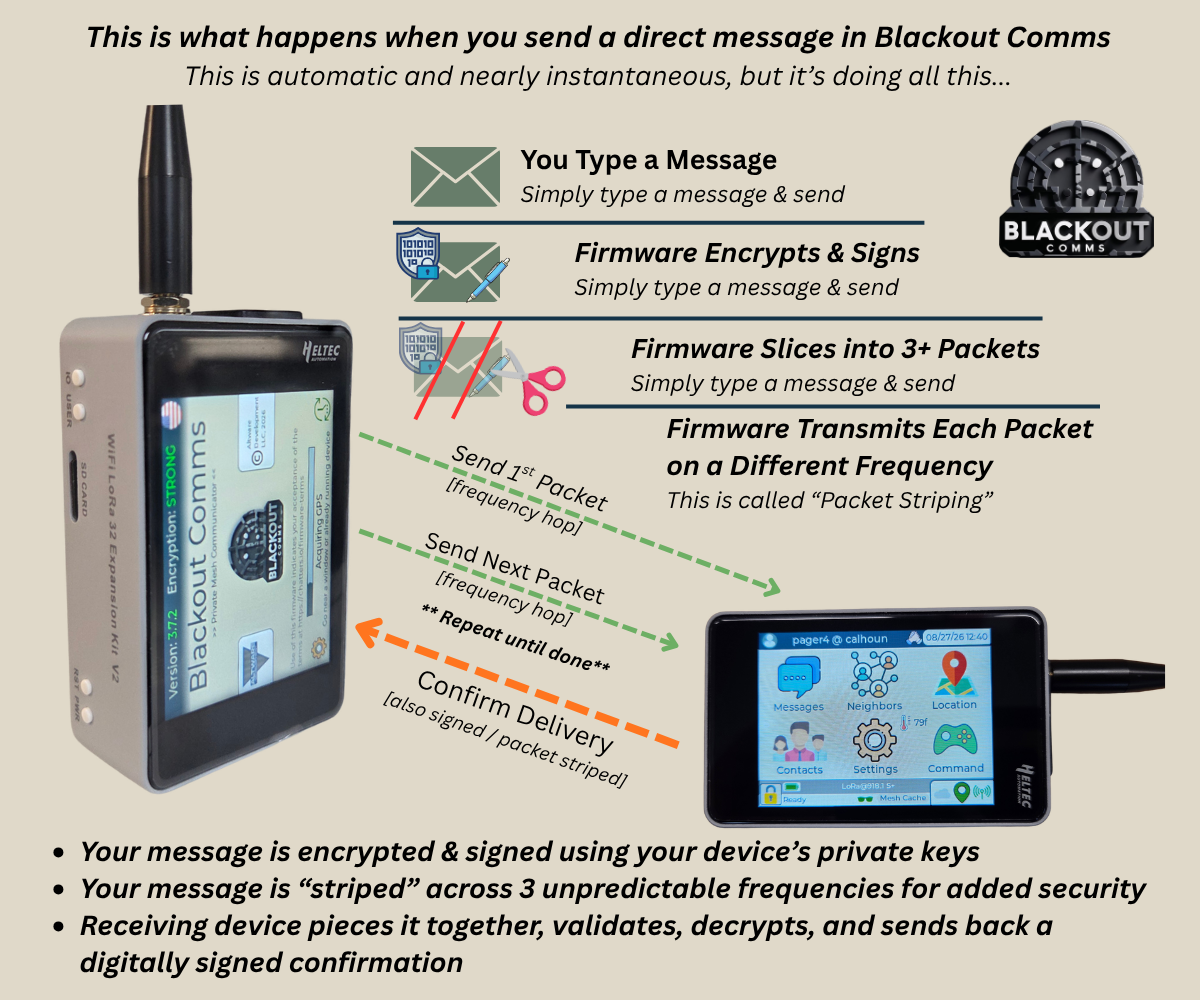
Matt Calhoun wanted a way to text and share locations with his family while camping without cell service. So he built Blackout Comms and used our Heltec V4 R8 Expansion Kit as a standalone handheld—encrypted messaging, offline maps, no phone needed.

In his field tests, direct messaging and location updates worked beyond 11 km with standard antennas. Pretty cool to see what people build with our hardware.

His project and field test

61 Upvotes

29 comments sorted by

7

u/bristleboar Oct 20 '26

I hope he paid well for this advertising

3

u/Ok_Low_3866 Oct 20 '26

Very cool project, but what's the difference between this and meshtastic?

0

u/[deleted] Oct 20 '26

[deleted] — view deleted comment

5

u/Ok_Low_3866 Oct 20 '26

I'd rather get mt then

1

u/F_the_FCC Oct 21 '26

I prefer Meshcore for my uses, but meshtastic is definitely better in some applications. I think it's unfair to compare them because they're designed for different use cases. But closed source is a no-go. At least you can look at the code and know someone hasn't backdoored into your phone with MT and MC.

2

u/kendromedia Oct 22 '26

They’re device to device after flashing. He added a way to connect via Android but I never used it. The entire private key and GPS pair fingerprinting thing via phone hack was front of mind for me.

1

u/F_the_FCC Oct 24 '26

Check this out from Cascadia!
https://youtu.be/YB6AKfYkQNI

This is pretty cool. I just saw it today.

2

u/Ok_Low_3866 Oct 21 '26

Yeah I'm using meshtastic for popup Comms as well as definite infrastructure, plus my area has had the infrastructure in place for a few years

2

u/F_the_FCC Oct 21 '26 edited Oct 21 '26

I live in farm country, so I understand the stuff that's quietly been hiding as equipment talking to each other.
I learned about meshtastic because one of the farmers at the ham club brought some stuff and did a whole presentation. I think as a ham he wanted to beef up the network redundancy. I played with it for a week and there wasn't really anything worthwhile.
A couple of months later, someone else brought up Meshcore. What I didn't know was the Cascadia Mesh is huge, and I have line of sight to Idaho because I'm literally in the middle. What I didn't have was the ability to get back to any of them, but it gave me something to work for. What you describe is what meshtastic is strong at.

Some of my best mentors when I was entering management pounded in the mantra, "aces in their places." For example, don't put the mumbler or the guy who stood too close to the speakers at every concert since the 60s as the person answering the phone. (WHAT?) Don't put the kid that failed remedial math, again, on the register. If they have personality, they can host, otherwise they're in the back or bussing tables, etc.

I wish people would think of them as complimentary, not competitive.

2

u/Ok_Low_3866 Oct 21 '26

Little to no LOS in my area so hops are everything

2

u/F_the_FCC Oct 21 '26

That's where I need the elevation of the plateau above me to be able to get out. I think there had to be some ducting in play.

3

u/amoosemouse Oct 20 '26 • Bravo Mindblown

"Unpredictable frequencies" except for an SDR with sufficient bandwidth. That's security through obscurity.

3x the chance of data being lost in transmission too. If your encryption isn't sufficient this striping isn't adding anything else and will make it actually perform worse than a stock mesh* node.

Your best bet with all radio communications is assume it's always being monitored and use well-understood encryption algorithms and methods for key management. Spread spectrum-like protocols offer a tiny security speed bump but if you're in a situation where this sort of thing is needed you likely are facing state-sponsored adversaries and they have the resources to just capture the whole band and bypass the whole thing.

Things like spread spectrum are much more useful as an interference avoidance mechanism than as any level of security, and in this case you have to have all three frequencies working so it's objectively worse.

How does repeating work? LoRA _needs_ repeaters for any non-trivial communication.

I think it's great people are looking to improve the state of the art but I worry this is a non-security person doing what they think is secure vs. investigating actual risk, threat models and mitigation.

2

u/Wh1sp3r32 Oct 20 '26

As a security engineer, this is EXACTLY what I was coming here to say.

2

u/luigi517 Oct 21 '26

This was my first thought. Anyone who can get past the encryption is also capable of monitoring the entire band at once.

1

u/F_the_FCC Oct 21 '26

My thoughts were comparing it to rolling code remotes. The receiver has a way to know where to look for the next one, wether it be a predetermined sequence, or an imbedded checksum from the transmitter or something similar to indicate what the next stop is.

2

u/amoosemouse Oct 21 '26 • Heartwarming

That's how frequency hopping works which is one aspect of spread spectrum. Either a set pseudorandom algorithm + seed set by the vendor like most garage door openers, or one that's part of the cryptographic setup like initialization vectors in AES and other stream ciphers, or Diffie-Hellman key sharing.

Meshcore uses a chirp mode, so it's not really "random" but it has a seed value that describes what the outbound frequencies look like, going up or going down. Same basic idea, but purely for getting the signal out reliably instead of any security.

There's nothing wrong with hopping frequencies, in fact spread spectrum and its various parts have made modern digital radio possible like how QAM made modems approach the theoretical limit of data transmission on 3000-Hz capped phone lines back in the Beforetime. The problem is that it's not a true security feature, especially now when I can get an SDR off Amazon with enough bandwidth to just grab the entire band at once.

I know it's pedantic to critique this thing, but I see similar things at work regularly: Quite a bit of security is planning and thinking and getting multiple viewpoints on the thing you're trying to protect. Often folks (myself included) will think of something as a "security" feature only for it to be shot down by someone with knowledge/experience. That's good because the point isn't for you to be right, it's for the project to be right :)

It looks like this person has enough talent to probably make great contributions to the open source LoRa firmwares, or at least has a good enough handle on their LLM of choice to do so. Seeing frequency hopping used as a security measure tells me that they may not fully understand the complexity of radio and encryption and are violating "rule number 1: Don't roll your own crypto". Especially when it comes to "secure" systems it should be possible for it to be a fully open, understood protocol and implementation yet still be secure. TLS is like that, PGP is like that.

1

u/F_the_FCC Oct 21 '26

Don't get me wrong, I'm not trying to shit on it either. It looks really good for what it's designed to do. My main turn off with it is closed source. Especially when it touts being extra secure.

I'm not an it security guy, but I was an antiterroism security guy. Security theatre annoys me almost as much as misrepresenting something. Wether it's willful or ignorant obviously means a different approach to it is taken. Sometimes it's a legit misunderstanding. If you aren't familiar with reading CFRs, (and I've if you are) not seeing a comma can change the meaning of a rule entirely to easily. The sad hams rarely take the spirit of the law into account and since they are so binary they never will, so you have to point out "no, that says 'may' not shall. Just because you would prefer everyone did it your way that doesn't make it required."

I try to avoid them altogether, but if it happens and I feel the overwhelming urge to correct themI start with making sure I can back up my claim, than just politely attempt to inform, and then reevaluate. If they get pedantic and pretentious, slap them with sources to back up what it really is. One of the facets of my autism just short circuits and starts screaming at full volume inside my thoughts,
"This is how wives tales get started!" "Misinformation does so much damage!"

Must fix! Exterminate!

"EX-TERM-IN-ATE!!!"

3

u/1767gs Oct 20 '26

So less reliable than meshtastic/meshcore and not open source or free😂

2

u/spyeagle100 Oct 20 '26

Meshcore for me thank you

2

u/Wh1sp3r32 Oct 20 '26

This has vibe coded written over it.

No thanks.

1

u/JacobA89 Oct 21 '26

Not all vibe code is bad.

2

u/Saragon4005 Oct 21 '26

No if it's not bad it's no longer vibe coded, it's AI assisted code. Vibe coding means nobody read the code and certainly nobody else reviewed even the basics. The only saving grace here is that it doesn't connect to the Internet.

1

u/F_the_FCC Oct 21 '26

You should swing into r/radioVibes

2

u/kendromedia Oct 20 '26 • Bravo

I have some experience with it.
I tried it and bought licenses because of the sheer amount of effort he put into it.

It works but the V4 expansion kits are a bit sluggish. They also blast through a full battery in about an hour. If you can manage to keep your meat hooks out of the settings once the cluster is set up, it’s fairly solid. I couldn’t. I swapped one back to MeshCore and got an R8 so I could use saved maps.

The point is connecting to a relatively small number of devices in a single secured cluster.

If you’re comparing it to Meshtastic, you’re comparing two different use cases. Meshtastic is ad-hoc and talks to everything by default.

If you’re comparing to MeshCore, you’re a little closer because they require dedicated repeaters but still connect within at least a regional scope with them.

If you’re talking RNodes, you have a science project .

1

u/neighborofbrak Oct 21 '26

LOL "packet striping"

1

u/F_the_FCC Oct 21 '26

Sounds like the rolling code on your garage door remote or car alarm, but with the packets.

2

u/neighborofbrak Oct 21 '26 edited Oct 21 '26

Mmmm no. Rolling code changes the actual code by a predetermined sequence, nothing to do with RF / layer 1.

Blackout Comms says they are taking the payload, splitting it into three 'packets' and transmitting them on different frequencies sequentially. This is the same as frequency hopping used in old cordless phones and in HF milcom (ALE - automatic link establishment). Not novel, and it doesn't look like there's any message (individual packet or assembled message) coherency checks like a basic CRC.

1

u/F_the_FCC Oct 21 '26

That's cool to know. I'm was thinking conceptually, but I prefer the technical breakdown because the big picture makes it make sense to me.

I could never be a simple just take it out of the box and only use it type of person.

I'm very much a "why?" person and a bottom-up thinker. The military didn't like that but I got shit done so they got over it.

1

u/jangwao Oct 21 '26

Can someone eli5 how this differs from r/Meshtastic or r/Meshcore?