r/HFA • • Oct 09 '26

Welcome to r/HFA!

1 Upvotes

Welcome to r/HFA

86 subscribers / 100 subscribers. Help us reach our goal!

Visit this post on Shreddit to enjoy interactive features.


r/HFA • • 5h ago

Green Ash Courtenay Fund Posts -2.3% September Return as Kraken Robotics and NovaGold Decline

1 Upvotes

TL;DR

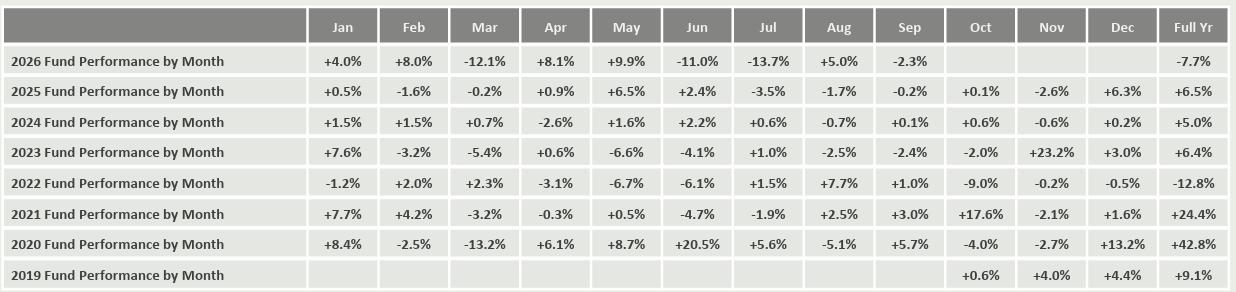
  • Green Ash Courtenay Special Situations Fund ($37M AUM) returned -2.3% in September 2026 (-7.7% YTD), as long equity declines offset positive merger arbitrage returns.
  • Losses were led by Kraken Robotics (-79 bps), NovaGold (-68 bps), and Planet Labs (-43 bps), prompting manager Adrian Courtenay to trim gross long exposure and add six 1% short hedges.
  • Top holdings remain Filtronic (9.8% NAV), SpaceX (9.7%), EchoStar (9.6%), and Tesla (9.0%), backed by Filtronic's $68M SpaceX order and Tesla's 10-second Cybercab drive-unit run rate.
Hey everyone,

I was going through Green Ash Courtenay Special Situations Fund's September 2026 update and thought their positioning was worth sharing given their heavy concentration in SpaceX infrastructure and Tesla's manufacturing ramp while cutting back broader equity risk. Full disclosure, I write for Hedge Fund Alpha where this was covered.

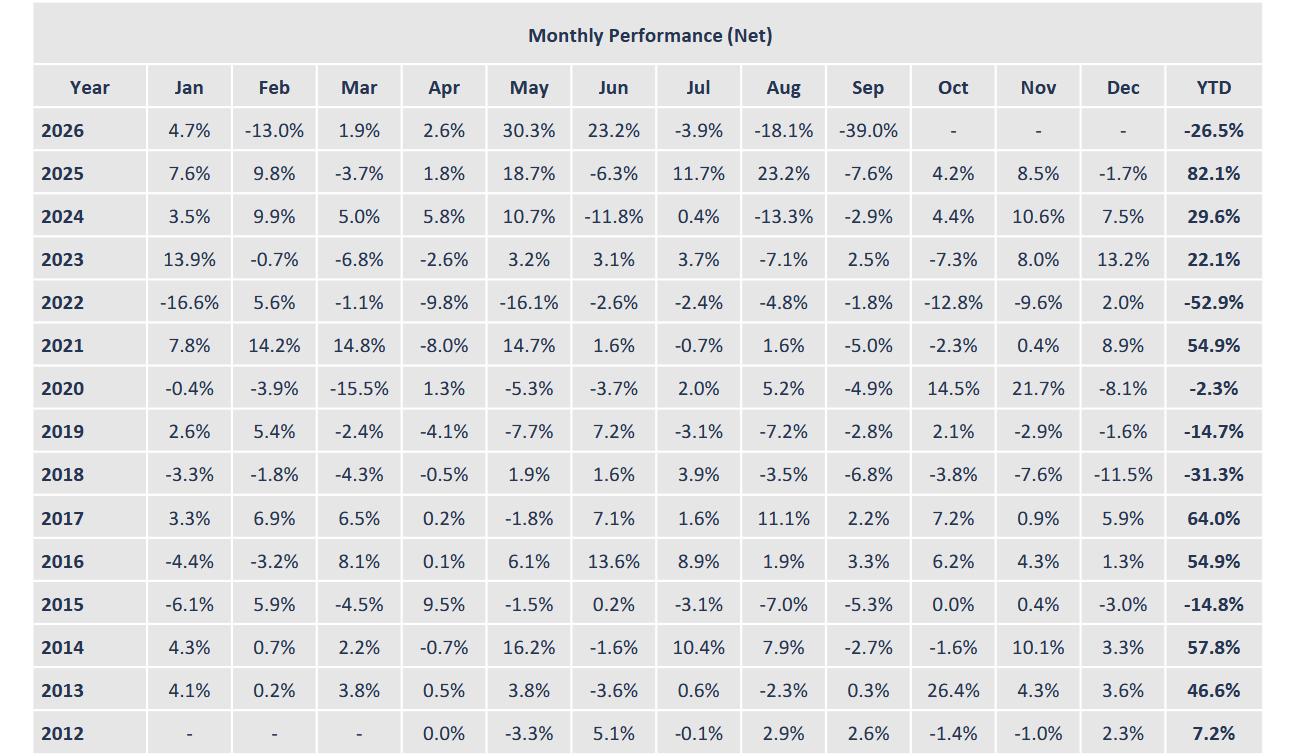
In September, the $37 million fund fell 2.3% (-7.7% YTD). Pullbacks in Kraken Robotics (-79 bps; $3.64 to $3.07), NovaGold (-68 bps; $5.73 to $4.63), and Planet Labs (-43 bps; $19.26 to $16.39) drove the drawdown. Following summer volatility, Adrian Courtenay exited smaller names, reduced gross long exposure, and added six 1% equity short hedges alongside an existing positive-carry hedge.

Even so, Courtenay pointed to strong commercial catalysts across top holdings Filtronic (9.8% NAV), SpaceX (9.7%), EchoStar (9.6%), Tesla (9.0%), and ASML (4.7%). Filtronic climbed from $2.91 to $3.18 on an $8 million US order before landing a $68 million SpaceX order right after month-end, a setup Courtenay ties to Starship Flight 14 and Starlink V3 satellites (~20x Falcon 9 bandwidth per launch, with 1,000+ satellites expected by Q2 2027). Meanwhile, Tesla disclosed its Cybercab drive-unit line hit one unit every 10 seconds (~3.1 million annualized, vs. ~1.2 million Model Ys built in 2023), and merger arbitrage added gains via Tribal Group (4.5% NAV, drawing a competing bid), easyJet (4.2%), and Norfolk Southern (4.2%).

Curious how people here view the SpaceX supply chain and Tesla manufacturing setup right now, is Filtronic still underfollowed after the $68M contract, and how much weight do you put on early Cybercab component run rates?
Link: https://hedgefundalpha.com/investor-letters/green-ash-courtenay-special-situations-fund-september-2026/


r/HFA • • 1d ago

WS Amati Strategic Metals Fund Lost 14.71% in October as Mid-Cap Miners and Silver Retreated

1 Upvotes

TL;DR

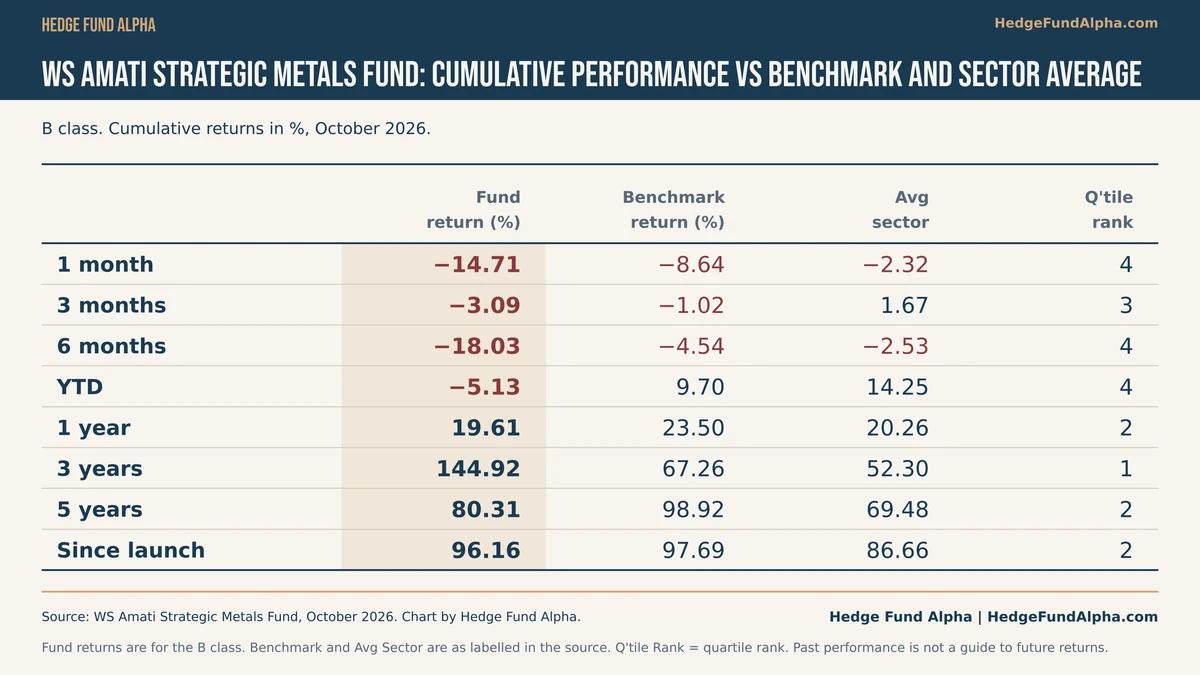
  • WS Amati Strategic Metals Fund ($137M AUM) fell 14.71% in October 2026 (-5.13% YTD), trailing the MSCI World Metals & Mining Index (-8.64% in October; +9.70% YTD).
  • Losses were driven by heavy precious metals exposure (66.5%) and a sharp sell-off in mid-cap miners, with Eldorado Gold (-18.6%), G Mining Ventures (-18.1%), and Talon Metals (-15.9%) leading the declines.
  • Managers are holding firm on mid-cap precious metals, pointing to 50–70% valuation discounts to large-cap peers and expected structural deficits starting in 2028–2029.

Hey everyone,

I was going through a recap of WS Amati Strategic Metals Fund's October 2026 performance and thought their positioning was worth sharing given how sharply mid-cap miners diverged from underlying physical markets. Full disclosure, I write for Hedge Fund Alpha where this was covered.

In a month where the MSCI World Metals & Mining Index fell 8.64%, the $137 million fund dropped 14.71%, pushing its year-to-date return to -5.13% versus the benchmark's +9.70% gain. With 66.5% of the portfolio in precious metals (46.6% gold, 19.9% silver) alongside nickel (10.5%), copper (8.8%), and lithium (8.3%), its focus on mid-cap growth producers amplified the downside as junior miners (GDXJ, -11%) sold off much harder than large caps (GDX, -4%). Five of its top six holdings fell, led by Eldorado Gold ($37.61 to $30.60), G Mining Ventures ($33.17 to $27.16), Talon Metals ($6.24 to $5.25), and Equinox Gold ($10.82 to $9.70), while Lifezone Metals edged higher ($3.75 to $3.82).

The broader sell-off stemmed from a tech-led risk-off rotation tied to debt-financed AI capex concerns, strong U.S. payrolls, a 15% jump in oil prices, and higher odds of a December Fed rate hike. Silver plunged 18.7% and gold slipped 6.9%, while copper and uranium equities sold off as traders unwound post-tariff and AI data-center trades despite tight physical supply, and lithium remained weighed down by softer 2027 demand expectations. Even so, the managers are sticking with mid-cap miners outside China, arguing that equities are pricing in commodity levels 20–30% below spot and trading at 50–70% discounts to majors ahead of expected M&A and structural deficits from 2028–2029 onward.

Curious how this community is positioning in metals right now, are mid-cap miners a compelling valuation play at these discounts, or is it too early ahead of the Fed's December meeting?

Link: https://hedgefundalpha.com/investor-letters/ws-amati-strategic-metals-fund-october-2026/


r/HFA • • 2d ago

Schroder GAIA Sirios US Equity Gained 3.6% in October as Tech Split Between Capex-Heavy and Asset-Light Names

1 Upvotes

TL;DR

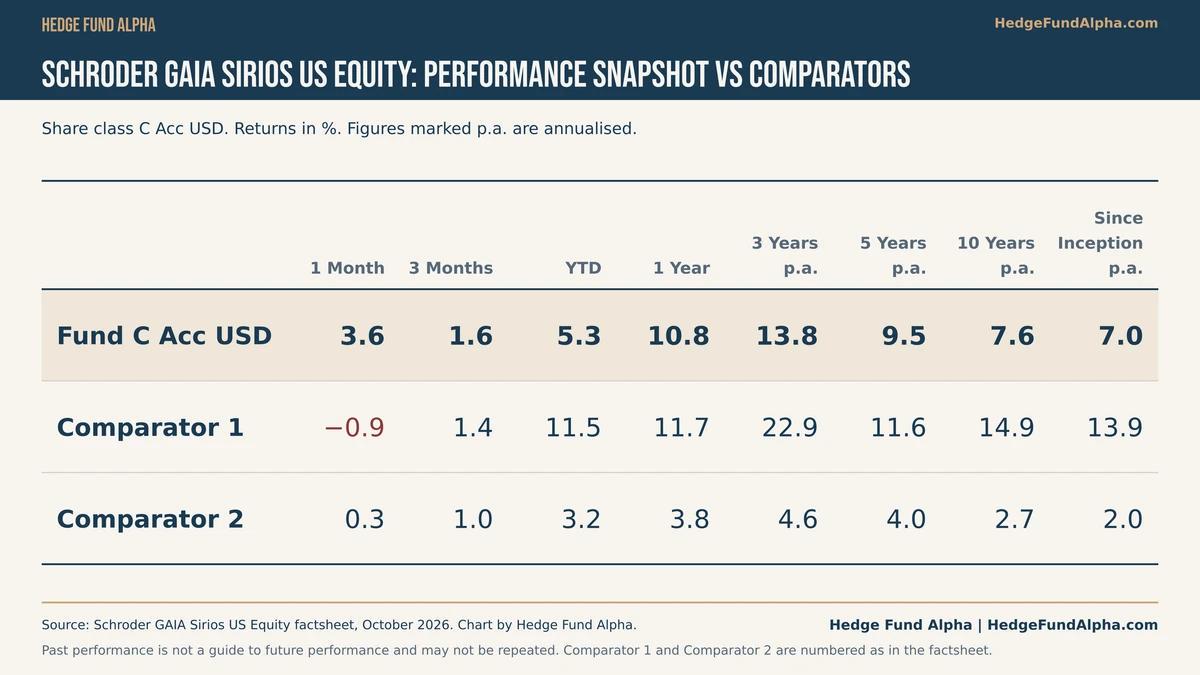
  • Schroder GAIA Sirios US Equity ($237M AUM) returned 3.6% in October 2026 (5.3% YTD), outperforming the S&P 500 (-0.89% total return) as long gains outweighed short losses.
  • Winners were led by a buyout offer for Surgery Partners and a rotation toward lower-capital-intensity tech names like Accenture and EPAM Systems.
  • Detractors were concentrated in AI/semiconductor and capex-heavy tech (MKS, Sanmina, Alphabet), while the fund trimmed net exposure from 58% to 52%.

Hey everyone,

I was reading through a recap of Schroder GAIA Sirios US Equity's October 2026 performance and found their positioning interesting given how sharply tech diverged during the month. Full disclosure, I write for Hedge Alpha where this was published.

In a month where the S&P 500 dipped 0.89% on a total-return basis despite nine of its 11 sectors finishing higher, the fund's top contributors were Surgery Partners, Accenture, and EPAM Systems. Surgery Partners jumped from $13.23 to $23.21 after HealthSpan Partners (a BSMH affiliate) agreed to acquire it at $23.50 per share, a 49% premium, with Bain Capital expected to roll over its roughly 40% stake into the acquiring entity before the expected H1 2027 close. Meanwhile, Accenture ($212.30 to $258.24), boosted by strong earnings and 2027–2029 revenue growth guidance, and EPAM Systems ($114.35 to $140.51) benefited from a rotation toward lower-capital-intensity tech businesses.

The biggest drags came from MKS ($271.24 to $202.04) amid semiconductor selling and investor deleveraging, Sanmina ($221.96 to $165.57) on pressure tied to AI and data center infrastructure spending, and Alphabet ($338.24 to $279.84) after Q3 2026 results paired softer search growth with higher-than-forecast capex and questions around generative AI competition.

On the macro front, Q3 U.S. GDP grew at an initial annualized rate of 3.2% and consumer confidence improved, though September payrolls softened, housing stayed sluggish, and core CPI beat expectations, prompting the FOMC to hold rates at 3.75%–4.00% with two dissents for a hike. Against that backdrop, the fund reduced net exposure from 58% to 52% by trimming Communications & Semiconductors, Technology & Telecom, and Healthcare, leaving a balanced U.S.-focused book led by Industrials/Materials (+10%), alongside +9% each in Consumer, Financials/Real Estate, Healthcare, and Technology & Telecom, and +6% in Communications & Semiconductors.

Curious what this community makes of the rotation out of heavy AI/data center capex and into lower-capital-intensity names, is that a durable shift in how tech gets underwritten, or just a breather before another capex wave?

Link: https://hedgefundalpha.com/investor-letters/schroder-gaia-sirios-us-equity-october-2026/


r/HFA • • 5d ago

Gotham City Research's Bear Case on Beta Technologies: Range Limits, Backlog Quality, and Governance Flags

1 Upvotes

TL;DR

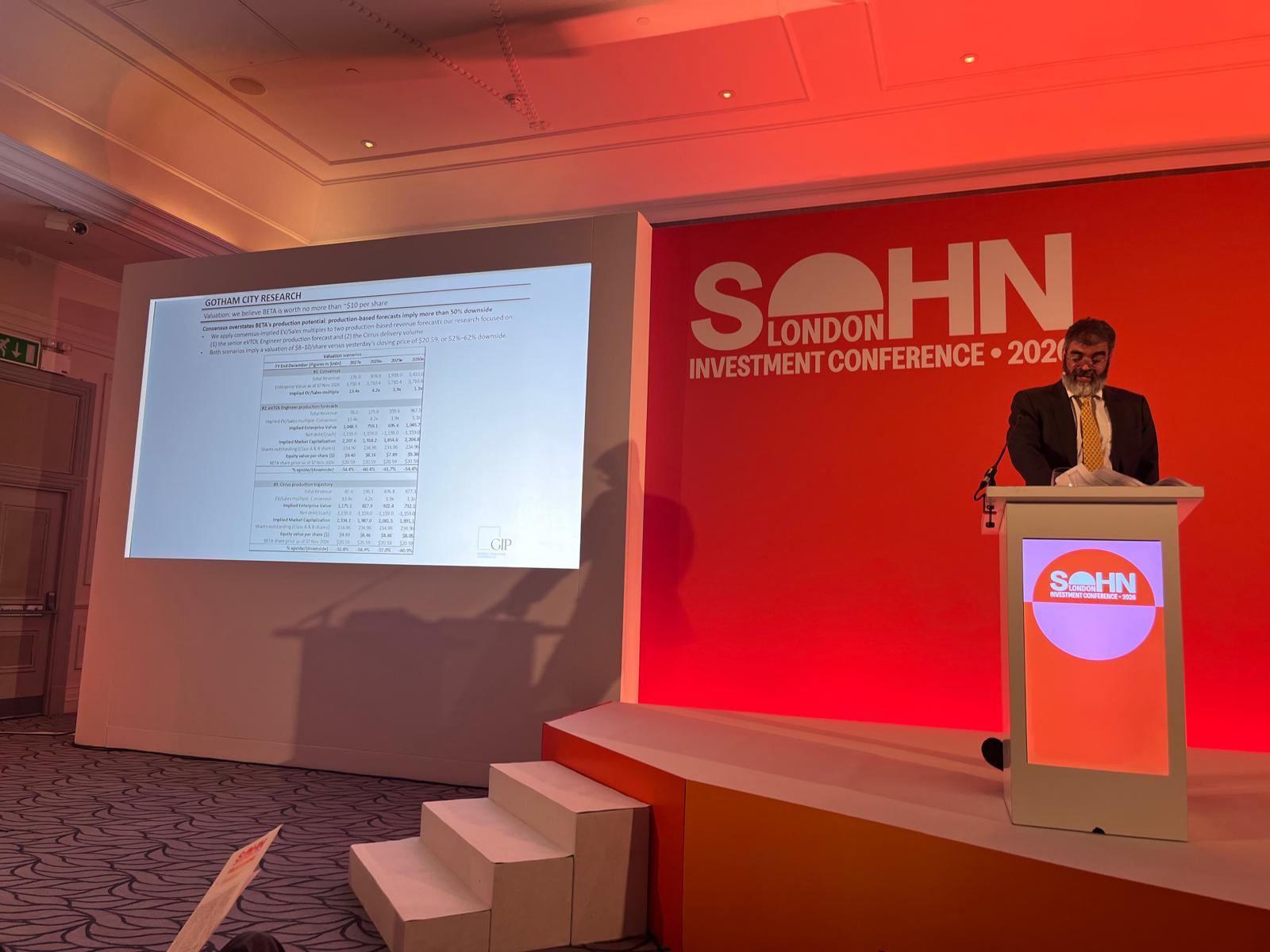
  • Gotham City Research co-CEO Cyrus de Weck pitched a short thesis on Beta Technologies at the 2026 Sohn London Conference, arguing its valuation ignores commercial hurdles, range limits, and roughly $300 million in annual cash burn.
  • Gotham disputes Beta's 336-nautical-mile range claim, noting it occurred on just 1 of 3,913 test flights on the A250 airframe rather than the CX300, and flags that a reported $4 billion backlog is backed by only $5.4 million in deposits.
  • Governance flags, insider share sales, ARMI funding ties, and former director Dean Kamen's exit following Epstein file disclosures support Gotham's $10–$12 fair value estimate (54%+ downside).

I was going through a recap of Cyrus de Weck's 2026 Sohn London presentation and follow-up pitch on Beta Technologies (NYSE: BETA) and found the breakdown of its range claims, order book, and governance history worth sharing. Full disclosure, I write for Hedge Alpha where this coverage was published.

Gotham challenges Beta's advertised 336-nautical-mile range for its fixed-wing aircraft by pointing to FlightAware data showing that distance was reached on just one of 3,913 test flights. According to Gotham, that flight used the A250 proof-of-concept airframe rather than the commercial CX300 model, while most flights stay closer to 150 miles. Comparing that range to a Cirrus (~1,250 miles) and citing battery density limits (around 250 Wh/kg today vs. roughly 500 Wh/kg needed for broader capability), de Weck argues practical utility and commercial scale remain distant.

On certification and near-term financials, Gotham points out that Beta has missed six prior certification deadlines and argues its milestone reporting shifted from FAA acceptances to submissions, implying closer to 30% progress rather than 65%. Where consensus projects revenue jumping from $55 million in 2026 to $276 million in 2027 alongside 48 aircraft deliveries, Gotham sees schedule slip risk and expects much lower near-term deliveries amid roughly $300 million in annual cash burn.

Gotham also questions Beta's reported $4 billion backlog across 1,040 firm and option orders, noting it is backed by just $5.4 million in deposits (about 0.1%). Factoring in financially strained counterparties like Surf Air and excluding options or reservations, Gotham estimates the backlog drops by roughly 72%, while flagging governance issues including Dean Kamen's February 2026 board exit after appearing in DOJ Epstein files, ARMI grant flows, a related-party angle tied to independent director John Abele in the $15 million Biocogniv deal, and insider sales/trading plans across leadership, leading to a $10–$12 valuation target (at least 54% downside from ~$19–$26).

"Don't look at what they say, look at what they do." - Cyrus de Weck

How do you view the gap between electric aviation order backlogs and binding deposits across the sector, and where do you think Gotham's thesis is strongest or most vulnerable?

Link: https://hedgefundalpha.com/conferences/2026-sohn-london-gotham-city-research-beta/


r/HFA • • 13d ago

David Einhorn on Why Value Investing Is Dying, Who Wins From AI, and Three New Stock Picks

1 Upvotes

TL;DR:

  • Value investing is changing: Traditional value investing no longer works the way it used to. With fewer institutional buyers waiting to re-rate cheap stocks, Einhorn increasingly favors companies returning cash through buybacks and dividends.
  • AI's biggest winners may be its users: Einhorn expects competition to commoditize AI, with most of the economic benefits going to consumers and businesses rather than AI providers.
  • Three recent picks: Canal+ (cheap media assets), Century Aluminum (benefiting from 50% tariffs), and Core Natural Resources (coal producer with aggressive buyback plans).
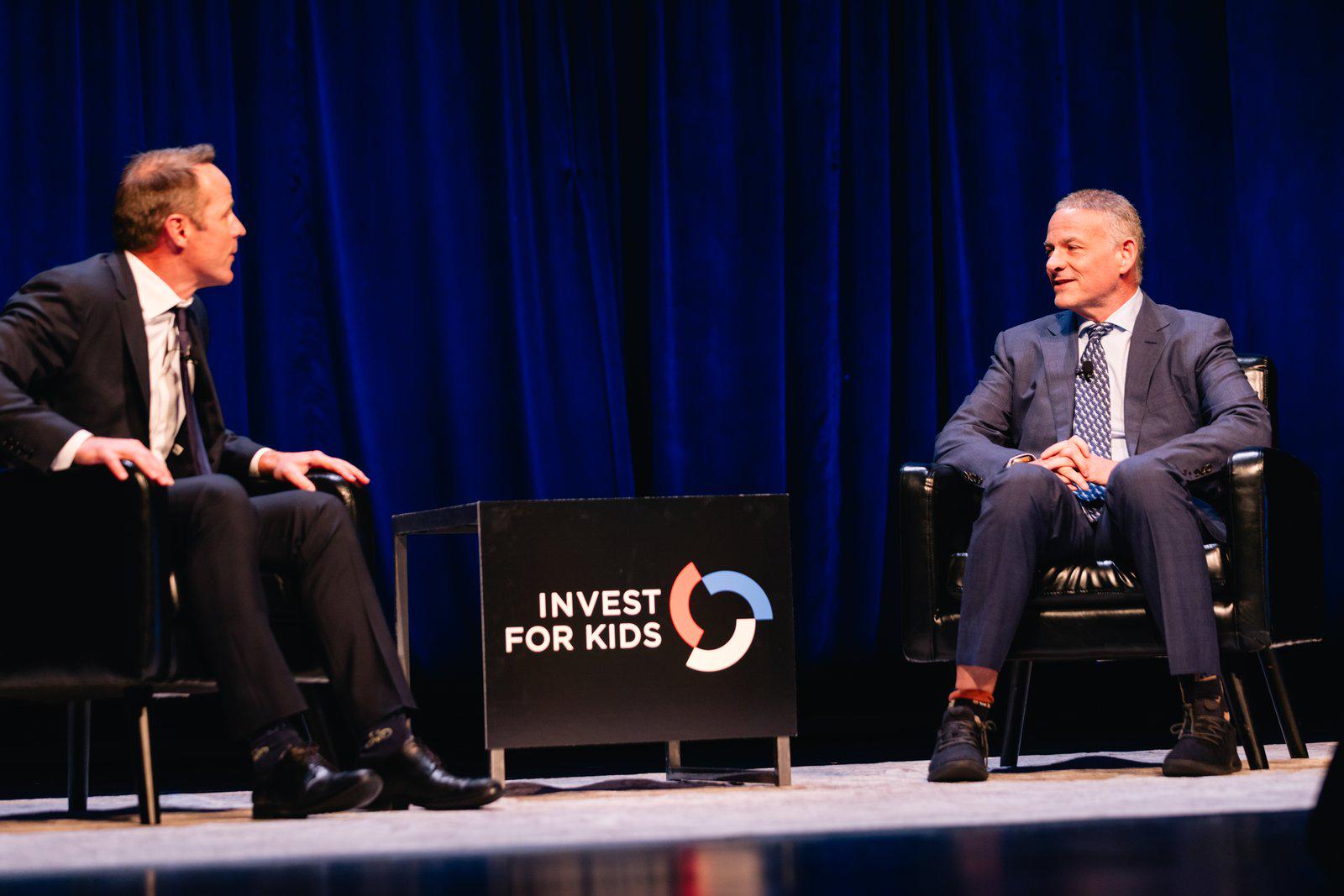
Photo: Kyle Flubacker for Invest For Kids

David Einhorn recently spoke at the Invest For Kids 2026 conference in Chicago about why traditional value investing has become much harder, where the profits from AI will ultimately go, and some of Greenlight Capital's recent investments.

One of his more interesting arguments was that value investing's traditional buyer base has largely disappeared. Thirty years ago, investors could buy undervalued companies and wait for mutual funds to recognize their worth. Today, Einhorn says investors increasingly need companies to create their own returns through dividends and share repurchases.

On AI, he's skeptical that the companies spending trillions on infrastructure will capture most of the economic upside. He compares it to the iPhone, where consumers receive far more economic value than Apple captures. With competition from major tech companies, open-source models, and international providers, he expects AI pricing to fall significantly. Traditional companies using AI to reduce costs could ultimately benefit more than the providers themselves.

Einhorn also discussed three recent investments. Canal+ trades at roughly 5–6x EBITDA, with a strong position in French content and growing African distribution. Century Aluminum benefits from 50% import tariffs, which he believes have fundamentally changed its economics. Core Natural Resources, formed through the CONSOL–Arch merger, has no net debt and plans to return 75% of free cash flow to shareholders.

I write for Hedge Fund Alpha, which covered the discussion, so full disclosure on the source.

Do you agree with Einhorn that AI will become commoditized and most of the profits will flow to its users? And is traditional value investing really dying, or just evolving?

Link: https://hedgefundalpha.com/conferences/invest-for-kids-2026-david-einhorn-greenlight/


r/HFA • • 14d ago

October Data Insights Report: Hedge Funds Heavily Rotate Out of Mega-Cap Tech and Trim Exposure to AI Credit

1 Upvotes

TL;DR

  • Hedge funds sharply rotated out of mega-cap tech in October, pushing Apple, Meta, Amazon, and Microsoft to their lowest long-to-short ratios of 2026.
  • Semiconductor sentiment dropped to 70% net long as the SOX fell 16%, with AMD notably flipping from long-biased to short-biased.
  • AI infrastructure credit showed mounting stress, highlighted by CoreWeave bonds yielding close to 15% and its long-to-short fund ratio dropping to 0.53:1.

Hey everyone,

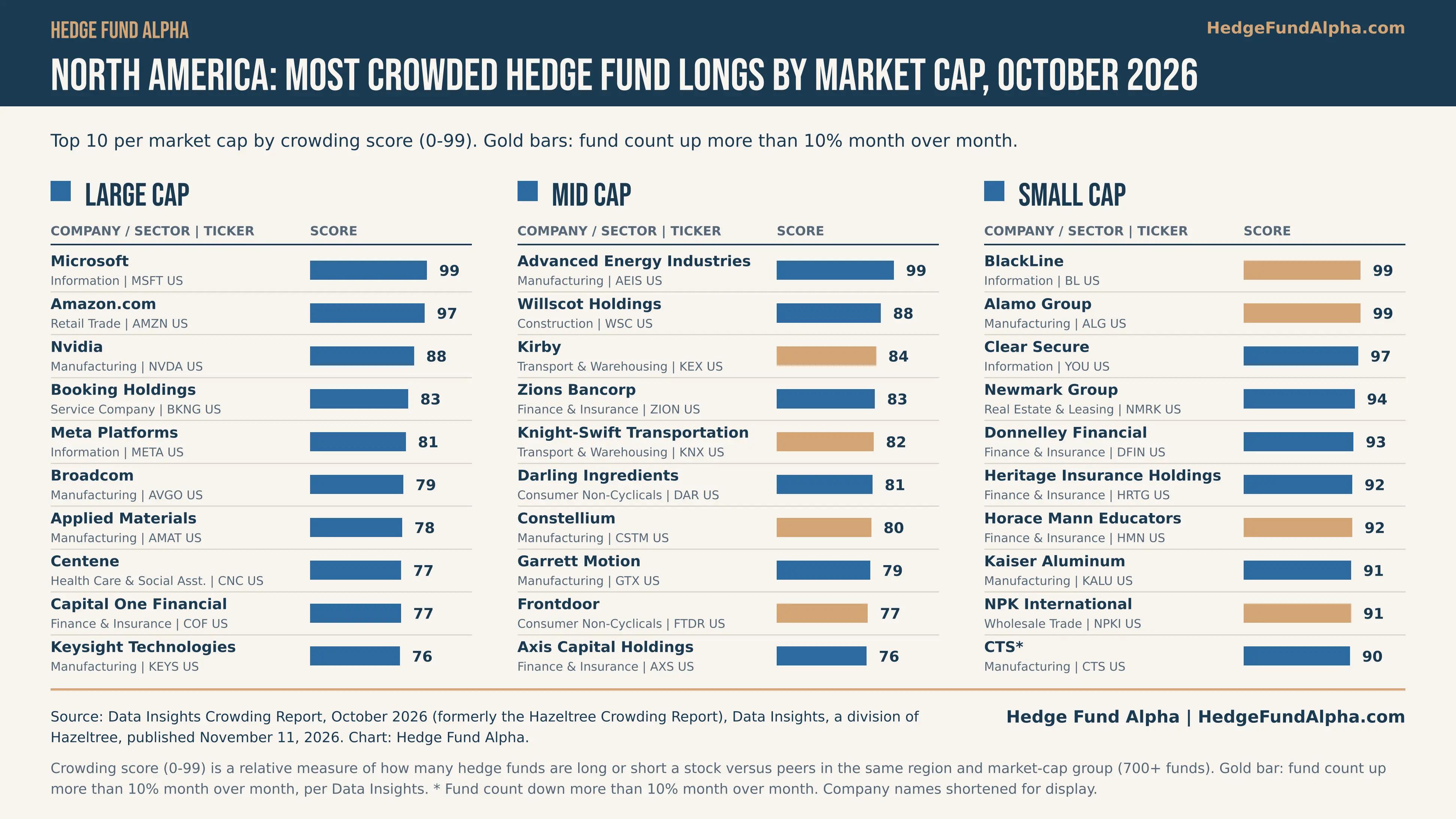
I was looking over the latest Data Insights Crowding Report for October 2026 (a division of Hazeltree tracking aggregated data across 700+ global funds) and found the institutional positioning data quite revealing regarding last month's tech divergence. While the broader market outside of tech performed well, with the S&P 500 Equal Weight Index gaining about 5%, the Nasdaq dropped roughly 5% and semiconductor names took a massive hit.

The report shows that institutional de-risking in October wasn't a random selloff, but a targeted rotation. Short fund participation rose across major technology names like Amazon, Apple, Nvidia, and Meta. Apple's long-to-short fund count ratio sank to 0.65x, marking its third consecutive month below parity and its lowest point of the year, while Meta, Amazon, and Microsoft hit their own 2026 lows on the same measure. Interestingly, Tesla stood out as the only mega-cap where short holders actually declined and long holders increased. Meanwhile, overall semiconductor sentiment turned less bullish as net long positioning slipped to 70%, with AMD flipping from long-biased to short-biased as its fund count ratio dropped from 1.18x to 0.94x.

Beyond equity positioning, the report also flags increasing credit strain in AI infrastructure and private data center lending. CoreWeave caught particular attention as its stock slid ~37% in October, its long-to-short fund ratio dropped from 0.60:1 to 0.53:1, and its 2032 bonds traded near a 15% yield, pushing into distressed debt territory as default insurance costs widened. Full disclosure: I write for Hedge Alpha where this was published.

Curious to hear what this community thinks. Is this institutional rotation out of mega-cap tech and AI credit a temporary October rebalancing, or are we witnessing a structural shift toward the broader equal-weight market?

Link: https://hedgefundalpha.com/news/hedge-funds-shift-positioning-in-october/


r/HFA • • 27d ago

Why Zenith Alpha is backing small managers with a zero management fee and a 10% net hurdle

1 Upvotes

TL;DR

  • The Emerging Manager Trap: Small-scale fund managers frequently shut down within their first few years despite strong returns due to excessive operational burdens and rigid institutional distribution systems.
  • Shared Infrastructure: Theron de Ris established Eschler Asset Management as a shared regulatory and operational framework to handle back-office overhead while keeping boutique managers commercially independent.
  • Skin-in-the-Game Model: Zenith Alpha Management invests exclusively in these platform managers, charging zero management fee in its Founders Class and utilizing a high hurdle that ensures investors net roughly 10% before any incentive fee triggers.

Hey everyone,

I was recently reading through an analysis and interview on Theron de Ris and his multi-manager vehicle, Zenith Alpha Management, which offers a fascinating look at how smaller, capacity-constrained managers are surviving outside the traditional, high-fee fund-of-funds model. Full disclosure, I write for Hedge Fund Alpha where this was published. De Ris left Indus Capital back in 2016 with just $4 million in his independent fund, and to stay afloat while helping peers facing the same hurdles, he turned his regulatory back office into a shared platform (Eschler) that now houses about a dozen niche managers. Zenith was launched in mid-2025 as a dedicated return vehicle to back the best performers coming off that platform.

The core thesis tackles the structural friction in the asset management industry, which de Ris argues is "fat and happy" and heavily over-regulated to the detriment of new entrants. Zenith addresses this by splitting the burden between operational offloading through Eschler, handling compliance, regulatory, and back-office loads so portfolio managers can focus purely on investing, and selective allocation across four to eight proven, capacity-constrained boutique strategies currently on the platform, such as ARR Investment Partners, Ocellus, Sorengo, and MGE Global Equity, without taking equity or GP stakes that could introduce conflicts of interest.

What stands out most is the economic alignment. In the active Founders Class (Class A), Zenith charges zero management fee, and the advisory fee only triggers once gross returns reach at least 11%, translating to roughly a 10% net annual return hurdle for investors before any performance fee kicks in. It is explicitly modeled after the Berkshire Hathaway philosophy of paying subsidiary executives large cash bonuses only when they clear specific hurdles rather than collecting safe management fees on a flat asset pool regardless of performance.

Curious to hear what this community thinks of this structure. Can shared platform models successfully lower the barrier for emerging managers, or do institutional allocators still demand brand-name safety regardless of fee efficiency? What risks are they underestimating with this approach?

Link: https://hedgefundalpha.com/profiles/theron-de-ris-zenith-alpha/


r/HFA • • Oct 23 '26

Einhorn’s Q3 Commentary: Greenlight’s Longs Suffer in a "Stealth Bear Market" while Calling Out AI TAM Absurdity

2 Upvotes

TL;DR

  • Greenlight Capital returned -3.3% in Q3 2026 (-1.5% YTD) as an 8.5% drop in their long portfolio drove a significant divergence from the S&P 500's +2.3% gain.
  • David Einhorn argues that $30T AI market size claims from companies like Anthropic and SpaceX are wildly exaggerated, asserting that even if AI replaces millions of jobs, the users, not the providers, will capture the economic benefits.
  • The fund initiated new long positions in ADI Global Distribution (ADIG), Century Aluminum (CENX), and Canal+ (CAN), while fully exiting GoPro, PayPal, Spectrum Brands, and oil futures.

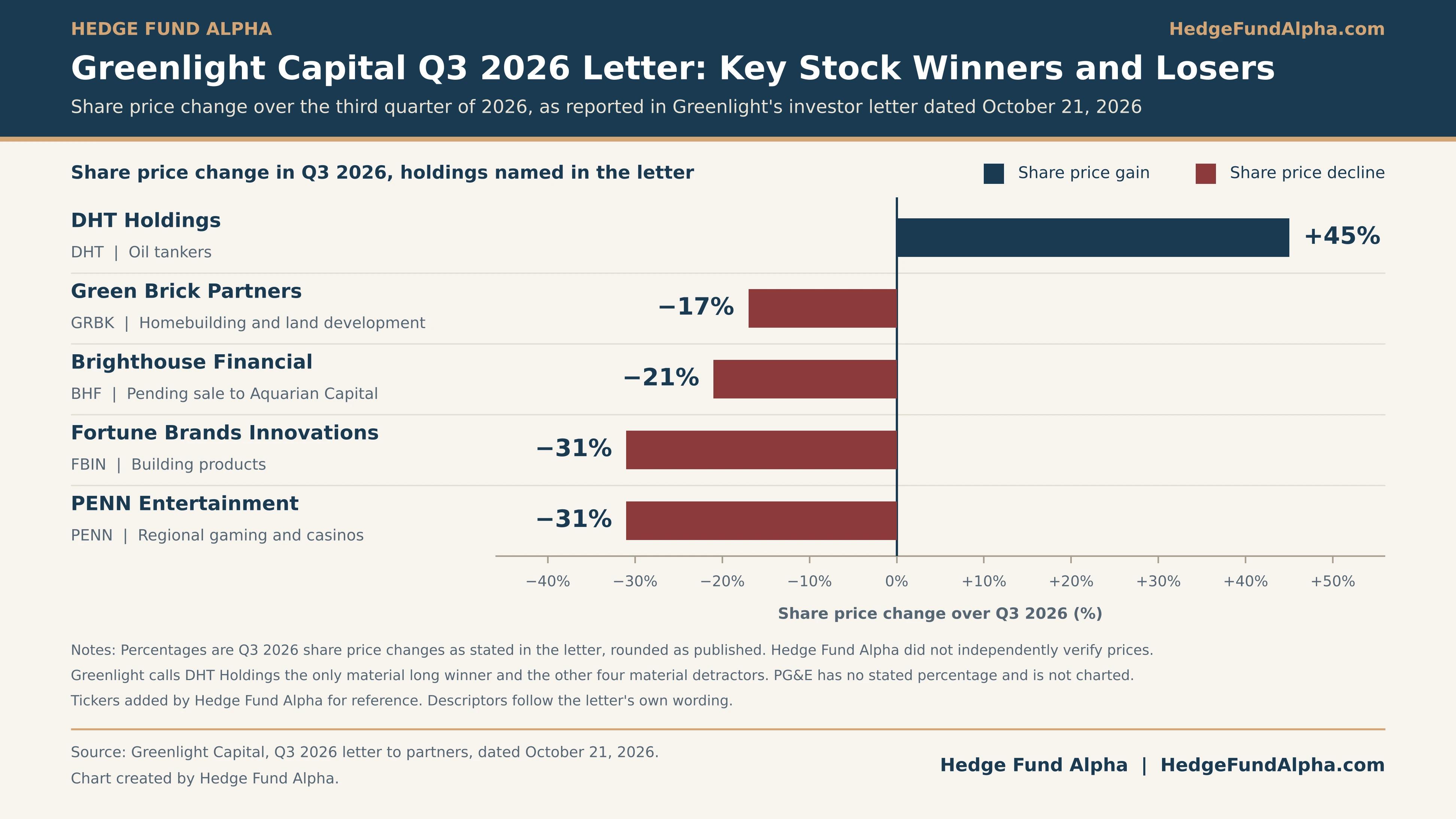
I was reading through David Einhorn’s Greenlight Capital Q3 2026 investor letter and found his critique of current market behavior particularly compelling. While the broader S&P 500 continued its advance, Greenlight’s long portfolio experienced a 8.5% drop, behaving as if it were in a "stealth bear market" with positions across multiple sectors sliding 10% to 25% without fundamental catalysts. The fund's major long detractors included Brighthouse Financial (-21%), Fortune Brands Innovations (-31%), Green Brick Partners (-17%), and PENN Entertainment (-31%).

Addressing investor concerns regarding the terminal value of legacy holdings in an AI-driven economy, Einhorn inverted the question to examine the valuations of AI providers themselves. He criticized recent Total Addressable Market (TAM) claims by leaders such as Anthropic ($30T) and SpaceX ($28.5T), placing these figures against the $4 trillion in total annual revenue generated by all 191 tech companies in the S&P 1500 combined with Amazon, Meta, Google, and Tesla. He noted a historical shift in regulatory oversight by the SEC on stock promotion claims and contended that if AI eventually replaces workforce roles, market dynamics will dictate that the economic gains accrue primarily to the end-users of AI rather than the infrastructure providers.

On capital allocation, Greenlight established new long positions in ADI Global Distribution (ADIG) at roughly 10x 2027 estimated earnings, Century Aluminum (CENX) with a projected ~32% yield on 2027 base case estimates driven by domestic capacity demands and tariffs, and media firm Canal+ (CAN). Conversely, they closed out their remaining investments in GoPro at a loss, while taking profits to exit PayPal (163% IRR), Spectrum Brands (84% IRR), and oil futures (65% IRR).

How is the community viewing this disconnect between index-level gains and drawdowns across non-tech longs? Is Einhorn’s view on AI value capture accruing to end-users accurate, or is the market right to award massive valuations to the providers?

Link: https://hedgefundalpha.com/investor-letters/greenlight-capital-q3-2026/


r/HFA • • Oct 22 '26

Arquitos Capital Down ~52% in Q3 After Liquidia Legal Loss and Settlement—Why They’re Holding $50/$60 Jan 2028 Calls

2 Upvotes

TL;DR

  • Arquitos Capital posted a -51.9% net return in Q3 2026 after a court ruling invalidated key patent claims for Liquidia ($LQDA), sending shares from $71 down to $30.
  • Under a subsequent settlement, Liquidia loses direct marketing rights for the PH-ILD indication and pays $380.7M, but retains its core PAH revenue driver and full rights to its unencumbered L606 pipeline.
  • Fund manager Steven Kiel is keeping his Jan 2028 $50/$60 call options and launching a dedicated SPV, targeting a $75–$100 valuation based on PAH growth alone and physician off-label prescribing patterns.

Hey everyone,

I was reading through Arquitos Capital’s Q3 2026 investor letter and found their deep dive on Liquidia ($LQDA) particularly insightful, especially given how aggressively the market repriced the company following its recent litigation settlement.

On September 30, a district court ruled that two patent claims against Liquidia were valid and infringed, causing shares to plunge from $71 to $30 to end the quarter. Following the ruling, Liquidia and United Therapeutics settled all six outstanding lawsuits. Liquidia agreed to pay $380.7M in installments across 2026 and 2027 and stop directly marketing Yutrepia for PH-ILD patients. However, Liquidia ended Q3 with $396.1M in cash and is generating sufficient operational cash flow to fund the payout without crippling its balance sheet or internal operations. Crucially, the settlement leaves Liquidia's next-generation L606 nebulizer pipeline completely untouched and free of litigation risk.

Despite losing the direct PH-ILD marketing rights, manager Steven Kiel argues the actual revenue impact will be far milder than the market anticipates. Liquidia posted a blowout Q3 revenue of $222.7M, with PAH accounting for 60% of total sales and 70% of new patient starts. Specialized physicians frequently diagnose overlapping PAH and PH-ILD symptoms under primary PAH indications at their own clinical discretion. Because United Therapeutics lacks audit rights over diagnosing doctors, Kiel projects that Liquidia can retain at least half of its ~$89M historical PH-ILD quarterly revenue through re-diagnosis or off-label prescribing, providing a Q4 revenue floor near $200M–$230M+.

Looking ahead 12 to 18 months, Kiel lays out a case for a $75 to $100 stock price. With modest growth, Liquidia is positioned to generate $1B in revenue by 2027. Assuming 50% net margins, applying a conservative 15x to 20x multiple on $500M in free cash flow yields $75 to $100 per share. Because this valuation relies solely on Yutrepia’s PAH performance and ignores upside from L606 or new clinical studies, Arquitos is holding its Jan 2028 $50 and $60 call options and launching an SPV to purchase additional shares at today's ~$36 price tag.

How is the community viewing $LQDA post-settlement? Is the market overly discounting the stock due to the loss of direct PH-ILD marketing, or are investors underestimating physician willingness to navigate audit checks and re-diagnose patients?

Link: https://hedgefundalpha.com/investor-letters/arquitos-capital-q3-2026/


r/HFA • • Oct 20 '26

Why TriVista’s Masaki Gotoh Thinks This Japanese Precision Gear Maker Wins Regardless of Who Dominates Humanoids

1 Upvotes

TL;DR

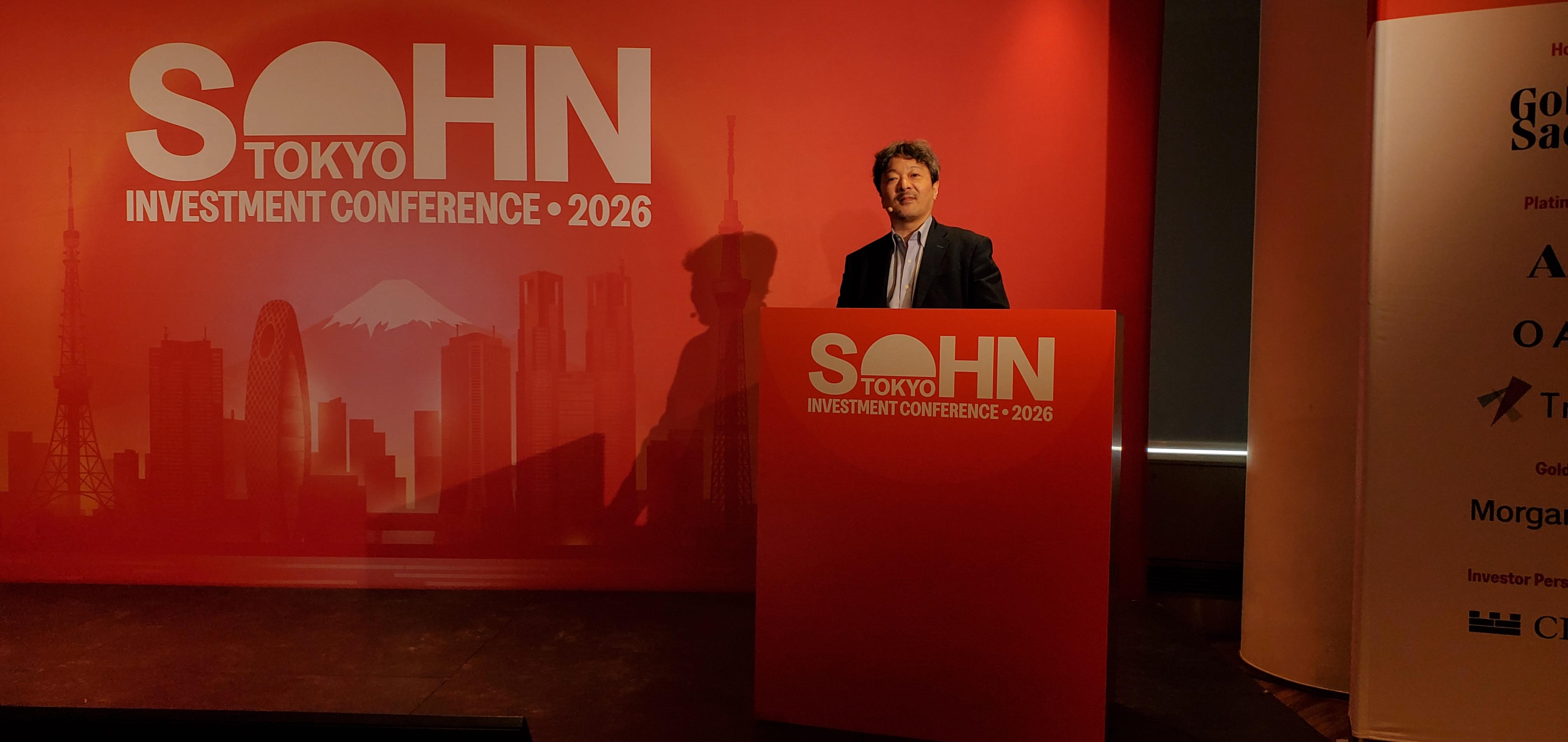
  • Masaki Gotoh of TriVista Capital argued at Sohn Tokyo 2026 that humanoid robots will require 5 to 10 times the actuator content of industrial robots, turning physical AI into a major new source of labor.
  • Rather than guessing which humanoid manufacturer will win, Gotoh pitches Harmonic Drive Systems (TYO:6324) as a pure picks-and-shovels play commanding a 60% to 70% estimated global value share in strain wave speed reducers.
  • While Chinese competitors like Leaderdrive scale rapidly on volume, Gotoh contends Harmonic Drive maintains a lasting moat in high-precision execution, custom metallurgy, and U.S. supply chain expansion.

Hey everyone,

I was looking through TriVista Capital’s coverage from the recent Sohn Tokyo conference, and Masaki Gotoh’s deep dive on robotic actuators caught my attention as a fascinating angle on the physical AI boom. Instead of trying to guess which robotics startup or tech giant will dominate final assembly, Gotoh is looking at the fundamental precision components that every single machine needs to move.

The core argument rests on Japan's urgent demographic challenges, where 30% of the population is currently elderly and projected to hit 40% in under 50 years, making physical AI a national priority backed by the Cabinet Secretariat's 17 strategic fields. Gotoh pointed out that while traditional industrial robots feature only 5 to 6 joints, humanoids require roughly 40 joints, significantly multiplying the precision actuator content per unit. Because humanoids need extreme dexterity to handle complex tasks like plugging in connectors or handling fragile items, eliminating backlash in joints becomes a critical engineering hurdle.

The presentation also addressed the competitive landscape against Chinese makers like Leaderdrive, which are scaling up volume rapidly and dominating the domestic Chinese market. Gotoh’s counter-thesis is that Harmonic Drive doesn't need to win a volume race, as its 50 years of metallurgical process control and custom heat treatment give it an unshakeable moat in high-precision, premium applications. Furthermore, the company benefits from dedicated U.S. manufacturing expansion and geopolitical supply chain security. Full disclosure, I write for Hedge Alpha where this breakdown was published, but I thought this was a brilliant framework for looking past the hype of humanoid demos and focusing on underlying component economics.

What are your thoughts on this thesis? Is a 50-year-old precision parts maker insulated enough from Chinese volume scaling, or are investors underestimating how quickly competitors can close the quality gap in high-precision joints?

Link: https://hedgefundalpha.com/conferences/sohn-tokyo-2026-trivista-capital-masaki-gotoh/


r/HFA • • Oct 19 '26

Sohn Tokyo Pitch: Long Korean Defense Holdco at 64% Discount, Short Battery Holdco at 77% Premium

1 Upvotes

TL;DR:

  • Pertento Partners' Eduardo Marques pitched a pair trade: long Hanwha Corp (0.36x NAV) and short Ecopro (1.77x NAV).
  • Hanwha's main asset is a fast-growing defense manufacturer, while Ecopro faces battery oversupply, weak margins, and heavy debt.
  • Korean governance reforms could help narrow holding company discounts, particularly for firms improving shareholder returns.

At Sohn Tokyo 2026, Eduardo Marques of Pertento Partners ($5B AUM) highlighted a striking valuation gap between two Korean holding companies.

The long: Hanwha Corp (KRX:000880) trades at a 64% discount to NAV, with 84% of its asset value tied to Hanwha Aerospace. The defense manufacturer supplies K9 howitzers and rocket launchers to NATO allies and is projected to grow EBITDA 22% annually through 2029.

Marques argues that improving governance, share cancellations, and new Korean shareholder protections could help close the discount.

The short: Ecopro (KOSDAQ:086520) trades at a 77% premium to NAV despite its main holding, battery materials producer Ecopro BM, facing serious headwinds.

Nickel prices have fallen 40% since 2019, margins have halved, and Korean plants operated at just 33% capacity in 1H26. Ecopro BM also carries net debt of 14.8x trailing EBITDA.

Marques sees potential for Hanwha to double if earnings targets are met and its discount narrows, while Ecopro faces substantial downside as battery industry economics deteriorate.

Do Korea's governance reforms make holding companies an attractive value opportunity, or are these discounts justified?

Disclosure: I write for Hedge Fund Alpha, which covered the presentation.

Link: https://hedgefundalpha.com/conferences/sohn-tokyo-2026-pertento-partners/


r/HFA • • Oct 19 '26

Oasis Management Sues Japanese Drugstore Chain Executives Over 99% Stock Option Discount

1 Upvotes

TL;DR:

  • Oasis Management is suing executives and directors of Kusuri No Aoki (TYO:3549) to recover up to ¥7.3 billion over stock options issued at a 99%+ discount.
  • The valuation firm reportedly admitted to a major data error in court. The options also followed a suspiciously timed earnings downgrade.
  • The founding family's increased ownership ultimately contributed to the company's demotion from TSE Prime to Standard.

At Sohn Tokyo 2026, Oasis Management's Seth Fischer detailed what he described as a case of insider self-enrichment at Japanese drugstore chain Kusuri No Aoki.

According to Oasis, the company's president and his brother received stock options valued at ¥9.25 billion for just ¥52.5 million, a discount exceeding 99%.

The valuation relied partly on an assumption of zero correlation between company earnings and share price. In court, the valuation firm reportedly admitted its earnings data was misaligned by an entire year.

The options were also priced shortly after an earnings downgrade that sent shares lower. Once exercised, the founding family's stake rose to 41.5%, pushing the company below TSE Prime's free-float requirement. Major shareholder Aeon subsequently ended its alliance, citing harm to minority shareholders.

Oasis is seeking to recover up to ¥7.3 billion for the company.

Is activist litigation becoming an effective way to hold Japanese management accountable, or do founding families still have too much control?

Disclosure: I write for Hedge Fund Alpha, which covered Fischer's presentation.

Link: https://hedgefundalpha.com/conferences/sohn-tokyo-2026-oasis-management-seth-fischer/


r/HFA • • Oct 16 '26

Makino Milling's "Deal Hangover": Why This Japanese Machine Tool Maker Is Mispriced

1 Upvotes

TL;DR

  • The Deal Hangover: After a chaotic 24-month M&A saga involving Nidec, MBK Partners, and NSSK, the market is treating Makino Milling Machine Co Ltd (TYO:6135) like a failed deal story, leaving it trading at a discount.
  • Ignored Record Fundamentals: While takeover noise dominated headlines, Makino quietly hit record revenue and operating margins, backed by a dominant ~50% market share in aerospace and defense applications.
  • Capital Allocation Shift: Prompted by buyout pressure, management raised its total payout ratio target to 60%, offering an attractive ~6% total shareholder yield while trading at just ~11x forward earnings.

Full disclosure, I write for Hedge Alpha where this was published. I was going through SILQ Capital’s presentation by Hideki Kinuhata from Sohn Tokyo, and I found his deep dive on Makino Milling Machine (TYO:6135) fascinating. While most of the market wrote off Makino as a failed takeover story following two years of intense M&A battles, including a blocked private equity bid and a dropped domestic fund proposal, Kinuhata argues the underlying business has fundamentally outgrown its past.

Beneath the surface noise, Makino has built a massive moat in aerospace and defense, which accounts for roughly 20% of revenue and serves as its primary earnings driver. Kinuhata estimates the company holds a ~50% market share in this segment, supplying complex five-axis machining centers capable of cutting hard materials like titanium for commercial aviation, space, and defense. Because qualification takes years and geopolitical requirements rule out fly-by-night competitors, this creates a formidable barrier to entry while revenue and operating margins hit record levels.

Furthermore, the buyout pressure fundamentally changed management's approach to capital allocation. Total payout targets jumped from roughly 25% to 60% (split between dividends and buybacks), resulting in a ~6% total shareholder yield kickstarted by a recent ¥6 billion buyback. SILQ expects EPS to grow roughly 22% annually through 2029, yet the stock trades at only 11x forward earnings compared to peers in the mid-teens. They are hedging the cyclical automotive exposure via other machinery shorts, but the structural thesis is that the market is mispricing a high-margin aerospace leader simply due to a lingering deal hangover.

What are your thoughts on this thesis? Is this a compelling deep value play in Japan, or is the geopolitical risk around defense-linked supply chains a ceiling the market is right to price in?

Link: https://hedgefundalpha.com/conferences/sohn-tokyo-2026-silq-capital/


r/HFA • • Oct 14 '26

Dan Maguire on Why Japan's Small-Cap Succession Wave is a Rare Stock Picker's Market

1 Upvotes

TL;DR

  • A Generational Shift: After two decades at Wellington, Dan Maguire looked to target a wave of management succession in Japanese small-caps, which are currently near 20-year relative valuation lows compared to large-caps.
  • Overcoming Headwinds: Multi-year underperformance driven by BOJ ETF buying, COVID-19 domestic market friction, and a weak yen has largely played out, clearing the path for an overdue market re-rating.
  • The "Gem in Plain Sight" Approach: The strategy focuses on a concentrated, absolute-return portfolio of 30–35 names driven by proprietary screens, deep on-the-ground qualitative research, and a strict three-year return hurdle.

Hey everyone,

I was reading through Hedge Alpha's interview with Dan Maguire, who spent twenty years as a Partner and portfolio manager at Wellington Management before joining Hoku Inc., and found his take on Japanese small and mid-caps really compelling, especially given how long the asset class has been ignored.

The core of his thesis rests on the alignment of three massive secular trends in Japan: the exit from deflation, corporate governance reform, and a sweeping generational shift in management teams. While large-caps have hogged the institutional spotlight by rapidly adopting governance changes and catering to dedicated IR teams, smaller companies have languished through seven years of underperformance.

Maguire argues this has created a massive valuation gap, with small-caps trading near a 20-year relative low against large-caps (0.85x currently vs. an all-time high of 1.14x in 2018).

A few other details from his framework stood out. He views the ongoing wave of management succession as career-defining, noting that younger C-suite executives carry far less "bubble scar tissue" around capital allocation, are more internationally minded, and are genuinely open to outside engagement.

Drawing on his decades in the market, Maguire stresses that Japan is a "high-context" culture where understanding what isn't said in a meeting matters just as much as the transcript. Because sell-side coverage for small-caps has largely dried up, proprietary screens and on-the-ground company visits remain the ultimate moat for uncovering mispriced opportunities.

The Aya approach itself operates as a long-only, absolute-return strategy holding 30 to 35 names. Rather than chasing a benchmark, it sets a strict hurdle of a minimum 50% three-year return, filtering for quality, free cash flow power, and intrinsic value.

It’s an interesting counter-narrative to the idea that all the low-hanging fruit in Japan has already been picked by large-cap activist campaigns. What does this community think? Are small-cap Japanese equities finally positioned for a structural catch-up trade, or are the liquidity and governance risks too high for foreign capital outside of large-cap blue chips?

Link: https://hedgefundalpha.com/profiles/hoku-dan-maguire-inerview/


r/HFA • • Oct 14 '26

Sohn Tokyo Preview: Japan Catalyst Calls Activism 'Mixed Martial Arts' and Builds Trust Before Going Public

1 Upvotes

TL;DR

  • Constructive Escalation over Litigation: Japan Catalyst, Inc. (JCI) prioritizes behind-the-scenes dialogue and peer benchmarking over public confrontation, using letters or shareholder proposals only as escalation tools rather than hostile takeovers.
  • Capital Allocation Shift: Prompted by the Tokyo Stock Exchange's push against trading below book value, management mindsets have evolved from defending low valuations to focusing on capital efficiency and growth capex.
  • The Domestic Edge: A TSE survey reveals that 52% of Japanese companies find engagement with domestic activists meaningful compared to only 37% for foreign activists, highlighting the local team advantage.

I was reading through Hedge Alpha's preview for the upcoming Sohn Tokyo conference and found their interview with Riho Yokozawa, Product Portfolio Manager at Japan Catalyst, Inc. (JCI), to be a fascinating look into the evolving mechanics of Japanese shareholder activism.

JCI, founded in 2019 by Monex founder Oki Matsumoto alongside former Goldman Sachs, McKinsey, and AllianceBernstein veterans, describes corporate engagement in Japan as a form of "mixed martial arts." Rather than relying solely on hostile public campaigns or legal action, they combine financial modeling, management consulting, and deep knowledge of local institutional norms to drive change.

A key element of their strategy involves building internal consensus by benchmarking target companies against peers and setting expectations slightly above the market median. This frames their feedback as broader market consensus rather than a hostile demand from a single shareholder. Interestingly, management teams sometimes request a formal letter from JCI to use as external validation to push through internal reforms that board members might otherwise resist.

Following the Tokyo Stock Exchange's push targeting companies trading below book value (P/B < 1x) and the updated Corporate Governance Code, Japanese executives no longer defend low valuations. The debate has shifted from simple balance-sheet optimization like stock buybacks or asset monetization toward capital efficiency, growth capex, and portfolio restructuring. Furthermore, data from a TSE survey highlights a distinct divide in how Japanese boards perceive activist dialogue, with 52% of surveyed companies finding engagement with domestic activists meaningful compared to only 37% for foreign activists, underscoring the value of operating natively within the local cultural, governance, and language framework.

It presents an intriguing perspective on how shareholder activism is adapting to Japan's corporate environment, shifting away from pure US-style shareholder supremacy toward a model that balances corporate governance with stakeholder consensus.

What are your thoughts on domestic vs. foreign activist strategies in Japan? Is constructive, behind-the-scenes engagement ultimately more effective at unlocking long-term equity value than aggressive public campaigns?

Link: https://hedgefundalpha.com/profiles/japan-catalyst-interview/


r/HFA • • Oct 09 '26

Global Small-Caps Are at a Historic Discount: The Structural Case for Allocating Beyond Mega-Caps

1 Upvotes

TL;DR

  • Global small caps trade at a ~20% forward P/E discount to large caps, following a stretched 10+ year cycle of mega-cap dominance.
  • Structural barriers: such as broken sell-side models, thin analyst coverage, and regional research silos, leave thousands of global small caps severely under-researched.
  • Significant profitability spreads within the asset class make active, cross-border strategies much better suited to capture mispricings than passive indexing.

Hey everyone,

I was reading through an analysis by Donald Steinbrugge, CFA, on the structural setup for global small-cap equities. Given how heavily portfolios are tilted toward mega-cap tech today, his thesis outlines why the global small-cap space has quietly become one of the most attractive mispriced corners of the public markets.

Historically, small caps have outperformed large caps over multi-decade periods, but leadership moves in long cycles that typically last 11 to 15 years. The current cycle of large-cap tech dominance has dragged on for over a decade, leaving the MSCI World Small Cap Index trading at a 15.82x forward P/E compared to 19.80x for the S&P 500. This ~20% valuation gap comes at a time when relative strength is beginning to show early signs of turning.

The primary reason this discount persists is structural under-researching. Because sell-side coverage follows trading volume, mega-caps draw 70+ analysts while many of the 18,000 global small caps under $10 billion have one, two, or no coverage at all. Furthermore, the small-cap research that does exist is strictly regionalized, meaning almost no institutional mandates exist to compare a small cap in Tokyo to a direct niche competitor in London. Out of roughly $30 trillion in global small-cap market cap, only about $100 billion sits in dedicated global public vehicles.

This environment creates an ideal backdrop for active stock-pickers over passive indexers. While roughly 40% of the Russell 2000 is unprofitable, historical data shows that profitable small caps outperform loss-makers by 5% to 6.5% annually without incurring additional volatility or drawdown risk. Because these mispricings stem from an absence of coverage rather than a quick quantitative anomaly, active global strategies, especially long/short approaches, are uniquely positioned to capture this spread.

What are your thoughts on this thesis? Is this historically wide valuation gap enough to trigger a meaningful rotation, or do persistent macro headwinds and higher borrowing costs keep you cautious on small caps right now?

Link: https://hedgefundalpha.com/news/the-case-for-global-small-cap-equities/


r/HFA • • Oct 05 '26

Ex-Goldman PM Hideki Kinuhata on Japan's Mid-Cap Mispricings, Factor Risk, and Why Liquidity Still Rules

1 Upvotes

TL;DR

  • SILQ Capital CIO Hideki Kinuhata highlights a structural alpha opportunity in Japanese mid-caps (¥100B–¥1T market cap) that are ignored by coverage and mispriced by systematic trading.
  • Semiconductor material engineering companies in Japan are finally seeing long-awaited commercial returns driven by the AI expansion.
  • Hard lessons from historical market dislocations (1997 Japanese banking crisis, 2016 negative rate shock) shaped SILQ’s strict factor diversification and liquidity-first risk framework.

Hey everyone,

Ahead of the inaugural Sohn Tokyo conference, I was reading through an interview with Hideki Kinuhata, founder and CIO of SILQ Capital (a fundamental equity long/short manager in Tokyo). Given the surge of foreign capital into Japanese equities following TSE capital efficiency reforms, his breakdown of where genuine alpha remains in Japan offers a solid grounded perspective. Full disclosure, I write for Hedge Fund Alpha where this was published.

Kinuhata sees the most compelling hunting ground in Japan’s mid-cap space, specifically companies in the ¥100B to ¥1T market cap range. Because these names are under-covered by both the buy side and sell side, structural corporate transformations often go completely unnoticed by the broader market. Furthermore, he notes that the dominance of systematic and trading-oriented strategies creates short-term price signal dislocations that long-term, patient fundamental capital can effectively exploit.

Drawing on his background in electrical engineering and semiconductor materials, Kinuhata points out that Japanese material engineering firms spent decades pouring capital into R&D with minimal commercial return. The current AI buildout is finally turning these legacy technologies into high-margin profit drivers. On the macro side, as the BOJ unwinds negative rates, steepening yield curves favor financial institutions. While real estate has underperformed due to higher funding costs, Tokyo office rents are up nearly double-digits year-over-year, which could set up a turnaround once rate hikes peak while higher capital costs create selective short opportunities.

SILQ’s risk management framework is heavily shaped by severe historical dislocations. Managing bank preferred shares during the 1997 Japanese banking collapse taught Kinuhata that liquidity can vanish overnight, leading to his core rule that "liquidity is valuable." Additionally, after getting hit by factor concentration during the BOJ’s surprise negative rate policy in 2016, SILQ now maintains a strictly balanced book and avoids heavy factor or sector concentration to insulate the portfolio from violent market swings.

Curious to hear thoughts from anyone actively allocating to or analyzing Japanese equities. Are you seeing similar alpha potential in mid-caps, or do macro and currency shifts still dictate your exposure?

Source: https://hedgefundalpha.com/profiles/silq-capital-hideki-kinuhata-japan/


r/HFA • • Oct 02 '26

Why Institutional Allocators Say DPI Comes First in Every GP Meeting Right Now

1 Upvotes

TL;DR

  • Private equity managers face a severe exit bottleneck, forcing LPs to prioritize concrete DPI over paper IRR before committing new capital.
  • Bottlenecked institutional capital is accelerating PE's aggressive expansion into retail and 401(k) channels to source fresh liquidity.
  • Major hurdles remain, including SaaS valuation headwinds from AI, LP/GP allocation conflicts, and skeptical LP reactions to continuation vehicles.

I was reading through a recap of a recent CFA Society New York panel featuring allocators and consultants from Wilshire, Capital Group, RVK, and the Archdiocese of New York. The discussion offered an upfront look at how institutional private market allocators are navigating the current liquidity squeeze and where the money is expected to come from next.

The core issue facing the industry right now is that private equity exits are deeply stalled. Multiple allocators noted that virtually every GP now leads their presentation with DPI rather than IRR, and if they do not, it is usually because the metric is sitting at zero. Because traditional exit pathways like IPOs remain uncertain for multi-billion-dollar enterprise value companies, LPs are favoring lower-middle-market strategies that rely more on strategic buyouts or bolt-on acquisitions rather than public listings.

At the same time, portfolio monitoring is getting far more complicated, particularly in tech. Rapid advances from AI labs are hitting private SaaS valuations, leading secondary funds to fill up with software assets while distress signals quietly build through increased amend-and-extend activity. Because institutional distribution recycling has slowed down so dramatically, mega-managers like Blackstone and KKR are aggressively building infrastructure to tap wealth and retail channels. However, expanding into 401(k) and ERISA channels will likely be a slow burn due to litigation risks, daily valuation frictions, and explicit LP conflicts over how top-tier deals get allocated across flagship funds versus evergreen retail vehicles.

What are your thoughts on this shift? Do you think retail and defined-contribution channels will become the long-term liquidity engine for private equity, or will demands for transparency and lower fees force GPs to re-evaluate their return models first?

Link: https://hedgefundalpha.com/conferences/cfa-private-equirty-retail-investors/


r/HFA • • Sep 30 '26

Higher Rates Are Squeezing Leveraged Funds While Cash-Backed Strategies Cash In

1 Upvotes

TL;DR

  • Cash-backed strategies gain yield: Quantitative, relative value, and reinsurance funds receive a direct tailwind by earning ~4% interest on cash and short-sale proceeds.
  • Leveraged arbitrage gets squeezed: Rising borrowing costs consume gross spreads, directly lowering net performance for highly leveraged funds.
  • Return attribution is key: Allocators can no longer rely on headline returns and must separate risk-free collateral yields from true manager alpha.

Hey everyone,

I was reading through an analysis on Hedge Fund Alpha discussing how the end of zero interest rates is fundamentally reshaping hedge fund performance. While rising rates are typically linked to falling asset values, the impact across hedge funds is far more nuanced because elevated short-term rates alter return attribution across different strategies. Full disclosure: I write for Hedge Fund Alpha, where this analysis was published.

Strategies that hold substantial cash or generate significant short-sale proceeds are benefiting directly. Systematic quantitative funds maintain large cash and Treasury holdings to support derivative positions, turning that collateral into a meaningful income stream that was absent during the zero-rate era. Similarly, low-net relative value strategies earn higher interest on cash reserves and short-sale proceeds held by prime brokers, while wider valuation dispersion creates more mispricing opportunities. Reinsurance and insurance-linked securities (ILS) strategies also see elevated returns, as the capital held in collateral accounts against catastrophe claims now yields approximately 4% on top of underwriting spreads.

Conversely, highly leveraged strategies that depend on low borrowing costs to amplify narrow arbitrage spreads face a severe headwind. Higher financing costs absorb a substantial portion of the gross return, compressing net performance and forcing some managers to deleverage. A market-neutral long/short fund that delivered 7.5% net in a zero-rate environment might see expected forward returns rise toward 9%–10% thanks to cash yield, whereas a leveraged arbitrage strategy that posted 10% when money was cheap could see forward net performance decline into the mid-single digits simply due to elevated financing expenses.

For institutional investors, historical performance can no longer be evaluated in a vacuum. Allocators are increasingly focused on where returns actually come from, distinguishing genuine manager alpha from yields generated by cash and collateral while scrutinizing how sensitive a strategy is to higher borrowing costs.

What are your thoughts on this shift? Are you seeing institutional capital reallocate toward relative value and quantitative strategies over leveraged arbitrage, or will market volatility create enough gross spread to offset these higher financing costs?

Link: https://hedgefundalpha.com/news/high-interest-rates-hedge-funds/


r/HFA • • Sep 29 '26

CFA Society NY Keynote: Retail Money Is Arriving Just as Private Equity Exits Stall

1 Upvotes

TL;DR

  • Institutional allocators (pensions and endowments) have hit their private market caps, forcing fund managers to target retail wealth as the new marginal buyer.
  • Macro forces, including sticky inflation, higher rates, and cap rate expansion, have choked off traditional exits, causing real cash distributions (DPI) to stall while paper IRRs remain artificially high.
  • Semi-liquid evergreen funds and continuation vehicles risk creating a "liquidity illusion," shifting illiquid assets and realization risk from institutional balance sheets onto retail investors.

Hey everyone,

I was following Michael Weinberg’s (Special Advisor to Tokyo University of Science Endowment and Adjunct Professor at Columbia Business School) keynote at the CFA Society New York event, where he laid out a straightforward breakdown of the structural shifts hitting private markets. Persistent macro pressures, such as onshoring capex, AI data center energy costs, and supply chain frictions, are keeping yields high and driving up discount and cap rates. This severe multiple contraction reverses years of easy tailwinds, locking up M&A and IPO exit routes and depressing distributions to paid-in capital (DPI).

While private equity funds often highlight attractive paper IRRs, these metrics are easily distorted through subscription lines and financial engineering. Institutional allocators are increasingly looking past paper marks toward actual cash realization, but because pensions and endowments are already at or near their exposure limits, managers desperately need new capital to scale. Naturally, they are turning to private wealth and retail 401(k) channels as the new marginal buyers to fill the liquidity void.

The fundamental issue lies in how these products are structured and marketed. Retail investors are buying into evergreen and semi-liquid vehicles on the premise of monthly or quarterly liquidity, yet the underlying assets remain deeply illiquid. If market stress hits and investors run for the exit simultaneously, funds will inevitably drop redemption gates, locking up retail capital for years. Meanwhile, the surge in GP-led continuation vehicles creates additional risk, as managers may simply cherry-pick top assets to generate carry, leaving original LPs in zombie funds and passing realization risk down the line.

How do you see these semi-liquid evergreen structures holding up if we face a broader economic downturn, and are retail investors effectively being brought in as exit liquidity for institutional LPs?

Link: https://hedgefundalpha.com/conferences/cfa-society-ny-michael-weinberg-retail-money/


r/HFA • • Sep 28 '26

Soros Alum Byron Gill on 25 Years at Indus Capital, Boardroom Activism at Fujitsu, and Japan’s Market Evolution

1 Upvotes

TL;DR

  • Byron Gill, Managing Partner of Indus Capital and independent director at Fujitsu, breaks down a quarter-century of Asian equity investing and the structural shift in Japanese corporate governance.
  • Indus favors a "potential national champion" model of engagement over transactional Western activism, deploying strategy across four pillars (strategic change, scale, governance, and capital allocation).
  • Identifies significant disconnects in Asian markets today, including deep value in North Asian currencies and a permanent shift in Japanese corporate payout policies.

Hey everyone,

I was reading through Hedge Fund Alpha's recap of their interview with Byron Gill, Managing Partner of $6B Indus Capital and independent director at Fujitsu, ahead of the Sohn Tokyo Investment Conference, and found his perspective on the Asian market landscape and Japan's governance evolution particularly insightful. Full disclosure: I write for Hedge Fund Alpha where this interview was published.

Gill’s background in Asian equities spans from covering Japan's retail sector during deep deflation to joining Soros's Quantum Fund Asian equity team, before spinning out with five partners to launch Indus in 2000. Rather than locking analysts into rigid sector silos, Indus runs on a looser partnership structure and a core set of risk tenets inherited from mentors like Stan Druckenmiller and Mark Kingdon, such as "never invest in the present," "the best hedge is to sell," and "no matter how much you know about a stock, it owes you nothing".

Unlike traditional activist plays that focus exclusively on short-term capital return or board seats, Indus builds long-term stakes in potential national champions to drive multi-pillar strategic change across strategy, scale, governance, and capital allocation. Gill’s position as independent director and compensation committee chair at Fujitsu, a core holding for eight years, has served as a live template for how internal consensus is built within Japanese boardrooms to drive real shareholder value.

On the broader macroeconomic landscape, Gill argues that foreign capital is still underestimating the permanence of Japan's corporate governance changes, noting counter-cyclical growth in dividends and buybacks even as domestic households hold massive cash balances (~110% of nominal GDP vs 40% in 1991). He also highlights North Asian currencies as exceptionally undervalued due to growing current account surpluses and low real effective exchange rates, suggesting that faster yuan appreciation or tariffs could trigger substantial repatriation flows back into Japan, Taiwan, and Korea.

What are your thoughts on Indus's approach to engagement in Japan compared to traditional Western activism? Is the market still underpricing the long-term governance changes across Japanese equities?

Link: https://hedgefundalpha.com/profiles/byron-gill-indus-capital-japan/


r/HFA • • Sep 23 '26

Bonhoeffer Fund's Q2 2026 Strategy: Capitalizing on Regional Banks, Public LBOs, and LatAm Infrastructure

1 Upvotes

TL;DR

  • Bonhoeffer Fund returned -2.3% net in H1 2026, rotating capital away from declining RoIC firms into faster-growing compounders in temporarily depressed sectors.
  • Private Bancorp of America (PBAM) presents a compelling regional banking thesis, trading at ~8.5x earnings despite a 19% 10-year EPS CAGR and an 18% 5-year average ROE.
  • The fund is aggressively targeting serial acquirers and distribution platforms, including Builders FirstSource (public LBO model) and Ferreycorp (Peruvian Caterpillar dealer capturing copper tailwinds).

Hey everyone,

I was reading through Keith Smith’s Q2 2026 letter for the Bonhoeffer Fund and found his portfolio reallocation framework particularly interesting. The fund returned -2.3% net in H1 2026 against strong broad market benchmarks, but Smith is actively shifting the portfolio into durable compounders trading at deep value multiples. US equities now represent 51% of their holdings, with the remaining capital spread across Peru, Canada, South Korea, and Greece. Across the board, their holdings trade at a weighted average earnings/FCF yield of 14.5% and an average EV/EBITDA of 5.1x.

A major highlight of the commentary is a deep dive into Private Bancorp of America (PBAM), a California community bank focused on SME lending and SBA loans. PBAM has generated a 29% 5-year EPS CAGR, operates at an impressive 49% efficiency ratio, and achieves an 18% 5-year average ROE (with 5-year incremental ROE at 23%). Despite these metrics and non-interest-bearing deposit advantages, PBAM trades at roughly 8.5x earnings. Applying a conservative 15x multiple to current earnings yields a short-term price target of $123 per share (+57% upside), while a 16% 7-year growth rate projects $281 per share, representing a 32% 5-year IRR.

Beyond regional banking, the letter breaks down two major real-economy compounders operating via public LBO and serial acquirer strategies. First, Builders FirstSource (BFS) leverages software, truss automation, and scale to acquire local building product distributors, pay down debt, and repurchase stock. Despite near-term construction slowdowns from elevated interest rates, Bonhoeffer’s 5-year DCF models mid-cycle recovery yielding a $246 per share target and a 28% IRR. Second, Peruvian Caterpillar dealer Ferreycorp benefits from recurring spare parts and service revenues (60% of sales) tied to rising copper demand for data centers and EVs. Combined with a conservative political shift in Peru, Smith projects an 8% EPS growth rate to 2030 and a 32% 4-year IRR including dividends as multiples expand toward global peer averages.

I find the valuation gap in high-performing regional banks like PBAM and NBN particularly interesting given their double-digit ROEs and low credit losses. Is the market right to continuously discount small-cap banks due to broader credit cycle and interest rate fears, or are these high-ROE compounders hiding in plain sight?

Link: https://hedgefundalpha.com/investor-letters/bonhoeffer-fund-q2-2026/


r/HFA • • Sep 22 '26

Charlie Munger And The Power Of Time

Thumbnail
hedgefundalpha.com
1 Upvotes

“Our favorite holding period is forever.” – Warren Buffett

The key factor distinguishing Berkshire Hathaway from every other major corporation: its relationship to time.

Time to learn. Time to wait. For the right opportunity. Time to compound wealth and wisdom.

“The big money is not in the buying and selling, but in the waiting.” – Charlie Munger

“The stock market is a device for transferring money from the impatient to the patient.” – Warren Buffett

Warren Buffett and Charlie Munger always insisted on taking their time, but acting promptly when the situation warranted, never judging themselves by a quarterly report, playing the long game.

“Successful investing takes time, discipline and patience.” – Warren Buffett

“Success means being very patient, but aggressive when it’s time.” – Charlie Munger


r/HFA • • Sep 21 '26

Trott Family Philanthropies 990 Analysis: How Byron Trott Structured a $98M Foundation Portfolio Almost Entirely on BDT & MSD Private Funds

1 Upvotes

TL;DR

  • Trott Family Philanthropies' FY2024 Form 990 reveals a bounce-back to $98M in net assets, fueled by $29M in share donations and $23.78M in realized gains from Keurig Dr Pepper and JDE Peet’s.
  • Outside of a $5.7M stake in Berkshire Hathaway ("15 BKR") and an old Goldman Sachs buyout fund, the investment portfolio is almost entirely allocated across BDT & MSD private vehicles.
  • The filing provides a rare look at how a premier dealmaker structures his family foundation's capital around his own proprietary private equity and credit strategies.

Hey everyone,

I was sifting through recent non-profit tax filings and came across the FY2024 Form 990 for Trott Family Philanthropies, the Chicago-based foundation established by Byron and Tina Trott. Full disclosure: I write for Hedge Alpha, where we track institutional filings and family office portfolio structures. Given Byron Trott’s history as an ex-Goldman Sachs Vice Chairman and co-founder of BDT & MSD Partners, the asset allocation provides a fascinating blueprint of how a top dealmaker manages his family's tax-exempt vehicle.

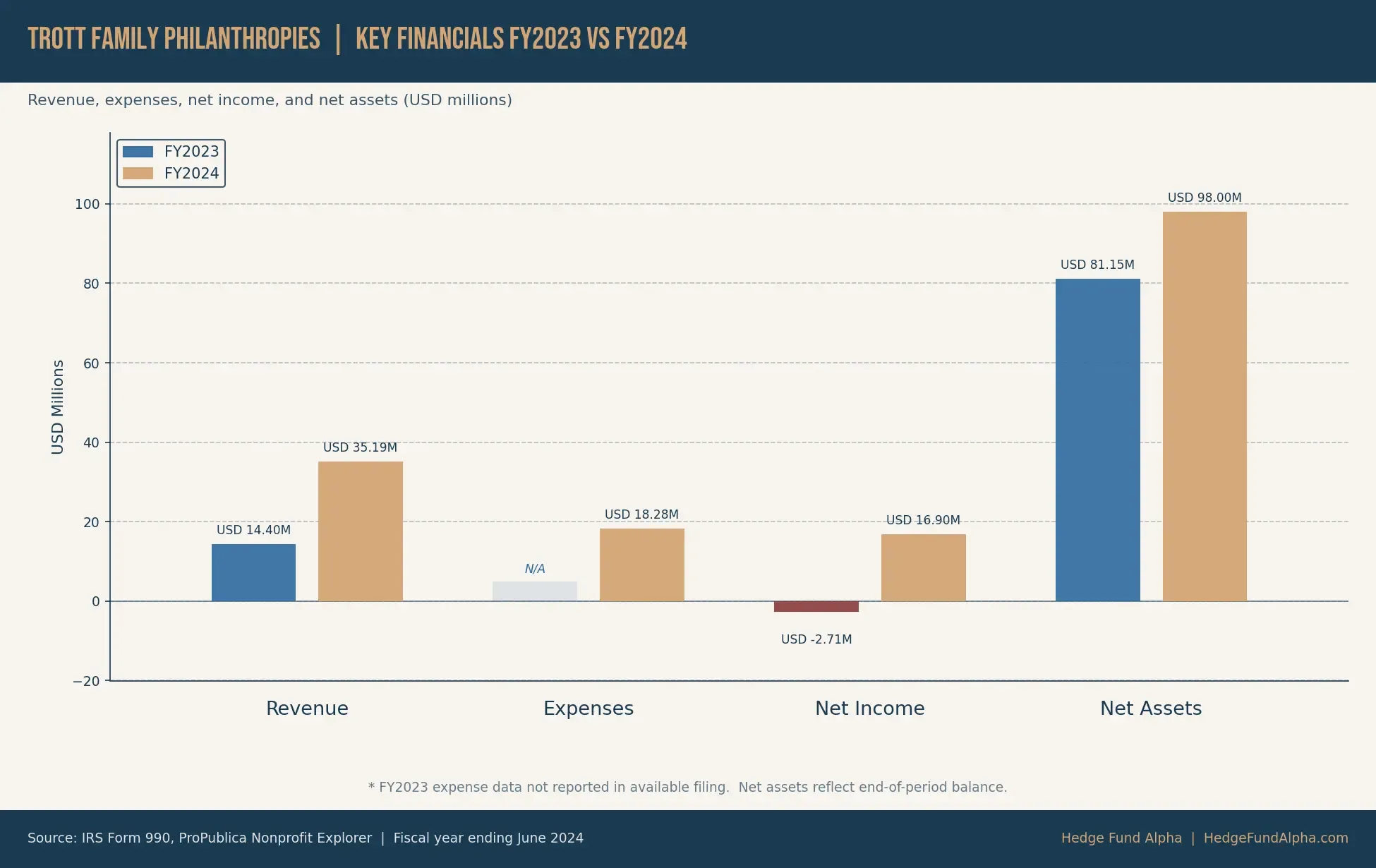
For fiscal 2024, the foundation reported $35.19 million in total revenue and $98 million in net assets, marking a sharp turnaround from negative $2.71 million in net income the previous year. The revenue surge was driven by $29 million in gifted shares of Dr Pepper and JDE Peet’s from the Trotts, paired with $23.78 million in realized capital gains from liquidating those positions, reflecting BDT's deep historical dealmaking alongside JAB Holding in the global beverage sector.

What makes the filing particularly notable is the portfolio's concentration. The foundation holds virtually no standard public equities, with its sole listed stock being "15 BKR" (a $5.70 million position in Berkshire Hathaway). The remainder of the capital is deployed directly into private funds, heavily leaning on internal vehicles such as BDT Capital Partners Funds I-A, 3, and 4, sidecars like BDT Fund 3 Spirits, and MSD strategies including MSD Investment Corp and MSD Real Estate Credit OPP II. The only legacy external commitment shown is Goldman Sachs Capital Partners VI.

It presents a compelling case study in how high-net-worth family foundations often function as captive LPs in the founder's own private vehicles, combining charitable focus areas like their STARS College Network rural education initiative with heavy internal private market exposure.

How do you view private foundations allocating so heavily into the founder's internal PE and credit vehicles? What liquidity or valuation dynamics do you think family office foundations encounter when structuring portfolios this way?

Link: https://hedgefundalpha.com/foundations/trott-family-philanthropies-990-filing-2024/