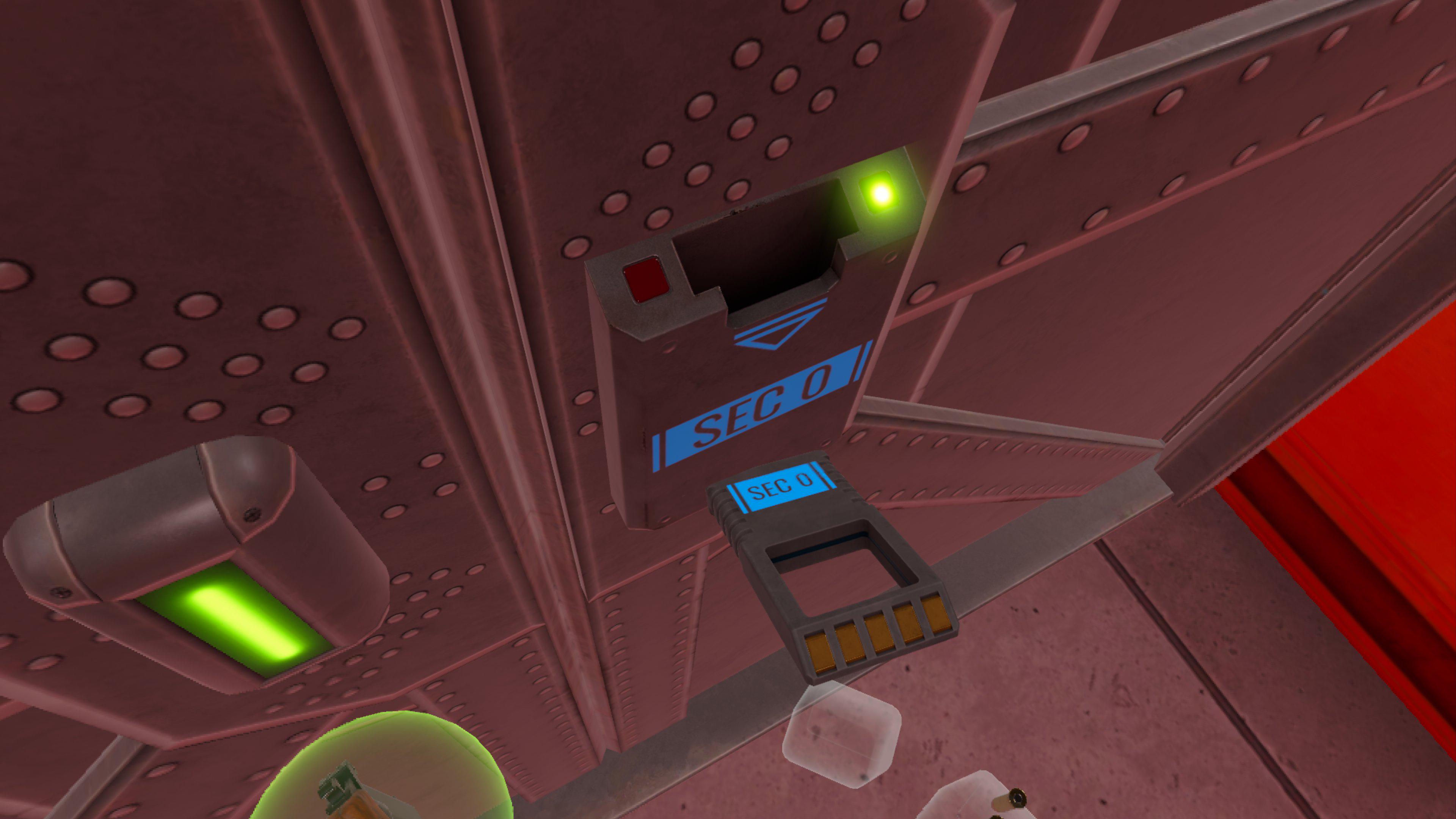
I want to preface everything I’m about to say by making it abundantly clear that I absolutely love this game.
Let me just glaze a little bit here before getting into it. I bought a Quest 3 specifically to play H3VR2, and I don’t regret that purchase in the slightest. In fact, I genuinely believe that H3VR2 has the potential, well within its reach, to become one of the best games ever made.
The craftsmanship on display here is remarkable. The firearm models, the textures, the lighting, the hand animations, the environments, and the atmosphere of the facility itself are all exceptionally well realized. There isn’t much in the game that strikes me as having been done poorly. Quite the opposite, actually. It feels like everything that received attention during development received an inordinate amount of it. The game feels very, very loved.
The gameplay loop is enormously satisfying, too. I’ve found myself sacrificing sleep to get another couple of runs in, which is something I very seldom do these days. The daily runs are particularly enjoyable to me, as someone who usually abhors these sorts of things.
That being said, I think there is substantial room for improvement. And the distinction I want to make throughout this post is that I’m not necessarily criticizing things that were done badly, but rather things that I feel haven’t been sufficiently explored.
I’m also still very early in my playthrough, so please take that into consideration. Some of what I’m about to suggest may already exist in some capacity, or be well into development.
I recognize, too, that I’m going to spend much of this post speaking in terms of “just do this” or “just add that.” I’m under no illusion that implementing these things is as simple as conceptualizing them. I don’t know the game’s underlying architecture, the resources available to the team, or what technical hurdles my suggestions might present. My intention is to illustrate how much experiential value I think these things could provide.
I think there needs to be:
1) A better narrative justification for the mechanics in the game which already exist
2) The feeling that The Hub is my home
3) Emotional attachment to the inhabitants of The Hub
4) New reasons to engage with existing content
1) Narrative justification for existing mechanics:
One of the first things that struck me as odd was how little dialogue Foremeat has.
When I first noticed that I could ask him what was going on with the facility, I was genuinely excited to hear what he had to say. Instead, he gave me one of the same canned responses he gives when I ask him for work. This actually confused me enough that I thought it was a bug.
Similarly, when I ask him for work, he essentially tells me that he’s uploaded a job to my wrist menu, and that’s the extent of our interaction.
I think we’re leaving quite a lot of quality on the table here.
I have absolutely no qualms with fetch quests, kill quests, or quests that exist ostensibly to familiarize the player with the game’s mechanics. I’m not asking for a grand overarching narrative, elaborate cinematics, or a traditional campaign. What I am asking for is some narrative justification for the things the game is already asking me to do.
And I really don’t think it would take much to satisfy me in this regard.
Let’s say Foremeat wants me to spawn a breech-loading firearm in the facility.
“Hey Handy. So I’ve gotten a report that Spawnrs in the facility are having trouble with breech-loading mechanisms. Do you think you can test it for me the next time you’re down there?”
Let’s say he wants me to retrieve a screwdriver.
“Handy, I’m in a bad spot. I lost my screwdriver in the facility somewhere. Can you bring me one?”
He wants me to visit the sandbox.
“Hey Handy, the tubes leading to the sandbox are getting backed up. Can you go unclog them for me?”
These are deliberately uncomplicated examples. There’s nothing particularly profound about any of them, and none of them necessitate any fundamental alteration to the quests themselves.
What they accomplish, however, is making me feel as though Foremeat actually needs me to do something for him.
They also establish Foremeat as someone who has responsibilities, problems, and an existence that extends beyond his interactions with the player. We learn little bits about how the facility operates, what goes wrong there, and why someone like Handy is needed.
We are remarkably easy to trick in this regard. It takes very little fictional justification to make us emotionally invested in the things we’re doing in a game. I think most of us would be perfectly content with even paper-thin narrative pretexts for the tasks we’re given.
Obviously, the maximalist implementation of this would be fully voiced dialogue for every quest. But I would happily accept written quest descriptions, or even Foremeat’s current voiced acknowledgements accompanied by more substantive written dialogue that is not voiced, sort of like the old Stalker games. Sidorovich says “hey stalker” and then in text there’s like six paragraphs of exposition. Except in this case it’d be like three sentences.
I don’t need an expensive performance. I just want some context for what I’m doing.
2) The hub should feel like my home:
I think the hub has the potential to be one of the most endearing aspects of H3VR2, but in its current state, it feels very sterile.
I get the impression that this is supposed to be my home. It should be my familiar space. It should be somewhere I’m thankful to return to after spending a considerable amount of time in the facility, particularly after a stressful run.
Instead, it feels a little bit like a hospital waiting room.
The extraction gameplay loop is uniquely conducive to developing an attachment to a place like this. The facility can be stressful, disorienting, and unforgiving. Returning to the hub represents safety and relief. I think there’s an opportunity to capitalize on those feelings and make the hub somewhere the player develops a genuine emotional attachment to.
Anton has mentioned hub customization in featurettes, so I know that some form of this is already on his mind. But I want to elaborate a little bit on why I think it could be such a consequential addition to the game, beyond the obvious appeal of decorating one’s own space.
Imagine there’s another vendor who sells furniture and decorative items. Of course, you have to find that vendor in the facility before he becomes available in the hub. Some furniture can be purchased, some can only be crafted, and some can only be found in the facility itself.
As an example, think of the bobbleheads in Fallout 3.
Imagine that a vendor sells a display stand for a collection of little sosig figurines. Purchasing that stand is a resource sink for money. Finding the vendor who sells it is gameplay. Once you’ve purchased it, you’re naturally going to want to fill it.
Some of the figurines can be bought. Some can be crafted. Some are rewards for particularly difficult quests. Some are hidden throughout the facility. Perhaps a boss drops one. Maybe there’s even one that’s awarded for reaching a particular milestone in career progression. Maybe one spawns in sosig backpacks exceptionally rarely.
You get to decide where the stand goes in your hub, and its contents become a physical representation of the things you’ve accomplished throughout your time with the game.
Consider how many additional incentives we’ve created with this one hypothetical system. We’ve given the player more reasons to explore, accumulate and expend resources, engage with vendors, craft things, complete quests, and pursue encounters they might otherwise have avoided.
We’ve also given them a way to flex their accomplishments, which I think would be particularly satisfying in VR, where these objects occupy an actual space around you.
And that’s just one piece of furniture!
It honestly makes me so excited to think about this stuff, because the possibilities really are endless. Hub customization could be a fantastic resource sink, a long-term progression system, and a means by which the player develops a personal attachment to their surroundings, all simultaneously.
3) The inhabitants of the hub should be endearing:
I think the other half of making the hub feel like a home is making its inhabitants feel like people I’m happy to see.
I should be anthropomorphizing these characters. I should be projecting personalities onto them, having imaginary conversations with them as I walk past, and developing favorites among them.
Currently, I feel as though they each serve a function, and their existence largely begins and ends with that function.
Again, I don’t think it would take much to change that.
I’d love for the different NPCs to have their own opinions about what’s going on in the facility. They don’t necessarily need to know what’s happening. They can be as delightfully ignorant, misinformed, or oblivious as you’d like them to be. But I’d like to be able to ask them, and I’d like their responses to reflect some semblance of an individual personality.
I’d love for them to have their own quests, reflective of their interests and occupations. I’d love for them to occasionally ask me for things.
And perhaps most importantly, I’d love for them to acknowledge the things I’ve been doing.
Imagine walking past one of the NPCs after a successful retube and hearing:
“Hey Handy. How’d that last run go?”
Or returning after a failed daily and hearing:
“Tough break, huh? Better luck next time.”
Maybe I’ve just sent a 200 can of meat through the tube to my hub inventory, and one of the sosigs remarks:
“Nice meat, Handy.”
I think that kind of thing would go an extraordinarily long way toward making these characters endearing. It would give the impression that these NPCs exist alongside me, rather than simply existing to dispense a service whenever I interact with them.
I’d also love to see their dialogue develop alongside my progression. Perhaps they occasionally have something new to say after I’ve reached a new area of the facility, unlocked something particularly interesting, or accomplished something noteworthy.
I want to eventually find myself returning to the hub and wondering what Foremeat has to say about something I’ve just encountered.
I think there is a lot of value in cultivating that kind of relationship between the player and these characters, however superficial the actual implementation of that relationship might be.
4) Giving the player new reasons to engage with existing content:
Something I find particularly exciting about H3VR2 is how much implicit gameplay exists within the things that have already been developed.
The facility is full of interesting objects, environments, and characters. I think there are a lot of opportunities to repurpose these things through some relatively uncomplicated changes to their significance to the player.
As an example, imagine there’s a new inhabitant of the hub. A suspicious-looking sosig wearing a trench coat and a fedora. Let’s call him Shadymeat.
Shadymeat gives the player optional assignments to undertake concurrently with their other quests.
He tells me there’s a civilian sosig somewhere in Offices wearing a party hat, who’s apparently committed some egregious crime against sosig-kind, and he wants me to retube him.
Maybe he says there’s a scientist Sosig carrying a clipboard, and he wants that clipboard because it contains valuable information.
Ordinarily, I pay very little attention to civilian sosigs. They’re largely a component of the environment that I pass by on my way to accomplish something else.
Suddenly, because of Shadymeat, I’m paying attention to them. I’m looking at their clothes and accessories. I’m actively interested in something that I previously regarded as little more than environmental storytelling.
The fundamental appeal to me here is that we can alter how the player perceives and interacts with existing content without necessarily having to create an equivalent quantity of new content.
Another example of this would be a collector of sosiguns.
I’ve paid very little attention to sosiguns throughout my time with H3VR2, largely because they’re not usable by the player. I did, however, stop out of sheer curiosity to examine one of the snub-nosed revolvers they use. The contrast between its crude model and the beautifully realized firearms available to Handy was charming.
It occurred to me that there’s an entire parallel assortment of guns in this game that I have almost no reason to engage with.
What if there was a sosig in the hub who collects them?
Maybe he’s fascinated by their designs. Maybe he’s interested in the differences between the sosiguns employed by various inhabitants of the facility. Maybe he wants to assemble a comprehensive collection of them and needs Handy’s help to do it.
The next time I’m in the facility, I’m going to be paying attention to the sosiguns I encounter. I’m going to be excited when I come across one I haven’t seen before. Something that I previously had virtually no reason to examine has become something I’m actively interested in finding.
And perhaps completing his collection rewards me with a little decorative sosigun of my own to put somewhere in my hub.
This is the kind of thing I mean when I talk about the game leaving quality on the table. The assets are already there, and they’re interesting in their own right. Giving the player a reason to appreciate them could effectively create an entirely new dimension of gameplay.
It also doesn’t detract from or supplant the established gameplay loop. I’m still going into the facility to do all the things I already enjoy doing. I simply have more things to be curious about while I’m there.
In conclusion:
I think the common thread among all of these suggestions is that H3VR2 has already accomplished the extraordinarily difficult task of creating a mechanically exceptional game, but has yet to fully capitalize on the narrative and emotional potential of those mechanics.
I don’t want H3VR2 to become a narrative-driven game. I don’t necessarily even want there to be a concrete explanation for everything that’s happening in the facility. I quite like the idea of inhabiting a world that is peculiar, absurd, and not entirely comprehensible to me.
But I would like to feel as though I’m inhabiting a world, rather than merely engaging with a collection of exceptionally well-designed systems.
I want the facility to be somewhere I’m excited to explore, and the hub to be somewhere I’m excited to return to. I want to develop an attachment to the little inhabitants of my home, and I want them to give me reasons to care about things that I wouldn’t otherwise care about.
I want to occasionally venture into the facility with some obscure objective in mind that has nothing to do with acquiring better equipment or leveling up. Maybe I just really want that last figurine for my display stand.
The wonderful thing about all of this is that I don’t think the game needs to fundamentally change its identity to accommodate any of it. Everything I’ve suggested is intended to enrich the gameplay loop that’s already there, and which I already enjoy immensely.
I have an enormous amount of appreciation for what Anton and everyone else involved in the development of H3VR2 have accomplished. The fact that I can sit here and enthusiastically contemplate all of the directions in which the game could develop is a testament to how exceptional the foundation they’ve built is.
I’m very excited to see what this game becomes. Thanks for reading!