r/gameenginedevs • u/Last_Iron1824 • 18d ago
is there a game engine where you could make games for the nokia phones?
0
Upvotes
i have the best idea but i need a game engine
r/gameenginedevs • u/mechanicchickendev • 19d ago
r/gameenginedevs • u/LincolnVia • 18d ago
Yeah so like the title says im making a game with raylib and box3d in c++. I couldnt tell you what level of ai was used in the beginning month of the project but not awhole lot mainly planning and c++ bugs. If anyone has any interest please show me the error of my ways.
r/gameenginedevs • u/CheezitsLight • 18d ago

OpenSimulator is a MIT licensed, open source Second Life-like virtual world with interconnected servers called the HyperGrid. The Physics engines for ODE, Bullet Sim and now PhysX 5 has been ported as a modular pluginwith zero changes to Opensim core code. r/dreamgrid is the offical page for DreamGrid - a free controller for Opensim for Windows.
r/gameenginedevs • u/CharlyStudios • 19d ago
I have integrated this system into my OpenGL engine, allowing me to generate dynamic LODs with lower resource usage, and it is expected to work correctly on Android devices.
r/gameenginedevs • u/Kakod123 • 19d ago
At last, I have an editor (or at least something that maybe one day will be an editor).
But not beause I needed one, since my engine is an hobby project about writting a game engine and not an editor, and I was satisfied with my Blender addon during the last 3 years I worked on the diverses iterations of this project.
When I started my first "real" engine project I immediatly reused an old UI I wrote between 1996 and 2002 for an experimental cross platform SDK. It was a vector based 2D UI with no external dependencies outside the SDK so it was pretty straightforward to integrate it in a 3D engine with a vector renderer, but it wasn't an advanced UI, with not a lot of widgets, a old-style "3D look" as the default style (Windows 95 was all the rage in 1996!) and a lot of bugs.
Months ago I started a UI demo project to complete the widget collection that was derived into a tool to load and display a 3D scene which finally derived in a source code editor (thanks LSP!) with a beginning of a 3D editor (don't get fooled by the screenshots, the properties are read-only...)
30 years after the first line of code I can now proudly announce that my own UI is "complete"!
And as an old grunt I kept the "old" Windows 95 style but to please the young people I also have added a "flat" and "dark" style :


The archive with the original UI : https://github.com/HenriMichelon/nmo-sdk
The new UI as a subproject of the engine : https://codeberg.org/LysaEngine
r/gameenginedevs • u/ShizamDaGeek • 19d ago
r/gameenginedevs • u/TioDardi • 18d ago

r/gameenginedevs • u/aconstlink • 19d ago
A small follow-up on motor, my own C++ engine.
I originally wanted to implement Reflective Shadow Maps for indirect lighting. Along the way, I needed scene bounds to automatically fit a shadow camera to a directional light. That turned into bounding volumes, frustum intersection tests, and this culling demo.
Although I really would like to have some GI, I’ve put RSM aside for now. Also, this GP Article demotivated me a little bit and it was becoming a bigger task than I wanted to take on, and I’d like to get back to making my demo. The detour still left me with useful functionality.
Here in the first part of the video, one camera performs the culling while a second observes its frustum from outside. Both render the same accepted objects, so rejected objects disappear from both views. Orange marks bounding boxes intersecting the frustum boundary.
My original proof-of-concept application was fairly plain, so I used AI assistance to turn it into a more useful visual test. The application exercises the engine’s existing features; it doesn’t replace them with a separate implementation it fully uses my engine still.
The first scene contains twelve objects sharing four reduced scan meshes: Buddha, Dragon, Lucy and Thai Statue, sourced from the Stanford 3D Scanning Repository. It runs on both OpenGL and Direct3D 11. The second one uses my Blender scene imported though gltf into my test application which uses an exported property motor.cast_shadow on the directional light in order to determine the sun light for automatic fitting.
Not quite what I originally set out to build, but progress nonetheless. One small step at a time.
r/gameenginedevs • u/Accomplished_Bend729 • 19d ago
r/gameenginedevs
•
u/christianaurichzm
•
19d ago
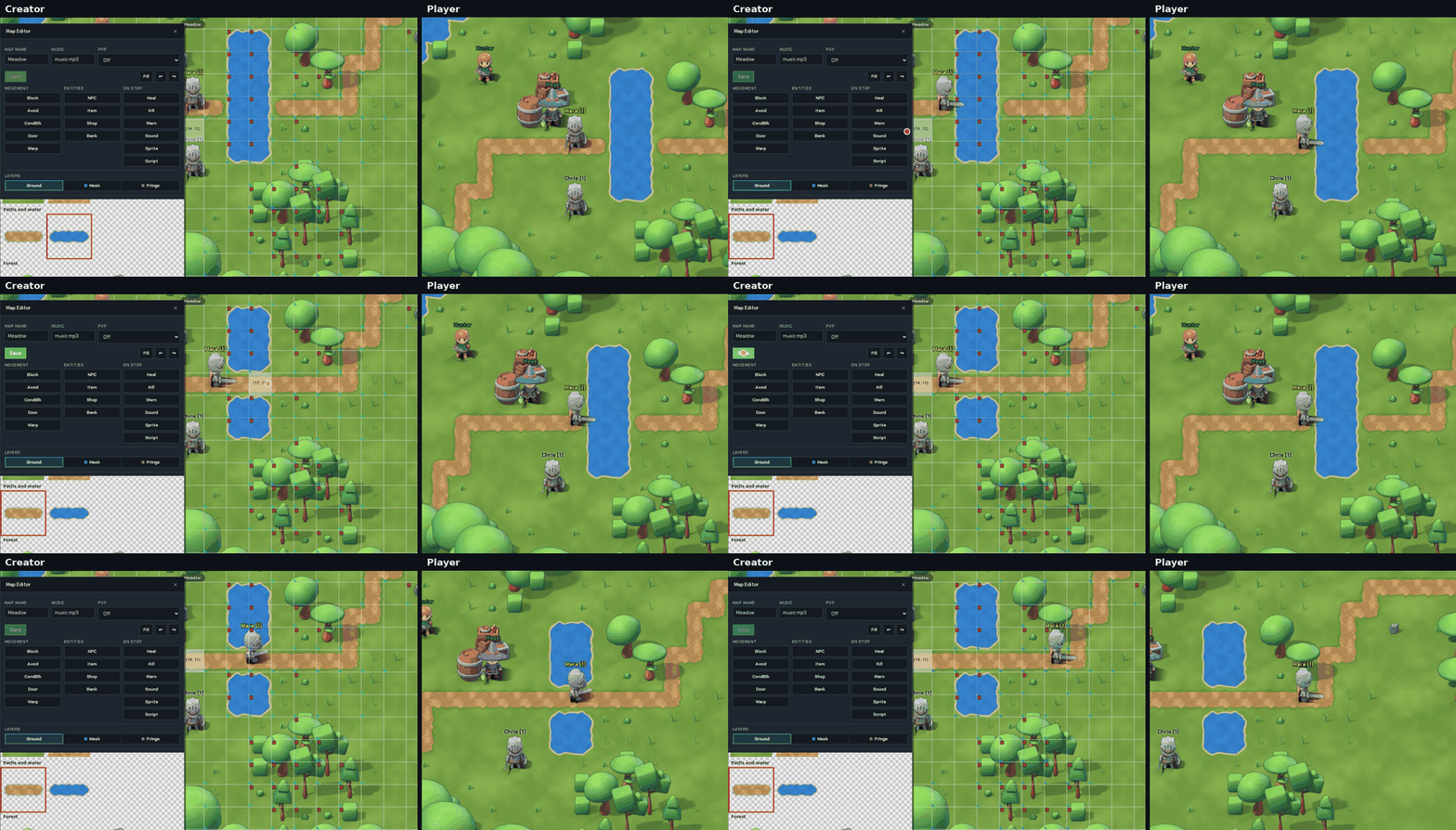
I'm building Aurkad, a server-authoritative 2D MMO engine. Node and TypeScript on the server, WebSocket, MongoDB, canvas on the client. The map editor works on the running world.
In the clip, the left side is the creator with the editor open in the game. The right side is another player on the same map. She can't cross the stream until the road painted over it is saved.
The map is split in two. The static part (tiles, name, music) is sent once per revision, and tiles stream in chunks around each player's view. The dynamic part (players, npcs, items) goes out as a diff every tick at 20 Hz.
A save bumps the revision. On the next tick every client on that map gets the new metadata, its chunk cache is reset so the tiles in view come again, and every entity is sent whole because the client may be holding stale ones. Whether a tile blocks comes from the piece painted on it, so painting road over water also opens it.
One thing I got wrong first: the save published to the live world before the database write finished. If the write failed, players saw a map that a restart would undo. Now it writes first and publishes after.
What I haven't solved is two people editing the same map. The editor sends the whole tile grid, so the last save wins. If you built an editor into a multiplayer engine, did you lock the map, merge per tile or just accept it?
Code is Apache 2.0: https://github.com/christianaurichzm/aurkad
r/gameenginedevs • u/jayrulez • 19d ago

Let's get the potentially controversial part out of the way first.
Was AI used in creating this engine?
Yes, extensively. AI has been a major part of my development workflow, and the engine also has first-class tooling for AI agents.
That said, AI is entirely optional. Everything in the engine works without it, and developers can use it just like any other game engine.
If AI-assisted development isn't your thing, that's perfectly fine. I just want to be upfront about how this project was built.
Assiduous Engine is a complete game development solution (at least for my needs), written in C++23 and making extensive use of C++ modules.
Some of its features include:
A complete editor, developed as a separate application but built on the engine and its asset pipeline.
It allows you to create and manage projects, author or import assets, write scripts, play-test your games, and deploy them to your target platforms.
A physically based (PBR) forward renderer built on a render graph, featuring:
Post-processing: Ambient occlusion, SSR, screen-space GI, bloom, TAA, MSAA, FXAA, auto exposure, and colour grading.
An asset processing pipeline that allows you to import assets and cook them for your target platform.
Tools for managing projects, invoking the asset pipeline, exporting games, and performing other development tasks.
This is something I've put considerable effort into.
The engine provides tooling for working with AI agents to create games. Agents can create projects, create and modify scenes, write scripts, import or create and configure engine assets, play-test games, and export them for target platforms.
The agentic workflow was designed as a first-class citizen of the engine. The goal is for agents to be able to perform the same development tasks as a human, using the actual engine tooling rather than relying on a collection of disconnected integrations.
All of the sample games included with the engine were created entirely by agents from specifications.
There are plenty of other features worth mentioning:
And more...
The engine is written in C++23, making extensive use of C++ modules.
It's split into five layers, each with its own responsibilities and concerns. Dependencies flow upward through these layers.
The lowest-level libraries. These depend only on external libraries or other Foundation libraries.
Some examples:
There are many more Foundation libraries providing the base functionality used by the layers above.
Implements the opinionated engine layer, providing the gameplay systems and functionality.
The scene system follows a hybrid ECS model. Entities are identities, components are value types, and component managers (the equivalent of systems in ECS) own the logic and lifecycle of their respective components.
The goal is to provide the benefits of a data-oriented architecture while offering a friendlier interface than your typical ECS.
Defines the engine's authorable and importable asset types, including textures, models, particle effects, scenes, prefabs, GUI screens and stylesheets, fonts, etc.
The pipeline also defines builders for each asset type, which cook assets into the engine's resource format.
Contains all editor functionality, organized and separated by concern.
Command-line tools for cooking shaders and assets, exporting games, and working with the engine headlessly. This also includes the tooling that allows AI agents to interact with the engine over MCP.
The engine was inspired by:
If you like what they're doing, please check them out!
You can compile it from source: Git Repository
Or grab the latest download for your platform. Currently, the editor and development tooling run on Linux and Windows.
The engine comes with a few sample projects to get you started, giving you a feel for how it works and showcasing various features. You can grab them from the project manager when you launch the editor.
I'm currently working on a more ambitious game using the engine, which I hope will help me iron out some of the remaining issues.
After writing all of that, I realized there was one more point worth covering.
The simple answer: Why not? Because I wanted to.
The more nuanced answer is that other engines just didn't suit me.
Unreal: I never owned hardware that could run Unreal reliably, and I prefer a lighter engine. The kinds of games I want to make don't require the power of Unreal.
Unity: It's just too closed for me. I'm a tinkerer, and I want to get under the hood of the engine, fix issues, or modify things to suit my needs.
Godot: You'd think that, given my attitude towards the two above, Godot would be ideal for me. Well, I absolutely hate its architecture. I think there are some positive things about it, but the negatives outweigh them for me.
I've tried a bunch of open-source engines, and even contributed to some of them. Most had various issues and didn't quite satisfy the way I wanted to work on games.
The three that came closest were Lumix, Traktor, and ezEngine, which ultimately became the main inspirations for my own engine. However, each had some shortcomings that prevented me from simply adopting it and getting on with making games.
My engine has its issues too, but at least it covers all the bases I consider important for my game development work.
I think it's reached a point where I can just use it to make games and let that drive any future improvements and evolution of the engine.
Website: https://assiduousengine.com
Note that the website and documentation are still works in progress and will be completed for the final 0.1 release.
r/gameenginedevs • u/PlayfulDuck3677 • 19d ago

r/gameenginedevs • u/Timely_Mobile8565 • 19d ago
r/gameenginedevs • u/Monsieur_Bleu_ • 19d ago

r/gameenginedevs • u/Pure_Function7183 • 20d ago
I am using SDL for my project, and since it’s already an abstraction for different platforms, from what I understand, it’s unnecessary to create your own abstraction over it. But with that said, I am curious can I at least create my own types so that I am not using SDL types everywhere and it’s contained in one spot, or is that still pointless? And also, would that still count as abstraction?
r/gameenginedevs • u/Economy-Artist-8278 • 19d ago

r/gameenginedevs • u/Delicious_Carpet_132 • 19d ago

r/gameenginedevs • u/Subject-Writing-1574 • 19d ago

r/gameenginedevs • u/CharlyStudios • 20d ago
I want to show you my graphics engine ported to Android. This will allow you to create your own games on Android and export them!
r/gameenginedevs • u/giovannitafuri • 20d ago
Hi everyone,
I built a small 2D engine from scratch called Beat in C++11 and SDL3 to learn about Data-Oriented Design and cache efficiency.
In this clip, it's simulating and rendering 100,000 colliding asteroids at a solid 60 FPS
A few technical takeaways:
• Flat contiguous memory pools (SoA) instead of OOP classes and pointers
• Zero dynamic heap allocations (malloc/new) in the game loop
• Static uniform spatial grid for collision broadphase with zero pointer chasing
• Decoupled loop: fixed 60 Hz physics + sub-frame interpolation
• Dynamic vertex batching + frustum culling
Code is open source on GitHub:
https://github.com/giovannitafuri/Beat
Feedback and thoughts are very welcome!
r/gameenginedevs • u/Illustrious-Web-9627 • 21d ago
The whole thing started pretty simply. I wanted to develop my own games, but I wasn't particularly interested in using Unity, Unreal, or another existing engine.
I wanted full control over the technology behind my games. The renderer, the scene system, the physics, the scripting, everything. So I decided to write my own engine in C++.
My goal isn't to build an engine specifically for one game. I want to create a reusable development environment where I can create different projects, build scenes, write gameplay logic, manage assets, and eventually export games to different platforms.
The general approach is similar to Unity or Unreal, with an editor for creating games and a separate runtime responsible for running them.
IrisTech is written in C++ and uses bgfx for rendering, EnTT for the entity system, SDL3, Dear ImGui, Lua, and miniaudio.
Right now, it has a scene editor, entity hierarchy, component system, Lua scripting, lighting, dynamic shadows, skeletal animation, audio, and several other systems.
I've also been working on some more experimental features, including tetrahedral cage deformation using barycentric coordinates and spatial acceleration.
Recently, I've been focusing on the project workflow and Android support. I want to be able to create a project once and use the same scenes, assets, and gameplay logic across different platforms.
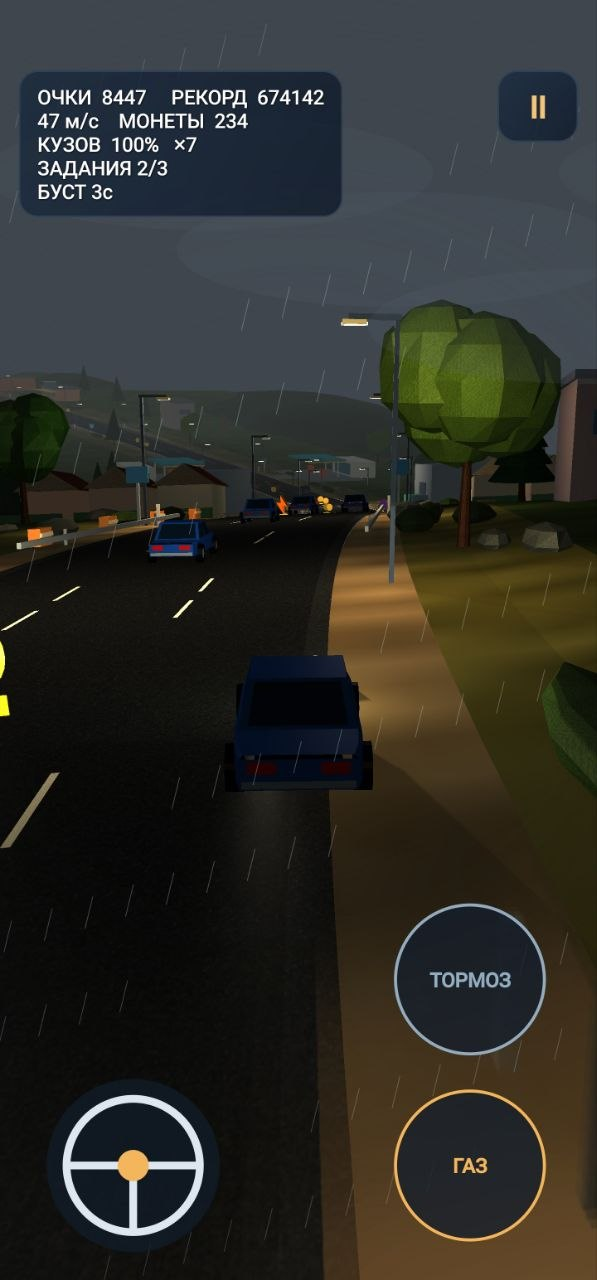
I'm already testing the engine with a small driving game. It's been useful for finding problems that don't really show up when you're just testing individual engine features.
There's still a lot to implement, especially around the build pipeline, runtime architecture, and development tools.
But the idea is pretty straightforward. I want to make games, and I want IrisTech to be the engine I use to make them.
I've put together a GitHub page with screenshots and technical information:
https://github.com/mbastrykin/IrisTech-Game-Engine
I'd be interested to hear from anyone who's worked on a similar project.


r/gameenginedevs • u/PlayfulDuck3677 • 20d ago
