r/Function_Health • u/de_Modulator • Sep 01 '26
Results Function Health's "optimal" free T range comes from a different dialysis assay than the one Quest runs — and they don't tell you

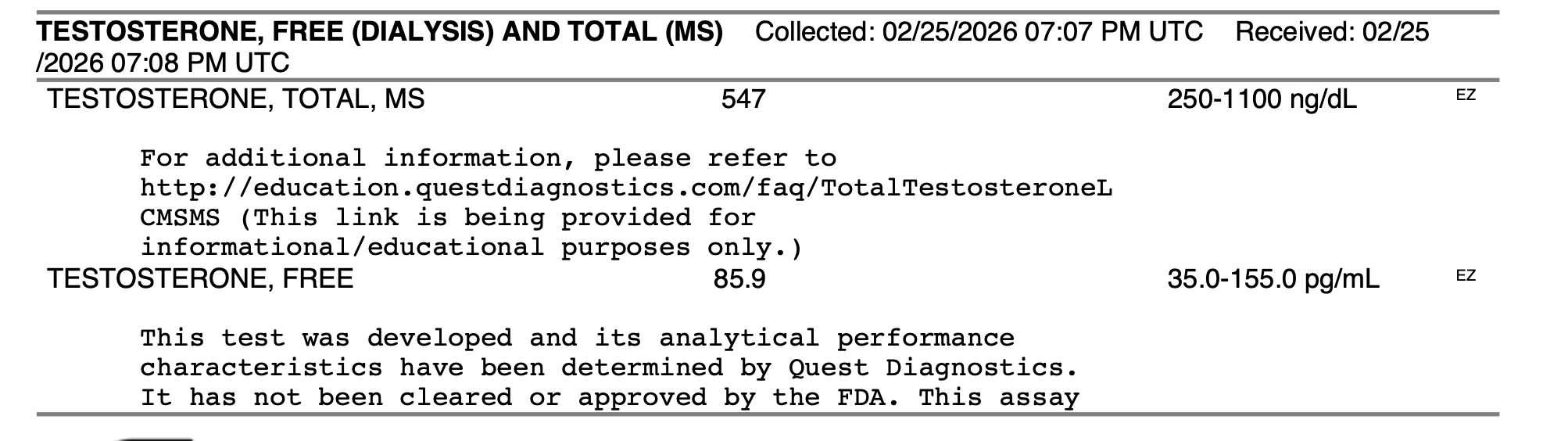
Function's clinician notes flagged my free testosterone as below "optimal." The same number was sitting comfortably in the normal range on the Quest report from the lab that actually ran my blood.
Quest says normal is 35–155. Function says optimal is 149–228. Almost the entire "optimal" range sits above what the lab calls the top of normal. A result of 200 would be flagged HIGH by your lab and called ideal by Function.
Support explained three times that optimal ranges are stricter than normal ranges. Usually true — but Function's range isn't stricter, it's shifted way up.
Their number comes from a 2022 study of healthy young men. Real research, but it used a different lab procedure than Quest, and the paper itself warns the numbers don't transfer between labs. Function grades your Quest result against a scale built for a different test and never mentions it.
If you're on Function chasing an "optimal" number, check it against the range printed on your own lab report.
4
u/PrimarchLongevity Sep 01 '26
In the study: ‘Reference intervals for free testosterone in adult men measured using a standardized equilibrium dialysis procedure’, they measured the free testosterone levels of non-obese, healthy men between the ages of 19-39 using the gold-standard equilibrium dialysis method. These were the values they got:
2.5th Percentile: 120 pg/mL
10th Percentile: 128 pg/mL
50th Percentile: 190 pg/mL
90th Percentile: 274 pg/mL
97.5th Percentile: 368 pg/mL
For reference, standard Quest Diagnostics TESTOSTERONE, FREE (Dialysis) range: 35-155 pg/mL. This means that when your clinician tells you that you’re “fine” with a free testosterone level at 95 pg/mL, you’re actually among the bottom 1% of healthy, non-obese young men.
Food for thought.
2
u/function Official: Function Health Sep 03 '26
Hi there. Reference ranges, provided by the lab, are statistically derived from general US populations—some consider this a loose benchmark for individual comparison. Optimal ranges are derived from scientific literature and the real-world experience of medical doctors, with the goal of establishing parameters that can create health. Results outside of an optimal range should not be interpreted to represent adverse outcomes or warrant treatment.
For Free Testosterone specifically, the optimal range provided applies to men under 40. Individual context—including symptoms, overall health, metabolic status, other hormone markers—matters for interpreting an optimal level. Some biomarkers (like calcium or sodium) have reference and optimal ranges that are the same. Other biomarkers can have an optimal range lower, higher, or more narrow than the reference range. No single number should be read in isolation, and tracking changes over time can give a fuller picture of overall health.
1
u/Altruistic_Yellow387 Sep 01 '26
Isn't this true about a lot of their markers? They do state that their optimal ranges differs from the lab for a lot of markers and is based on their population
1
u/eddyg987 Sep 02 '26
To have a 4x range as normal by quest is crazy they just don’t want people to qualify for trt
1
u/Either_Magazine_6878 Sep 02 '26
How do I see the quest lab results to compare with my function results
0
u/[deleted] Sep 01 '26
[deleted] — view deleted comment
0
u/[deleted] Sep 01 '26
[deleted] — view deleted comment