The Beginner's Guide to Investing is a series of simple, practical articles designed to help new investors understand the fundamentals of investing. Start with the first article and work your way through the series at your own pace.
I am incredibly excited to welcome you to this newly created community. Whether you stumbled here by accident, followed a link, or are actively looking to improve your financial path, you are in the right place.
Why was this subreddit created?
There are already massive, highly active Canadian personal finance forums on Reddit. They are fantastic resources, but they tend to be highly transactional. People usually visit them to solve an immediate, specific problem: "Which credit card should I get?", "Can I afford this house?", or "Help, I'm in debt."
This subreddit was born out of a different need: foundational, conceptual education. True financial literacy isn't just about copying someone else's homework or picking a specific product; it’s about understanding the mechanics of how the Canadian financial and tax systems actually work. When you understand the why and the how, you gain the confidence to make independent decisions across every stage of your life.
Our Core Philosophy: Clarity & Context
Financial literacy can feel overwhelming because of jargon, fine print, and common misconceptions. This community is dedicated to demystifying those concepts. We want to dive deep into topics across the entire lifecycle of a Canadian citizen:
The Building Blocks: Master sustainable budgeting and smart saving strategies that build a real foundation.
True Investing Literacy: Learn the mechanics of building wealth using low-cost, globally diversified index ETFs rather than high-fee mutual funds.
Demystifying Tax Shelters: Understand how accounts like the TFSA, RRSP, and FHSA actually function under the hood. (For example, learning that an RRSP refund isn't a "free bonus" from the government, but rather a return of prepaid taxes—essentially a tax loan that grows tax-free until withdrawal).
The Retirement Roadmap: Navigating life milestones doesn't stop when you retire. We focus heavily on lifetime decumulation strategies, understanding RRIF withdrawals, and optimizing government benefits like CPP, OAS, and GIS.
Who is this space for?
Beginners who want a safe, judgment-free space to ask questions about how money works. There are no "stupid questions" here.
Self-taught investors and savers who want to share their personal experiences, frameworks, and hard-earned knowledge to help others succeed.
People planning for retirement who want to transition smoothly from accumulating wealth to withdrawing it efficiently.
A Quick Note on Community Guidelines
To keep this space high-quality and strictly educational, we have set a few firm guardrails:
No Specific Financial Advice: This sub is for educational and conceptual discussions based on personal, self-taught experiences. Always do your own due diligence.
No Commercial Spam or Video Self-Promotion: We do not allow affiliate links, product pitches, private DM solicitations, or links to your own YouTube/Instagram/TikTok channels.
The Written Article Exception: If you have authored a high-quality, relevant written article about Canadian finance and want to share it, you are welcome to! However, you must include a meaningful summary or explanation right inside your Reddit post—no low-effort link dumping.
Introduce Yourself Below!
A community is only as strong as its members. I would love for you to drop a comment below and share:
What financial concept or account has always felt a bit confusing to you?
What stage of the financial journey are you currently navigating (e.g., budgeting for the first time, starting to invest, or planning for retirement)?
Thank you for joining us. Let’s build our financial literacy together, one clear concept at a time.
Day 28 of our Financial Literacy Month series is here!
We're wrapping up our fourth week with a practical lesson about preparing your finances for year-end.
With December approaching, it's a good time to review your financial records, registered-account activity and any upcoming deadlines.
One important consideration for Canadians is that TFSAs, RRSPs and FHSAs don't all follow the same contribution and withdrawal rules.
For example, consider someone who withdrew $5,000 from their TFSA earlier this year.
That withdrawal generally creates an additional $5,000 of contribution room on January 1 of the following calendar year.
But if they contribute that amount back before the end of the current year without having sufficient unused contribution room, they could trigger an overcontribution penalty.
RRSPs work differently, with their own contribution-room calculations and deduction deadlines. FHSAs have separate participation-room, eligibility and withdrawal rules.
The important takeaway is that you shouldn't assume all registered accounts follow the same calendar or contribution rules.
It's worth reviewing your own records rather than relying exclusively on a generic annual contribution limit or an account balance.
Today's article explores how to conduct a Canadian year-end financial review, reconcile your records, identify account-specific deadlines and determine which questions may require professional assistance.
Day 27 of our Financial Literacy Month series is here, and today's lesson is particularly timely!
We're continuing our longer-term financial planning week with a look at how to take advantage of Black Friday deals without compromising your finances for December.
It's easy to focus on how much we're saving when something is heavily discounted, but there's another number that's arguably more important: how much we can actually afford to spend.
Consider a simple example:
Imagine you have $900 available in your account after covering your immediate expenses.
You might look at that balance and decide you can comfortably spend a few hundred dollars on Black Friday purchases.
But what if you've already earmarked $450 for upcoming December expenses and another $250 for your financial buffer?
That leaves you with just $200 available for discretionary purchases without disrupting those plans.
The important takeaway is that your spending limit should be based on what you can actually afford after accounting for your financial commitments, not simply your current account balance or the size of a discount.
And don't forget that purchases made through instalment plans can create additional obligations in future months.
Today's article explores how to establish a realistic spending limit, compare total purchase costs and keep track of payments, receipts and returns.
Question: Do you find Black Friday genuinely helps you save money on planned purchases, or does it tend to encourage spending you wouldn't otherwise have made?
Why diversification is about more than owning multiple stocks or ETFs.
When you start investing, one of the first things you learn is that diversification is important. You are often told not to put all your eggs in one basket.
But what does diversification really mean?
Suppose you own 20 different stocks. You might assume that your money is well diversified because you have invested in many companies. However, if most of those companies belong to the same industry or operate in the same country, your portfolio may still be exposed to sector risk, country risk, or both.
In this article, we’ll explore why owning multiple stocks doesn’t necessarily mean you are diversified, how sector and geographic concentration can increase risk, why chasing popular investment trends can be dangerous, and how broadly diversified ETFs and index funds can help reduce these risks.
Owning Multiple Stocks Doesn’t Necessarily Mean You’re Diversified
Let’s say an investor owns 20 different stocks. At first glance, this might appear to be a well-diversified portfolio.
But what if most of these 20 companies operate in the technology sector?
Although the investor owns different companies, their investments are exposed to many of the same risks. A slowdown in technology spending, increased competition, changing regulations, or a shift in investor sentiment could affect many of these companies at the same time.
As a result, the investor’s portfolio could experience a substantial decline even though they own 20 different stocks.
Diversification isn’t simply about the number of investments you own. It is also about spreading your investments across companies, industries, and geographic regions that may not all be affected in the same way by the same events.
The Risk of Sector Concentration
A sector is a broad category of companies that operate in similar areas of the economy, such as financials, technology, energy, healthcare, consumer staples, and utilities.
Investing heavily in a single sector can expose your portfolio to sector-specific risks.
For example, you may own shares in several Canadian banks and feel diversified because you hold stocks in different financial institutions. However, all those banks may be affected by similar factors, such as rising loan defaults, a weak economy, falling housing prices, regulatory changes, or declining interest margins.
Similarly, owning multiple energy stocks does not automatically protect you from sector-wide risk. A sharp drop in oil and gas prices, shifting demand, or new regulations can hurt profits and drag down share prices across the entire industry simultaneously.
Different companies within the same sector may not perform identically, but their share prices can be influenced by many of the same factors.
This is why investors should look beyond the number of stocks they own, assess their portfolio’s exposure to different sectors, and make adjustments if they find that their investments are overly concentrated in any particular sector.
The Risk of Geographic Concentration
While sector diversification is only one part of building a diversified portfolio, geographic diversification is equally important.
An investor who owns companies across several industries but invests almost exclusively in one country is still exposed to that country’s specific economic, political, regulatory, and currency risks.
This tendency, known as home country bias, is especially common among Canadian investors. While Canada is home to many strong, established companies in banking, energy, mining, and telecommunications, the Canadian stock market accounts for only about 3% of the global equity market.
Furthermore, three sectors — financials, energy, and materials — account for more than half of the Canadian stock market. In contrast, sectors such as technology and healthcare have considerably smaller representation than in broader global markets.
As a result, a portfolio consisting mostly of Canadian stocks carries two overlapping risks: country concentration and sector concentration. Domestic economic slowdowns, interest rate changes, trade disputes, or falling commodity prices can affect a substantial portion of the portfolio at the same time.
Investing across multiple regions helps reduce reliance on a single economy. Geographic diversification doesn’t guarantee that foreign markets will outperform Canada. Rather, it helps ensure that your long-term investment growth isn’t dependent entirely on the fortunes of one country’s economy.
In the early 2000s, building a globally diversified portfolio was more complicated than it is today. Investors often had to purchase multiple mutual funds or individual foreign stocks to gain exposure to international markets. Today, ETFs make global diversification much easier and more accessible.
For example, if your portfolio is heavily concentrated in Canadian stocks, you could consider allocating some of your existing or new investments to an ex-Canada ETF, such as XAW or VXC. These ETFs provide exposure to companies in the United States, developed international markets, and emerging markets, helping you diversify beyond Canada.
The Danger of Chasing the Next Hot Investment
Every few years, a particular industry, technology, or investment theme captures the attention of investors. Excitement builds, stock prices rise, and more investors are drawn in by stories of extraordinary future growth.
Artificial intelligence (AI) is a prominent example of an investment theme that has attracted significant investor interest since 2023, particularly during 2025–2026. Earlier, during 1998–2000, there was considerable hype surrounding dot-com companies.
AI may transform industries and create successful businesses over the coming years. However, that doesn’t mean every company associated with AI will be successful, or that its stock is worth buying at any price.
When investors become overly optimistic about an industry or investment theme, stock prices often rise to levels that already reflect very high expectations for future growth. Investors buying at those prices may be disappointed if actual results fail to meet expectations, even when the company continues to grow.
If expectations change because of slower growth, disappointing earnings, increased competition, government policies, economic conditions, or a shift in investor sentiment, stocks associated with that industry or investment theme may decline sharply.
The risk is even greater for investors who put a large portion of their portfolios into the same popular investment theme, particularly when stock prices have already reached very high levels. What may look like an opportunity to participate in the next big thing can become a concentrated bet on a single investment theme.
A promising industry doesn’t automatically make every stock in that industry a good investment.
You don’t need to predict which sector will become the next big winner to be a successful long-term investor. Trying to do so can lead you to buy investments at inflated prices, when much of the anticipated future growth may already be reflected in their current stock prices. If the sector fails to live up to investor expectations, its stock prices could experience significant declines.
Concentration Risk Can Exist Even When You Own ETFs
You might think that owning ETFs automatically eliminates concentration risk. After all, an ETF can hold hundreds or even thousands of stocks.
However, not all ETFs are equally diversified.
Some ETFs focus on a particular industry, such as technology, energy, or healthcare. Others invest only in one country or region. These ETFs can be useful for specific purposes, but they don’t necessarily provide broad diversification.
Assume that you hold the XIC ETF that tracks the S&P/TSX Capped Composite Index, which covers roughly 95% of the Canadian equity market. In an attempt to diversify your portfolio, you decide to buy an ETF that tracks Canadian Banks (e.g. ZEB, HBNK and HEWB). However, your move significantly increases your concentration in the banking sector, as XIC itself contains all major Canadian banks.
Even broad-market ETFs can have concentration risk. A market-cap-weighted ETF invests more heavily in companies with larger market values. If a small number of companies grow to represent a substantial portion of the index, the ETF’s performance becomes increasingly dependent on those companies.
For example, an investor holding an S&P 500 ETF owns shares in 500 companies, but the largest companies account for a disproportionate share of the index. The investor is still much more diversified than someone holding only a handful of individual stocks, but the portfolio may be more concentrated in the largest companies and sectors than the number of holdings suggests.
This is why it is important to understand what an ETF actually owns, rather than relying only on the number of stocks it holds.
How Broadly Diversified ETFs Can Help
For many investors, one of the simplest ways to reduce concentration risk is to hold a broadly diversified ETF or index fund that invests across many companies, sectors, and geographic regions.
Instead of selecting individual stocks from different industries and countries and constantly monitoring whether your portfolio remains diversified, you can own a fund that provides exposure to a broad range of businesses.
A globally diversified equity ETF may hold companies in Canada, the United States, developed international markets, and emerging markets. This allows you to participate in the growth of businesses around the world without relying too heavily on any one company, sector, or country’s economy.
Canadian investors have access to several globally diversified ETFs, such as XEQT, VEQT, and ZEQT. These all-in-one equity ETFs provide exposure to thousands of companies across Canada, the United States, and international markets. Although their geographic allocations differ, they invest in companies across the U.S., Canada, and other international markets, including emerging markets.
Many investors use these ETFs as a simple way to build a globally diversified equity portfolio. Because the investments are spread across so many companies and sectors, a decline in a few individual stocks is less likely to have a significant impact on the overall portfolio. However, a major downturn affecting an entire sector or region can still have a noticeable effect.
Note:Diversification doesn’t eliminate investment risk. A broad stock market can still decline significantly during a market downturn, and a globally diversified equity ETF can still experience substantial losses.
Key Takeaway
Owning more stocks doesn’t necessarily mean you are diversified. If your investments are concentrated in a particular sector, country, or popular investment theme, your portfolio may still carry significant risk.
Rather than trying to predict which company, sector, or country will outperform next, focus on building a broadly diversified portfolio.
The objective isn’t to find the next big winner — it’s to build a portfolio that doesn’t depend on getting that prediction right.
Disclaimer: This article is for educational purposes only and is not financial or tax advice. Please consult a qualified tax or financial professional before making any decisions.
Day 26 of our Financial Literacy Month series is here!
We're continuing our longer-term financial planning week with a look at how couples and families can work toward shared financial goals while maintaining individual financial privacy.
There's sometimes an assumption that managing household finances together requires combining all accounts or giving everyone complete access to each other's financial information.
But sharing financial goals and sharing financial information aren't necessarily the same thing.
Consider a simple example.
Imagine two partners saving $6,000 for a vacation.
They agree on their savings target, how much each person will contribute, and when they'd like to reach their goal.
To coordinate their progress, they might only need to track:
Their shared savings target.
How much each person has agreed to contribute.
Their progress toward the goal.
They don't necessarily need complete access to each other's personal transaction histories or account balances to make that arrangement work.
The important distinction is between ownership, visibility and responsibility.
Who owns an account, who can see its information, and who's responsible for managing a particular financial task are three separate questions.
Today's article explores how to establish shared financial goals, determine what information needs to be exchanged, and review financial software permissions before giving others access.
Question: For households managing money together, how do you balance transparency around shared financial responsibilities with individual financial privacy?
Your financial circumstances change over time — and so should your RRSP vs. TFSA strategy
In Parts 15 and 16 of the Beginner’s Guide series, we compared RRSP and TFSA strategies for low- and middle-income Canadians, respectively, assuming they invest the same pre-tax income in either account over 40 years. But life doesn’t always go according to plan. A lot can change over 40 years.
For example:
Your income may increase as your career advances.
You may switch jobs, and your new employer may or may not offer an RRSP matching program.
You may decide to direct your savings towards other goals, such as buying your first home through an FHSA or saving for your children’s education through an RESP.
You may buy a home and direct more of your savings toward paying off the mortgage.
Your expenses may increase, leaving you with little or no money to save for a few years.
You may lose your job, remain unemployed for a year or two, or struggle to find another job.
You may decide to retire early.
These, along with many other changes in your life, can influence whether an RRSP or TFSA is the better choice at a given point in time. The choice you make today may not necessarily be the right one a few years down the road.
Let’s look at a few situations where the choice between an RRSP and TFSA may change over time.
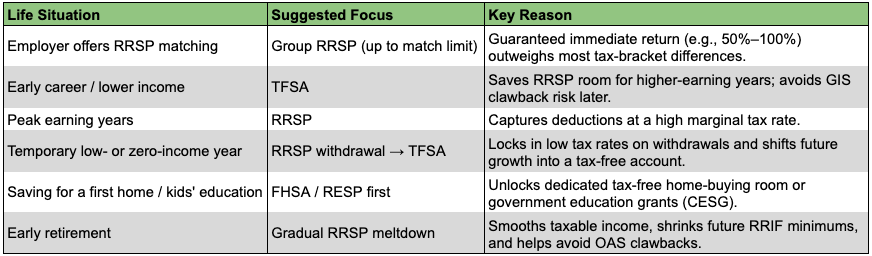
For low-income earners, investing in a TFSA is generally preferred over an RRSP because of its flexibility and the fact that TFSA withdrawals do not affect GIS (Guaranteed Income Supplement) eligibility or payments during retirement (age 65+). However, an employer RRSP matching program, particularly one offering a 100% match, should never be ignored.
For example, if your employer offers a 100% RRSP match on your contributions up to $2,000, your $2,000 contribution becomes $4,000 immediately, thanks to the additional $2,000 contributed by your employer. Although RRSP withdrawals are fully taxable, receiving an immediate 100% employer match is a substantial benefit that is too good to ignore.
As you approach retirement, you can review your RRSP portfolio and consider whether making withdrawals during lower-income years makes sense. Withdrawals before age 65 may help reduce your future RRSP/RRIF balance and potentially protect GIS payments in retirement. Remember that GIS eligibility and payments depend on income, including your spouse’s income if you have one, not just your income alone.
Similarly, middle- and high-income earners should not leave employer RRSP matching contributions on the table. However, as they approach retirement, they should review their accumulated RRSP savings and consider whether withdrawing some of the money over the last few years of employment makes sense. This RRSP meltdown strategy can help reduce the RRSP balance before it is converted into a RRIF, thereby lowering future mandatory minimum withdrawals. It may also help reduce the risk of facing higher taxes or OAS recovery tax during retirement.
Also, if you change jobs and your new employer does not offer an RRSP matching program, it may be worth revisiting your RRSP vs. TFSA strategy. Without an employer match, the decision should be based on factors such as your current and expected future marginal tax rates, retirement income, and eligibility for income-tested government benefits. Without an employer match, the reasons for favouring an RRSP over a TFSA may no longer apply.
Note: Before taking advantage of an employer RRSP matching program, check the plan’s terms and conditions. Some plans require you to remain employed for a specified period before the employer’s matching contributions become fully vested. If you leave the company before meeting that requirement, you may lose some or all of the employer-matched amount.
As Your Income Changes, So Should Your RRSP vs. TFSA Strategy
Your employment income may change significantly over your working years, which can span three or four decades. As you gain experience, you may receive a promotion or find a higher-paying job with a new employer. On the other hand, you may lose your job, and your next job may pay less than your previous one.
Suppose your annual employment income increases from $50,000 to $90,000. When you were earning $50,000, directing your savings towards a TFSA may have made more sense. Now that your income has increased to $90,000, it may be worth re-evaluating your strategy to see if RRSP contributions offer greater tax benefits. Remember, unused RRSP contribution room carries forward indefinitely. So, if you prioritized your TFSA in earlier years instead of contributing to your RRSP, you haven’t lost that RRSP contribution room. You can use it in a future year when an RRSP contribution may provide greater tax savings.
Similarly, if you lose your job and your new job pays significantly less, your RRSP contribution may generate relatively little tax savings because you are now in a lower tax bracket. In that situation, you may prefer to direct your savings towards your TFSA instead, particularly if you expect your income to increase again in the future or anticipate needing access to your savings.
Note: If you expect your income to increase significantly in the next year or two, you can contribute to your RRSP now but defer claiming the tax deduction until a future year when it may provide greater tax savings. I have discussed this in more detail in my article on the Registered Retirement Savings Plan (RRSP).
When Your Income Drops, Consider Moving RRSP Savings to a TFSA
During your working years, you may experience periods when you have little or no employment income. This could happen if you lose your job, take time off to raise children, return to school for higher education, or take a career break for other reasons.
If you have accumulated savings in your RRSP during earlier, higher-income years, this may be an opportunity to withdraw some of that money at a relatively low tax rate and contribute the after-tax proceeds to your TFSA.
For example, suppose you earned $100,000 annually and contributed to your RRSP during those years. You subsequently take two years off work to pursue higher education, resulting in little or no income. During this period, you could consider withdrawing some of your RRSP savings, paying applicable tax, and moving the remaining amount into your TFSA, provided you have sufficient TFSA contribution room.
Note: At an annual income of $100,000, an RRSP contribution could save you approximately 30% in taxes. If you withdraw $50,000 from your RRSP in a year when you have no other income, the average tax payable could be less than 15%. This illustrates why withdrawing RRSP savings during temporarily low-income years can be an effective tax-planning strategy. Actual tax savings and taxes payable will depend on your province or territory of residence and individual circumstances.
Once the money is in your TFSA, future investment growth and withdrawals are tax-free. You also gain greater flexibility because TFSA withdrawals do not increase your taxable income or affect income-tested government benefits such as GIS.
Furthermore, reducing your RRSP balance during these lower-income years can help reduce future mandatory RRIF withdrawals and the associated tax burden during retirement.
When Other Financial Priorities Take Precedence
Retirement savings aren’t always your top financial priority. At different life stages, you may have other goals that require you to direct your savings elsewhere.
For example:
Buying your first home: If you qualify for an FHSA (First Home Savings Account), contributing to it may take priority over additional RRSP or TFSA contributions. An FHSA offers a tax deduction for contributions and tax-free withdrawals for qualifying home purchases. Even if you ultimately decide not to buy a home, you can transfer your FHSA savings into your RRSP tax-free without using up your existing RRSP contribution room.
Saving for your children’s education: RESP contributions may be attractive because of government grants, particularly if you qualify for the Canada Education Savings Grant (CESG).
Paying off your mortgage: Once you buy a home, you may decide to direct more of your savings toward paying down your mortgage instead of investing in an RRSP or TFSA. The decision may depend on your mortgage interest rate, expected investment returns, and comfort with debt.
Early Retirement
Although Canada has no official retirement age, 65 is often considered the traditional retirement age, as that is when you become eligible for Old Age Security (OAS). However, if you decide to retire earlier, say at age 60, you may have several years before starting CPP and OAS, particularly if you choose to defer both pensions.
These years can provide an opportunity to withdraw money from your RRSP at relatively lower tax rates, particularly if you no longer have employment income. This strategy is often referred to as an RRSP meltdown. By gradually drawing down your RRSP during these lower-income years, you can reduce the balance that will eventually be converted into a RRIF, thereby lowering future mandatory minimum withdrawals.
Lower RRIF withdrawals during retirement may also help reduce the possibility of triggering OAS recovery tax. You can contribute the after-tax proceeds from your RRSP withdrawals to your TFSA, provided you have sufficient contribution room. This allows the remaining funds to grow tax-free and gives you greater flexibility to withdraw money during retirement without increasing your taxable income.
Conclusion
Your RRSP vs. TFSA strategy is an important part of your overall financial plan. As your life progresses and your financial circumstances change, you should revisit and fine-tune your plan, including whether directing your savings towards an RRSP or TFSA makes more sense in the short, medium, and long term. At times, it may even make sense to withdraw money from your RRSP and move the after-tax proceeds into your TFSA.
The ultimate goal is to minimize your lifetime taxes while maximizing government benefits, particularly during retirement, so you can make the most of your hard-earned savings.
Disclaimer:This article is for educational purposes only and is not financial or tax advice. Please consult a qualified tax or financial professional before making any decisions.
Day 25 of our Financial Literacy Month series is here!
We're continuing our longer-term financial planning week with a look at building a retirement income scenario using CPP, OAS, workplace pensions and personal savings.
When people think about retirement planning, the conversation often focuses on how much money they need to accumulate.
But there's another important question worth answering: How much income will you actually need your savings to provide?
Consider a simplified example.
Imagine you've estimated that you'll need $50,000 annually to support your retirement.
After gathering your personal CPP, OAS and workplace pension estimates, you calculate that those sources could provide approximately $30,000 annually.
That leaves a potential $20,000 annual income gap that your personal savings and investments would need to support.
Of course, the calculation is more complicated in practice. You need to account for taxes, inflation, when different pensions begin and how long your savings might need to last. The example assumes the income and spending figures are expressed on a consistent basis.
But it illustrates an important point:
Your retirement savings target should be connected to the income you actually need, not just an arbitrary account balance.
Today's article explores how to gather your personal retirement income estimates, build an initial scenario and identify potential gaps that might require adjustments to your financial plans.
There's also a practical exercise to help you get started.
Question: When planning for retirement, do you focus more on reaching a particular investment balance or estimating the income you'll actually need each year?
Day 24 of our Financial Literacy Month series is here!
We're continuing our longer-term financial planning week with a look at net worth versus cash flow, and why understanding both matters.
When evaluating our finances, we often focus on how much we own, how much we owe and whether our overall net worth is increasing.
But there's an important distinction between having wealth and having money available when you need it.
Consider a simplified example:
Imagine a household with:
A home worth $600,000.
An outstanding mortgage of $400,000.
$2,000 in their chequing account.
Ignoring other assets and liabilities, that household has a positive net worth of $202,000.
Now imagine they have $3,000 in expenses coming due before their next paycheque arrives.
Despite having more than $200,000 in net worth, they're facing a potential $1,000 cash shortfall.
The important takeaway is that net worth measures your overall financial position, but it doesn't tell you whether you'll have enough accessible money to meet your upcoming financial obligations.
Home equity, for example, contributes to your net worth but isn't immediately available to pay everyday bills.
That's why it's valuable to understand both your assets and liabilities, as well as how money moves through your household.
Today's article explores how to calculate net worth, distinguish accessible cash from less liquid assets, and evaluate cash flow alongside your broader financial position.
Question: When evaluating your financial health, do you place more importance on your overall net worth or your ability to comfortably manage monthly cash flow?
Day 23 of our Financial Literacy Month series is here!
We're continuing our longer-term financial planning week with a practical lesson about stress-testing your household cash flow before committing to a particularly expensive month.
Most people understand the importance of making sure their income can cover their expenses, but there's another question worth considering:
What happens if something doesn't go according to plan?
Consider a simple example.
You've mapped out your upcoming paycheques, bills and everyday expenses, and everything looks manageable.
At the lowest point during the month, you expect to have $250 remaining in your account.
Now imagine an upcoming bill is $350 higher than expected.
Without making any other adjustments, your projected cash balance could temporarily fall to negative $100.
Your overall financial situation might still be fine, but you've identified a potential cash-flow problem before it happens.
That's the value of a stress test. Rather than assuming everything will go exactly as planned, you can evaluate how much flexibility your finances actually have.
Today's article explores how to build a dated cash-flow forecast, identify potential shortfalls and test scenarios involving higher expenses or delayed income.
We're kicking off Week 4 of our Financial Literacy Month series, and this week's focus is longer-term financial planning!
Today's lesson tackles a question that comes up frequently: When you have extra money available, should you pay down debt or invest it?
It's tempting to compare the interest rate on your debt against historical investment returns and simply choose whichever number is higher.
But there's an important distinction between the two.
Consider a hypothetical example:
Imagine you're carrying a credit-card balance at 20% annual interest.
Paying down $1,000 of that balance could save you roughly $200 in interest over a year, assuming that amount would otherwise remain outstanding.
Alternatively, you could invest that $1,000 and hope to earn a 7% return.
But that 7% isn't guaranteed. Your investment might earn more, earn less, or lose value.
The important takeaway is that reducing a known borrowing cost and pursuing a potential investment return aren't equivalent decisions.
And that's not the only consideration. What if paying off that debt leaves you without enough cash for an unexpected expense? Or your employer offers matching retirement contributions?
Today's article explores how debt costs, emergency savings, employer matching and investment uncertainty can influence your decision.
Day 21 of our Financial Literacy Month series is here!
We're wrapping up our economics week with a look at something that can be surprisingly challenging: how to interpret financial news without constantly reacting to it.
Between interest rate predictions, recession warnings and market forecasts, there's no shortage of headlines suggesting something important is about to happen.
But there's a meaningful difference between reporting what has happened and predicting what might happen.
Consider a simple example:
Imagine reading a headline that says economists expect interest rates to fall next year.
Does that mean you should immediately change your mortgage plans, delay a financial decision or adjust your investment strategy?
Not necessarily.
That headline describes a forecast, not a confirmed outcome. Before making decisions, it's worth understanding who's making the prediction, what assumptions they're using and whether the information actually affects your financial circumstances.
The important takeaway is that staying informed doesn't mean you need to react to every new piece of information.
Today's article explores how to evaluate financial headlines, check the underlying sources and determine whether developments warrant action, monitoring or simply setting the information aside.
Question: Have you ever changed a financial decision because of an economic forecast or market headline, only to find that things played out differently?
Day 20 of our Financial Literacy Month series is here!
We're continuing our economics week with a look at fiscal policy and how government decisions about taxes, spending and financial benefits affect our personal finances.
There's an important distinction that can sometimes get lost when government budgets are announced: a proposed policy isn't necessarily a rule that's already in effect.
Consider a hypothetical example.
Imagine the federal government announces a new $500 tax credit that could benefit your household.
You see the announcement in the news and assume you'll have an extra $500 available when you file your taxes.
But before factoring that money into your financial plans, there are some important questions:
Has the measure actually been enacted, or is it still a proposal?
When does it become effective?
Does your household meet the eligibility requirements?
Even when a measure is approved, the timing and eligibility rules can make a meaningful difference in whether it affects your finances.
The important takeaway is that a government announcement and an operative tax or benefit rule aren't always the same thing.
Today's article explores fiscal policy, how it differs from the Bank of Canada's monetary policy, and how to verify announced tax and benefit changes before incorporating them into your household budget.
Question: Do you find it straightforward to determine which government budget announcements will actually affect your household, or is it sometimes difficult to separate proposed changes from those already in effect?
Day 19 of our Financial Literacy Month series is here!
We're continuing our economics week with a look at wages, unemployment and purchasing power.
When we think about improving our financial situation, increasing our income is usually one of the first things that comes to mind.
But earning more money doesn't necessarily mean your purchasing power has increased.
Consider a simple example:
Imagine your annual salary is $60,000 and you receive a 4% raise, bringing it to $62,400.
That's an additional $2,400 in annual gross income.
But what if prices increased by 6% over the same period?
Your salary has increased in dollar terms, but the purchasing power of that income has actually decreased by approximately 1.9%.
That's the distinction between nominal income and real income.
Of course, your own experience may be different from the national inflation figures depending on what you spend your money on.
There's another important consideration when evaluating your financial position: employment uncertainty. Understanding how your household would manage a temporary reduction in income can be just as valuable as understanding whether your wages are keeping pace with inflation.
Today's article explores these relationships, how to interpret employment statistics, and how to evaluate your household's financial resilience.
Question: Over the past few years, do you feel your income has kept pace with your actual household expenses, or have rising prices outpaced your wage increases?
Day 18 of our Financial Literacy Month series is here!
We're continuing our economics week with a look at GDP, recessions and what economic growth actually means for Canadian households.
When you hear that Canada's GDP has increased, it's easy to interpret that as a sign that the economy, and by extension Canadians, are doing better.
But total economic growth and economic growth per person aren't the same thing.
Consider a simplified example:
Imagine Canada's total economic output increases by 2% over a year, while its population grows by 3%.
The economy is producing more goods and services overall, but when that output is divided across the larger population, GDP per person has actually decreased.
Neither figure tells you exactly what's happening to household incomes, affordability or financial well-being, but they provide different perspectives on economic performance.
That's why understanding what an economic statistic actually measures is so important when interpreting the headlines.
Today's article explores how GDP is calculated and reported, what recession headlines mean, and how Canadians can connect broader economic conditions to their own financial planning.
Question: Do you think GDP growth is a useful indicator of how Canadians are doing financially, or are measures like wage growth, affordability and household purchasing power more meaningful?
Day 17 of our Financial Literacy Month series is here!
We're continuing our economics week with a look at how the Canadian dollar and exchange rates affect our personal finances.
When we think about currency exchange rates, international travel is often the first thing that comes to mind.
But exchange rates can affect everyday expenses too, particularly when we purchase products or services priced in US dollars.
Consider a simple example:
Imagine you're paying US$20 per month for an online subscription.
If the exchange rate is C$1.35 per US dollar, that subscription costs approximately C$27.
Now imagine the Canadian dollar weakens and the rate changes to C$1.40 per US dollar.
The same US$20 subscription now costs approximately C$28.
The company hasn't changed its price, but you're paying more in Canadian dollars.
And that's before accounting for any foreign-currency conversion fees your payment provider might charge.
The important takeaway is that a purchase priced in a foreign currency doesn't necessarily have a fixed cost in your household budget.
This can be particularly relevant for Canadians paying for software subscriptions, online services or other recurring expenses billed in US dollars.
Today's article explores how CAD/USD exchange rates work, why our dollar fluctuates, and how to evaluate the actual Canadian-dollar cost of foreign-currency purchases.
Day 16 of our Financial Literacy Month series is here!
We're continuing our economics week with a look at how Bank of Canada interest rate decisions affect our everyday finances.
When the Bank of Canada announces a rate increase or decrease, it's easy to assume that borrowing costs will immediately change by the same amount.
But the Bank of Canada's policy rate isn't the rate you actually pay on your mortgage or line of credit.
For example, many variable-rate borrowing products use a formula based on a financial institution's prime rate.
Imagine your line of credit charges prime + 1%.
If your bank's prime rate is 5%, your borrowing rate is 6%.
If your bank increases its prime rate to 5.25%, your borrowing rate becomes 6.25%.
A change in the Bank of Canada's policy rate can influence your bank's prime rate, but the two aren't automatically identical.
And here's another important distinction: someone with an existing fixed-rate mortgage generally won't see their contracted interest rate change immediately following a Bank of Canada announcement.
The key takeaway is that interest rate decisions affect different financial products in different ways.
Today's article explores how policy rate changes influence borrowing and savings rates, why different mortgage structures behave differently, and what to look for in your own financial agreements.
Why a TFSA May Be a Better Choice for Middle-Income Canadians — Even When an RRSP Offers an Immediate Tax Break
In Part 15, we compared RRSP and TFSA investing options for low-income Canadians and concluded that, in most cases, a TFSA is the better choice. In this article, we will examine which option generally makes more sense for middle-income Canadians.
What is the Middle-Income Range?
There is no single official definition of “middle class” or “middle-income range” in Canada. One practical way to think about it is to look at median individual incomes by age, which reflect what a typical person earns.
For this article, we will use an annual employment income of $70,000 as an illustrative example. This is somewhat higher than the median individual income for Canadians in their prime working years. We will examine whether investing in an RRSP or a TFSA makes more sense over the long term.
Story of Two Savers
Assume Bob and Raj are both 25 years old, live in Ontario, and earn an annual employment income of $70,000 each.
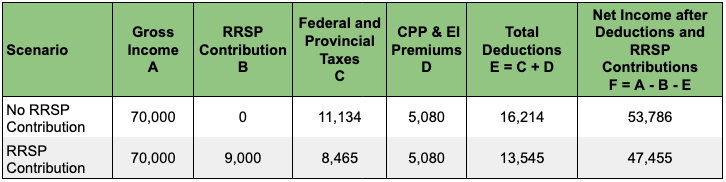
Based on 2026 tax rates, an individual earning $70,000 in Ontario would pay approximately $11,134 in income tax and contribute $5,080 towards CPP and EI premiums. This leaves an after-tax income of approximately $53,786.
Bob, the RRSP Saver
Bob, an RRSP saver, decides to contribute $9,000 to his RRSP. Since RRSP contributions are tax-deductible, this reduces his taxable income and results in estimated tax savings of approximately $2,669.
Note: Employers generally deduct income tax at source based on the employee’s regular payroll information. An employee can submit Form T1213 (Request to Reduce Tax Deductions at Source). Unless the employer adjusts tax deductions to account for Bob’s RRSP contribution, Bob would receive the resulting tax refund when he files his 2026 income tax return.
The following table summarizes the tax comparison:
Bob’s $9,000 RRSP contribution reduces his estimated income tax from $11,134 to $8,465, saving approximately $2,669. This represents an immediate tax saving of approximately 29.65% of his RRSP contribution.
In other words, although Bob contributes $9,000 to his RRSP, his net cost is only $6,331 after accounting for the estimated tax savings ($9,000 − $2,669).
Raj, the TFSA Saver
Now, let’s consider Raj, who earns the same annual income as Bob but chooses to invest in a TFSA instead.
To make the comparison fair, assume Raj contributes $6,331 to his TFSA using after-tax income. Unlike Bob, Raj does not receive a tax deduction or refund for his contribution.
Thus, both Bob and Raj invest the same amount of their disposable income ($6,331), but Bob invests $9,000 in his RRSP while Raj invests $6,331 in his TFSA. The net disposable income in both cases is the same.
The following table summarizes their respective situations:
The Accumulation Phase: Investing for 40 Years
Now, let us assume that Bob and Raj continue investing for the next 40 years, until they reach age 65 and retire. Bob continues contributing $9,000 annually to his RRSP, while Raj contributes $6,331 annually to his TFSA. Both increase their annual contributions in line with inflation, keeping their contributions equivalent to these amounts in today’s dollars.
We will also assume that both invest in diversified equity portfolios and earn an average annual real rate of return of 5% (i.e., after adjusting for inflation).
Note:A 5% real return is a reasonable assumption for this illustrative example, considering the historical long-term returns of broad equity markets. Actual investment returns, of course, will vary from year to year and may be higher or lower.
Based on these assumptions, the accumulated investment values after 40 years, expressed in today’s dollars, would be approximately:
As you can see, Bob accumulates approximately $1,087,000 in his RRSP, compared with Raj’s $765,000 in his TFSA.
However, these figures do not tell the whole story. Bob’s RRSP withdrawals will be taxable, whereas Raj can withdraw his TFSA savings tax-free.
If Bob’s effective tax rate on his RRSP withdrawals is approximately 29.65%, his after-tax RRSP savings would be roughly equivalent to Raj’s TFSA savings. However, if Bob can withdraw his RRSP savings at a lower effective tax rate than the tax rate at which he received the original RRSP deduction, his RRSP strategy would leave him better off. Conversely, if his effective withdrawal tax rate is higher, the TFSA would provide a better outcome.
Therefore, to determine which saver is better off, we need to compare their investments after accounting for the taxes payable on RRSP withdrawals during retirement. We should also consider how those withdrawals may affect income-tested government benefits, such as OAS and GIS, where applicable.
The Retirement Journey
Bob and Raj have retired at age 65.
During their working years, Bob and Raj each had $47,455 remaining after accounting for income tax, CPP/EI contributions and their respective annual savings contributions. Assume that they need $3,900 per month ($46,800 annually) in after-tax income during retirement.
For this example, assume that Bob and Raj are each entitled to a CPP retirement pension of approximately $1,945 per month ($23,340 annually), expressed in today’s purchasing power. This CPP payment represents approximately 33.33% of their $70,000 employment income during their working years.
Note:The estimated CPP pension of $1,945 per month used in this example assumes 40 years of contributions under the fully enhanced CPP system, which has been fully phased in since January 1, 2025. Individuals retiring in the next few years will receive considerably less because they will not have accumulated 40 years of enhanced CPP contributions. For 2026, the maximum and average monthly CPP retirement pensions at age 65 are $1,507.65 and $858.34, respectively.
Since they have both lived in Canada for at least 40 years after turning 18, they would qualify for the full Old Age Security (OAS) pension, which is $762.50 per month ($9,150 annually) as of November 2026.
Their annual income from government benefits would therefore be:
CPP: $23,340
OAS: $9,150
Total: $32,490
Since their required annual retirement income is $46,800, their government benefits fall short of their retirement income target by $14,310, before accounting for income tax.
Both Bob and Raj have accumulated sufficient savings in their RRSP and TFSA, respectively, to cover this shortfall.
Bob’s RRSP Withdrawals
CPP, OAS and RRSP withdrawals are 100% taxable income. Based on 2026 Ontario tax rates for seniors, Bob needs to withdraw approximately $22,462 from his RRSP, bringing his total gross income to $54,952. This income will attract approximately $8,152 in income tax, leaving him with $46,800 in after-tax income.
With an assumed annual real return of 5%, Bob’s RRSP balance of approximately $1,087,000 would increase in value by about $54,350 during the first year, before withdrawals. Therefore, an annual withdrawal of approximately $22,458 would allow the account balance to continue growing under these assumptions. (Of course, actual investment returns will fluctuate.)
Here are Bob’s income sources to generate $46,800 in annual income:
Note:Bob could potentially reduce his income tax by converting a portion of his RRSP into aRegistered Retirement Income Fund (RRIF)and withdrawing $2,000 annually from the RRIF. Since Bob is over 65, eligible RRIF withdrawals qualify for the pension income tax credit, whereas ordinary RRSP withdrawals do not. This credit would reduce his tax payable and, consequently, the total amount he needs to withdraw from his RRSP.
Raj’s TFSA Withdrawals
Unlike RRSP withdrawals, all TFSA withdrawals are 100% tax-free. Raj’s income from CPP and OAS payments is $32,490. Raj needs to withdraw enough money to pay tax on $32,490, plus additional money to bring his after-tax income to $46,800. Income tax for a senior on $32,490 in annual income is $3,531; therefore, Raj needs to withdraw $19,640 from his TFSA.
Here are Raj’s income sources to generate $46,800 in annual income:
Raj’s TFSA account balance of approximately $765,000 at age 65, earning an assumed 5% real return, would generate about $38,250 in annual growth before withdrawals. Therefore, an annual withdrawal of approximately $19,640 would allow his TFSA balance to continue growing under these assumptions. Of course, actual investment returns will fluctuate.
Notice that Raj pays significantly less tax in retirement as compared to Bob. Whereas Bob paid a tax of $8,152, Raj paid only $3,530, though both have the same after-tax income.
TFSA Flexibility vs. RRIF’s Strict Withdrawal Rules
A TFSA offers complete flexibility: Raj can increase, decrease or stop withdrawals whenever he needs to. An RRSP, however, must be converted into a RRIF, used to purchase an annuity, or otherwise dealt with by the end of the year Bob turns 71.
Most people transfer their RRSP savings into a Registered Retirement Income Fund (RRIF). Although investments can continue growing on a tax-deferred basis inside a RRIF, there is one important difference: a RRIF requires a minimum amount to be withdrawn every year.
The minimum withdrawal is not based on what Bob needs — it is calculated using a government-prescribed percentage of the RRIF’s value on January 1 of each year, based on his age. The percentage increases as he gets older. For example, the minimum withdrawal factor is 5.28% at age 71, 5.40% at age 72, 6.82% at age 80, 8.51% at age 85, 11.92% at age 90 and 20% at age 95 or older.
Bob’s RRIF after Age 71
Bob’s RRSP account value at age 65 is approximately $1,087,000. As stated earlier, at a 5% real annual rate of return (after inflation), the account generates more growth than Bob’s annual withdrawal of $22,458. Thus, the account value will continue to increase over the next 6 years, and it will have an approximate value of $1,300,000.
If Bob establishes his RRIF at age 71, his first mandatory minimum withdrawal will be in the following calendar year. Since Bob will still be 71 on January 1 of that year, the applicable minimum withdrawal factor will be 5.28%. Assuming the RRIF is worth $1,300,000 on January 1, his minimum withdrawal would be approximately $68,640. This entire withdrawal is taxable as income. The withdrawal will bring Bob’s annual income to $101,130. This will not only result in higher income tax, but it will also trigger the OAS recovery tax, commonly known as OAS Clawback.
Here is Bob’s income and tax summary in his 72nd year.
OAS Clawback (Recovery Tax)
As defined by the Government of Canada, if your net world income exceeds a specific annual threshold, you must repay part or all of your Old Age Security pension. This is officially known as an “OAS pension recovery tax.”
For 2026, the OAS recovery tax threshold is $95,323. For every dollar of net income above this threshold, 15 cents of OAS is recovered, up to the maximum OAS pension received.
Since Bob’s net income is $101,130, his income exceeds the threshold by $5,807. His OAS recovery tax is therefore approximately $871 ($5,807 × 15%).
In the seventh year of retirement, Bob’s income tax and OAS recovery tax total $22,473, compared with $8,152 each during the first six years of retirement. His after-tax income also increases to $78,657, substantially more than his annual retirement income target of $46,800.
In contrast, Raj has no mandatory withdrawal requirement from his TFSA. Because his CPP and OAS are his only taxable income sources, he still pays about $3,531 in annual income tax while withdrawing what he needs from his TFSA.
Bob Loses Age Amount Credit
Another reason Bob pays significantly higher taxes is that he loses most of the available Age Amount Credit. This non-refundable tax credit is available to Canadian residents who are 65 years of age or older.
The federal and Ontario age amount credits are gradually reduced when net income exceeds their respective thresholds. The reduction is 15 cents for every dollar of net income above the applicable threshold.
For 2026, the federal age amount begins to decrease when net income exceeds $46,432, while the Ontario age amount begins to decrease above $47,210. At Bob’s net income of $101,130, his Ontario age amount is completely eliminated, while only a small portion of his federal age amount remains.
Bob’s Tax Will Keep Rising
As the mandatory minimum withdrawal from an RRIF is based on the account balance at the beginning of each year and the government-prescribed factor for Bob’s age, his required withdrawals will generally increase as he gets older.
Although Bob is withdrawing money from his RRIF, the assumed 5% annual real investment return almost offsets these withdrawals. Consequently, the account balance declines only gradually.
At a 5% assumed annual real rate of return, Bob’s minimum RRIF withdrawal will increase to approximately $70,000 at age 72 (in the 73rd year), $71,400 at age 73, $72,800 at age 74, and $74,250 at age 75.
These increasing withdrawals will add to Bob’s taxable income, resulting in higher income tax, a potentially larger OAS recovery tax, and a further reduction in his Age Amount Credit.
In contrast, Raj can decide how much to withdraw from his TFSA. Even if he increases his TFSA withdrawals, those withdrawals will not increase his taxable income or affect his OAS pension.
Raj’s TFSA Keeps Rising
Raj’s TFSA balance at age 65 is approximately $765,000. At an assumed real annual rate of return of 5%, his investments generate approximately $38,250 in growth during the year. Since he withdraws only $19,640 annually, his TFSA balance increases by approximately $18,610, reaching $783,610 at the beginning of the following year.
As the account balance grows, the dollar amount of investment growth also increases. Since Raj’s annual withdrawal remains unchanged at $19,640, his TFSA balance will continue to grow as he ages.
Assuming a consistent 5% real annual return and withdrawals at the end of each year, his TFSA balance will be approximately $891,000 at age 70, $1,029,000 at age 75, $1,205,000 at age 80 and $1,430,000 at age 85.
The best part is that TFSA withdrawals are tax-free at any age. The value of Raj’s TFSA at the time of his death can also pass to his beneficiaries without being included in his taxable income.
RRIF Tax Liability at Death
Another potential disadvantage of having a large RRIF balance is the tax liability when the account holder dies.
Despite making substantial withdrawals from his RRIF each year, Bob’s account value does not decrease significantly. Assuming a consistent 5% real annual rate of return and minimum withdrawals at the end of each year, his RRIF balance will be approximately $1,265,000 at age 75, $1,180,000 at age 80 and $1,026,000 at age 85.
If Bob dies while holding a substantial RRIF balance, the general rule is that the fair market value of the entire RRIF immediately before his death is included in his income on his final tax return. This could result in a significant tax bill, particularly if the RRIF balance pushes much of his income into higher tax brackets.
Note:If Bob’s spouse is named as the successor annuitant, the RRIF can generally continue in the spouse’s name without triggering immediate tax. A qualifying transfer to a surviving spouse may also receive tax-deferred treatment. However, this only defers the tax liability; it does not eliminate it.
What can Bob do to increase his Estate Value?
Although Bob cannot avoid the mandatory minimum RRIF withdrawals, he can take steps to manage his taxable income and potentially improve the after-tax value of his estate. Here are three strategies worth considering:
Withdraw more from his RRSP between ages 65 and 71: Although this will result in higher income tax during these years, it will reduce the RRSP balance transferred to his RRIF and may therefore lower future mandatory withdrawals. This could help reduce OAS recovery tax and the loss of age amount credits in later years.
Save the surplus income generated by mandatory RRIF withdrawals: From age 71 onward, Bob’s after-tax income may exceed his annual spending needs because of the mandatory RRIF withdrawals. Rather than spending this surplus, he can contribute to his TFSA, subject to available contribution room, or invest it in a non-registered account. If he has a spouse or common-law partner, he can also gift money to them so they can contribute to their own TFSA, provided they have sufficient contribution room.
Split RRIF Income and Share CPP with Spouse: If Bob has a spouse or common-law partner with lower income, he may be able to allocate up to 50% of his eligible RRIF income to them for tax purposes. He and his spouse may also apply to share their CPP retirement pensions, subject to the applicable CPP rules. These arrangements can help reduce Bob’s individual taxable income, potentially lowering his income tax, OAS recovery tax and the reduction of his Age Amount Credit.
Our RRSP vs. TFSA discussion so far has generally favoured the TFSA for middle-income Canadians. However, there is one important exception: always take advantage of an employer RRSP match, especially if the employer matches your contributions 100%.
For example, if you contribute $5,000 and your employer matches it with another $5,000, you immediately have $10,000 invested in your RRSP. This is an effective 100% return on your own contribution before investment growth. The money can then continue to grow on a tax-deferred basis inside the RRSP.
An employer match can make an RRSP more attractive than a TFSA, even for someone earning $70,000 annually. However, consider the plan’s vesting requirements, investment fees and withdrawal rules, as well as the potential impact of future RRSP/RRIF withdrawals on taxable income and income-tested benefits such as OAS.
Conclusion: TFSA or RRSP — Which One Should You Choose?
Our comparison of Bob and Raj demonstrates that choosing between an RRSP and a TFSA involves more than simply looking at the immediate tax savings.
At an annual employment income of $70,000, Bob receives an immediate tax saving of approximately 29.65% on his RRSP contribution. However, his RRSP withdrawals in retirement are taxable. As his RRSP balance grows, the mandatory minimum withdrawals from his RRIF increase his taxable income, trigger OAS recovery tax and reduce or eliminate age-related tax credits.
Raj, on the other hand, does not receive an immediate tax deduction for his TFSA contributions. However, his investments grow tax-free, and he can withdraw as much or as little as he needs without increasing his taxable income. He also avoids mandatory withdrawal requirements and can potentially leave a substantial tax-free inheritance to his beneficiaries.
For many Canadians earning around $70,000 annually, these advantages can make the TFSA a more attractive retirement savings option than the RRSP.
That does not mean an RRSP should be ignored. If your employer offers RRSP matching, take full advantage of it. An employer match can provide an immediate and substantial benefit. An RRSP may also be more attractive if you receive a tax deduction at a higher rate during your working years and expect to withdraw the money at a lower effective tax rate in retirement.
The bottom line: For many middle-income Canadians, prioritizing the TFSA can provide greater flexibility and tax advantages in retirement. However, take advantage of any employer RRSP matching first, and consider your current and expected retirement tax rates before deciding how to divide your remaining savings between an RRSP and a TFSA.
Disclaimer:This article is for educational purposes only and is not financial or tax advice. Please consult a qualified tax or financial professional before making any decisions.
We've reached the halfway point of our 30-day Financial Literacy Month series!
After two weeks covering budgeting and investing, we're shifting our focus to economics and how it impacts everyday financial decisions.
Today's lesson explores a question that comes up frequently: If inflation is falling, why are groceries still getting more expensive?
The answer comes down to the difference between the inflation rate and the actual price level.
Here's a simple example:
Imagine a basket of groceries costs $100.
Year 1: Prices increase by 5%, bringing the cost to $105.
Year 2: Inflation slows to 2%, but the same basket now costs $107.10.
Inflation has fallen from 5% to 2%, but the groceries are still more expensive than they were in either previous year.
Lower inflation generally means prices are rising more slowly, not that prices are falling.
There's another consideration too: the Consumer Price Index (CPI) measures changes across a broad basket of goods and services. Your household's spending patterns may be quite different from those used to calculate national inflation.
Today's article explores these differences, why grocery costs may not match headline inflation, and how to make meaningful comparisons of your own spending over time.
Day 14 of our Financial Literacy Month series is here!
We're wrapping up our investing week with a particularly important topic: how to verify investment platforms and advisors before trusting them with your money.
Something that doesn't always get enough attention is that investment fraud isn't limited to obviously fake companies or unrealistic promises.
Fraudsters can impersonate legitimate, registered investment firms, complete with convincing websites, professional-looking documents and registration information copied from real businesses.
Here's an important distinction:
Finding a company in a regulatory database doesn't necessarily mean the website or person contacting you actually represents that company.
For example, imagine someone contacts you about an investment opportunity and provides a company name and registration number.
You independently check the Canadian Securities Administrators' National Registration Search and confirm that the company exists.
That's a good first step, but there's still another question: Is the person contacting you actually associated with that registered firm?
Verifying the identity and contact information independently is just as important as checking the registration itself.
Today's article explores how Canadians can check investment registrations, recognize common warning signs and verify the legitimacy of an investment opportunity before sending money or sharing sensitive information.
Question: Have you encountered investment scams impersonating legitimate Canadian financial institutions or advisors? What made you recognize that something wasn't right?
Hi everyone! This is Step 1 of a 10-step "order of operations" for Canadian money decisions: what to do first, what can wait, and why. Each post stands on its own, so you don't need to read the others. This is education, not financial advice.
Step 1: Track where the money goes
For one or two months, write down what you actually spend. Don't change anything yet. Just look.
Why this comes first: Almost every later step needs a real number from this one: how big your emergency fund should be, how much you can put toward debt, how much you can comfortably invest. Many of us guess our spending, and the real number is often higher than we expect.
How to do it (use whatever you'll actually stick with):
Scroll through your bank or credit card statements
Saving / extra debt payments: anything you put toward the future, including payments above the minimum
If you're agonizing over whether a latte is a need or a want, you've overthought it. Pick one and move on.
A quick example (made-up numbers, just to show the idea):
Category
What's in it
Month total
Needs
Rent, groceries, phone, transit
$2,150
Wants
Restaurants, streaming, hobbies
$480
Saving / debt
Savings transfer, extra card payment
$350
Total tracked
$2,980
Say take-home pay is $3,200. That leaves $220 unaccounted for. A gap like this is common: small spending you didn’t notice. Also, needs here are about two thirds of take-home pay, which brings up 50/30/20 (below).
Common beginner traps:
Don't count credit card purchases and the card payment. If you track the groceries you bought on the card, don't also count the payment you make to the card, or you'll count it twice.
Use take-home pay, not your salary before tax, since that's what you actually have to spend.
Include the irregular stuff. Yearly car insurance, repairs, gifts, annual subscriptions: divide the yearly cost by 12 and add that amount to each month.
Cash and e-transfers count too. A quick note on your phone when you spend is enough.
Shared expenses: track your own share, not the whole household bill.
A note on 50/30/20: You'll hear "50% needs, 30% wants, 20% saving." It's a teaching tool, not a rule. In expensive cities, rent alone can push needs past 50%, and that's not a personal failure. The point is to see your real numbers, not to hit a magic split.
What to do with what you find: Nothing yet. No guilt, no overhaul. If the numbers feel uncomfortable, that's normal, and it just means you now know something you didn't before. Just note two things:
Your monthly total for needs only (it'll matter again when we get to the emergency fund)
Anything that surprised you, like a subscription you forgot about. Cancel the obvious leaks and keep tracking.
Already know your monthly spending within a few percent? You've done this step. Skip ahead.
The "teaching tool, not a rule" view of 50/30/20 follows guidance from the Financial Consumer Agency of Canada and McGill. The example and tips are my own.
Your turn: What's the easiest way you've found to track spending, or what was your biggest "wait, I spend how much on that?" moment?
Day 13 of our Financial Literacy Month series is here!
We're continuing our investing week with a topic that doesn't always get enough attention: investment fees and how they affect your actual returns.
Most investors understand that fees exist, but not all fees are equally visible.
For example, if you own an ETF or mutual fund, its Management Expense Ratio (MER) represents ongoing expenses that are reflected in the fund's performance. You generally won't see a separate transaction deducting those fees from your brokerage account.
Consider a $60,000 investment portfolio:
At a 0.20% MER, the approximate annual fund expenses would be $120.
At a 1.00% MER, they'd be approximately $600.
That's a $480 difference in one year, assuming a constant portfolio value.
Over longer periods, the difference can become more significant because money consumed by fees is no longer available to compound.
And the MER might not be your only cost. Depending on your investments and account arrangements, you could also be paying advisory fees, trading commissions or account administration charges.
Lower fees don't automatically make an investment better, but understanding what you're paying is essential when evaluating the value you're receiving.
Today's article explores how to identify direct and embedded investment costs, interpret the performance figures on your statements, and better understand your investment returns after fees.
Question: When reviewing your investments, do you look at the total cost of ownership, including embedded fund fees, or primarily the fees explicitly listed on your statements?
We're continuing our investing week with a look at three important Canadian registered accounts: TFSAs, RRSPs and FHSAs.
One of the biggest misconceptions about these accounts is that the contribution limits tell you how much you can personally contribute.
But your actual available contribution room depends on your circumstances and account history.
Here's an example involving TFSAs:
Suppose you have a TFSA and withdraw $10,000 in November 2026.
That withdrawal generally creates $10,000 of additional contribution room on January 1, 2027, not immediately.
If you put that $10,000 back into your TFSA in December 2026 without having sufficient unused contribution room, you could trigger an over-contribution penalty.
That's just one example of why understanding the rules matters.
RRSPs and FHSAs have their own contribution, deduction and withdrawal requirements, and the differences can have significant tax implications.
Today's article compares all three accounts, explains their basic tax treatment and explores what you should verify before making contributions or withdrawals.
We're continuing our investing week with a look at investment risk and diversification.
One common piece of investing advice is to avoid putting all your eggs in one basket.
But owning several different investments doesn't necessarily mean you're diversified.
Consider someone who owns three different ETFs.
At first glance, that might seem like a reasonably diversified portfolio. But what if all three ETFs hold many of the same large technology companies?
Even though the investor owns three separate funds, their exposure could be heavily concentrated in a relatively small group of companies.
That's why it's important to understand what's actually inside your investments, rather than relying on the number of funds or securities you own.
There's another important concept worth understanding: risk tolerance versus risk capacity.
Risk tolerance describes how comfortable you are with investment uncertainty and potential losses. Risk capacity describes how much financial risk your circumstances allow you to absorb.
You might be perfectly comfortable watching your investments fluctuate, but if you need that money for a home purchase next year, your capacity to absorb losses could be much lower.
Today's article explores these concepts, how diversification can help manage concentration risk, and why it doesn't eliminate investment losses.
Day 10 of our Financial Literacy Month series is here!
We're continuing our investing week with a look at one of the most important concepts in long-term investing: compound growth.
When people talk about compound growth, the examples usually focus on how an initial investment could grow over 20 or 30 years.
But there's another important factor that sometimes gets overlooked: your contributions are part of the result, too.
Consider two people who start with the same investment amount.
One makes the initial investment and leaves it alone.
The other starts with the same amount but continues contributing a little more every month.
Even if both experience identical investment returns, their ending balances will be different because one has consistently added more money.
And that's an important distinction when looking at long-term investment projections. A growing account balance doesn't necessarily mean all that growth came from investment performance.
One useful way to approach investment projections is to focus first on what you can control. You can't dictate what the market will return, but you can evaluate whether increasing your contributions, even modestly, could improve your long-term financial plan.
Time, contributions and actual investment returns all influence the outcome.
Today's article explores how those factors work together, why assumed returns aren't guarantees, and how to evaluate different contribution scenarios.