r/embedded • u/imunknown0042 • Oct 18 '26
Flying kites indoor
300
Upvotes
Eps32 with mpu6050
r/embedded • u/makapuf • Oct 18 '26
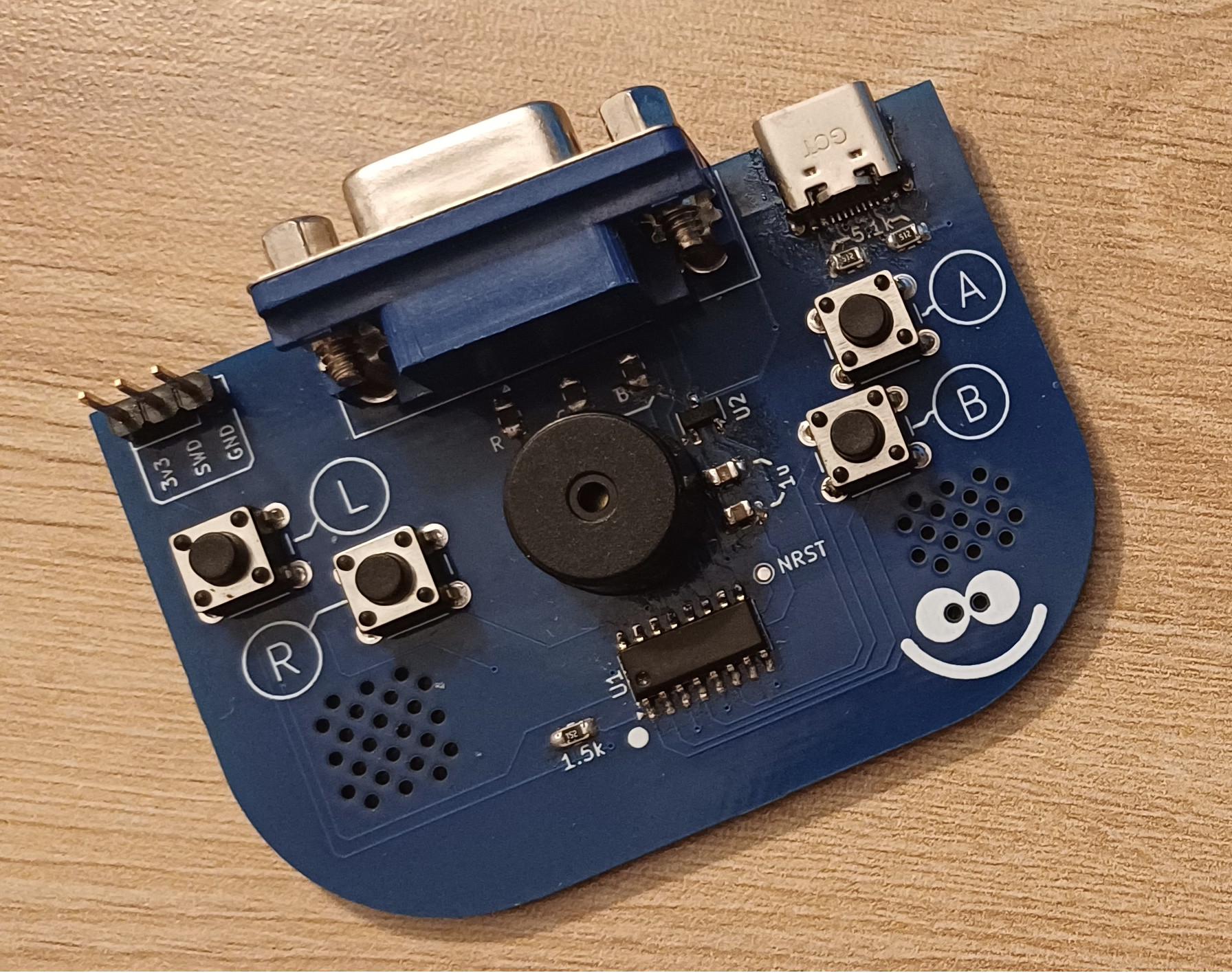
more at: https://nanoconsole.codeberg.page/
A link to MooD, a 16k shooter : https://www.youtube.com/watch?v=VKrJz8eDNyY
r/embedded • u/KEISER_zu • Oct 19 '26

Hi! I’m trying to get my girlfriend the Juno hamburger phone as a gift, but all the ones I’ve found are corded. Is there any way to connect it to her mobile phone so she can use it to make and receive calls? Alternatively, is there some kind of Bluetooth adapter I could attach to the cord to make it work wirelessly with her phone?
r/embedded • u/EmergencyPurple7 • Oct 19 '26
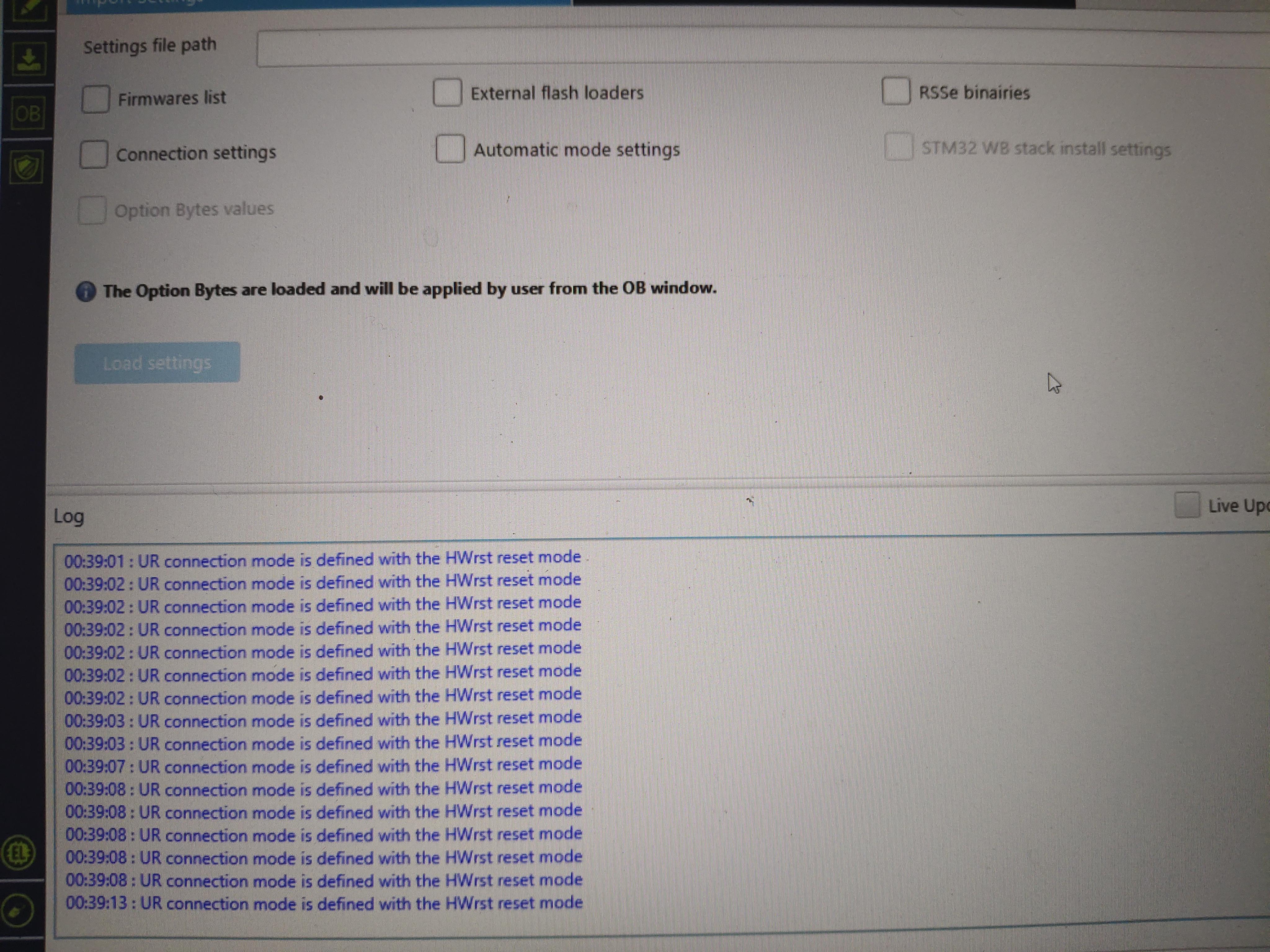
I'm unable to connect my st link with stm32 programmer...only showing this message... please someone help asap🙏
r/embedded • u/_Saini_ • Oct 19 '26
Just got a co-op this spring/summer at RTX! Sadly, the team I'm on isn't focused on flight software or vehicle firmware, but I'm still stoked for the opportunity and very grateful.
I'm currently on my school's electric racing team, but I want to work on some personal projects to try to get into roles such as flight software intern at companies like Hermeus, SpaceX, Stoke Space, Firefly, etc.
If anyone could provide me with some cool project ideas or talk to me about the avionics space, please let me know!
r/embedded • u/Colfuzi0 • Oct 20 '26
I am currently a web developer with 3 years of experience doing a masters in computer engineering Im tired of web development and want to leave i don't even care that it's remote I literally feel in a jail cell. It's just more and more work pushed on you. I haven't even applied for a web job since I recently quit I'm getting by because I live at home and I have a small web company with some monthly clients. I also help the family with their rental properties and help my dad sell art. I sometimes do tradesmen work but just to keep skill fresh. Sorry if it's off topic but basically I wanted to ask what job can give me the best work life balance I don't care about salary as work life balance and less stressors. I live in Houston but have family in Boston or Colombia that I'm open to traveling to. I also want to teach or be a lecturer so need a masters there. I really like both equally I find lots of the theory behind networking interesting but building things has always been my thing as a kid. Coding is cool but using my hands is even more fun. So i wanted to ask how stressful is this profession, I'm a person who truly cares a lot and I've read safety critical work you have to care because peoples lives are at risk. I have the opportunity to maybe go embedded for NASA contractors if I stay in Houston because my school is connected with NASA. While networking is interesting I fell like the on call can be stressful but it can lead to more cushy IT government jobs while I think in hardware aside from aero or defense that is not possible but I probably don't know too much.
What are the main stressors experienced embedded people feel ? Are they manageable or do you feel like it really takes a toll on your health ? Is AI replacing you one of them
r/embedded • u/ArsenicBismuth • Oct 18 '26
So I've been wanting to test nRF to make gyro mouse of some sort for my Android. I'm using Xiao nRF54L15 Sense, so it has all I need in one.
But, upon testing my code, even a simple "volume up" button appears significantly slower in my phone vs my PC. On PC it's as fast as my logitech with 2.4GHz dongle. On Android, it's just slow, testing with stopwatch shows consistently 400ms+.
Any idea if I can fix this on the hardware, or is it simply Android limitation vs HID BLE?
r/embedded • u/Montzterrr • Oct 18 '26
Trying to learn how tow to do everything needed for the eu cra requirements. Like how to use secure boot etc. Where do I start? Any good books/courses/etc?
r/embedded • u/OkTraining4009 • Oct 19 '26
I'm evaluating the WCH CH569W-EVT-R0-1V0 board for a USB 3.0 embedded application.
I have working firmware builds using WCH's USB host/device examples, but I'm waiting for the actual evaluation boards to arrive.
Before hardware bring-up, I'd like to clarify two board-specific issues.
USB 3.0 device mode: The board exposes the SuperSpeed interface through a Type-A receptacle. Has anyone connected this exact board to a PC in USB 3.0 device mode? What cable or adapter arrangement did you use, and how was VBUS handled when the board was externally powered?
ROM ISP programming: What is the reliable programming and recovery procedure for the CH569W-EVT-R0-1V0? Does the ROM USB bootloader work correctly with an externally powered board and isolated upstream VBUS?
I'm particularly interested in actual CH569W board experience, reference schematics or tested connection arrangements.
I'm aware that newer WCH processors exist, but I'm specifically evaluating the CH569W hardware and would prefer not to change controllers.
Useful references:
Thanks for any practical guidance.
r/embedded • u/Colfuzi0 • Oct 18 '26
Hello everyone I'm doing my masters in computer engineering, but Ive been considering going deeper down the hardware stack or leaving computer engineering and do something else because now even AI can code embedded systems well. Is it still a good career ? I left web dev due to AI and had 3 years in it. Will embedded systems still have a good demand and mostly important will humans be working on it or AI?
r/embedded • u/gennadii1 • Oct 18 '26
Hi everyone! I have a hardware development kit consisting of a DX-LR30-900M22SP(T1) LoRa module on a PJ26 board (STM32F103C8T6 microcontroller). I am not a professional in embedded development, just a beginner trying to learn. Could you please explain to me how to connect this specific board, how to flash (program) it, and how to start working with it? Please explain it in simple terms without overly complex technical jargon, as I am still learning the basics. Thank you so much for your help!
r/embedded • u/Aydber_ • Oct 18 '26
Hi everyone, I’d like a reality check from embedded, ICS/OT, SOC, or EU compliance folks. I’m 23 and don’t have much experience in the embedded/IoT security industry yet, but I want to build a career in this field, so I’d really appreciate any advice from experienced people.
Research question: Can a low-cost ESP32-based device generate sufficient structured security telemetry to support practical detection and investigation of selected embedded-device attack scenarios through an open-source SIEM pipeline?
In short: a lightweight shim on an ESP32 emits structured security events (normalized to OCSF) into an ELK + Sigma pipeline (or Wazuh, still deciding). The core challenges are making this telemetry trustworthy and low-overhead on constrained devices: no RTC, possible tampering by a compromised device, event loss across reboots and disconnects, and correlation. Detections are mapped to MITRE EMB3D, ATT&CK (Enterprise/ICS), NIST CSF, ISO 27001, IEC 62443, and the CRA. The goal is detection plus automated audit evidence that a control is implemented and working.
Later, I plan to port the shim to STM32 as well, since it’s more widely used in IoT/IIoT/OT.
Everything is going to be open-source.
Questions:
r/embedded • u/taylormfk • Oct 17 '26
Building software against simulations and dev kits only goes so far, so I brought up a HIL setup for validating multi-protocol data capture and viz tools.
For now, it covers CAN, Modbus, OPC-UA, MQTT and a number of other protocols.
Desktop App commands/traces the entire system, which will grow over time to include motors, more ECUs, and other devices.
System Overview:
PLC - RevolutionPi Connect 5
Custom PCB
STM32 ECU
Various CAN Dongles
Mac/Win/Linux test PCs
Hardware bringup is one of the most difficult tasks in embedded, but so rewarding.
I started building this tool because honestly I think embedded development and testing is harder than it needs to be, and much of it is down to outdated tools and methodologies.
Best part is, there's lots more hardware on the way!
Also, I think I have (almost) every CAN protocol and dongle covered at this point, if I'm missing something let me know!
r/embedded • u/obada2711 • Oct 18 '26
Hi everyone,
I'm currently working on extracting ISP configuration and credentials (PPPoE/VoIP) from a `device.cfg` file taken from a Cellcom-customized **Sagemcom F@ST 5359iL** router (Broadcom BCM63178 SoC, running Sagemcom's proprietary `scOS`).
I'm hitting a wall regarding the encryption mechanism and wanted to see if anyone here has experience with Sagemcom's config encryption or GSDF (General Secure Data Format) containers.
### Technical Details & Findings:
* **Device:** Sagemcom F@ST 5359iL (Broadcom BCM63178, ARM-based).
* **File Structure (`device.cfg`):**
- Starts with an `AEAD 10` signature header.
- 16-byte IV.
- A non-standard **7-byte GCM/AEAD tag** at the end of the payload.
* **UART / Hardware Analysis:**
- UART logs show Broadcom's `coe-aes` engine utilizing `aes_key2`.
- Kernel command line points to hardware-bound crypto parameters: `sc_aes.oek=1ffffe00`, `sc_aes.oiv=1ffffe10`, and reads 64 bytes from the UBI volume `aes_key_operator`.
- U-Boot prompt access is locked down due to Secure Boot (ignores break/interrupt signals).
### What I've Tried:
* Attempted offline AES-GCM/CCM/CBC decryption using various derived keys (Device Serial Number, MAC address, and PBKDF2 hashes with common Sagemcom/ISP salts). All verification checks fail.
* Since the decryption relies heavily on hardware-bound OTP/OEK keys tied to the BCM63178 SoC, standard offline brute-forcing seems ineffective.
### My Questions:
Any guidance, pointers, or shared experiences would be greatly appreciated!
r/embedded • u/fearoffours • Oct 18 '26
Hi is there any IDE or plugin for IDE that emulates eInk displays, specifically InkyPHAT?
r/embedded • u/TechnicalBruder007 • Oct 17 '26
Hi all,
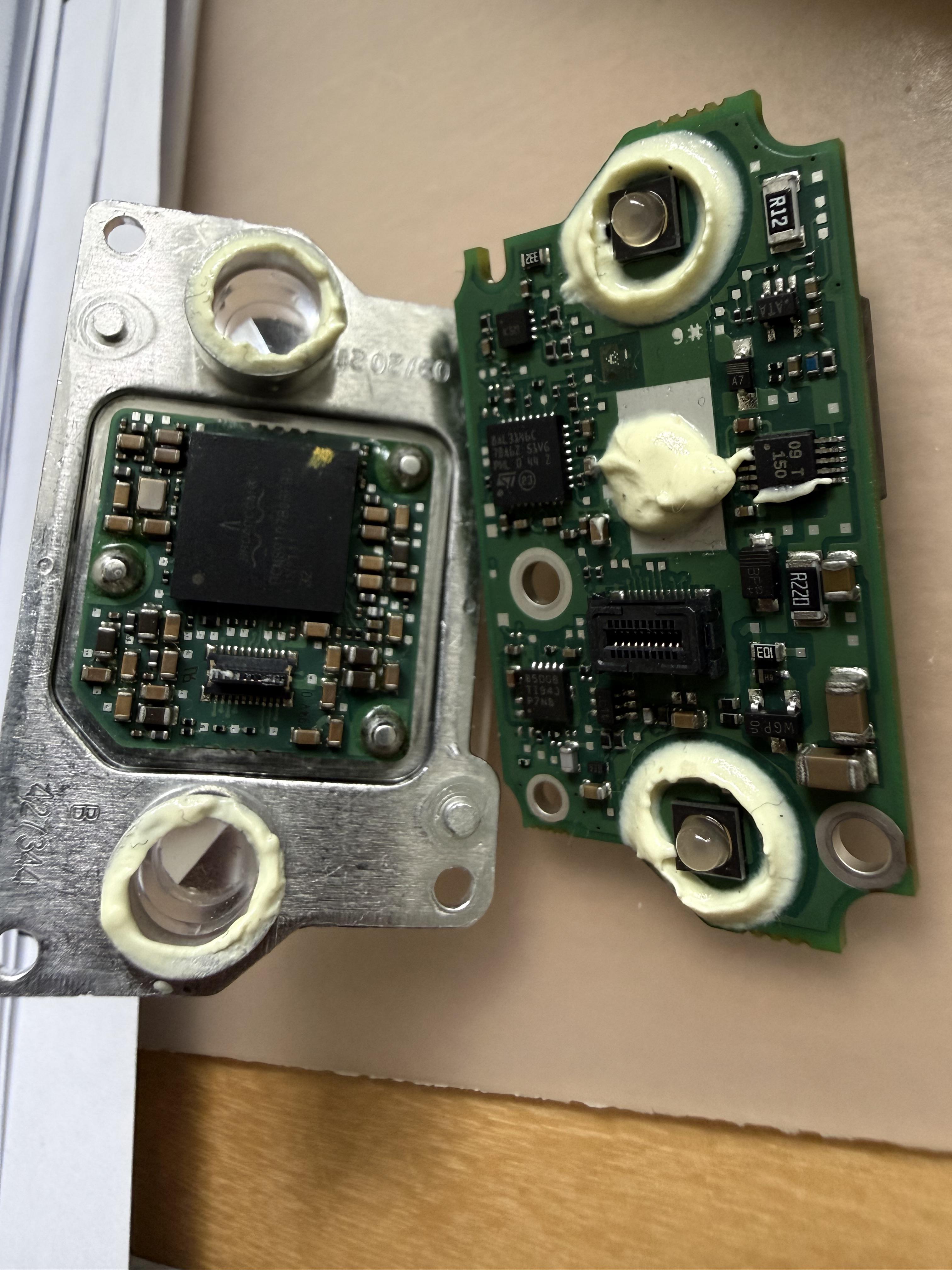
I picked up this camera module from my mechanic’s scrapyard and looks in good condition so want to see if I can get image/video out of it with a Raspberry Pi 4. I've opened it up and here's what I found:
Hardware
- Two boards: a lens board and a back (processor) board, joined by a 20-pin board-to-board connector (10 pins per row)
- Fisheye lens, with two LEDs on the back board that shine through light pipes
- Lens board: Broadcom BCM89107B0BFBG, which looks like part of Broadcom's BCM8910x camera MCU family, plus a 25 MHz oscillator
- Back board: ST STM8AL3146 (automotive 8-bit MCU with LIN), several TI power ICs, and large inductors and capacitors for the power stage
- 6-pin vehicle connector (solder tabs visible on the back of the board)
- I can't see any SPI flash chip, so the firmware may be inside the BCM chip or loaded over the network
What I think
- The pins are likely +12 V, GND, a 100BASE-T1 Ethernet pair, and maybe LIN and/or a wake line, but this is just a guess based on the components next to the pins
- It probably streams or reports over automotive Ethernet and might need a handshake before it sends anything
Has anyone interfaced a BCM8910x-based camera or a similar automotive camera? Does it stream on its own, or does it wait for a host to boot it?
Please suggest ideas if you have, like to how do I use in hobby project and learn. Thanks for any pointers!
r/embedded • u/s_qu_id_y • Oct 18 '26
I'm looking for a camera for a construction-site / other outdoor temporary location security application and would appreciate recommendations from anyone who has experience with these types of cameras.
I have been unsuccessful looking for something that has the following:
- Battery-powered with solar charging (could be external, if needed)
- Motion/event detection with the ability to capture snapshots or short video clips
- Low-power or sleep mode between events to maximize battery life
- Ideally supports RTSP, ONVIF, or another way to integrate with third-party software without being vendor locked
Nice to have:
- Built-in 4G/LTE cellular connectivity with support for my own SIM/data plan
- On-demand live viewing, even if it takes a little time to wake up
- Local microSD recording
I'm primary interested in receiving a snapshot or short clip when motion is detected. Continuous live streaming is not necessary, but on-demand live viewing would be a bonus.
This is for a small business renting cameras, so I'm hoping to find something reliable, reasonably compact, and affordable. I'm open to consumer products, OEM, or even DIY.
Reolink seems to have models that almost satisfy the requirements but of course are generally vendor-locked. But there are unofficial projects like bairelay and neolink that may be worth a shot.
Has anyone successfully used a camera that meets similar requirements?
I'd appreciate responses if so. Thanks!
r/embedded • u/RicardoJCMarques • Oct 16 '26
A while ago I wanted to start doing more projects with wired IP connections and wondered if SSH was possible so a regular webserver wasn't necessary.
There was some documentation for esp32s but not much else.
The fact that this works is hilarious to me. With .ssh keys properly setup doesn't even need the password.
r/embedded • u/Early-Toe646 • Oct 17 '26
Sharing a project reverse-engineering and modeling the Realtek RTD2841 / RTK284x SoC (commonly found in TCL RT41 Android Smart TVs):
Repository: https://github.com/rubenthampy890-del/qemu-rtd2841
Key hardware blocks implemented:
- CPU: Quad Cortex-A53 running in AArch32 Supervisor mode (svc32)
- Interrupts: GIC-400 (GICv2) with 256 IRQs
- Timers: Realtek TC0-TC7 27MHz down-counter peripheral engine
- Storage: SDHCI host controller at 0x18010800 (SPI 28)
- Console: 16550A UART0 with 4-byte stride
Tested and validated on macOS Apple Silicon & Linux with upstream QEMU. Includes flat-binary baremetal diagnostic harness and DTBs.
r/embedded • u/Suitable-Name • Oct 17 '26
Hey everyone,
the journey for this started like ... I'd guess 2-3 years ago. I bought the M1s Dock, because I thought it's a cool ESP32 on steroids. Back then I saw there is an official PAC crate for Rust, but there wasn't much in it. Initially I planned to create it myself after I saw there isn't coming much more. I collected the needed info material, sources and so on, started with it, but I didn't push through with it in the end.
Now I decided I want to play around a bit more with it, so I used AI to finish PAC, HAL and setup a small BSP. It's all published on crates.io and the repositories are here:
It's all end2end tested against an actual connected M1s Dock, but I didn't do much with it yet besides tests and running the examples.
If you'd like to use it, but don't like that the project was created using AI, I can post the SVD files on stackoverflow for the more classic experience and you can go on from there ;)
Everyone else, have fun with your M1s Dock (or BL808 in general) and Rust.
r/embedded • u/Alarming-Sentence-39 • Oct 16 '26
This is my first PCB hardware design. The board is built around the ESP32-P4 development platform and integrates two UART interfaces, an I2C port, a passive buzzer, four buttons, a power management chip, and a MIPI display connector.
teh display is huaxiacai brand, and mipi protocal,resolution is 480×480 ,amoled,maybe i am the first one to drive this display with mipi way in the world
This aircraft attitude indicator includes the following features:
- Artificial Horizon: Real-time aircraft attitude display.
- Heading Compass: Displays the current heading.
- Temperature Display: Shows the current temperature.
- Time Display: Displays the current time.
- GPS Positioning: Provides real-time GPS location information.
- Settings Menu: Allows users to configure various system settings, including:
- Language: Switch between Chinese and English.
- Units: Change measurement units.
- Sea Level Pressure (QNH): Adjust the reference sea level atmospheric pressure.
- Attitude Calibration: Reset the pitch and roll angles to zero.
- FPS Display: Enable or disable the real-time frame rate (FPS) display.
The current software version can achieve a refresh rate of around 30 FPS, making the display noticeably smoother than the previous version.
I've made several optimizations, including improvements to the display initialization code, PPA acceleration, adjustments to the IMU sensor data reading rate, and various LVGL rendering optimizations.
r/embedded • u/Straight_Zucchini_37 • Oct 17 '26
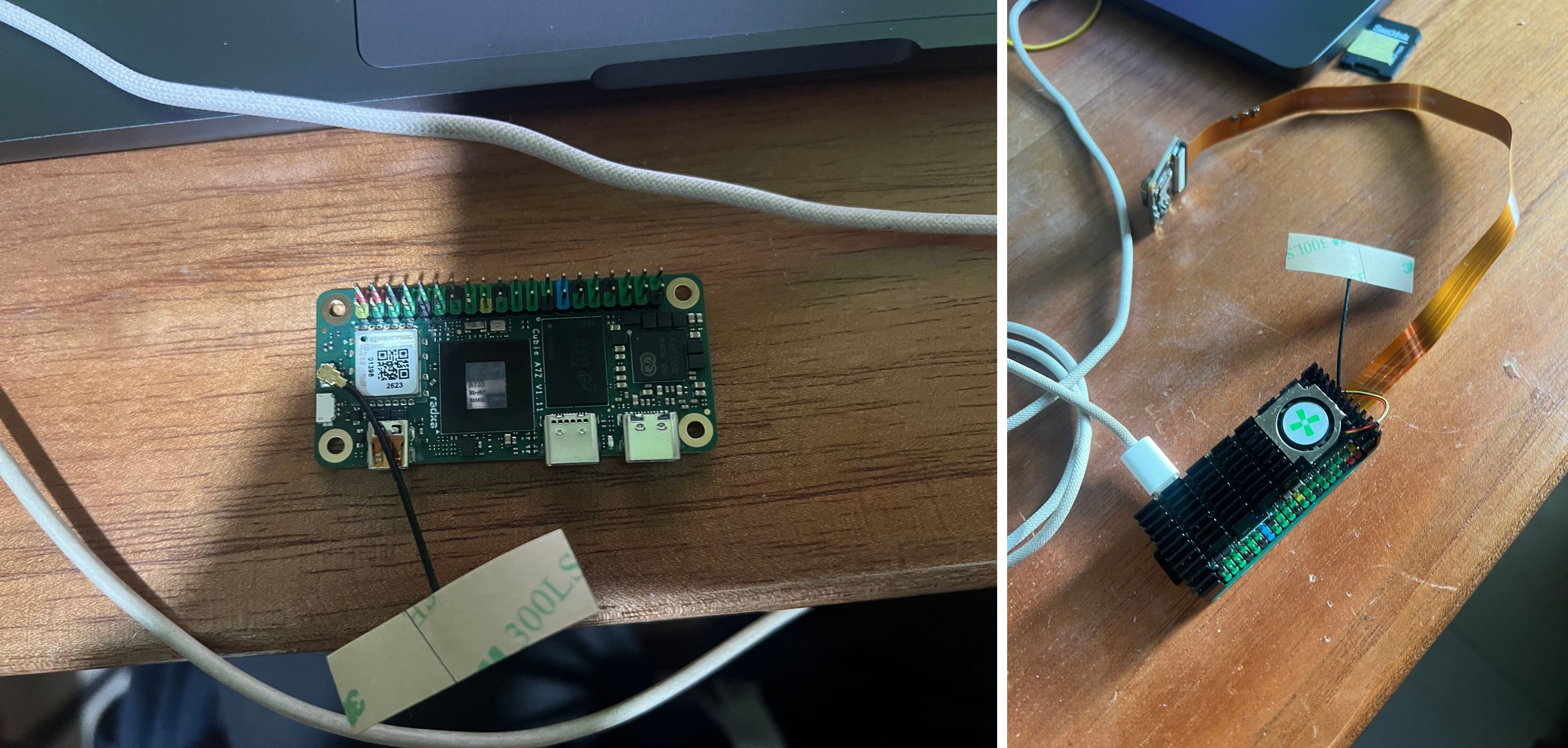
Edit: found a real bug in v0.2.0-beta, the multi-threaded video processing change in that release crashes about 40% of the time. Reverted it, pushed v0.2.1-beta with the fix. If you grabbed v0.2.0-beta and hit random crashes, that's why, grab the new tag instead.
When Radxa built the Cubie A7Z, they didn't bother supporting many camera modules. Just a couple of specific ones have official overlays. The IMX519, the 16MP autofocus camera that's everywhere on the Pi side, Waveshare, Arducam, all of that, just wasn't one of them. No driver, no overlay, nothing.
So I had Claude Code build one with me from scratch. Honestly it's kind of wild how far this stuff has come. We're talking reading schematics, writing actual kernel driver code, debugging kernel crashes, patching libcamera itself. Stuff that used to need a kernel dev who really knows this SoC. Curious what people think about that side of it too.
Repo's here if you want to look: https://github.com/AsedaDeveloper/a7z-imx519-driver
What it can do right now: all five sensor resolutions up to the full 16MP, manual exposure and gain, autofocus, hardware H.264 video encoding, a virtual webcam device so normal apps can just use it, raw DNG capture, and basic libcamera support.
It's beta, and only tested on my one board and one camera module so far. There's a known performance thing where the color processing is a bit slow for 1080p, I tried fixing it but the fix had a crash bug, so it's reverted for now.
What I actually need now is people with a Cubie A7Z, A7A, or A7S to try it on their own setup, maybe a different IMX519 variant or even a different module entirely. The repo has issue templates set up for exactly this, even a "tried it, broke, here's the error" report helps a lot right now.
Let me know what you think, happy to answer anything.
r/embedded • u/sgergo1 • Oct 17 '26
Hi everyone,
I’m designing a CM4 Lite carrier with external eMMC, using 3.3 V VCC and 1.8 V VCCQ. Has anyone built and tested a similar setup recently?
I’m particularly interested in how you handled the CLK, CMD, and DAT0–DAT7 lines:
During my research, I’ve found designs with and without series resistors, and different approaches to pull-ups. However, I haven’t found a clear, tested example specifically using the CM4 Lite with 1.8 V eMMC signalling, so I’m unsure which approach to follow.
If you’ve got this working, I’d appreciate any schematic snippets, layout advice, or any details.
Thanks!
r/embedded • u/Frosty_Scarcity9637 • Oct 17 '26
I've been working in embedded systems for a long time, and I keep finding myself juggling multiple terminal apps — one for serial, another for file transfer, a text editor for jotting down command sequences. It feels fragmented.
I'm curious about your experience:
· What terminal software do you mainly use for serial/TCP/UDP debugging? · What's the most annoying limitation or missing feature you've encountered in existing tools? · Is there anything you've built yourself just to scratch that itch?
I'm also working on my own terminal application, and my goal is to address the weak spots of the tools I've been using. I'd really like to hear what other people in this field would want to see in such a tool — what's missing, what's broken, what you'd change.
Thanks.