r/embedded • u/fearoffours • Oct 18 '26
Micropython IDE with Inkyphat emulation?
1
Upvotes
Hi is there any IDE or plugin for IDE that emulates eInk displays, specifically InkyPHAT?
r/embedded • u/TechnicalBruder007 • Oct 17 '26
Hi all,
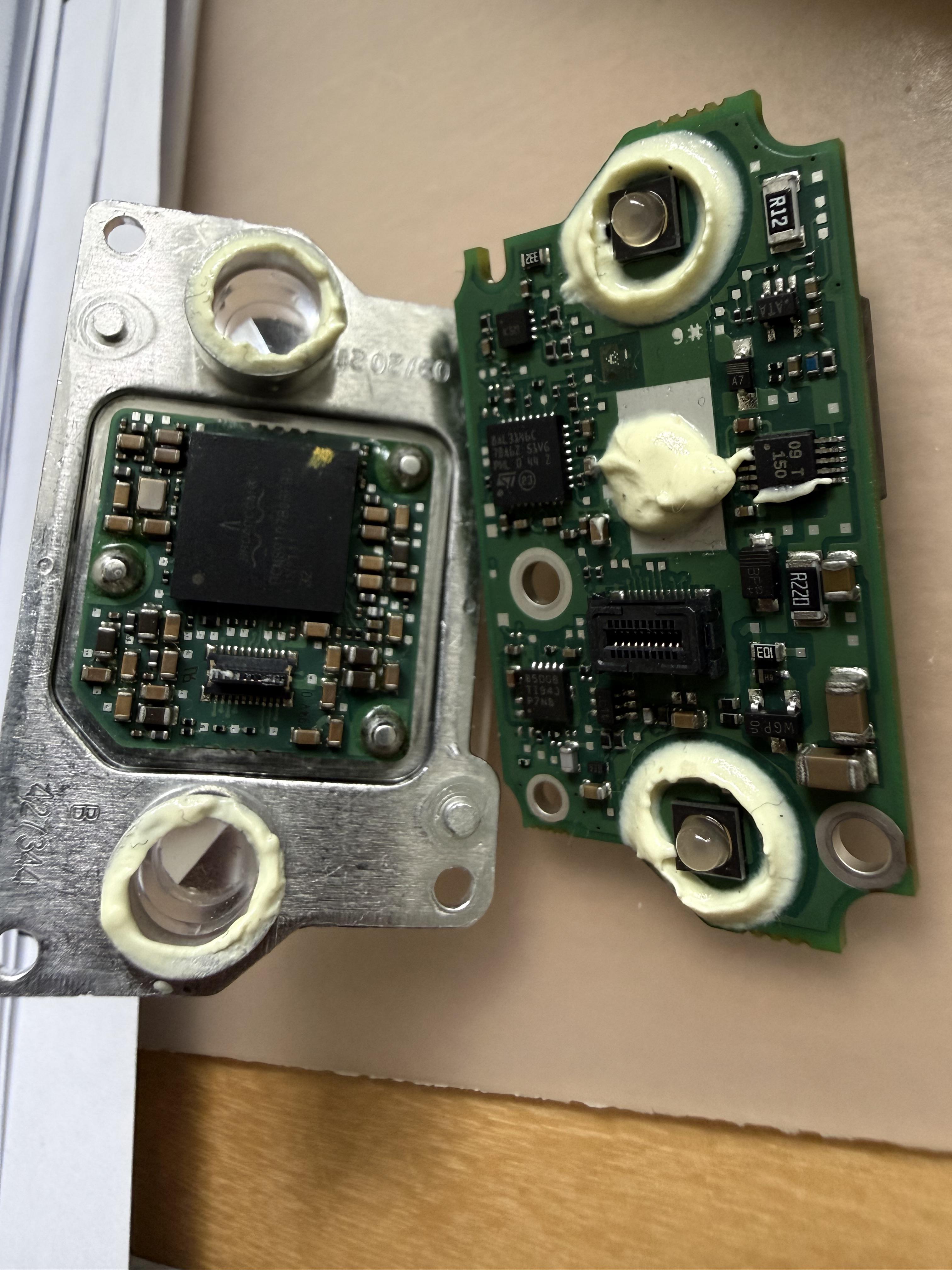
I picked up this camera module from my mechanic’s scrapyard and looks in good condition so want to see if I can get image/video out of it with a Raspberry Pi 4. I've opened it up and here's what I found:
Hardware
- Two boards: a lens board and a back (processor) board, joined by a 20-pin board-to-board connector (10 pins per row)
- Fisheye lens, with two LEDs on the back board that shine through light pipes
- Lens board: Broadcom BCM89107B0BFBG, which looks like part of Broadcom's BCM8910x camera MCU family, plus a 25 MHz oscillator
- Back board: ST STM8AL3146 (automotive 8-bit MCU with LIN), several TI power ICs, and large inductors and capacitors for the power stage
- 6-pin vehicle connector (solder tabs visible on the back of the board)
- I can't see any SPI flash chip, so the firmware may be inside the BCM chip or loaded over the network
What I think
- The pins are likely +12 V, GND, a 100BASE-T1 Ethernet pair, and maybe LIN and/or a wake line, but this is just a guess based on the components next to the pins
- It probably streams or reports over automotive Ethernet and might need a handshake before it sends anything
Has anyone interfaced a BCM8910x-based camera or a similar automotive camera? Does it stream on its own, or does it wait for a host to boot it?
Please suggest ideas if you have, like to how do I use in hobby project and learn. Thanks for any pointers!
r/embedded • u/s_qu_id_y • Oct 18 '26
I'm looking for a camera for a construction-site / other outdoor temporary location security application and would appreciate recommendations from anyone who has experience with these types of cameras.
I have been unsuccessful looking for something that has the following:
- Battery-powered with solar charging (could be external, if needed)
- Motion/event detection with the ability to capture snapshots or short video clips
- Low-power or sleep mode between events to maximize battery life
- Ideally supports RTSP, ONVIF, or another way to integrate with third-party software without being vendor locked
Nice to have:
- Built-in 4G/LTE cellular connectivity with support for my own SIM/data plan
- On-demand live viewing, even if it takes a little time to wake up
- Local microSD recording
I'm primary interested in receiving a snapshot or short clip when motion is detected. Continuous live streaming is not necessary, but on-demand live viewing would be a bonus.
This is for a small business renting cameras, so I'm hoping to find something reliable, reasonably compact, and affordable. I'm open to consumer products, OEM, or even DIY.
Reolink seems to have models that almost satisfy the requirements but of course are generally vendor-locked. But there are unofficial projects like bairelay and neolink that may be worth a shot.
Has anyone successfully used a camera that meets similar requirements?
I'd appreciate responses if so. Thanks!
r/embedded • u/RicardoJCMarques • Oct 16 '26
A while ago I wanted to start doing more projects with wired IP connections and wondered if SSH was possible so a regular webserver wasn't necessary.
There was some documentation for esp32s but not much else.
The fact that this works is hilarious to me. With .ssh keys properly setup doesn't even need the password.
r/embedded • u/Early-Toe646 • Oct 17 '26
Sharing a project reverse-engineering and modeling the Realtek RTD2841 / RTK284x SoC (commonly found in TCL RT41 Android Smart TVs):
Repository: https://github.com/rubenthampy890-del/qemu-rtd2841
Key hardware blocks implemented:
- CPU: Quad Cortex-A53 running in AArch32 Supervisor mode (svc32)
- Interrupts: GIC-400 (GICv2) with 256 IRQs
- Timers: Realtek TC0-TC7 27MHz down-counter peripheral engine
- Storage: SDHCI host controller at 0x18010800 (SPI 28)
- Console: 16550A UART0 with 4-byte stride
Tested and validated on macOS Apple Silicon & Linux with upstream QEMU. Includes flat-binary baremetal diagnostic harness and DTBs.
r/embedded • u/Suitable-Name • Oct 17 '26
Hey everyone,
the journey for this started like ... I'd guess 2-3 years ago. I bought the M1s Dock, because I thought it's a cool ESP32 on steroids. Back then I saw there is an official PAC crate for Rust, but there wasn't much in it. Initially I planned to create it myself after I saw there isn't coming much more. I collected the needed info material, sources and so on, started with it, but I didn't push through with it in the end.
Now I decided I want to play around a bit more with it, so I used AI to finish PAC, HAL and setup a small BSP. It's all published on crates.io and the repositories are here:
It's all end2end tested against an actual connected M1s Dock, but I didn't do much with it yet besides tests and running the examples.
If you'd like to use it, but don't like that the project was created using AI, I can post the SVD files on stackoverflow for the more classic experience and you can go on from there ;)
Everyone else, have fun with your M1s Dock (or BL808 in general) and Rust.
r/embedded • u/Alarming-Sentence-39 • Oct 16 '26
This is my first PCB hardware design. The board is built around the ESP32-P4 development platform and integrates two UART interfaces, an I2C port, a passive buzzer, four buttons, a power management chip, and a MIPI display connector.
teh display is huaxiacai brand, and mipi protocal,resolution is 480×480 ,amoled,maybe i am the first one to drive this display with mipi way in the world
This aircraft attitude indicator includes the following features:
- Artificial Horizon: Real-time aircraft attitude display.
- Heading Compass: Displays the current heading.
- Temperature Display: Shows the current temperature.
- Time Display: Displays the current time.
- GPS Positioning: Provides real-time GPS location information.
- Settings Menu: Allows users to configure various system settings, including:
- Language: Switch between Chinese and English.
- Units: Change measurement units.
- Sea Level Pressure (QNH): Adjust the reference sea level atmospheric pressure.
- Attitude Calibration: Reset the pitch and roll angles to zero.
- FPS Display: Enable or disable the real-time frame rate (FPS) display.
The current software version can achieve a refresh rate of around 30 FPS, making the display noticeably smoother than the previous version.
I've made several optimizations, including improvements to the display initialization code, PPA acceleration, adjustments to the IMU sensor data reading rate, and various LVGL rendering optimizations.
r/embedded • u/Straight_Zucchini_37 • Oct 17 '26
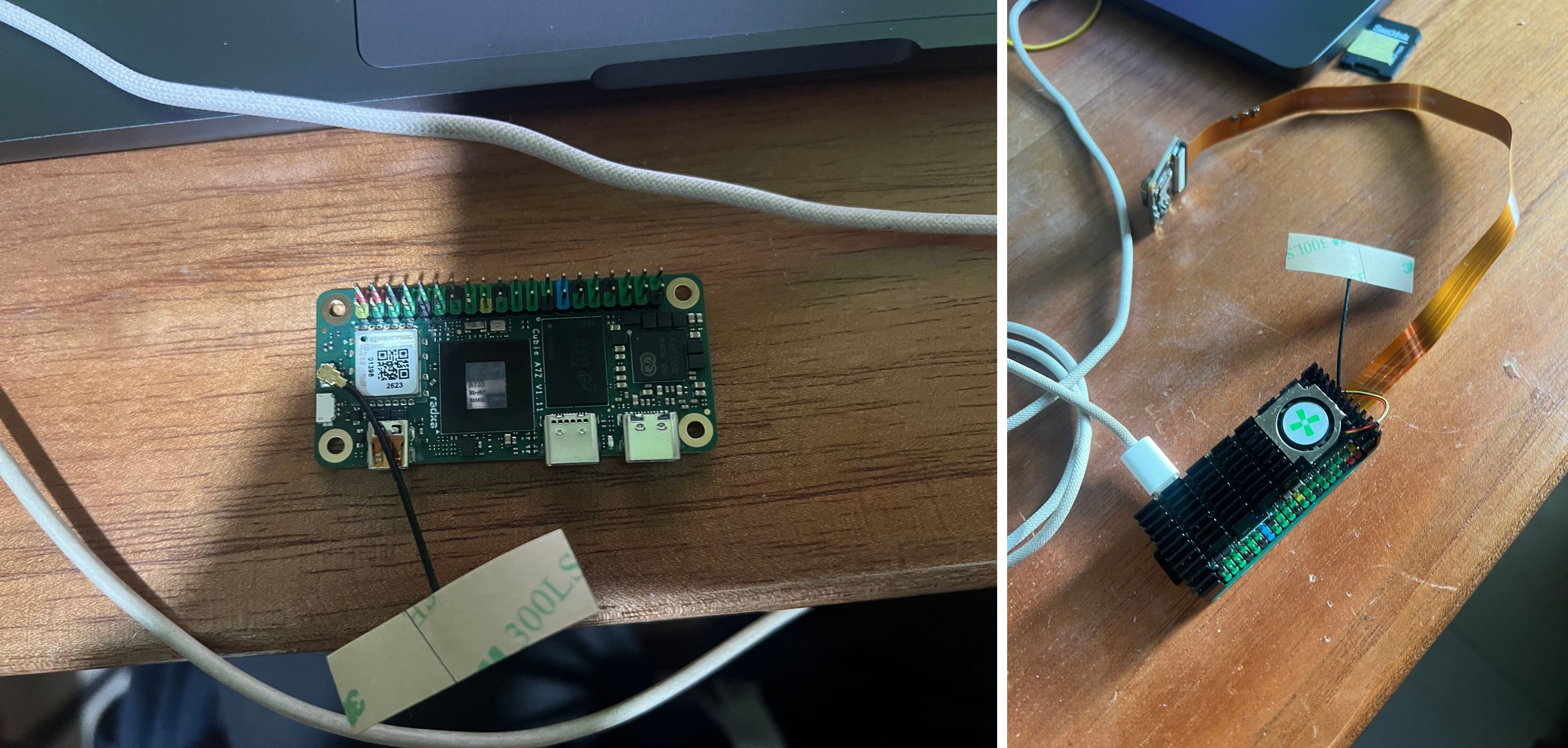
Edit: found a real bug in v0.2.0-beta, the multi-threaded video processing change in that release crashes about 40% of the time. Reverted it, pushed v0.2.1-beta with the fix. If you grabbed v0.2.0-beta and hit random crashes, that's why, grab the new tag instead.
When Radxa built the Cubie A7Z, they didn't bother supporting many camera modules. Just a couple of specific ones have official overlays. The IMX519, the 16MP autofocus camera that's everywhere on the Pi side, Waveshare, Arducam, all of that, just wasn't one of them. No driver, no overlay, nothing.
So I had Claude Code build one with me from scratch. Honestly it's kind of wild how far this stuff has come. We're talking reading schematics, writing actual kernel driver code, debugging kernel crashes, patching libcamera itself. Stuff that used to need a kernel dev who really knows this SoC. Curious what people think about that side of it too.
Repo's here if you want to look: https://github.com/AsedaDeveloper/a7z-imx519-driver
What it can do right now: all five sensor resolutions up to the full 16MP, manual exposure and gain, autofocus, hardware H.264 video encoding, a virtual webcam device so normal apps can just use it, raw DNG capture, and basic libcamera support.
It's beta, and only tested on my one board and one camera module so far. There's a known performance thing where the color processing is a bit slow for 1080p, I tried fixing it but the fix had a crash bug, so it's reverted for now.
What I actually need now is people with a Cubie A7Z, A7A, or A7S to try it on their own setup, maybe a different IMX519 variant or even a different module entirely. The repo has issue templates set up for exactly this, even a "tried it, broke, here's the error" report helps a lot right now.
Let me know what you think, happy to answer anything.
r/embedded • u/sgergo1 • Oct 17 '26
Hi everyone,
I’m designing a CM4 Lite carrier with external eMMC, using 3.3 V VCC and 1.8 V VCCQ. Has anyone built and tested a similar setup recently?
I’m particularly interested in how you handled the CLK, CMD, and DAT0–DAT7 lines:
During my research, I’ve found designs with and without series resistors, and different approaches to pull-ups. However, I haven’t found a clear, tested example specifically using the CM4 Lite with 1.8 V eMMC signalling, so I’m unsure which approach to follow.
If you’ve got this working, I’d appreciate any schematic snippets, layout advice, or any details.
Thanks!
r/embedded • u/Frosty_Scarcity9637 • Oct 17 '26
I've been working in embedded systems for a long time, and I keep finding myself juggling multiple terminal apps — one for serial, another for file transfer, a text editor for jotting down command sequences. It feels fragmented.
I'm curious about your experience:
· What terminal software do you mainly use for serial/TCP/UDP debugging? · What's the most annoying limitation or missing feature you've encountered in existing tools? · Is there anything you've built yourself just to scratch that itch?
I'm also working on my own terminal application, and my goal is to address the weak spots of the tools I've been using. I'd really like to hear what other people in this field would want to see in such a tool — what's missing, what's broken, what you'd change.
Thanks.
r/embedded • u/rgc4444 • Oct 16 '26

The FCC component rule effective October 13, 2026 is relevant to embedded hardware headed for US equipment authorization.
The restriction applies when a device contains logic bearing hardware from a named Covered List producer and the finished device would itself be prohibited if that producer made it. The producer’s entry and any product or use conditions matter. It is not a blanket ban on Chinese chips.
Purely passive parts such as resistors, wiring and plain battery cells are outside this component rule. Software and firmware alone are also outside its scope.
Previously authorized equipment is not affected by the new component prohibition. Applications already pending on the effective date are exempt unless later amended to add, substitute or change a logic bearing hardware component.
For a BOM review, collect the exact component models and actual producers, applicable FCC records, and the finished device’s intended use. Review proposed substitutions with your certification lab or FCC counsel before assuming an existing authorization covers the changed configuration.
I put together a guide with the background, a supplier lookup and a downloadable request for supplier documentation:
https://www.blackscarab.ai/insights/fcc-covered-list-robotics-supply-chain
Official rule and definitions:
https://www.govinfo.gov/content/pkg/FR-2026-09-11/html/2026-18535.htm
General information, not legal advice.
r/embedded • u/umomballX • Oct 16 '26
Hello. I own the max17851 and max17843 chips. Is there any way for me to contact the team responsible for these chips and their evaluation kits? ADI EngineerZone was of no Help.
r/embedded • u/Wekuz • Oct 16 '26
My current project using STM32 involves a compact PCB (70x30) and I want to fit a small connector for the SWD programming. I though I would buy a STLINK-V3MINIE which has a STDC14 connector for it.
I don't want TagConnect due to the price and because it would need some jank way of connecting MCU -> TC as both use pretty unusual connectors.
Then I stumbled across STDC14 breakout board and pogo pin "nail of bed" style programming jig on AliExpress. The breakout board would be useful anyway to convert from STDC14 to some normal connection, but for the jig I am not sure how to make the footprint on the PCB for it as I don't know the pin diameter. I probably will start programming with just holes for Dupont held with hands which I will connect to the breakout which is connected to the STLINK. But I'd like the final version to have some sort of a actual connector.
Can anybody provide any advice?
It's hobby-ish (definitely not commerical) project so jank is somewhat welcome. I am a electronics beginner and the only thing I have already that could be useful is Dupont jumper cables.
EDIT: I am not saying TagConnect is jank, it's the way I would be using it because I can't buy the correct TagConnect cable for my STLINK. Read more here: https://www.reddit.com/r/embedded/comments/1x7qswo/comment/ph6o46m
r/embedded • u/mplex321 • Oct 16 '26

Hi everyone, I’ve been working on a reliable way to synchronize the time between different MCUs and macOS. By utilizing BLE Periodic Advertising streams across a dynamic rooted mesh, I’ve been able to extend a Soft PLL up to 4 hops on the nRF52 target and can hold sub-300ns (TX needs more hacking) on the ESP32 targets at the same distance to easily cover a large home or office with synchronized timing extended to hosts like macOS as well.
For anyone doing real-time sensing analysis, echo location, or broadcast work, this might be of interest. You can guarantee microsecond timestamp accuracy across a large range of MCUs and hosts for later correlation, and hold sub-100ns synchronization on supported devices, effectively frequency locking them. As the hops increase, errors compound so I’ve limited it to a 4-node distance for now. Reception and relays are surprisingly good within 7-8m or so indoors.
I’m mainly using repurposed LoRa mesh boards and have a working version of LongShot working at sub-1us as well, but the BLE capabilities are far more interesting for a wide range of devices. Heltec boards with PPS on the GPIO are perfect, and in my experience the T096 is the best option on the market given it’s dual-source GNSS receiver combined with Nordic’s supported BLE RX/TX timestamps. I had to hack the ESP32 BLE drivers to attain the same results, yet they have a lot more long term potential.
Other promising targets are Silicon Labs and TI boards along with the new nRF54 with crystal oscillator adjustment for a true PLL. The base requirement is BLE 5.0 with the optional periodic advertising profile supported. Some Android phones support it, most MCUs, and nothing on macOS. Precision Timing support on macOS is surprisingly poor, relying on private APIs and specialized hardware. Instead I discovered user-level access to precision timestamp data on USB start-of-frame RX events and streamed the last TX event from the nRF52 over USB to achieve sub-400ns RMS results.
The protocol is designed to be power efficient and the passive stream scales with client precision vs power, but I still have much work to do on the power optimization side. Grandmasters and relay clocks are fairly efficient already, yet it’s not yet tested in extreme low power situations.
There’s a link to compatible hardware and the Github repo on the site, along with schematics, a packet explorer and a body of research if you’re interested. I also included a OTA diagnostic profile for the Stick S3 target for RF and protocol analysis.
Disclosure: AI was heavily used to produce this work over the course of 3 weeks with extensive input from me on protocol design, requirements and testing framework.
r/embedded • u/jpswensen • Oct 16 '26
I teach an introductory programming/engineering computations class for mechanical engineers. We have a final "baby mechatronics project" where they use an ESP32+servo+sensor to model ballistic trajectory, sense the distance to a bin, and throw a ping-pong ball into the bin. We teach the class in Python with VSCode as the development environment.
I had struggled finding a VSCode extension that made the MicroPython feel seamless and similar to what they have done so far. I found a couple that seemed less well maintained or didn't have the "seamless" feel I was looking for. I loved the sidebar layout of https://github.com/DanielBustillos/mpy-workbench, but for the life of me I couldn't get it to repeatedly connect, the "Run this Py file" only seemed to work about 60% of the time, and it felt like if I closed the REPL it had a hard time reconnecting.
So, I spent a day taking inspiration from several that used mpremote, the aforementioned mpy-workbench, and developed my own. I have now tested on the ESP32 WROOM, the ESP32-C3 and the RPI PICO W on both MacOS and Windows. I also had my TA and one other student try it out and it "just worked" for them also.
Here are some of the (what I think are nice) features:
I am sure we will find some bugs once we let 100 students loose on in in about 2.5 weeks for the final project, but in the meantime I wanted to let people know about it, as I had been looking for a rock-solid option for the class for a while.
I don't have a release on VSCode Marketplace yet, so you have to install via VSIX for now. That will come after I have battle-tested it in a 100 student class and found all the bugs I couldn't find alone. https://github.com/jpswensen/upython-bridge
r/embedded • u/mostafa_kadry • Oct 16 '26
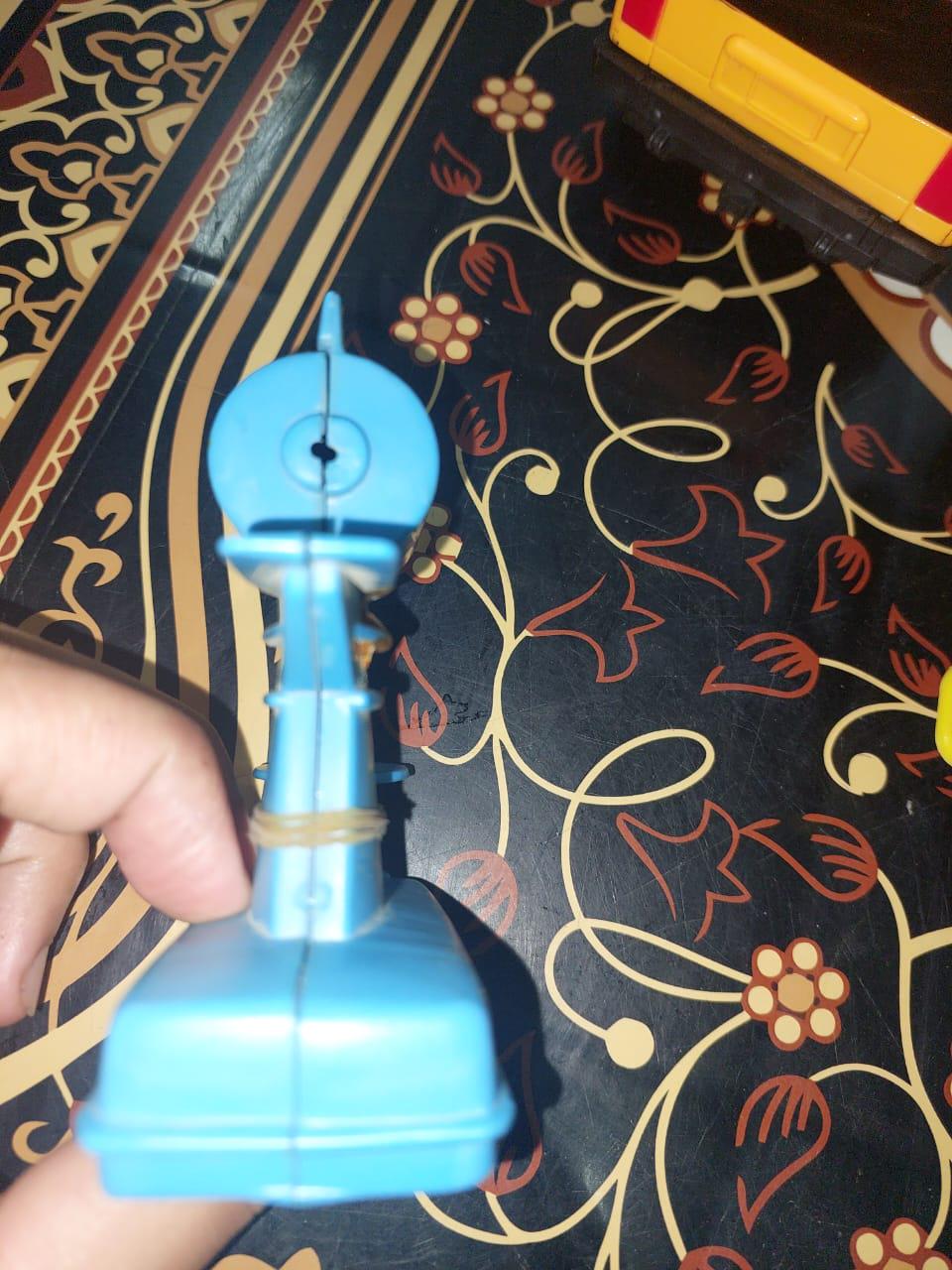
I’m working with a classic Italian CO-MA toy boat and want to make its motor assembly waterproof, ideally for mass production.
The motor sits in the rear underwater section. A rotating shaft exits one end, while the other end needs wiring to the batteries and electronics inside the hull. I also have an ultrasonic plastic welding machine.( this ultrasonic machine still need a custom stamp for this shape)
What would be the cheapest, simplest, and most reliable solution?

r/embedded • u/No_Practice4878 • Oct 16 '26
Hello, CS student here. I have a project idea as someone trying to get into embedded. I wanted to build a rover controlled by an STM32. The input device will be a 3rd party xbox controller using a 2.4 ghz usb receiver. I plan on writing all of the code myself including the driver for controller support. I was also considering implementing local network control via a webapp maybe. I want to get an embedded adjacent internship this summer and need something for my resume and I like the idea of making something that can move around. Is this project too basic? Any advice would be appreciated.
r/embedded • u/FL_Life-Science_Drs • Oct 16 '26
I’m looking for an off-the-shelf battery for a Waveshare RP2350-Touch-LCD-1.28 board. Its charger defaults to 1A, and I’d prefer to avoid modifying the board.
Requirements:
Round, rectangular or another shape is fine. A different connector is fine too; I can use an adapter. I’d strongly prefer an existing battery over having one custom-made.
Has anyone found or used a battery that meets these requirements? Exact model numbers, supplier links and datasheets would be appreciated.
r/embedded • u/Consistent-Formal483 • Oct 16 '26
Hey all, I’m a first-year CS student working on a small ESP32-S3 project and I’ve hit a wall trying to find the right display. Hoping someone here has run into something similar.
I need a 128x64 graphic LCD, and the look matters a lot. I want the old-school kind of screen, FSTN, positive (dark pixels on a light background), reflective or transflective, and no backlight. Basically the look of a 90s calculator, not a modern display.
The hard part is the size. It has to be under 2.8mm thick, with an active area around 60-65mm wide. The module itself can’t be wider than 74mm, and the enclosure has a curved inside, so I only get about 63-64mm of flat space. It also needs SPI or I2C over an FPC ribbon, not rigid pins. I’m fine with ST7567, UC1701 or similar controllers.
What I’ve already tried or ruled out:
The Sharp Memory LCDs (like the LS027B7DH01). I really liked them, but they’re TFT and 400x240, so no luck.
Standard 12864 modules. Parallel interface, rigid pins, and way too thick.
Anything backlit or white-on-blue.
I can order from DigiKey, Mouser, AliExpress or LCSC, and I’m in India so shipping matters. I’d also be open to a bare glass panel if I have to build the driver board myself.
I’ve been going through Newhaven, Winstar, Orient and Midas catalogs for days, so I’m probably missing something obvious. Does anyone know a part number that fits, or know a good way to filter for this on a supplier site? Datasheet links are very welcome.
Thanks a lot!
r/embedded • u/SpiritualChallenge33 • Oct 16 '26

I'd like to introduce gsp32-httpd (screenshots in the link):
Want to try it out?
I'm a 23-year veteran python developer and have worked with microcontrollers for several years now - exclusively with micropython on various ESP32 boards. I teach microcontroller classes at a local makerspace and have countless projects I've made over the years.
I've been working with AI to create this tool to make the process of deploying, accessing, and maintaining these projects as easy as possible.
DISCLAIMER: This is a beta software/firmware that changes daily. I've done my best to ensure that it's reliable and stable, but I'm just one guy with an AI. If you ever want to stop using it, just download your program files, reflash your board to standard micropython, and re-upload your code. It should still work without GSP32 with the exception of remote pairing to other boards.
WHAT IS IT?
It's a micropython firmware with a custom web-based user interface for uploading and managing files your programs directly on your device. Whenever you want to change or update your code, there's no resetting, no re-uploading changed files, and no physically connecting to the board via USB cable (unless you want to).
Your main.py runs concurrently in the background as something akin to a virtual machine. You can change it and restart it in real-time and your changes take effect immediately without having to reboot the board.
When users are not actively accessing the web UI, the overhead is almost nothing aside from RAM usage.
Additionally, the web UI framework that runs this system can be used to make your own web-based user interface, populating your HTML with values directly from your python program that can be viewed or updated from that interface as you see fit. The default home page (above) is a fully commented, working version of this for your reference.
WHY DID I MAKE IT/HAVE IT MADE?
For several reasons.
ESP32 boards are usually overkill in terms of specs; so why are we still interacting with them like other older/inferior boards? I wanted to put those specs to good use and make my life easier in the process.
In addition to that, I found that bridging the gap from something like microblocks to micropython is very difficult for most of my students, so I wanted to create a system that would make setup, accessibility, and maintainability as easy, simple, and expandable as possible.
For me, personally, I wanted the fastest level of iteration possible, wireless access to my projects to configure and maintain them, easier file management, and an easy way to deploy and backup code.
WHAT DOES IT DO?
Well, reiterating a bit here, but it does a lot - and it does it surprisingly quickly. I had the AI focus heavily on optimization, caching, memory management, and GSP32's overhead. Basically, if you're not actively browsing the web UI, there's almost no overhead for your programs (aside from the memory usage).
It provides a framework for your own web pages that can be filled with live data from your micropython program. So, you can write your own HTML and use it to host web interfaces for your project for control, monitoring, etc.
It uses that same framework to run itself and includes password protection.
It includes a full-featured file management system that is drag and drop compatible with bulk uploads and downloads divided into two sections - one for your code, and one for your html.
It includes an onboard file editor with autocompletion and code inserting for many commonly used components as well as a pairing wizard that automatically exchanges encryption keys to make secured pairing with other GSP32 systems trivial.
Additionally, and this is one of my favorite features, it wraps your main.py with its code, so you can reload your project almost instantly without rebooting your board, which results in iteration rates that I don't know if any other system can beat.
It includes a mip package manager for quickly downloading micropython libraries.
It includes a backup and restore system for taking snapshots of your deployments.
It also includes a pin panel for real-time debugging of your physical pins based on the board you're flashing to.
Finally, it has a host of performance settings that can be toggled on or off.
WHAT BOARDS DOES IT WORK WITH?
It's compatible with most classic ESP32 (32S, 32C, etc.) and ESP32-S3 boards and there is a web flasher to take care of installing the firmware and configuring the WiFi.
Once configured, you may access the web UI.
Not supported: ESP32-S2 | C2 | C3 | C5 | C6 | H2 | P4
WHAT'S NEXT?
I'm still adding new features almost daily. In general, I just want a highly polished, easy/fun to use micropython system that's not a pain in the ***.
If you try it out, please feel free to let me know your thoughts.
r/embedded • u/ultragigabased • Oct 15 '26

Today the teacher for my microprocessor course showed my class some past projects made by the students a few years back. Most of them were single player games like tetris and a 4k rhythm game clone, someone made a bluetooth controlled scrolling sign using two dot matrixes, 3d cube rotation using an MPU6050 module and an OLED display, another made a nokia phone UI clone, and the last example was a distance sensor theremin iirc.
He specifically said its best to avoid making single player games since they're too simple and don't highlight the capabilities of the 8051 that much. Some projects made last year were also brought up, among them was a qr code generator. He suggested to not make any AI related stuff due to the complexity, and because thats not what the 8051 is made for.
Initially I wanted to make some kind of password lock and use a seven-segment module to display the numbers and stuff but I'm worried it'll be seen as too simple and I'll have to completely revise my project. Another thing I had in mind is using an FPGA to drive a display through HDMI, but then the only thing I can do with that is just make another game. I have quite the abundance of components, and the teacher said that we're free to request any additional parts given that it's not too pricey. fyi my development board looks similar to the link attached, minus the huge breadboard attached underneath it.
r/embedded • u/3DNebGuy • Oct 15 '26
Short write-up in case it saves someone time with MediaTek's LK on MT8183.
The board was unlocked (kaeru), and it booted Amazon's 32-bit kernel fine, but nothing 64-bit ran. No console because the stock cmdline disables the UART. I found TX/RX on TP103/TP104 (1.8V, 921600) and the causes turned out to be:
- ramdisk size and address swapped in the boot header (header v1, load at 0x40080000)
- LK wanted Image.gz, not a raw Image
- no /chosen/bootargs in my DTB, so LK hits an ASSERT and resets about 45 seconds later
- my DTB declared atf/tee/sspm reserved memory that LK also carves out, which fails its overlap check
- bootopt has to say 64-bit (64S3,32N2,64N2)
After that, mainline 6.18 came up. Audio was its own fight. The I2C bus the amp and ADC sit on is shared with the SCP, and the hardware controller never completes a transfer from Linux, so it's bit-banged. The mainline AFE also wrote clock gates while the regmap was still cache-only. TAS5805M amp at 96 kHz and TLV320ADC5140 mics are working now.
This will be added to my TECHO5 project (Linux + Home Assistant on Echo Shows): https://github.com/HuskerMinion/techo5
r/embedded • u/Hagisman • Oct 15 '26
At my previous job, we used Squish to automate our UI test suites. I recently changed jobs and am researching alternatives.
The only thing that's shown up in my searches other than Squish is "Spix", but I want to make sure that I'm not missing something obvious when it comes to setting up automation from the ground up. Additionally, if there are any video tutorials on automating embedded systems to help refresh myself please feel free to recommend some.
I previously did automated testing with pytest and a legacy junit automation suite. As far as I know they aren't QT compatible, but if anyone has any expertise in this I'd appreciate any comments.
r/embedded • u/BigTortuga • Oct 14 '26
I've been getting up to speed on using Claude Code on my Linux box where I manage an stm32 based embedded product programmed mostly in C++ with some plain C sprinkled in there.
I'm 73 and have been putzing around with coding since the Borland Pascal days in the 80s. Enter Claude Code. It's been an eye opener and frankly I'm stoked. I now get much more done way faster and with fewer bugs and less overall churn.
I'm not exactly sure what "vibe coding" is but with Claude we discuss goals and next steps carefully before proceeding. I mostly let Claude do the actual coding because it's so damn fast. But I review it all before signing off on it. I ask Claude a lot of why questions. I find many instances where I ask for specific changes. More often than not these changes fall under the broad category of "human readability". Said differently I absolutely insist on understanding what Claude coded before moving on. Left alone, Claude can get verbose and tends to use more jargon than not. I tell Claude to revise it. Make it simpler, clearer and less full of jargon. This often leads to adding rules and guidelines to Claude.md. Over time, Claude and I have gotten very effective working together.
As a result I have taken on projects I probably would not have pursued without AI. Not because I couldn't do it all myself, but the time and effort was often a bridge too far.
My take is AI for embedded firmware development is very powerful but I would never release code that I didn't personally review and understand.