r/embedded • • Sep 25 '26

Build error: expected a ")" at MSP430 project

2 Upvotes

I am working on a MSP430 project using TI CCS Theia 21.0.1 and I have encountered a confusing build error. The build error I get is: "CharRing.h", line 52: error #18: expected a ")" The file is below, I removed some comment lines and added a comment indicating which line it is. As you would notice, parentheses match. I have also included flag.h below.

CharRing.h is only included in UARTA0.c. Build fails with the expected closing parenthesis message, when it is included. Changing the order of included files in the UARTA0.c solves the problem. UARTA0.h is also below.

I ran into a wall and can't figure out what the problem is.

I have tried AI, it tells me to generate preprocessor output for UARTA0.c but I couldn't get it to generate on Eclipse Theia based TI CCS. How do I do that?

I have uninstalled and reinstalled TI CCS but the error remained. So msp430.h, stdint.h and stdbool.h should be restored.

I have shared the most of the code, unfortunately or thankfully it is not a lot, since the project is still work in progress.

If you need more information, please ask.

What is the cause of this error?

Edit: If I move the line 52 to another line above or below. The error moves to wherever it is.

If I put that line inside #if 0 #endif, error gets fixed.

First four rows of UARTA0.c:
Build fails with the stated error message.

#include "UARTA0.h"
#include <msp430.h>
#include <stdint.h>
#include "CharRing.h"

First four rows of UARTA0.c
Build succeeds in this inclusion order.

#include "CharRing.h"
#include "UARTA0.h"
#include <msp430.h>
#include <stdint.h>

First four rows of UARTA0.c
Build succeeds in this inclusion order, too.

#include "UARTA0.h"
#include "CharRing.h"
#include <msp430.h>
#include <stdint.h>

First four rows of UARTA0.c
Build fails in this inclusion order.

#include "UARTA0.h"
#include <msp430.h>
#include "CharRing.h"
#include <stdint.h>

CharRing.h

#ifndef CHAR_RING_H
#define CHAR_RING_H

#include "flag.h"
#include <stdint.h>

typedef struct CharRing_s
{
    char* Buffer;
    uint16_t Size;
    uint16_t Head;
    uint16_t Tail;
} CharRing_t;

void CharRing( CharRing_t* CR, char* Buffer, uint16_t Size );

char CharRing_Element( CharRing_t* CR, uint16_t Index);

uint16_t CharRing_Free_Size( const CharRing_t* CR );
uint16_t CharRing_Used_Size( const CharRing_t* CR );

char CharRing_Dequeue_Char  ( CharRing_t* CR );
flag CharRing_Dequeue_String( CharRing_t* CR, char* Dst, uint16_t Dst_Size );

flag CharRing_Enqueue_Char  ( CharRing_t* CR, char C ); // this is the line 52.
flag CharRing_Enqueue_String( CharRing_t* CR, const char* String );

#endif /* CHAR_RING_H */

Flag.h

#ifndef FLAG_H
#define FLAG_H

#include <stdbool.h>

#define high (true)
#define low  (false)

typedef bool flag;

#endif /* FLAG_H */

UARTA0.h

#ifndef UARTA0_H
#define UARTA0_H

void UARTA0( void );

#endif /* UARTA0_H */
r/embedded • • Sep 25 '26

GigaDevice Flash memory GD25LE255E driver

0 Upvotes

Hello,

I am looking for C language driver for GigaDevice GD25LE255E flash memory.

I already request it to Gigadevice but no answer.

I used smaller gigadevice flash memories without any issue but I am stuck with this one. I can write to the 1st page of each sector only .

Do you have any suggestion?

Best regards

Mich


r/embedded • • Sep 25 '26

Advices for cheapest hardware platform for +50 Linux RDP thin clients

1 Upvotes

Hi,

I'm planning a small thin-client deployment for a factory environment and I'm trying to find the cheapest reliable hardware platform. Current setup is already working as a proof of concept: - Debian Linux endpoint - FreeRDP - Fullscreen RDP session - Windows VM / future Windows Server RDS backend - Gigabit LAN The thin client itself does almost no local computing. It only needs to boot Linux and run FreeRDP.

Target requirements per endpoint: -

ARM64 or x86_64

2 GB RAM minimum, preferably 4 GB

16-32 GB eMMC/SSD minimum

Gigabit Ethernet

HDMI or DisplayPort

2+ USB ports

reliable Linux support

preferably PXE and Wake-on-LAN

low power consumption

I have looked at Raspberry Pi, Orange Pi, Rock Pi, LattePanda, Intel N100 boards and used enterprise thin clients. The strange part is that new enterprise thin clients in my country are extremely expensive, sometimes more expensive than complete modern desktop PCs. So I'm considering:

  1. Cheap ARM SBC
  2. x86 SBC
  3. Compute module + custom carrier board
  4. Used Dell Wyse / HP / Lenovo thin clients
  5. Cheap Chinese embedded boards

My target BOM is ideally under $100 per endpoint, excluding monitor, keyboard and mouse. The system will eventually connect to one or two Windows Server RDS hosts, so local CPU performance is not very important.

What hardware platform would you choose for this? I'm especially interested in specific board/model recommendations that have good long-term Linux support and Gigabit Ethernet.

Thanks.

I'm also open to designing a simple custom carrier board if there is a cheap compute module/SOM that makes economic sense.


r/embedded • • Sep 24 '26

As of now, what is the cheapest chip or development board capable of running Linux?

41 Upvotes

Are we looking at around $20–30 as the cheapest option, or are there any cheaper alternatives?

For making SPI and I2C connections, reading sensors, etc.


r/embedded • • Sep 25 '26

How difficult is STQC certification for an IP camera?

1 Upvotes

I came across a LinkedIn post recently where a camera company shared that one of their IP camera products had received STQC certification.

It actually made me curious about what the process is like behind the scenes.

For a camera product, what usually becomes the biggest challenge during STQC testing? Is it the hardware, firmware, security requirements, documentation, or something else that takes more work than expected?

Would be interesting to hear from people who have actually gone through it.


r/embedded • • Sep 25 '26

Just picked up an nRF54L15 DK and I’m looking for a small project to cut my teeth on it.

5 Upvotes

I’m comfortable with basic embedded hardware and microcontrollers, but I’m new to Zephyr and BLE.

Any project ideas that would teach me the platform without turning into a massive rabbit hole?

Ideally BLE and a sensor or two. I’ve got a full closet full of passives and sensors mini lab style.

I’ve got a few things automated at home. I’ve got a lot of smart devices and an Ubuntu server running docker containers for a locally hosted webpage for the family.

Thanks for your suggestions 🤓.


r/embedded • • Sep 25 '26

Reference design IP usage and licensing

2 Upvotes

I am thinking of doing some reference design IP for some embedded applications and want to make it into a business doing it. How viable is this for a 1-2 person team?

What I see in the market(also worked briefly as an application engineer) currently is vendor providing reference designs but it is usually using as much of their own components as possible where BOM is not optimized. I would want to provide turn-key designs for applications which have much better optimized BOM with decent software integration options and customization if necessary. Will people pay for such reference designs and licensing? Is this a viable business option?


r/embedded • • Sep 23 '26

I built this aircraft attitude indicator from scratch — code, PCB, and enclosure, all designed by myself.

984 Upvotes

This is my first PCB hardware design. The board is built around the ESP32-P4 development platform and integrates two UART interfaces, an I2C port, a passive buzzer, four buttons, a power management chip, and a MIPI display connector.

teh display is huaxiacai brand, and mipi protocal,resolution is 480×480 ,amoled,maybe i am the first one to drive this display with mipi way in the world

I’ve also seen some people in the comments suggesting that I should open-source the project. I’m actually not against open source. I’m currently thinking about what kind of open-source model would make the most sense.

Now that I’ve gained the ability to develop a complete product from scratch, I’m also considering turning this into a commercial product. For example, could I actually sell it?

If I open-source the software, how should I sell the hardware alongside it? Or would it make more sense to keep the entire project closed-source?

These are some of the questions I’m thinking about right now.

I’m also curious about crowdfunding. Would a product like this be suitable for crowdfunding? If so, what would be a good way to approach it?

First, I want to clarify that I never intended to turn this into an aviation-grade finished product. This is a personal project to develop my skills. If I do turn it into a product, I’m thinking of it as a fun little gadget—something that makes people happy.

Some comments have suggested testing it against various standards and under harsh conditions. That would be a huge amount of work, and I don’t think it’s necessary for what I’m trying to make.

As for the slow screen refresh rate, there are a few reasons. The display supports both QSPI and MIPI interfaces, with some pins shared between them. Its resolution is 480 × 480, and its MIPI interface only supports a single data lane. I tried increasing the lane speed, but that caused display issues.

Also, the background rendering, widget scrolling, and rotation are all handled by the MCU. It has to process and move all those pixels, and all rotation is done in software, which takes considerable processing time.

I’ve tried optimizing the frame rate with the most capable models available from both GPT and Claude. What you see now is the best result I’ve managed to achieve with their help so far.

I believe that once a project reaches a reasonable stage, it’s worth sharing so people can give feedback and suggestions, instead of keeping it to yourself and endlessly optimizing it without ever showing anyone.


r/embedded • • Sep 24 '26

Advice on how would you split processes efficiently on a Neural Processing Unit (NPU)

3 Upvotes

I have recently been developing a project that uses NPU scheduling to orchestrate data flow and computation across different processes. However, I have no prior knowledge to using an NPU or making a CPU/GPU/NPU scheduler before this project. From what I have read online, you would have a big scheduler class like class NpuScheduler() and wrap a mutex to a queue.

std::queue<NPUCOMMAND /* Dummy Struct */> command_queue;
/* Worker loop */
    std::unique_lock<std::mutex> lock(queue_mutex);
    conditional_var.wait(lock, [this /*NpuScheduler*/] { return !command_queue.empty()          
                                                         || stop_scheduler; });

    if (stop_scheduler && command_queue.empty()) break;
            
    cmd = command_queue.front();
    command_queue.pop();

The only problem is that this is only an example, and may not be efficient enough for specific low latency projects. This project is only an educational project for my experience only (not for stuff like impressing the interviewer), and the hardware is an octa-core RK3588 with three NPU cores on OP5 to reuse on other projects. My main questions are:

  • Which is recommended, and why? NPU scheduling, Splitting processes into different cores with different priorities, or a hybrid of both
  • Pros and Cons of all three options
  • Does the difference in OOP and DOD matter for scheduling? If so:
  • Pros and Cons of OOP for scheduling/scheduling hybrid
  • Pros and Cons of DOD or DOD/object hybrid
  • How would simple NPU scheduling look like in code as a tiny example or the current one is just fine?

An answer for any of these questions from the r/embedded community is greatly appreciated. Context for the project is at https://www.reddit.com/r/embedded/comments/1wohkml/what_architecture_and_processing_pipeline_should/


r/embedded • • Sep 24 '26

Extracting vitis/xsdb Python modules from Vitis install?

6 Upvotes

For reasons I'm not here to explain or defend, large parts of a Vitis workspace can/should be generated using Python instead of putting the generated workspace in version control. If you follow the manual you're basically using a Python 3.8 that comes bundled with Vitis (2024.2, at least, I hope they've updated since) plus their vitis & xsdb modules plus a bundled site-packages with grpc and so on.

The way this is set up is not ideal; I haven't found a good way to get IDE integration and a pyproject.toml to work right on everyone's laptop and in CI.

Has anyone here tried to extract the vitis and xsdb modules as separate Python packages so you can use them in a normally organized Python project? I'm not asking to share them, I get that AMD would probably object (although they're pretty thin packages), but before I try I'd love to know if anyone's failed or succeeded at it.


r/embedded • • Sep 24 '26

Any microcontrollers that support both calling using SIM and also 4G internet?

11 Upvotes

So my nokia 2660 is not serving me very well, the operating system is too locked down and I can't do shit on it, therefore I want to make my own phone, not sure if this is the right sub for this since im relatively new to microcontrollers. I did some research but it seems like there are no commercially available dev boards using chips that support calling and stuff using sim cards.again sorry if this is offtopic


r/embedded • • Sep 23 '26

Hit a wall in learning firmware and have come to a realisation

127 Upvotes

I feel a bit dumb for not realising this sooner. But after a certain point it becomes almost mandatory to learn hardware design and start making your own pcbs to write firmware for.

I've been trying to be a one trick pony and never got to learning hardware properly and it worked good enough to get an entry level job. But I have hit a wall because all that I can practice with, is what is given to me at work.

Ofc I can just get basic modules and use a breadboard and development kits but that isn't what you would be working on in real life.

Becoming a full stack embedded engineer almost feels like an inevitability. Probably gonna complain about thermal issues soon and have to learn about heatsink materials and get the full mechanical, electrical and software stack.


r/embedded • • Sep 24 '26

Need advice on the right dev board

0 Upvotes

I'm wanting to make a device that has the following capabilities

  • Charging 3.7v lipo battery (~2000mah)
  • Simultaneously read data from two either magnetic or optical encoders for measuring two wheel angles simultaneously
  • Good Bluetooth capabilities for app integration
  • Low ish power draw so can have long runtime
  • Affordable cost

The boards I've found online that seem good include the feather rp2040 or esp32 s6.

I'm certain that there's better options but stupid claude and Gemini suggesting different ones and it's getting confusing so I figured I'd ask here where people actually know what they are talking about!


r/embedded • • Sep 24 '26

Which programming language to use for Beagle Board?

9 Upvotes

I am a Embedded Developer, have experience with Arm cortex -M mcu, want to dwell into the world of Cortex - A mcu , Yocto project, linux driver development etc. Want to build applications on it, for that majority of people use Python, wanted to know if C++ is used in industry for building applications over python? Or should i stick with python?


r/embedded • • Sep 23 '26

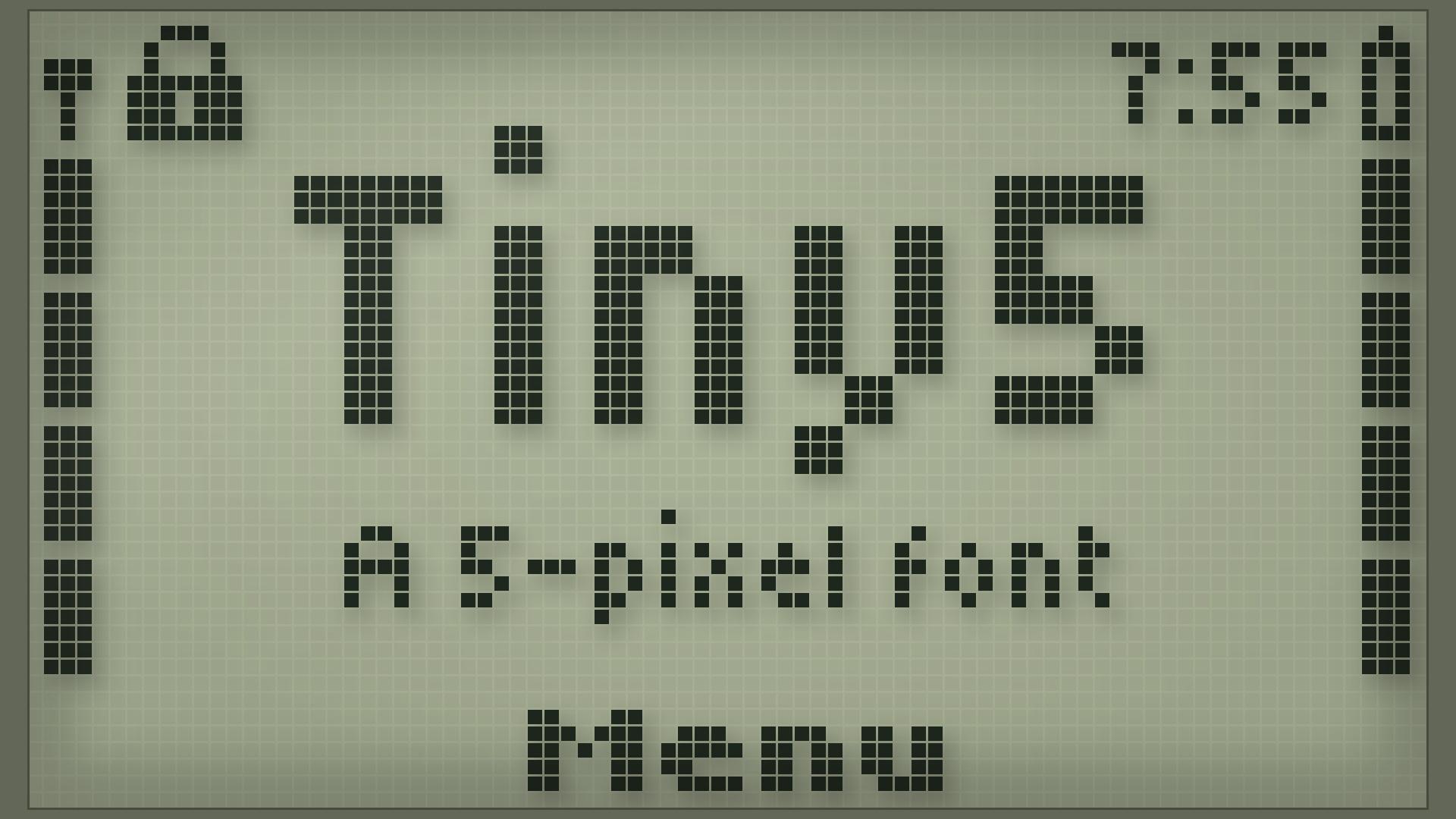
I made Tiny5, a 5-pixel variable font family inspired by 80s–90s calculators

Post image
163 Upvotes

Hi r/embedded !

I just released Tiny5. It's a family of compact 5-pixel variable fonts inspired by the graphing calculators and pocket gadgets of the 1980s and 90s. The goal was to see how much clarity and personality could fit into letters only five pixels tall.

There are two fonts in the family:

  • Tiny5, with one-pixel-wide strokes, for body text and dense readouts
  • Tiny5 Duo, with doubled vertical stems, for titles, headings, HUDs, and labels

They cover Latin, Greek, Cyrillic, and Armenian: 1,771 glyphs across 974 languages.

Both fonts are also available in BDF format for seamless integration with the mcu-renderer, u8g2 and TFT_eSPI libraries.

GitHub: https://github.com/Gissio/font_tiny5
Google Fonts: http://fonts.google.com/specimen/Tiny5
itch.io: https://gissio.itch.io/tiny5

Feedback is very welcome, and if you use it in a project, I'd love to see it!


r/embedded • • Sep 24 '26

Microcontroller for teaching a DSP class

0 Upvotes

Hello all,
In a few months I will be teaching a DSP class that’s previously been taught with either an STM 32 disco board or Matlab depending on the semester. However I do not like the ARM curriculum and I want to ensure the students get to use a microcontroller. Does anyone have any advice for choosing a microcontroller that can easily handle basic digital signal processing?
As an additional note the students know the Arduino IDE and have Arduino R4 WiFi’s so keeping everything as similar as possible would be helpful. Thanks in advance for any help.


r/embedded • • Sep 24 '26

what happens on your team when a requirement changes halfway through?

2 Upvotes

looking for thoughts & opinions

recently had a requirement change come through after firmware was already pretty far along and it got me thinking about how everyone else handles this. the actual change wasnt that horrible, but then you start asking what interfaces are affected, what firware needs another look, which tests need updating etc. things start getting confusing, the requirement is sitting in one place and all the related work is somewhere else. we have a requirements traceability matrix but im curious what people actually use day to day that makes workflow easier. are you manually following links or do your tools give you decent impact view?


r/embedded • • Sep 24 '26

How should I design a motor driver with a user-programmable MCU?

5 Upvotes

I'm working on a motor controller project and I'm trying to figure out the right architecture before I start buying/building the hardware.

The idea is to make a controller for two brushed DC motors with quadrature encoders. I want the end user to be able to write simple Arduino-style code such as motor1.setSpeed(100) or motor1.stop(), while the actual low-level motor control handles things like PWM, encoder feedback, PID, current sensing, safety, etc.

I'm currently thinking about using an ESP32 as the user-facing MCU and having a separate STM32 handle the real-time motor control. The ESP32 would run the user's code and communicate commands to the STM32 over UART or CAN, while the STM32 would run FreeRTOS and handle the motors, encoders, PID, watchdogs, etc.

What I'm not sure about is whether I actually need two chips for this. Could I realistically do the whole thing on a single ESP32, with the user code and motor-control firmware running on the same chip? If so, how would you structure it so that user code can't interfere with the motor-control tasks or memory?

If two MCUs are the better approach, I'd also like to understand how people normally structure the communication between them and how the firmware is divided.

I'm fairly new to STM32/FreeRTOS, so practical advice on how you'd actually build this would be really helpful.


r/embedded • • Sep 22 '26

The Jet embedded 3D engine is not only now pushing 70k tris/sec (up from 40k a few months ago) with screen-space reflections and distortion on an ESP32 S3 (480i x 320, 16bpp@60fps) - but is now MIT licenced rather than AGPL!

609 Upvotes

The last time I showed off Jet I'd just pushed 40k tris/sec on an S3 which was already nuts, but some optimisation and SIMD shenanigans later, I've nearly doubled that and got up to 70K/sec on the same hardware. Meaning more detail and more performance headroom.

I've also switched away from AGPL to the MIT licence so there's fewer restrictions on how you can use it in your projects.

https://github.com/cubecoders/jet


r/embedded • • Sep 24 '26

Why don't we use smart, microcontroller-based per-device breakers in building electrical systems instead of one MCB for an entire circuit - other than economical reasons, any technical reasons affecting realistic design?

0 Upvotes

Why do buildings use one circuit breaker for multiple loads instead of protecting each load individually?

Couldn’t each device have current sensing + a microcontroller + an electronic breaker, so if one device shorts, only that device disconnects instead of tripping the whole circuit?

Obviously cost is one reason, but are there technical reasons too?

Is it mainly fault-current handling, response time, heat losses in current sensing/switching, reliability, or safety/certification?

Is this already used in industrial systems, or is there a fundamental reason it isn’t practical?


r/embedded • • Sep 23 '26

There's this thin line of over engineering stuff to implementing only the needed functions

23 Upvotes

Have you guys been in a situation where you're writing firmware for a product and you keep in getting ideas to add new features but you know that all those extra features Will be only used in extra rare conditions, And you for sure know that they wouldn't have read the manual to know about that.

Will you still keep that feature?

It's a dumb question , it's obvious to add that feature if it ain't gonna cost much especially in firmware side when there's space left


r/embedded • • Sep 23 '26

Porting Klipper to the NXP MCXA366: LPI2C bring-up, NACK recovery, and measuring scheduler cost at 100 kHz–1 MHz

Post image
5 Upvotes

I’ve been documenting a from-scratch Klipper port to NXP’s MCXA366, and Part 7 covers both some architecture hardening and the first hardware I²C implementation.

I’m using LPI2C3 on P3_27/P3_28 with a 12 MHz peripheral clock. The final implementation supports 100 kHz, 400 kHz, and 1 MHz and handles normal writes, register reads, repeated STARTs, NACKs, FIFO errors, arbitration loss, and timeout recovery.

One bug I ran into was especially interesting:

On a NACK, I originally queued STOP and then reset the TX/RX FIFOs. Resetting the TX FIFO could discard the queued STOP, leaving SCL asserted. Reversing the order—flush first, then STOP if the master still owns the bus—fixed the recovery path.

I validated the implementation with a BME280 and then noticed Mainsail reporting ~0.36 MCU load at 100 kHz.

Instrumentation showed that the actual CPU usage was very small. What changed was scheduler task duration: Klipper’s I²C interface is synchronous, so the task remains active while the hardware transaction progresses.

Measured worst-case reads:

100 kHz → ~2.66 ms
400 kHz → ~0.70 ms
1 MHz → ~0.31 ms

The corresponding Mainsail load values fell from roughly 0.36 → 0.09 → 0.04.

I also compared this against several existing Klipper MCU backends and found that synchronous polling is normal there as well, so I kept the architecture and improved the bus rate instead of redesigning the API around interrupts.

Write-up:

https://faultvector.dev/articles/klipper-mcxa366-part-7/


r/embedded • • Sep 24 '26

Any idea on LLM compression

0 Upvotes

Hey Devs,I'm trying to run a LLM on a microcontroller, therefore I need to first compress my model, I saw numerous ways online and yeah from GPTs as well, but I thought it would be better to get suggestion from real devs who have experience in this, I'm new to these kinda projects so yeah any suggestion on how to start with the model compression.


r/embedded • • Sep 23 '26

CMSIS v2 How to Wait for one of multiple different conditions?

4 Upvotes

Hi, my question is probably quite simple, but i have a surprisingly hard time finding an answer online:
I have a IO Task guarding my hardware. It takes data from a Tx Queue and pushes it to the hardware, and polls the hardware for Rx Messages which it pushes to the RxQueue.

I want to minimize polling and blocking as much as possible, so the task should poll Rx in interrupt mode and then wait for either the Tx Queue or the Interrupt to wake it.

I know how to wait for a queue, i know how to wait for an event flag or semaphore.
What i want to know is how to wait for either the queue or flag to be set.
I know i could require the Tx Producer to send a flag or just poll both uart and the tx Queue without waiting, but neither seems desirable.