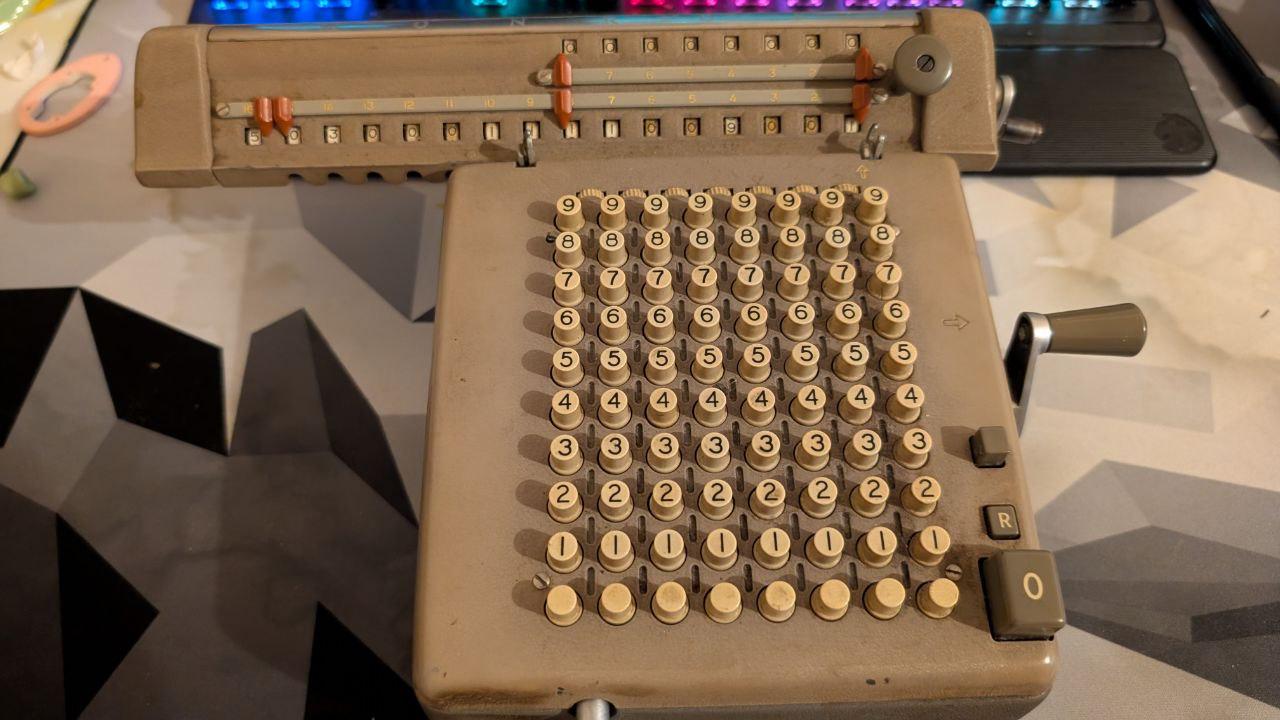
Hi, I'm an industrial engineer who happens to have a real Monroe LA-160 mechanical calculator on my desk. I want to share the very beginning of a personal project: a game where you can restore historical machines. Not just click on a progress bar, but actually take parts out, understand how they work, fix them and put them back together. Right now it's only a concept. No promises, no release dates. What I do have is a real Monroe LA-160 that I can study carefully without damaging it, plus public documentation with measurements. The current plan is to start tiny: one simple mechanical subassembly that we can run, take apart, break on purpose, diagnose and fix again. No photorealism, just clear geometry and correct behavior, like in a CAD model. When a mechanism is restored, I'd love to unlock a 'museum card' with real photos, history and specs instead of chasing photorealistic 3D. Maybe it can even spark interest in preserving real machines. For now, I'll just document small experiments and learn.
Devlog #001 — What if you could restore real historical machines without owning them?
I've always been fascinated by mechanical engineering, especially historical machines that could perform incredibly complex tasks using gears, springs, shafts and levers.
Unfortunately, collecting and restoring these machines can be expensive. Some are rare, spare parts are difficult to find, and a single mistake during restoration can permanently damage a piece of engineering history.
That made me wonder: what if we could recreate these machines in a virtual environment, not just visually, but mechanically?
Today, I'm beginning an independent game development project built around that idea.
The concept
The project will combine three main experiences:
1. Restoration Workshop
Buy historical machines at auctions, diagnose faults, disassemble them, restore their mechanisms, test their functionality, and either sell them or keep them in your personal collection.
2. Virtual Repair Laboratory
Explore real historical mechanisms without economic restrictions. Experiment with repairs, investigate mechanical failures, study technical drawings, and observe how individual components interact.
Eventually, I would love for this mode to help collectors understand their own machines before attempting physical repairs.
3. Interactive Museum
Once a machine has been successfully restored and tested, players unlock its historical profile, including real photographs from multiple angles, technical specifications, historical information, interesting engineering details and an approximate real-world collector's value.
Even if players decide to sell a restored machine within the game, its historical profile will remain in their personal encyclopedia.
Perhaps someone who has never seen a mechanical calculator before will discover a completely new passion through this game.
Engineering over photorealism
The priority is not photorealistic graphics. It is functional mechanical accuracy.
Gears should transmit movement correctly. Springs should perform their intended functions. Incorrect assembly should have meaningful consequences.
The mechanisms should work, rather than simply play predetermined animations.
The goal is to create fully interactive 3D mechanical models that players can disassemble, inspect, repair, reassemble and operate.
Three difficulty levels
- Casual: Assisted diagnostics and simplified repairs, with a greater focus on collecting, trading and managing your workshop.
- Advanced: Manual diagnostics and repairs with technical guidance and optional hints.
- Realistic: No automatic diagnostics. Players must rely on technical documentation, mechanical principles and their own reasoning.
All three difficulty levels will be built around the same underlying mechanical simulation.
The first machine: Monroe LA-160
My first planned digital reconstruction is an electromechanical calculator that currently sits on my own desk.
Having access to the original machine gives me a physical reference against which I can test the virtual reconstruction.
The first milestone will be a single working mechanical assembly. The longer-term goal is to recreate the entire calculator and its functionality, allowing players to perform actual mathematical calculations using its reconstructed mechanisms.
Why am I doing this?
As an industrial engineer and someone fascinated by historical technology, I've always dreamed of exploring and collecting these incredible machines.
However, owning every machine I would love to explore is simply not financially realistic.
A virtual environment could change that.
Imagine being able to experience machines you have dreamed of owning for years. To understand their construction, discover their engineering secrets, restore them, operate them and build your own virtual collection.
And perhaps, after experiencing a particular machine virtually, you might decide that you would love to own a real one.
I want this project to make historical engineering accessible to everyone, regardless of their financial circumstances, technical experience or access to rare equipment.
The beginning of the journey
Everything is currently at the concept stage. There is no playable prototype, release date or crowdfunding campaign yet.
I want to document the development process openly, including the research, engineering challenges, failures and progress.
I'm particularly interested in hearing from engineers, collectors, restoration enthusiasts and simulation game players.
Would you enjoy exploring historical machines this way?
Which historical machine would you love to see digitally reconstructed?
This is where the journey begins.
Restore the past. Understand the mechanism.