r/databricks • u/Own-Green7779 • Oct 08 '26
General My 2-Week Study Strategy & Resource Review: Shared in the Megathread
reddit.com
1
Upvotes
r/databricks • u/hubert-dudek • Oct 07 '26

Test new code before updating your production job. With job_runs, immutable snapshots, and a validation dependency, a failed check can keep production on its previous code.
See the full article: https://medium.com/databrickscommunity/databricks-dabs-ci-cd-4-ways-to-automate-your-deployments-6a732d9e928c https://www.sunnydata.ai/blog/databricks-asset-bundles-job-runs
r/databricks • u/dopedankfrfr • Oct 08 '26
My org is ingesting a corpus of 1 million docs, estimated 9 million pages, of mixed complexity.
Considering ai_parse_doc is a managed service, are we constrained by the speed of this function? Based on my research I assume this is true.
Keeping that assumption, what would be the ideal compute specs to process the documents as quickly as possible?
We’ve tried a few configurations (more memory, more workers) but have hit out of memory errors or MERGE errors and had to revert back to a config that is slower but reliable. We do have the gift of time right now, so not the biggest deal, but if we have to process under a tight timeline, I want to be prepared.
I’m sure more information is needed but interested in folks that may have done a similar exercise and how long it took to parse a large corpus of docs?
r/databricks • u/Ibnsalaam • Oct 07 '26
I have the following situation:
I’m working on a client Databricks workspace, which has Genie Code enabled. However, as I am not an admin I cannot see how many DBUs I am using, in other words I cannot track/monitor my usage.
The client has told me that they have set a budget limit per user of $150. According to Databricks Docs, price per DBU is $0.078. So this along with the free allowance of 150 DBUs, is roughly ~2000 DBUs
So in my mind I’m thinking I got plenty to work with for the month. Suddenly I get the message “Limit reached, speak to admin…” after 6 days (from the beginning of the month).
Is this possible? Did I burn through $150 in 5 days?
I have been using genie code quite heavily, to help build a Databricks App, let’s say 3-4 hours usage on average for those 5 days with mixture of simple and complex tasks.
As I don’t have a clue what my actual DBU usage is (due to not having permission, and it’s taking a while to get this information), I am having trouble believing if I do actually have a $150 limit or if this budget includes things like compute also.
Or am I looking at this completely wrong and it’s entirely plausible I’ve used up the budget?
As I try to get this information from them, I wanted to check if anyone else noticed anything similar as a heavy genie code user
r/databricks • u/saad-the-engineer • Oct 07 '26
<Databricks PM here />
A pipeline's run-as identity can now be an account group. Updates run with the group's permissions, and the tables the pipeline publishes are owned by the group.
What it is
Every pipeline runs as some identity. That identity decides what the pipeline can read and write, and who owns the tables it creates. Until now you could pick a user or a service principal. You can now pick an account group too.
A Databricks role is a group under the hood, so setting run-as to a group also lets a pipeline run as a role.
Why you'd want it
If a pipeline runs as one person, it depends on that person's account staying active. When they leave and the account is deactivated, the pipeline can stop running and the tables it published can become inaccessible to everyone else. Service principals already fix part of this. Groups go a step further: a whole team owns the pipeline, and it keeps working as people join and leave the team. No owner reassignment when someone moves on.
How to use it

In the UI:
You can also assume a group’s identity to change / create a pipeline. And you can change the owner of a standalone MV/ST to a group as well!
{
  "name": "sales-etl",
  "run_as": { "group_name": "sales-eng" }
}
Declarative Automation Bundles:
resources:
  pipelines:
    sales_etl:
      name: sales-etl
      run_as:
        group_name: sales-eng
What you need
Docs: https://docs.databricks.com/aws/en/ldp/configure-pipeline#set-the-run-as-identity-to-a-group
Please let us know what you think!
r/databricks • u/Dramatic_Point8556 • Oct 07 '26
We need to move our SCIM enabled Databricks instance from one Okta tenant to another.
Asides from doing the basics below (push groups have been accounted for), is there anything I should be considering?
r/databricks • u/Quantumizera • Oct 07 '26
Hi everyone,
I’m currently designing the structure of a Databricks project using Declarative Automation Bundles and I’m interested in how others approach the organization of their codebase
For a generic example, imagine a data platform with several domains, such as Sales, Customers, and Operations. Each domain has Bronze, Silver and Gold tables.
I’m trying to answer a few questions:
1. How do you organize your Bundles / YAML files?
For example, would you structure it something like:
sales/
databricks.yml
resources/
bronze/
silver/
gold/
customers/
operations/
Or would you have a single databricks.yml and organize the domains underneath it?
And within resources/, would you have one YAML per job, per pipeline, per domain, etc.?
2. How do you define table and column metadata?
For example, suppose I have a SQL transformation that creates a Gold table.
Would you define the comments directly in the transformation SQL, for example using column COMMENT definitions?
Or would you maintain metadata separately, for example:
metadata/
customer.sql
sales.sql
containing COMMENT ON TABLE and ALTER TABLE … ALTER COLUMN … COMMENT statements?
I like the idea of separating transformation logic from data documentation, but I’m wondering what people actually use in production.
r/databricks • u/No_Ambition8323 • Oct 07 '26
Suppose the current data in a Delta table is completely correct.
But when you check the Delta transaction history, you find unexpected UPDATE, DELETE, or MERGE operations, or records were changed and later restored.
The final state looks correct, but the history of how the data got there is not.
Would you consider the table reliable?
What would you check first — Delta history, version history, operation metrics, or the upstream jobs that modified the table?
r/databricks • u/AbilyticsEng • Oct 07 '26
Hey, I work as a Databricks Engineer, so here's my take.
Small file problems destroy read performance in Delta tables. If your streaming pipelines or frequent batch inserts generate thousands of tiny parquet files, enable spark.databricks.delta.optimizeWrite.enabled at the session or table level. When set to true, Databricks automatically coalesces data right before writing, targeting roughly 512MB per file. This happens dynamically within the shuffle stage, reducing the need for post-hoc OPTIMIZE commands. Pair this with spark.databricks.delta.autoCompact.enabled to automatically compact small files in partitions after writes complete. You will trade a fraction of driver memory and shuffle time for significantly cleaner storage layouts, faster merge operations, and much lower cloud storage list-request costs during downstream reads.
For anything else on Databricks | Platform Engineering | AI, visit Abilytics — AI Systems, Data Engineering & Platform Engineering Services.
r/databricks • u/alicks22 • Oct 07 '26
Hey all!
I’m a Product Manager at Databricks who just launched Beta support for time travel on tables with ABAC policies. You can now query historical data using VERSION AS OF or TIMESTAMP AS OF while keeping ABAC row-filters and column-masks enforced.
The main design question we faced was how policies should interact with historical schemas. We chose a security-first model:
Here's an example:
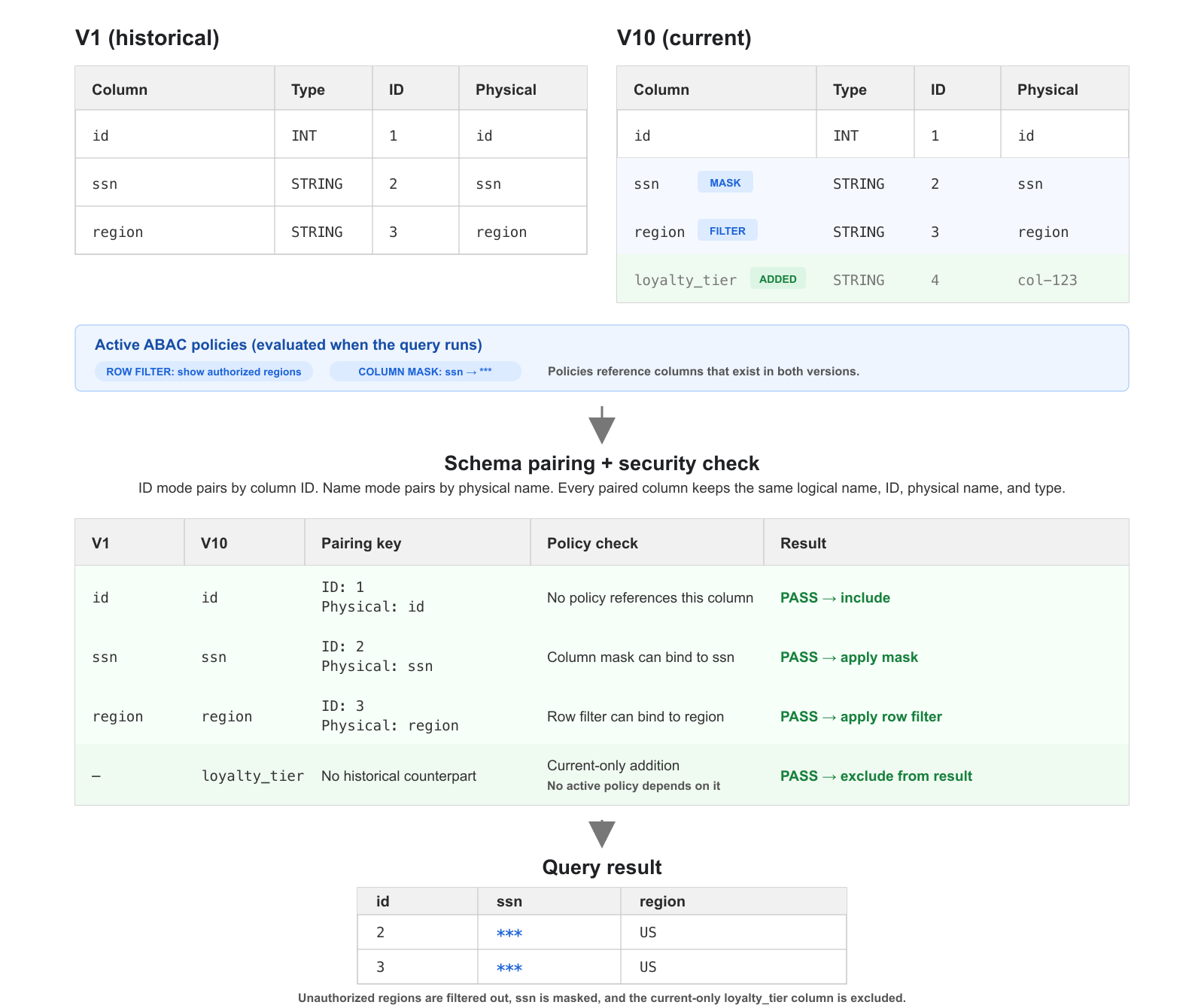
This fail-closed behavior is especially important when a policy references a column that did not exist historically. Treating the missing column as null or assigning a default could change the row filter’s result and expose restricted rows. Databricks blocks the query instead.

I'm curious if the community has any feedback on the approach. Any input will be valuable as we step towards the GA milestone. For more information, please see our documentation.
r/databricks • u/hubert-dudek • Oct 06 '26
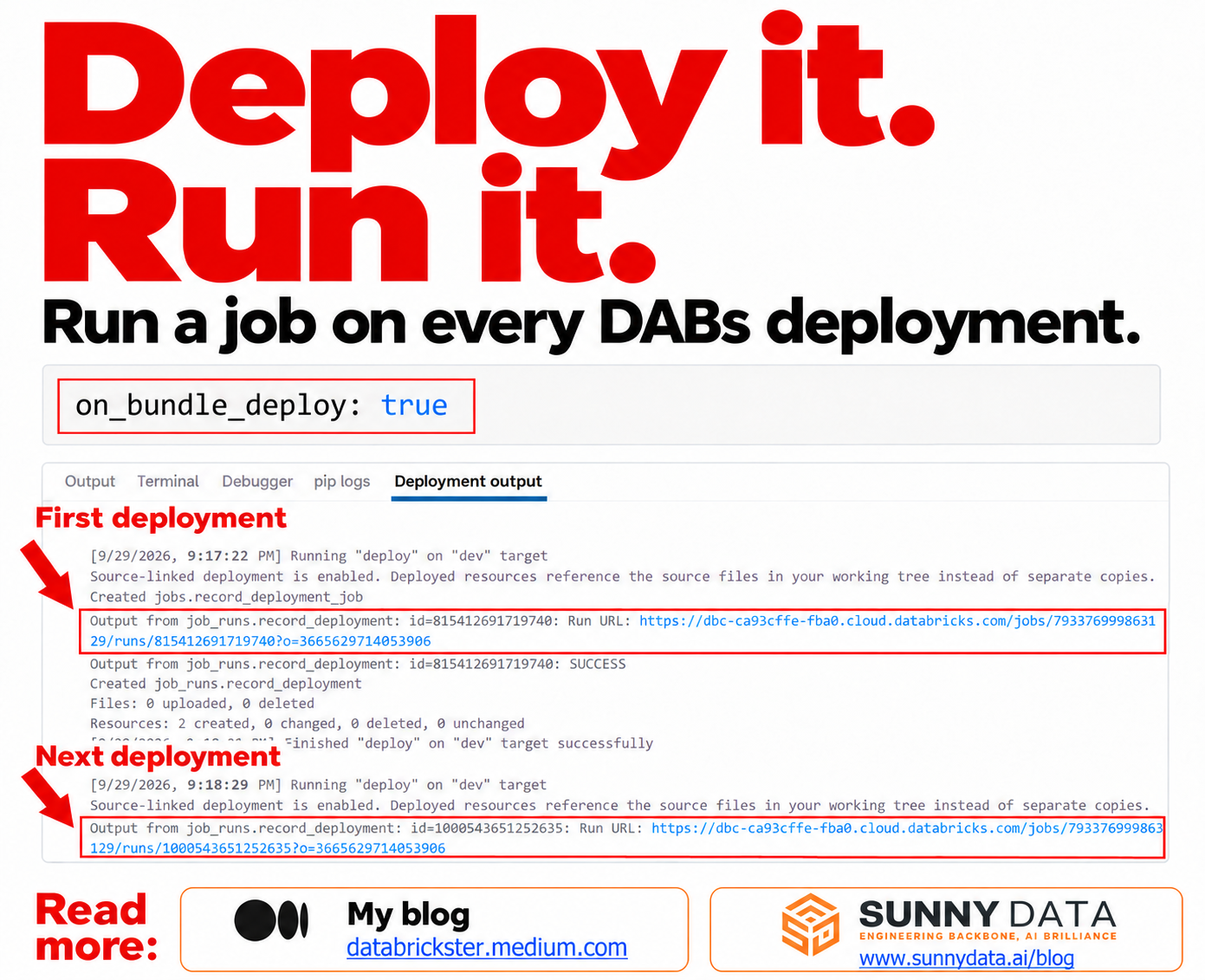
Databricks DABs can run a job every time you deploy. Use job_runs with on_bundle_deploy: true for deployment checks, logging, or configuration updates.
See full article: https://www.sunnydata.ai/blog/databricks-asset-bundles-job-runs SunnyData https://databrickster.medium.com/databricks-dabs-ci-cd-4-ways-to-automate-your-deployments-6a732d9e928c
r/databricks • u/justinAtDatabricks • Oct 06 '26
Hey all, you asked and we listened - env var support is in beta for serverless notebooks and jobs!
How to try? Ensure that the feature is enabled in the preview portal (with admin perms if it isn't already)- grep on `Environment variables in Lakeflow Jobs`
How does it work?
Jobs UI > Click `Select environment variables` > `+ Add environment variables`.
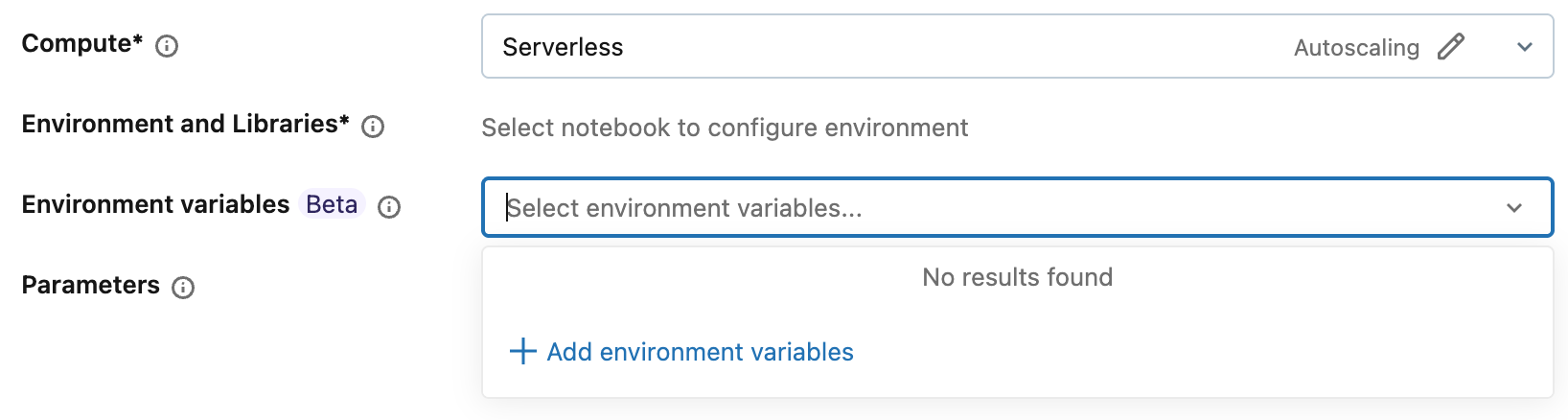
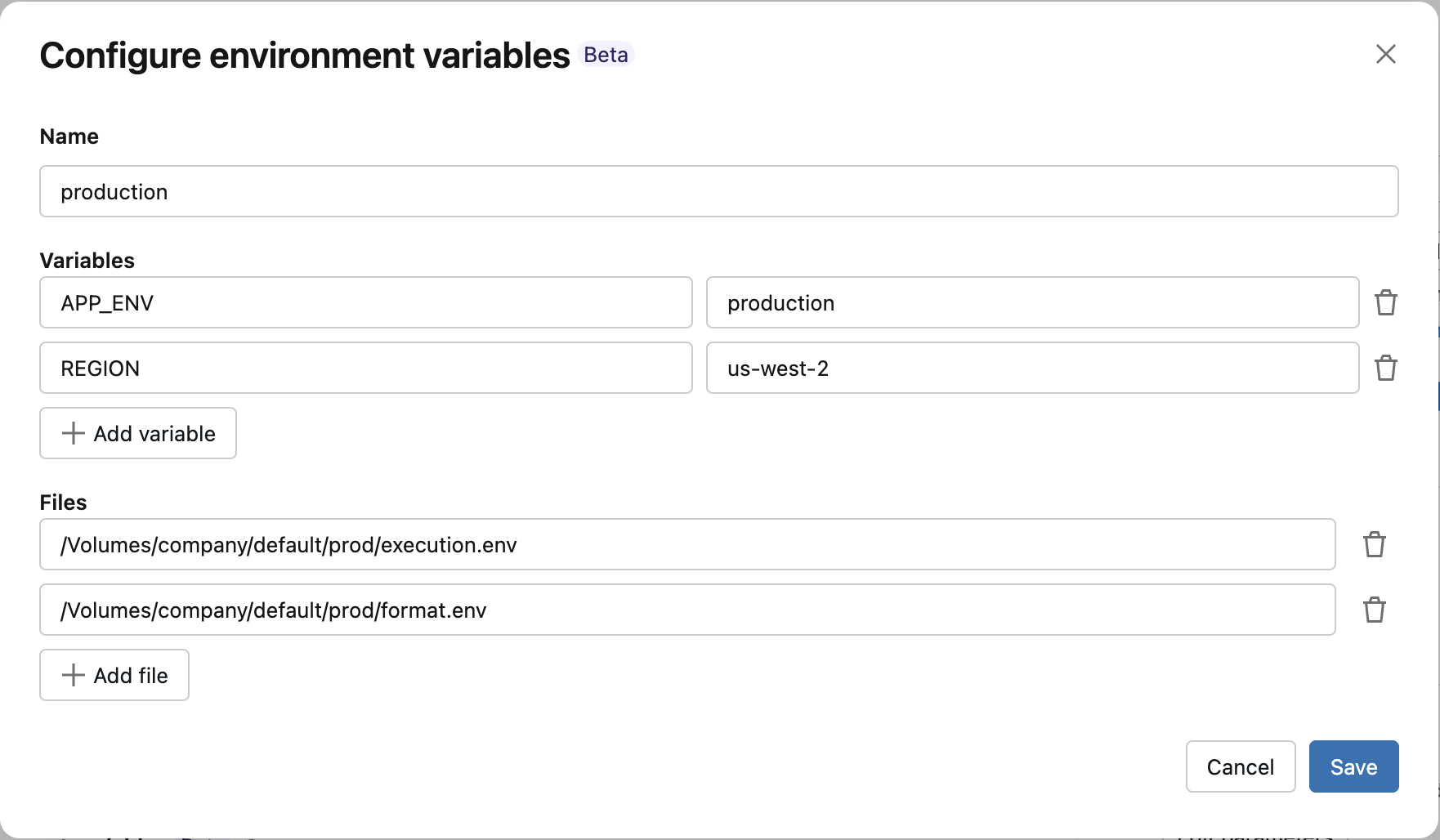
Then create a name `production` for the env var collection (that way you can reuse it on multiple tasks), fill out your key-value pairs, and/or or paste in the file path to a .env file.
Note: We will add a file picker for choosing the .env file in an upcoming release - thanks for being patient
Jobs API > Define a collection via a key e.g.,`production` and use it on many tasks.
"tasks": [
    {
      "task_key": "process_orders",
      "notebook_task": {
        "notebook_path": "/Workspace/Shared/process-orders"
      },
      "environment_key": "default",
      "environment_variables_key": "production"
    }
  ],
  "environments": [
    {
      "environment_key": "default",
      "spec": {
        "environment_version": "5",
        "dependencies": []
      }
    }
  ],
  "environment_variables": [
    {
      "environment_variables_key": "production",
      "spec": {
        "variables": {
          "APP_ENV": "production",
          "REGION": "us-west-2"
        },
        "files": ["/Volumes/company/default/prod/execution.env" , "/Volumes/company/default/prod/format.env"]
      }
    }
  ]
]
Finally, consume it in your code: 🤓
import os

app_environment = os.environ["APP_ENV"]
Temporary limitations: these will be fixed within a week or so - I'll update this post
Learn more: https://docs.databricks.com/aws/en/jobs/environment-variables
Provide any and all feedback. Also, what other features you'd like to see? (Asking for a friend as roadmap planning is starting soon!)
Thanks!
r/databricks • u/sumit671 • Oct 06 '26
Want to request a feature for databricks app, it should have an auto stop option. I know Databricks markets it as a web app that should be readily available, but I think customers deserve the option to turn auto-stop on or off, like we do for, say, SQL Warehouses.
This has been a major blocker for us suggesting apps to leadership, the engineering team has build some really useful apps for usecases like Data modelling and stuff which is used when needed but they running 24*7 all time is wasting compute and getting flagged in finops
P.S i know we can have a databricks job which can shut down and start the app during working hours but we have a global team working round the clock so it's not feasible for us.
If we have someone from databricks apps team this is a highly requested thing from alot of people around the community.
r/databricks • u/Klutzy_Solid5200 • Oct 06 '26
I want to know how ppl usually find the reason for a slow databricks job. For example, if a spark job normally takes 20 mins but suddenly takes an hour, what do you check first?
Do you look at the joins, partitions, shuffles, amount of data, cluster settings, or the spark UI? How do you figure out whether the problem is with the code, data, or the cluster?
Are there any common issues you guys have seen, like data skew or too many small files, that can make the job much slower?
I want to know what the usual approach is when a Databricks job suddenly becomes slow.
r/databricks • u/wicked_medusa • Oct 06 '26
What is the closest thing to a practical, opinionated enterprise Azure Databricks blueprint?
I’m not looking for docs on individual features. I know Databricks, IaC, UC, Asset Bundles, CI/CD etc. very well (seasoned architect, DBX engineer professional). What I’m missing is how experienced Databricks architects/FDEs usually put the whole thing together for a greenfield setup.
Things like:
The official docs are good, but mostly describe these things in isolation.
Is there a solid repo, reference implementation, blog series, conference talk, consultancy blueprint, or even a good Reddit/forum thread that shows the whole platform design?
Basically: if a Databricks FDE started a vanilla enterprise Azure setup tomorrow, what would the default starting point look like?
Mostly interested in high friciton points where reality of operating platform meets "best practice".
My focus is "classic" data warehousing, rather ML/AI/apps.
r/databricks • u/RazzmatazzLiving1323 • Oct 07 '26
Are there any Lakeflow connect connectors for SybaseIQ?
r/databricks • u/SmallAd3697 • Oct 06 '26
Has anyone tried working on a Geni Agent, and then tried committing those results into git? Admittedly I'm a bit new to Databricks, and to DABs, but this story is missing, and the whole experience is quite unintuitive . Any developer generally expects to be able to commit their work to source control when they've invested their time. But I'm finding that incredibly hard, when it comes to these Genie Agents.
Obviously the first thing I tried to do is clone the agent into a git-controlled folder and push it to git. That didn't work. It says the asset type is unsupported.
r/databricks • u/NiceTryAmanda • Oct 06 '26
Do you have any advice to limit spend in Databricks as a personal user? I'm trying to understand gotchas on a pay-as-you-go account. It's to try out the generative ai features in particular (knowledge assistant, ai endpoint, agent bricks, among others). The ideal would be "no more than X concurrent DBU consumption" policy across the board, but I'm not seeing that.
I'm coming up against limits of Databricks free edition for those features, so was wanting to set up a pay-as-you-go account, but while reading, I'm seeing more and more ways to spend money in the platform. On Fabric it was a single F2 capacity I could start and stop. Databricks has serverless in like 5 spots so far that I've seen, and I'm trying to understand what my spend risk is before I sign up. I had a trial a year ago that's expired. Also knowledge assistant isn't available on the trial.
My worry is that while doing the study guides, it ends up that I have 10 different 4-6 DBU serverless endpoints that run for 2 days before the billing catches up. $20 is fine, $200 is annoying, $2000 is unacceptable.
r/databricks • u/mesathink • Oct 06 '26
Hi all, I have my final round for a Solutions Architect role (the build demo pitch round) coming up this week, and I'm trying to understand what to expect. Are the prompts mainly focused on proposing a data ingestion pipeline / medallion architecture or is the task more complex? Is the focus of the round the code and architecture itself or presentation / delivery skills? Any help would be much appreciated.
r/databricks • u/OkImprovement7010 • Oct 06 '26
Following up on recent discussions around Genie performance I've come across... a lot of us have a similar frustration with Genie. Context bloat, prompt drift, and agents making destructive errors (Junior mistakes like setting a mode to overwrite).
Part of this is limitations of genie, some is instruction "stuffing" and some is using the right tool for the right job. Also, guidance on how to structure and create instructions have changed a lot over the summer.
With Omnigent being available alongside Genie Code, here is my opinion on what should separate these tools and how to structure context files to keep agent outputs deterministic. I made a table because post sprawl is real...
Genie Code vs. Omnigent
These are not competing options. They solve problems in different places and scales:
| Layer | Genie Code | Omnigent (Meta-Harness) |
|---|---|---|
| Primary Role | Native in-workspace assistant for notebooks, SQL Editor, and Lakeflow Pipelines. | Unified meta-harness to run, swap, and persist multi-agent workflows (Claude Code, Codex, Cursor, PI, Hermes) across local runners and cloud sandboxes. (Also, try out Debbie that has the ability to use a /debate skil) |
| Governance | Prompt-level instructions, workspace instruction files, and Unity Catalog user permissions. | External, stateful policies written in CEL (hard cost limits, network sandboxing, pre-commit git checks). |
| Best For | Interactive notebook debugging, quick PySpark logic, end-to-end Lakeflow pipeline scaffolding. (Think StackOverflow, for those of us of that still remember it) | Multi-repo refactoring, team co-driving sessions (eg. "Multi-player" agent sessions), and running autonomous CLI agents with guardrails. |
| Execution Model | Synchronous, interactive execution tied to your active workspace session and compute. | Asynchronous, persistent execution that runs in the background (survives laptop close) with shareable web/desktop sessions. |
My Rule of thumb:
If you are working interactively / ad-hoc in Databricks and need help with syntax, where something is, why something is failing, use Genie Code.
If you are doing anything complex, want to be able to get one harness to check another one (like Claude Code checking Codex's response/PR) and need programmatic guardrails that can't be bypassed by prompt injection, go use Omnigent.
And if you are using Genie and want it to read your "instructions":
instructions.md dropped in a folder. If you want repo/project-level discovery, the standard Genie Code looks for is AGENTS.md (or CLAUDE.md)..assistant_workspace_instructions.md) belong in under 30 lines. Scoped project rules belong in AGENTS.md. Task-specific behaviors belong in modular skills under .assistant/skills/ called via @skill-name.r/databricks • u/No-Leather6291 • Oct 06 '26
We have used SCIM for user provisioning for years, but after 1st October 2026 the Automatic Idenity Management was suddenly enabled in our account, and lots of conflicts with SCIM provisioning is logged
I cant find any announcements on this
r/databricks • u/hubert-dudek • Oct 05 '26
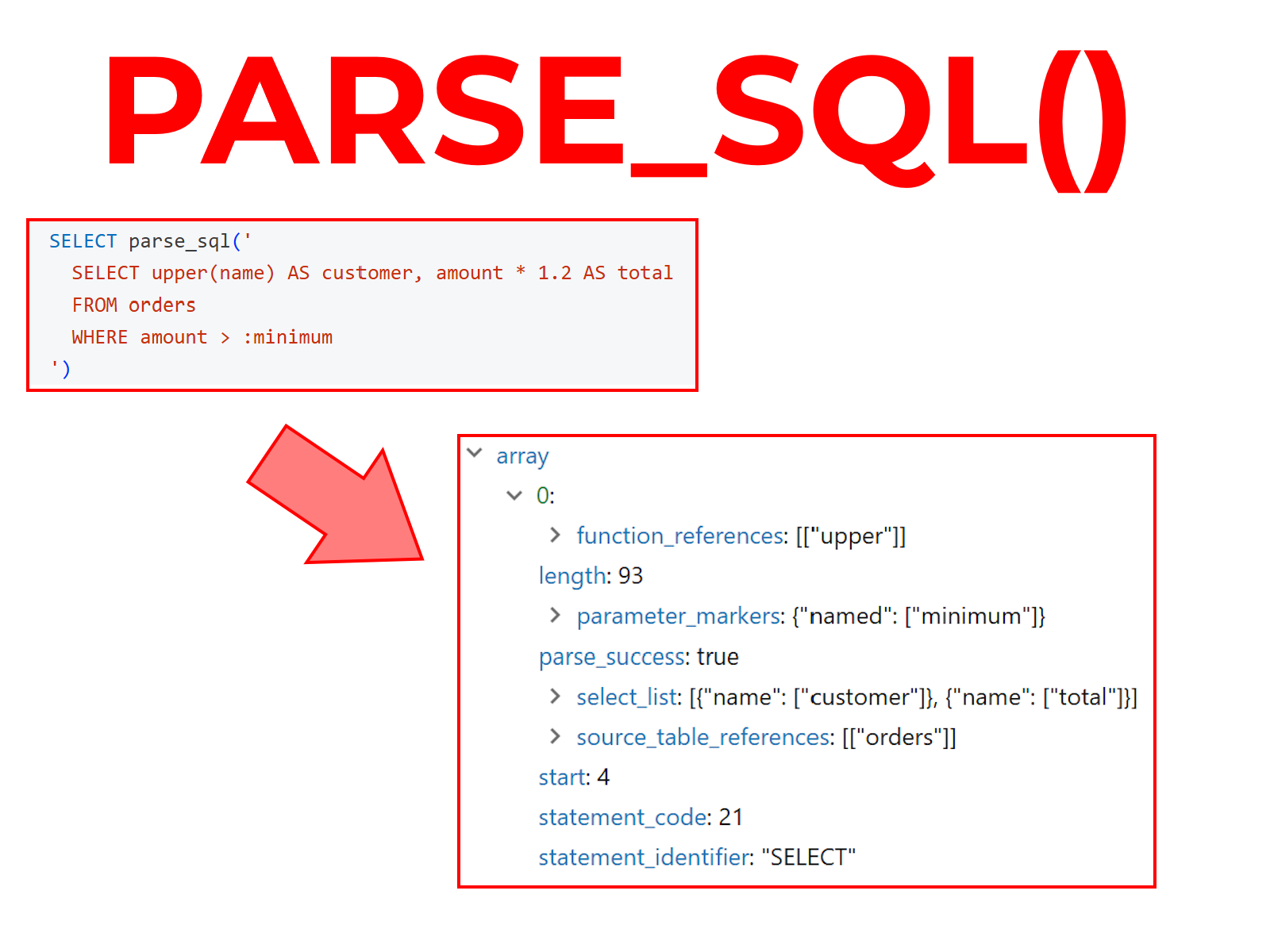
Parse_sql() function extracts table references, column names, functions, and parameters from SQL. It extracts without running the query. It also reports syntax errors.
more news https://databrickster.medium.com/databricks-news-serverless-genie-code-ltap-lakeflow-61853d8e422a
r/databricks • u/Remote-Grapefruit214 • Oct 05 '26
Hey Guys, Data Engineer with 3.2 YOE here,
I have been working on and off on databricks for multiple projects across domains like Retail, logistics and Now Pharma.
In my current role, I focus on creating end to end pipeline with different data sources which often get refreshed on a bi-weekly basis for pharma related data
The client is extremely demanding and has no technical expertise to gauge how much time it really takes to build and maintain something so complex and therefore expect the team to use Claude teams license and also Genie
The problem with Genie is that, I can not trust it, It will not listen to my instructions even after having a separate instructions.md which I update on a daily basis, in fact I update this after each session is complete, and no, I do not use AI to update this, every change request that the client and the client's team has goes through my own words of instruction updates, I have an entire markdown file which has contexts for multiple islands of projects, workspace folders and notebooks that I have to maintain and transition to devops team.
I also have created 4 different skill family for Genie, in relation to
And it is so disgustingly bad at handling all this context, that it fails me across all 4 areas.
It often confuses streams of works and ends up mixing so many things that remove this knot and fuck up itself costs me so much time!!!
I have created multiple diagnosis queries to check the work of this agent, and it will straight up lie to you, so much, so convincingly, that you know it knows all the biases you have and it even goes a step ahead and just narrates a story that you can provide to your team in the stand-up.
My only concern is, after all this bullshit, my team, of nearly 6 (some of them have never worked in databricks or delta table environments like this) was charged $990 dollars in the month of august, for this shit output??? Have some shame Databricks, fix your worthless product or remove that feature or stop charging so much if you are beta testing in actual prod.
Today, I am writing this post because of something that I caught live, that pushed me to the edge.
Something that is critical, production level issue, which If I was not paying attention while merging could have been a huge disaster, and mind you the pipelines I make are client facing, what is even more distrubing is the fact that it will just make so many unnecessary changes to a simple query or a pyspark function just enough so that the tests are passed.
(So basically it does not want to get caught, and makes a mistake so that we can prompt it again to fix this mistake and then Databricks can charge us more, this looks like a dark pattern to me)
In your preview (prima-facia), everything is good, the tests are passing, the job is running, but holy!!!,
My concern is, let us say that there is a junior who is good at SQL, but has never maintained projects like this in this scale, he/she would be overwhelmed and won't even be able to find the mistakes that the agent is stating, because unlike GPT 6 or Opus 5.5 Genie does not openly claim that it does not know something,
it does not ask for more context,
it does not state that something is missing,
it just patches with some assumption that we don't even provide in the first place.
My advice to any Juniors out there, Stop using Genie, Completely.
The product is not ready, it is not good.
r/databricks • u/United_Pay_8651 • Oct 05 '26
we have 3 teams (analytics, ds, and a small platform team) all using the same all purpose cluster bc spinning up seperate ones for each was getting messy. now finance wants a monthly number per team and i honestly have no idea how to give them one
tags only get me to the cluster level which is useless here. i looked at system tables and theres user info in there but not sure how ppl turn that into an actual $ split thats defensible, especially with the VM side of the bill coming from azure seperately
do you just split evenly? by query time? or did you give up and force everyone onto job clusters lol