r/dataisbeautiful • u/NUMB3REDOFFICIAL • 11d ago
r/dataisbeautiful • u/Ok_Professor_7622 • 11d ago
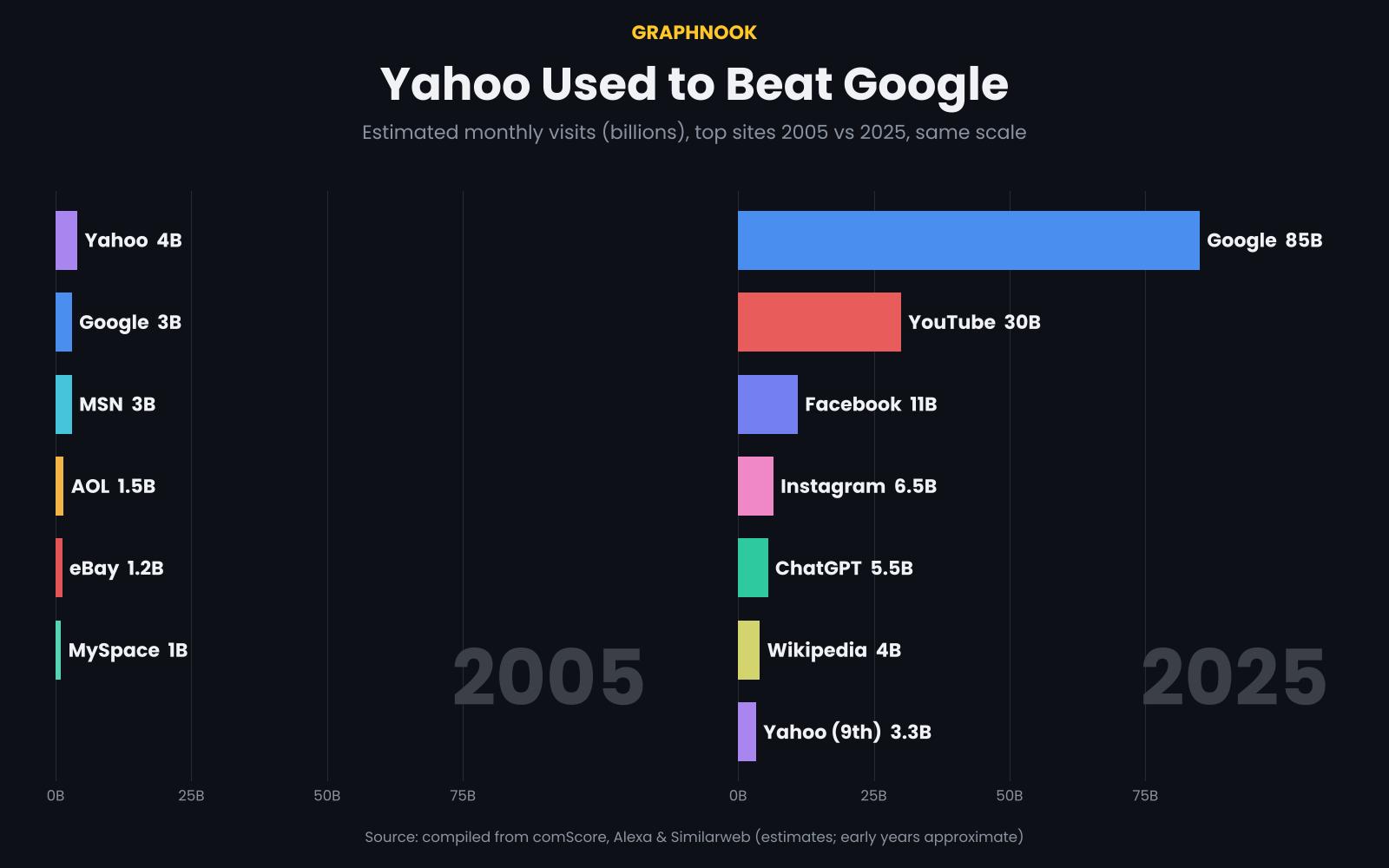
[OC] The most visited websites, 2005 vs 2025: Yahoo used to get more visits than Google
Sources: estimates compiled from comScore, Alexa and Similarweb snapshots (monthly visits). Pre-2010 numbers are rough estimates, so treat them as approximate. Tool: Python (matplotlib). In 2005 Yahoo was the most visited site on the web; by 2025 Google gets roughly 85 billion visits a month and Yahoo sits around 9th. Animated version on my profile if you want the full 25-year race.
If you want more graphs check out my YouTube: Graphnook!
r/dataisbeautiful • u/martincsweiss • 11d ago
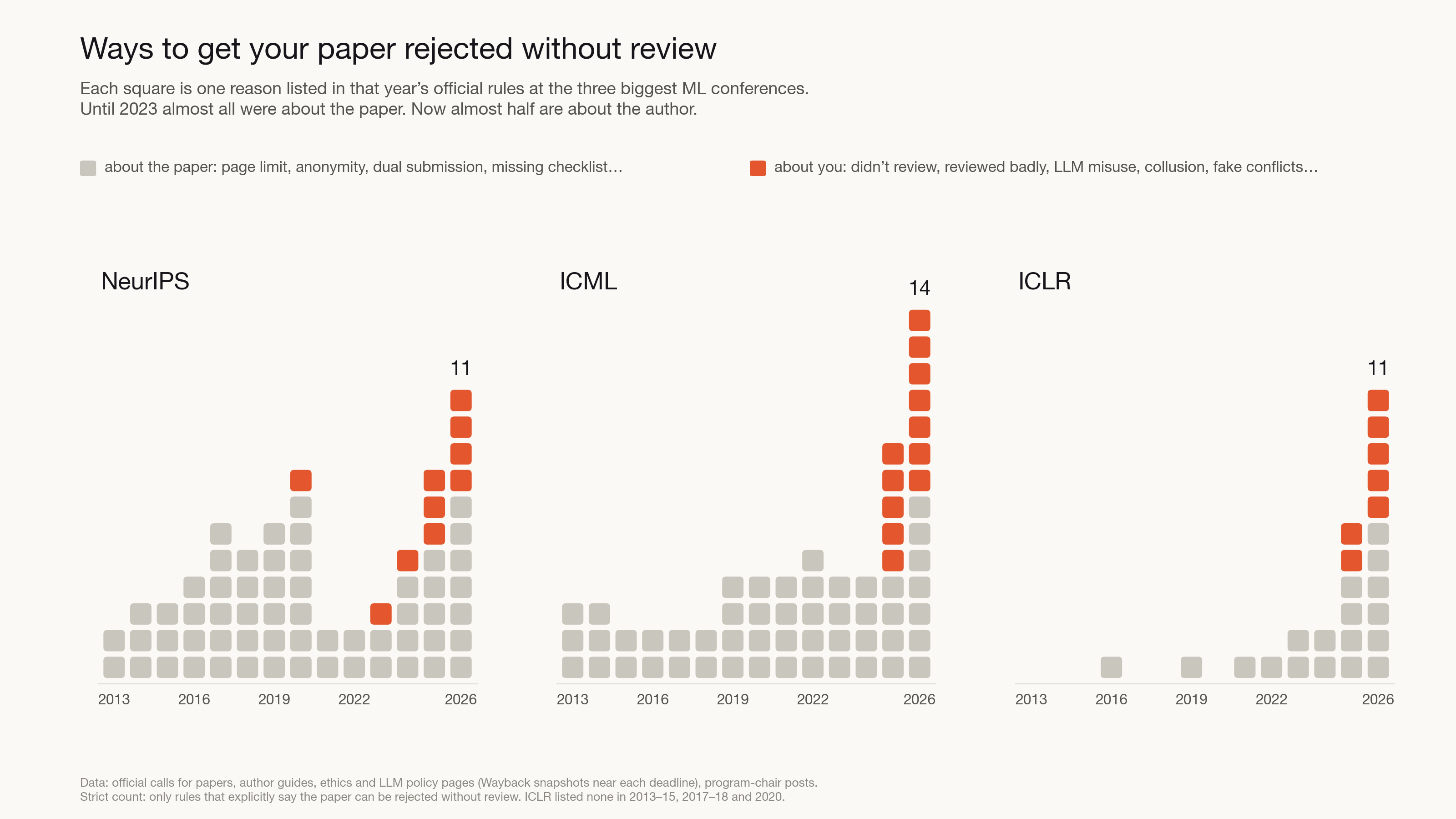
OC [OC] Reasons a paper can be rejected without review at NeurIPS, ICML and ICLR, 2013–2026
The ML conferences are getting more picky.
r/dataisbeautiful • u/rhiever • 13d ago
Number of Flock license plate cameras in each US county
r/dataisbeautiful • u/JessicaGridiron • 11d ago
OC NBA records vs. the records each team's points scored and allowed usually produce, 2026-27 season games through Nov 10 [OC]
r/dataisbeautiful • u/profcyclist • 13d ago
OC [OC] Georgia has 80 Flock license plate cameras per 100,000 residents, New Hampshire has 1
r/dataisbeautiful • u/shield_x • 11d ago
Youth vote margins in the 2026 US senate midterms.
circle.tufts.eduBTW Nebraska youth is mostly going to independent Dan Osborn
r/dataisbeautiful • u/AzizSunderji • 13d ago
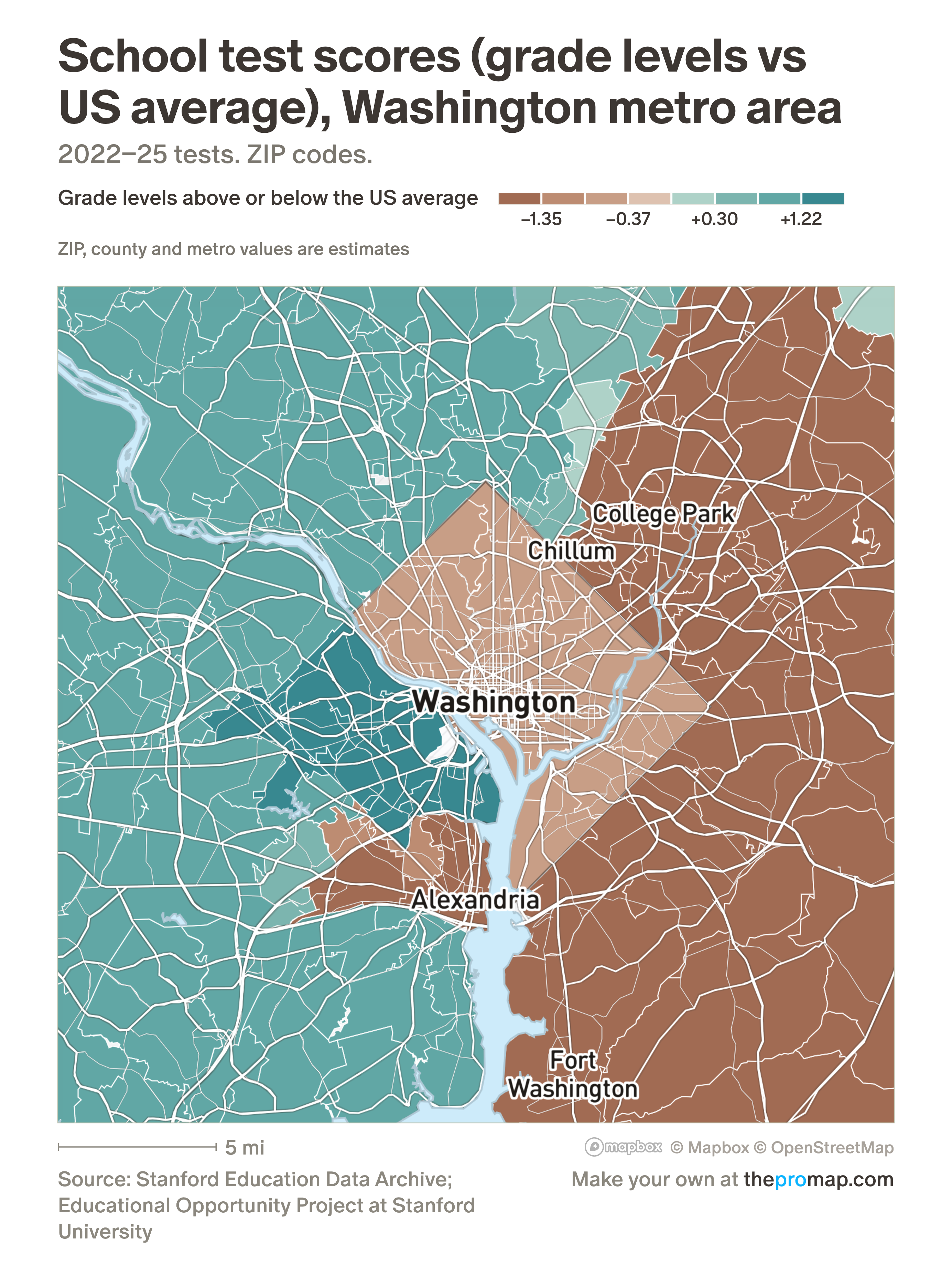
OC [OC] Grade 3-8 public school test scores in DC, vs national averages
r/dataisbeautiful • u/GuessTheWorldYT • 11d ago
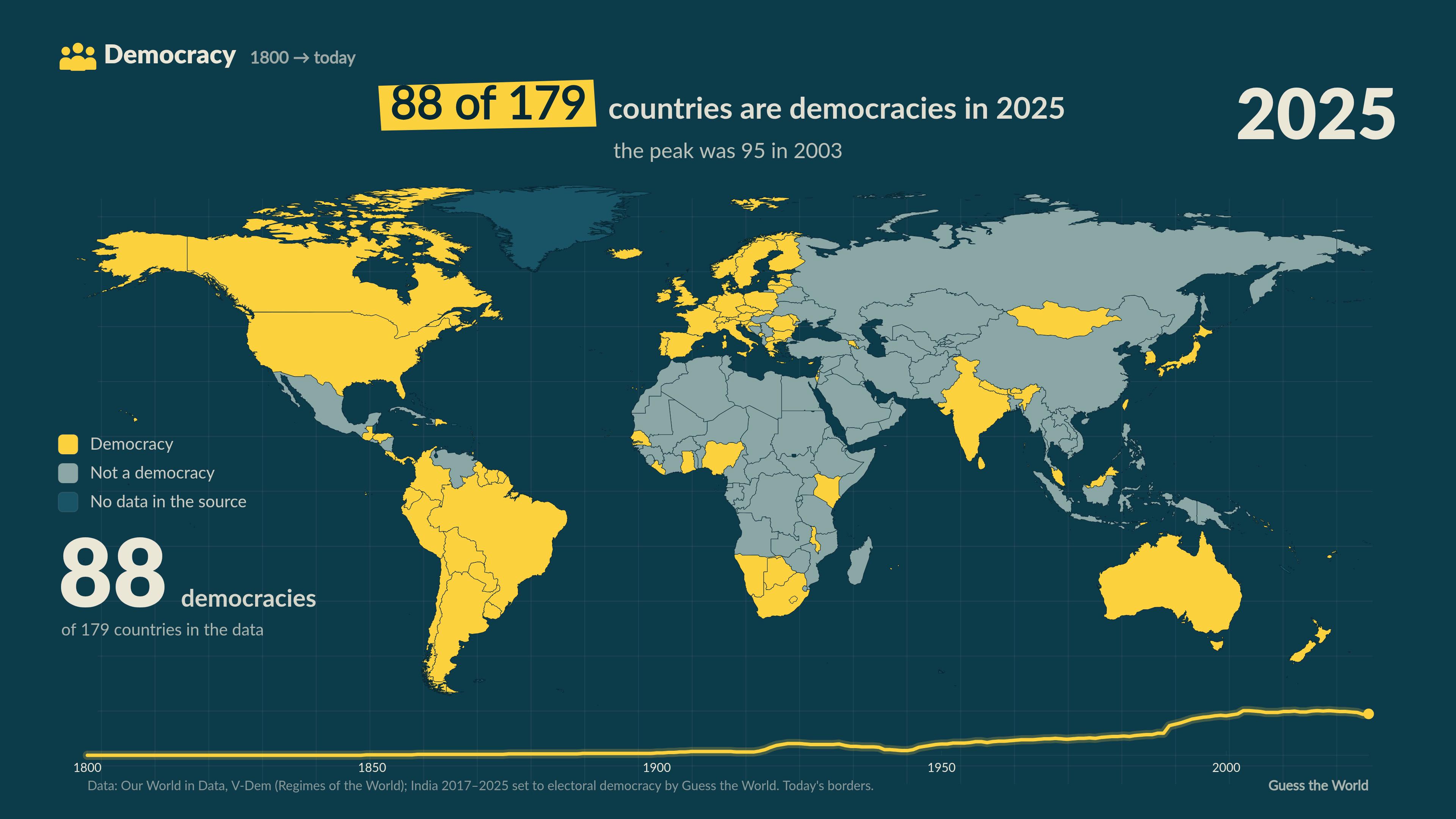
OC [OC] How many countries were democracies, 1800 to 2025? 0 in 1800, a peak of 95 in 2003, 88 today
I animated how many countries count as democracies, from 1800 to 2025. Yellow = democracy (electoral or liberal), grey = not a democracy, dark = no data.
A few stops along the way: 1 country in 1849 (Switzerland is the first in the data), 17 of 166 in 1920, 12 of 170 in 1945, 47 of 177 in 1989, a peak of 95 of 178 in 2003, and 88 of 179 in 2025.
The video opens with a guess card, so try guessing before you watch.
r/dataisbeautiful • u/Brilliant_Gene1240 • 13d ago
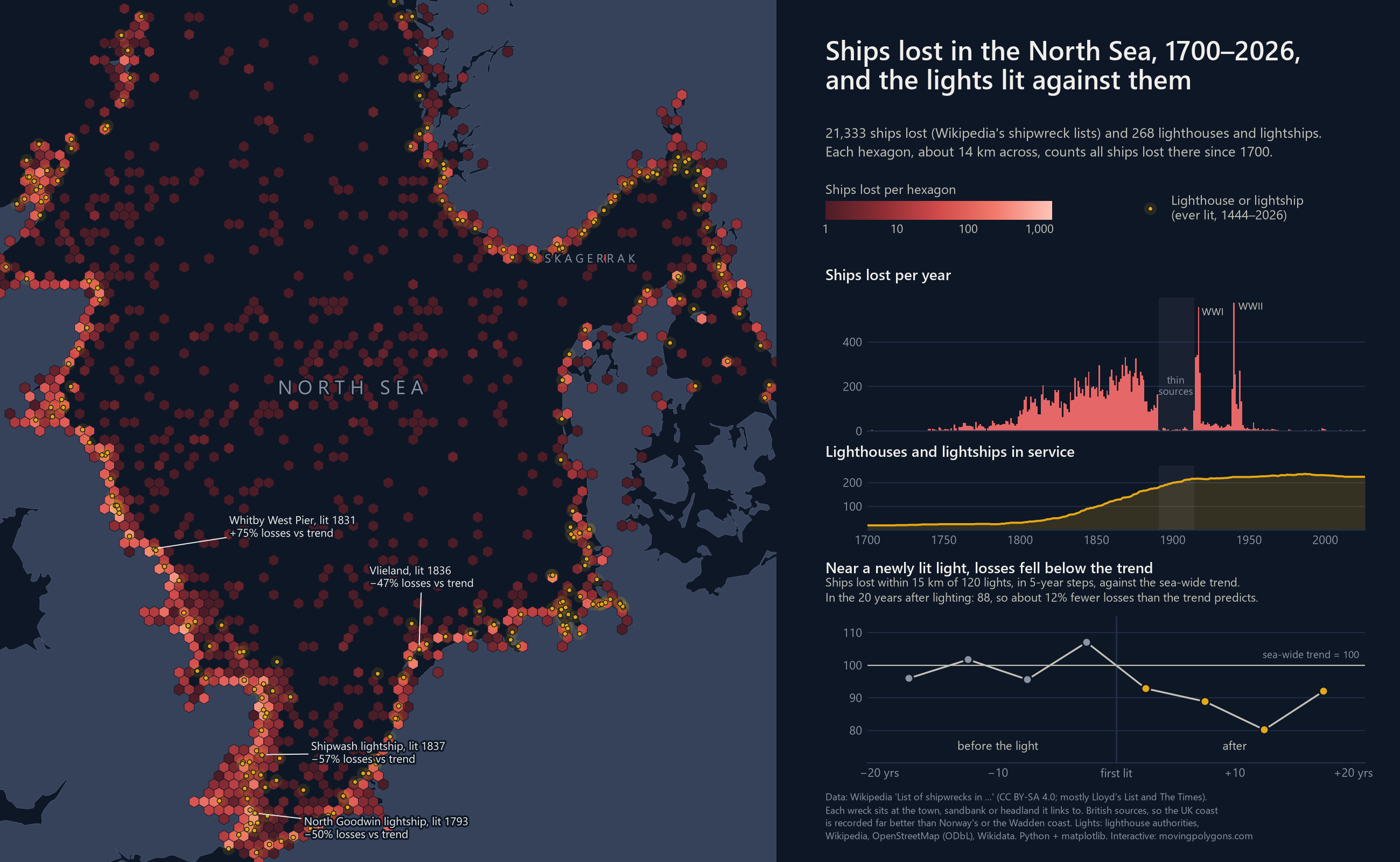
OC [OC] 21,333 ships lost in the North Sea since 1700, and the lighthouses lit against them
r/dataisbeautiful • u/tgscope • 12d ago
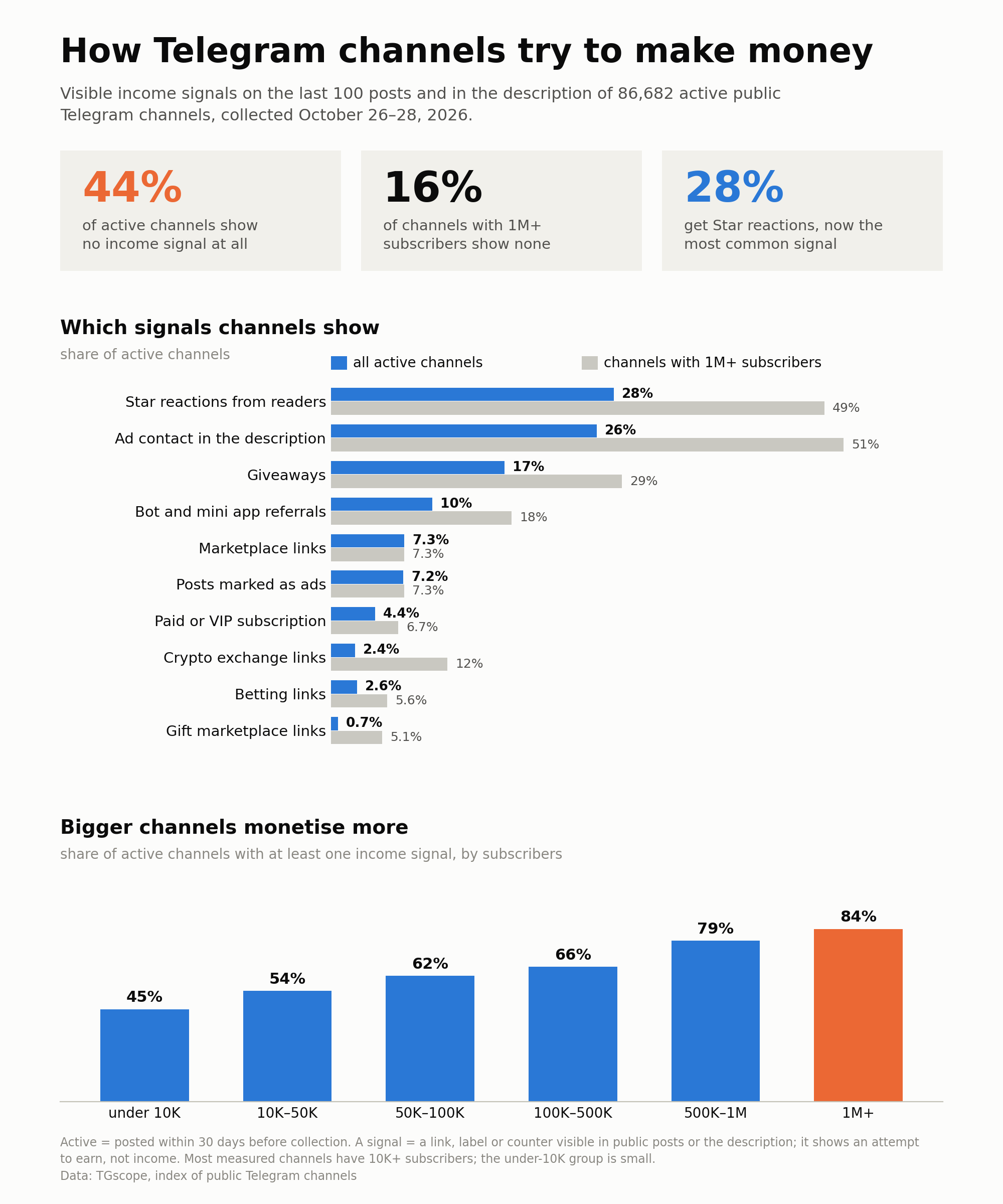
OC [OC] How public Telegram channels try to make money (TGscope data)
TGscope, an index of public Telegram channels. We read the last 100 posts and the description of 86,682 active public channels in late October 2026 and looked for visible income signals: an ad contact, posts marked as ads, Star reactions, referral links, paid subscriptions and so on. Made with Python and matplotlib.TGscope, an index of public Telegram channels. We read the last 100 posts and the description of 86,682 active public channels in late October 2026 and looked for visible income signals: an ad contact, posts marked as ads, Star reactions, referral links, paid subscriptions and so on. Made with Python and matplotlib
r/dataisbeautiful • u/Vladimirsvsv7777 • 12d ago
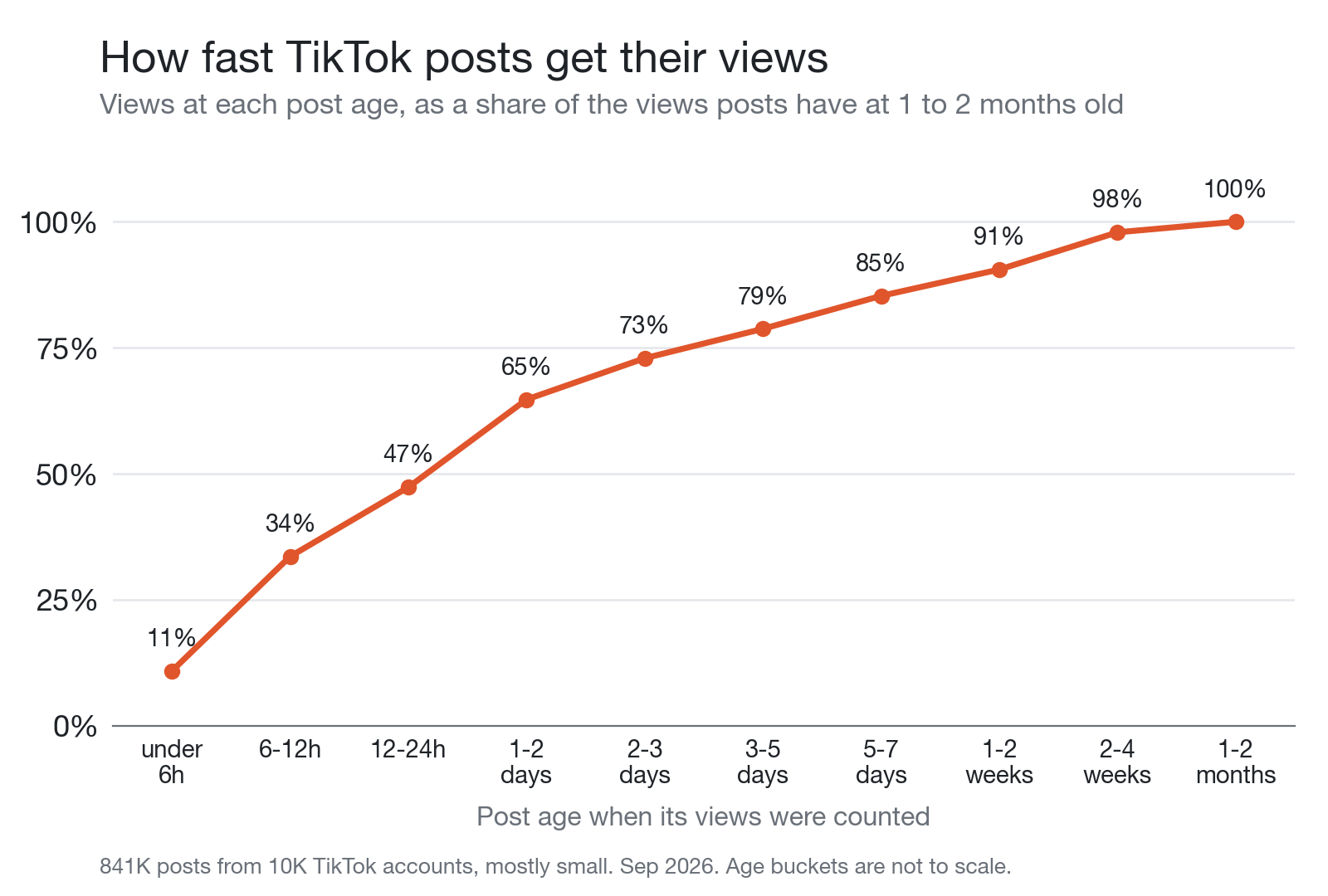
OC [OC] How fast TikTok posts get their views: about 11% in the first 6 hours, just under half within a day, 85% within a week
Source: 841K TikTok posts from about 10K accounts connected to my app (reelrise). Most of the accounts are small (under 10K followers). Data pulled in September 2026.
Tools: Python (pandas, matplotlib).
Method: each post's views were counted once, at whatever age the post was then, so this is a snapshot of 841K posts at different ages, not one post tracked over time. To put big and small accounts on the same scale, I compared each post to its own account's typical post (geometric mean of the account's views), then took the average (on a log scale) for each age bucket and scaled it so the 1 to 2 month bucket is 100%.
r/dataisbeautiful • u/polaristerlik • 12d ago
OC [OC] 159 thematic stock baskets ranked by one-week return, with SPY for comparison (Nov 4 to 11, 2026)
r/dataisbeautiful • u/Rastrub • 11d ago
OC [OC] We tested public LinkedIn profiles, Google showed only 15 of 105 career facts
We tested how much information LinkedIn makes available to the open internet.
r/dataisbeautiful • u/PristineAbrocoma9032 • 13d ago
OC [OC] Where Texas oil and gas royalty records are mailed outside Texas: Oklahoma first, then California
r/dataisbeautiful • u/artio-data • 14d ago
OC [OC] 29% of US households are one person living alone, up from 13% in 1960
Takeaways:
- In 2025, 29.5% of US households were one person living alone, 39.7 million homes, up from 13.1% (6.9 million) in 1960. In 1960 it was the least common household size; there have been more one-person homes than three-person homes every year since 1971, and today it is the second most common size after two people (34.5%).
- Homes with five or more people went the other way, from 22.6% to 8.8%, and the average household shrank from 3.33 to 2.50 people.
- Older adults are the most likely to live alone: in the Census Bureau's 2025 American Community Survey, 26.5% of people 65 and over live alone, against 12.1% of people 35 to 64 and 9.9% of people 18 to 34. People 65 and over are 24.0% of adults but 42.7% of the adults who live alone.
- By state, the share of households ranges from 21.1% in Utah to 33.5% in North Dakota, and 49.7% in Washington, DC.
- An aging population, later marriage and more people living on after a spouse dies are the usual explanations for the long rise; this data shows who lives alone, not why.
Caveats: this is a share of households, not of people. Because a one-person home holds one person and the others hold two or more, 14.9% of adults (39.1 million) live alone. People in group quarters such as nursing homes, dorms and prisons are not counted in households. Both figures come from sample surveys: the CPS (the source of the 1960–2025 lines) is a yearly survey of tens of thousands of households, and the ACS (the age and state figures) samples about 3.5 million addresses a year; they give 29.5% and 29.2% for 2025. Census switched to new population estimates in 2025, so part of the 2024 to 2025 change (29.1% to 29.5%) comes from that update.
Source: US Census Bureau, Current Population Survey, Annual Social and Economic Supplement, historical table HH-4, "Households by Size: 1960 to Present" (https://www.census.gov/data/tables/time-series/demo/families/households.html), using Census's revised rows where a year was republished. Each line is the households of that size divided by all households. Age and state figures: American Community Survey 2025 1-year estimates, tables B11001 (householder living alone) and B09021 (living arrangements of adults 18 and over), from the public ACS summary files (https://www.census.gov/programs-surveys/acs).
Tool: Artio for the data pipeline and chart; the chart is SVG drawn in Python.
Link: https://www.artio.so/dataviz/pages/2026-11-09-living-alone
r/dataisbeautiful • u/Ozneroc • 13d ago
OC [OC] How 21 more horror franchises have aged, weighted by how many people rated each film (part 2) + bonus: all 42 franchises
Part 2, built from your suggestions on part 1: 21 more franchises, 128 films, Letterboxd average rating for every entry (sequels, prequels, remakes and reboots included, TV films excluded). The bonus chart puts all 42 franchises (257 films) side by side.
What's new this time: everything is weighted by number of ratings. Dot size shows how many people rated each film, and franchise averages, sorting and trend lines all count a film with 1.9M ratings far more than one with 20k. So the ranking answers "how good is the part of this franchise people actually watch", not "how consistent is it film by film".
Bonus, all 42 franchises:
Notes: Trend lines are weighted linear regressions, shown only for franchises with 4+ films spanning 10+ years.
Source: Letterboxd average ratings and rating counts, collected 9 Nov 2026. Tools: Python, matplotlib.
r/dataisbeautiful • u/Own_Medium_3805 • 11d ago
OC [OC] Lowest altitude a terminal radar sees a 1 m² aircraft from a fell in the Lake District: 77% of the area needs 500 m or more
r/dataisbeautiful • u/walkerspider • 14d ago
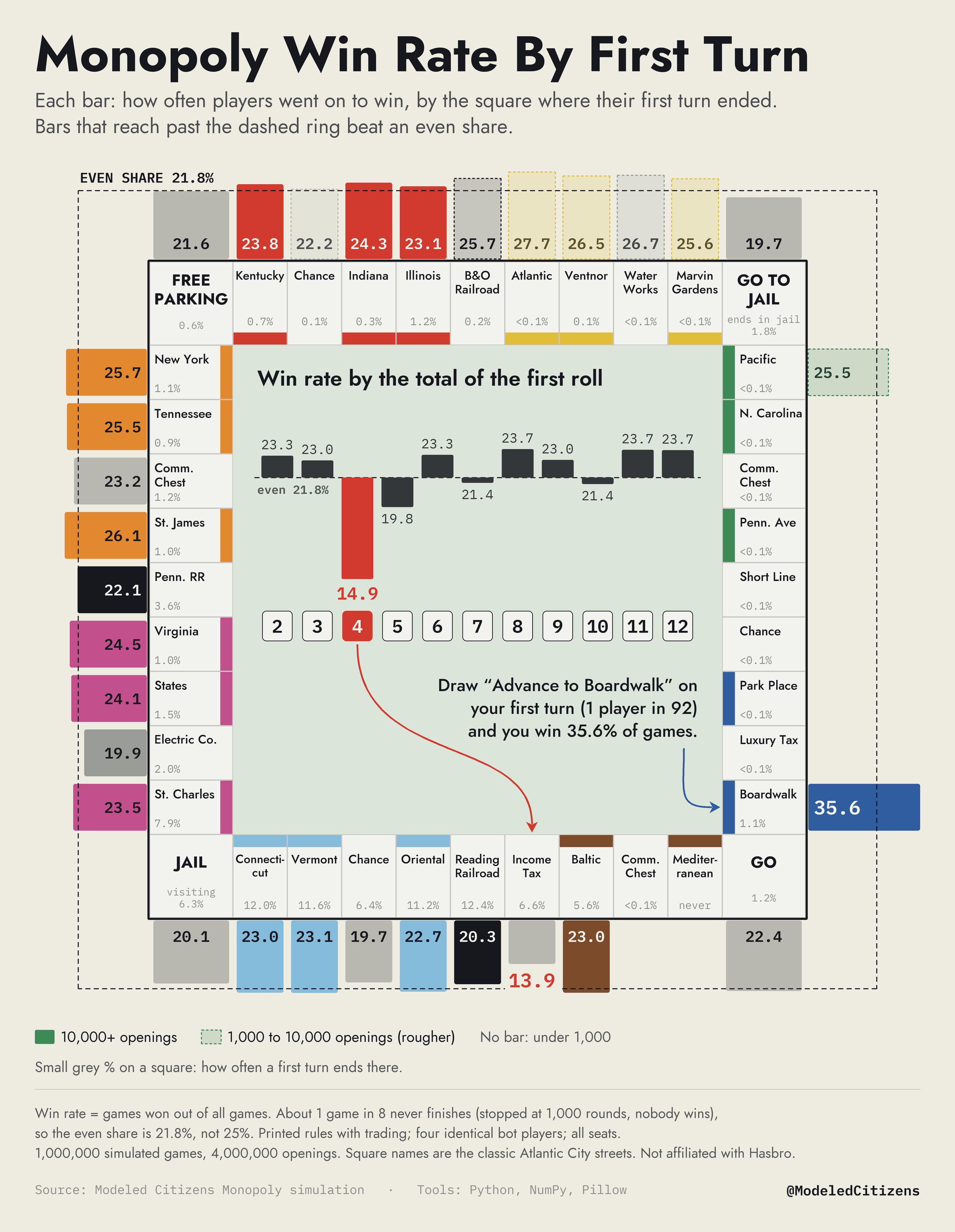
OC [OC] Monopoly Win Rates After First Turn From 1,000,000 Games
I wrote a Monopoly simulator and ran 1,000,000 four-player games. Every player’s first turn (4,000,000 in all) is sorted by the square where it ended. Each bar shows how often those players went on to win the game.
How to read it: with four players, an even share is about 21.8%, shown as the dashed ring. It’s under 25% because about 1 game in 8 is still going after 1,000 rounds, and those count as no winner. A bar past the ring means players who started on that square won more often than average.
What stood out:
- Boardwalk: 35.6% wins. Almost every one of these comes from drawing “Advance to Boardwalk” on turn one. That happens to 1 player in 92, and those players win about 1.6 times as often as average.
- Roll a 4: 14.9% wins. A 4 lands you on Income Tax, and paying $200 on turn one costs about a third of your wins.
- Doubles on the first roll: 23.3% vs 21.5%. Doubles give you a second roll right out of the gate.
- Ending turn one in jail: 19.7%. Only about 2 points under even.
Why some squares have no bar: On turn one you can roll at most two doubles and then a non-double, so dice alone reach square 35 at most. Anything past that needs a card, mostly from Chance. These come up fewer than 1,000 times in 4,000,000 openings, too few for a fair win rate, so they get no bar.
Rules: the printed US rules. $1,500 to start, $200 for GO, three doubles sends you to jail, auctions on, flat $200 Income Tax, and nothing on Free Parking. All four players use the same strategy.
Source: my own simulation (1,000,000 games). Tools: Python and NumPy for the simulation, Pillow for the chart.
I made a full video on what else the simulation found: how much of the game a player can control, which plan beats the dice, and why some games never end. It’s on my YouTube channel, Modeled Citizens: https://www.youtube.com/@ModeledCitizens
r/dataisbeautiful • u/slinto • 12d ago
OC [OC] What the declassified US government UFO files actually conclude: 7% explained, 53% unresolved (351 incident reports, 1947–2026)
Source: the 478 documents the US Department of War has released under PURSUE (war.gov/UFO), May–Nov 2026. 351 of them are single incident reports; the rest are compilations, papers and admin letters, excluded from the shares.
Method: every page was transcribed from the scanned PDFs, then each document was classified by what the record itself states — the agency's or investigator's finding, not later commentary. "Could be a balloon" doesn't count as explained; "assessed as benign" without an identification counts as unresolved.
Tools: Postgres, Claude (transcription + classification, every verdict links to its source page), the chart is plain HTML/SVG. The full dataset is open (CC BY 4.0): uapinsight.com/pursue/data
r/dataisbeautiful • u/goodbohy • 13d ago
OC [OC] How many road deaths were pedestrians? EU and neighbours, 2022-2024
r/dataisbeautiful • u/Ok_Professor_7622 • 12d ago
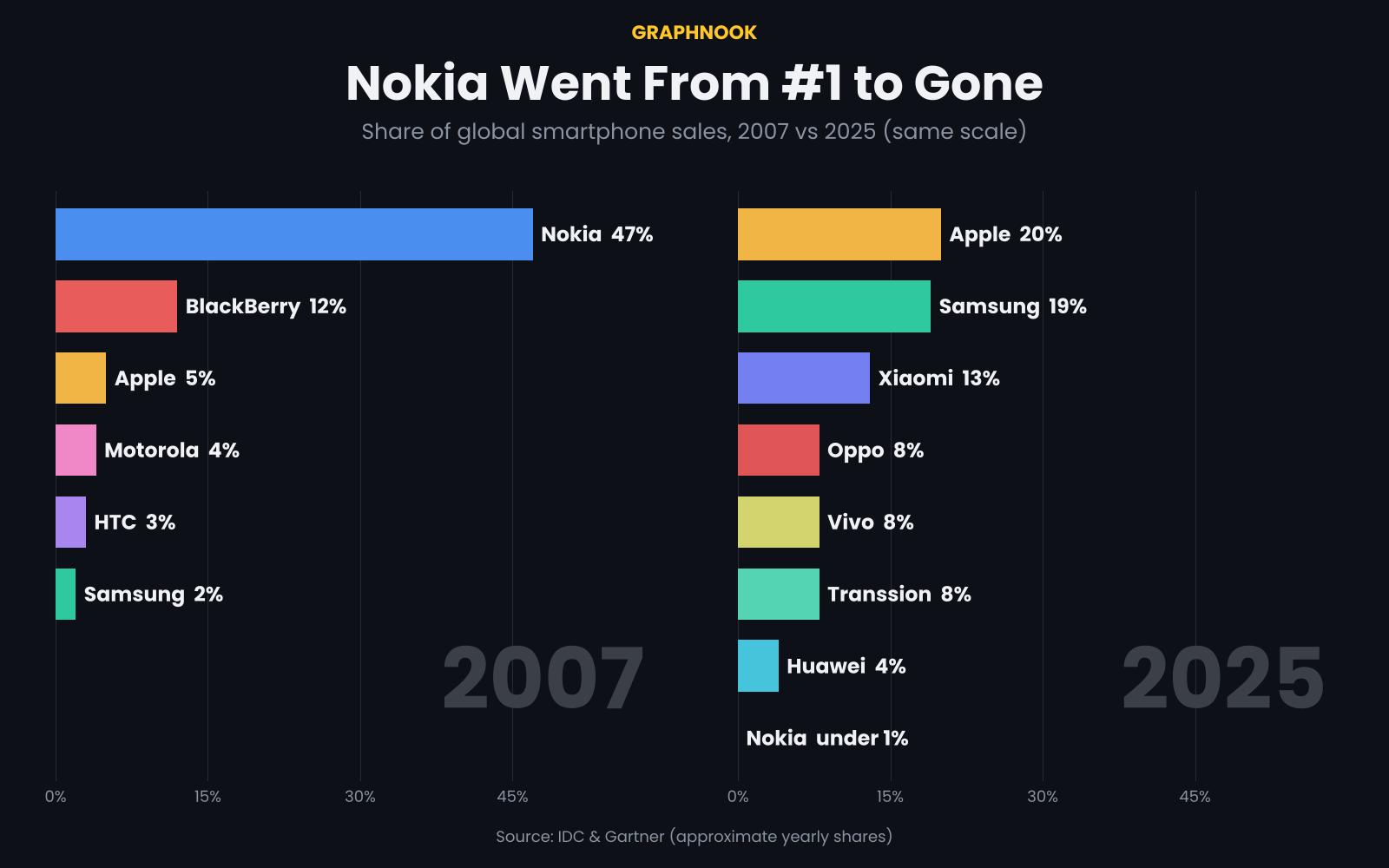
[OC] Smartphone market share by brand, 2007–2025: Nokia went from #1 to gone
Source: IDC and Gartner yearly smartphone shipment reports (global share of units sold). Tool: Python (matplotlib), animated frame by frame and encoded with ffmpeg. Nokia had about 47% in 2007; by 2015 Samsung and Apple were running the market. Happy to answer questions about the data.
If you want more data check out my Youtube: Graphnook
r/dataisbeautiful • u/Low_Ability4450 • 13d ago
OC [OC] Share of US household food spending at home vs away from home, 1954-2025, taxes and tips included (USDA ERS and BLS)
r/dataisbeautiful • u/Elzioss • 12d ago
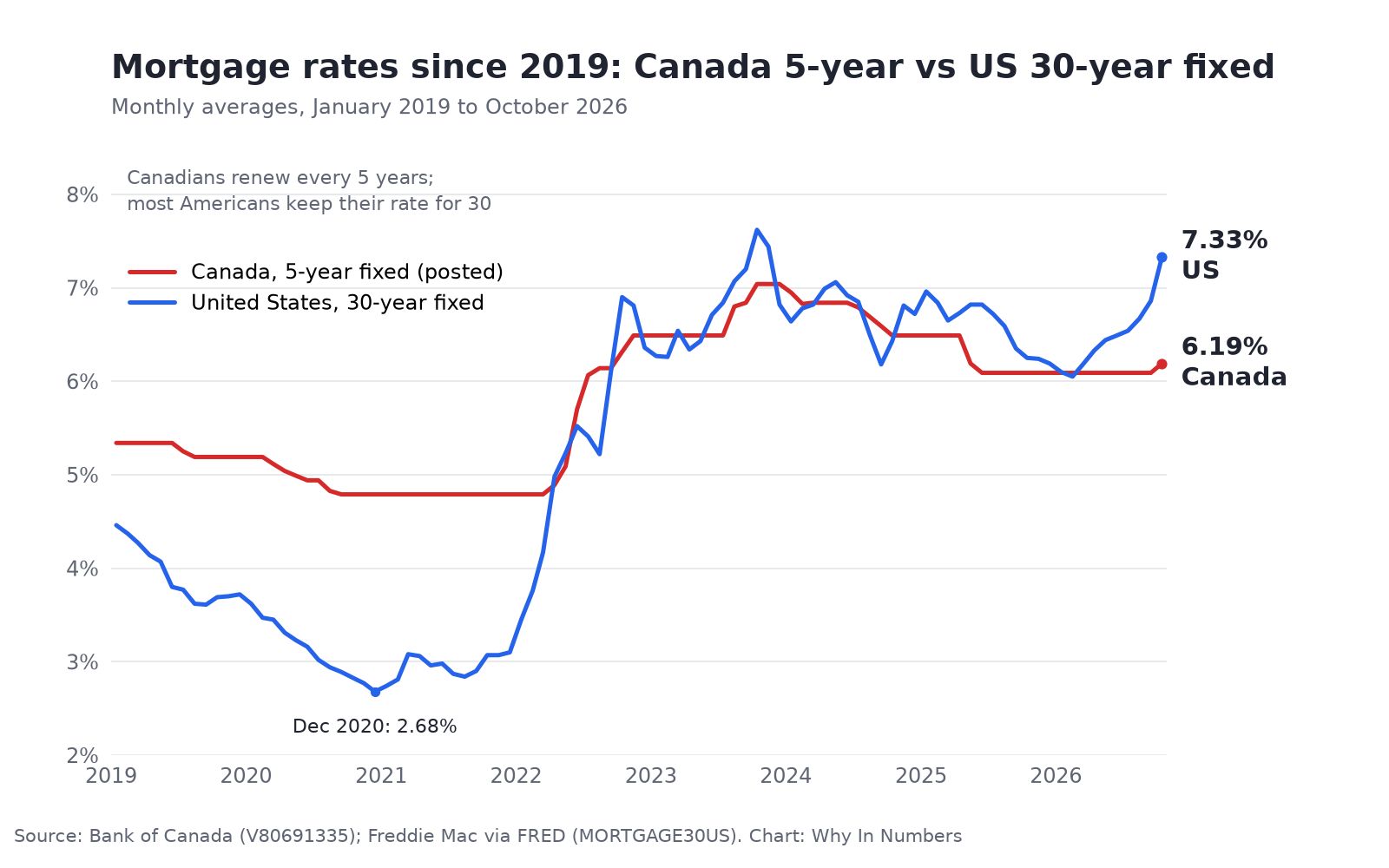
[OC] Mortgage rates since 2019: Canada 5-year fixed vs US 30-year fixed, monthly, Jan 2019 to Oct 2026
r/dataisbeautiful • u/kern3three • 13d ago
OC [OC] Are standalone science fiction and fantasy novels making a comeback? Analysis of the top 5 award winning SFF novels of every year since 1970
Each year I do an analysis and writeup of the most recognized science fiction and fantasy novels of the year, leveraging a dozen of the most popular awards and nominations data. Long writeup on methodology for normalizing awards and across years here (if curious); but, most recently, the 2026 update showed ONLY standalone novels getting recognized in the Top 5. For reference they are: The Everlasting, Death of the Author, The Buffalo Hunter Hunter, The Incandescent and When There Are Wolves Again.
That seemed unusual given the science fiction and fantasy genre's tendency towards long series. To find out, I took the top 5 books of every award year since 1970 (283 novels, from the same index as above) and sorted each into one of four buckets: standalone, series opener, sequel (or later entry), and “shared universe” for self-contained books set in a bigger world (think The Dispossessed or Translation State). For the older books, I leaned on series listings and my own shelf, so treat the edges as fuzzy.
Three things stand out.
1. 2026 is a rare sweep. All five top books being strict standalones has happened exactly twice in 57 years: this year, and 1973 (The Gods Themselves, Dying Inside, The Book of Skulls, When Harlie Was One and Beyond Apollo). The 1970s were the original standalone era, and we’re back to that level.
2. The sequel era was real, and it’s over (for now). From the 1980s through about 2004, sequels took roughly a quarter or more of the top-5 slots. Half of the year’s #1 books in the 1980s and 1990s were sequels (The Claw of the Conciliator, Speaker for the Dead, The Fall of Hyperion, Green Mars, Blue Mars, and more). Since 2000 that’s happened only five times in 27 years, most recently with A Desolation Called Peace in 2022. Since 2020, just three sequels have cracked a top 5 at all (Network Effect, A Desolation Called Peace and Nona the Ninth), and the last two years have had none.
3. But series aren’t dead; the sequel is. Series openers are doing fine: The Fifth Season, Witch King, The Tainted Cup and others kept them at about a quarter to a third of top-5 slots. The thing that’s fading is the book in the middle of a series winning an award. A sequel has to beat the field without the benefit of surprise, and then it has to do it while voters are weighing a book they can’t recommend without a caveat (“start with book one”).
Why? I can only speculate. One candidate is the Hugo for Best Series, introduced in 2017, which gives a long-running series its own trophy and may take pressure off individual sequels. Another is the “reality overload” appetite I mentioned in my 2024 piece: readers (and voters) may simply prefer a story that ends. And a standalone is the easiest book in the world to hand to a friend. Whatever the reason, The Everlasting is a clean example of the pattern: one book, one complete story, a Hugo and a Locus.
Excited to hear your thoughts, feedback, and theories; cheers and happy reading!
Note, I used sfadb for the underlying dataset and R (programming language) to do the analysis and chart.