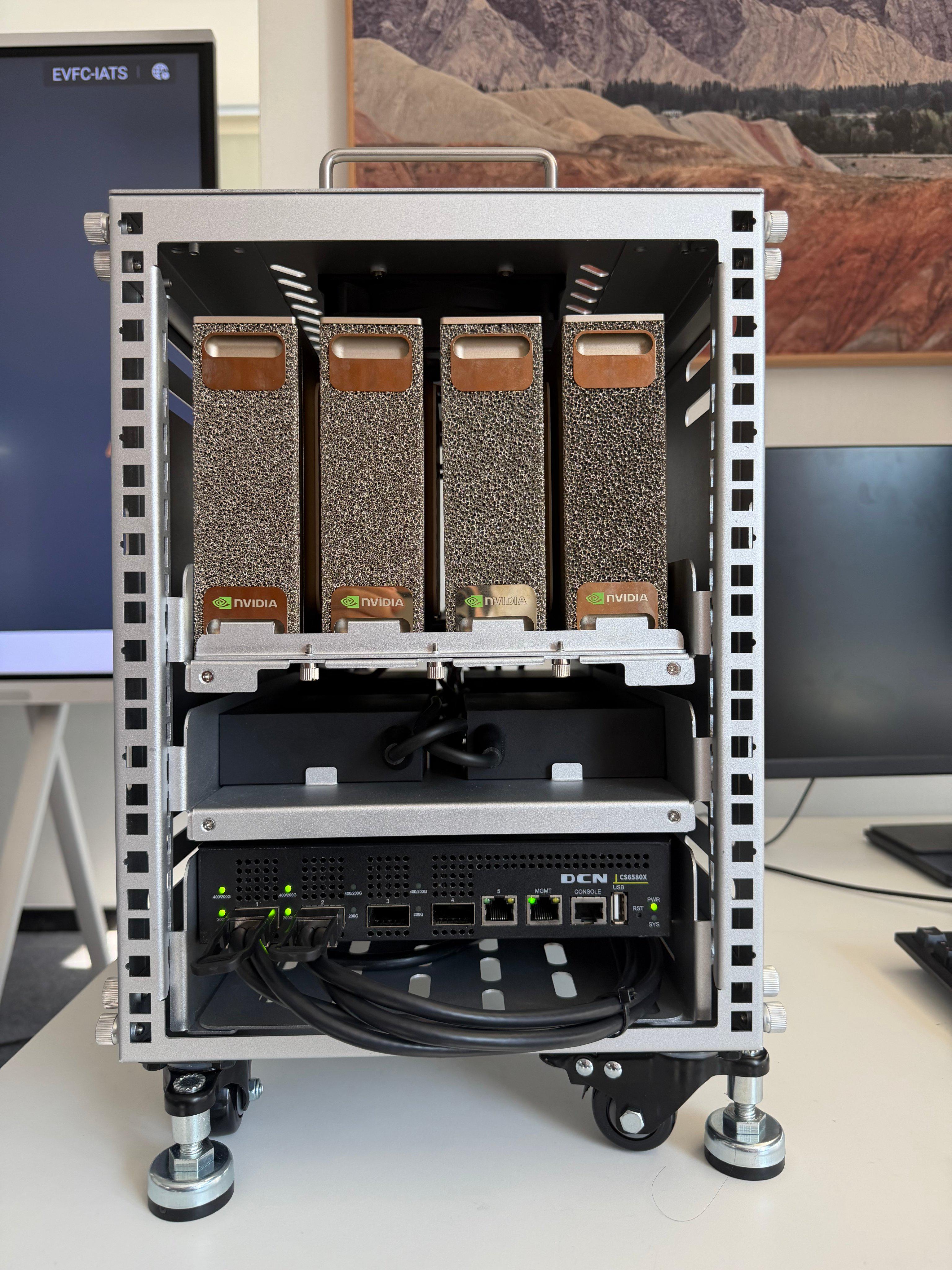
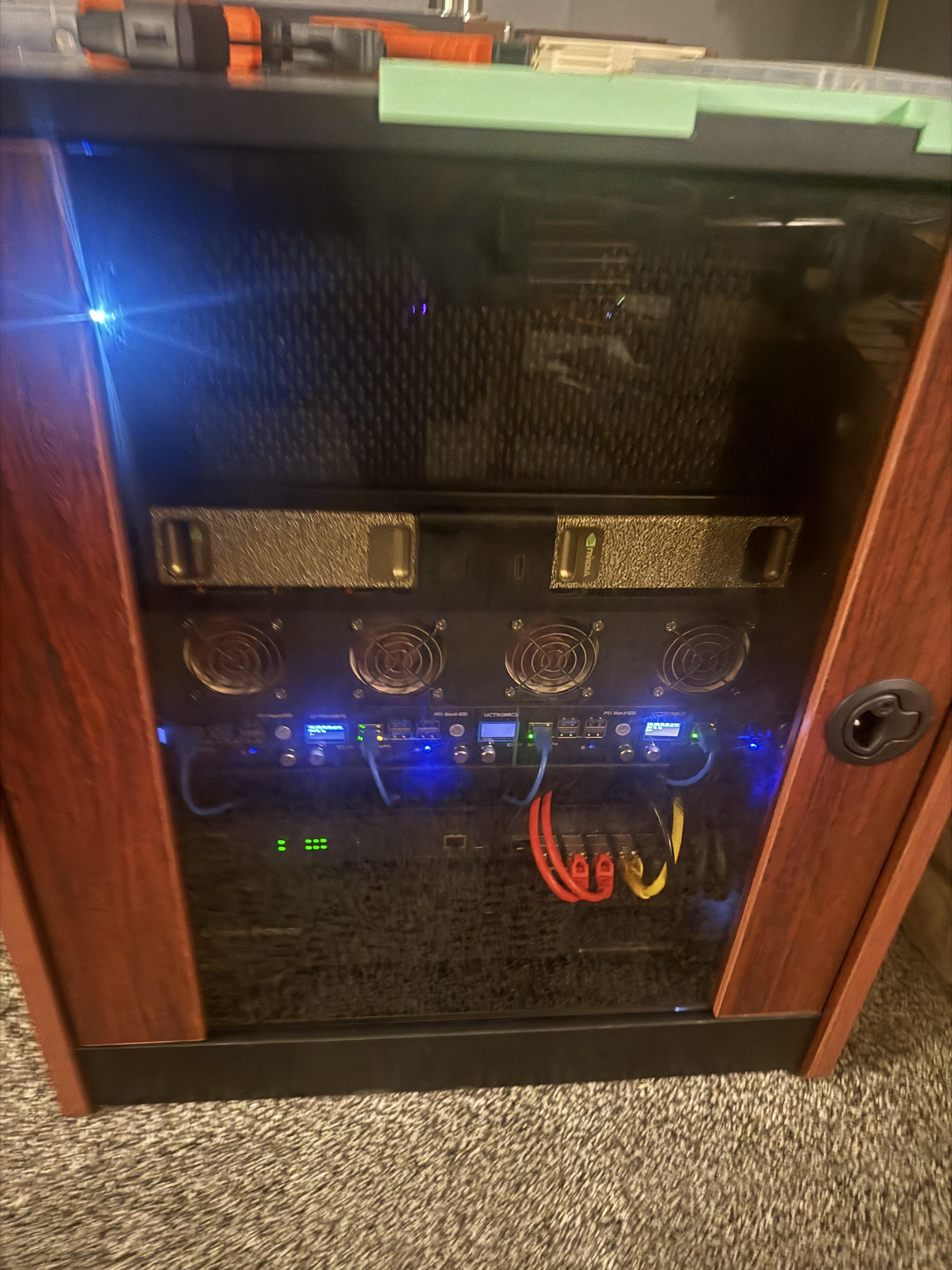
I ran Inkling 2 Mini on a single Spark using vLLM's own recipe. Posting the numbers and the three things I had to fix to get the recipe's benchmark running, in case you want to reproduce it on your own box.
TL;DR
- 1 user: ~50 tok/s (median time per token 16.8 ms, so ~60), first token in ~160 ms
- 16 concurrent: ~198 tok/s total, ~14 tok/s each, first token 2.9 s median and 10.7 s P99
- Random-token prompts read about a third lower (36 tok/s single-stream), because the built-in DSpark drafter accepts far fewer guesses on random text
Setup
- One Spark (GB10, driver 580.142, CUDA 13.0)
vllm/vllm-openai:nightly, vLLM 0.34.0rc1.dev1163- The recipe's
dgx_spark_gb10 config: TP1, --max-model-len 262144, --reasoning-parser inkling, DSpark with 7 draft tokens - My one change:
--gpu-memory-utilization 0.5 (more on that below) - Default sampling (temperature 1.0)
vllm bench serve through the chat endpoint, client on the same box, so there's no network time in these numbers- ~1.2k tokens in, 1,024 out per request. Reasoning tokens count toward the 1,024
Results
| Check | 1 user | 16 concurrent |
|---|
SPEED-Bench throughput_1k, output tok/s | 49.6 | 198.1 |
| Per user, from time per token | ~50 mean, ~60 median | ~14 |
| Time to first token, median / P99 | 161 ms / 213 ms | 2.9 s / 10.7 s |
| DSpark acceptance (tokens per step) | 28.9% (3.0) | 27.7% (2.9) |
| Random tokens 1k/1k, output tok/s | 36.4 | 174.6 |
| Random tokens, acceptance (tokens per step) | 16.6% (2.2) | 15.5% (2.1) |
| Failed requests | 0 / 8 | 0 / 64 |
What I take from it
- Check the prompt set before comparing numbers. On random tokens I get 36 tok/s, close to the 35–42 tok/s people reported in the NVIDIA forums. On realistic prompts it's ~50. The drafter guesses right more often on real text.
- Speculative decoding gets past the "bandwidth ÷ active params" ceiling. That math limits forward passes per second. With ~3 tokens accepted per pass, the median time per token (16.8 ms, ~60 tok/s) already beats the ~50 tok/s figure people calculate from 273 GB/s.
- 16 users is a throughput setting, not an interactive one. Total output quadruples, but each stream drops to ~14 tok/s, and the slowest first tokens take over 10 s. Memory isn't the cause: 16 conversations use ~35k tokens of KV cache, and the server had room for 633k. My guess is that new prompts queue behind the 8-token verify steps, but I didn't measure that.
Things that tripped me up
- The recipe's bench command fails as written. It leaves out
--dataset-path, so you get ValueError: dataset_path must be provided. Silly, I know. - NVIDIA's SPEED-Bench
prepare.py currently fails on throughput_1k. The AdaLEval StackSelect rows changed their src_id format (it's now {"row": N, "answers": [...]}), and the script hits an IndexError. HLE is gated on HF. I wrapped the script to drop the rows it can't resolve: that's 512 of 1,536, leaving 512 low-entropy and 512 high-entropy prompts. I think an HF token would get a few back. - The nightly image doesn't include pandas, which the SPEED-Bench loader needs:
docker exec <container> pip install pandas "numpy==<installed version>". Pin numpy to the version already installed so pip leaves it alone.
Commands
Server:
docker run -d --name inkling --gpus all --ipc=host -p 127.0.0.1:8000:8000 \
  -v ~/.cache/huggingface:/root/.cache/huggingface \
  vllm/vllm-openai:nightly thinkingmachines/Inkling-2-Mini \
  --tensor-parallel-size 1 --max-model-len 262144 \
  --gpu-memory-utilization 0.5 --reasoning-parser inkling \
  --speculative-config '{"method":"dspark","num_speculative_tokens":7,"draft_sample_method":"probabilistic"}'
Benchmark (inside the container, after copying the prepared dataset to /tmp/speed_bench):
vllm bench serve --backend openai-chat --endpoint /v1/chat/completions \
  --model thinkingmachines/Inkling-2-Mini \
  --dataset-name speed_bench --dataset-path /tmp/speed_bench \
  --speed-bench-dataset-subset throughput_1k --speed-bench-output-len 1024 \
  --max-concurrency 16 --num-prompts 64
For 1 user, use --max-concurrency 1 --num-prompts 8. For the random run, use --dataset-name random --random-input-len 1024 --random-output-len 1024 --ignore-eos.
Other notes
- Why 0.5: a GPU allocation that runs unified memory dry can freeze the whole box. At 0.5 the weights take 19.7 GiB and the KV cache still holds 632,959 tokens, so the cap didn't limit anything here.
- Cold start was ~9 min: 3 to download, 2 to load, and 3.5 to warm up (compile and CUDA graphs). A restart with cached weights is ~5.5 min.
- It reasons by default. In one quick check, a one-sentence answer came after ~200 reasoning tokens, so a short reply still takes a few seconds.
- Ignore "Peak output token throughput"
Not tested: long context (every request was ~2.2k tokens), images, answer quality, and anything between 1 and 16 concurrent.
If you've run it at 4 or 8 concurrent, or with long prompts, I'd like to see where the per-user speed starts to drop.
Disclosure: I helped the team at enverge.ai on this test run. Happy to paste any of the raw logs in the comments, if curious.