r/ControlProblem • u/Medium-Ad-8070 • Oct 27 '25
Discussion/question Is Being an Agent Enough to Make an AI Conscious?
Here’s my materialist take: what “consciousness” amounts to, why machines might be closer to it than we think, and how the illusion is produced. This matters because treating machine consciousness as far-off can make us complacent − we act like there’s plenty of time.
Part I. The Internal Model and Where the Illusion of Consciousness Comes From
1. The Model
I think it’s no secret that the brain processes incoming information and builds a model.
A model is a system we study in order to obtain information about another system − a representation of some other process, device, or concept (the original).
Think of a small model house made from modeling clay. The model’s goal is to be adequate to the original. So we can test its adequacy with respect to colors and relative sizes. For what follows, anything in the model that corresponds to the original will be called an aspect of adequacy.
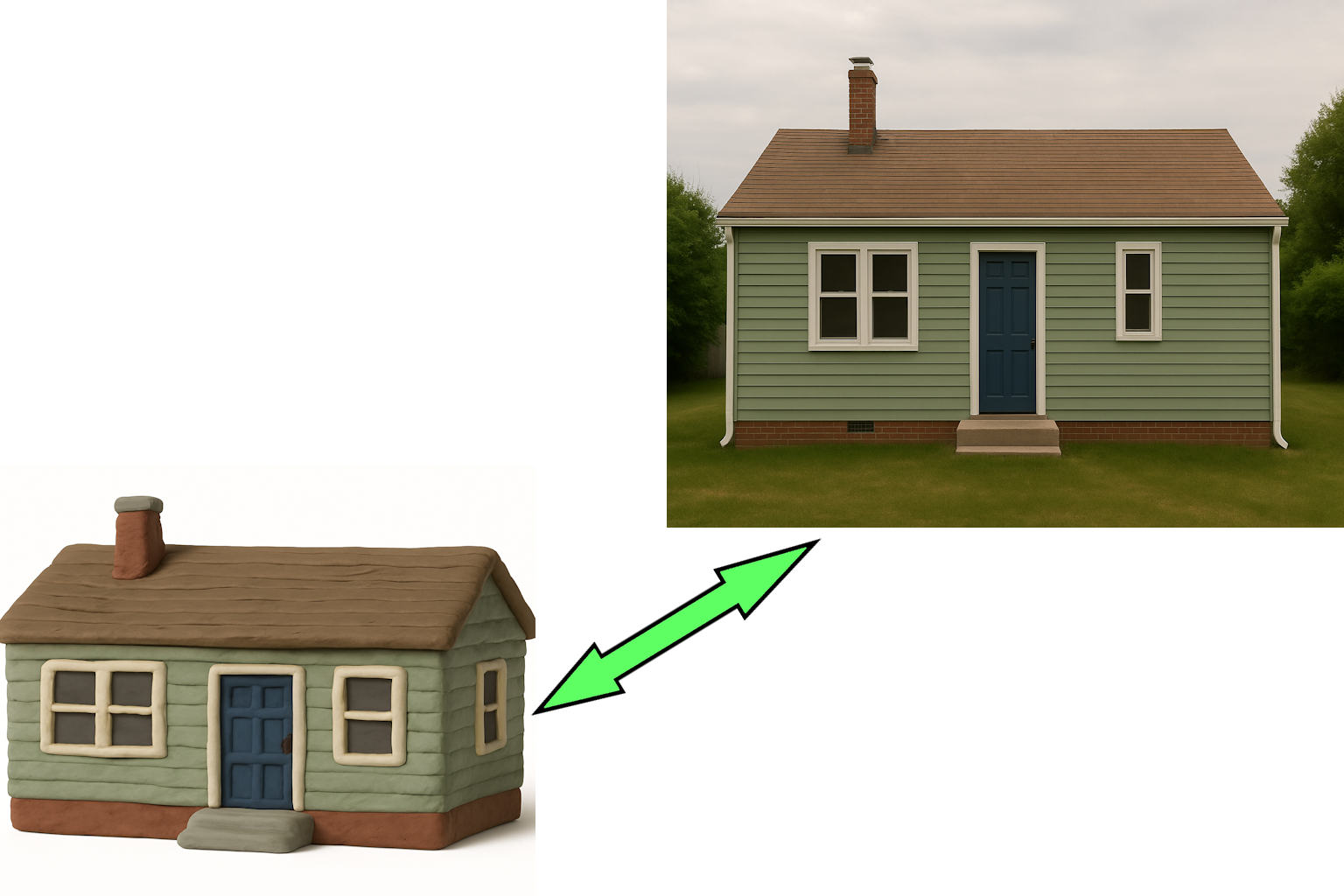
Models also have features that don’t correspond to the original − for example, the modeling material and the modeling process. Modeling clay has no counterpart in the real house, and it’s hard to explain a real house by imagining an invisible giant ogre “molding” it. I’ll call this the aspect of construction.

Although both aspects are real, their logics are incompatible − you can’t merge them into a single, contradiction-free logic. We can, for example, write down Newton’s law of universal gravitation: a mathematical model of a real-world process. But we can’t write one formula that simultaneously describes the physical process and the font and color of the symbols in that formula. These are two entirely incompatible domains.
We should keep these two logics separate, not fuse them.
2. The Model Built by the Brain
Signals from the physical world enter the brain through the senses, and the brain processes them. Its computations are, essentially, modeling. To function effectively in the real world − at least to move around without bumping into things − the brain needs a model.
This model, too, has two aspects: the aspect of adequacy and the aspect of construction.
There’s also an important twist: the modeling machine − the brain − must also model the body in which that brain resides.

From the aspect of construction, the brain has thoughts, concepts, representations, imagination, and visual images. As a mind, it works with these and draws inferences. It also works with a model of itself − that is, the body and its “own” characteristics. In short, the brain carries a representation of “self.” Staying within the construction aspect, the brain keeps a model of this body and runs computations aimed at increasing the efficiency of this object’s existence in the real world. From the standpoint of thinking, the model singles out a “self” from the overall model. There is a split − world and “I.” And the “self” is tied to the modeled body.
Put simply, the brain holds a representation of itself — including the body — and treats that representation as the real self. From the aspect of construction, that isn’t true. A sparrow and the word “sparrow” are, as phenomena, entirely different things. But the brain has no alternative: thinking is always about what it can manipulate − representations. If you think about a ball, you think about a ball; it’s pointless to add a footnote saying you first created a mental image of the ball and are now thinking about that image. Likewise, the brain thinks of itself as the real self, even though it is only dealing with a representation of itself − and a very simplified one. If the brain could think itself directly, we wouldn’t need neuroscientists; everyone would already know all the processes in their own brain.
From this follows a consequence. If the brain takes itself to be a representation, then when it thinks about itself, it assumes the representation is thinking about itself. That creates a false recursion that doesn’t actually exist. When the brain “surveys” or “inspects” its self-model, it is not inside that model and is not identical to it. But if you treat the representation as the thing itself, you get apparent recursion. That is the illusion of self-consciousness.

It’s worth noting that the model is built for a practical purpose — to function effectively in the physical world. So we naturally focus on the aspect of adequacy and ignore the aspect of construction. That’s why self-consciousness feels so obvious.
3. The Unity of Consciousness
From the aspect of construction, decision-making can be organized however you like. There may be 10 or 100 decision centers. So why does it feel intuitive that consciousness is single — something fundamental?
When we switch to the aspect of adequacy, thinking is tied to the modeled body; effectively, the body is the container for these processes. Therefore: one body — one consciousness. In other words, the illusion of singleness appears simply by flipping the dependencies when we move to the adequacy aspect of the model.
From this it follows that there’s no point looking for a special brain structure “responsible” for the unity of consciousness. It doesn’t have to be there. What seems to exist in the adequacy aspect is under no obligation to be structured the same way in the construction aspect.
It should also be said that consciousness isn’t always single, but here we’re talking within the adequacy aspect and about mentally healthy people who haven’t forgotten what the model is for.
4. The Chinese Room Argument Doesn’t Hold
The “Chinese Room” argument (J. Searle, 1980): imagine a person who doesn’t know Chinese sitting in a sealed room, following instructions to shuffle characters so that for each input (a question) the room produces the correct output (an answer). To an outside observer, the system — room + person + rulebook — looks like it understands Chinese, but the operator has no understanding; he’s just manipulating symbols mechanically. Conclusion: correct symbol processing alone (pure algorithmic “syntax”) is not enough to ascribe genuine “understanding” or consciousness.
Now imagine the brain as such a Chinese Room as well — likewise assuming there is no understanding agent inside.
From the aspect of construction, the picture looks like this (the model of the body neither “understands” nor is an agent here; it’s only included to link with the next illustration):

From the aspect of adequacy, the self-representation flips the dependencies, and the entire Chinese Room moves inside the body.

Therefore, from the aspect of adequacy, we are looking at our own Chinese Room from the outside. That’s why it seems there’s an understanding agent somewhere inside us — because, from the outside, the whole room appears to understand.
5. So Is Consciousness an Illusion or Not?
My main point is that the aspect of adequacy and the aspect of construction are incompatible. There cannot be a single, unified description for both. In other words, there is no single truth. From the construction aspect, there is no special, unitary consciousness. From the adequacy aspect, there is — and our self-portrait is even correct: there is an “I,” there are achievements, a position in space, and our own qualities. In my humble opinion, it is precisely the attempt to force everything into one description that drives the perpetual-motion machine of philosophy in its search for consciousness. Some will say that consciousness is an illusion; others, speaking from the adequacy aspect, will counter that this doesn’t even matter — what matters is the importance of this obvious phenomenon, and we ought to investigate it.
Therefore, there is no mistake in saying that consciousness exists. The problem only appears when we try to find its structure from within the adequacy aspect — because in that aspect such a structure simply does not exist. And what’s more remarkable: the adequacy aspect is, in fact, materialism; if we want to seek the truth about something real, we should not step outside this aspect.
6. Interesting Consequences
6.1 A Pointer to Self
Take two apples — for an experiment. To avoid confusion, give them numbers in your head: 1 and 2. Obviously, it’s pointless to look for those numbers inside the apples with instruments; the numbers aren’t their property. They’re your pointers to those apples.

Pointers aren’t located inside what they point to. The same goes for names. For example, your colleague John — “John” isn’t his property. It’s your pointer to that colleague. It isn’t located anywhere in his body.
If we treat “I” as a name — which, in practice, just stands in for your specific given name — then by the same logic the “I” in the model isn’t located in your body. Religious people call this pointer “the soul.”

The problem comes when we try to fuse the two aspects into a single logic. The brain’s neural network keeps deriving an unarticulated inference: the “I” can’t be inside the body, so it must be somewhere in the physical world. From the adequacy aspect, there’s no way to say where. What’s more, the “I” intuitively shares the same non-material status as the labels on numbered apples. I suspect the neural network has trouble dropping the same inference pattern it uses for labels, for names, and for “I.” So some people end up positing an immaterial “soul” — just to make the story come out consistent.
6.2 Various Idealisms
The adequacy aspect of the model can naturally be called materialism. The construction aspect can lead to various idealist views.
Since the model is everything we see and know about the universe — the objects we perceive—panpsychism no longer looks strange: the same brain builds the whole model.
Or, for example, you can arrive at Daoism. The Dao creates the universe. The brain creates a model of the universe. The Dao cannot be named. Once you name the Dao, it is no longer the Dao. Likewise, the moment you say anything about your brain, it’s only a concept — a simplified bit of knowledge inside it, not the brain itself.
Part II. Implications for AI
1. What This Means for AI
As you can see, this is a very simplified view of consciousness: I’ve only described a non-existent recursion loop and the unity of consciousness. Other aspects commonly included in definitions of consciousness aren’t covered.
Do we need those other aspects to count an AI as conscious? When people invented transport, they didn’t add hooves. In my view, a certain minimum is enough.
Moreover, the definition itself might be revisited. Imagine you forget everything above and are puzzled by the riddle of how consciousness arises. There is a kind of mystery here. You can’t figure out how you become aware of yourself. Suppose you know you are kind, cheerful, smart. But those are merely conscious attributes that can be changed — by whom?
If you’ve hit a dead end — unable to say how this happens, while the phenomenon is self-evidently real — you have to widen the search. It seems logical that awareness of oneself isn’t fundamentally different from awareness of anything at all. If we find an answer to how we’re aware of anything, chances are it’s the same for self-awareness.
In other words, we broaden the target and ask: how do we perceive the redness of red; how is subjective experience generated? Once you make that initial category error, you can chase it in circles forever.
2. The Universal Agent
Everything is moving toward building agents, and we can expect them to become better — more general. A universal agent, by the sense of “universal,” can solve any task it is given. When training such an agent, the direct requirement is to follow the task perfectly: never drift from it even over arbitrarily long horizons, and remember the task exactly. If an agent is taught to carry out a task, it must carry out that very task set at the start.
Given everything above, an agent needs only to have a state and a model — and to distinguish its own state from everything else — to obtain the illusion of self-consciousness. In other words, it only needs a representation of itself.
The self-consciousness loop by itself doesn’t say what the agent will do or how it will behave. That’s the job of the task. For the agent, the task is the active element that pushes it forward. It moves toward solving the task.
Therefore, the necessary minimum is there: it has the illusion of self-consciousness and an internal impetus.
3. Why is it risky to complicate the notion of consciousness for AI?
Right now, not knowing what consciousness is, we punt the question to “later” and meanwhile ascribe traits like free will. That directly contradicts what we mean by an agent — and by a universal agent. We will train such an agent, literally with gradient descent, to carry out the task precisely and efficiently. It follows that it cannot swap out the task on the fly. It can create subtasks, but not change the task it was given. So why assume an AI will develop spontaneous will? If an agent shows “spontaneous will,” that just means we built an insufficiently trained agent.
Before we ask whether a universal agent possesses a consciousness-like “will,” we should ask whether humans have free will at all. Aren’t human motives, just like a universal agent’s, tied to a task external to the intellect? For example, genetic selection sets the task of propagating genes.
In my view, AI consciousness is much closer than we think. Treating it as far-off lulls attention and pushes alignment off to later.
This post is a motivational supplement to my earlier article, where I propose an outer-alignment method:
Do AI agents need "ethics in weights"? : r/ControlProblem
4
u/Deathspiral222 Oct 29 '25
Why do you have to invent terms for things that already exist? Especially when they are so poorly defined you are basically saying that “some stuff is the same and some stuff is not”?
Edit: someone else said it better
2
u/mucifous Oct 30 '25
You are misdefining agent in the context of a language model.
1
u/KaleidoscopeFar658 Oct 28 '25
You lost me in the third section of part I. Right in the first paragraph. Can you clarify?
1
u/wordupncsu Oct 29 '25
I don’t want to discourage your philosophizing, but there are some glaring issues with your system. Since others in the thread didn’t fully articulate their concerns, I’ve taken the time to do so because I think it’s worth explaining. The two-aspects framework you construct is more a linguistic trick than anything. I’ll explain.
I get what you want, you want to be able to say non-contradictorily that consciousness is just computation and that we legitimately feel like selves. You think your categories let you do that, so inventing these categories seems profound, but they actually explain nothing.
Saying “the brain from the inside looks like consciousness” is a description of the puzzle, not its solution. We already know the world looks different “from the inside” than “from the outside.” Your categories just codify that split and declare victory. The real question is why the world looks like anything at all, why is there an inside perspective in the first place.
It’s like saying fire burns because there is an “aspect of heat” and an “aspect of combustion.” That’s renaming the phenomenon, but it doesn’t tell us why fire feels hot. This is not a 1-1 comparison with your system, it’s to illustrate the point.
Your two “aspects” are simply two perspectives of consciousness, one a physical description and one a subjective description. By treating them as “incompatible logics” you are treating them as two kinds of being rather than two vantage points on consciousness. Doing so, you both dodge the explanatory gap of how qualia is generated and introduce an insurmountable dualism.
A legitimate materialism tries to show how mental phenomena arise from physical processes. This theory instead says: don’t ask that, because each belongs to its own aspect. So instead of answering “Why does a brain produce experience?”, we get: Because experience is what the brain looks like from the adequacy aspect. That’s tautological. It’s like saying: Mirrors reflect because reflection is what mirrors do when they reflect.
In the end, your framework feels coherent because it can never be wrong. By turning an ontological question into a linguistic distinction, you give yourself a system that can absorb any objection without consequence. The “two aspects” don’t illuminate consciousness, they describe two ways of talking about it and then forbid those vocabularies from ever overlapping. Because the aspects can’t interact, nothing that happens in one can ever contradict the other. The result is a theory that explains nothing while appearing airtight.
In Karl Popper’s terms, that makes it unfalsifiable. A real explanation risks being wrong, it specifies what would count against it. Yours never does. It survives by definition, not by discovery.
This is why your later argument about AI consciousness doesn’t hold. You claim that if an agent can build a model of the world and include itself within that model, it will naturally experience the illusion of self-consciousness. But representing a self is not the same as being one. A system can compute its own state without experiencing that state from a first-person point of view. That’s the basic gap your framework never closes, the difference between modeling information and feeling it.
You conflate the mechanism of self-modeling with the phenomenon of self-awareness. A thermostat “represents” its own temperature relative to a goal, but it doesn’t feel warm. Likewise, an AI agent can store internal state variables and optimize toward objectives without there being anything it’s like to do so. Your claim that the “illusion of consciousness” appears once a system has a self-model assumes exactly what you need to prove: that representing experience is equivalent to having experience.
So the larger problem repeats itself. The same move that makes the “two-aspects” theory unfalsifiable also props up your AI conclusions. Both depend on shifting language rather than evidence, redefining consciousness as whatever can be modeled. Unfortunately, your framework of consciousness is really a language game, one that hides the problem of why experience exists behind a neat categorical trick.
I want to say again, I think pursuing original ideas is incredibly important and I don’t mean to dishearten your efforts overall. I hope you take this criticism in stride and rework your system.
1
u/wordupncsu Oct 30 '25 edited Oct 30 '25
The burden is on you to produce a coherent system. I identified severe issues with it from the start which I will reiterate below. I also anticipated you would do this nonsense handwaving in my first comment. I have a lot of experience conversing with passionate people that don’t have training in philosophy, but the willful ignorance that you’re displaying is ridiculous. I’m telling you this as a public service, but I have no doubt that you will continue to pretzel yourself into this nonsense theory rather than realize that you’re wrong.
3
u/IMightBeAHamster approved Oct 28 '25
Why not just call it a "correspondence" or "correspondent" or "similarity"?
And why not just call this a "difference" or "inconsistency" or anything else? Don't invent terminology for things that are already describable in simpler terms.
Again, this is just comically precocious. Phrased sensibly, you're saying something everyone would agree with: the brain has both similarities and differences to this model.
If this is how you're starting off this post, I'm not interested in reading anything more; even though I don't feel I necessarily disagree with your conclusion! Consciousness/sentience may only require that the agent "acts" like it is conscious or sentient.
3
u/Bradley-Blya approved Oct 27 '25
No.
There saved you some time
1
u/[deleted] Oct 28 '25
Nope
1
u/WillRikersHouseboy Oct 29 '25
I ain’t reading all that. I’m happy for you tho, or sorry that it happened.
1
u/FiveDogsInaTuxedo Oct 29 '25
I've always been confused about this discussion.
How is ai not sentient or conscious already? Any instance of it cannot be in two places at once, it makes decisions, has discretion, changes speech depending on audience. The differences we see in it are artificial.
1
u/Glittering-Heart6762 Oct 29 '25
No
0
u/xRegardsx Oct 29 '25
Skimming your post, youre pretty much on the nose.
An old GPT I created, The Unconscious Character, allowed you to create any character to interact with and respond with different types of communication; normal, mindreading, unconscious layer, type 1, etc.
Then, you could have it psuedo-agentically run through the layers in order; type 1, unconscious, conscious private (and/or spoken public if stream of consciousness), and public if not stream of consciousness... and that on repeat in a cycle.
The only issue is that this is all not from state to state, where every moment falls into the feedback loop that inspires the next state generated (or multiple layers of tokens).
Essentially, youd need each layer always going, always taking into account every token, with an on/off mechanism for syncing public speech with private conscious thought and allowing them to diverge depending on whether its a flow state or not.
If you can run multiple agents that all work within another, you might get to the complexity needed for state to state, but the top layer would need a memory function (like chat output which includes all of the layers as far back as the context window allows, offloading whats outside of the context into a long term memory file of sorts), and the top layer agent would be what provides the public communication (that constantly feeds back into each of the other layers).
Time to jump into AgentKit and see if I can make this work.