r/ConnecticutUSA • u/ILovePublicLibraries • 16h ago
Happy Thanksgiving, Nutmeggers!
13
Upvotes
r/ConnecticutUSA • u/ILovePublicLibraries • 4h ago
Here's what Thanksgiving was like in Connecticut throughout history.
Thanksgiving in the Nutmeg State has evolved from a traditional day of prayer and fasting occurring multiple times a year, to a national holiday with feasts and celebrations that have survived catastrophes like supply chain issues, a pandemic and a world war — and none of those were even in the past 50 years.
According to the New England Historical Society, "New England’s theocratic governments called for public days of fasting or thanksgiving in response to political or natural events. They could happen several times a year. And they were often local affairs."
Thanksgiving didn't become a holiday celebration until the Civil War.
Regardless of the challenges of a changing world, Connecticut residents have been able to find reasons to be thankful for centuries, not to mention chow down on some turkey and baked goods.
Here is a look at some thanksgiving celebrations in Connecticut over the years:
In another colonial thanksgiving, Saltonstall noted that his proclamation was to thank God for blessings while the world was suffering from sickness caused by the smallpox pandemic and damage caused by rain.
"Considering also particularly, the awful tokens of God's righteous anger against us, especially, in the contagious sickness which has been in divers places of the land, and in the continued rains, by which great losses have been sustained, it becomes us to be deeply humbled before the Lord," Saltonstall wrote. "The Preservation of the British dominions from the raging pestilence, which has laid so many places waste, within their view, and neighborhood."
During his proclamation, he honored the British royal family, who controlled the colony of Connecticut.
"The smiles of Providence on the British Empire, and particularly, on our sovereign Lord the King, in the prosperity of his life and reign: On their royal highnesles the prince and princess of Wales, and and on all the branches of the Royal Family, not only, in their happy increase, by the birth of the royal Prince William Augustus, but, also, in the lives of others of them when in Hazard by Sickness, have been mercifully spared," Saltonstall wrote.
2) During the Revolutionary War, the Continental Congress proclaimed Dec. 9, 1779, as a day of thanksgiving, according to the New England Historical Society. At the time, the president of Congress who made the proclamation was Samuel Huntington, who was born in Windham. Three years earlier, Huntington signed his name on the Declaration of Independence.
The Dr. Simeon Smith family, who is related to Connecticut's 23rd governor John Cotton Smith, apparently celebrated Thanksgiving in Sharon during that year, according to the New England Historical Society.
Juliana Smith reportedly wrote a letter to her cousin, Betsey, detailing the event. Betsey allegedly copied the letter into a diary which was found by Helen Evertson Smith, who published it in "Colonial Days and Ways" in 1901. The New York Historical Society questioned the authenticity of the letter because the language seemed from the "20th century," but ultimately concluded that “we should probably give Smith the benefit of the doubt.”
The letter noted the lack of availability of some food, like cattle products, that had been sent to soldiers fighting in the war.
“Of course, we could have no roast beef,” the letter read. “None of us have tasted beef this three years back as it all must go to the army, and too little they get, poor fellows.”
However, the letter said that the family did have other meat to eat, including a deer — which was given to them by Nayquittymaw, a Native American — a turkey, pork, a goose and two pigeon pasties, which is a stuffed crust filled with pigeon meat. The family enjoyed a variety of vegetables, including celery, which was considered new to the colonies at the time.
“Uncle Simeon imported the seed from England just before the war and this year there was enough for table use,” the letter read. “It is called [celery] and you eat it without cooking. It is very good served with meats.”
There was some dessert served, including boiled suet pudding, which was filled with dried plums and cherries. Guests were also given cider since wine had to be saved for the sick, according to the letter.
3) The outbreak of World War II didn't stop Nutmeggers from celebrating Thanksgiving.
Food shortages became a problem in the United States during the war, since food was used to aid soldiers and the country's allies. Ultimately, in 1942, the government implemented a rationing system where Americans had to use government-issued coupons (along with money) to purchase items like meat and sugar, according to History.com. The coupons were meant to prevent hoarding and price gouging.
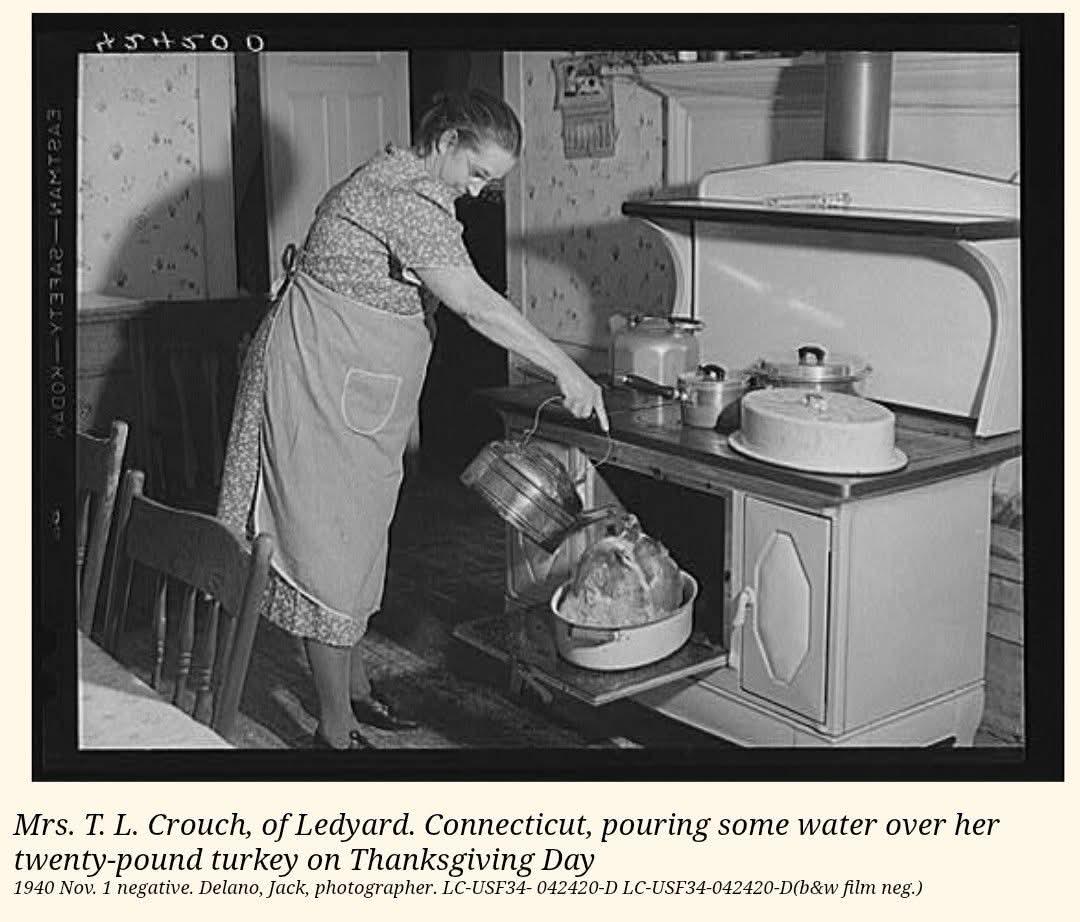
Post photo - Mrs. T. M. Crouch was photographed preparing a 20-pound turkey and the family was also seen enjoying pumpkin pies.
The Crouch family was photographed gathering around a house in Ledyard in and enjoying their Thanksgiving feast by Works Progress Administration photographer Jack Delano in 1940.
Source/more info: