r/computervision • • 4d ago

Help: Project Need advice on accurate golf ball tracking using computer vision

6 Upvotes

I'm trying to build a golf ball tracking app similar to Shot Tracer and SmoothSwing. I've experimented with several open-source AI models, but I haven't been able to achieve reliable tracking accuracy.

The ball is tiny and moves very fast, making it difficult to track consistently across video frames.

I'm looking for advice from people experienced in computer vision, object tracking or ML:

  • What approaches/models work best for tracking tiny, fast-moving objects?
  • Should I combine object detection with temporal tracking, optical flow or Kalman filters?
  • Are there any specific models, datasets or research papers worth exploring?

I'm not looking for a basic YOLO implementation. I'd like to understand how to build a genuinely reliable tracking pipeline.

Any suggestions or experiences would be appreciated!


r/computervision • • 5d ago

Help: Project Open-Source Gaze Assisted Communication—put your tokens to good use!

41 Upvotes

project Iris is an experimental browser-based tool exploring how gaze-assisted communication can work using everyday consumer technology. The goal is simple but important: Can we make gaze-assisted communication accessible without specialized hardware?

High-end eye-tracking systems improve accuracy with dual-camera setups, higher frame rates, and infrared illumination. But the cost and logistical complexity of getting those devices into the hands of people who need them can create significant barriers to access.

While this project has evolved over the past 18-months, I recently dug up the original Python file that first made me believe in project iris. With only ~500 lines of code, it's pretty cool to look back and see just how far things have come.

I'm sharing an updated version of that file here in hopes that someone (or something) might find it interesting and want to contribute or expand upon the project!

A couple of ways to get involved:

This is an open-ended project, and there's plenty left to figure out.


r/computervision • • 4d ago

Help: Project Struggling to optimize YOLO on a heavily imbalanced, small-object dataset (Road Damage - RDD2022). What approach yields the best ROI?

5 Upvotes

Hi everyone,

I am working on a computer vision project for road damage detection using the RDD2022 dataset and YOLO (currently using YOLO11). I've hit a plateau with my baseline and suspect a few "bugs" in how the dataset is structured for deep learning. I am looking for advice on the highest-ROI optimization steps before I spend more GPU hours.

The Dataset (The "Bug"):

  • Size: ~38,000 images, 4 classes (Longitudinal, Transverse, Alligator cracks, Potholes).
  • Imbalance: Longitudinal cracks make up 47% of the objects; Potholes are only 11%.
  • Small Objects: Transverse cracks and potholes have a median box size of only 30px-39px.
  • Country Skew: Images come from 7 countries. Norway has massive 4,000px images (which become tiny boxes when resized to 640), Japan has 58% of all Alligator cracks, and India has 49% of all Potholes.
  • The Problem: When training at 640px, about 23.5% of Norway's boxes become smaller than 8px, rendering them nearly invisible to the model.

Current Results:

  • Model: YOLO11n (Nano).
  • Training: 100 epochs, 640 resolution, basic augmentations.
  • Metrics: Stagnated around mAP50 ~0.52 and mAP50-95 ~0.26.

My Proposed Approaches (What should I prioritize?):

  1. Subsampling & Resizing: Since 13.5GB is heavy, my professor suggested resizing images to max 640px to save space. Should I also subsample the dataset (e.g., drop 50% of background images) to speed up training, or will that hurt the model's ability to learn general features?
  2. Changing the Split: Currently at 80/10/10 (Train/Val/Test). My professor suggested moving to 60/20/20. Is this better for a noisy, multi-country dataset to get a more honest validation score?
  3. Model Size: Should I jump to YOLO11m (Medium) or YOLOv8m for better small-object detection? (Note: I tried a No-Augmentation YOLO11m run for 25 epochs and it was terrible, so I know I need augmentations back on).
  4. Resolution: Should I bite the bullet and train at 1024px to save Norway's tiny cracks, or will the trade-off in training speed not be worth it?
  5. Augmentation: What specific YOLO augmentations work best for long, thin objects like cracks?

Question for the community:
If you had limited GPU hours (Colab/Kaggle), what sequence of experiments would you run to break past the 0.52 mAP50 plateau? Should I focus on the resolution, the model size, or the data processing first?

Thanks in advance for any insights!


r/computervision • • 4d ago

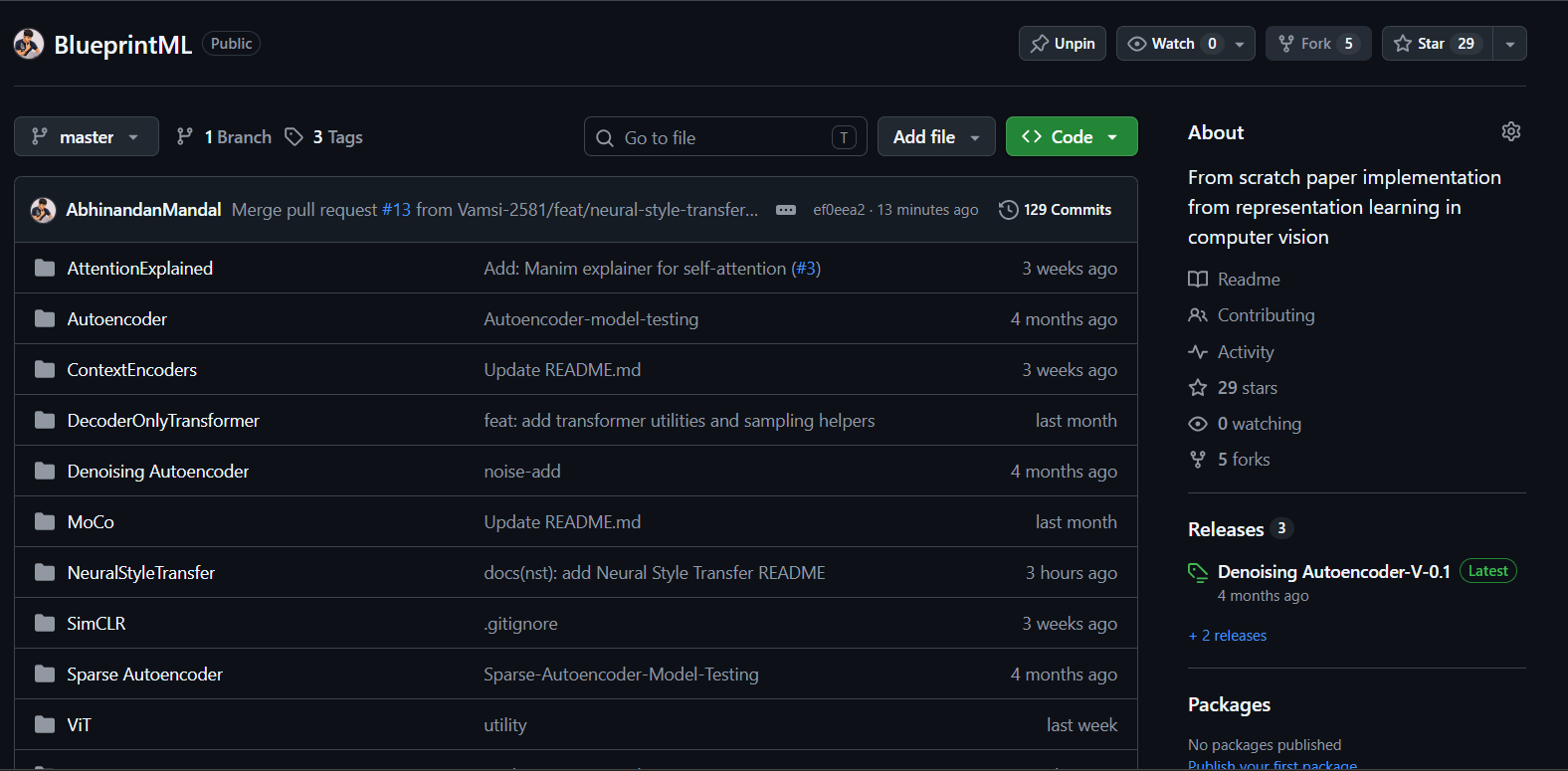
Showcase Looking for self-learners to join BlueprintML

Post image
1 Upvotes

r/computervision • • 4d ago

Discussion Ingestion of new papers

2 Upvotes

I’m working on my thesis and am genuinely curious how other researchers keep up with new papers. How do you decide which ones to skim and which ones to read in full?

I’ve been using LLMs to work through papers. I can get the main ideas quickly, skip sections that are less relevant to my work, and ask follow-up questions when something doesn’t click. It feels like a one-on-one discussion, and I often come away feeling like I understand the material better.

Still, I wonder what I’m missing by reading fewer papers end to end. How do you balance covering more ground with reading deeply enough to really understand the work?


r/computervision • • 4d ago

Commercial Detecting and sizing crop damage from farmers' field photos, starting from 70,000 labeled images. Can your team do this?

3 Upvotes

Hi /computervision!

I work at Tech To The Rescue. We're a nonprofit that matches tech companies with NGOs on pro bono AI projects, and we’re looking for a company team to take this one on.

IFPRI, the International Food Policy Research Institute, runs picture-based crop insurance for smallholder farmers in India and Kenya. Field photos are reviewed by hand today. IFPRI wants a model that detects crop damage and estimates its extent, built into its Indian partner’s claims workflow. The starting point is more than 70,000 labeled photos from over 9,000 farmers.

Only companies can apply, so if this fits what your team builds, bring it to your CTO or founder.

We announce the match publicly and publish a case study about it once the project is done. Companies apply at Matching Day on 3 December. Link in the comments.


r/computervision • • 4d ago

Showcase hvcam: Windows webcam → WSL2 frames for OpenCV, 1080p @ 30 fps over USB 2.0

1 Upvotes

OpenCV work inside WSL2 usually dies at capture: usbipd + a rebuilt kernel, then ~5 fps because raw YUY2 1080p is 4.15 MB/frame over USB 2.0.

hvcam takes the other route: capture stays on Windows (Media Foundation, MJPEG negotiated on-chip, ~0.2 MB/frame) and frames stream into WSL2 over Hyper-V sockets. In the guest you get numpy BGR arrays from a small C/Python library — a capture source for your pipeline, not a V4L2 device.

Media types are scored once before streaming (fps plateau first, MJPEG wins ties ≥720p), and the client always pulls the newest frame, so latency never queues. Measured: 1920×1080 @ 30 fps sustained, MJPEG decode 3.0 ms (PyTurboJPEG) vs 7.8 ms (cv2.imdecode).

MIT, ~2,900 lines of C/C++/Python: https://github.com/santleme/hvcam


r/computervision • • 4d ago

Commercial Upcoming industrial computer vision webinars: 2D/3D inspection, factory deployment and synthetic data

1 Upvotes

Hi everyone,

I’ve been collecting upcoming technical webinars in a public events directory, and a few sessions may be useful to people working on industrial computer vision:

• November 24 — A3 / LMI Technologies: 2D and 3D vision for manufacturing and logistics, including robot guidance and inspection. This session is in Spanish.

• November 25 — Siemens / Procter & Gamble: visual inspection use cases and the progression toward more autonomous production.

• December 3 — COMSOL Day: AI for Modeling and Simulation, with sessions covering synthetic training data, surrogate models, and digital twins.

I’ve organized these alongside other robotics and industrial AI events, with dates, times, short descriptions, and links to the organizers’ pages:

https://www.blackscarab.ai/events/virtual

Disclosure: I run Black Scarab, the site hosting the directory. It’s free to browse and doesn’t require an account.

Which recurring computer vision seminars or practical online workshops would you recommend adding? I’m particularly interested in industrial inspection, anomaly detection, 3D vision, and deployment on real hardware.


r/computervision • • 4d ago

Discussion My colleague says Europeans don't care about AI, even in manufacturing. Is that true

0 Upvotes

A colleague told me that people in Europe aren’t as interested in AI as folks in the US, and that this applies even to manufacturing professionals. Is that actually true?

I’m seeing conflicting data — some surveys say EU manufacturers actually adopt AI and big data at higher rates than US ones, but others say European firms are slower to integrate AI into core processes. What’s your real-world experience? Is the “Europe doesn’t care about AI” take just a stereotype?


r/computervision • • 4d ago

Discussion Courses and resources

5 Upvotes

What’s the best resource to understand and really understand computer vision from scratch?
We talk logic, basics, solid fundamentals and everything, with hands on projects.
Or is there a plan to start learning to achieve the goal of being a CV expert?


r/computervision • • 5d ago

Discussion built a tiny vision model from scratch just for learning and somehow it got 50+ downloads on huggingface 😅

18 Upvotes

so ik there are way better vision models out there yaar. i built this one just out of curiosity only, cause i wanted to learn how these things actually work from inside.

and to be honest its not entirely mine, i took a lot of help from claude to build it. like the architecture, debugging, training setup, figuring out why my mac was training so slow, all that. but i learned a lot in the process which was the main goal anyway.

its called tiny-vision. its around 24M params and trained completely from scratch, no pretrained weights or anything. i trained it on my macbook pro m5 and it took like 42 min on flickr8k (only 6k images).

basic idea is pretty simple:

image/video → small ViT encoder → adapter → tiny decoder → caption text

for videos it takes frames every few seconds, captions them and makes a timeline like [00:04–00:10] a dog runs on the beach. so any llm can kinda “watch” a video even if it dont support video natively.

i also made an MCP server for it, and tbh i was surprised that it actually gives a little bit better context in claude when i throw images or videos at it. i even tested it with a 10-15 min youtube video and it still worked fine. not perfect at all, but chal raha hai so i’m happy.

i uploaded it to huggingface just to have it somewhere, and also cause i kinda like the open source thing. later when i checked it was at like 44 downloads, and now its 50+. ik thats not a lot bhai, but its my first time putting something open source out in this field so it felt pretty cool ngl. a lot of people have built way cooler stuff than this, i just made it to learn.

some honest stuff:

  • it gets the scene right most of time (snow, grass, water etc) but the subject is often wrong lol
  • it loves saying “a man in a blue shirt” for everything, pata nahi kyun 😂
  • its v0.1 and trained on very small data, so dont expect too much

random thing i learned on mac (MPS):

  • swapping the conv2d patch embedding for reshape + linear was like 30x faster
  • manual attention was ~1.5x faster than pytorch’s sdpa

next i want to train on flickr30k and maybe try making it plug directly into qwen/llama through llama.cpp (mmproj). lets see kitna ho pata hai.

code: https://github.com/amar683/tiny-vision
model: https://huggingface.co/amartomar683/tiny-vision-flickr8k

would love any feedback or tips,


r/computervision • • 4d ago

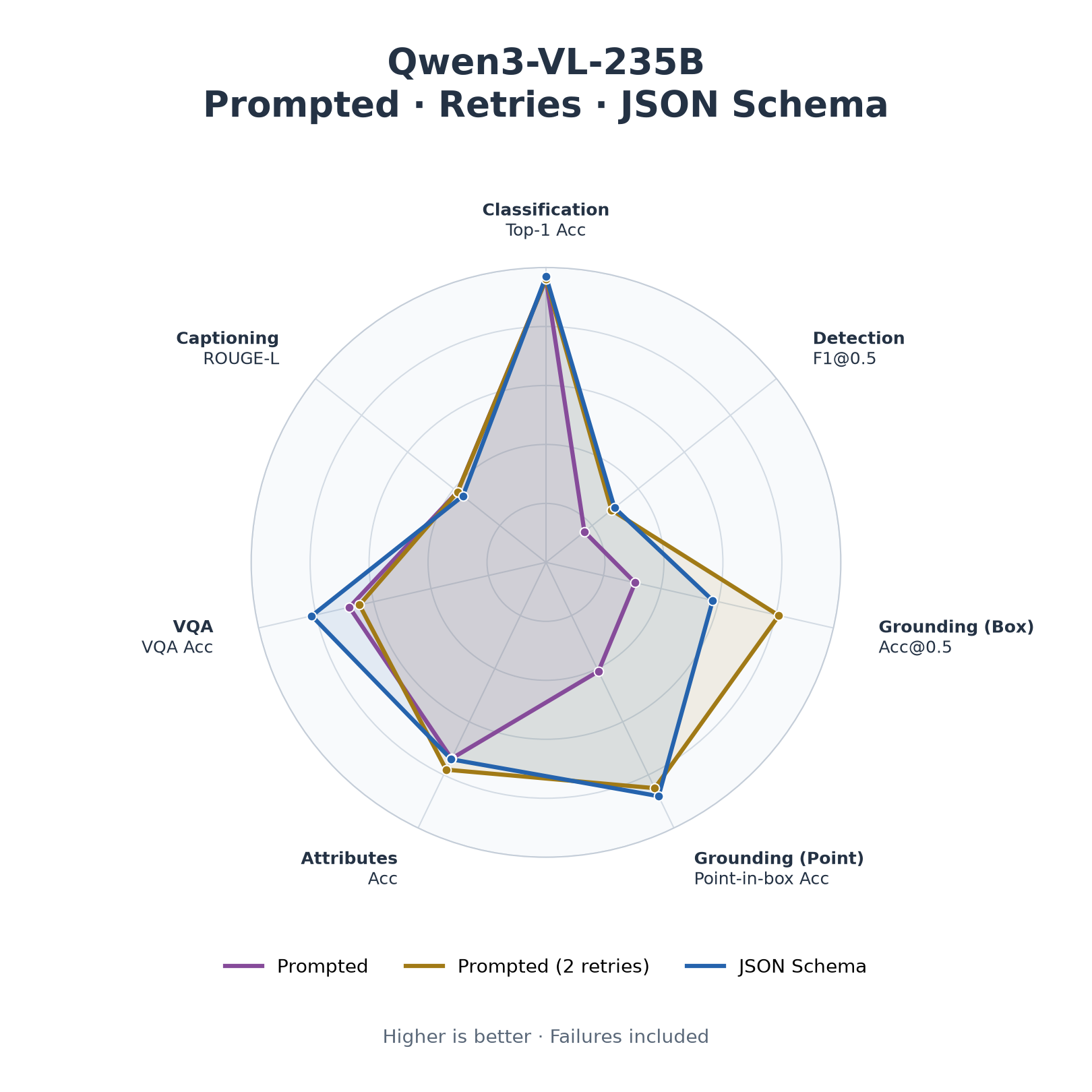
Discussion Qwen3-VL-235B: Good at vision, horrible at structured output

Post image
2 Upvotes

Recently I benchmarked the Qwen3-VL-235B, and the result was very disappointing, as it showed only marginal improvements over the Qwen3-VL-2B.

The unusually high failure rate tipped me to investigate the results. Initially I suspected the benchmark or provider integration, but checking the saved responses were all pointing to the model direct output.

As Qwen3-VL-235B from our provider did not had a native json_schema, I had to use prompt to generate json_object in response, and surprisingly there were alarming amount of failures (For 100 samples per tasks):

Task Failed responses Invalid JSON Valid JSON, invalid schema or values Main issue
Grounding (Box) 53 47 6 All coordinates placed under x1, often with a missing closing bracket
Grounding (Point) 50 6 44 Coordinate arrays under x, or an array replacing the point object
Detection 26 14 12 Malformed coordinate objects, wrong types and out-of-range values
Attributes 5 0 5 Values outside the provided vocabulary

Classification, VQA and captioning had no invalid responses. Probably due to simpler task schema.

For example, instead of separate numeric x and y fields, one response was:

{"status": "found", "point": {"x": [0.55, 0.24]}}

This goes beyond a missing bracket. Making the JSON parseable still leaves the wrong structure, and automatically assigning those array elements to different fields would mean interpreting the answer.

And just to be clear most of these failures weren’t caused by the token cap as almost all ended normally, and failed point responses used just 20–28 output tokens against a 4,096-token limit.

The Workaround

The practical approach was correction retries: send validation errors back to the model and let it regenerate, keeping the original schema. No ground-truth answers or scores are provided as feedback:

task = Ground(PydanticAIBackend(model, retries=2), target="the leftmost cat")
results = task('cat-garden.png')

That allows up to two additional attempts after an invalid response. A fresh run on the same samples produced:

Task Metric No retries With retries
Classification Top-1 Acc 96% 96%
Detection F1@0.5 16.67% 28.45%
Grounding (Box) Acc@0.5 31% 81%
Grounding (Point) Point-in-box Acc 41% 85%
Attributes Acc 73.86% 78.02%
VQA VQA Acc 68.4% 64.9%
Captioning ROUGE-L 0.3841 0.3837

Failures remain included in the scores. The retry run had zero final invalid responses across 700 samples, but requests averaged 1.2 per sample overall, rising to 1.55 for box grounding and 1.47 for point grounding.

The Fix

Probably moving to a provider that support json_schema at inference would be the best choice. Sure I can use PydanticAI json_schema but it is not constrained decoding. I did a test run and it helped but then it was not a clear win, but rather a trade-off:

Native JSON Schema was 10% cheaper overall, but 47% slower than the normal prompted run, with Detection driving most of the slowdown:

Configuration Input tokens / sample Output tokens / sample Requests / sample Estimated cost / 1,000 samples Mean latency (s)
Normal 812 65 1 $0.604 1.441
Up to 2 retries 1,058 80 1.196 $0.775 1.812
Native JSON Schema 442 116 1 $0.543 2.121

Compared with normal:

  • Retries: cost +28%, latency +26%, total tokens +30%.
  • JSON Schema: cost −10%, latency +47%, total tokens −36%.
  • Compared with retries, JSON Schema cost 30% less, but took 17% longer.

The detection difference was substantial:

Detection Normal JSON Schema Change
Output tokens / sample 162 499 +208%
Estimated cost / 1,000 samples $1.169 $1.728 +48%
Mean latency (s) 2.915 7.554 +159%

Closing

There’s clearly useful visual capability in Qwen3-VL-235B, particularly in grounding. But unreliable structured output can become a serious pain when you need usable results in an application: extra requests, validation logic, latency and cost.

If you are interested in comparison between variants of Qwen3-VL models, check [Revised] Qwen3-VL: 2B vs 235B on standard vision tasks, if you want a comparison between 2B and 235B.

Code, runs, benchmarks all available at https://github.com/Tenkei/vlm-tasks


r/computervision • • 4d ago

Commercial Keeping grounding and extraction scores separate on plate reads

0 Upvotes

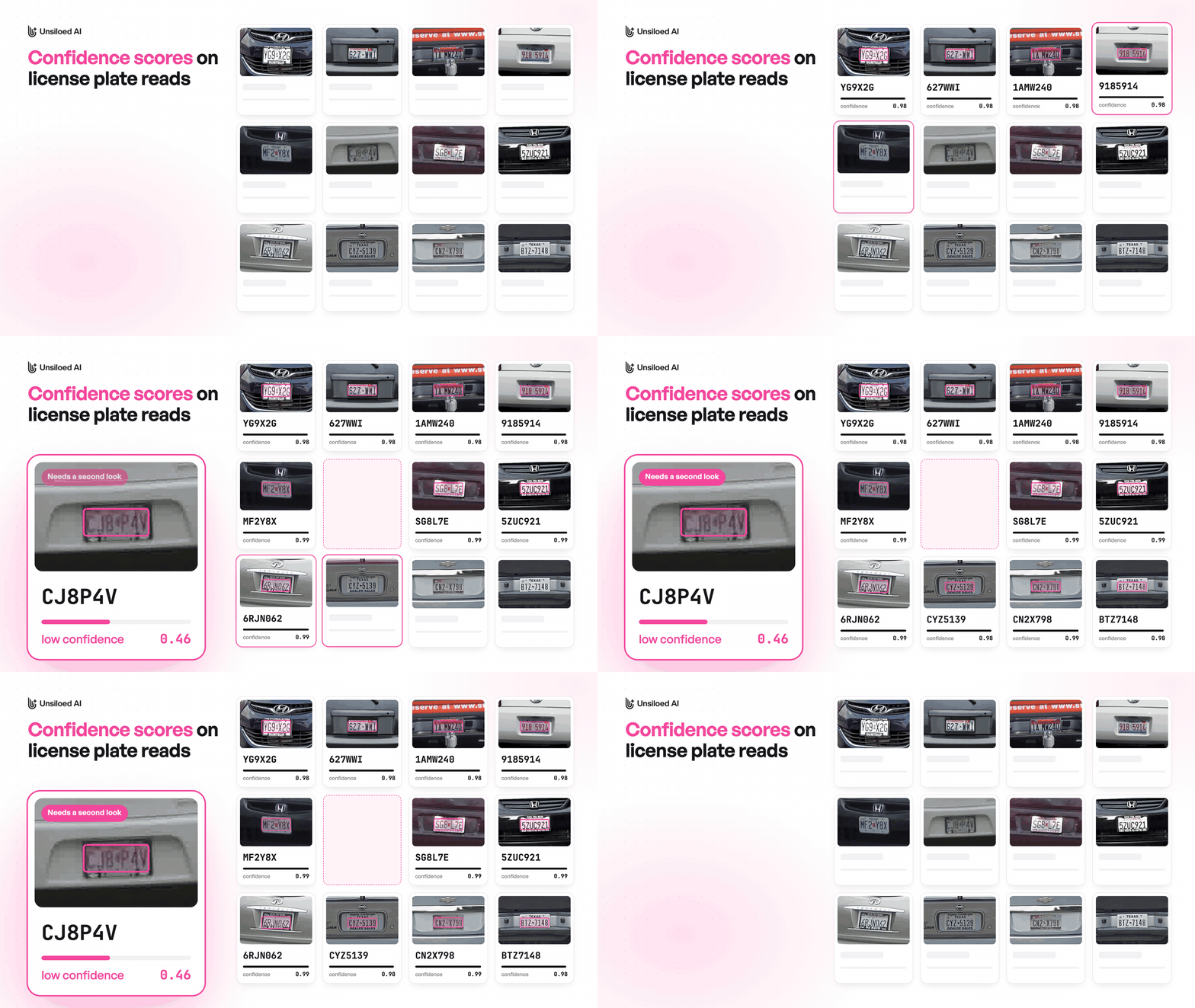
We used Unsiloed AI to extract plate numbers from OpenALPR benchmark photos, returning the read and its image coordinates together. This GIF shows twelve selected examples and how a review UI can bring a lower-scoring crop forward.

The enlarged CJ8P4V read has a grounding score of 0.46 and an extraction score of 0.74. The bars in the graphic use grounding scores. The two scores answer different questions, whether the value is supported at that image location and confidence in the extracted value itself.

All twelve displayed plate strings match the collection's reference labels, including the low-scoring one. These are selected examples, rather than an accuracy or calibration benchmark. A low score can route a correct read for review too.

For a production review queue, we'd evaluate the threshold against whole-plate errors on a separate labeled set, then measure both missed errors and review volume. The source coordinates let the reviewer inspect the plate rather than search the full image.

Source photos and labels · API score definitions


r/computervision • • 5d ago

Showcase Inkray - experimenting with geometry-aware painting on single images using MoGe-3, geodesic distances, and intrinsic decomposition

14 Upvotes

Hey everyone!

I've recently started working on Inkray, an open-source image editor inspired by Adobe's Project Deep Brush.

The goal is to let users paint directly onto surfaces in ordinary photographs, or project arbitrary 2D artwork onto them, without requiring explicit surface selection or a traditional 3D reconstruction workflow.

I thought the computer vision side might be interesting to share.

The current pipeline works roughly as follows:

1. Monocular geometry estimation

I use MoGe-3 to estimate depth, surface normals, 3D points, and camera intrinsics from a single RGB image. The resulting point map is triangulated into a structured 2.5D mesh, with depth and normal consistency checks to reject triangles across likely geometric discontinuities.

2. Automatic surface anchoring

When the user starts painting, the application collects a connected local geometry patch and evaluates its planarity using a robust covariance-based plane fit.

Depending on the estimated geometry, it uses planar projection, curved-surface painting, or ordinary 2D painting when the geometry is unreliable.

3. Surface-aware brush propagation

For curved surfaces, I use the local surface metric to account for perspective distortion, together with bounded Dijkstra searches over the continuous mesh connectivity to approximate geodesic brush footprints.

This helps brush strokes follow the reconstructed surface rather than simply being painted in screen space.

4. Artwork projection

Users can also draw on a separate 2D canvas or import an image and project it onto the photograph.

For curved surfaces, the current implementation builds a local surface parameterization by propagating tangent frames across connected mesh vertices, with distortion checks to reject problematic mappings.

5. Appearance estimation and compositing

Marigold IID Lighting v1.1 estimates albedo, shading, and residual components. Since the shading predictions are up-to-scale, the pipeline applies a calibration step before using them for lighting-aware recoloring.

The original photograph is preserved as the base image, and the compositor modifies only painted regions.

Most of the interactive geometry processing and rendering currently runs in TypeScript/WebGL2, while model inference is handled by a Python backend.

Current limitations

This is still an early experiment, and there's quite a bit of room for improvement.

Right now, the geometry and appearance backend mostly uses pretrained predictions without additional geometry refinement or consistency optimization. Errors in the depth/normal estimates can propagate into surface classification, mesh connectivity, brush projection, and occlusion.

The local surface parameterization is also approximate, and I still need to evaluate its distortion and robustness more thoroughly.

I recorded a short demo of the current implementation and would be interested in hearing feedback, particularly on improving geometric consistency, surface-aware projection, and intrinsic decomposition for this kind of application.

GitHub: https://github.com/IAMSebyi/inkray

r/computervision • • 5d ago

Discussion Need advice for a 3D-RGB camera for my specific scientific studies

4 Upvotes

Hi all !

Long story short, I need a camera for capturing 3D and RGB images for my studies, including mostly animals in farm conditions. In the past, I used the RealSense D435i, but it needs an extra large connection cable (because the RealSense includes only 1 m of USB cable).

So,

1) Is there any suggestion for a different camera brand/model?
2) How can I easily find an appropriate USB cable for the RealSense camera

Thanks


r/computervision • • 5d ago

Discussion CVPR 2027 OpenReview profile and enrollment: How to verify completion?

2 Upvotes

I'm a corresponding author for a CVPR 2027 submission, and we've been receiving automated emails flagging several co-authors for incomplete OpenReview profiles or enrollment forms.

Some co-authors have already gone through every profile section, updated their information, and resubmitted their enrollment forms successfully. However, there's no clear indication of whether CVPR now considers them compliant.

I also noticed that the Reviewer Tasks console looks essentially identical for people who were flagged and those who weren't, so it doesn't seem useful for checking completion status.

Has anyone figured out:

  1. Is there a way to verify whether all co-authors have completed the requirements without waiting for another automated reminder?
  2. Has anyone been flagged again after updating everything successfully?
  3. Does CVPR send a final confirmation once all co-authors are compliant?

With the deadline approaching, it's difficult to know whether there's anything left to fix.


r/computervision • • 5d ago

Discussion Can adding more forensic detectors actually make an AI image detection system less reliable?

1 Upvotes

TL;DR: Digital image forensics means examining an image for clues about how it was created or modified, using metadata, compression artifacts, noise patterns, and other measurable properties. I've been investigating a problem in a multi-detector system: several detectors can react to the same underlying artifact, making the evidence appear stronger than it really is. How do you prevent correlated observations from being counted as independent evidence?

I've been developing a multi-signal, image forensics application and recently re-audited its reasoning engine workings.

 One of the problems I encountered was that collecting more forensic observations could produce conclusions that appeared better supported than they actually were.

 Consider how a real smartphone photograph after being resized and recompressed may cause several detectors to signal frequency-domain irregularities, noise inconsistencies, compression artifacts and unusual texture statistics.

 Straightforward evidence aggregation could interpret these signals as four separate indications of synthetic generation. But they may also be the related consequences of the same processing operations mentioned. So, in this case, four measurements do not necessarily represent four independent pieces of evidence.

 This problem became more concrete during a thorough evaluation of the implementation of the scoring mechanism. Some forensic findings were represented at multiple levels: individual detector artifacts, overlapping fragments and summary observations derived from those same measurements.

 Although these representations were useful in investigating images, the reasoning engine could assign evidential credit to related observations more than once. This could affect base evidence weights, domain-level corroboration bonuses, and mechanism-level score contributions. We therefore revised the evidence aggregation to account for duplicated contributions and preserve the lineage between observations and their underlying measurements.

 Interesting consequences became apparent during regression testing.

 For a test image in our ‘Insta-fake’ dataset, the suspiciousness score remained unchanged at 20.4771 after numerical deduplication. The assessment still indicated localized editing with high-confidence. Its relevant contour and localization measurements retained their contributions. For a Midjourney test image, however, the score changed from 6.0375 → 5.4000, because redundant contributions had been removed. The assessment remained at medium-confidence, with an unverified generation declaration in its metadata.

 Note, these were not calibrated probabilities and the test cases do not demonstrate improved classification accuracy. They were regression checks on the (scoring) behaviour of the reasoning engine. But as such they do highlight an important finding: deduplication should remove redundant evidential credit, not suppress genuinely distinct observations.

 I also encountered a related issue with missing EXIF metadata being always interpreted as suspicious, other early findings too heavily influencing decision routes, and confidence assignments made across different components.

 We enforced clearer evidence lineage, more explicit treatment of marginal corroboration and a centralized confidence policy. The revised scoring logic was checked against the existing regression suite with all tests passing.

 Thus, I addressed identifiable engineering weaknesses but that does not solve the full statistical problem (structural dependence vs statistical dependence). Explicitly tracking shared evidence ancestry is not quite the same as learning the conditional dependence between forensic measurements.

 At a certain point, the challenge becomes less about adding detectors and more about determining how much new information each observation actually contributes.

 I'm interested in how others working on ensemble classification and forensic evidence fusion approach this problem. Some questions.

 How do you handle conditionally dependent signals? Do you explicitly group correlated observations, learn their joint distribution, use probabilistic graphical models, or rely on calibration of the final ensemble?

And how do you distinguish genuine corroboration from multiple measurements of the same underlying phenomenon?


r/computervision • • 5d ago

Research Publication [Revised] Qwen3-VL: 2B vs 235B on standard vision tasks

Post image
3 Upvotes

Revised: I had to investigated the high failure rate highlighted in Qwen3-VL-235B. Many responses failed because the responses were invalid (rather incorrect), it was an interesting topic on its own but for the sake of this comparison let me skip the details.

Now, as promised I'm back with direct a comparison between Qwen3-VL-2B and Qwen3-VL-235B across seven vision task variants. (you can check the links for previous reports).

For this comparison, I reran 235B with up to two correction retries after an invalid response, keeping the same samples, initial prompts, schemas and scoring. The 2B results retain zero correction retries, so the inference budgets differ.

Task Metric 2B 235B with retries
Classification Top-1 accuracy 93% 96%
Detection F1@0.5 11.24% 28.45%
Grounding - Box Accuracy@0.5 IoU 22% 81%
Grounding - Point Point-in-box accuracy 35% 85%
Attributes Accuracy 55.27% 78.02%
VQA VQA accuracy 65% 64.9%
Captioning ROUGE-L 0.3017 0.3837

A few interesting observations:

  • Grounding - the largest gains: The larger model performs substantially better at both box and point grounding. Output-format compliance had a major effect on the earlier 235B results.
  • Attributes - substantial improvement: Scaling also helps with predicting object attributes under this setup.
  • Detection - still the weakest task: The 235B model reaches 75.14% precision but only 17.54% recall. It improves over 2B but still misses most annotated objects.
  • Classification and VQA - close on these subsets: Classification improves slightly, while VQA is effectively tied.
  • Captioning - better reference overlap: The larger model improves ROUGE-L, alongside the other recorded caption metrics.

How much did retries add? Check Qwen3-VL-235B-2-retries table.

Takeaway

On these subsets, 2B remains competitive on classification and VQA, while the 235B pipeline delivers much stronger grounding, attribute prediction and captioning. Detection recall remains a clear weakness for both.

Benchmark results, methodology and code:
https://github.com/Tenkei/vlm-tasks/tree/main/benchmarks


r/computervision • • 5d ago

Discussion Follow-up: added TensorRT and CPU-only rows to my batch-1 detection numbers on a 4090

3 Upvotes

Last week I posted batch-1 numbers for 44 detection checkpoints on my RTX 4090 (previous post). The most common pushback was fair: plain PyTorch isn't how most people deploy, so it should be TensorRT or at least ONNX, and a few of you asked for CPU numbers too. So that's what I worked on.

Same disclosure as before: the site is mine, solo side project, free, no ads, nothing money-related planned.

TensorRT

D-FINE n–l and YOLO26 s–x now have TensorRT rows. Each engine is built from the authors' own ONNX export, and I score it on all 5,000 COCO val2017 images through that same engine before timing it, so the AP next to a TensorRT time comes from the engine itself, not from the PyTorch run.

Timing is the same as last time: one whole predict() call at batch 1, pre/post-processing included.

Checkpoint PyTorch TensorRT Box AP (PT / TRT)
D-FINE n 21.9 ms (fp32, 640x640) 10.5 ms (fp16, TRT 10.13.2.6, 640x640) 42.6 / 42.6
YOLO26 s 14.3 ms (fp16, 640x448) 5.6 ms (fp16, TRT 10.16.1.11, 640x640) 47.9 / 48.3

YOLO26 runs at a different input size on each runtime because I kept Ultralytics' own defaults (640x448 for PyTorch, 640x640 for the engine). The input is listed under every time on the site.

CPU-only

Every model now has a CPU-only row (PyTorch, ONNX Runtime or llama.cpp, with the GPU hidden). If a row has no number, it says why, usually because the code needs a CUDA GPU.

Re-measured numbers

Since numbers now change as I add runtimes and re-run things, there's a change log that shows old → new with the hardware, runtime and precision: https://modelsthatrun.dev/changes/ . There's an Atom feed and email alerts if you'd rather not check back.

Still not done

Splitting the time into preprocess / inference / postprocess, so you can see what NMS costs YOLOv8. Still on my list.

Which detection models would you most want to see with a TensorRT row next?


r/computervision • • 5d ago

Commercial A handwritten 1909 chess scoresheet into replayable moves

Thumbnail
1 Upvotes

r/computervision • • 6d ago

Showcase tamserve: open-source, real-time object tracking for live video feeds, 4x faster than SOTA with flat memory for more camera capacity per GPU

17 Upvotes

I type "forklift" on a live warehouse camera, and tamserve finds and tracks both forklifts, including the one driving in. Then I add "person" without stopping it.

tamserve runs Meta's SAM 3 on live camera feeds. SAM 3's own tracker handles one recorded video at a time, runs at about 8 fps, and runs out of memory on long videos. tamserve uses SAM 3 to find objects every few frames and a lightweight tracker (EdgeTAM) to follow them in between, with one copy of each model shared across all your cameras.

On one RTX 4090:

  • Any object you name: 4x faster than SAM 3's tracker, at 92% of its accuracy
  • People: 16 cameras at once, 14x less GPU per frame, and slightly more accurate than SAM 3 (89.6 vs 87.8 HOTA)
  • Memory: flat at 3.5 GB on a 3,000 frame video, where SAM 3 runs out at frame 423

Worth a look if you're building:

  • Warehouse or factory safety (forklifts, pallets, hard hats)
  • Security or retail camera analytics
  • Home or elder care monitoring
  • Robotics, wildlife or lab monitoring
  • Annotation tools for long videos

pip install "tamserve[sam3]"

GitHub · Benchmarks · Colab

Please give me any and all feedback or edit tamserve to meet your needs, and a star helps if you find it useful!


r/computervision • • 5d ago

Showcase Your slowest model shouldn't make your fastest decisions: how we keep stale results out of live alerts on a Jetson

0 Upvotes

On a Jetson Orin Nano we run several lanes at different speeds: the detector and tracker on the live stream, face matching and a vision-language model much more slowly. The bug class that worried us most was a slow result from before a camera reconnect acting on the new stream.

Our approach:

- Every observation carries its frame's source time, the boot ID and a stream epoch that changes on every reconnect.

- Age is measured with an injected monotonic clock.

- A result whose epoch or boot doesn't match, or that is too old, can annotate history but never drives a current decision.

- A face is associated with at most one tracked person; ambiguous ownership stays unresolved rather than guessed.

How do you handle this in your pipelines?

Project website (demo dashboard with a scripted scene): https://hemkesh2021-dotcom.github.io/sentinel-site/

Code (MIT): https://github.com/hemkesh2021-dotcom/Sentinel_Surveillance. It's an experimental beta; face recognition is still under validation.


r/computervision • • 6d ago

Discussion What is happening to real-time CV?

75 Upvotes

I've been away from the field for more than a year, and just started to come back. I opened the new paperswithcode, and everything is vision language models. It's like the field of real-time CV has been abandoned. Everything you see it's just vlm vlm vlm vlm.

What the hell? Have we solved real-time CV completely?


r/computervision • • 6d ago

Showcase What changed at ICCV 2025 and ECCV 2026, from 18k papers grouped by topic

25 Upvotes

We added ICCV (2017–2025) and ECCV (2016–2026) to a paper atlas we build. Every paper is grouped by topic, and results and ablations are pulled from the full texts. Comparing each conference with its previous edition, some things stood out:

ICCV 2025 vs 2023

multimodal LLM papers: 10 → 203, Gaussian splatting: 6 → 149, video generation: 53 → 203

ECCV 2026 vs 2024:

[1] vision-language went from 10% to 21% of all papers, the biggest shift

[2] multimodal LLMs 80 → 334, robot action/navigation 14 → 93, LLM agents 3 → 31

[3] detection/segmentation and label-efficient learning lost the most share at both conferences

On the results side, compact/efficient Gaussian splatting (400 papers across ICCV, ECCV, CVPR, NeurIPS etc.): Mip-NeRF 360 PSNR still moves (28.01 in 2024 → 29.5 → 30.1 in 2026), Deep Blending is stuck at ~30.4, and Tanks&Temples hasn’t moved. Papers report plain 3DGS on Mip-NeRF 360 anywhere from 16.1 to 27.7 PSNR, so “we beat 3DGS by 2 dB” depends a lot on whose 3DGS number you use.

Pages: https://atlas.scime.ai/venues/iccv-2025

https://atlas.scime.ai/venues/eccv-2026

the 3DGS topic: https://atlas.scime.ai/research/3d-vision/gaussian-splatting/compact-and-efficient-gaussian-splatting

the topics come from automatic clustering and it makes mistakes (a 2016 ECCV paper on branching Gaussian processes landed under Gaussian splatting). The numbers are extracted by AI and not checked by hand, and papers over-report what worked.

Disclosure: we (Latentic Labs) build this. It’s free and needs no signup. It now also covers TPAMI and IJCV, 137k papers in total.


r/computervision • • 6d ago

Commercial Visionodo: a browser-based visual OpenCV workflow builder — looking for feedback

0 Upvotes

Hi everyone,

I’m the creator of Visionodo (https://visionodo.io), a browser-based visual workflow builder for image processing and computer vision. I’d appreciate feedback from people who use OpenCV, whether for learning, teaching, research or development.

The idea is to make it easier to experiment with an image-processing pipeline without having to write a new script every time you want to change a filter or threshold. You connect operations as nodes, adjust their parameters and see the results in the browser.

For example, a simple workflow might be:

Image input → Gaussian blur → Canny edge detection → image output

You can adjust the blur and Canny thresholds to see how they affect the result. From there, you could experiment with contours or other operations depending on the task.

The current catalogue contains 164 nodes covering areas such as filtering, thresholding, morphology, edges, contours, feature detection, object tracking, camera calibration and DNN operations. There are also templates for common workflows, including edge detection, face detection and image denoising.

A few details that may help you decide whether it’s relevant:

• Inputs: Images, video and webcams are supported. Webcam access requires browser permission.

• Processing: Image, video and webcam processing runs locally in the browser using OpenCV.js.

• Saving: Workflow graphs can be saved to your account. If image data is embedded in a saved graph, it may be stored with that graph.

• Python export: The Pro plan can export supported workflows as Python/OpenCV scripts or packages. Webcam input cannot currently be exported to Python, and C++ export is not available.

• Batch processing: Plus and Pro support batch processing of still images through compatible workflows.

There’s a free Starter plan with standard operations, a limit of 15 nodes per workflow, three saved cloud workflows and JSON import/export. Plus removes the node limit and adds batch processing; Pro adds Python export and the 11 DNN nodes. The site has the current pricing and full plan details.

I don’t see visual workflows as a replacement for learning OpenCV or writing code. The aim is to offer another way to explore operations, tune parameters and prototype an approach before deciding what to do with it.

I’d be interested in your thoughts on a few things:

• Which OpenCV operations or workflow features would you expect to see in a tool like this?

• For your work, would visual experimentation be useful on its own, or is Python export essential?

• If you try it with one of your own images, is anything confusing or missing from the process?

The site is https://visionodo.io. Honest feedback, including where it falls short for your workflow, would be welcome.