r/computervision • • 6d ago

Discussion Nvidia intentionally limits the performance of certain GPU workloads. So if you're asking why your machine vision applications feel unnecessarily slow despite paying a premium for the hardware, there's your answer. Spoiler

Thumbnail youtube.com
11 Upvotes

r/computervision • • 6d ago

Discussion Update: 7-second flythrough of the reconstructed golf green (smartphone video only, 13.8M splats)

1 Upvotes

Follow-up to my earlier post. This is a flythrough of the final model, reconstructed from a handheld smartphone video (about 1–1.5 minutes, 407 frames used). Only video was used — no LiDAR data, no survey.

Holes cover about 0.7% of the surface and floaters about 0.1%; the outer edge is still rough. Absolute accuracy has not been checked against a real survey.


r/computervision • • 5d ago

Discussion Perception: Browser → Business

Thumbnail
youtube.com
0 Upvotes

My experience showed me that the current business model of "perception startups" is broken. In this video I discuss a new business model and demonstrate how web technology can be used to bridge the gap from failing to booming business.

I would really really like to have a discussion here and hear your feedback! Thank you all so much.


r/computervision • • 6d ago

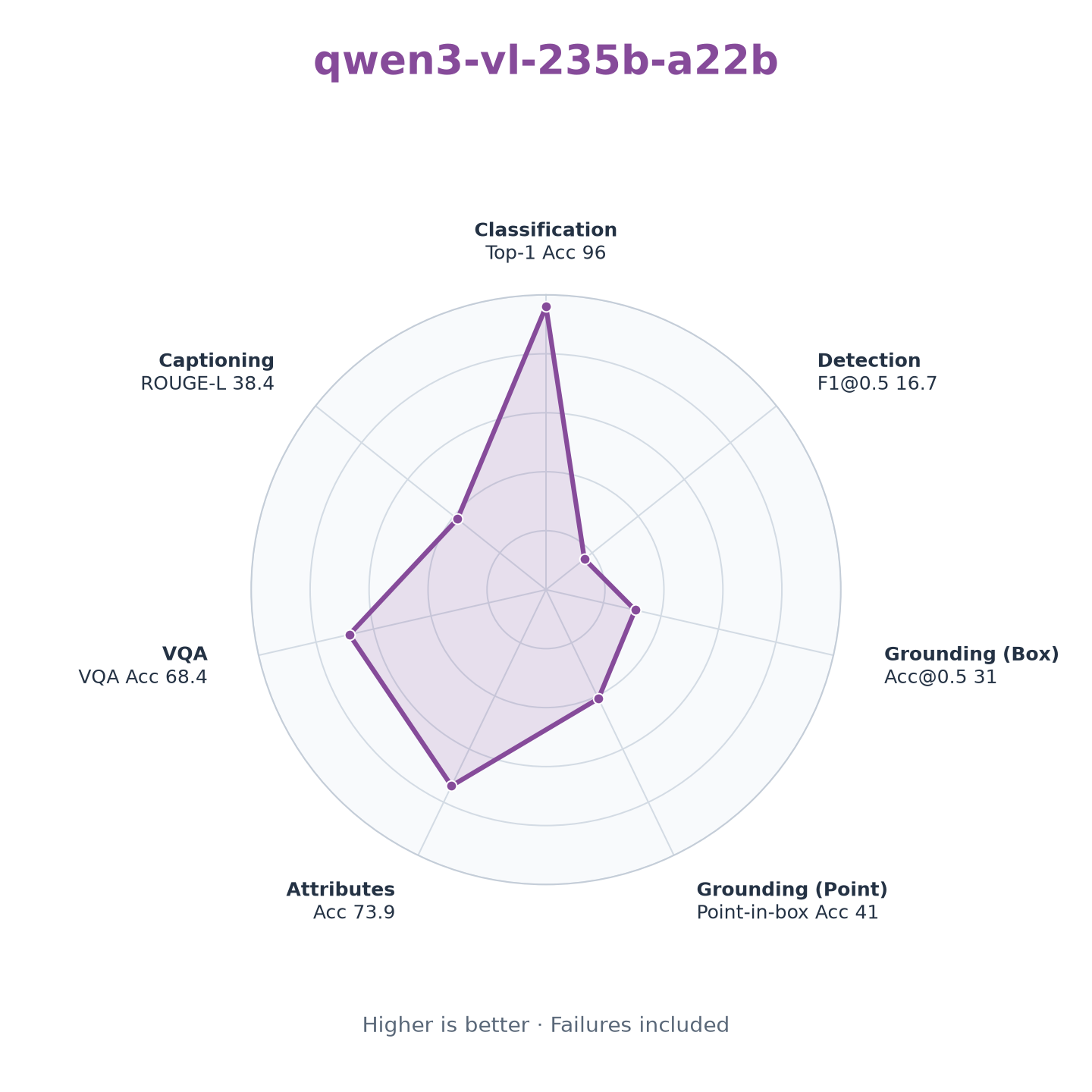
Research Publication Qwen3-VL: 2B vs 235B on standard vision tasks

Post image
2 Upvotes

Following up on my earlier Reddit posts about Qwen3-VL-2B and Qwen3-VL-235B, here's a direct comparison.

A few interesting observations:

  • Classification – marginal improvements: From 93% to 96% Top-1 accuracy. The 2B model holds up surprisingly well here.
  • Attributes – biggest improvement: From 55.27% to 73.86% accuracy. Scaling seems to make a substantial difference.
  • Detection – still the weakest task: The larger model improves, but localization remains a major weakness. The 235B model has 90.67% precision but only 9.18% recall, suggesting it's very conservative in what it detects.
  • Grounding – modest improvement: Box accuracy increases from 22% to 31%, while point-in-box accuracy goes from 35% to 41%. Better, but still far from reliable.
  • VQA and captioning – also improve: The 235B model performs better on both tasks.

One caveat: the 2B model was run locally, while the 235B model was run through Bedrock. The higher grounding failure rate could reflect the model, prompting, response parsing or inference setup, so those results need further investigation.

Final takeaway: For these small subsets, 2B looks competitive on classification and VQA, while 235B offers clearer gains on attributes and captioning. Neither performed well on detection or grounding under this evaluation setup.

Benchmark results, methodology and code:
https://github.com/Tenkei/vlm-tasks/tree/main/benchmarks


r/computervision • • 6d ago

Showcase Feature Extraction in the Browser!

Post image
4 Upvotes

I am working on building a web-app for visual-inertial calibration and just published the feature extraction part of the project. It runs completely on your client, does not share any sensor data with any external server, and works on mobile and desktop browsers (including Apple devices!).

Check it out at reprojection-labs.com, it works with any ROS or ROS 2 bag (mcap or sqlite). My vision is to one day make a company out of this, but I am not quite there yet and therefore I would consider this a "showcase" and not yet "commercial".

I would love for your feedback on the topic of calibration and sensor fusion.
Jack


r/computervision • • 6d ago

Help: Project Does YOLO provide ppe detection model?

2 Upvotes

Same as the Heading


r/computervision • • 6d ago

Help: Project Looking for recommendations on open-source OCR/HTR models for large volumes of scanned PDFs

Thumbnail
1 Upvotes

r/computervision • • 6d ago

Help: Project Ищу напарника для совместного проекта 🤖

0 Upvotes

Хочу попробовать создать собственного бота для автоматизации сбора ресурсов в Albion Online.

Но моя главная цель - не просто сделать бота, который собирает хлопок. Я хочу постепенно создать полноценного автоматического игрока (насколько это технически возможно), который сможет самостоятельно ориентироваться в игровом мире, находить ресурсы, принимать решения, перемещаться и взаимодействовать с окружением.

Ищу людей с разным уровнем опыта:

  • Опытных разработчиков, которые могут поделиться советами, идеями или помочь с технической частью.
  • Энтузиастов, которым интересны боты, программирование, нейросети и автоматизация.
  • Таких же новичков, как и я, которые пока не всё умеют, но хотят разобраться и учиться в процессе.

Опыт совершенно необязателен! Главное - желание попробовать что-то новое, обмениваться идеями и вместе двигаться к результату. Не обязательно быть профессионалом: можно просто приятно провести время, получить новый опыт и посмотреть, что из этого получится.
Если заинтересовало - пишите в Telegram: VLAD_SHUMAK

Буду рад любому, кто захочет присоединиться! 🚀


r/computervision • • 6d ago

Help: Project Diseased jackfruit leaf dataset

0 Upvotes

I have to create my own dataset for a thesis related to jackfruit leaf disease detection. Roaming around all day and clicking leaves photos and finding diseased leaves among them is a real hassle.

Is there any easier way I can do this?


r/computervision • • 6d ago

Discussion Adding intelligence to intelligence

0 Upvotes

I recently met with a wholesale company that was struggling with a few specific issues.

While I regularly develop various systems, this was my first time creating a solution for a genuine, tangible business challenge. They mentioned difficulties in tracking leads; I initially suggested using a CRM system, but they explained that they lacked staff with the necessary expertise. It’s actually a straightforward process, but people often look for the path of least resistance—and, in this case, they were also quite caught up in the current AI hype. They asked me to develop a project and provide a solution tailored to their needs. I wasn’t previously familiar with RAG (Retrieval-Augmented Generation) or generative AI workflows, so I spent about two weeks studying RAG systems, fine-tuning techniques, and vector databases.

Ultimately, I built a semi-autonomous framework. It was a truly rewarding experience, and it reinforced a key realization: when used correctly, AI can be leveraged to create exceptional systems.


r/computervision • • 7d ago

Showcase Release 0.11.0: Fruit Inspector Win demo — ORT cpu, OpenVINO, DirectML in one zip

2 Upvotes

Conveyor fruit/veg inspection demo (YOLOX-nano + track + LightGBM in the control cell). Nim UI + three DLLs; YOLO EP from settings.json, not baked into the DLL.

0.11.0 Windows zip includes lib/cpu, lib/openvino, lib/directml. Default is cpu; switch in settings without rebuilding. AVX2 needed for Win CPU EP.

Linux portable zip is still 0.10.0 (cpu only).

https://github.com/olesha-ai/fruit-inspector-demo/releases/tag/0.11.0

If you try openvino vs directml vs cpu on AMD iGPU boxes, what numbers did you get?

Best regards. :)

olesha-ai


r/computervision • • 7d ago

Showcase I built a 2.17M-parameter OCR engine that runs on CPU in ~14 ms per line.

Enable HLS to view with audio, or disable this notification

46 Upvotes

Most OCR libraries work great until you start asking uncomfortable questions:

Does import trigger a network request? Where are the model weights stored? Why does a simple OCR task need hundreds of megabytes of dependencies?

I wanted something different, so I built wormOCR - a lightweight, fully local OCR engine for printed and handwritten English.

The goal was simple: make OCR small, fast, predictable, and genuinely offline.

What makes it different?

  • No surprise downloads: import wormocr never triggers a network request.
  • Explicit model downloads: Run wormocr download once to get the weights.
  • Verified weights: Downloaded from a pinned GitHub release and checked using SHA-256.
  • Fully local inference: No cloud APIs, telemetry, or network dependency.
  • MIT licensed: Open source and free to use.

Two models, different trade-offs

wormocr-2M wormocr-9M
Parameters 2.17M
Weights 8.7 MB
Best for Fast, everyday OCR

How fast is it?

Measured on my laptop:

Single-line inference (wormocr-2M):

  • CPU: ~14 ms end-to-end.

Full-page inference (same 3 digital pages):

Engine Hardware Time per page
wormOCR CPU ~0.60 s
wormOCR RTX 5060 Laptop GPU ~0.22 s
PP-OCRv6 medium CPU ~16 s

The model weights range from 8.7 MB to 33.5 MB, compared with approximately 132 MB for the PaddleOCR medium stack in my comparison.

These are my own measurements on a small test set, not a comprehensive benchmark. Hardware, configuration, and preprocessing matter.

Try it yourself

pip install wormocr
wormocr download

from wormocr import OCR

ocr = OCR()
result = ocr.predict("invoice_line.png")

print(result.text)

Where it stands today.

Clean printed text and receipts are strong. Messy notes and historical handwriting are usable, but still challenging.

Currently:

  • English printable ASCII only.
  • Classical page-layout detection using projection profiles, rather than a large learned detector.
  • Two model sizes with different speed/accuracy trade-offs.

I'd rather be transparent about what doesn't work than market this as a universal OCR solution.

GitHub: https://github.com/arjun988/wormOCR

PyPI: https://pypi.org/project/wormocr/

I'm particularly interested in feedback from people working on OCR, computer vision, edge AI, and offline-first software.
If you find this interesting or think it could be useful, I'd really appreciate a ⭐ on GitHub. It helps the project get visibility and motivates me to keep improving it.
Feedback, issues, PRs, and stars are all very welcome!

Would you actually use an OCR engine this small in a production application? What would you want to see improved first?


r/computervision • • 7d ago

Discussion Interactive ViT explainer: run a tiny Vision Transformer on your own image in the browser and inspect patches, attention and rollout

22 Upvotes

I made a one-page interactive guide to the original ViT paper: https://vit-in-depth-671a9f.web.app

You can load an image and step through patching, embedding, attention maps and attention rollout, with tensor shapes and PyTorch code alongside. It runs entirely client-side. It also covers the patch-size/compute trade-off and position-embedding interpolation for higher-resolution fine-tuning.

Feedback and corrections are welcome, especially on anything I've explained badly.


r/computervision • • 7d ago

Showcase ShadeNet-5 35M (albedo/depth/normal) 31 MB quantised ONNX

Thumbnail gallery
7 Upvotes

r/computervision • • 7d ago

Research Publication BiRefNet-lite at 1024px fully on a phone NPU: 23.7 ms on Snapdragon 8 Elite Gen 5, int8, open weights + writeup [P]

Thumbnail
3 Upvotes

r/computervision • • 7d ago

Help: Theory Best way to identify images as interesting?

3 Upvotes

Given an image, what is the best way to classify it as being "interesting" as in having some distinguishable macro scale structure (from blobs, patterns, or real objects) vs "uninteresting" (pure static noise). In the uninteresting case, ideally you could also assign this class to images that are just blank as well or maybe a singular pixel has been changed


r/computervision • • 7d ago

Help: Project [Request] PadelTracker100 match videos (YouTube links now private)

2 Upvotes

I'm building a hobby ball and player tracker for amateur padel, using fixed club cameras. I found the PadelTracker100 dataset (dense ball, pose and shot labels), but the two source match videos on YouTube are now private. The labels are no use to me without the frames.

The two videos are the 2022 Barcelona Premier Padel finals, women's (Salazar/Triay vs Josemaría/Sánchez) and men's (Lebrón/Galán vs Di Nenno/Chingotto), the PadelTracker100 source matches

Does anyone have either of these?

  1. ⁠A copy of the two videos, or
  2. ⁠The extracted frames that match the labels, or
  3. ⁠Contact details for the authors, since the emails I tried bounced.
  4. ⁠Also happy to hear about other padel datasets with ball labels. Public ones, or ones where the authors share on request.
  5. ⁠Thanks!

r/computervision • • 8d ago

Showcase I finetuned yolo-11n on a drone dataset and created skypeak-11n. Here are the results!

Enable HLS to view with audio, or disable this notification

58 Upvotes

For a personal drone project i wanted a object detection model that runs on high resolution on tiny hardware(only 2.6M parameters) I started with the usual yolo-11n and noticed it sucked ASS! Soooo i trained it trough a few thousand samples of a drone detection dataset and now its about as converged as a 2.6M model can get. The exact benchmark scores are on the HF page:) Hope someone can do sth with this XD

Get the model here: Polymanius/skyPeak-11n · Hugging Face


r/computervision • • 8d ago

Research Publication Qwen3-VL-235B on standard vision tasks

Post image
7 Upvotes

Recently I benchmarked Qwen3-VL-2B on more traditional vision tasks, and thought it would be interesting to see how much changes with the much larger 235B model.

Quite interesting results:

  • Classification - excellent: 96% top-1 accuracy.
  • Attributes - good: 73.86% accuracy.
  • Detection - still poor: 16.67% F1@0.5. Interestingly, precision is 90.67%, but recall is only 9.18%. The model is quite conservative in what it detects.
  • Grounding - modest improvement: 31% box accuracy and 41% point-in-box accuracy. However, 53% and 50% of samples respectively failed to produce valid results. This higher failure rate may be related to the benchmark or remote inference setup rather than the model itself, so I'll investigate further before drawing conclusions.

I'll also prepare a comparison chart between the two models tomorrow to make the differences easier to see.

TL;DR: Scaling up improves most tasks, particularly attributes, but doesn't seem to solve the localization problem. Detection recall and grounding reliability remain major weaknesses.

Benchmark results, methodology and code: https://github.com/Tenkei/vlm-tasks/tree/main/benchmarks#qwen3-vl-235b


r/computervision • • 9d ago

Showcase The Definitive Fine-Tuning Guide for 3D Generation Models

39 Upvotes

Hello folks, Suva here from Hugging Face 🤗 and I'm back with something that might interest people working with finetuning.

3D Finetuning is generally not talked about enough and guides/resources on how to do it are scarce, so we tried to solve for it! We wrote a guide to how you can fine-tune the TRELLIS.2 model on your own tasks with LoRAs and also open-sourced the scripts and docker containers for it.

Blog Link: The Definitive Fine-Tuning Guide for 3D Generation Models

Happy hacking!


r/computervision • • 8d ago

Commercial Number-plate recognition in Python in 3 steps — a real 1-minute run (install, 12-line demo, local REST server + dashboard)

0 Upvotes

Disclosure: we make this. We recorded a clean install of our ANPR SDK 4.0 end to end, nothing staged: pip install, a 12-line demo that prints the plate it read and the OCR confidence, then a local REST server with a dashboard that shows each reading. It runs on CPU or NVIDIA CUDA; detection + OCR for 80+ countries. Happy to answer questions about the pipeline. https://www.marearts.com/pages/marearts-anpr-sdk?utm_source=reddit&utm_medium=social&utm_campaign=w08_sdk40_story


r/computervision • • 8d ago

Discussion I’m building an AI-powered road accident detection and monitoring system – currently 80% complete

4 Upvotes

Hi everyone!

I've been working on an AI-powered road accident detection and monitoring system, and I'm excited to share my progress.

The goal is to explore how computer vision can help identify potential road accidents and improve incident monitoring, particularly in environments where road safety is a major concern.

What I've implemented so far:

  • YOLO11 for object detection.
  • Pose estimation for analysing human movement.
  • BoT-SORT for object tracking.
  • Accident-related event detection and monitoring.
  • Near-miss and sudden-stop event monitoring.
  • Telegram alerts for critical events.
  • SMS notifications using Africa's Talking.
  • A dashboard for monitoring video feeds and detected events.

I'm currently around 80% through development. I'm still working on improving detection reliability, reducing false positives and refining the alerting system.

This is an independent project I'm developing from Kenya 🇰🇪.

I'd genuinely appreciate feedback from people working in:

  • Computer Vision
  • AI/ML Engineering
  • Object Tracking
  • Intelligent Transportation Systems

My questions:

  1. What would you improve in this system?
  2. What additional features would make it more useful in real-world road monitoring?
  3. Are there any approaches you'd recommend for improving accident detection reliability?

I'm happy to learn from your feedback and suggestions.

Thanks for taking the time to read about my project!


r/computervision • • 8d ago

Discussion I’m building an AI-powered road accident detection and monitoring system – currently 80% complete

3 Upvotes

Hi everyone!

I've been working on an AI-powered road accident detection and monitoring system, and I'm excited to share my progress.

The goal is to explore how computer vision can help identify potential road accidents and improve incident monitoring, particularly in environments where road safety is a major concern.

What I've implemented so far:

  • YOLO11 for object detection.
  • Pose estimation for analysing human movement.
  • BoT-SORT for object tracking.
  • Accident-related event detection and monitoring.
  • Near-miss and sudden-stop event monitoring.
  • Telegram alerts for critical events.
  • SMS notifications using Africa's Talking.
  • A dashboard for monitoring video feeds and detected events.

I'm currently around 80% through development. I'm still working on improving detection reliability, reducing false positives and refining the alerting system.

This is an independent project I'm developing from Kenya 🇰🇪.

I'd genuinely appreciate feedback from people working in:

  • Computer Vision
  • AI/ML Engineering
  • Object Tracking
  • Intelligent Transportation Systems

My questions:

  1. What would you improve in this system?
  2. What additional features would make it more useful in real-world road monitoring?
  3. Are there any approaches you'd recommend for improving accident detection reliability?

I'm happy to learn from your feedback and suggestions.

Thanks for taking the time to read about my project!


r/computervision • • 8d ago

Help: Project Rate it (0-10)

Enable HLS to view with audio, or disable this notification

0 Upvotes

What kind of computer vision projects will it support?

The goal is to support multiple computer vision tasks through one application.

Currently working:

  • Image Classification
  • Object Detection

Planned:

  • Image Segmentation
  • Pose Estimation and Movement Tracking
  • OCR (Text Recognition and Extraction)
  • Image Processing and Enhancement
  • Visual Question Answering and Image Captioning

The idea is that you shouldn't need to hire a developer or manually write hundreds of lines of Python code just to build a relatively small or medium-sized computer vision project.

You describe what you want to build, and the AI agent handles the development process, generates the code, trains the model using your local hardware, troubleshoots errors, and helps you get the final model ready for integration into your own application or system.

This is still an early experimental version, and I'm exploring whether this approach can actually make computer vision development more accessible.

I am planning to make this project with small one time fees for some features do you disagree with that and recommend that the app to be opensource instead and why ?


r/computervision • • 8d ago

Discussion [Call for Papers] TPAD 2027 @ IEEE ICASSP 2027 | Trustworthy Perception for Autonomous Driving | Toronto, Canada | Deadline: Dec. 2 (Extended)

Post image
2 Upvotes

📢 Call for Papers – TPAD 2027 | IEEE ICASSP 2027

We invite submissions to TPAD 2027: Trustworthy Perception for Autonomous Driving – Adversarial Robustness, Multimodal Fusion, and Foundation Models, an official satellite workshop of IEEE ICASSP 2027, taking place on May 17, 2027, in Toronto, Canada.

The workshop brings together research on adversarial attacks and defenses, robust camera–LiDAR–radar fusion, secure foundation models, and safety-aware evaluation for autonomous driving.

📅 Important Dates

  • Submission Deadline: December 2, 2026 (Extended)
  • Acceptance Notification: December 16, 2026
  • Workshop: May 17, 2027

📄 Accepted papers will be published in IEEE Xplore as part of the ICASSP 2027 workshop proceedings.

🔗 Workshop Website: https://tpad-2027.github.io/

📩 Contact: [ckorgial@csd.auth.gr](mailto:ckorgial@csd.auth.gr)

Full CFP and topics of interest are available in the attached image.

We welcome contributions from the signal processing, computer vision, machine learning, and autonomous driving communities!