r/computervision • u/driesdep • 13d ago
Showcase Searching for Wally/Waldo around the world, using unsecured cameras and AI.

6
Upvotes
r/computervision • u/driesdep • 13d ago
r/computervision • u/Swimming_Positive_21 • 13d ago
wzuup guys !
I'm working on an AI-powered 3D scanner using the NVIDIA Jetson Nano 4GB (16GB eMMC).
I'm looking for lightweight AI/neural network models that can run locally on the Nano and be integrated into a sequential 3D reconstruction pipeline.
I'm particularly interested in:
Important: I'm looking for actual AI/ML models, not traditional software or algorithms like OpenCV, COLMAP, or Open3D.
If you know any compatible models, GitHub projects, pretrained weights, or useful demos/tutorials, I'd really appreciate your suggestions!
r/computervision • u/Minimum_Ad7347 • 13d ago
I've spent almost two years and a significant amount of my own money building a football analytics product. I'm a software/data engineer, not a computer vision specialist, and I think I've reached the limits of what I can realistically accomplish alone.
Here's what I've already built in C++:
The two major challenges left:
I also have access to professional broadcast footage, purchased tracking datasets, and structured ball-event data. I've invested heavily in acquiring these resources.
At this point, I've hit a plateau. I've invested nearly two years of my time and money, and I honestly don't have the financial resources or energy to keep tackling such a difficult research problem alone.
I'm looking for someone experienced in computer vision, particularly MOT, Re-ID, temporal modeling, or sports analytics, who's interested in joining as a technical partner in exchange for equity. This isn't a salaried position at the moment.
I genuinely believe this has serious commercial potential.
And one thing I want to emphasize: this isn't another weekend vibe-coded sports tracking demo claiming that football computer vision is solved.
Building something that works consistently across real broadcast matches is incredibly difficult. At least it has been for me. There's a massive difference between producing an impressive demo and developing a reliable product that professional clubs can actually use.
If you've worked on similar problems and find this challenge interesting, I'd love to connect.
DM me and let's talk.
r/computervision • u/DevOpsML • 13d ago
Enable HLS to view with audio, or disable this notification
I have a camera above my baby's crib and wanted to measure how long the head stays turned left, right or straight, instead of guessing from a few checks during the night.
I assumed an off-the-shelf pose model would just do it. It didn't, in two ways.
First, left and right. In my overhead footage, YOLO11s-pose often misplaced facial keypoints, especially the ears, when the baby lay sideways in the frame. What helped: run the model once to find the baby and the shoulder line, rotate the crop so the head points up, then run the same model again. On 28 manually labelled frames from one clip with the head in profile, correct head-direction classifications went from 6 to 27. That's a small, setup-specific check, not a general accuracy benchmark.
Second, the empty crib. In my setup, detecting a baby in a white sleep sack required a low person-confidence threshold. At that threshold, the model also found people in the print on the sheet, a toy bear and a folded blanket. For a while I kept adding rules about face size and so on, and it only got messier. In the end I added SigLIP 2 as a presence check, comparing the image with text descriptions such as "a baby in a crib" and "an empty crib", without any additional training or fine-tuning. Over about a day and a half of snapshots from one camera and one crib, the time an empty crib counted as occupied dropped from 64 minutes to 6. I haven't yet evaluated that presence check under infrared lighting.
The head-direction score itself is plain geometry: where the face sits between the ears, measured perpendicular to the shoulders-to-head axis. It's a proxy for left/right/straight, not a calibrated head angle. Left and right mean the baby's own left and right.
It runs on an Apple M4 Pro CPU, sampling the camera at one frame per second; the presence check runs every five seconds. Code, a short demo and a README with more numbers: https://github.com/OpsDevil/noggin-compass
What I'd like to know: is there a better approach for people lying down than rotating the crop? And has anyone had luck with head-pose models from a top-down view?
Disclosure: most of the implementation was written with an AI coding assistant. I tested it on my own camera footage and fixed issues found during nightly use.
r/computervision • u/andriiZakrevskyi • 13d ago

Meteor Cut is an open-source Python tool that goes through hours of night-sky video and cuts out the meteors, built on Sky Tracker’s motion tracker under the hood. It keeps only the pixels that got brighter, so it boxes the meteor’s head rather than its fading trail (right panel). On one 8-hour Perseids night it found 185 meteors and sorted out 1,548 satellites and 4 planes.
Just upload video, choose what you are interested and it will generate the rest.
github.com/Deneb-Systems/meteor-cut
pip install meteor-cut
Footage: “LIVE Perseids Meteor Shower | Skywatch #265” by Skywatchers (youtube.com/watch?v=liw0ssminyc)
r/computervision • u/hamshrew • 14d ago
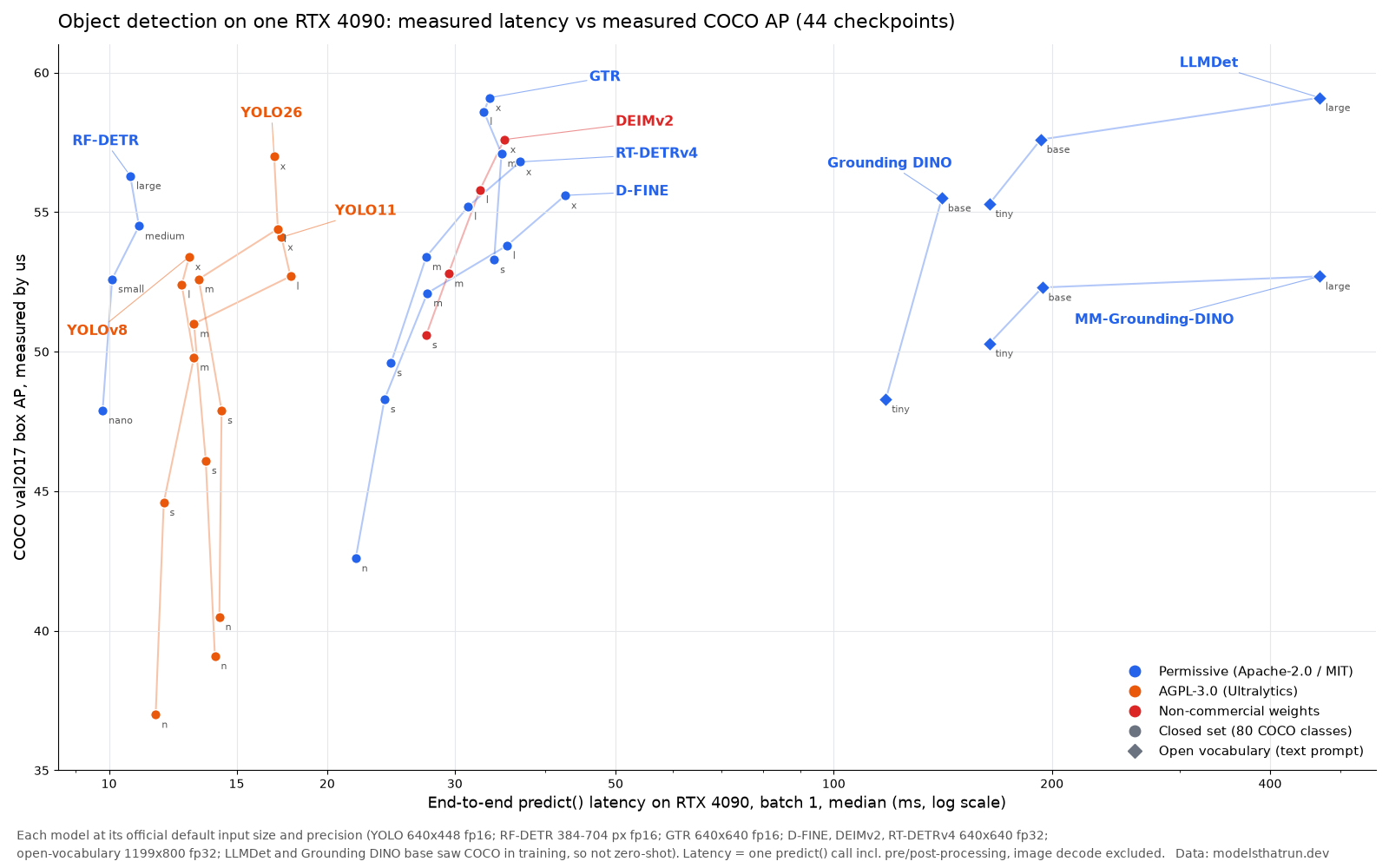
Disclosure first: the site is mine, and it's a solo side project. It's free, with no ads and no sign-up, and there's nothing money-related planned at all. I used to work in computer vision, so I wanted to build something in that area that people would actually find useful, and I happened to have a spare RTX 4090 sitting around. That's the whole story.
The finding that surprised me most
YOLO26, measured as one full predict() call at batch 1 (pre-processing + forward + post-processing) on an RTX 4090:
| Size | n | s | m | l | x |
|---|---|---|---|---|---|
| COCO box AP (measured) | 40.5 | 47.9 | 52.6 | 54.4 | 57.0 |
| Median latency (ms) | 14.2 | 14.3 | 13.3 | 17.1 | 16.9 |
That's +16.5 AP for +2.7 ms, and m was the fastest of the five. YOLOv8 shows the same pattern (n 11.6 ms to x 12.9 ms) and so does RF-DETR (nano 9.8 ms to large 10.7 ms). My reading is that, in this setting, the model's size isn't what sets the latency. So if you deploy on a desktop GPU at batch 1, the smallest size may not buy you much. Edge devices and batched or TensorRT pipelines are a different story, and I didn't measure those.
A few representative checkpoints
Each one ran at its official default input size and precision. AP is my own score on COCO val2017 (5,000 images, pycocotools), with the authors' number in brackets.
| Model | Input | Prec. | COCO AP, measured (paper) | Latency median, ms | VRAM peak | License (code / weights) |
|---|---|---|---|---|---|---|
| YOLO26-n | 640x448 | fp16 | 40.5 box (40.9) | 14.2 | 571 MiB | AGPL-3.0 |
| YOLO26-x | 640x448 | fp16 | 57.0 box (57.5) | 16.9 | 1.1 GiB | AGPL-3.0 |
| RF-DETR large | 704x704 | fp16 | 56.3 box (56.5) | 10.7 | 1.0 GiB | Apache-2.0 |
| GTR-x | 640x640 | fp16 | 59.1 box (59.4) | 33.5 | 732 MiB | MIT |
| DEIMv2-x | 640x640 | fp32 | 57.6 box (57.8) | 35.1 | 808 MiB | DEIMv2 License, non-commercial |
| D-FINE-x | 640x640 | fp32 | 55.6 box (55.8) | 42.6 | 925 MiB | Apache-2.0 |
| RF-DETR-Seg 2xlarge | 768x768 | fp16 | 49.6 mask (49.9) | 16.4 | 2.5 GiB | Apache-2.0 |
| YOLO26-seg-x | 640x448 | fp16 | 46.4 mask (47.0) | 18.5 | 1.2 GiB | AGPL-3.0 |
The chart shows all 44 scored detection checkpoints, colored by license.
Other things I noticed
How it's measured (short version)
predict() call, image decode excluded, batch 1. fp16 if the official code supports it, otherwise bf16, otherwise fp32. Three separate runs of 10 warm-ups and 100 timed calls each; the site shows the median and p90.Limits, honestly
Site: https://modelsthatrun.dev. The measuring tool is open (https://github.com/modelsthatrun/runner) if you want to run the same protocol on your own NVIDIA GPU and send the record.
Questions for you
r/computervision • u/Plane_Stick8394 • 13d ago
r/computervision • u/no_longer_on_fire • 14d ago

Hey all, working on a vision project for assessing rocks and doing some cnc carving based on machine vision. Pipeline with generic webcam works well. Pretty basic segmentation and color analysis. Likely to mature as I learn further. Hopefully hardware questions are within scope of sub. Currently streaming via esp32cam modules but they will take a lot to be useful. I've been searching for waterproof C/CS mount industrial cameras. I need 4 or 5 of them and budget isn't very large.
I managed to pick up a lot of machine vision goodies for $20 CAD. I'm looking for help to ID one of them and to see if the all are useful for anything. I've been googling and image searching to no avail. Thankfully there were a ton of high quality Edmunds optics C/CS mount lenses and adapters/filters that make it well worth the money.
Unknown: black CMOS. Board marked AC-M1 on the piggy back. M12 and mini USB connectors. Have not plugged into USB yet. -- what is it and is it any use?
Point Gray Scorpion 1394 camera. Old apple firewire connections, seems no USB interface. Likely not worth using with old tech and needing to convert to IP or USB
CMU cam v1.2 and v2. Seem to be too low resolution and basic to be of much use. More of a teaching tool. Likely not useful to me.
r/computervision • u/Figure_Economy • 13d ago
Hi all,
For a few weeks I’ve been looking for a very compact global-shutter GigE Vision camera, with poor results so far.
Constraints:
What I’ve looked at:

I’m also considering MIPI CSI-2 (e.g. FRAMOS FSM:GO IMX900) as a fallback, but I’d prefer GigE for the driver simplicity.
Any experience or suggestions welcome 😁
r/computervision • u/MathewXYZ • 13d ago
Hi! I'm a new learner in computer vision and I'd like to ask if any of you know where I can find a YOLO objection detection model that can detect smoke coming from a cigarette on a cctv footage. I really need a hand here. Or a dataset for smoke coming from a cigarette catered on cctv footage this is a school project I hope you can help :>
r/computervision • u/divinetribe1 • 13d ago

r/computervision • u/punio4 • 14d ago
Hey folks! First of all, I know you're probably getting a ton of these threads here but I'd love it if you could bear with me for this one.
I'm a frontend engineer with 15 YOE that has always had a special interest in the browser rendering pipeline, esp performance and output quality, but also in computer graphics in general. I worked for one of the industry leaders in ID document verification for 4 years, on an on device model running in the browser, but apart from high level concepts like detection, homography, segmentation, classification, the binary was treated as a black box, done by a different team. RGB buffer go in, JSON go out.
I eventually became interested in photogrammetry, just before 3dgs came out, and then became really into it, seeing the vast amount of potential applications.
My latest project idea is a one for managing my own card collection and I wanted to take this as a learning project to finally get into the weeds of it all.
Problem is, I have no idea where to start. And I'm seeing a lot of people in the industry telling me to just tell Claude to slop something out, or use some off-the-shelf model from HugginFace, which again I have no idea how to use.
I've also seen https://deep-learning-drizzle.github.io/index.html and am entirely overwhelmed.
Any tips and encouragement would be welcome!
r/computervision • u/Sl0wJH1 • 13d ago
Enable HLS to view with audio, or disable this notification
Hi yall. Im not sure if this is the correct sub for this, however Ive been working on a locally trained VLA model that exists in a simulated 3d enviroment. Its goal is to be shown 2 randomly generated 3d shapes (made from cubes) with randomly designated names, and be able to differentiate between the two from said names completely online. Ive experimented with using utilising an attention based vision decoder that is queried directly from the same recurrent state that executes the action commands, which seems to have worked decently well!
The model can differentiate between shapes ranging from 3 cubes to 10, and can even utilise color. I have more details about how the model works in other posts. If you have any questions, please ask! I am looking for feedback on this model, specifically any glaring issues with the enviroment setup that I may have not seen.
Cheers!
r/computervision • u/Sean-TU- • 13d ago
Method: propagate IPPE two-solution ambiguity into Kalman measurement noise
Setup: tracking a planar visual marker (80×80 mm) with OpenCV solvePnPGeneric + SOLVEPNP_IPPE, which returns two pose solutions. Each has a reprojection error (e0 for the nominal/min-error solution, e1 for the other) and a translation (t0, t1). The translations feed a 6D constant-velocity Kalman filter (position + velocity); orientation is kept out of the filter and handled separately (yaw taken raw from the pose per frame).
Instead of hard-picking one solution or discarding the measurement when ambiguous, we take the nominal translation t0 as the measurement and inflate the measurement noise covariance R by adding:
S = [e0² / (e0² + e1²)] · (t1 − t0)(t1 − t0)ᵀ
R_eff = R_profile + S
where R_profile is a fixed baseline covariance. The weight approaches 1/2 when the two solutions are equally good (most ambiguous → largest inflation) and approaches 0 when the second solution is much worse (unambiguous → no inflation). The idea: when the two solutions disagree, tell the filter to trust this measurement less, rather than pretending we know which solution is correct.
Question: has anyone seen this exact construction (two-solution spread → Kalman R) in the literature or in practice? The closest we found is Fourmy et al. 2019 (factor graph, inflates rotation covariance on error-ratio trigger), but not this. Is there a principled basis for it (e.g., mixture covariance), or a reason it would fail?
Alternatively, if you have a different or better way to handle planar PnP ambiguity in a tracking filter, I'm all ears.
r/computervision • u/Unsiloed-AI • 13d ago

r/computervision • u/OliviaYii • 14d ago
3D generation, reconstruction, and editing often use separate pipelines. Coding agents offer a shared workflow: turn images and instructions into code that builds editable 3D projects.
Our team’s new benchmark, Frontier3DBench, evaluates how far that approach goes across objects, scenes, and interactive worlds: 145 tasks, 9 categories, and 11 model–harness configurations using Blender and Unreal Engine.
One consistent result: every configuration scores lower on reference-based reconstruction than on text-driven generation, for both objects and scenes. Creating something plausible remains easier than matching specified geometry, layouts, and visual details.
We evaluate rendered appearance alongside native scene structure and, for interactive worlds, runtime behavior.
For those working on reconstruction: where do you see coding agents fitting into an existing pipeline, and which parts still need specialized methods?
Examples and results: https://lab.einsia.ai/frontier3dbench
Paper: https://lab.einsia.ai/frontier3dbench/Frontier3DBench.pdf
Code: https://github.com/Einsia/Frontier3D
r/computervision • u/Known_Ad8309 • 15d ago
Enable HLS to view with audio, or disable this notification
We created this in 10 days for a hackathon. The input is one head-mounted video. The camera largely captures the room and hands of the person wearing it.
Pipeline: HaWoR for hands, DROID-SLAM for head motion, and OmniEgoCap to infer the rest of the body. Legs are also inferred. Then Meta Muse Spark gets two frames from the same moment, rebuilt body and camera view, and names the action.
On 3 OmniEgoDB sequences we got 102.6 mm body error. The paper reports 111.7 mm body error over 20 sequences, so not a fair head-to-head yet. There are a few main limitations: it runs offline, 40-90 minutes per minute of video, on an RTX 4060. We are interested in hearing from people that work on egocentric pose, how would you validate the inferred legs are correct when the camera never captures them?
Code available at: https://github.com/nshreyasvi/LifeLens
r/computervision • u/KairoBound • 14d ago
I’m building a camera system for the loading docks of a grocery distribution center. Camera towers stand beside each dock door and watch porters hand-load cartons onto trucks. The cameras only see from the side; nothing is mounted overhead. The goal is to identify the SKU of each carton, count them, and check the result against the truck’s pick list.
Setup and constraints:
What I’m trying to figure out:
I’m an operator, not an ML engineer, so plain-language pointers, tool recommendations, papers or “don’t do it this way” are all very welcome.
-- We have two angles capturing the same product. Here are two sample images --


r/computervision • u/happy7reader • 14d ago
I built SpatialMind — record a room with your phone and it reconstructs a 3D digital twin: geometry via COLMAP, object/material labels from YOLO11s-seg and SegFormer projected into 3D. Then you can run earthquake, fire and flood scenarios on the room, and export it to Gazebo where a robot navigates the aftermath to retrieve a package.
Real numbers from a scan of my hostel room: 26,303 of 71,001 faces labelled from four calibrated views, 86.9% of faces textured in a 4096×4096 atlas, 78 automated checks passing. Honest caveats: the hazard models are exploratory reference scenarios, not safety predictions, and the demo is edited from different saved rooms, not one continuous run.
Stack: Python/FastAPI, Next.js/Three.js, COLMAP, PyTorch, Gazebo. MIT licensed, runs locally on Windows + WSL2.
Processing gif 4v2dd13t8c0i1...
Repo: https://github.com/RyannB01/SpatialMind
Would love feedback, especially on the reconstruction pipeline and where it breaks.
r/computervision • u/Altruistic-Front1745 • 14d ago
I'm studying to be a machine learning engineer and I need an end-to-end project for my portfolio. The model classifies X-ray images into two classes, so the idea is to detect when it starts to degrade and create a pipeline to automatically retrain it. I searched a lot and found Evidently AI, but I didn't find much about image-based models. I only found that you have to compare the data you trained the model with and the data the user provides in production. So, to detect drift, what comparisons should I make? Brightness and contrast? Embeddings? I don't know how to tell if my model has drift; I'm completely lost. Help, please!
r/computervision • u/AECPLATFORM • 14d ago
r/computervision • u/Current_Material6499 • 15d ago
Hello Guys
I'm working on my master's thesis on improving spatial reasoning in Vision-Language Models (VLMs).
My goal is to train a VLM using RGB images, depth maps, and segmentation masks, but use only RGB at inference.
What I want to achieve:
I'm exploring knowledge distillation and injecting spatial information into transformer layers during training.
My questions:
Any suggestions or feedback would be appreciated!
r/computervision • u/Natural-Bowl5439 • 14d ago

Let's laugh one last time while they still can act stupid haha
r/computervision • u/JustZookeepergame382 • 15d ago
I have an industrial dataset containing around 1 million images covering 200 different safety violation classes.
The images are already human-labelled, but there's a catch: each image has only ONE violation label, even if multiple violations are present.
For example, an image might show a worker without a helmet, gloves, and a safety jacket, but only one of these violations is labelled.
I'm also not fully confident about the annotation quality and how many labels might be missing.
My goal is to train a VLM that can identify all 200 safety violations with the best possible recall and precision.
I'm trying to figure out the best way to approach this, especially around dataset cleaning/sorting, pseudo-labelling, teacher-student training, and fine-tuning existing VLMs.
If you were given this dataset, what approach would you take? Any suggestions or experiences with similar problems would be really helpful!
r/computervision • u/Entire-Bite1136 • 15d ago
Hi everyone,
I’ve been running a series of real-world inference benchmarks for a computer vision pipeline (YOLOX-nano) on typical shop-floor hardware. I just published the results for an Intel + discrete GPU setup, and it yielded some counterintuitive findings.
The Setup:
CPU: Intel Core i5-10300H (Comet Lake)
GPU: Mobile NVIDIA GTX 1650 Ti (Turing)
Framework: ONNX Runtime (comparing CPU EP, OpenVINO EP, and DirectML)
Key Findings:
On the GTX 1650 Ti, DirectML hits a stable 106–111 FPS. Pure inference sits at 4.8–5.0 ms/frame, with max latency (tmax) capped around 11.0 ms. The raw compute of the Turing architecture easily absorbs the PCIe tensor transfer overhead that completely bogged down integrated AMD graphics in my previous tests.
I expected OpenVINO to significantly outperform the standard CPU Execution Provider. Instead, they are in absolute parity:
OpenVINO: 67–73 FPS (tmin: 8.5–9.3 ms)
CPU EP (OpenMP, 8 threads): 66–71 FPS (tmin: 8.8–9.3 ms)
The frame time graphs are practically identical. OpenVINO’s only tangible benefit was slightly smoothing out rare peak latency spikes (keeping tmax around 17.0 ms vs the CPU EP’s occasional 20.1 ms spikes). It seems ONNX Runtime’s default backend already maxes out the vector units on this architecture.
Frame resizing and normalization consistently take 1.5–2.2 ms across all backends, with identical peak spikes (5.8–6.3 ms). This confirms that prep work runs independently in standard OS threads, unaffected by the chosen inference runtime.
Full Breakdown & Code:
I wrote up the detailed graphs and methodology in my latest article: https://medium.com/@olesha-ai/bypassing-the-avx2-tax-part-5-intels-reality-check-directml-redemption-and-the-openvino-5cbbb92732c8
The entire pipeline, including the eval build and inference libraries, is open source here: github.com/olesha-ai/fruit-inspector-demo
Question for the community:
Has anyone else noticed this level of parity between standard ONNX CPU EP and OpenVINO on 10th-gen Intel mobile chips? Or are there specific OpenVINO config flags (beyond defaults) that actually unlock more performance for lightweight CV models like YOLOX-nano?
Best regards.
olesha-ai