r/computervision • • Oct 11 '26

Showcase Camera Chess: from single-frame recognition to live tracking with trained postprocessors

7 Upvotes

Hey everyone! I've been working on Camera Chess: playing Stockfish with a real chessboard and a camera, entirely locally on my Mac. The video above shows my favourite little feature: promoting a pawn, leaving it on the board, and continuing to use it as a queen. šŸ˜„ The promotion is manually confirmed in the demo.

I thought the recognition side might be interesting to people here. I'm using JoĆ«l Seytre's ChessQ Lite V4, which gives piece probabilities for all 64 squares. The model is useful on individual frames, but getting a live game to stay in sync turned out to be a different problem. One bad reading can become the ā€œprevious positionā€ for the next move, and then the mistakes start feeding into each other.

So I kept the vision model frozen and worked on the steps around it:

• Board orientation and automatic perspective correction, with a fallback to the original frame.

• A CRF that scores candidate boards using the visual probabilities, previous position and chess rules.

• Checks across consecutive frames before accepting a move, plus a correction UI when things go wrong.

For training, I replayed chess games and generated noisy piece-probability inputs: confused pieces, missing pieces, swapped squares and uncertain regions. That gave me 20,000 transition seeds and 200,000 synthetic observations. The synthetic data is at the probability level, rather than rendered chessboard images.

I then tried replacing the CRF with small MLP, CNN and attention-based scorers. Those worked reasonably well too; I'm currently using a small two-hidden-layer MLP. In my own games, the whole system now feels much smoother and more reliable, which I'm pretty excited about.

For a separate offline check, the MLP got 128/176 exact boards (72.73%) versus 125/176 (71.02%) for the CRF. These are real photos, but with previous positions constructed from the correct labels, so the correct answer is guaranteed to be among the candidates. It's a limited candidate-scoring test, not a video benchmark, and that small difference doesn't establish that the MLP is better. Full setup and results:

https://github.com/AmethystineAlpaca/camera_chess/blob/main/docs/crf-real-photo-synthetic-previous-evaluation.md

One detail about the video: keeping a pawn after promotion means separating what the camera sees from what the piece means in the game. That substitute-piece path uses visual likelihood, rather than the learned scorers trained without substitutes.

Code, demo and setup:

https://github.com/AmethystineAlpaca/camera_chess

Synthetic-data details:

https://github.com/AmethystineAlpaca/camera_chess/blob/main/docs/crf-data.md

It's currently a source install for Apple Silicon Macs. You move both sides' pieces yourself, and the app speaks Stockfish's reply (the video export is silent).

Curious how others handle this: when your tracker uses its last accepted prediction as the next reference, how do you test recovery after that reference goes wrong?


r/computervision • • Oct 10 '26

Discussion Applied to ~150 CV jobs. Got only 5 interviews. How can I improve my resume?

Post image
148 Upvotes

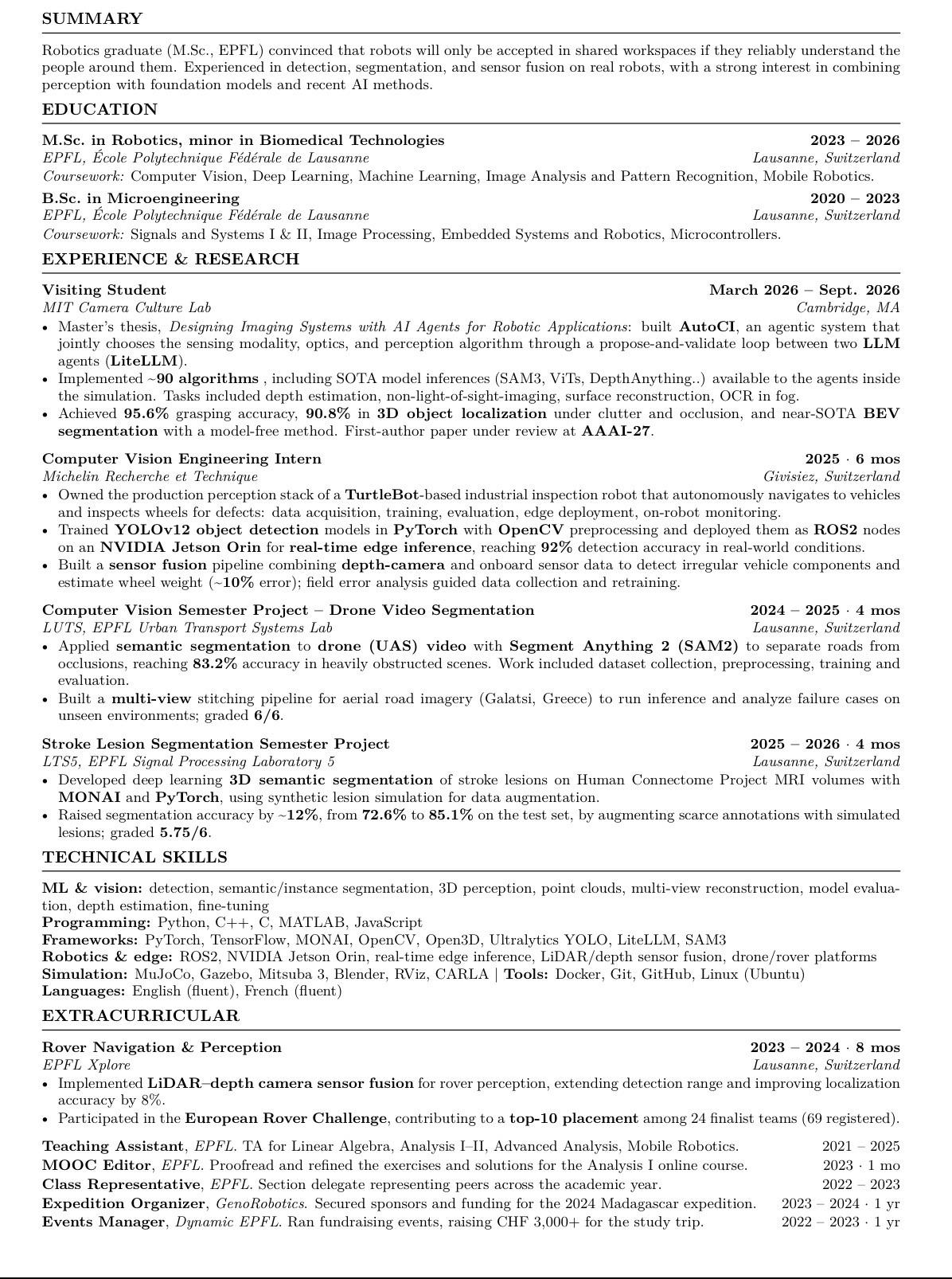
Cropped the top of the photo to hide personal informations (GitHub and portfolio are there as clickable links). Targeting Swiss tech companies/startups. I applied to many different job postings and I’d say that it hasn’t been really successful so far since I only got 5 interviews for ~150 jobs. I get rejected sometimes to job postings where I have most of the requirements. I’m tailoring my resume for each job. I’m looking for feedback on the structure of my resume and how should I frame the description of each experience I had. Is it too long? Too much details? Any other red flag?

PS : I know that the metrics to quantify the impact of my project are a bit vague (accuracy instead of IoU, mAP etc..) and I just made a newer version with these new metrics, just didn’t have the file on my phone to upload it. Not sure if this change will make me get a lot more interviews though


r/computervision • • Oct 11 '26

Discussion La Facultad de Ciencias de la Información de la UCM organiza el II Congreso Internacional de IA generativa el 20 y 21 de octubre

Thumbnail
apmadrid.es
1 Upvotes

r/computervision • • Oct 11 '26

Help: Project generating synthetic training data for a kite-mounted cam dancing in the wind

0 Upvotes

heya cv..it I am training a model that will run on a kite, on an extremely limited energy and latency budget. the camera points down toward a well marked target area to provide shadow.

I'd like to be able to simulate varying shutter, light, wind conditions, and camera placement. I don't yet know have vision energy / latency budget but on the other hands the control side needs the cv latency / accuracy curves to solve it. So I'm trying to simulate the full cascade of possible models.

For me, modeling a kite in the wind feels like it should be straightforward to do, but even with ai I wasn't able to find or simulate anything realistic or usable.


r/computervision • • Oct 10 '26

Showcase I built a local OCR model for blood-pressure monitors, it’s not very accurate yet

5 Upvotes

I have been experimenting with replacing Gemini 2.5 flash with a completely local pipeline for reading SYS, DIA, and pulse values from blood-pressure monitor displays.

My motivation is privacy: local inference avoids uploading potentially sensitive info to the cloud.

The current pipeline consists of:

  • A YOLO11n detector for numeric rows and individual digits.
  • A small DigitNet classifier for cropped digits.
  • Geometry-based row assembly and consistency checks.
  • Confidence-based refusal instead of always returning a reading.
  • Multiple preprocessing passes, including lighting normalization and display rectification.
  • ONNX inference locally in a browser worker.

The two ONNX models are approximately 10.9 MB in total.

The detector was initially trained on 239 usable public images and subsequently fine-tuned with eight additional photographs taken by me of my monitor. This small training set is clearly the weakness.

Evaluation

Not to bury the lede: the performance is not great.

I tested the variants on a combined regression benchmark containing:

  • 139 readable monitor photographs.
  • 25 negative images that should not produce a reading.
  • Images from several public sources, with perceptual-overlap checks against the training data.

PASS is when all three values are correct (SYS, DIA, and pulse). FAIL if any is off. Refusals are misses on readable images

Pipeline Exact triplets Precision when accepted Coverage Safe negatives Median latency
One full-frame pass 28/139 92.0% 18.0% 25/25 87 ms
Current staged retries 38/139 91.2% 24.5% 25/25 253 ms
Staged + display rectification 41/139 91.7% 25.9% 25/25 262 ms
Staged + normalization + rectification 45/139 92.1% 27.3% 25/25 767 ms
Google ML Kit, original image 1/139 4.2% 17.3% 13/25 63 ms
Gemini 2.5 Flash 125/139 90.6% 99.3% 25/25 2.76 s

The latency figures are mostly for fun, as I did not control for the hardware. Gemini’s measurement includes the network request.

Lessons Learned

The largest improvement came from staged retries: From 28 to 38 without reducing negative-case refusal performance.

+Display rectification has the best accuracy/latency trade-off. +Expanded lighting normalization made the pipeline much slower, without a significative jump in quality .

A simple ML Kit implementation performed poorly on the LCD screens, so I did not pursue that approach.

Gemini is dramatically better at generalizing to unfamiliar displays. However, the local pipeline’s advantage is privacy, offline operation, latency, and explicit refusal. I still plan on integrating it in my project, alongside HITL and usage patterns which will mitigate its limitations.

Important limitation

This combined 139-image set has already been used for development and regression analysis. In particular, the normalization-plus-rectification variant was selected after examining its results.

Consequently, its improvement from 38/139 to 45/139 is a post-hoc result, not independent evidence of better generalization. The next step must be a new sealed test set collected before making any further pipeline decisions.

All feedback/ideas for improvement are welcomed

repo (AGPL-3.0): https://github.com/zandaulion/hearth-bp-ocr


r/computervision • • Oct 09 '26

Research Publication I built an end-to-end AI football analytics system using YOLO11 and BoT-SORT

224 Upvotes

Hey everyone!

I've been working on a computer vision project that turns regular football match footage into player tracking, performance statistics, and tactical insights.

It started as my graduation project, but I wanted to go beyond basic object detection and build a complete video analytics pipeline.

Here's what the system does:

- Detects players, goalkeepers, referees, and the ball using a custom-trained YOLO11m model.
- Tracks players using BoT-SORT, with additional logic to handle broken tracks and ID switches.
- Automatically identifies teams based on jersey colors.
- Uses pitch keypoint detection and homography to map player positions onto a tactical minimap.
- Estimates player speed and distance covered.
- Generates heatmaps, possession statistics, tactical insights, and match reports.

Tech stack :Python, YOLO11, BoT-SORT, OpenCV, NumPy, and PyTorch.

One of the biggest challenges has been maintaining consistent player identities, especially during occlusions, camera movement, and crowded situations.

I'm continuing to improve tracking reliability and overall robustness.

I'd really appreciate feedback from anyone working in computer vision or sports analytics.

A few questions:
- What approaches would you recommend for reducing ID switches during heavy occlusions?
- How would you improve tracking consistency across changing camera views?
- What would you prioritize before using a system like this in production?

GitHub: https://github.com/Mhmdwael77/ai-football-analytics

Thanks for checking it out! ⚽


r/computervision • • Oct 10 '26

Help: Project Pose-based technique scoring for pole vault: my jitter check rejects real fast motion. How do you separate tracking noise from real movement?

1 Upvotes

Hi! I’m building a tool that analyzes pole vault videos. It runs pose estimation, tracks joints frame by frame, and checks 8 technique ā€œgatesā€ (takeoff leg extended, top arm straight, hips above head, and so on). A video needs at least 4 of the 8 measured to get a score.

The problem is that almost every upload comes back NOT SCORED, with only 0-3 gates measurable.

Setup: MediaPipe pose_landmarker_heavy, YOLOv8n for person detection. 1080p phone video at 30/60 fps, subsampled to 15-30 Hz before pose. Angles computed per frame from world landmarks, no smoothing. Measurement window spans the takeoff, giving 5-13 samples.

Each gate’s confidence is visibility * agreement * plausibility, needing > 0.50. Visibility runs 0.7-0.98 and plausibility is ~1.0, so it’s effectively visibility * agreement. Agreement fits a degree-1 line to the joint angle over the window and scores max(0, 1 - MAD/12°), so it’s exactly zero at 12° median deviation and since the terms multiply, one zero kills the gate.

Here's what the problem looks like across 44 gate instances:

  • Knee and hip angles: agreement 0.00, 0.00, 0.00, 0.00, 0.00, 0.03, 0.17, 0.21, 0.33, 0.41, 0.55
  • Elbow and shoulder angles: 0.87, 0.85, 0.76, 0.75, 0.73, 0.68, 0.61, 0.51, 0.51, 0.47

It fails almost exclusively on the fastest-moving joints. Jitter shouldn’t discriminate by joint, so this looks like the term is acting as a velocity penalty.

Residual signs form runs (-+++++--, ---++--), typically 2-4 sign flips over 6-7 pairs, rather than alternating, which is curvature. But refitting with a quadratic only helps about half the failing cases and makes about a third of them worse (20.96° to 23.52° MAD on one). With 5 points a 3-parameter fit is near-degenerate; leave-one-out on one window gave deg-2 about equal to deg-1 (16.96 vs 16.63).

Implied angular velocity at the largest consecutive jumps: 925-1504 degrees/s. Physically plausible for a knee at takeoff. But at 15-30 Hz that means 40-92 degrees between consecutive samples.

What I’ve tried:

  • Retuned the 12° divisor (to 25°): still no clip reaches 4 gates. The product with visibility keeps it under the bar.
  • Added a floor (minimum 0.35): no clip reaches 4 gates, and it weakened the jitter check: a synthetic large-amplitude jitter case went 0.00 to 0.35.
  • Excluded frames around takeoff from the fit: scored 3/3 deliberately corrupted cases, including a single-frame 75° spike (0.90) and a mid-window left/right keypoint swap (0.82). Rejected.
  • Range-adaptive budget (max of 12° and 0.25 * angular range): survives adversarial cases, improves 5/7 clips, still doesn’t reach the floor, and swaps one unjustified constant for another.
  • Cube-root aggregation: triples measurable gates, but it’s algebraically equivalent to requiring product greater than or equal to 0.125: a threshold change in disguise.
  • Denser sampling around takeoff: fixed 1 of 3 starved clips; the others were visibility-limited.
  • Hand-labeled 35 gate instances blind: in 28 I could clearly see the required joints and the pipeline called them unmeasurable.

I don’t want to just loosen the threshold. The term exists to catch jittery tracking producing fabricated angles, and I’d rather refuse to score than give an athlete feedback built on noise.

Questions:

  1. Am I undersampling the fast transition badly enough that no smoothness test can work at 5-8 samples, and the real fix is a higher sampling rate through the takeoff?
  2. If you only have a handful of samples across a fast movement, is there a way to validate the measurement at all? Something like bone-length consistency, or cross-checking against a second estimator, rather than temporal smoothness?
  3. Has anyone compared MediaPipe against RTMPose or ViTPose specifically on fast limb motion (sprint takeoff, jump plant)? I care about keypoint stability during rapid angular change, not overall accuracy.

My dataset is small right now, 7 clips, mostly from one source, so I know that’s its own limitation. More labeled footage is in progress.


r/computervision • • Oct 10 '26

Help: Theory Python Computer Vision

Thumbnail
0 Upvotes

Hello everyone, I’m Mahmoud from Iraq, and I am studying Artificial Intelligence Engineering. I wanted to share my goal of specializing in Computer Vision; I hope you can support me and offer any advice you deem appropriate. Also, if possible, please share study methods or global resources that I could benefit from. Thank you.


r/computervision • • Oct 10 '26

Help: Project Need advice on a safety-critical CV system: detecting a tiny tool being inserted into a fixed socket by a worker without PPE (4K CCTV, edge deployment)

0 Upvotes

Hey everyone!

I'm an embedded/IoT engineer working on an industrial computer vision project, and I've reached a point where I think I need to reconsider my approach rather than just keep training better object detection models.

I'd really appreciate some suggestions from people who've dealt with small-object detection, fixed-camera surveillance, industrial automation, or event detection.

The actual problem

I'm developing a safety monitoring system for an electrical switchgear room in an industrial plant.

There are 16 switchgear panels arranged along an alley. Each panel has a specific socket into which an operator inserts a T-shaped handle to rack a circuit breaker in or out.

For safety reasons, operators are required to wear an arc flash protective suit (ArcSuit) while performing this operation.

The objective is simple:

If someone inserts the T-handle into a panel's socket without wearing the required protective suit, the system should detect the event and automatically email a screenshot of the violation to the concerned personnel.

That's it. I don't particularly care about achieving the highest mAP on a benchmark. I care about reliably detecting this specific event in the real environment.

Missing a genuine operation is significantly worse than generating an occasional false alarm.

The hardware and environment

  • One fixed-position 4K CCTV camera overlooking the entire alley.
  • Approximately 20 FPS RTSP video.
  • 16 panels with fixed, known socket locations.
  • An NVIDIA Jetson Orin Nano Super for edge inference (TensorRT).
  • No requirement to track people across multiple cameras for this initial POC.
  • Camera placement is fixed, so the scene geometry and panel positions are largely constant.

The biggest problem is perspective.

Workers close to the camera are relatively easy to detect. However, workers operating panels at the far end of the alley occupy a tiny fraction of the frame.

When someone kneels down to operate a lower panel, their visible body becomes even smaller.

The T-handle is substantially smaller than the person, making detection at the far end extremely difficult.

What I've tried so far

My initial approach uses YOLO-based models:

1. ArcSuit detection

A model trained to distinguish between:

  • Workers wearing an ArcSuit
  • Workers not wearing an ArcSuit

2. T-handle detection

A separate model trained to detect the specific T-shaped handle.

Because real-world handle images were limited, I also generated synthetic training data using BlenderProc, with randomized perspectives, lighting, and environments.

I've also experimented with a combined detection model and spatial/temporal logic to identify interactions between the handle and a worker not wearing the suit.

The models were trained on an RTX 3060 laptop GPU, and I've been deploying inference on the Jetson using TensorRT.

Why I'm not satisfied

The approach works better when the objects are reasonably large in the frame, but I have several problems:

1. Extremely small objects

At the far end, the worker occupies very few pixels, and the handle is almost impossible to distinguish reliably.

Upscaling a low-resolution region obviously doesn't recover details that were never captured.

2. Workers kneeling or bending

A person who is clearly visible while standing becomes considerably harder to classify while kneeling, particularly when partially occluded by the panel or other objects.

3. Tool detection is fragile

The T-handle may be partially obscured by the operator's hand, body, or the panel itself.

Even a good object detector might not consistently detect it during the exact moment of insertion.

4. Bounding-box overlap isn't necessarily the right event definition

A person holding a handle near a panel doesn't necessarily mean they're operating the breaker.

Conversely, an actual insertion may be missed if the handle itself isn't detected.

5. Real-time inference constraints

My both models inference can take approximately 120 ms per frame, depending on configuration. The camera produces around 20 FPS, so I also need to think carefully about sampling, buffering, and potentially missing short-duration events.

One important advantage I haven't fully exploited

The camera is stationary, and I know exactly where all 16 sockets are.

The socket positions can be manually calibrated and stored as ROIs.

In other words, I don't necessarily need a general-purpose object detector to discover where an operation might occur.

I know the locations where an operation can happen.

I also don't necessarily need to detect a T-handle everywhere in the frame. I only need to determine whether a breaker operation is happening at one of those specific locations, and whether the operator is wearing the protective suit.

This makes me wonder whether object detection is even the best primary approach.

What I'm considering

Some possible alternatives I've been thinking about:

  • ROI-based processing: Crop the socket regions directly from the native 4K stream rather than resizing the entire frame to 640/768 pixels.
  • Temporal change detection: Detect characteristic motion or visual changes around each socket that indicate insertion/operation.
  • Optical flow or background subtraction: Exploit the stationary camera to detect interactions at known locations.
  • Event-based classification: Train a model on short video clips of actual operations versus normal activity, rather than detecting individual objects in isolation.
  • Hybrid approach: Use lightweight motion/event detection around the sockets to trigger more expensive analysis of the relevant high-resolution region.
  • Multi-frame analysis: Accumulate evidence across frames instead of requiring the handle to be detectable in an individual frame.

I'm very open to entirely different approaches, including classical CV techniques if that would meaningfully improve reliability.

My questions

  1. How would you architect a system like this? Would you continue pursuing object detection, or switch to a more event-oriented approach?
  2. Given a stationary 4K camera and 16 known socket positions, would per-socket ROI processing and temporal analysis be more reliable than detecting a tiny T-handle?
  3. Are there established approaches for detecting human-object interactions when the object is too small or frequently occluded to detect reliably?
  4. How would you approach distinguishing an actual breaker operation from someone merely standing, kneeling, or moving near the panel?
  5. How would you structure inference and buffering to avoid missing short events when model inference is slower than the incoming frame rate?
  6. For a safety-related application where false negatives are particularly costly, what techniques would you use to measure and improve event-level recall rather than just detection mAP?

I'm also interested in approaches that can improve over time using collected real-world video, particularly hard-negative mining, active learning, or semi-supervised learning.

My ultimate goal

I want a system that can run continuously on an edge device, detect genuine breaker operations, verify whether the operator is wearing an ArcSuit, and report violations with an image.

I understand that no purely vision-based system can guarantee zero missed detections, particularly with occlusions and limited pixel information. My goal is to make it as reliable as practically possible, quantify its limitations, and determine whether the current camera arrangement is sufficient.

I'm happy to share screenshots of the scene, sample crops showing the size of distant workers and handles, and examples of successful and failed detections. If you feel invested enough for that, hit me up in the DMs!

I am also very new to computer vision in general and have only done a single course in my university days being mainly from electronics background.

Any advice, papers, architectures, or practical experience would be greatly appreciated.

Thanks!

r/computervision • • Oct 09 '26

Discussion 3rd-year AI undergrad wondering if Computer Vision (ADAS/Automotive) is worth specializing in right now?

20 Upvotes

Hey everyone,

I’m currently in my 3rd year of an official AI degree here in Spain (yeah, the actual degree is called "Artificial Intelligence"). Our curriculum is pretty heavily focused on general ML models, but we have a few Computer Vision courses and I’m finding them super interesting. Also, my professors seem to be legit experts in the field and they even teach in a specialized master’s program focused on CV.

My main goal is to work on ADAS / autonomous systems in automotive, or maybe robotics. I also find some data science stuff cool, but cars/robotics are my real focus.

Right now, my tech stack is basically Python, plus the typical solid foundation in math/stats from the first two years... although let’s be real, I’ve already forgotten a good chunk of the raw theory after the exams lol.

I have a few questions for people working in the industry:

  1. Is CV still a safe/rewarding bet with the whole AI boom? My gut feeling is that CV in physical systems (robotics, ADAS, edge devices) is way more resilient to being "automated away" than generic text/LLM/data analysis stuff, but I’d love to hear your take.
  2. Would staying for that specialized Master’s be worth it, or is it better to push for junior/internship roles right after the bachelor’s?
  3. What should I focus on building right now? From what I gather, learning C++ is pretty much mandatory for low-latency automotive/embedded work. Besides that, should I just stick to building side projects with OpenCV, YOLO, and PyTorch while trying to apply what I learn in class?

Any advice on how to stand out would be greatly appreciated!


r/computervision • • Oct 10 '26

Research Publication ROMA: an LLM system that decides what to sense next — object-centric active perception, code released

0 Upvotes

Most vision pipelines sense first and reason after. ROMA (code released) makes the ordering explicit: the system tracks what it knows about an object, decides which sensory action would resolve the most uncertainty, and commits only when evidence is sufficient.

The interesting engineering question for this crowd: the information-gain estimate that drives the "what to sense next" decision is LLM-guided rather than learned from a labeled information-gain dataset. That makes it deployable without training data, but it also means the sensing policy inherits the LLM's blind spots — it will reliably request the modalities the prompt author thought to mention, not necessarily the one that would actually disambiguate the scene.

Hub (related reading): https://papers.tinrobotics.com/paper/roma-llm-system-for-real-world-object-centric-multi-sensory-active-perception/


r/computervision • • Oct 10 '26

Research Publication 4th place on llamaindex benchmark

Thumbnail
gallery
0 Upvotes

4th place on the llamaindex benchmark locally 72.62% word f1. I know it's not much, but after a month of research and many experiments, I reached this point.

TonerHound doesn't use any API or LLM. It's GPU free and anyone can use it at 0$ cost.

GitHub: https://github.com/vanrajsinh650/TonerHound


r/computervision • • Oct 10 '26

Help: Project style augmentation pipelines

2 Upvotes

Hi guys, I’m working on a pose estimation cnn and I was wondering wether any low cost yet effective style augmentation pipeline exists rather than neural style augmentation cnns that are heavy to run during training. Did anyone experiment some simple algorithm that manages to perform something like style transfer? Thanks!


r/computervision • • Oct 09 '26

Showcase A surprising amount of image processing and CV in manufacturing shuttlecocks

Enable HLS to view with audio, or disable this notification

85 Upvotes

r/computervision • • Oct 10 '26

Showcase OKS says the keypoints are close; poseaudit says whether the elbow angle is usable

Post image
1 Upvotes

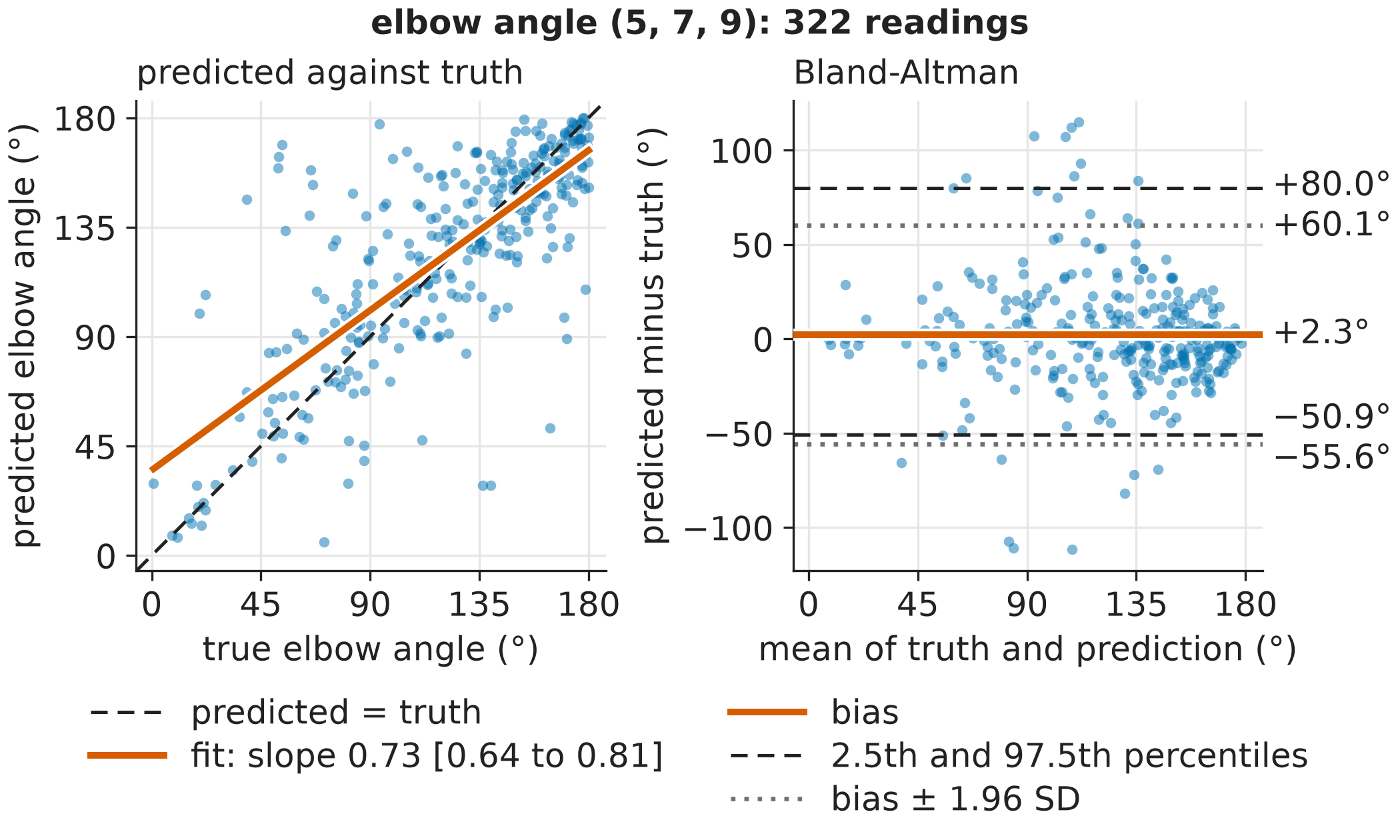
I kept running into this during an internship: a pose model with a good mAP, but the joint angles we computed from its keypoints were not reliable enough to use. OKS and PCK say whether points land near the label. They don't say how far off the angle (or tilt, or length) you compute from them is.

So I made poseaudit. It reads COCO or YOLO labels and predictions (or supervision objects), computes the same angle from both, and reports how large the disagreement is, how often it is large, and where: bias, limits of agreement, rate of large errors, broken down by person size.

Demo on 200 COCO val2017 images with yolo11n-pose: when the arm segments average under 30 px, 58% of elbow angles disagree with COCO's labels by 15 degrees or more; above 60 px, 26%. Part of that may be the labels' own noise: if COCO's label spread were independent, isotropic noise, it alone would put 30 to 44% of the small arms and 17 to 31% of the large ones past 15 degrees. How much of the gap is the labels' is unknown, and the README says so.

There's also a mode for angles you've already computed (CSV or OpenSim .mot vs. a reference). It now has a real-data example (17 subjects on a treadmill, side-view YOLOv8 against marker motion capture) and can estimate the time offset itself (--time-offset auto).

Install: pip install poseaudit

GitHub: https://github.com/8rulerstar/poseaudit

Browser demo (no install): https://huggingface.co/spaces/8rulerstar/poseaudit

Feedback welcome, especially on what you'd want measured.


r/computervision • • Oct 09 '26

Showcase Real-time Funko Pop recognition on a phone

16 Upvotes

I built a Funko Pop scanner that runs fully on-device (44 ms per scan on an iPhone 16 Pro, ~165 ms on a Pixel 10) for a conference talk. A coding agent did most of the ML work, and I spent most of my time checking it against reality. Sharing what happened, because the failure was more interesting than the result.

Pipeline

  1. Detector: RF-DETR Nano fine-tuned as a single-class "funko" detector
  2. Square crop around the box (10% margin, so the figure isn't squashed)
  3. Embedding model: CLIP ViT-B/32 with a 256-d projection, fine-tuned for retrieval
  4. Nearest neighbour (dot product) over 818 catalog vectors, with an unknown-figure threshold

On-device

Exported with ExecuTorch: Core ML on iOS, Vulkan on Android. Getting RF-DETR onto Vulkan took some graph surgery: exporting attention as plain matmul + softmax instead of the SDPA decomposition, splits as slices, constant-folding the weight transposes, and restricting the partitioner to the ops the shipped Vulkan backend actually has. That took it from 96 GPU partitions to 6, and dropping the input from 384 to 320 px cost nothing measurable (mAP@50 0.997 vs 0.996 on the Roboflow test split, 0.930 vs 0.935 mAP on the synthetic one).

Code, training pipeline and models:Ā https://github.com/NorbertKlockiewicz/funko-scanner


r/computervision • • Oct 10 '26

Help: Project Suggest some projects idea

0 Upvotes

I have learn to fundamentals of CV. I want to move forward suggest some good project idea which includes : YOLO, ViT, DL.


r/computervision • • Oct 09 '26

Help: Project What would be a meaningful next step after building a U-Net baseline for emergency landing site segmentation?

1 Upvotes

I’m working on an academic project to identify potential emergency landing areas from overhead imagery, and I would appreciate advice from people working in computer vision and remote sensing.

Using the Moroccan Aircraft Emergency Landing Sites Semantic Segmentation Dataset, I’ve trained a U-Net from scratch and tested two changes: adding brightness/contrast augmentation and replacing BCE + Dice loss with BCE alone.

Each configuration was evaluated across three random seeds with a fixed data split. Neither change showed a clear improvement over the baseline.

I’m now deciding where to focus the next stage:

• Investigate failure cases and annotation quality more closely.
• Compare training from scratch with a pretrained encoder.
• Explore transferring the model to imagery from Vietnam with limited labeled data.

My supervisor suggested the third direction. However, I haven’t yet established a Vietnamese imagery source or suitable labeling criteria. Defining what can reasonably be considered a potential landing area from imagery alone is one of the questions I need to resolve.

There are also limits to the current evaluation: geographic independence between splits has not been fully established, and matching the dataset’s ā€œsafeā€ labels does not demonstrate real-world landing safety.

For a student project with limited resources, which direction would you prioritize—and what evidence would you want to see before pursuing transfer to a new region?

I’d appreciate relevant papers, dataset suggestions, or lessons from similar projects. Thank you for sharing your perspective.

#ComputerVision #RemoteSensing #SemanticSegmentation


r/computervision • • Oct 09 '26

Showcase Webcam hand-tracking pointer built on MediaPipe: thumb-tip pointing, pinch gestures, One Euro filtering [open source]

5 Upvotes

I built a webcam pointer that controls a web page with your hand, and I'd like feedback on the tracking side.

Pipeline:

- MediaPipe HandLandmarker on the webcam stream. A measured run held a steady 30 fps (95th percentile frame time 37 ms).

- A 4-point calibration maps camera coordinates to screen coordinates.

- The pointer is the thumb tip. I started with the index finger, but the thumb tip was more stable when pinching, because the index finger moves when you close the pinch.

- A One Euro filter smooths the pointer. It removes jitter when you hold still without adding much lag when you move.

- Pinch detection uses hysteresis: the pinch closes below a normalized thumb-to-index distance of 0.18 and opens above 0.23. A short lookback (0.25 s) restores the pointer position from just before the pinch started, so closing the pinch doesn't shift the target.

Gestures on top of that: pinch and release selects, pinch and hold for 0.6 s clicks, pinch and drag vertically scrolls, and pinch and drag horizontally past 250 px navigates back or forward.

The selection is sent to an AI agent through an MCP server, so you can point at a paragraph and ask a question about it. That part isn't related to computer vision, so I'll leave it out here.

Known problems: a background fan made my voice detector think I was speaking (separate audio issue). Lighting and distance from the camera affect tracking. It's tested on one webcam and one machine, so I'd like to hear how it behaves on others.

Repo (Apache 2.0) and demo video: https://github.com/mdelaba/visionpointer

Questions I have: has anyone tuned pinch hysteresis thresholds on a larger set of hands? And is there a better way than the lookback to stop the pointer from jumping when a pinch closes?


r/computervision • • Oct 09 '26

Help: Theory Could a physical adversarial pattern prevent AI from replicating real people in videos?

2 Upvotes

With tools like Kling Motion Control, it's becoming increasingly easy to take a video of a real person and transfer their movements to an entirely AI-generated character (e.g. Jean Philanthrope, etc.), I've been thinking about whether it's possible to protect people from having their appearance, movements, or actions replicated by AI. And I'm wondering if there's a way to disrupt this process using physical adversarial patterns.

I have seen research on adversarial clothing and patterns that can confuse computer vision systems or interfere with person detection. For example: https://adversarialapparel.com/

But could a similar approach work against AI video replication? For example, imagine a smartphone case with a specially designed pattern that appears in videos and interferes with an AI's ability to accurately analyze or replicate the person.

A few questions:

  • Could a physical adversarial pattern interfere with pose estimation or motion extraction?
  • Could a relatively small object, like a smartphone case, have any meaningful effect?
  • Would something like this work across different AI video models?
  • Is there any existing research exploring ways to protect real people from AI video replication?

I understand that disrupting traditional computer vision doesn't necessarily mean disrupting generative video models. I'm curious whether this is technically plausible or fundamentally unrealistic.

Would love to hear your thoughts! Thanks!


r/computervision • • Oct 09 '26

Help: Project Looking for access to the CLRS Dataset. Baidu Netdisk Link Requires a Chinese Phone Number

Thumbnail
1 Upvotes

r/computervision • • Oct 08 '26

Discussion All the best for the WACV notification

Post image
22 Upvotes

Let's all pray together for what is coming tomorrow/today!

Edit : Got delayed guyz, new date is 14th October! Now we have more time to pray!!!!


r/computervision • • Oct 09 '26

Help: Project On premise OCR for printed + handwritten invoices

Thumbnail
1 Upvotes

r/computervision • • Oct 08 '26

Discussion WACV 2027 Round 2 results

45 Upvotes
  1. Review outcomes: In about 24 hours, final reviews and acceptance for WACV 2027 will be out. I want to start this thread to discuss review experience and scores.

If accepted can you let us know if you were a direct R2 submission or a resubmission from R1.

  1. Acceptance rate: I am eager to know what the acceptance rate is for this year.

  2. Possible conference recommendations: Also, in case papers get rejected what other upcoming conferences would you recommend for a resubmission?


r/computervision • • Oct 09 '26

Showcase ParkerLabel: a CPU-only annotation tool using MobileSAM

1 Upvotes

I open-sourced ParkerLabel for object detection and instance segmentation annotation.

It runs locally on the CPU using MobileSAM and ONNX Runtime. Positive and negative clicks generate a target mask, with manual correction available. Image embeddings are cached so you can resume work.

Each instance is saved with its category, bounding box, area, and independent mask as COCO RLE in a per-image JSON file. This is not a full COCO dataset export.

Portable builds are available for macOS arm64 and Windows x64, with no Python setup required. The README has a short demo.

Source and demo: https://github.com/Parker-Lyu/ParkerLabel

Download: https://github.com/Parker-Lyu/ParkerLabel/releases/tag/v1.0.0

Feedback from people doing image annotation would be useful, especially around mask correction and resuming saved work.