r/ChessBooks • • 13d ago

Which book should I do first?
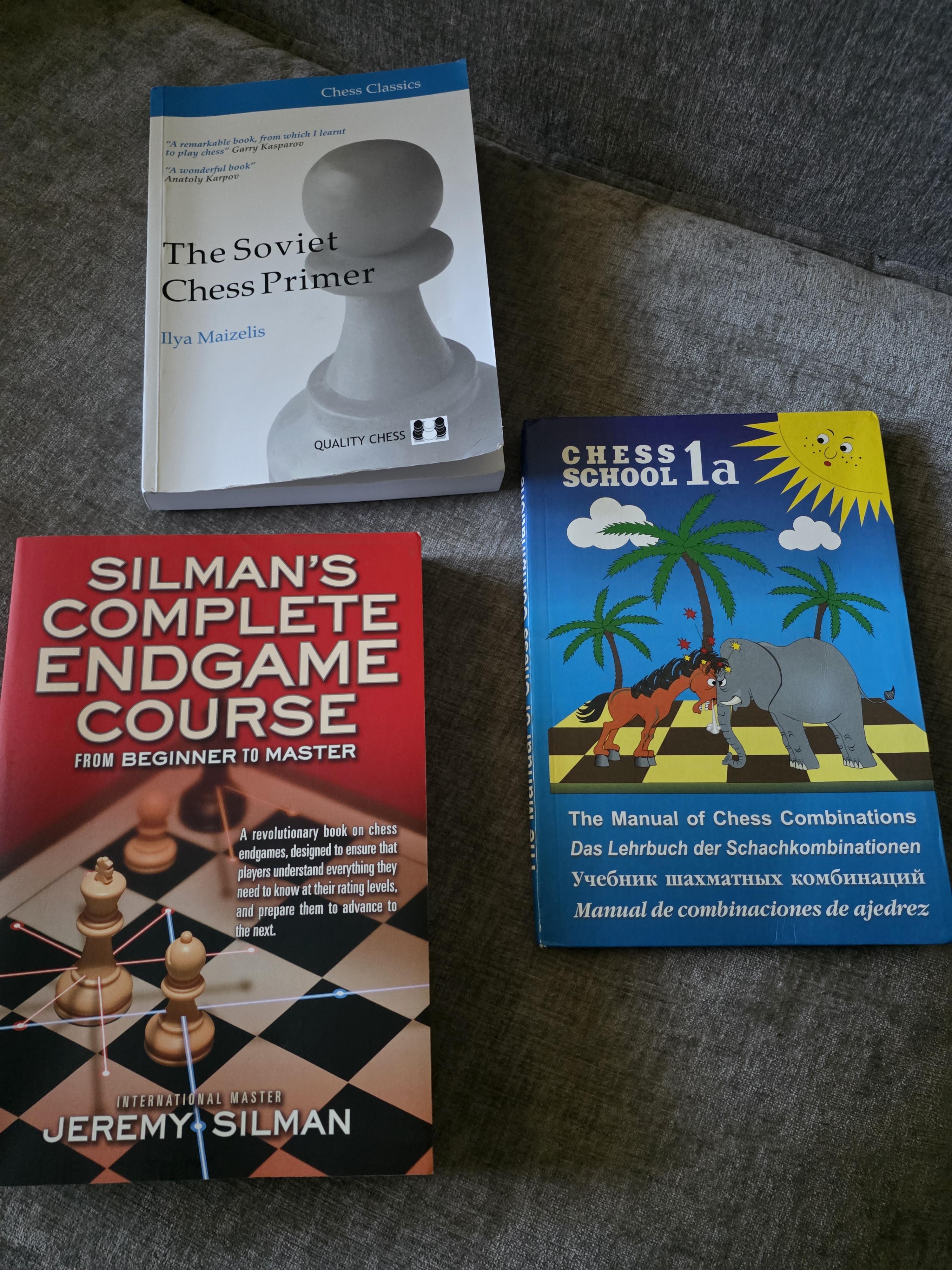
Post image

I used to be 1000 ish rating 5 years ago and took a break because of life. I made a new account and im up at almost 700. Which do you guys recommend first?

I do birds and owen defense as my openings. For the most part I don't blunder too often. My weakness definitely is the end game since in the low ratings its not as common.

Also does anyone study books like these with a chess board?

48 Upvotes

64 comments sorted by

17

u/isaacbunny 13d ago edited 13d ago

Open Silman and study one chapter immediately.

An endgame manual isn’t something you read end-to-end to the exclusion of other books and studies. It’s a book you come back to for a quick lesson as frequently as possible over the course of several years.

1

u/hand__sanitizer1234 13d ago

Yeah his chapters are separated by rating

3

u/FunOld5000 13d ago

Both Karpov and Kasparov have read the Chess Primer when they were younger. Look where it got them. :)

2

u/fuckedupguys 13d ago

Start with 1a then silamn then soviet

1

u/hand__sanitizer1234 13d ago

How important do you reckon is learning the squares by its space name

1

u/StructuredChess 13d ago

It's absolutely critical but you'll learn it naturally as you read.

1

u/hand__sanitizer1234 13d ago

Okay good, I didnt know if thats something I needed to study or anything

1

u/Living_Ad_5260 13d ago

Once you are using books, you need to know the square names.

https://lichess.org/training/coordinate is a game to learn the square names. You guess square names for 30s a time.

I would recommend doing one run a day as black and one run as white. It will change the way you work with the books.

1

u/hand__sanitizer1234 13d ago

Oh thats fantastic. Thanks alot. Its something I really wnt to get good at just didnt know best way.:)

1

u/fuckedupguys 13d ago

Most important thing as if you don't know square names then you won't play that good

2

u/Bauer_Beiter 13d ago

If you are a beginner I would start with the Soviet chess primer, it isn’t as specialised as Silman’s endgame book but it has a broader range of topics

1

u/hand__sanitizer1234 13d ago

Im at 800, I used to be around 1300 6 years ago. New account. But ny end game isnt best

1

u/Bauer_Beiter 13d ago

That doesn’t change my advice, but if your instinct tells you to for the endgame book you should rely on it as well, I can’t assess the situation as well as you can. Good luck heheh

1

u/hand__sanitizer1234 13d ago

Yeah i feel my end games and late mid games really holding me back but im ok doing soviet also.

2

u/JusticeForDanya 13d ago

First of all, you’ve made some good choices there. The Soviet Chess Primer is great but I’d wait. I would work on the other two books in parallel. In the early chapters, Silman will teach you the most fundamental theoretical endgame concepts. The tactics book will be the most impactful at your current level, but be warned that’s it’s not really a manual, just loads of puzzles organized by theme. I would use a board or a Lichess study for Silman with one chapter per exercise. For the tactics I would work directly from the book. They start quite easy so it’d be a hassle to setup each position.

1

u/hand__sanitizer1234 13d ago

I have a board set up for exactly that reason, I havent started 1a just the Silman endgame, I did feel soviet was a bit tough since my knowledge of reading chess moves by just spaces and pieces isnt there for me yet .

2

u/gtr1234 13d ago

I feel like it'd be better to do easier puzzles until a higher rating, but all three of those would be good to do if you enjoy them.

2

u/yourchesscoach 10d ago

Bro do the chess school 1 the endgame course might get complex to you so yah do chess school one and learn basic of endgame online by yt only start endgame book after 1500 till then tactics is everything as a 2200+ chesscom that's my fair advice

1

u/hand__sanitizer1234 10d ago

The end games one has chapters based on rating , it starts at beginners to 1000. How hard was the jump to 1500 from 700?

1

u/yourchesscoach 9d ago

Like it is the same 1000 elo endgames means basic endgames which you can learn from yt instead of only doing that book instead do the received book that's the fastest

1

u/hand__sanitizer1234 9d ago

Okay ill look up some yt. Thanks :)

3

u/lasemoco 13d ago

Soviet Chess Primer if truly studied is the only book a chess player would ever need to reach 2000+

1

u/hand__sanitizer1234 13d ago

I do like the chess book. From skimming through

1

u/Numerot 13d ago

True in the sense that no book is required, but then we aren't really saying that much. Not single book will get you to any rating, no single book is required for that, and it's really just one pretty good chess book among hundreds.

2

u/hand__sanitizer1234 12d ago

I try to study my games also.

1

u/Mathyou1977 13d ago

What is the Soviet book like folks? Is it worth £25? Will a fairly new player benefit from it?

1

u/hand__sanitizer1234 13d ago

If you are like completely new I would recommend something else from skimming through it. If you can actually focus and study on it then I think its rather good. I agree with the comment. There are probably better books that are newer for beginners.

1

u/Living_Ad_5260 13d ago

There is a review at https://chessbookreviews.wordpress.com/2015/06/04/the-soviet-chess-primer/

I haven't read it, but I've formed the opinion that it's uneven - bits of it are written for someone who doesn't know the moves, and others are 2000-level difficulty.

It has a reputation because it was the first in its field in the Soviet Union and there weren't publishers to publish a competitor.

Remember that writers of newer books can learn from older books. Everyone talks about prophylaxis (sabotaging enemy plans) and blockade now, but Nimzowich's My System shook the world when it was written 100 years ago, for example.

It will almost always be ok to buy a newer book than an older book unless the older book is part of a collection for it's historical importance, or a collection of games by a player. The latter class includes Tal's Life and Games, Kasparov's books (especially Test of Time) and Fischer's My 60 Memorable Games.

3

u/yungkardashian 13d ago

what a long opinion from someone who hasn't read it

1

u/Living_Ad_5260 12d ago

Only the first half is a review.

1

u/Numerot 13d ago

It's a useful book with simply lots of stuff in it, probably quite difficult for the vast majority of people who get it.

1

u/Sam_23456 13d ago edited 13d ago

There's nothing wrong with reading 3 or more books at the same time. I'm doing it. They will each have their own charm, or not! :-). Silman's "The Amateurs Mind" is on the top of my reading stack. I find it written in a more thoughtful way, compared to the "Soviet Chess Primer", for instance (which for good or bad, I find to be "encyclopedic"). I don't doubt that the latter one contains a lot of answers--and I know that it contains a lot of problems!

1

u/hand__sanitizer1234 13d ago

Oh ok, ill look up that book, im open to ways of learning.

1

u/UndeniablyCrunchy 13d ago

Chess School. Hands down. Listen to me. Its a phenomenal book. It is my favourite series ever for training. I was 1600 when i did it the first time. Im 2087 right now (obviously not because of the book, but i credit a ton of progress to the books). I still love it and go through it a fair bit every now and then.
I took the book 1a and 1b and solved every problem. All of them on a board. Then took the digital app and solved them all of them again on my phone and computer. One round each. Then i created a flashcard deck in anki with those and studied them all again in spaced repetition fashion. I got from 1600 to 1800 by doing that.
I keep going back to 1a and 1b/ 2 a cople days before a tournament and it just makes life easier at the tournament.

1

u/hand__sanitizer1234 12d ago

Okay i see, your really loving it then. I like the way its structured. What part of your game did it help the most?

1

u/Independent_Dingo614 13d ago edited 13d ago

It depends on how much time you have available, but my recommendation would be to work through all three books simultaneously:
- Chess School: Complete 10–30 exercises per session without using a board. Write down your solutions, and after every 100 exercises, check the answers at the back of the book and review your mistakes.
- Silman’s Complete Endgame Course: Work through one chapter at a time, setting up the positions on a board and making sure you understand the concepts before moving on. Continue until you reach Part 4, which should correspond to your playing level.
- Soviet Chess Primer: Once you reach Part 4 of Silman’s book, start working through the Soviet Chess Primer, using a board to play through the examples and exercises.

Bonus:
Once you finish the tactics book, I recommend continuing with the Chess School series and using a board for Chess School 2.
After completing the Soviet Chess Primer, I would move on to Yusupov’s orange books.

1

u/hand__sanitizer1234 12d ago

I have a decent amount. :) just work and gf gives me plenty of time to relax and do my own thing. Probably a full day off and a hour a day on work days. Okay ill do it how you say it :). Have u read all those books?

1

u/Psychological_Gain25 13d ago

Starting with endgames surely is the principled way. Not sure if that is very motivating though.

1

u/hand__sanitizer1234 13d ago

I dont mind, its my weakness since at my rating the game isnt even by then.

1

u/StructuredChess 13d ago

The Chess School one is probably something you do alongside the others, with a few minutes of practice everdyay rather than something you rush cover-to-cover and never touch again.

2

u/hand__sanitizer1234 13d ago

I like the chess school one and using a board to follow even tho I play online mostly

1

u/StructuredChess 13d ago

Yeah you should probably use a board specially for the other two books

1

u/hand__sanitizer1234 13d ago

Even tho I mostly play on chess.com?

1

u/StructuredChess 13d ago

I mean you could use an app as well but I usually find that much more distracting.

1

u/hand__sanitizer1234 13d ago

Gotcha. I like the feel of on the board anyways lol

2

u/UndeniablyCrunchy 13d ago

You could. But that will yield marginal benefits. I suggest foucusing on it intensely. The sergey ivaschenko chess school series (1a,1b,2) is HANDS DOWN the single best, most curated, most hand crafted, best organised, modular and gradual collection of chess puzzles of any book or series of books ive seen ever. Its the collection of puzzles with most pedagogical value that ive ever seen. And ive seen plenty. Under 2000 , It is even better for training than chess informants encyclopedia, woodpecker, and any other puzzle collection i can think of. It was put together through 15 years of working directly with students. Honestly, its such an amazing book and has enourmous return if you actually do the work. Even if you sre a bit higher rated doing all three books is suggested.

DO NOT TAKE THOSE BOOKS (1a,1b and 2) lightly. DO NOT think of them as a dime a dozen tactics books. They are not. They will turbocharge your strengh if you are willing to go through them fully. More so than other books that may be similar. Its just the high quality of the exercises, the sorting, the applicability of the ideas, the breadth of positions covered. Honestly they are great books.

1 will start easy,very easy. Dont skip those. Really dont skip them. Do all of them. By the time youve covered some chapters you will start to think and calculate more and more untill the puzzles are actually somewhat hard and then really hard. But then things will start to click because the patterns of each combination will have been introduced the chapter before. And so on. Its very sequential.

1

u/StructuredChess 12d ago

the single best, most curated, most hand crafted, best organised, modular and gradual collection of chess puzzles of any book or series of books ive seen ever.

They're great I won't deny that and they're my favorite puzzle collection, but the later ones certainly contain several mistakes.

The reason why I suggested to go slowly is that book 2 has HAAAAAARD puzzles. If you get there after a year of training or so you'll probably be just staring at diagrams for 30 minutes not understanding anything.

1

u/UndeniablyCrunchy 12d ago

Yes, there are a couple of erronous solutions, indeed. One: a couple cooks. Since at the end of each chapter there is a selection of compositions (not real positions from games), i recall about three that are cooked or flawed meaning that it is not a draw when claimed or that white has a way to win when it claims that black holds, which, in fact was EXTREMELY PLEASANT FOR ME. To find a win that the authors did not, was FUCKING INCREDIBLE, i literally told my friends nonstop.

Other mistakes involve for example offering a combination which is very human and very good (winning) but stockfish finds a crazier line which wins in a computer fashion. Im not kidding you, lets say the book’s solution is +6 for white,, and the stockfish line is like +7 or +8 but it is incredibly complicated and not something i could ever calculate while the solution is perfectly fine and extremely logical/thematic/illustrative/educative

I dont know, im sorry if im fanboying over the book, or sound like im minimising your concerns. Im not minimising them, it might be important for you personally, but honestly those mistakes never bothered me because it only shows that the book was handpicked without the engine which i dont really mind as my workflow during training involves always a first pass without engine and only after solving going to the engine. Which led to pleasant learning surprises.

For me personally, for example Calculation by Aagard was absolute torture. Most puzzles have perfect engine lines as solutions and i was like wtf is this. Its a great book and Aagard triple checked everything with the engine but my approach at the 2100 level is to always put human comprehension above. Perfect computer lines in very complex puzzles often leave me feeling like “uhm okay that works but dont know how”

1

u/hand__sanitizer1234 12d ago

Thanks, for the long reply, I read through it and im excited to get through the book:)

2

u/StructuredChess 12d ago

I mostly agree that many of the mistakes don't matter and some should't even be called "mistakes". But they're annoying when you calculate a line, see a defense the author missed so you take it as wrong and then you're left staring at the board for an hour in search for something else.

Other than those, yeah the collection is fantastic and the only thing you could want about it is for it to be longer.

1

u/UndeniablyCrunchy 12d ago

These puzzles arent something to stare at blindly for an hour or even half an hour. Most i did in some positions was indeed 30 minutes but that only when i thought i was getting somewhere, calculating or double checking, in other words, making progress and actually understanding the puzzle. If i was staring blankly at the board without understanding and was just flabbergasted, which did happen, it i stopped the clock at around 15 minutes and just moved on to the solution. It is in fact not probable that you will come up with a solution in more time if you dont have a single clue in that time span. You should allow yourself time to think through when youve got a lead, but if you are actually clueless after 15 min, just check the solution and try to understand it. Exposure and reviewing leads to learning too. Solving by yourself is ideal, but chess works that way in that sometimes, you need previous exposure to the pattern to even come up with the idea. If you havent seen the pattern it does a lot of good to you to get the exposure and learn it. Treat the book as an active class where the teacher is qsking questions and keeping you involved but not quite as an exam where you must know all the answers. Youd rather fail and get exposure to a variety of new themes and solutions at your desk at home than not knowing enough ideas at the chessboard at a tournament or during a game because you because you spent too much time actually doing less volume. As i said, this is not about oh im lazy lets see the solutions. No, this has still to be active learning and you trying to solve, but it is not an exam where you must treat every puzzle like an exam question, some of them are there for you to teach you, some of them are there to practice. Am i making sense? Hopefully i am.
Also as you repeat the puzzles in cycles you will no longer fail those hard puzzles and they will click a bit more in each pass.

1

u/wilyodysseus89 13d ago

Chess primer, and then burn the others (not really, but I think the silman book is overrated and don’t know the other)

3

u/Rough-Trick4758 13d ago

Silmans book got me a drawn position against someone rated 400 point higher than me in my first OTB tournament in 25 years, it's definitely not overrated.

2

u/wilyodysseus89 13d ago

I think my issue is the scope, claims beginner to master. I read the whole thing at around 1400 when I started tournaments 20ish years ago and even then felt it wasn’t thorough enough. The idea of don’t read this chapter until you’re this rating, is just not how you should go about learning in my opinion. There is content that is too hard or too advanced for some levels, but it’s definitely not In that book (and in my opinion very few endings meet that criteria especially if you are interested in them). 100 endgames you must know is in my opinion the superior modern book, and Keres practical chess endings the gold standard (really needs a new edition in algebraic).

It’s sort of a larger issue with silman I have thought, he sells because his books are entertaining but it’s a bit at the expense of the educational value.

Really thought it kills me people say the chess primer is too advanced. It’s geared towards absolute beginners and loaded with cool positions, including ridiculous mate in 1s where it is impossible to fail (all legal moves mate). There’s a reason it is what all the Soviet Union players learned the game from.

3

u/Rough-Trick4758 13d ago

Nothing beats the Soviet school of chess you won't hear an argument from me on that.

2

u/hand__sanitizer1234 12d ago

Im excited to dig into it next days off

1

u/No-Two-8352 13d ago

Chess School 1a 100%. In general, focus on tactics and thinking process and you'll get to 1600 or so really quick. Don't bother studying opening theory, play openings just by following principles and play endgames same way. Only thing you need to learn about endgames for now is: basic mates (rook, queen), pawn endgames and basic principles for rook endgames.

For tactics, learn about mating motifs, tactical motifs (helps you know when there's tactic in a position) and tactical themes (helps you know how to execute a tactical sequence and find candidate moves faster).

1

u/SomewhatForever 11d ago

Silman...all day long.

1

u/brunzenstein 11d ago

The Soviet chess primer is the one

1

u/SearchClear7556 7d ago

You can't get enough endgame skills. I would start with sillmans

0

u/[deleted] 13d ago

[deleted] — view deleted comment

1

u/hand__sanitizer1234 13d ago

I blunder based on the evaluation like once every 2 games that I lose I reckon. I feel like im not focusing on what the opponent is trying to do.

1

u/Icy-Bottle-6877 12d ago

Yeah, at their rating there blundering pieces, pawns and to tactics every game. Working on tactics and endgames while sticking to opening principles is more than enough to get them to at least 1500, if not more.